The AIS tracking feature has been a big hit as we’ve travelled down the coast of california, especially with concerned family. However, once we leave the country we will be out of range of the shore-based AIS stations, and we won’t show up on the map except maybe in very popular international ports.
At the request of family and friends, we purchased a SPOT tracking device. It cost $50 (after mail-in rebate), plus a $100/year subscription fee. For our purposes, each time we press the “check in/ok” button on this little jobby, it communicates our position to one of their satellites, and then it shows up as a pin on our SPOT map, which I added to the sidebar and also to our “Current Location” page (a bigger version). We plan on pressing the button about once a day; that will be our daily position report. Supposedly it will have coverage in MOST places, including the coast of Mexico. However! Important note that THE SPOT WILL NOT SHOW OUR POSITION WHILE WE CROSS THE PACIFIC, SO DON’T WORRY!
I have mixed feelings about this SPOT jobby. The box it came in was hugely wasteful, with extra stupid pieces of cardboard, the website interface to get it working is terrible, their widget that I put up on our site messed everything up until I did some extra html coding, and even using the damn thing is extremely counter-intuitive. It’s hard to tell when you’ve successfully turned it on, turned it off, or sent a signal, which is not so cool when you’re out in the middle of the ocean trying to figure out whether it worked to upload a checkpoint or not. I anticipate it to be buggy, so mom please don’t worry if it malfunctions on us and you stop getting position reports.
So, to be clear: the lack of a daily check/in is not a cause for concern. It probably means that we’re either having too much fun and forgot to press the button, or else that the piece-of-crap thing busted on us and is no longer working.
(fyi, the pins that you see on land in San Diego are a result of my initial testing right after we bought the SPOT, on foot and by bus; we left the boat in the marina)
The last priority projects have been checked off the list, the tools and food have been stowed. We are waiting for one item in Monday’s mail, and we still have to fill up on fuel and water and do a hundred other little things that need to get done when you’re about to sail away for a long time, but those are just details, not the kind of thing that will hold us back for too long.
Starting Tuesday, we look for a weather window. If the current predictions hold true, then Tuesday could end up being ideal for departure. If the weather isn’t adequate, we will sail circles in the bay until we can leave.
About the weather: this time of year is generally shitty sailing weather. Low-pressure systems form out in the middle of the pacific and head east, sometimes reaching the coast before they dissipate, and they bring with them bad weather. When they approach the coast, the wind picks up and shifts around such that it comes out of the south south-west–which happens to be exactly where we’re trying to go. If the storm is large, the wind produces large waves as well. Sailing upwind in stormy weather, heavy wind, and large swell is to be avoided if possible.
So we’re looking for a at least a three-day window in which none of these low-pressure systems are headed into our region. If we have three good days, we can head out, get a ways down the coast, and duck back into a harbor before the weather deteriorates.
We consult a few different weather sites: magicseaweed is a convenient portal to view the GRIB files, which give animated predictions for what the wind direction and strength will be (and swell height, period, also). My navigation software can download this GRIP data and overlay it on the sailing charts. I will trust the predictions for maybe three days out, after that I get rapidly skeptical and pay less attention to the predictions. Anything past five days is probably useless, though if it shows some good weather I can’t help but get a little excited. Check out magicseaweed–look for the squiggly line along the coast that is San Francisco Bay–and you’ll be looking at the same material we’re looking at each day. Remember we’re looking for at least a three day stretch where the wind is not predicted to be strong out of the south/southwest.
After we pass under the gate, we’ll turn south, head offshore about five miles, then set a course to stay roughly parallel the coast. We’ll keep going for as long as we feel awake, alert, healthy, and happy–that may be as little as one day or as long as a week.
I have a road-trip analogy: when you’re driving across the country, you make best use of wakefulness, as long as it lasts, to put some miles under the tires. If you feel good and happy, you keep going. As soon as you start to feel tired, you stop for the night. For a few hours before that happens you’ve been paying attention to potential stopping spots–rest areas, campgrounds, backroads, state parks, etc–so that you can stop somewhere as soon as you need to.
That’s is more or less our approach as we sail down the coast. The goal is to get south to better weather relatively quickly, within the parameters of staying happy and safe while we’re doing it. As long as all the crew are awake, alert, well-rested, enjoying themselves etc, we’ll continue to take advantage of whatever weather window we have. I have a list of harbors that are potential stops; at every point we’ll be within a day’s sail of a harbor on the list. When we need a break, or if conditions are predicted to deteriorate, we’ll head in to the nearest harbor on the list and stay for however long we feel like.
In a month or two, when we find ourselves in hot weather with clear warm water and white sand beaches, then we toast the trip, throw a party, and get lazy.
I’m in the passenger seat of the car writing this post right now, as Karen and I drive down to Bakersfield to drop off the car . . . tomorrow we catch the train back up to Emeryville. . . things are happening quickly now
Tonight Jim and Jeanne took all for of us (Pete, Ray, Karen, and myself) out to dinner. Jim and Jeanne have a Valiant 40 just down the dock from us, and have from the beginning been supportive fans. I get the feeling that they believe in us, they think we have been doing the right things, they think we’re ready to do this trip. Their vote of confidence feels pretty fantastic. So I thank them both for tonight’s dinner, and for their ongoing friendship.
Last night we had an informal departure party at a bar in San Francisco with a sizable crew of friends. It was uplifting and encouraging to feel the support of so many good people who want to see us succeed, who wish us well and are excited for us. I am grateful for such friends in my life. To be surrounded last night by rational, sensible people that were giving us the “thumbs up, good for you, we think you’re doing the right thing” . . . well it was powerfully nice.
I would like to point out that such support is rare. Most people who hear about our trip are not particularly encouraging, thinking either that we are being irresponsible (fiscally and morally), or unsafe. I understand why people believe those things–their reasoning is sound–so I don’t get angry and I don’t defend myself (I feel good about my choices). But it sure is wonderful to be with people that don’t give us a hard time, but instead a rather great time! So thanks to you all! And thanks also to all of you who read this blog and are excited for us!
We intend to be ready to leave by February 7th, and then picking the first weather window after that would be acceptable for sallying forth into the ocean. This is more or less the worse time of year to be sailing off the coast of California, so we intend to take a very careful look at the weather before we rush out to get bashed by unforgivingly cold wind and waves.
I have started experimenting with doing a “video journal”, uploaded to our youtube channel, which you can view by clicking on the video thumbnail in the sidebar (or by visiting the “videos” page). I am not yet comfortable in front of the camera, and I’m still trying to remember to look directly at the camera lens while filming myself instead of at the screen (which results in me looking like my eyes are malformed in some awkward way). But I think it is a valuable tool for me to capture some more candid and vulnerable moments that will make the trip more real for people who read this blog, and I will simply learn to deal with the constant feeling of looking like an idiot in the footage.
Today was the first day of sunshine in about three weeks, the second day it hasn’t rained. The past week has been an exercise in tolerating the supremely unpleasant feeling of cold water dripping down my neck while stuffed upside down in the tightest spots of our cockpit lockers, blinding trying to snake wiring in the darkness for a dozen different electronic things mounted on the stern.
One of those things was our AIS transponder, which is a system that transmits our position, speed, and heading out into the void, and receives the same information from other ships that are doing the same. When I plug the usb cable from the AIS into this very computer, all of those ships show up on my navigation software, complete with names, sizes, and sometimes even a picture (I uploaded our picture to the website). Although the system is not dependent on the internet, various stations on shore pick up the AIS signals, and a couple of internet sites collect that information and plop it on a map. Which means that when we happen to be close enough to a shore station, we will show up on the internet site in real-time. You can spy on us at this very moment (if I happen to have the AIS turned on, that is. It takes a little bit of power, so don’t count on it.) The AIS provides a significant measure of safety against collisions with container ships–glad to have it.
My icebox somehow sprung a leak, which I discovered after spending two rainy days building elaborate storage shelves for said icebox. It was a low moment–the icebox is my baby, my pride, I built the system from scratch, and it hurt me deep for it to be malfunctioning right before we are supposed to start our trip, broken in a way I did not comprehend, and without the proper tools aboard to fix it after we depart. After a day of bumming about I kicked it into a higher gear, started staying up working on shit till midnight each night, contacted Kollman on his refrigeration forum for some advice, and developed a workable plan. The icebox is back to working now (a video should be available for viewing on youtube in an hour or so), even though it probably still has a small leak, but I have obtained the tools I need so that I can fix it wherever we are, and that confidence has buoyed my spirits. I feel somewhat ashamed to have reached a point where such a thing as a fridge could have such an impact on me, but it was just one more thing, a punch in the gut, when I didn’t need it. A fridge is nothing in the scheme of things, but the symbolism couldn’t be ignored. But I’m over it now.
Our good friends Pete and Ray are going to sail south with us for a month or so. They are experienced sailors, and it brings me comfort to have them aboard for this first part of the trip. Pete arrived yesterday, with my new chainplates in tow (his backpack was 80lbs–as weighed in at the airport), and has already finished fixing the windlass and started in on another project–which for boat work is light-speed fast.
Even though the shrouds aren’t even connected to the boat at the moment and the mast would fall over (literally) if we tried to leave the marina right now, I feel pretty optimistic that we will be ready to leave next week. That’s saying a lot. We’ve worked hard to be able to do it and we deserve it. However, deserving it means nothing when you’re talking about a boat, and honestly I will be astonished if we aren’t delayed for some unforeseen reason, and that will be fine too. But we are almost ready.
I don’t have the energy or passion for a well-written update this time, but I know there are at least a few people out there who are curious about us. Full disclosure: I just finished reading an idiotic book and drinking a cup of jonny walker following a full 10 hours of stupid fiberglassing so my mood is shitty.
We moved out of our studio apartment over the holidays, while four friends visited and slept in our living room. Our guests were perfectly fine with the furniture and bed disappearing from underneath them (no kidding). Jon and Rishona came out to see the boat, work a bit, and meet us, because they are planning on joining us in the south pacific this summer, if all goes according to plan. Gary and Anna came out to california because they are awesome.
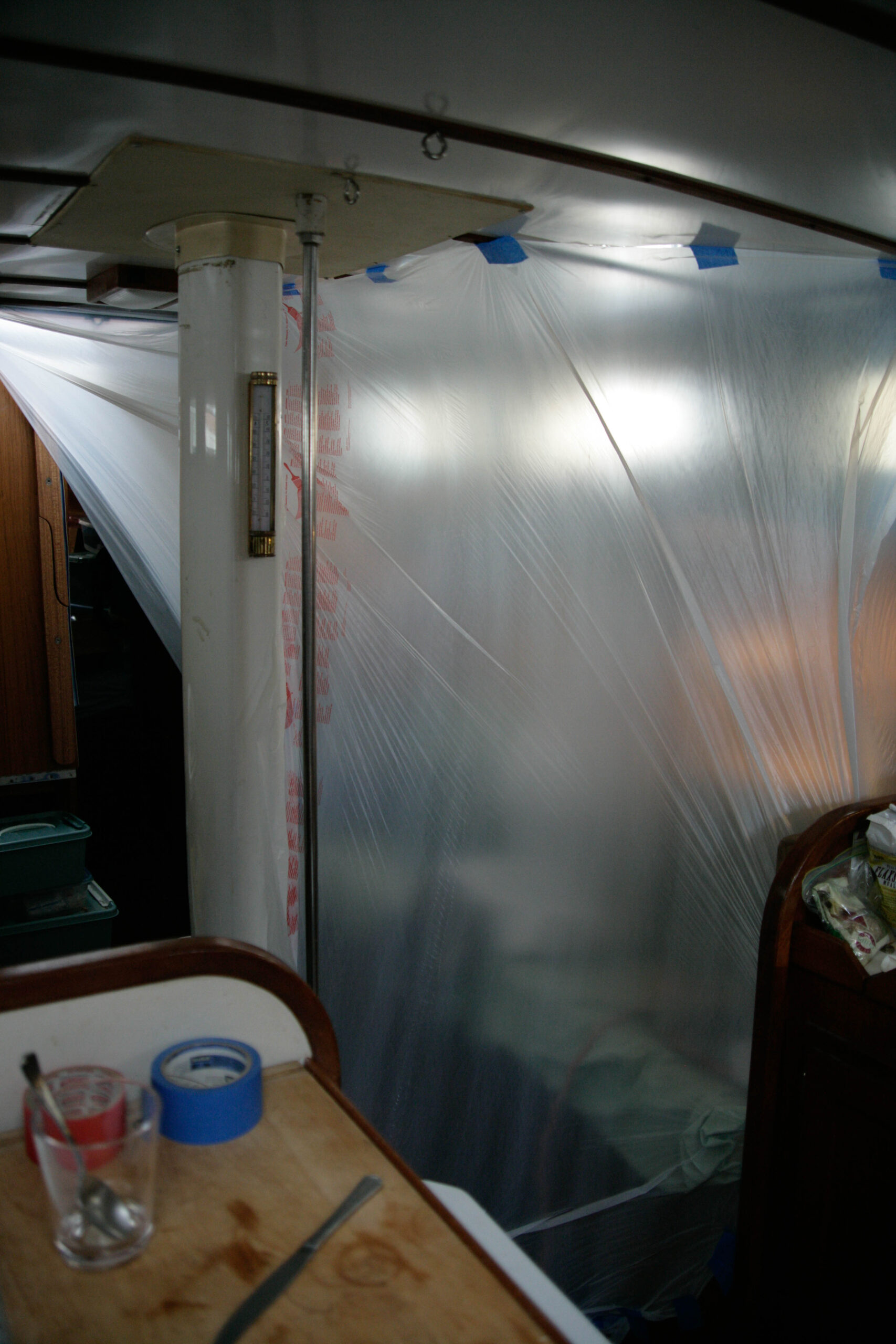
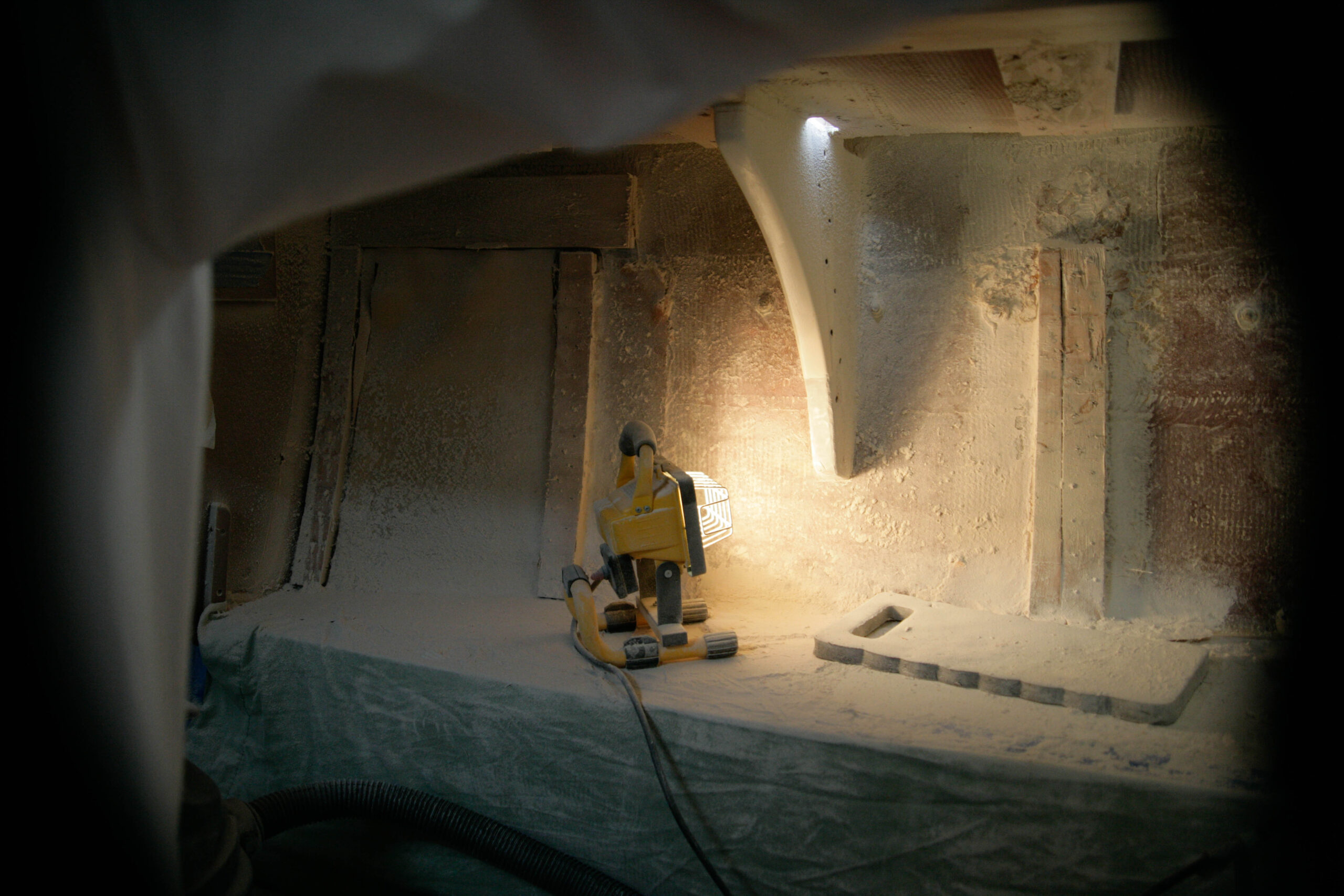
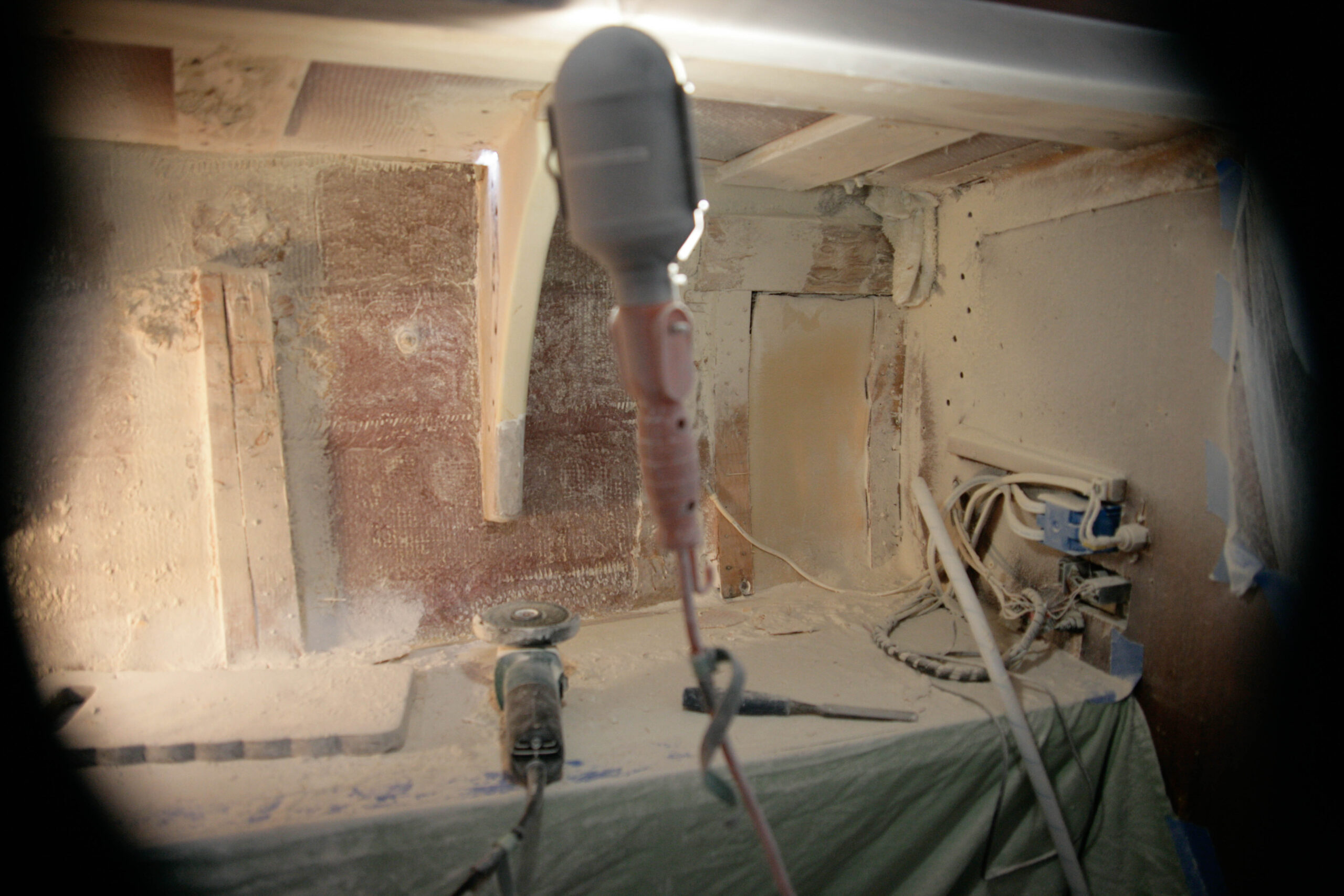
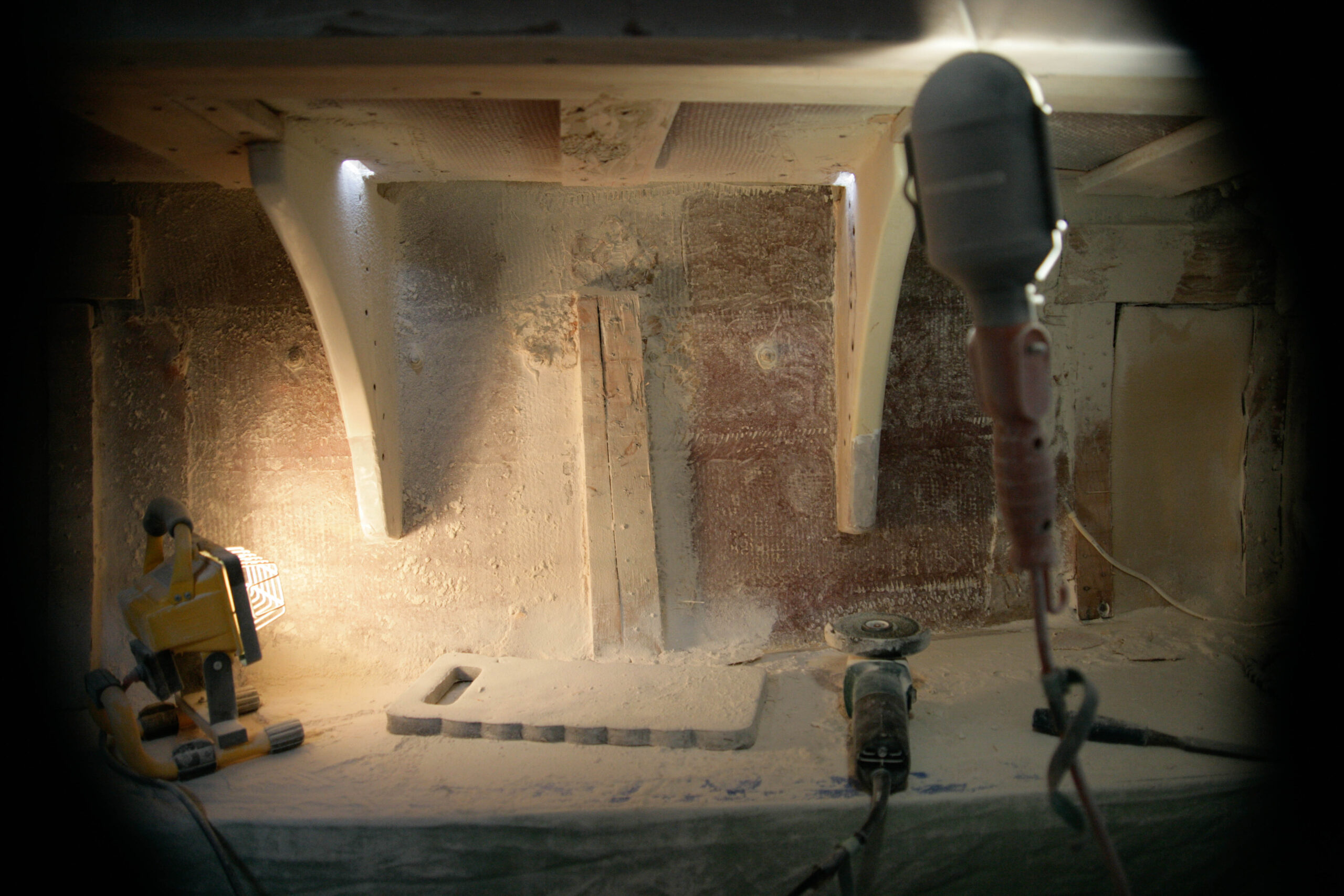
We moved onto the boat, though half of the boat is intermittently unlivable (and I mean 1/4″ fiberglass dust snow all over everything toxic air to breathe unlivable). Our belongings get shuttled around on an hourly basis like all those tiles in that hand held game where there is a grid of jumbled number tiles that you have to move around to put them in order but there’s only one blank space to use so you have to move all of the other tiles that you don’t want out of the way to move the number you want into place and it turns out that that process is difficult enough that they invented a game around it. Fully 10% of my waking hours are occupied by moving the same stuff back and forth and around and around.
As reported in the previous post, the knees of the boat came unbonded from the hull, a situation which justifies me giving a big middle finger to the fucking assholes who built this supposedly indestructible boat. The bomber reputation of the Valiant 40 is bullshit. Glassing the knees to the hull is second in importance only to actually having a hull in the first place, and the peons that glassed my knees to my hull did a shitty ass job of it and now I’m busting my ass to fix something that should have been included in the first 2,000 dollars of the much higher price of this boat.
We were planning on leaving January 14th, and our good friends Pete and Ray bought plane tickets to fly out and join us (the only reason for the very specific jan 14th date) and help us sail down the coast for a month. Since it’s down to just Karen and I and a busted boat, I am incredibly grateful to have their experienced assistance to do the first (wet cold worst) month. Well, now that the boat is sucking a big fat one, I mailed Pete one of the chainplates that needs to be replaced and he’s making a new set for me. How’s that for a friend, right? I screw up their plans and as an apology he gets a hunk of metal in the mail to duplicate 8 times over for me and they don’t even give me a hard time for it? Damn good friends, that’s for sure. (I even called him this morning and greeted him with a “so I have this windlass, and the threads on the shaft are crossed . . .”) I owe them big. So now Pete and Ray changed their flights and we’re planning on leaving February 7th now. All I have to do is rebuild the boat before then, no biggie.
I’m actually not all that bummed out as I sound, I’m just super exhausted and it just started raining and all I can think of is how many places it is undoubtedly leaking into the boat this very moment. A-we need to catch a break and B-we need to get the hell of out of this place, prontospeed.
Excellent question! We’re leaving in January (worst weather off the coast of California is in January) and heading south down the coast to Mexico. Then we will cross the pacific. Maybe in March or April? At this point we’re open to suggestions and easily influenced.
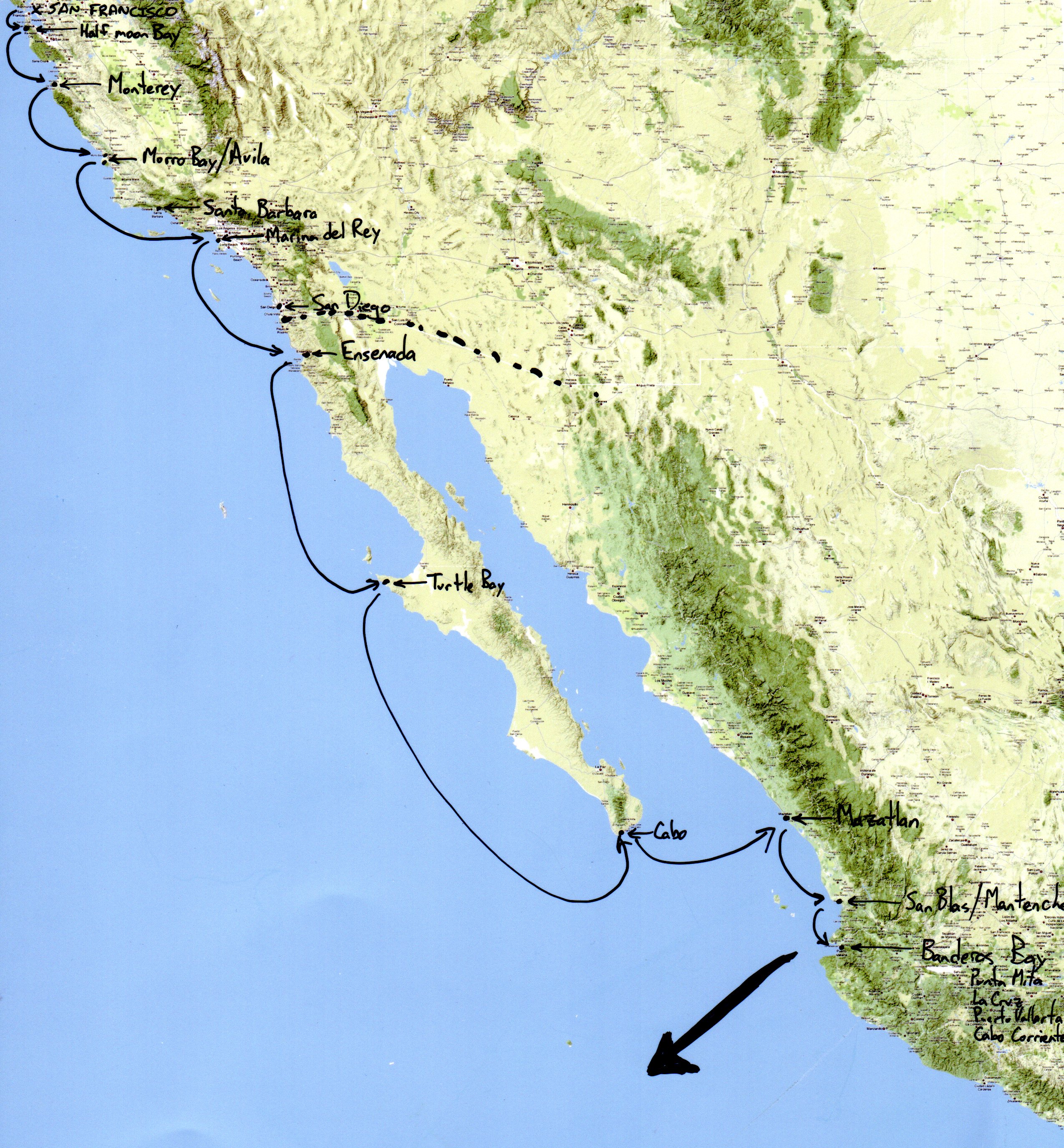
I have illustrated our basic plan on the diagram below, which admittedly is little better than a napkin sketch.
So that’s my cheat sheet, to help me keep it all straight in my head. “How do you know where to stop?” is another excellent question. I chose the stopping points on the map above largely from information gleaned from Louis and Laura, a fantastic couple who we are lucky to count among our friends. I used to race on the bay with Louis and Laura until they sailed their boat Cirque down the coast; they have been cruising all over the coast of Mexico since then (i.e. good people to ask for advice).
On their recommendation, Karen and I visited Waypoint in Oakland, a store which specializes in charts and navigation-related boating information (the owners also have a winery in the warehouse next to the store–very cool). We purchased two chart books and a cruising guide, and each night since then we have been spending a little time planning.
Maps of the sea are called “charts”. Together with a compass, the chart is the foundation for navigation: it is used to figure out where you are, where you’re going, and how to get there. Old-school charts (still readily available) are huge pieces of paper that you roll up and stuff in tubes to store, and then can never use because you can never flatten the damn things out again. A “chartbook” contains the same charts cut up into conveniently sized 16″ x 22″ sheets and spiral bound.
The two chartbooks we purchased at Waypoint are titled “Southern California” and “Mexico to Panama”. While sailing, one of these chartbooks will be open to the page for our location and we’ll plot our progress on it.
The charts are necessary for figuring out the route from port to port, but they don’t give information about where to go once you actually arrive. Some of the things we need to know about each port are 1) are there any obstacles and dangers while trying to enter the harbor that aren’t marked on the charts? 2) can we anchor? if so, where? if we can’t anchor, what marina do we go to and how much does it cost per night for a slip? 3) where is the dinghy dock or beach (the convenient spot to tie up the dinghy while going about your business on land) and how much does it cost? 4) where is the fuel dock, if we need more diesel? 5) where is the harbormaster’s office, so we can take care of any necessary paperwork?
The “cruising guide” is the source for this information. The cruising guide consists of mostly text, with rudimentary charts of each harbor (sometimes hand-drawn). I chose the “Mexico Boating Guide” by Rains; “Charley’s Charts” is another popular one.
And since I love maps and navigation, for extra credit I’m printing out 11″x17″ aerial photos from google maps of some of the anchorages in Mexico for which we have no detailed charts. It’s amazing how much information you can glean from the aerial photo–you can see where the sailboats are anchored, and you can see where it’s shallow because the water changes color. Also, it feels much more real and exciting when you can see other sailboats anchored out in the same spot where we will be.
Armed with these resources, we have been working out way down the coast, examining each port on the list we gleaned from Louis and Laura, looking at the charts and locating the anchorage, discussing the merits of whether to stop or skip each possible harbor down the coast. Most of the harbors get relegated to the “backup list”, to be used in an emergency, or if we get too exhausted and need to duck in for a rest. Some harbors–like Marina Del Rey and Ensenada on the map above–get the special nod as ideal places to resupply food or diesel. Others are unavoidable: Turtle Bay for example is pretty much the only protected harbor between Ensenada and Cabo San Lucas.
So we have the charts and the cruising guide and we know where we’re going to start and where we might visit, and that’s enough for now!
It’s Halloween night, and I found myself sitting with Karen at a table in the common area of our building complex, making large To Do lists for the next few months and planning the details of how to dispose of our worldly belongings and cancel all our accounts and memberships and subscriptions and plans. I was walking back to our apartment and it dawned on me that most other people were busy spending the night socially i.e. dressing up, drinking, partying, scaring people, trickortreating, whatever, while we were sitting in a large dark quiet room alone with big pieces of paper and magic markers and highlighters and lots of old partially completed to do lists, and then I had the thought: that would have been me a few years ago i.e. out partying and doing halloween stuff but now I’m the type that is planning a monstrous cruising trip without even remembering what day it is. And also I thought: maybe that’s what people who really sail across oceans would be like when they planned their trip.
Anyway, Karen and I started looking at where we will go in January. Sure, we’re headed south, then across the pacific, that’s the general plan, but honestly up until this point I haven’t even looked at a map to decide what ports we might hit on our way down the coast. No clue. So to buy a map and look at aerial photos on google maps and make a list of the spots we can duck into if the going gets rough–well that means we’re getting to a whole new stage of this adventure. That’s a different kind of preparation than sanding the deck or mounting solar panels (both of which also happened today). For one, it is a lot more fun to point at the map and say “let’s go there”. For two, we’re at the point where I’m actively doing all those things that one needs to do in order to depart from one’s former life start anew disembark cut ties and set out.
And also it means that hey!, we really think it’s going to happen, just like that point in the matrix when mr anderson shows up and is about to put the smackdown on keanu reeves, who wants to run, but then starts to feel all badass and the computer guy back on the mothership says “what’s happening??” and lawrence fishburne says all matter-of-factly “He’s Starting To Believe” with incredible articulation of his words and then keanu reeves doesn’t run to the phone booth to escape but turns around and looks all cocky and then gets totally caught up in this wicked gunbattle with mr anderson but wasn’t truthfully ready to come into his own as “the One” and so gets his ass royally kicked and nearly dies via punching to the stomach followed by being hit by a train before barely escaping. Moral I guess being that in the end (after the beat down) neo sails around the world! Metaphorically.
Over the last five hundred years or so, if a sailor did something stupid like neglect his duties or disobey orders or insult his captain, or strike an officer, or desert the ship, or display rank incompetence or drunkenness or insubordination, or steal a dram of rum, or spit on the deck, or fail to stow his things properly or to clean his clothes adequately, there were any number of punishments that could be meted out: the sailor could be flogged, or whipped, or pickled, or cobbed, or made to run the gauntlet or to clean the head or to carry a 30-pound cannonball around the deck all day or to station himself at the top of the mast for a few hours or just to stand still until told otherwise. He could be lashed on board every ship in the fleet, or he could be tied to the mast for a week, or keel-hauled, or he could have had his feet bound and covered in salt and presented to goats for licking, which quickly went from ticklish to agonizing, because the goats don’t stop licking before the sailor’s feet have become bloody stumps. Or, if the sailor had mutinied or murdered, he could be hanged, shot, or have his head cut off, boiled, and then shoved onto a spike above decks, and left there for a week or so, to serve as an example to the remaining and hopefully far more loyal crew. Magellan preferred this latter technique. If the sailor had buggered (aka sodomized) another sailor, that, too could earn him the severest punishments. The sea was not San Francisco, man. But, if the sailor, while meeting the locals on some tropical island far away from home, knocked up a local woman, or a bunch of local women: nothing. Getting a girl knocked up was what sailors did when they weren’t sailing, like Genghis Khan, or Mulai Ismail, the last Sharifian emperor of Morocco, who had something like 1400 sons and daughters before he died. Most sailors probably never knew how many women they knocked up on their voyages.
How far we’ve come since those days. I can neglect my duties all I want; I can make fun of Matt’s mom and call Jon a cabron and not get punched in the face; I can run off to Yosemite for a couple of weeks; I can trim the sails poorly and sail us home by some unimaginably indirect course; we can get so drunk that we decide to clean up our spilled wine with spilled beer; I can drink all of Matt’s beer and Jon’s expensive whiskey; I can spit on the deck or anywhere else on the boat I feel like it; and I’m not sure if I’ve ever stowed my things or washed my clothes properly. The boat is my oyster. If I were so inclined, I could invite over all the gay guys in the bay area with one simple Craiglist post; instead, I have tried my hand at luring girls here, all the while wondering what girl would really find this sailboat alluring. Remember: according to Google, Syzygy is a janky piece of shit, and based on the information in this paragraph (swearing, drinking, spitting, dirtying), I’m no example of fine manners, either. Finally, the biggest change of all: getting girls knocked up is decidedly not what sailors do. This is the 21st century, man, even if it is San Francisco.
So I’m 31, and dating, and it’s always a mystery when and how to tell girls about the boat. They always have a ton of questions. Is it small? It’s like a New York City apartment, you know, a 400-square-foot studio. Is there a fridge, and a stove? Yup. Is there any headroom? I can’t jump up and down, but I don’t have to squat. Is there a bathroom? Yup, but I prefer to piss in the bay. Is it noisy? Seagulls squawk in the morning, and sometimes the wind howls in the afternoons, and sometimes the docklines creak as they stretch taut. I try to make it sound romantic. Does it rock back and forth? The boat moves a little bit when tied up, but nothing crazy. And get this: the boat is so burly that if it gets knocked over 90-degrees it still pops right back up. In fact, if it gets knocked over 120-degrees, it still pops right back up. Do you get seasick? Not in the marina, but at sea, sure. Most sailors do occasionally. Is it cold? Not really, and I have a diesel heater. Sometimes I feel like a caveman, proving that I exist in modern times: yes, I have electricity and laundry and cell-phone service and an internet connection. Yes, a sailboat. Really, it’s not a big deal. It’s got a certain allure, I know it, but somehow I end up on the defensive.
And here’s how I can tell my dating life isn’t going so well: I’m sleeping with Bob Seifert. Not “sleeping with” in the euphemistic sense, but literally, as in sleeping beside the book he wrote, called “Offshore Sailing: 200 essential passagemaking tips.” I have a hardcover copy of it in my bed, and I cuddle up to it every night like it’s some titillating classic or a book of translated swooning poems. Page 27 describes one of my favorite projects: boom preventers. As if I need those. There’s no other way to put it: it’s my boat porn, full of seacocks and cockpits and blowers and interfacing electronics and deep-cycle batteries and coupling nuts and prop shafts and large tools and lubricants and docking equipment and proper bedding techniques. Talk about a change. I should be punished for my behavior.
There’s a cliche about boat-owning: they say that the best two days of a boat-owner’s life are the day you buy your boat and the day you sell it. Anecdotal evidence already suggests the opposite.
First, buying Syzygy was no fun. Buying the boat — literally paying for it — entailed electronically wiring the largest check I’d ever written to some obscure bank in Seattle, while at the same time second-guessing myself and wondering if I’d made a grave mistake. Was I buying the right sailboat? Had I taken a big hasty jump too soon? Did I just screw myself for the next three years? Five years? Life? My concerns ranged from tiny to huge, such that the actual boat-buying was fraught with anxiety and concern and distress. Which is to say that the day I bought the boat was not one of the best days of my life — 99% of the other days in my life, in fact, were better. A bad day at the dentist was better, because at least there was progress. With the boat, I wasn’t sure if I was going forward or backward. I can’t fathom how the first part of this myth was born.
Second, I saw Syzygy’s previous owners a year and a half ago, when we met them in Mexico to take the boat for a sea trial, and I would testify in court that they assuredly did not enjoy selling their boat. I think owning it made them feel young, spirited, engaged, and adventurous, and that selling it only reminded to them that life’s circumstances — increasing age and flagging ability and mobility — had finally caught up with them and forced their hand. It took them three years to sell their boat, and it’s difficult to imagine that, at the end of the ordeal, there remained, as far as Pavlov could be concerned, any joy still associated with their boat. Relief: sure. Annoyance: yup. Finality: fine. But exultation? No way. That’s not what I saw.
There is another cliche about boats and money that does hold true: they say a boat is a hole in the water that you pour money into. Some say BOAT stands for Bring On Another Thousand. Absolutely. Here’s how you quantify it: You think a project will cost $500? Triple it. Even if you’ve already beefed up your estimate, added some wiggle room — triple it. It’ll cost $1500, I guarantee it. It is absurd how much stainless steel, copper, and “marine-grade” parts cost. The only way to spin it positively: at least this isn’t aeronautics.
On top of projects and maintenance, there’s the cost of keeping a boat at a marina or, if you’re really feeling flush, at a yacht club. To most sailors, this is an extra cost, in addition to rent/mortgage for a dwelling on land. When the economy sours (as California’s has), boat owners promptly stop paying their slip fees. Marinas, in turn, chain up boats belonging to such delinquents, so that the owner can’t just sneak in one day and sail away. There are a few such boats here. Apparently, you can put freedom in shackles.
I suspect that John Tierney, in last month’s NYT science column, called “When Money Buys Happiness,” was right. He examined the relationship between money and happiness, and reported that houses, higher education, travel, electronics, and fancy cars, though expensive, tend to provide happiness. On the other hand, there’s children, marriage ceremonies, divorces, and boats. These things are also expensive, but don’t provide happiness. Tierney sums it up: “Boats: very costly, very disappointing. Never buy a boat.” I wish he’d told me that a year and a half ago.
There’s a corollary rule about time that’s related to money and happiness. If you think a project will take 5 minutes, that means 10 hours. If you predict 3 hours, that means 6 days. The rule: double the number, and step up the unit – from seconds to minutes, from minutes to hours, from hours to days, from days to weeks, and from weeks to months. Accordingly, as projects abide by this rule, and drag on and on, it’s easy to see where the happiness goes. It swims for shore, headed to Colorado. Boat owners chase after it, and before they know it, a few years have gone by and the bank account is near empty. So it goes.
Perhaps the best rules of all, though, I learned last summer from Tim, a friend who also owns a sailboat. We were at a bar, yabbering on about the ongoing nature of boat projects, when someone interrupted and asked if there were any general principles to sailing. He answered immediately. “Keep water out of the boat, keep people out of the water, keep the girls warm, and keep the beer cold.”
There’s only one last important rule, lest you are prepared to lose all of that happiness, time, and money: Keep the boat off land.
A month ago, on a flight to DC, I started up a conversation with my neighbor because he was flipping through a catalog of farm equipment — $150,000 tractors and combines and such. I asked what he was up to. He said he was a South Dakotan, and had picked up the catalog for fun, since his dad used to be involved in farming. We talked for a bit about machinery and engines, maintenance and reliability, lifespans and longevity. Such was our common ground. Was he still involved in farming? No, he worked for the South Dakota Department of Education, and was en route to DC for meetings with South Dakota’s elected representatives. In particular, he was eager to talk to Senator Thune about getting funding for a program to deter bullying. I asked what he meant by deter, since it seemed bullying would always be around. He said I was right, and that the program would help teachers to better deal with bullying. This reminded me of John Guzzwell’s definition of sailing: “prepare and deal.”
I’ve been thinking of Guzzwell’s definition of sailing a lot lately. At first, it suggests a 50-50 cut: half preparing, and half dealing. That’s not the split on Syzygy these days. Lately, it seems like 99% preparing, and 1% dealing. It’s frustrating, because the adventure is in the dealing, and here the preparing part is languishing interminably. We tear stuff out. We fix stuff. We make a mess. We clean it up. We buy things. We install them. We imagine that we are improving our boat — that we are making it more suitable for long passages and burly weather and rugged conditions — and we are. It just all seems so theoretical, so abstract. We want some hard evidence, damn it.
Our current preparations — a new (way more efficient) fridge, a new (better located) propane locker, and a new (far stronger and more adaptable) radar/solar/wind-generator arch — are, of course, bigger and badder than those behind us, and for some ridiculous reason we’ve chosen to tackle them simultaneously. Matt and I have convinced ourselves that, as such, they comprise “the hump.” Getting over the hump is what we dream about. Getting over it will mean we’re about 75% through our refit agenda, an achievement so staggering I’m somewhat scared to mention it. We imagine that the pressure, the frustration, and the difficulty will wane once we get over the hump. But John Guzzwell didn’t mention anything about a hump. He just said prepare and deal. Believe me, we are preparing. If anything, we’re preparing so much that we have to deal with it.
Mid-hump, there’s only one consolation, and it’s not pretty. Schadenfreude bolsters our spirits, gives us perspective. Things don’t seem so bad when I think about Robert, whose boom snapped in two while sailing on a not-particularly-windy day. Things seem OK on Syzygy when I think about Jim’s mainsail ripping clear across. The pace at which we’re proceeding seems more tolerable when I think of Marcus, who spent almost $4,000, and six months, building a new fridge.
And then there’s Stuart, who returned two weeks ago, with a new engine and $17,000 less in his bank account. Not knowing quite how to ask if he was satisfied with the result, I asked him, “Does it sound good?” “It sounds like an opera,” he said. “Wanna see?” I was glad he asked. It was beautiful, bright red and shiny as a fire truck.
A few days later, Stuart invited me over for a beer. We sat in the cockpit, listening to seagulls squawk over fish guts on a nearby trawler. The sun was low, the wind calm. Without prefacing it, he said, “Wanna hear it?” I said yeah. Stuart turned a switch, the oil-pressure alarm rang briefly, and then the engine started up. It purred, smooth and confident. Stuart said he might not even install sound-proof insulation in his engine compartment, given how quiet it ran. I was impressed.
The schadenfreude faded to envy. I can’t wait to feel that way about my boat.
A year ago, back when Syzygy was named Sunshine, and her port of call was listed as Portland, OR, I set to scraping off the old name and cleaning up the paint in preparation for applying the new vinyl letters.
The boat was up on stilts, then, at a workyard in Berkeley, so I had to climb a ladder to get aboard. I dragged the ladder back a few feet, closer to the stern, and climbed up five or six steps and from there began scraping off the letters. The letters were white vinyl, about eight inches tall, on blue paint, and it was just luck that I started on the left side, and not the right, so that after a little bit of work SUNSHINE became UNSHINE. I giggled at first, then thought about the irony, or the truth, as it were, in the new name. I sorta wished we hadn’t sent off our paperwork to the US Coast Guard with the name Syzygy, because UNSHINE was so perfect. It was our style. It was unique. And it was so easy — I’d barely started, and the job was already done. Voila, name removal and reapplication complete! If only other boat projects could be like that.
But Syzygy (which was my grandfather’s favorite word) it was, so on with the work I went. Maybe it was an omen, this little taste of completion well before it was deserved. Or maybe it was an omen that before things would be completed, they would lack a certain luster. Or maybe it was an omen that painting (or preparing to paint) is a bitch. Or maybe the omen was this: there will be jank. Lots and lots of jank.
Now, it has recently come to my attention that my sailboat is the 5th thing that pops up if you Google the phrase “janky piece of shit.” If you don’t use the quotes in your query, my sailboat pops up 8th on the list. Given how much there is to be proud of onboard Syzygy, the amount of satisfaction I gain from this little internet phenomenon is perhaps disproportionate to its actual value. I’m not concerned though; you take from life what joys it provides, and if those joys come wrapped in a package with a return address from Janky and Co., in Gary, Indiana, you don’t return the package to its sender and ask for a refund. You open it up, and enjoy the contents, even if the contents are pieces of crap, as janky as janky gets. So that’s how it is, an that’s why I now officially want my boat be at the top of the online janky list. When people around the world look up “janky piece of shit,” I want THE answer to be Syzygy.
This is no unsubstantiated desire, as Matt, Jon, and I derive great (dare I say intense?) pleasure from removing janky parts from the boat. Lately, I’ve discovered a new twist on the jank removal: if I’m good, I can double the fun by selling the janky stuff that we don’t want. This being America, eBay and Craigslist being only a few clicks away, perhaps this should have occurred to me earlier. I would never claim to have overlooked this option because I’m such a nice guy. No, I overlooked this option because the sheer removal of janky pieces of shit overwhelmed my senses to such a degree that rational thought was unavailable to me for the next half hour, and by then it was too late, because by then the janky piece of shit was in the middle of the dumpster.
So I’m not sure how this realization came to me; I blame poverty. And for the poverty, I blame the boat. Take warning, would-be-boat-owners! A sailboat will do that to you. It will eat your money, and force you to sell your trash, and trick you into thinking you are some kind of entrepreneurial genius for having thought of (aka resorted to) it. Take it from me!
Nevertheless, I sold the old metal radar arch for $300. I sold the old fiberglass propane locker for $150. I sold the old 15-gallon water heater for $100. To think: people want to pay me for the crap I don’t want! Amazing! What a world! Gooooooo capitalism!
Some jank, though, is so janky it’s hard to get rid of. I tried to sell a few cans of freon refrigerant from 1989, but my listing was removed from Ebay, because I’m not licensed by the EPA to sell that stuff. So what am I supposed to do with it? It’s janky, it’s toxic, and it eats holes in the Ozone layer — and some poor sailor out there is still using a refrigeration compressor older than I am, and probably could use it to keep his lemonade nice and chilly. I’m sure it’s illegal to ship the stuff, too. A conundrum, no? All I want to do is get rid of this jank, but the law won’t let me. Curses! I sure would like to barter it for something… ehem ehem.
So here’s one more effect of boat ownership: me and janky pieces of shit are now best buddies. In fact, I’m thinking of pointing jankypieceofshit.com to syzygysailing.com. Not bad, huh? That’s probably because I don’t own any more, because I’ve weeded them all out. It’s also probably because my last name isn’t Janky.
In late November I flew to the East Coast to visit my family for Thanksgiving. It was the first time I’d spent 10 days away from the boat in six months. They gave me an earful, my family.
On a walk in the woods with my mom, she asked if I was “prepared to weather a downturn in the economy.” I hemmed and hawed, and admitted all my savings were sunk into the sailboat. Then I tried to explain that cruising is really cheap — you load up on rice and beans, and just take off and go, like a climbing road trip. She seemed unconvinced, and rightly so.
My cousin Myles asked if I was done fixing up the boat; I told him it was complicated, that the boat was sorta like his house — a huge, ornate 1880’s Victorian, perpetually mid-repair, in a historic town. He grasped the situation immediately, and said, “So you’ll never be finished.” I smiled. “Exactly.”
My cousin Joel told me to read “Adrift” — Steve Callahan’s terrifying story of shipwreck and survival — and I told him I had, and that if he thought that story was good, he should read “Survive the savage sea,” by Dougal Robertson.
This got them — my whole extended family, now — riled up, and the comments began to pour forth. Myles, reasoning that piracy was more of a threat than sinking, suggested that I acquire cannons. My dad chimed in: torpedos! Myles: machine guns! My cousin Jim: Missiles!
I opened another beer, and tried not to get defensive. Maybe I should bring their phone numbers, so that I could have the would-be-pirates call them directly to negotiate the ransom?
While home, I also added a few more names to the list of People Who Wish They Could Come Sailing With Us:
-My mother’s boss
-At least one of my folks’ neighbors
-Half of my friends, including one who’s just finishing grad school and afraid to look for a job
-At least one former coworker
Heckling and eager stowaways aside, it felt good to get away from the boat and gain some some perspective. Onboard Syzygy, it’s easy to get so involved, so focused, so lost within a project that it’s impossible to decompress or relax. At the same time, being away from the boat was also disorienting. Soon enough, withdrawn from the boat, I found myself getting antsy. I chalked it up as an urge to tinker. The urge to repair and build was so physical — like I needed to hold tools in my hands lest they curl up and wither — that I had to wonder if the sailboat thing hadn’t changed me.
I climbed up onto the roof of my folks’ house and did some caulking. I put down some new roof with my dad. I cleaned the gutters. I tried to go with the urge, but this was just regular maintenance. I still yearned to build something, and the opportunity that presented itself came, courtesy of my mother, in the shape of… a squirrel-proof bird feeder. It was no sailboat, but it was a challenge: could I use a little ingenuity to outwit mother nature? (The answer, sadly, was no. Squirrels are tenacious little things.) As I dug through the garage looking for parts, I wondered: do I enjoy asking for trouble? Do I tend to invite problems my way? In another sense, I was looking for an opportunity to solve a problem. Such opportunities are often compelling. Can I get up that rock? Can I get up that mountain? Can I get down that canyon? Can I run those 26 miles? Or how about: Can I fix up an old sailboat and sail it around the world?
I spent last week away from the Syzygy, too, visiting my family again. The urge to tinker was still there — I climbed up the Chestnut tree in the backyard and hacked off some dead branches, and sanded and painted the rusting wrought iron railings on the front steps — but even more evident was the urge to nestle in, stay put, have some coffee and just relax. After all this fixing-up-a-sailboat work, I needed a break. I needed to, as they say in the South, “set a spell.” So I sat. And that’s when I noticed the coolest thing: I’ve changed. I’m way more patient than I used to be (though still no saint). I’m way more eager to immerse myself fully in a task. And I’m more comfortable without distractions, just me and my thoughts.
This last realization occurred near the end of a six-hour, coast-to-coast flight, when I noticed the passengers near me getting fidgety, almost childishly so. I sat, knees bent, safety belt buckled, neck squished against one of those godawful airplane headrests that comes standard on those godawful airplane seats, and thought: this is nothing. This aint no sailboat, and this aint no ocean.
There’s no shortage of advice at the marina. One guy in particular, Steel Boat Jim, who I refer to as Maine Guy on account of his Downeast accent, is a treasure trove. You’d be hard-pressed to carry on a conversation with him and manage to sneak away without having received a point in some direction.
The first time I met Maine Guy, back in November, he was wearing a gray t-shirt from which his stomach protruded, and he had a beer in hand. It was maybe noon. I liked him already.
“So when ahh you leaving?” he asked. I was up on deck, the grinder in my hands, and earplugs in my ears. I pulled them out, and said, “Huh?”
“When ahh you leaving?”
“Not for more than a year,” I said.
“Well, remember, after yooah all stocked up on food, then buy yooah electronics.”
“Sounds like good advice,” I said.
“Yeah, well, I’ve wrecked all my fuckin’ electronics.”
He went on, providing more detail — but the pattern had been established: 1) question; 2) answer; 3) unsolicited advice. Technically, the advice also goes unheeded, but he doesn’t know that.
I stopped by Maine Guy’s steel boat, the Arctic Tern, a couple of weeks ago, and after checking out his new solar panels, got to talking about wind generators.
“Yooah totally fuhcked if yooah relying on a wind genertah!” He said. “That thing’s a piece of fuckin’ gahbage! You gotta undastand, theah’s no wind from twenty degrees to twenty degrees. In the tropics, that generatah’s gonna be worthless.”
Maine Guy says that a lot: “you gotta undastand,” as if he’s the purveyor of ancient wisdom. That’s the prelude to his free advice. It’s not patronizing so much as amusing. Of course, he had a point. Wind generators produce no power in winds below about 10 knots, and much of the ocean is festooned with such light air.
“If you buy a wind generatah, theah goes a yeah of cruising,” he said. I’m not sure if I could survive for a year on $2,000, but I got the gist of it. He continued. “If you buy a radar, theah goes a yeah of cruising. If you buy a life raft, theah goes a yeah of cruising.”
I knew better than to steer the conversation toward money or the economy, as he had earlier e-mailed me a long rant about converting my savings from dollars to gold, so I played defense. I said, “Yeah, if you know what you’re doing, you may be OK without those backups.”
Maine Guy had an answer for that, too. “Hey, isn’t that what adventure’s about?”
Score another point for Maine Guy, but remember that there’s a line between adventure and recklessness, a line that we’ve gotten to know in the mountains. That and we already have a radar and a life raft, and we’re not about to sell them.
In the spirit of passing on more advice — this time literally — Maine Guy dug through his bookshelf and handed me a copy of “Blue Water,” by Bob Griffith, one of the circumnavigators on that list I found later. “If you read this book,” he said, “you’ll find out that the most important things on your boat are the anchor, the anchor, and the anchor. And that in two thousand years of sailing, not much has changed.”
“What’s the second most important thing,” I asked.
When I was growing up on the farm my dad would weld out in the shop all the time. And so I placed that activity in the same realm as everything else shop-related: loud, dirty, greasy, uncomfortable, involving flying hot shards of metal, and as a result I wanted nothing to do with it.
The boomerang of rebellious devil-may-care youth may fly far, but oh how often it eventually ends up right back where it started . . .
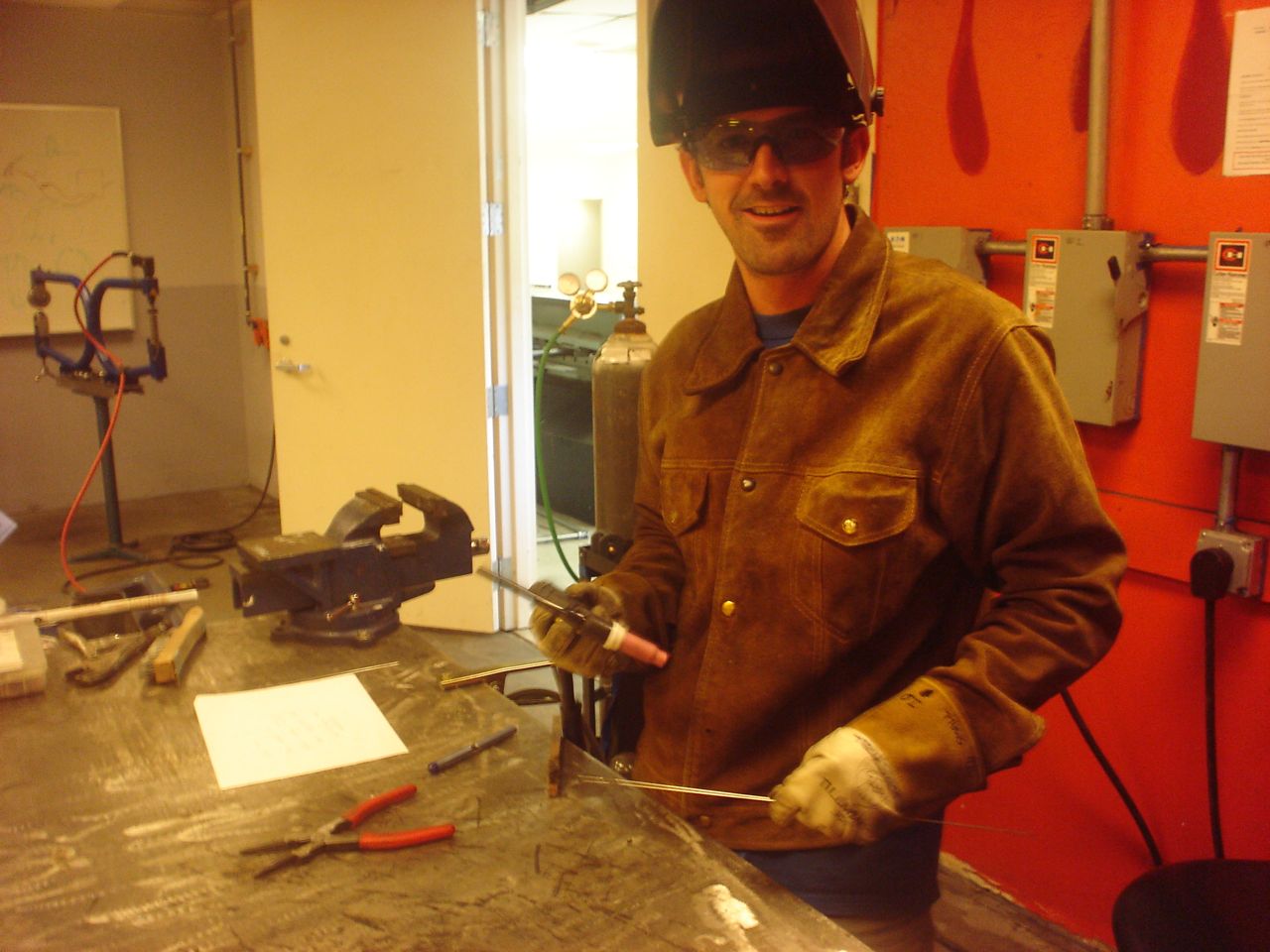
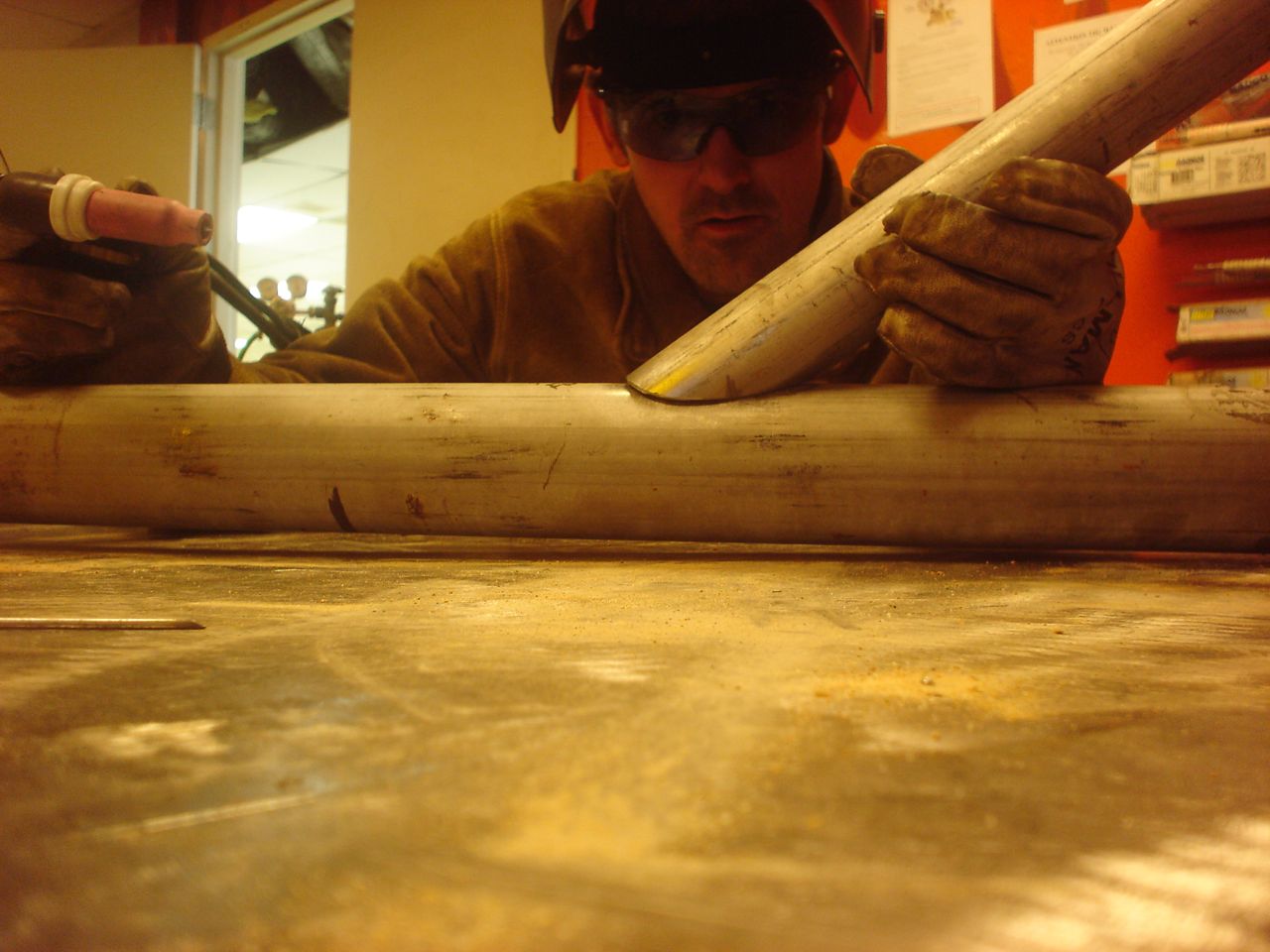
Since buying a boat I have become more and more fascinated with welding. I decided we needed a new radar arch to accommodate our future wind generator, solar panels, and radar antenna, and that I needed to learn how to weld so I could make it myself (of course, right? how else? everything always all by ourselves). Like Jon with his sailmaking–like everything else we’ve done–I went big all at once. I got a membership to the Tech Shop for $70/month, paid $50 for the introductory TIG welding class, and bought $250 worth of 20′ long sections of 2″ diameter 304 stainless steel pipe that were a real hassle to cart around on top of the xterra down the highway.
Maybe I used my learning to weld as an excuse to make a radar arch, or maybe I used the radar arch as an excuse to learn how to weld; either way at this point I’m in ‘ass deep to an elephant’, as jonny likes to say.
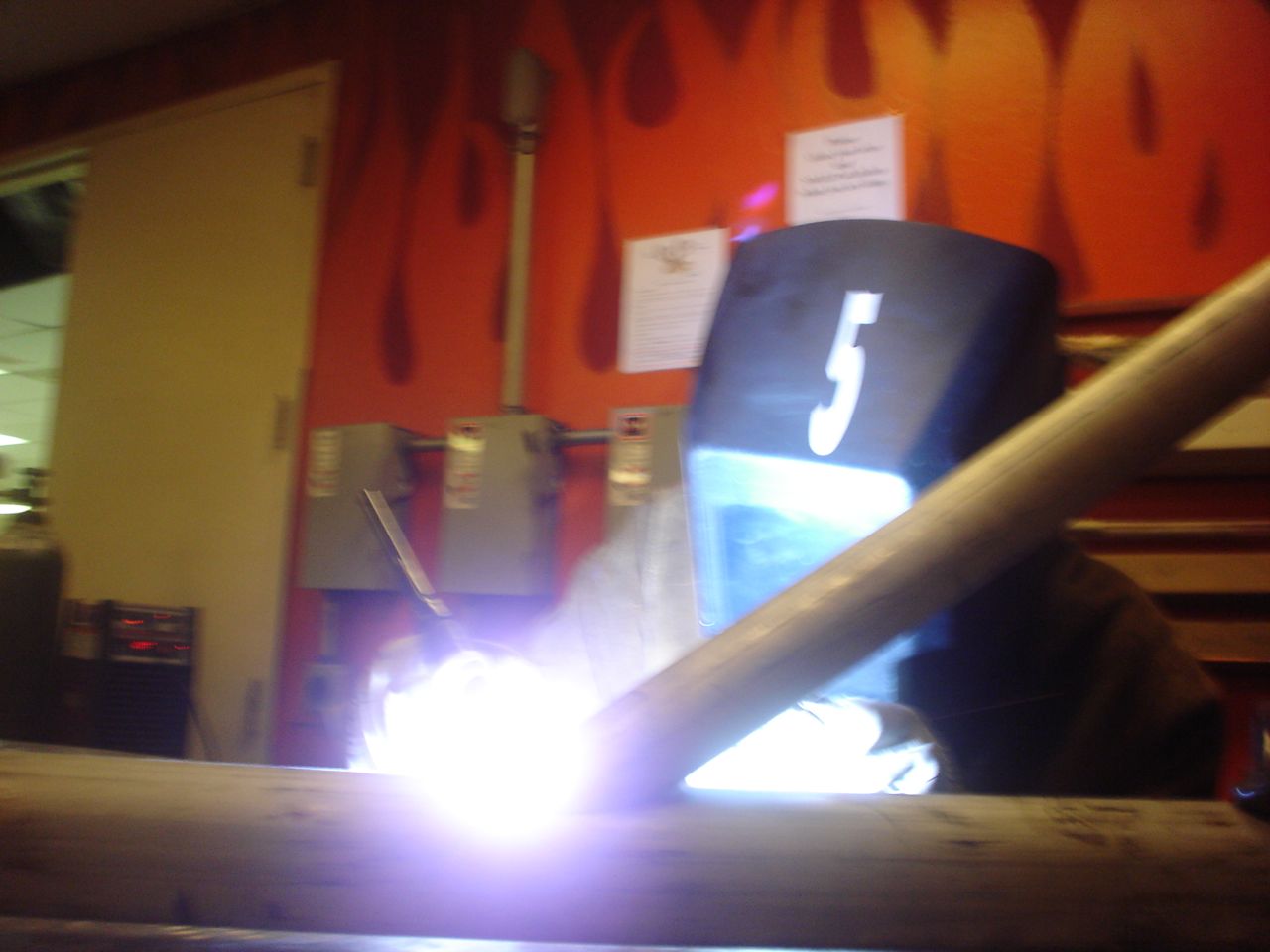
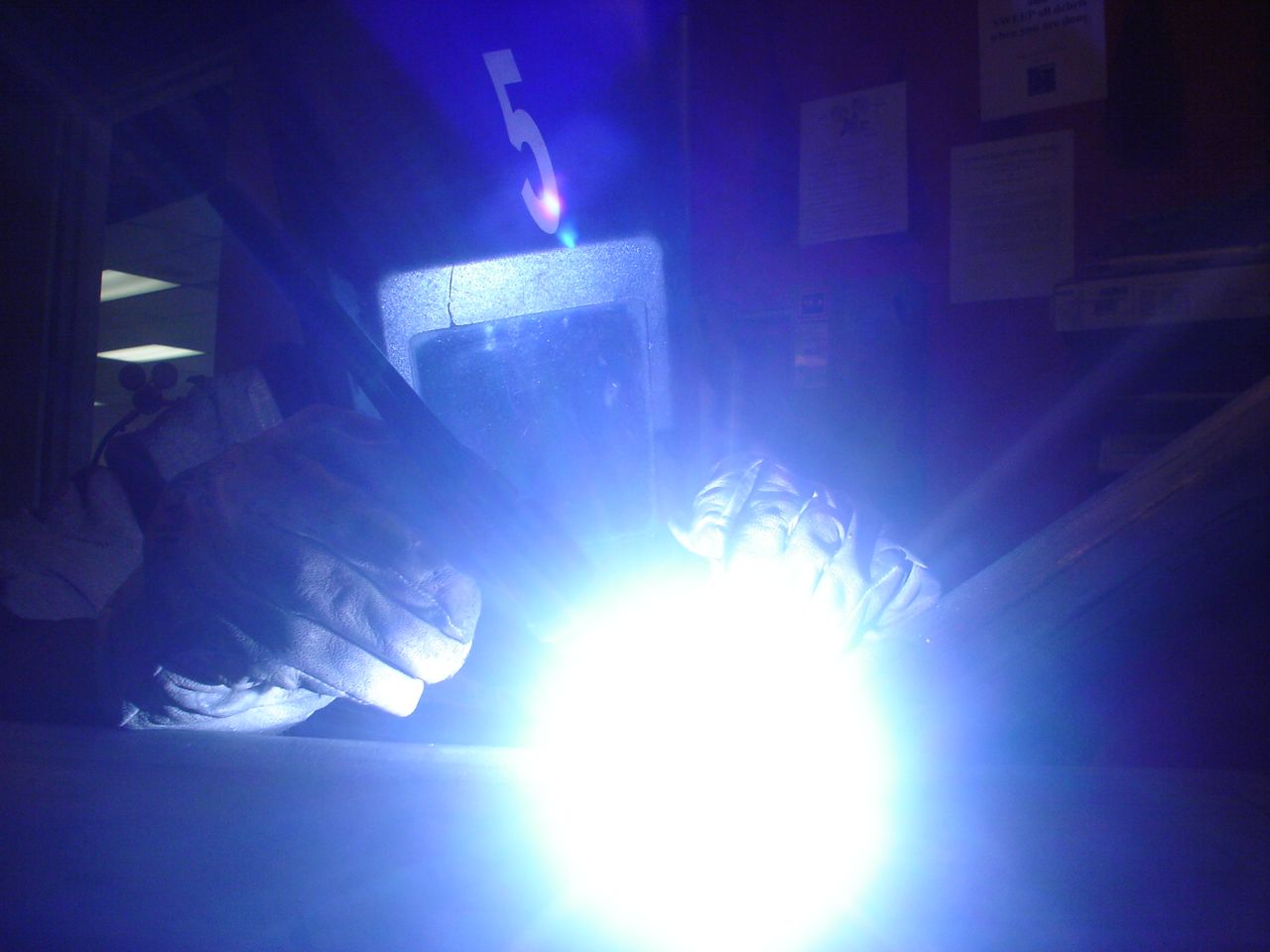
Turns out welding is absolutely amazing. Totally space-age modern-marvel out of this world activity. Welding is proof of how far science and technology has taken us. The welding machine that I use at the Tech Shop is a box approximately 1′ x 1.5′ x 2′ in size–much smaller than a suitcase. It plugs into the wall, and it hooks up to a gas tank. Then you grab a stylus-shaped “torch”, bring it close to a piece of metal, and press your foot on a pedal on the floor–and then would you believe that little machine ignites a 1/4″ cone of light hotter than the surface of the sun. That’s right: instant 10,000 degrees in the palm of your hand, a little mini sun that melts metal. (Crazy!) You have to wear a face mask too dark to see through in full daylight; without it the 10,000 degree arc will blind you in seconds. (Scary!) You have to wear gloves and cover all exposed skin, because it creates so much UV that it will give you a sunburn in a minute. (Hot!) When you hold that torch, your hand is 6″ away from a tiny 10,000 degree cone of orange and green plasma that dances on the metal. Now why didn’t they tell me THAT when I was younger? Who wouldn’t want to hold the sun and fire it up and melt some metal with 10,000 degrees of blinding light?
The type of welding I’m learning how to do is commonly referred to as TIG welding, which stands for “tungsten inert gas”. It’s more accurately called GTAW welding: “gas tungsten arc welding”. It is the most precise and most versatile, yet also slowest, most difficult, and least used form of welding. In TIG welding (as in other forms of welding), the metal is melted by heat created by an electric arc, EXACTLY like the static electric spark that jumps from your hand to the doorknob after you walk across a carpet with rubber soles. Welding is a sustained form of that static electric spark–if you could keep that spark going and then make it 100,000 times more powerful, you could be welding. In TIG welding, you connect the electricity to a thin, sharpened stake of tungsten (called the “electrode”) and then you bring the electrode really close to (but not touching!) the metal. Really close–like an 1/8″. Then you press the pedal to give it juice. And you have to hold it that exact distance while you move the torch along a path which you can hardly see because you have some dark-as-hell facemask on. And you have to move kind of fast but not too fast. And I haven’t even mentioned yet that with your left hand (the torch is in your right hand) you have to precisely jab (dab) a rod of “filler” metal into the melted pool of metal, to add metal to make the weld.
Get this: if the electrode touches the metal accidentally, or if you jab the filler rod into the electrode accidentally–both of which I do far too often–the event is punctuated by an even brighter spark and pop immediately followed by an accusatory green flame, which indicates that you have contaminated (i.e. fucked up) your weld with some of the metal from your electrode. At which point you have to CEASE AND DESIST, gingerly dismantle the torch (gingerly because it is still bloody hot, remember), and take your tungsten electrode over to the grinder to grind a fresh new uncontaminated tip onto it.
The whole thing is really hard. It’s really, really damn hard. It’s not hard to make any old arc, it’s not hard to melt any old metal. But it’s hard to get a result that doesn’t look like cyclops went wild on your metal with his phaser eye–I’m talking all black and gobby and bubbly and smoking crappy. And in welding (like in climbing), if it looks bad, it probably is bad: weak and worthless. Why is it so hard? There are tons of different settings, and it’s hard to tell which setting is having what effect. That little suitcase of a welding box is a freaking computer with a gazillion different options and blinking lights and whatnot. And then you have to have super fine motor skills to be able to hold both the torch and the filler rod so steady, and move them so quickly yet precisely, so close to the metal, all while you play this foot pedal to control how many thousands of degrees of heat you’re pumping into a tiny spot on the metal. And all metal is different, and different thicknesses need different settings, and each different joint requires a different technique . . .
All of which makes this radar-arch project daunting. I don’t want to add some ugly weak heavy janky piece of shit to the back of our boat now, do I? I agonized for months over what diameter and thickess and type of pipe to use, and how to join them, and where the support struts should go, and the moment of truth is coming in a day or so and I hope that it isn’t all shitty and stupid looking. I’ve spent a fair bit of time at the tech shop welding practice sections of tubing, and even at my best they are still black and ugly and melty. (You might well guess that at this point “ass deep to an elephant” may be too deep for me.) But I’m not getting much better and I don’t know what else to change and it’s time to move forward with this project and I think that my welds might be good enough. So tomorrow jonny and I go to the tech shop to make the first real welds on the actual radar arch. I KNOW they are going to be ugly. I’m hoping that they will at least be acceptably strong. I’ll post some pictures, regardless of how dissatisfied I am (especially now that I’ve laid the groundwork about how impossibly difficult it is :-). But damn! no matter what welding is a totally amazing thing that now I can (kind of) do!
*addition note: Pictures are complements of Jonny; I still have to add some shots of the resulting welds
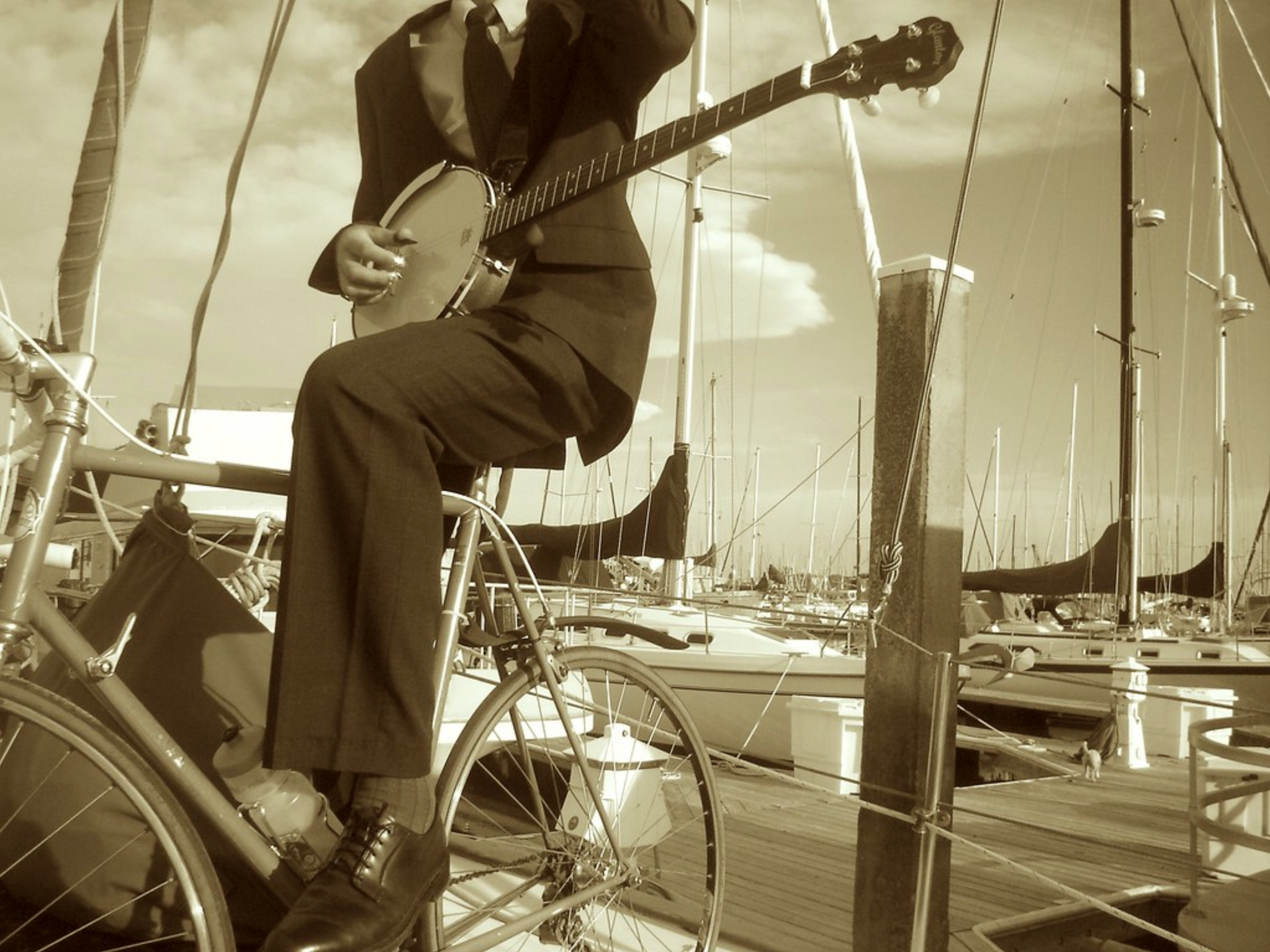
If you couldn’t tell, things are coming along swimmingly aboard Syzygy. I’m immensely proud. (Yes, that’s me on my banjo on my bike on my boat, drinking a beer, in black and white — how’s that for vainglory?)
I’m writing regularly about Syzygy — the work, the preparations, the doings in this new sailboat world — for Outside magazine’s blog — we have our own little Syzygy page, even.
I’m proud of these ramblings, too, and should have re-posted them here, but I hope you’ll understand that I was busy. I was probably cutting another hole in the boat. I’ve written about the hundreds times I’ve done that (cut holes in the boat, and also written about San Francisco’s notorious wind, about removing janky parts, about the modern history of metals, about the love/hate nature of sailing, about waging a war on stainless steel, about the cult of the Valiant, about inspiration from a sailing legend, and more. The pipelines are full, too.
It’s been almost a year since we started working on Syzygy, and sometimes, like when the engine wouldn’t start or when the lights didn’t work, or when the chaos of repair projects seemed to spread in every direction and leave no room to sit down (let alone think), standing up to face the pile of work head on has felt like a solitary endeavor indeed. Alas, lately I have been reminded how un-solitary, how befriended, I am — and how grateful I am for such help and friendship. So here’s a brief shout-out to all those who have lent a hand in some way. (If I’ve forgotten you, I apologize. I blame Craig, and the whiskey.)
Liz – thanks for help on so many projects: the deck, jib car tracks, stanchions, cleats, and pushpit rails, among others. Sorry for getting epoxy in your hair and under your fingernails. It’ll come out eventually, I promise.
Dave – thanks for letting me borrow/use the paint, throw cloths, and brushes again and again. And for the soup. And the beer. And the compliments.
Barry and Donna – it’s so great to have such big fans. Thanks for finding the time and energy after running 20 miles to swing by. And thanks for the food/drink, also. You’re too kind. If we had more space we’d let you come with us.
Pete and Ray, on board the Lady Margaret Rose – you’ve been our on-call boat support line. Thanks for helping out with the diesel engine, the compressor, and assorted mechanical issues… and for being friends.
Jason and Laureen, onboard the Excellent Adventure — thanks for letting me use your table saw, and for the burrito.
Jim and Jean, on board Kanga – thanks for such fine photography, steady praise, and for letting me copy the design of your table. Just because our boat’s older doesn’t mean it has to look it.
Craig – thanks for the whiskey. It’s good, and almost gone.
Jim (aka Maine Guy) – thanks for the steady stream of advice, and for letting me borrow some fine sailing literature.
John – thanks for such fine metalwork and custom machining. We remain endlessly proud of our mast steps.
Robert – for letting me borrow a carpenter’s square
Scott – for donating so much electrical equipment. It’s going to good use.
Heather, of Stitchcraft – thanks for playing banjo and singin’ up a storm on my birthday. If i hadn’t been so drunk, I’d say it was a birthday i’ll never forget.
Lindsay Mac – for inviting me to a show, and playing a song in Syzygy’s honor. Without music I’d go bonkers. You (but not your cello, it won’t fit) are welcome on the boat anytime.
Ryan – thanks for helping me paint the new shelves, and for assistance steering and soaking up the sun.
Moe – thanks for the homegrown lemonade supplies. It was delicious, and helped us avoid scurvy a little longer.
Chris and Lindsay – thanks for helping us sand and paint the rub rails, and for donating such awesome rope lights. It’s like a party on the boat, all the time!
Matt’s dad – thanks for help troubleshooting the diesel engine, and for the oil transfer pump. There’s a seat with your name on it in the engine room.
Zach, at Syzygy Wines – for the donation. What a kickass name! Can’t wait to raise a glass!
Kati, at Rickshaw Bags – for the technical support with our new stowage system.
Chris, onboard Vela – for letting us borrow your ingenious self-brushing brush. I hope Mexico is treating you well.
Last but not least, thanks to the mystery mariner who’s left a variety of little goodies for us on the boat — a tub, zipties, some straps, a 1978 issue of Climbing magazine, a 1981 issue of Sports Illustrated, and an out-of-print guidebook to an obscure climbing area in Washington. You work in mysterious ways, amigo.
Let me tell you how I have been dealing with the situation. Since the boat has been two-thousand miles away, all I have been able to do is prepare. I have prepared until I have nothing left to prepare.
I have made lists. I have made a list of all the tasks that need to be done while the boat is out of the water in the work area. I have made a list of all the tasks that need to be done when the boat gets back in the water but before it reaches the marina. I have made a list of tasks to be done when the boat reaches the Emeryville marina. I have made a list of EVERY SINGLE THING we want to do to the boat for the next YEAR. I have made a list of the tools that we need to obtain, organized by task. I have made a list of the tools and materials to gather together before starting each task. I have made a list of each step to do to complete each task.
Most of these lists I have rewritten and recopied over at least twice.
I made a spreadsheet with the precise measurements of all our rigging, a diagram of the location of all our through hulls, another diagram locating just the underwater through hulls, a diagram of how to rebuild the plumbing for the new head, two diagrams with brainstorms of how to rearrange the electrical system, a diagram of the mast steps I want to build.
I have been to two tool supply places today, five yesterday, and three the day before that. I have been to Svendsen’s Marine Center three times in the past week, without buying a single item.
Clearly, making lists and over-preparing is my thing. Clearly, I like this. But now I’m ready to be done with lists. Now I’m ready to check things off of lists. I’m ready to be too busy to make any more lists.
First it was the cushions. Now it’s getting the boat across the border.
We’d planned, months ago, to have Syzygy trucked up to San Francisco in mid March, during Jon’s spring break. Before Jon bought plane tickets to Mexico, I talked to Jazmin, at Marina San Carlos. She told me that the wacky spring tides were too low, preventing us from getting Syzygy out of the water until April 9th. (We later heard stories of other boats scraping against the bottom and getting stuck, right at the launch ramp.) So we rescheduled our trucking for April 14th, and pushed back Jon’s visit to April 25th. Since trucking Syzygy from San Carlos to San Francisco takes a week, we expected Syzygy to be here, well, now.
Then Jazmin quit (or got fired), and things got shuffled around.
Melissa, our new contact, assured me our plans were still on track.
Then Melissa sent me this email: — I am writing you regarding a situation we are having from the past couple of weeks. For the moment we are not able to cross a boat thru the border because, we need a number to import your boat back to the US. Customs told us it would take 10 days, to get this number, and the time has passed for about 1 month. They deny to give us the number and we are trying to figure it out what are we going to do regarding this situation. I had not sent you any e-mail, because I supposed this would be a matter of at least 15 days, but now it is out of my hands. For the moment I have 5 boats waiting to be ship to US, and I believe this would affect your date to be truck to Tucson. I already talked to your US Carrier and he told me it won’t be a problem at all. Believe we are trying to do the best we can to put everything on its place. I hope to hear very soon from you. —
That’s why people don’t buy sailboats in Mexico…
As I began pulling my hair out, we discussed a) complaining to our congressmen/senators; b) calling Customs ourselves; and c) whether or not Syzygy would be here by April 25th, when Jon was scheduled to arrive.
Then I talked to Melissa, and she told me she could ship the boat on Friday, April 18th. Two weeks, ago, in Mexico, she told me (in person), that things were looking good, and that it would happen on April 17th. Hair-pulling slowed down.
Then, according to Melissa, another boat got delayed at the border, and there were problems getting their oversize truck permit, so we got pushed back to Monday the 21st (since customs is closed on the weekend.) The only benefit: $400 off our trucking bill. Hair-pulling picked up.
Melissa called me on Monday morning with news of another delay. Apparently truck drivers in Nogales are protesting lengthy customs inspections (which take a few hours) thereby lengthening customs inspections for everyone, and delaying the delivery of Syzygy at least another day, if not more. Hair-pulling continued.
By today (Tuesday) at noon, Melissa hadn’t called, so I knew things weren’t looking good. She called at 1pm, and told me that Syzygy wouldn’t head north until Thursday (and that she’d deduct another $200 from the tab). That’s not good news for us; Jon’ll be lucky if he even sees the boat, and, at any rate, I’ll be bald by then.
Boat news has been a roller coaster lately: up, down, up, down, up, down.
It started when I stopped by the Emeryville Marina two weeks ago, and found a slip for us. I’m not much of a believer in omens, but I took it as a sign when the skies cleared and a double rainbow came out just as I rolled in on my bike. I was drenched, and my glasses were all foggy/drippy, but I was smiling. I could imagine Syzygy, sitting there in the rippling water, with a view of the whole of San Francisco bay — From Mt. Tamalpais to the Golden Gate Bridge to the city to Treasure Island to the Bay Bridge. It would be perfect.
Don, the harbormaster, and I chatted for a bit about details — he told me I’d have to get a $300,000 insurance policy to keep our boat there, and gave me a phone number of an insurance agent to call.
So I called. The conversation didn’t go so well. Wait; calling it a conversation isn’t quite fair. It was more of an insurance agent’s interrogation:
-Have you ever owned a boat before? No, hmmm. And how long have you been sailing? OK. Where’s the sailboat? It’s in Mexico? I see.. And how many people own the boat? Hmmm… that makes it difficult…
The result: the agent told me he wouldn’t be able to insure us. I hung up, exasperated. If we couldn’t get insurance, we wouldn’t be able to put the boat in the marina. If we couldn’t put the boat in the marina, we wouldn’t be able to go sailing. If we couldn’t go sailing, what’d we buy a sailboat for??
Before my head began to spin too much, I tried calling another insurance agent. This conversation went better:
Q: have you ever been denied coverage? A: no Q: have you been in any motor vehicle accidents, or made any claims, in the last 3 years? A: no Q: is your driver’s license in California? A: yes. Q: how many years of sailing experience do you have? A: well, um, i went to sailing camp when i was like 12, and, um, sailed a bit off the coast of maine, and in Boston, here and there… so, uh, i guess 10 years. Q: what’s the largest boat you’ve ever operated? A: um… 43 feet. Q: has matt ever been denied coverage? A: no Q: has matt been in any motor vehicle accidents, or made any claims, in the last 3 years? A: no Q: is matt’s driver’s license in California? A: yes. Q: how many years of sailing experience does matt have? A: i’d say, uh, 3 years. Q: has jon ever been denied coverage? A: no Q: has jon been in any motor vehicle accidents, or made any claims, in the last 3 years? A: no Q: is jon’s driver’s license in California? A: no, it’s in Colorado Q: how many years of sailing experience does jon have? A: i’d say, uh, 3 years. Q: OK. sounds good. A: Really? Really! Great! Q: Looks like… we can underwrite your boat for $265/year A: Wow! We’ll take it!
So, the agent said, since the boat is in Mexico, they couldn’t insure it yet. Once we get it here, then they’d be able sell me an insurance plan. Fear not, the agent assured me — the rate would still be available two months hence.
Greatly relieved, I emailed Jon and Matt the good news. Everything was coming together — I found a company that could truck the boat up to San Francisco, a slip in one of the best marinas around, and an agent who could insure us as soon as we got here.
Of course, I still hadn’t figured out the pattern, and didn’t realize what would follow Up, Down, Up…
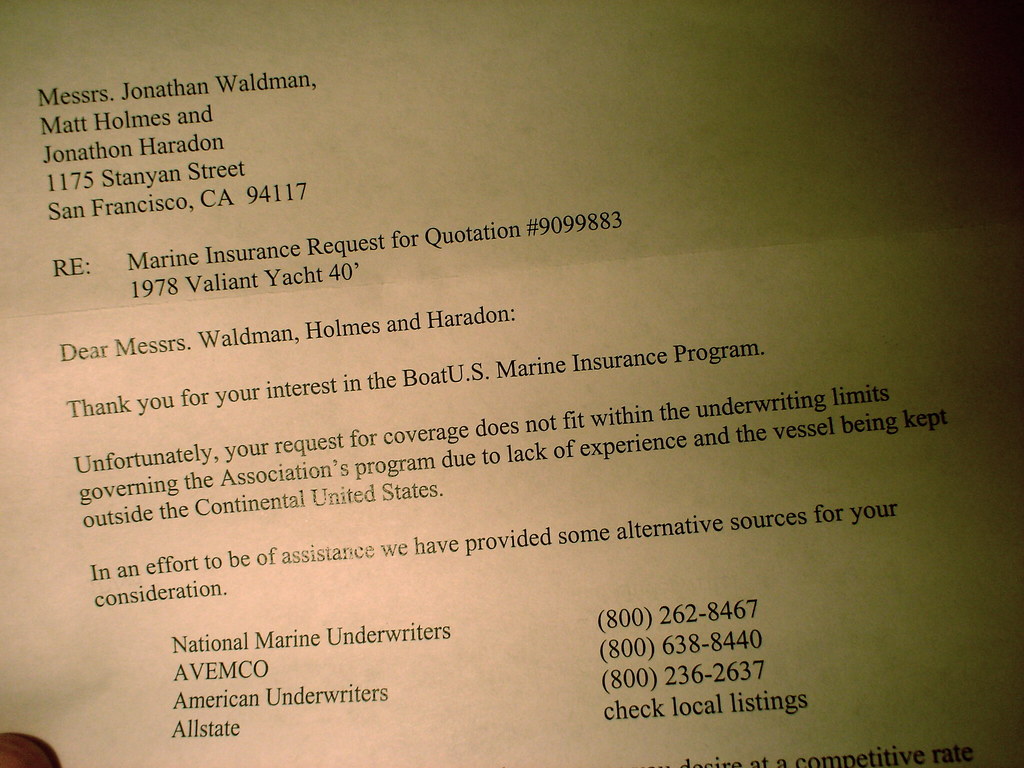
Three days later, a letter arrived, from the insurance company. “Thank you for your interest,” it began — an auspicious start for a form letter. “Unfortunately, your request for coverage does not not fit within the underwriting limits… due to lack of experience and the vessel being kept outside the continental United States.”
Let me be plain: I freaked out. I called back, and explained that while our boat is currently in Mexico, it wouldn’t be for long, and besides, we only wanted to insure it while it’s in the states, anyway.
OK, the agent said. It looks like that’ll cost $550/year. I tried calling, and haggling them back down to $265, but have had little luck so far. I’m not even sure if it’s worth complaining about.
Meanwhile, I’d been emailing Jazmin, at the trucking company, trying to schedule our boat delivery. (*We’d originally wanted to sail Syzygy up to San Francisco, but the logistics are a nightmare: time, currents, winds, the North Pacific swell, money, and boat repairs are all working against us.) Jon has only a week off from teaching at the end of March, so we’d been planning to spend that time in San Carlos, one last time, preparing the boat for its expensive overland journey.
So I emailed Jazmin, and told her we’d like to haul Syzygy out of the water on March 26th.
Her response:
“I was checking the tide and we won’t have enough water to haul out until April 9th at 7 pm. If we haul out that day, we can transport on April 14th.”
This was very bad news. I forwarded the email to Jon, and he left me a voicemail later that day:
“I am officially demoralized… and completely fucking hate our sailboat right now. Goddamnit. Why did we buy a boat down in Mexico. Fucking shit!”
So now it’s just Matt and I, headed down to Mexico in early April, to prep the boat for a very expensive (another bit of bad news) journey to San Francisco.
At any rate, a few days later, Jon called with better news: the last of our parts had arrived. Actually, this was sort of bad news, because we’d ordered $4,000 dollars of assorted boat parts (wire rigging, running rigging, a toilet, hoses, turnbuckles, etc.) almost two months ago, and had hoped to have it within a couple of weeks. We should have known that shipping a pallet would be complicated, or at least slow. But, Jon called, and he was proud to report, at long last, that every little thing we’d paid for was accounted for. He told Matt that he only had one more box to open up.
So he opened up the box to find… fluorescent pink lashing line. (It was supposed to be grey.) Jon laughed, while Matt expressed his fervent position on the matter, which is: there will be no pink lines on any boat Matt’s sailing.
Well, they must have sent us the wrong color line, Matt said. Well, um, no, Jon countered. It looks like we gave them the wrong part number.
My own feeling: when all is said and done, if we successfully a) truck the boat to San Francisco; b) put the boat in a slip; c) find someone willing to insure it; d) re-rig it without killing ourselves; and e) have a few laughs along the way, it’ll be the least of my concerns what color the friggin’ lifelines are.