Syzygy Sailing

Bought a boat, fixed a boat, sailed to Australia, sold the boat.

Category: fun activity

  • ex-HMAS Brisbane

    This post pertains to events that happened June 9th.

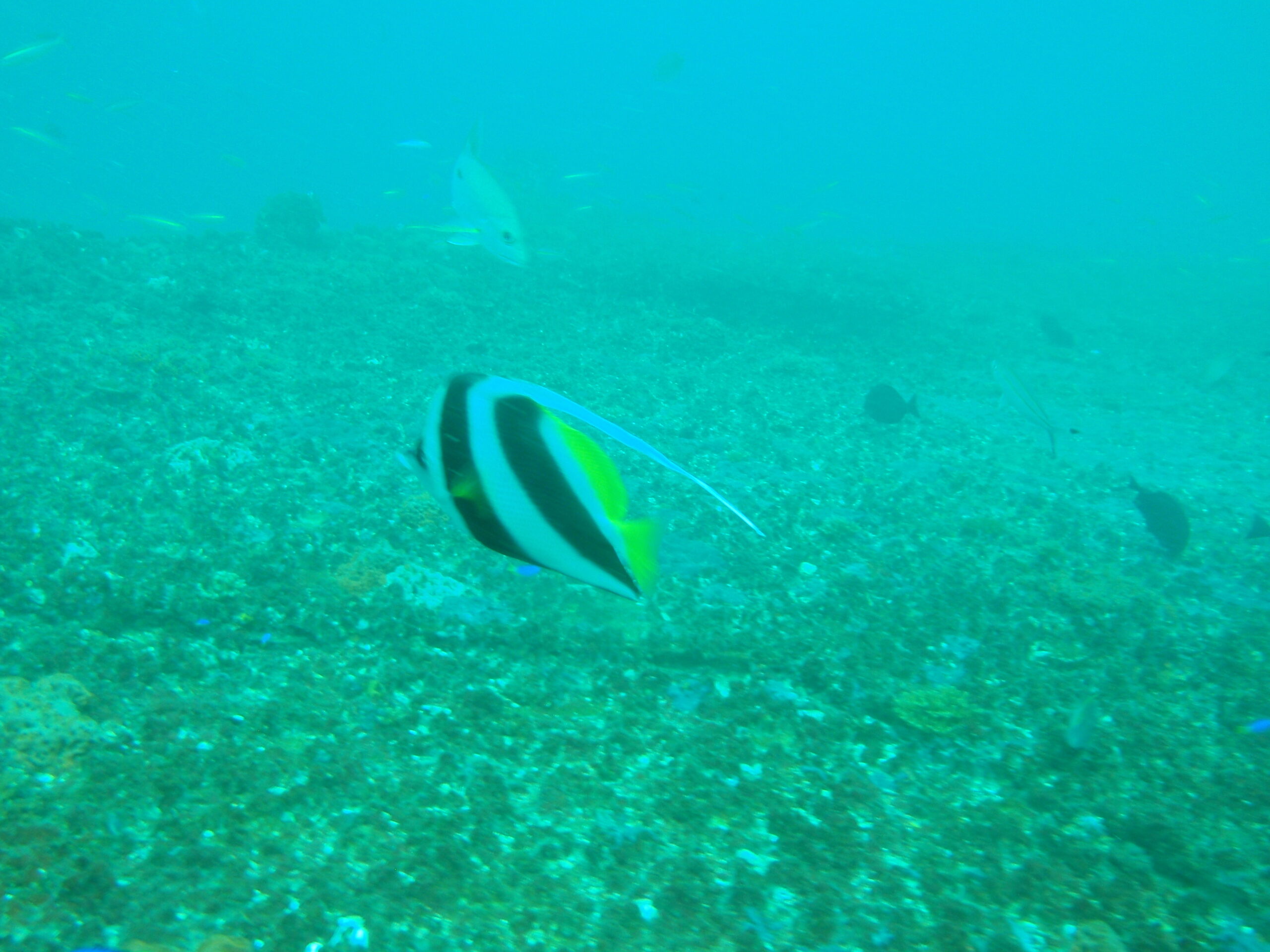
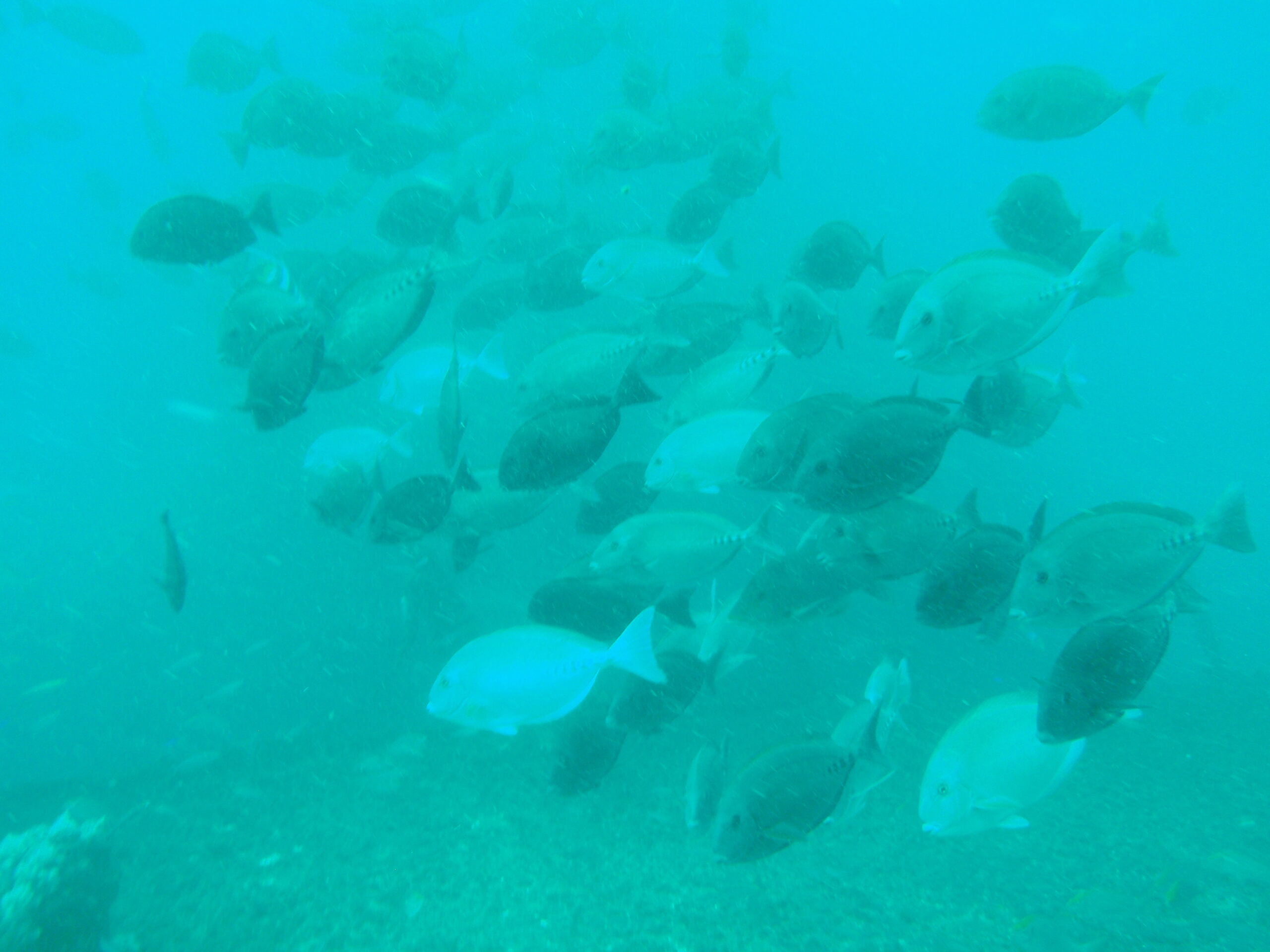
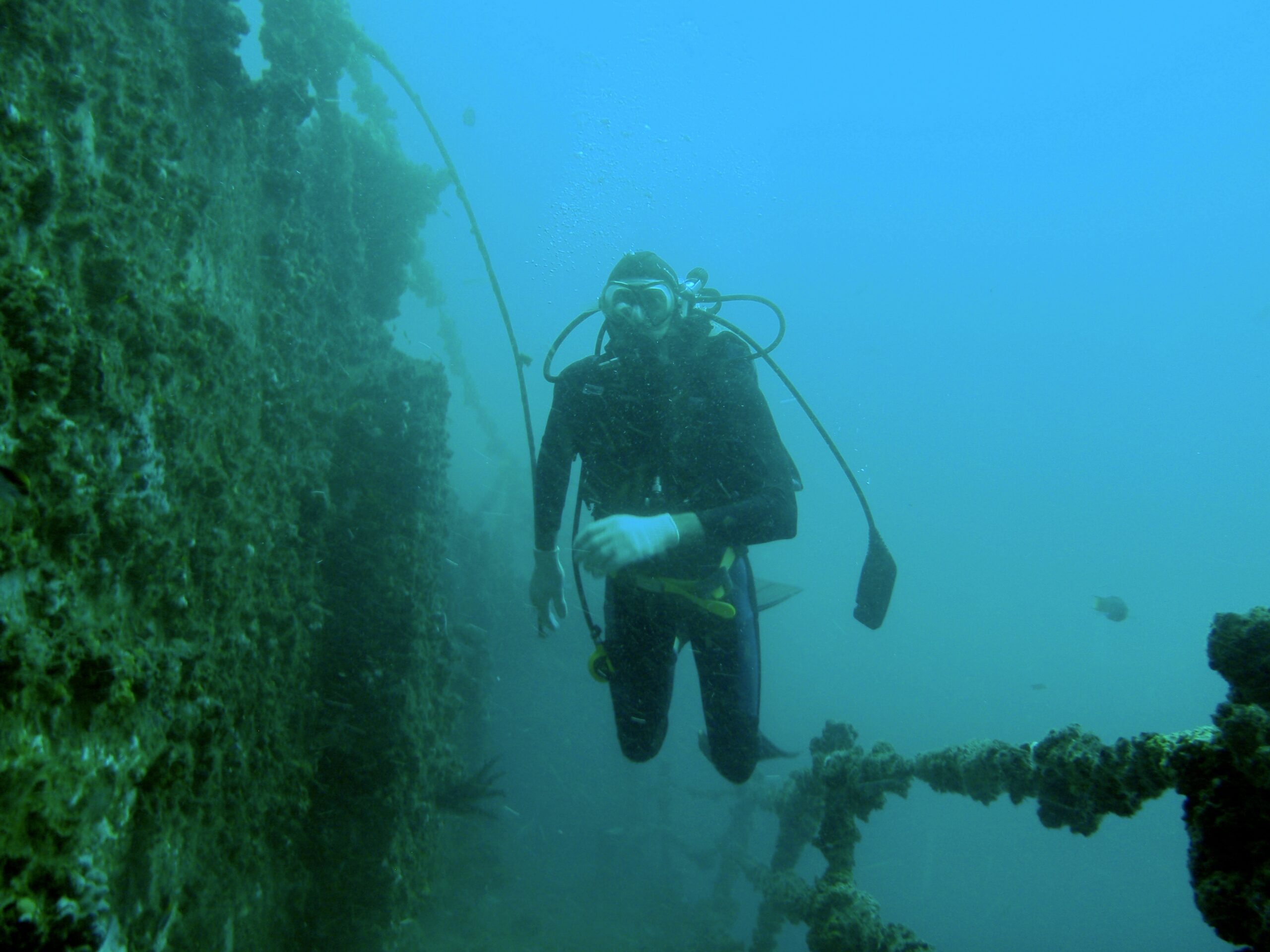
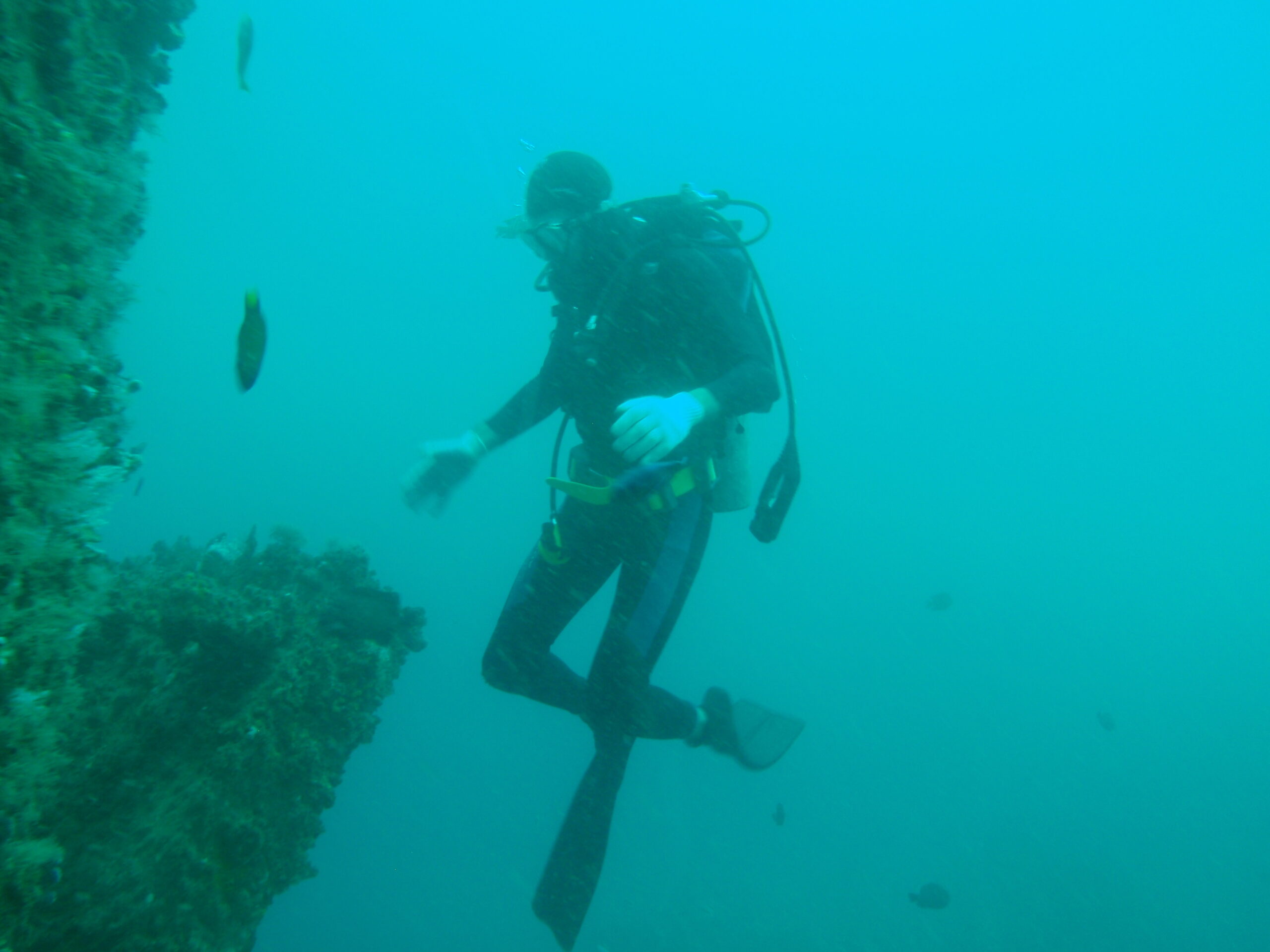
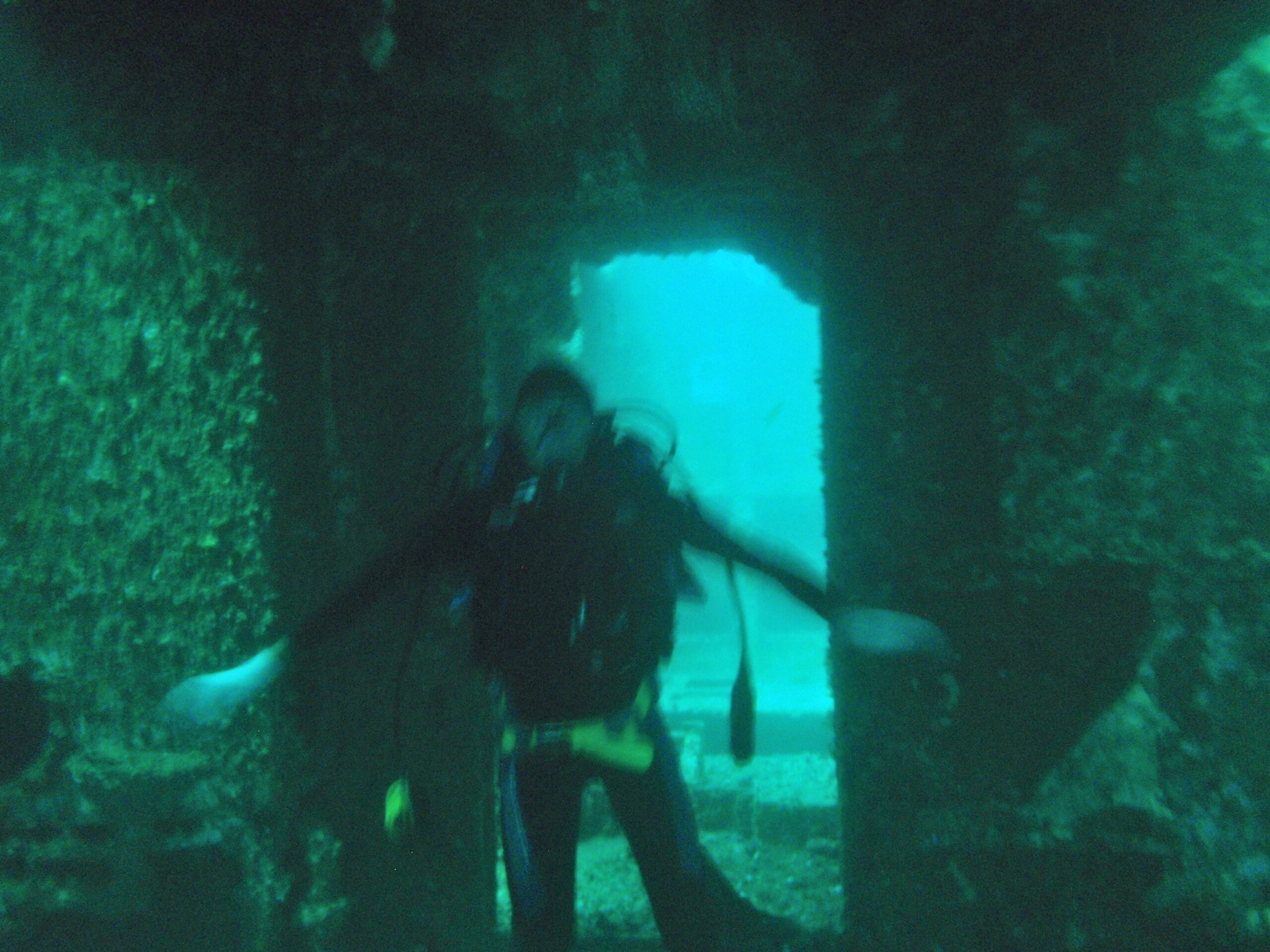
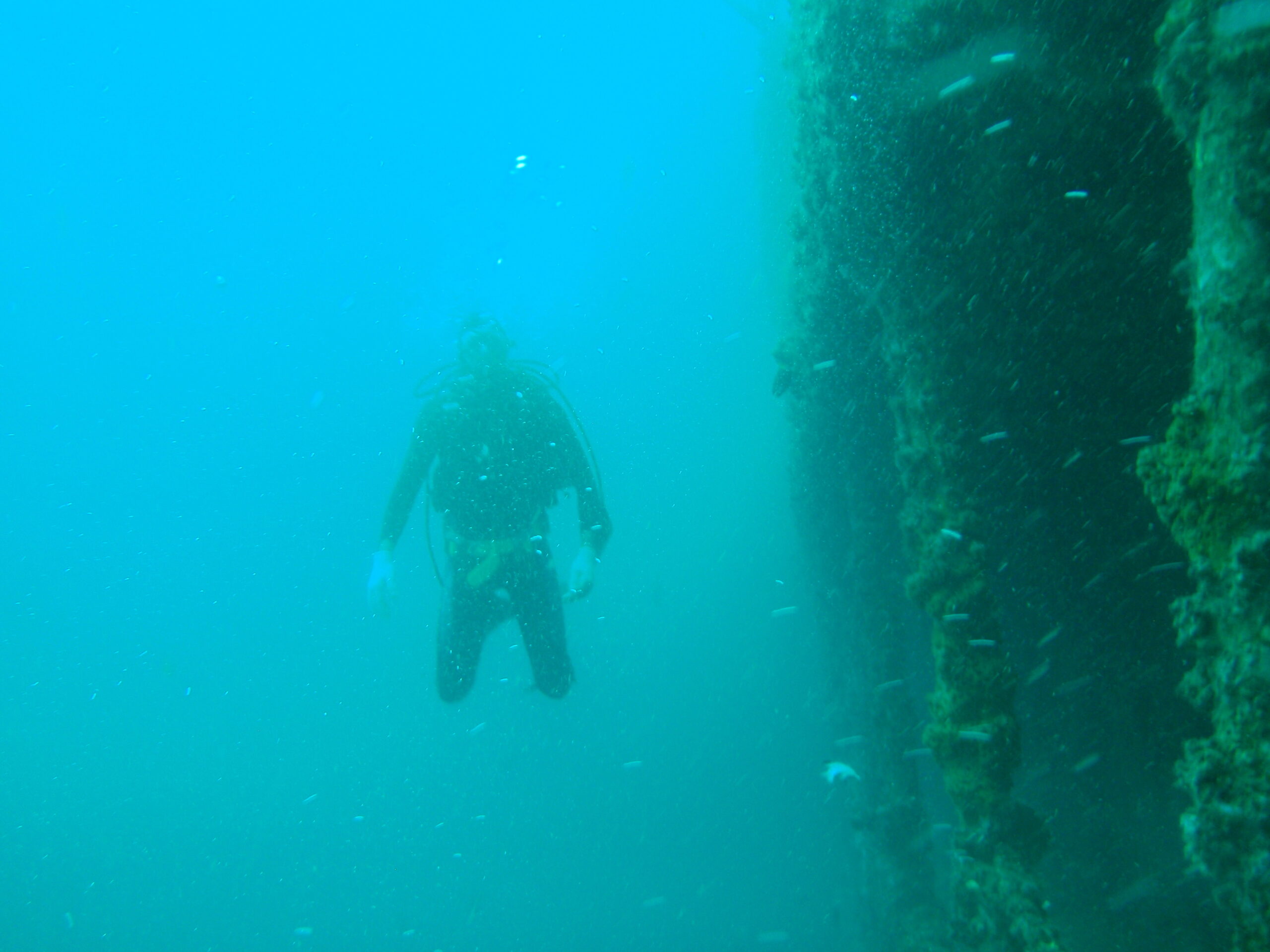
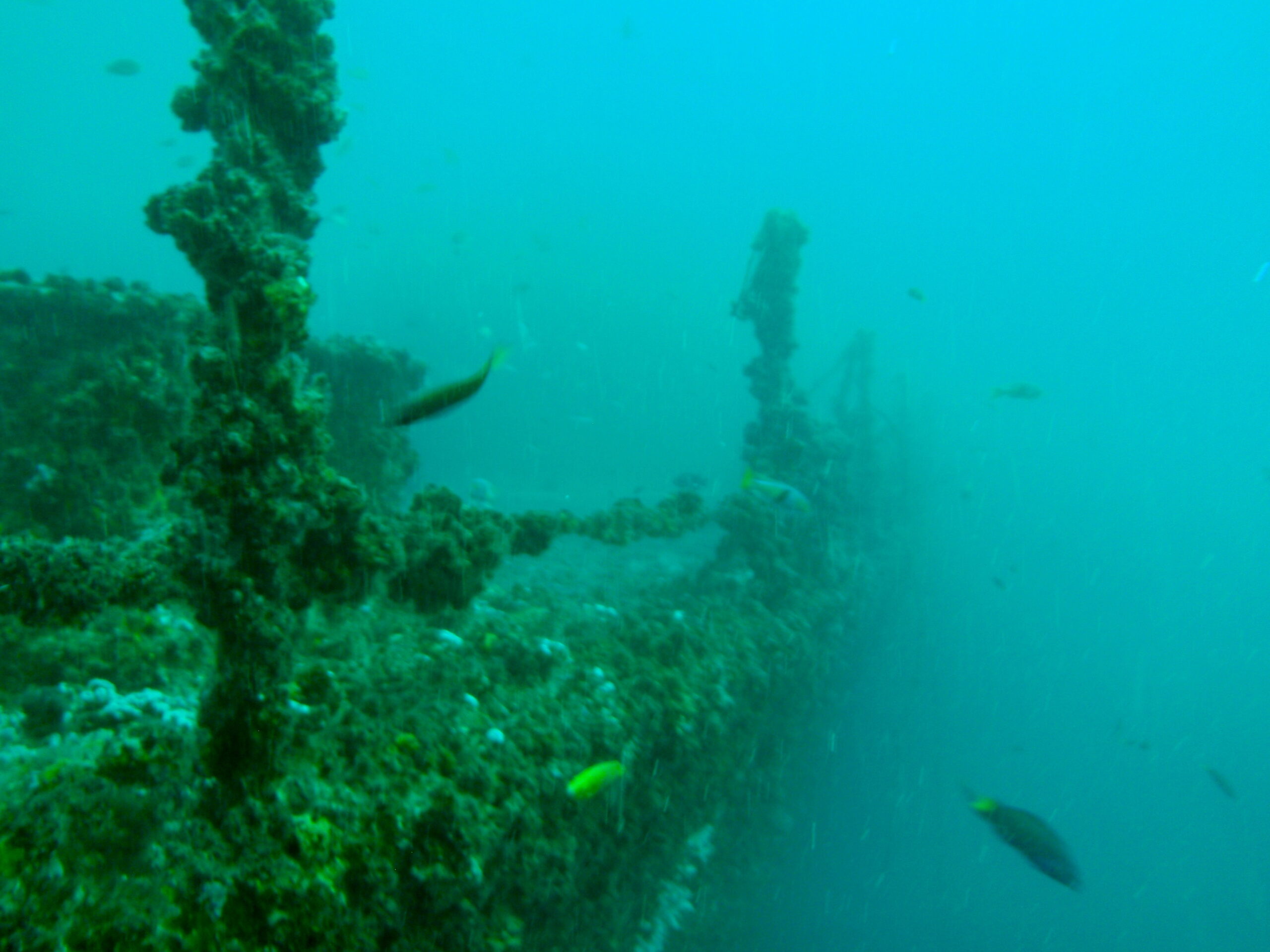
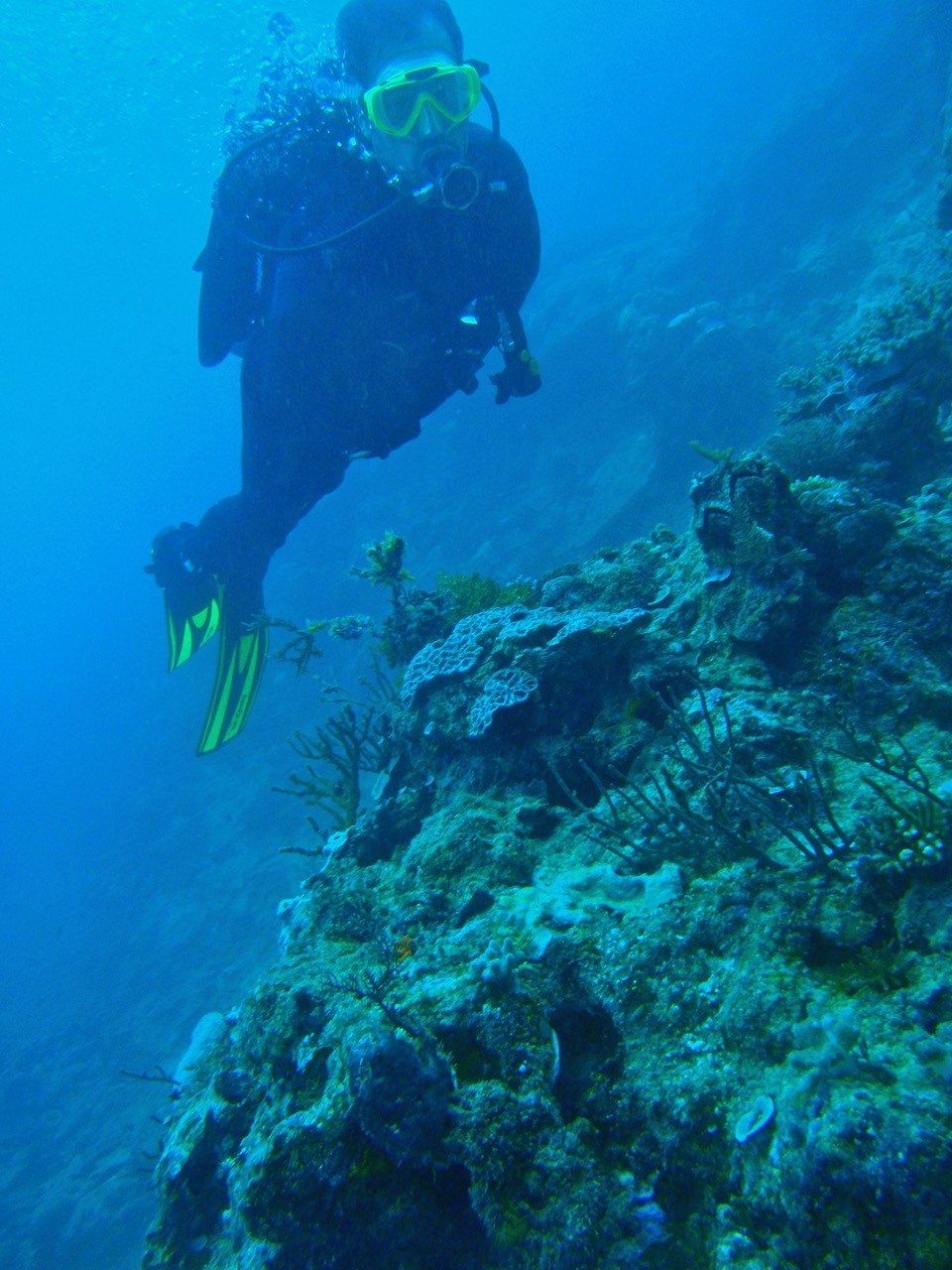
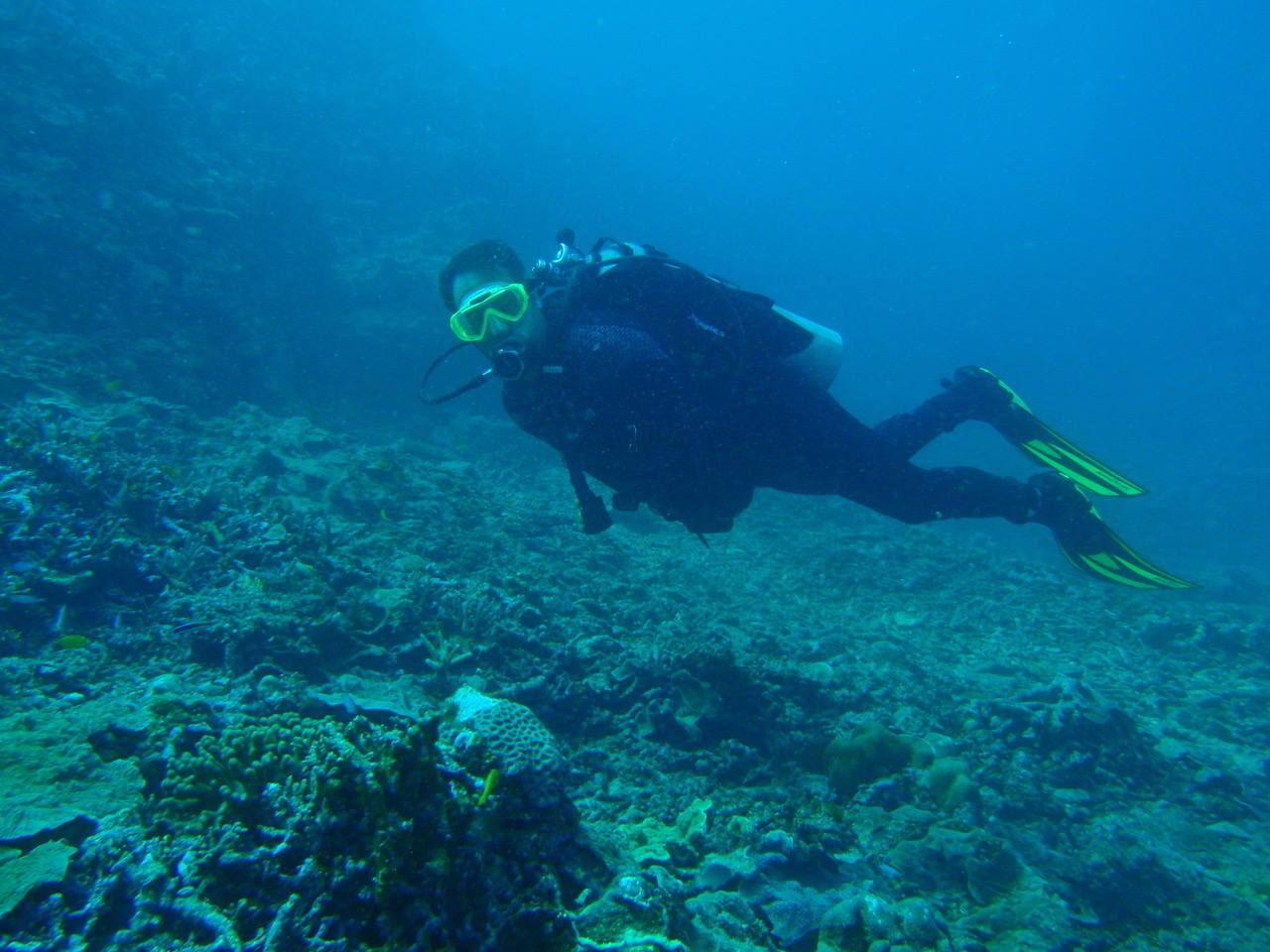
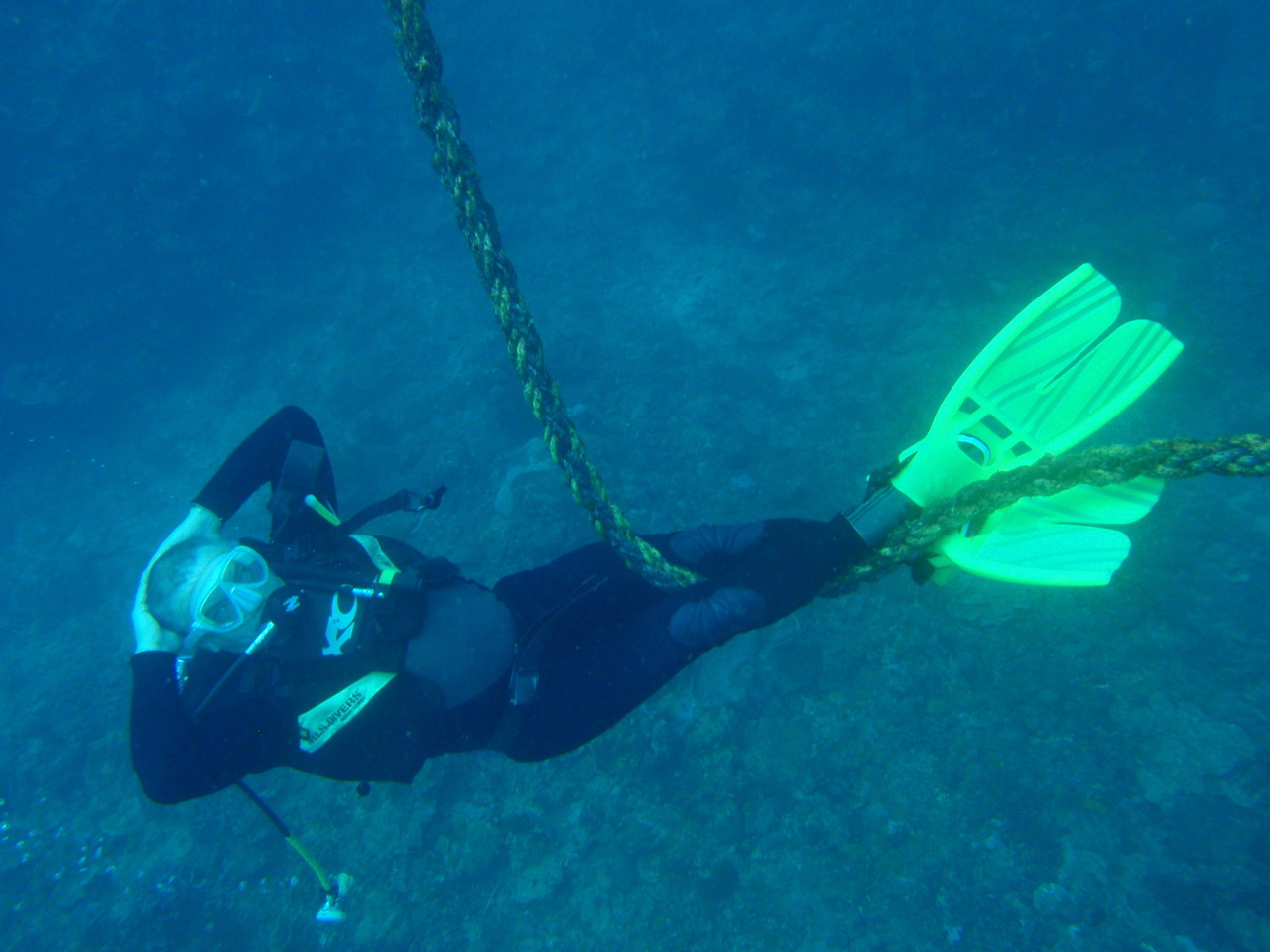
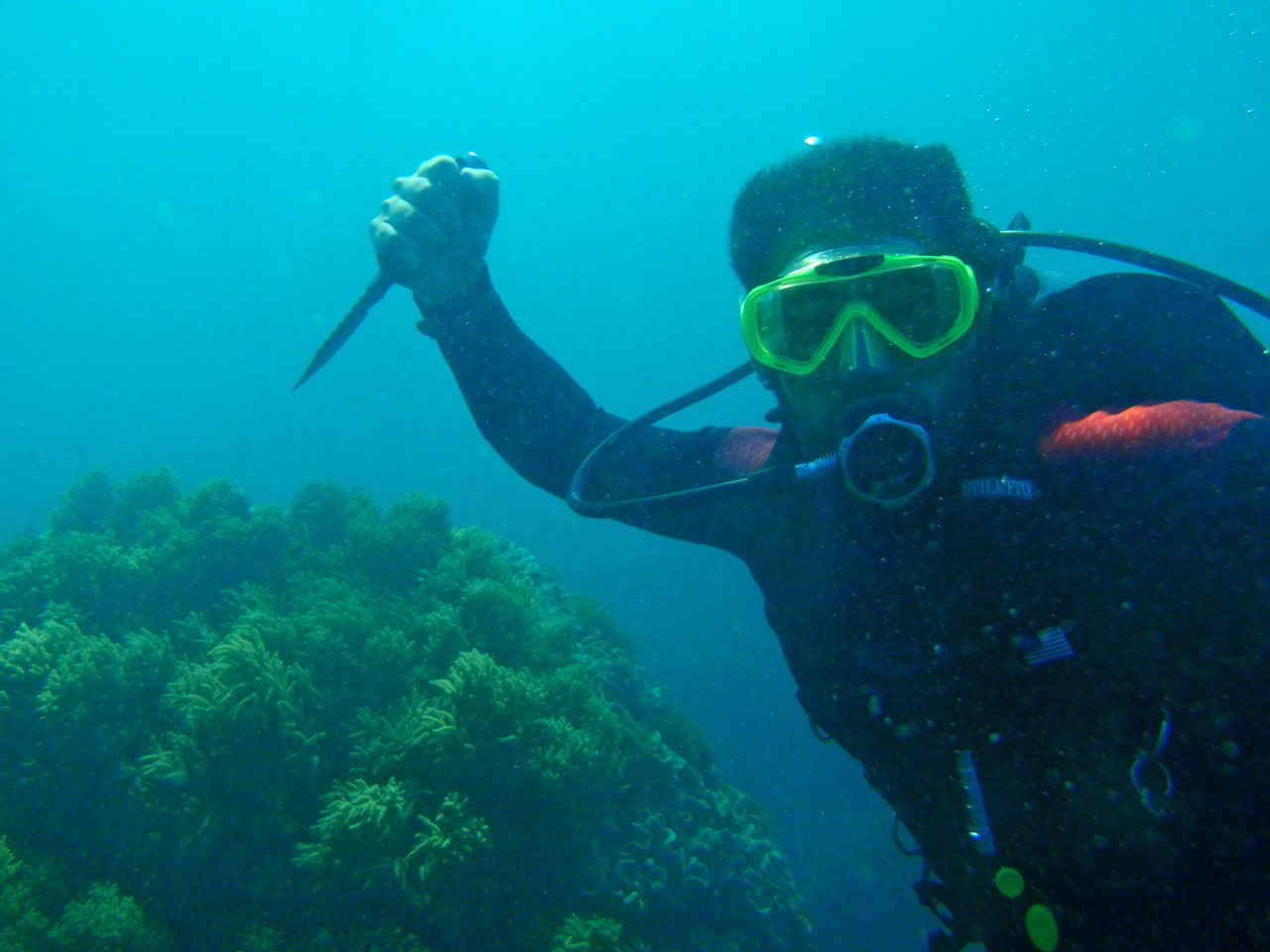
    Justin and I went diving on a wreck called the ex-HMAS Brisbane just outside of Mooloolaba. ‘Ex’ because she’s sunk. HMAS is her Her Majesty’s Australian Ship. Justin was our dive master for the trip based on his getting certified more recently, three years ago, than I, fifteen years ago. He also paid for the permit and listed himself as dive master. He also has a dive computer. I have yet to figure out how mine work.

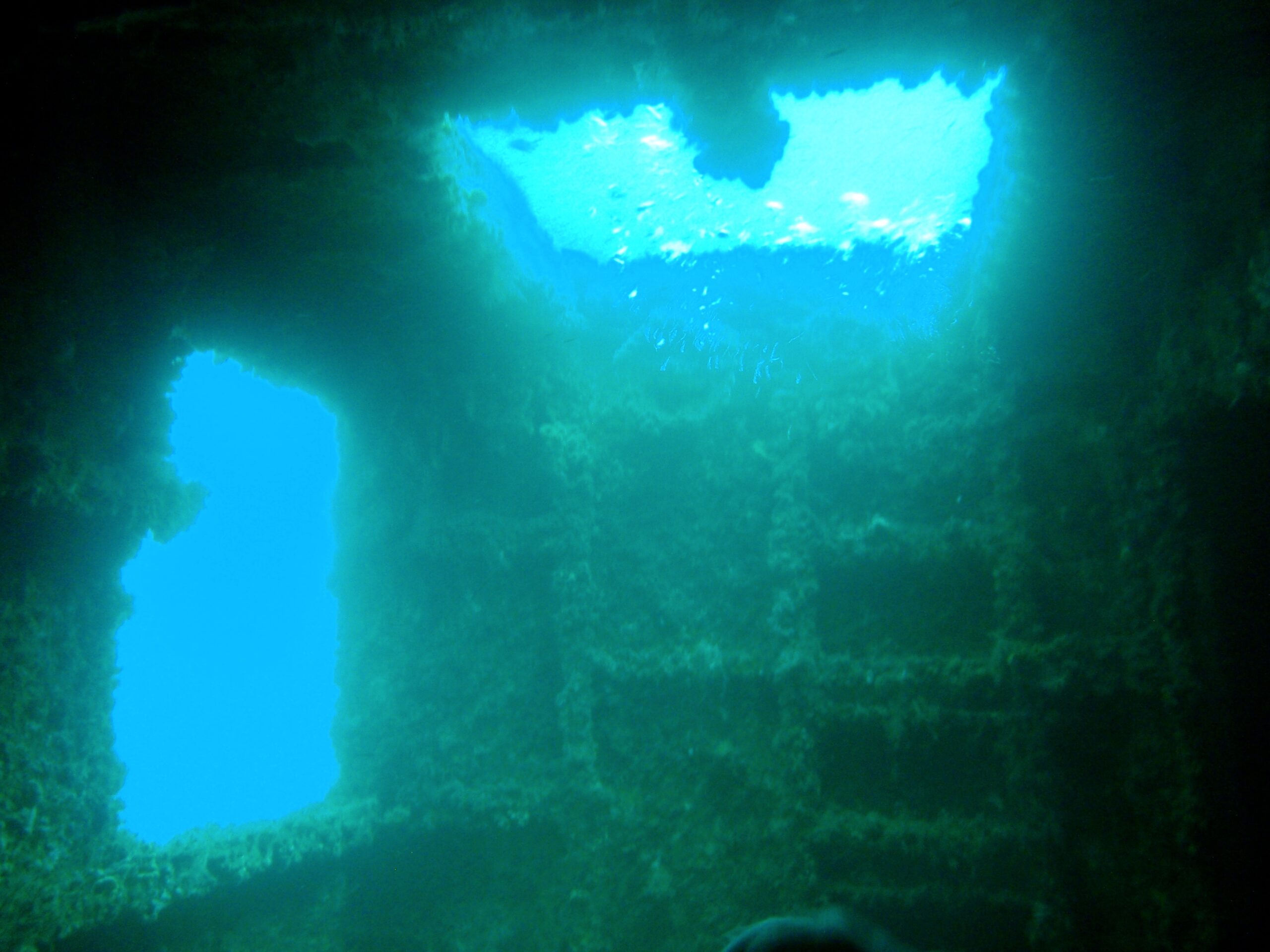
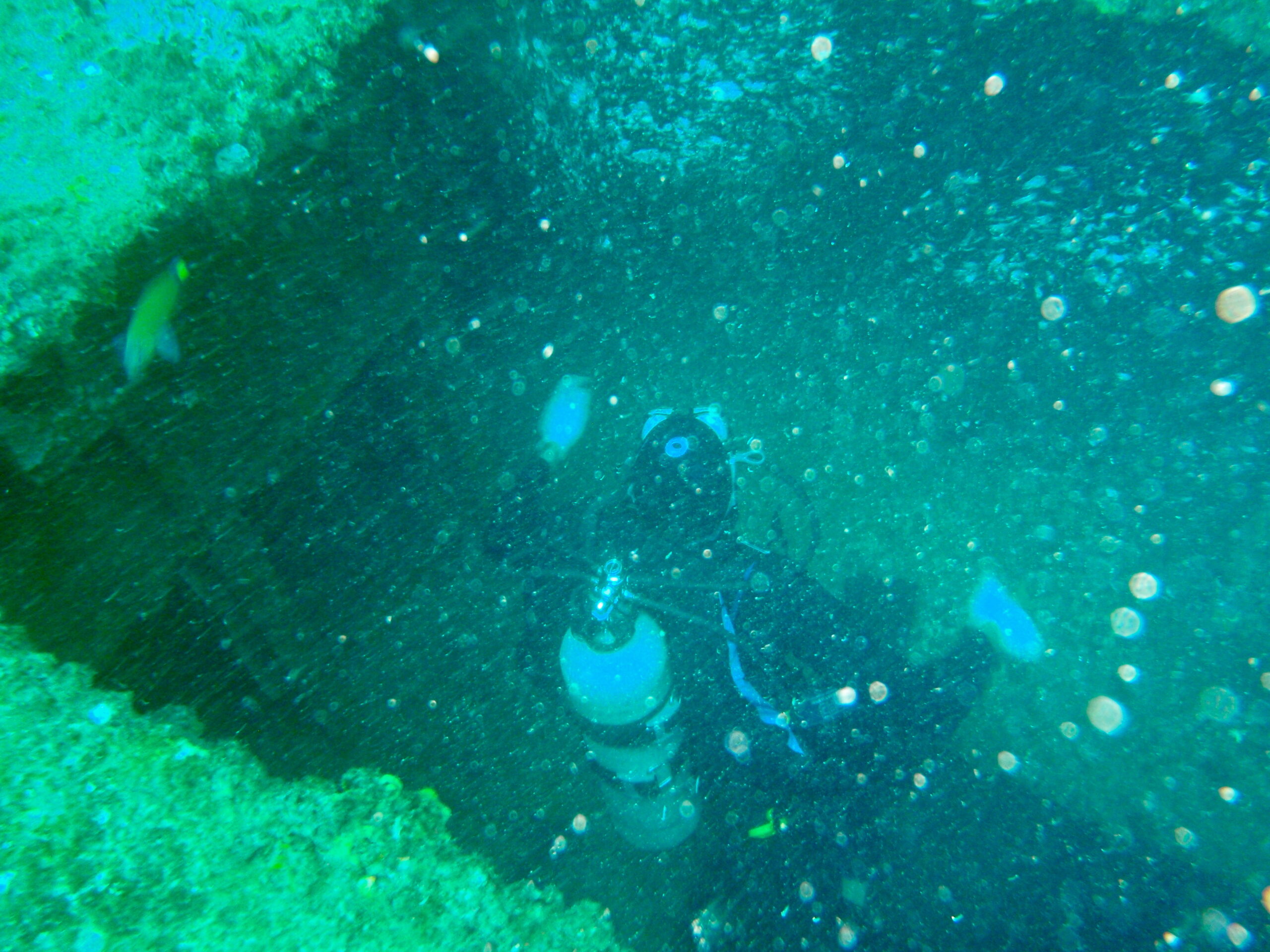
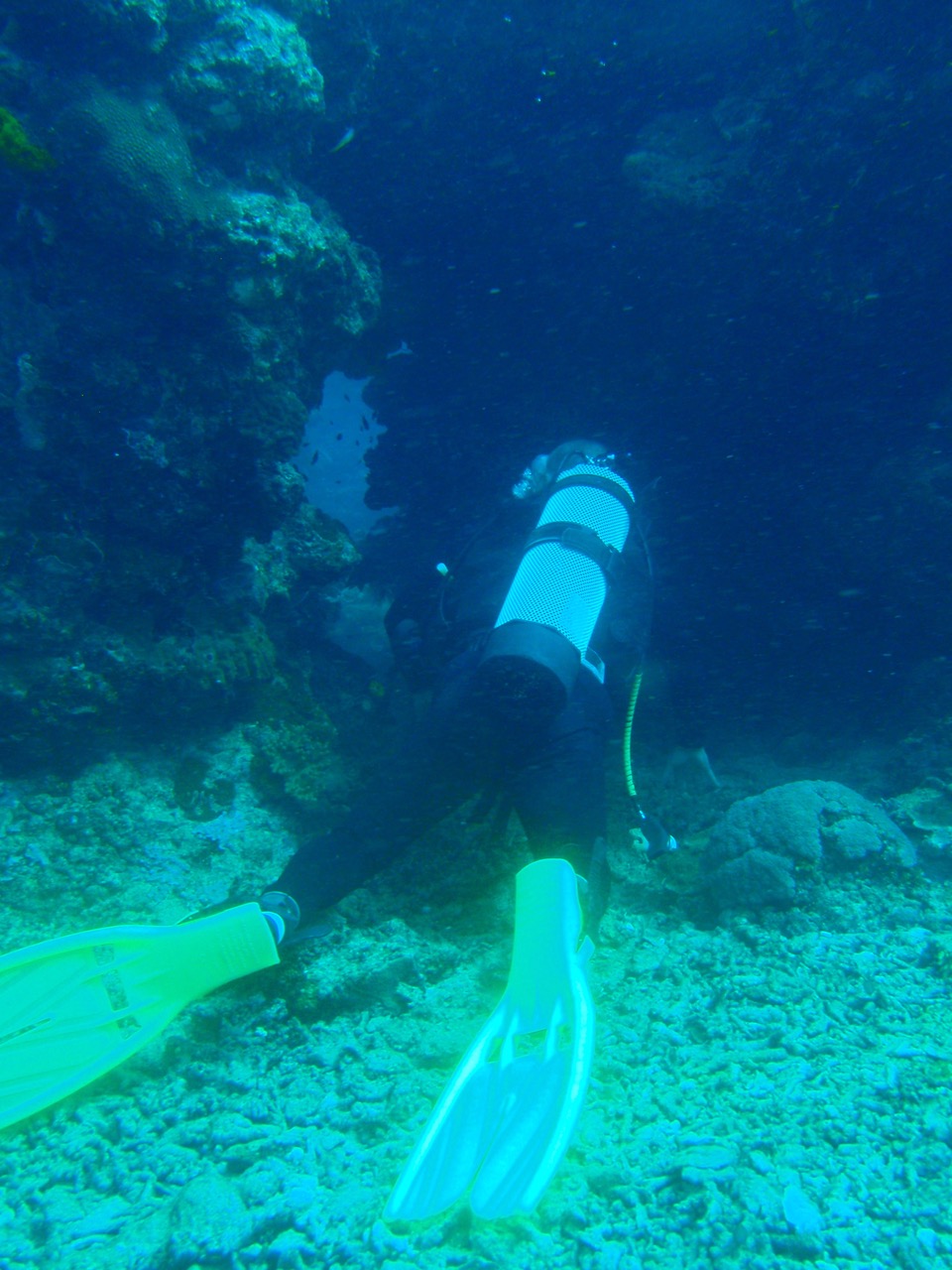
    The ex-HMAS is quite possibly the best first wreck dive you could do. It was purposely sunk to create a reef and a dive site. Large panels were cut through the sides to allow easy access all throughout the ship’s interior. Justin was hesitant before diving about going through the interior; going inside a real wreck can be a serious endeavor. Once we were down though, and right next to the eight foot wide cut-outs, I found it irresistible to not meander through and motioned that intent. What a cool experience.

    We almost were unable to do the dive, rough seas gave us fits as Justin tried to motor up to the mooring while I tried to snag the mooring with the boat hook. At one point, we had to execute a boat hook overboard, when I had snagged the mooring but was unable to hold on as the waves pushed us away. The boat hook was ripped from my hands. Justin did a few circles around the hook before finally closing in. We retrieved the hook and managed to secure up. And glad we were because it turned out to be a fantastic dive.

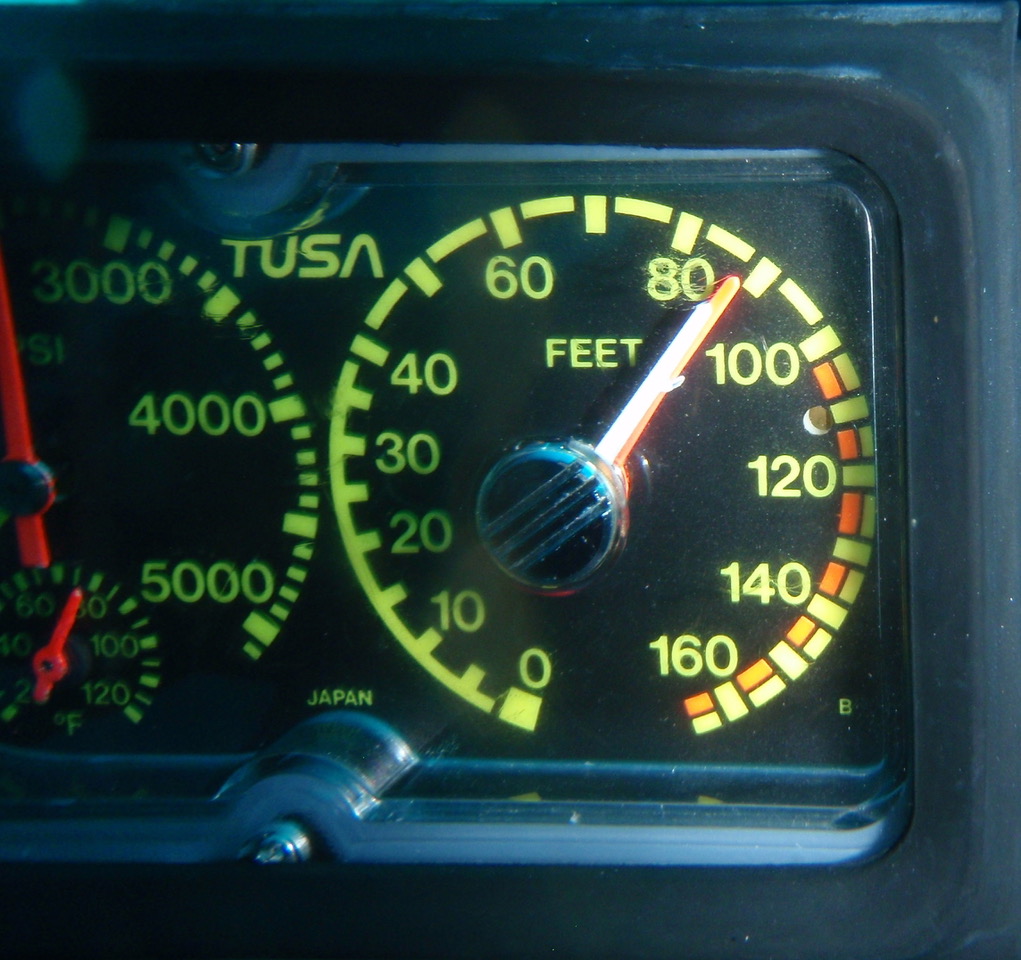
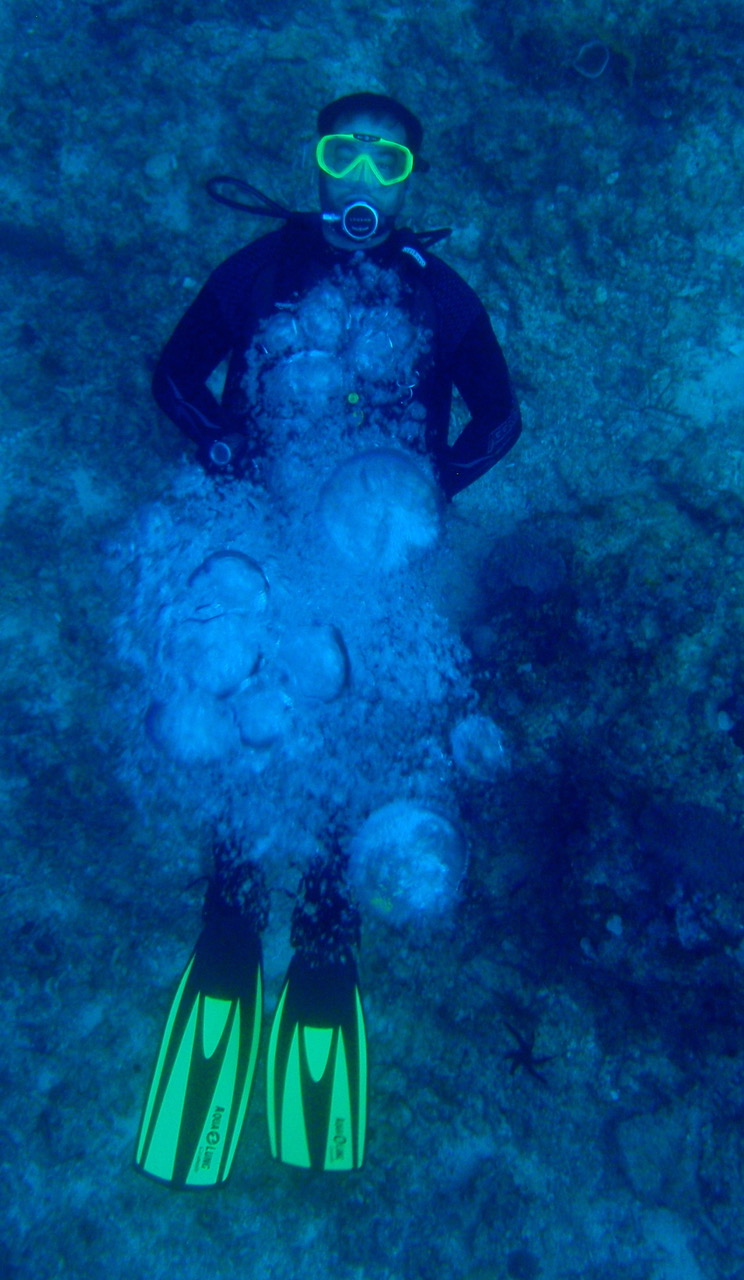
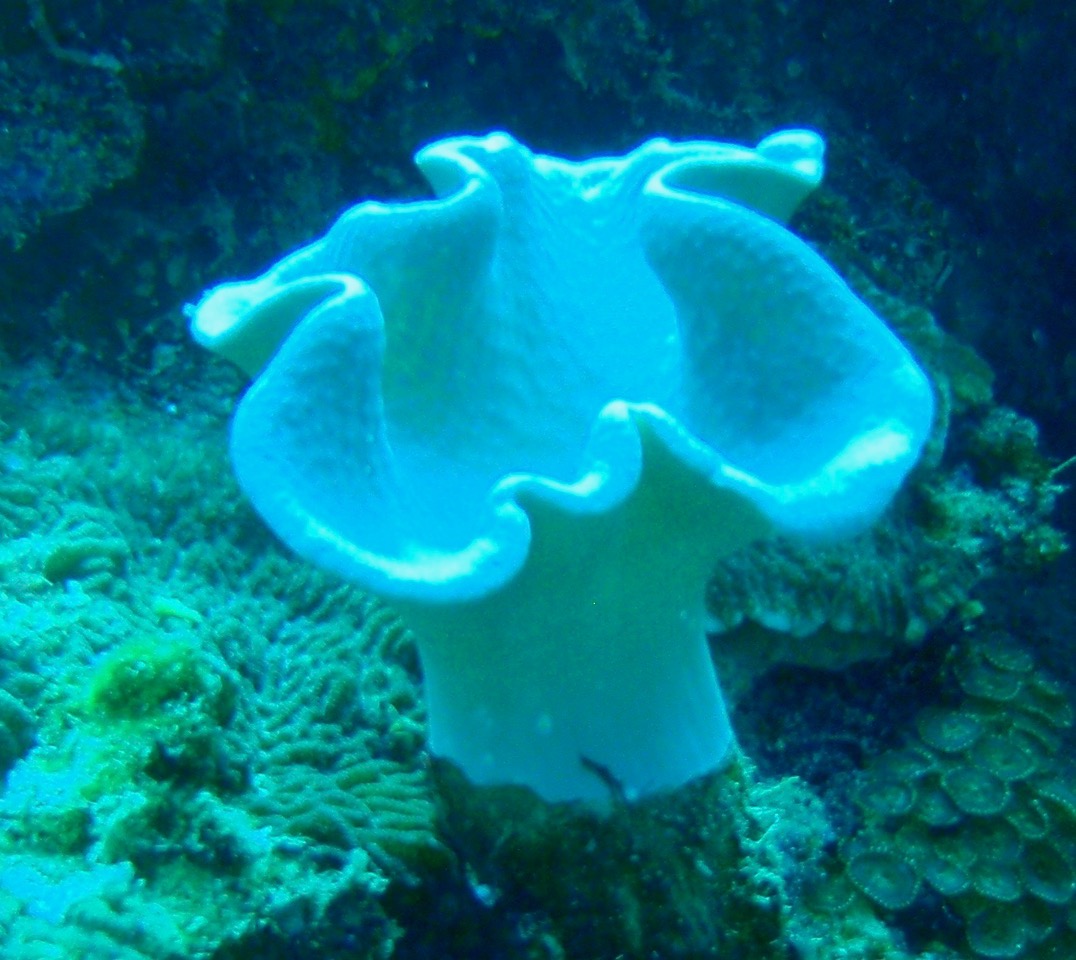
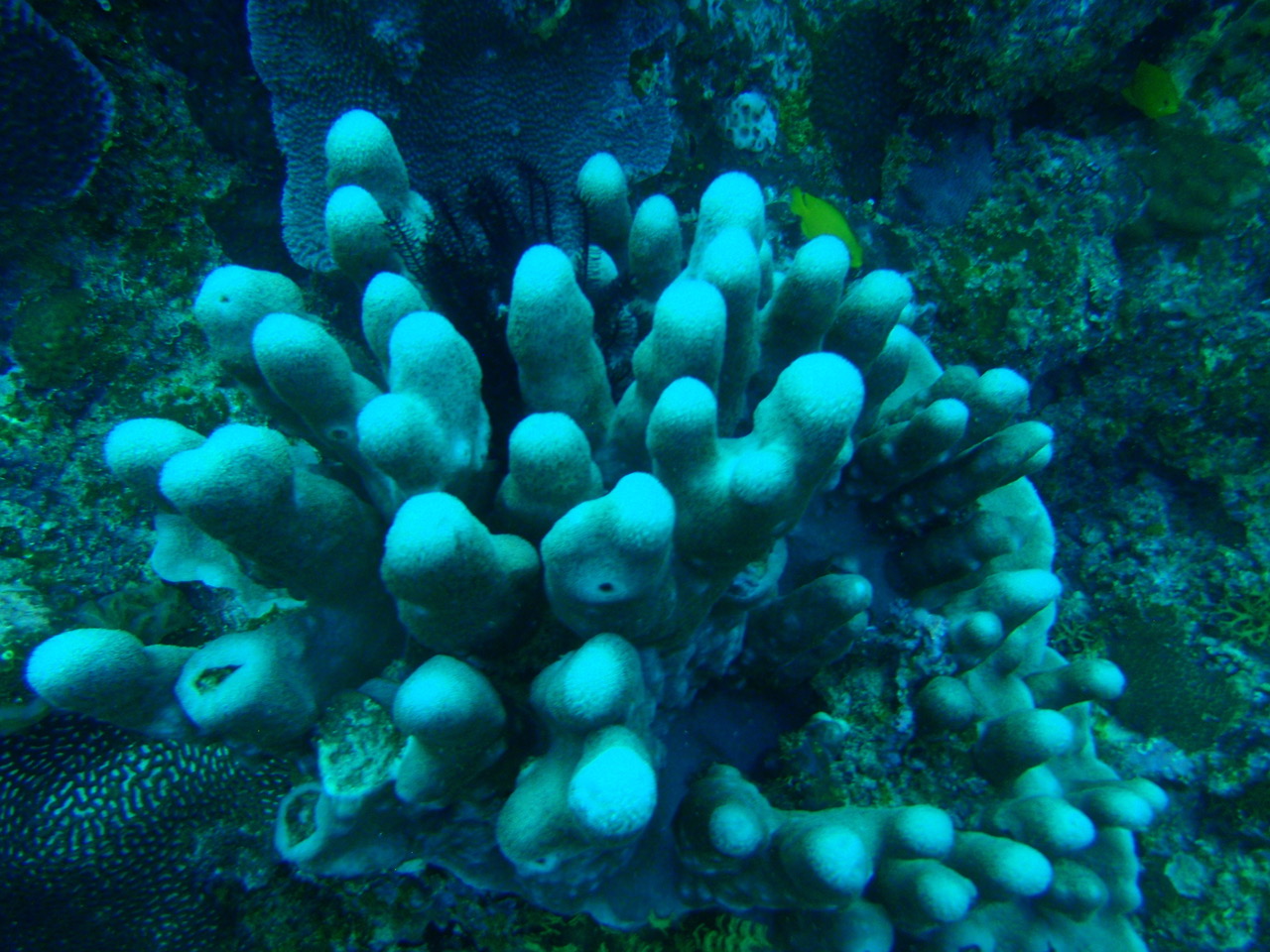
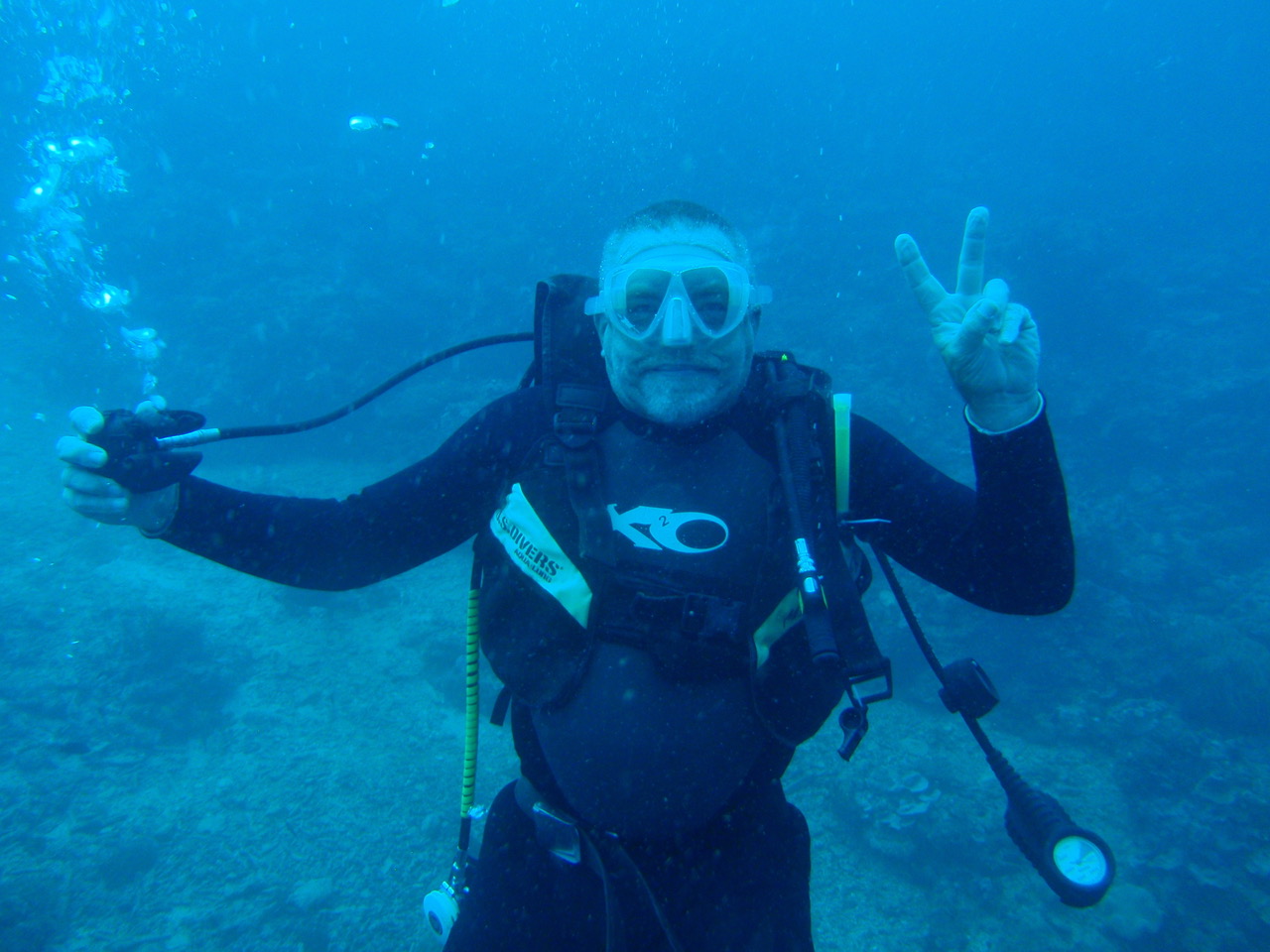
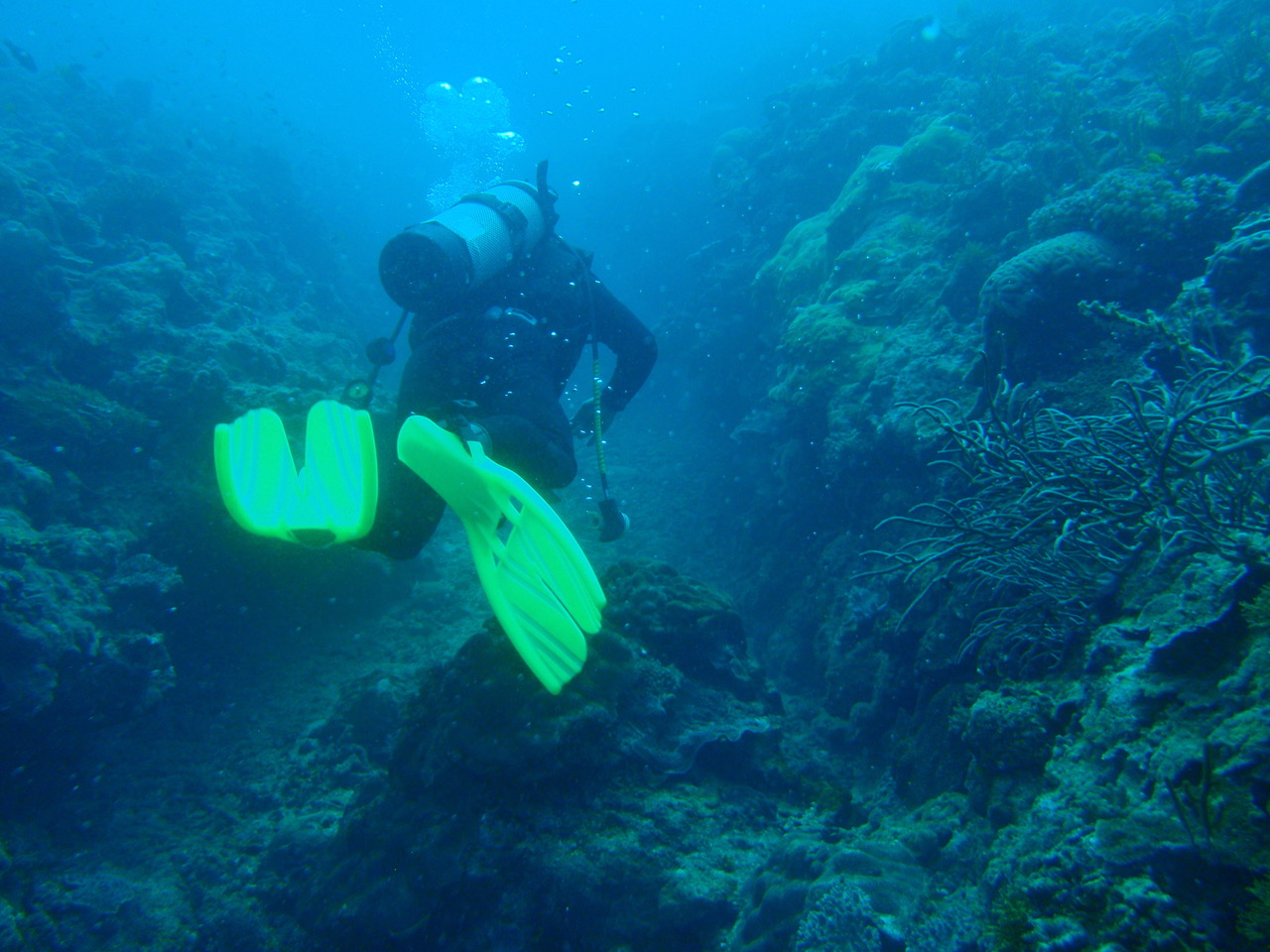
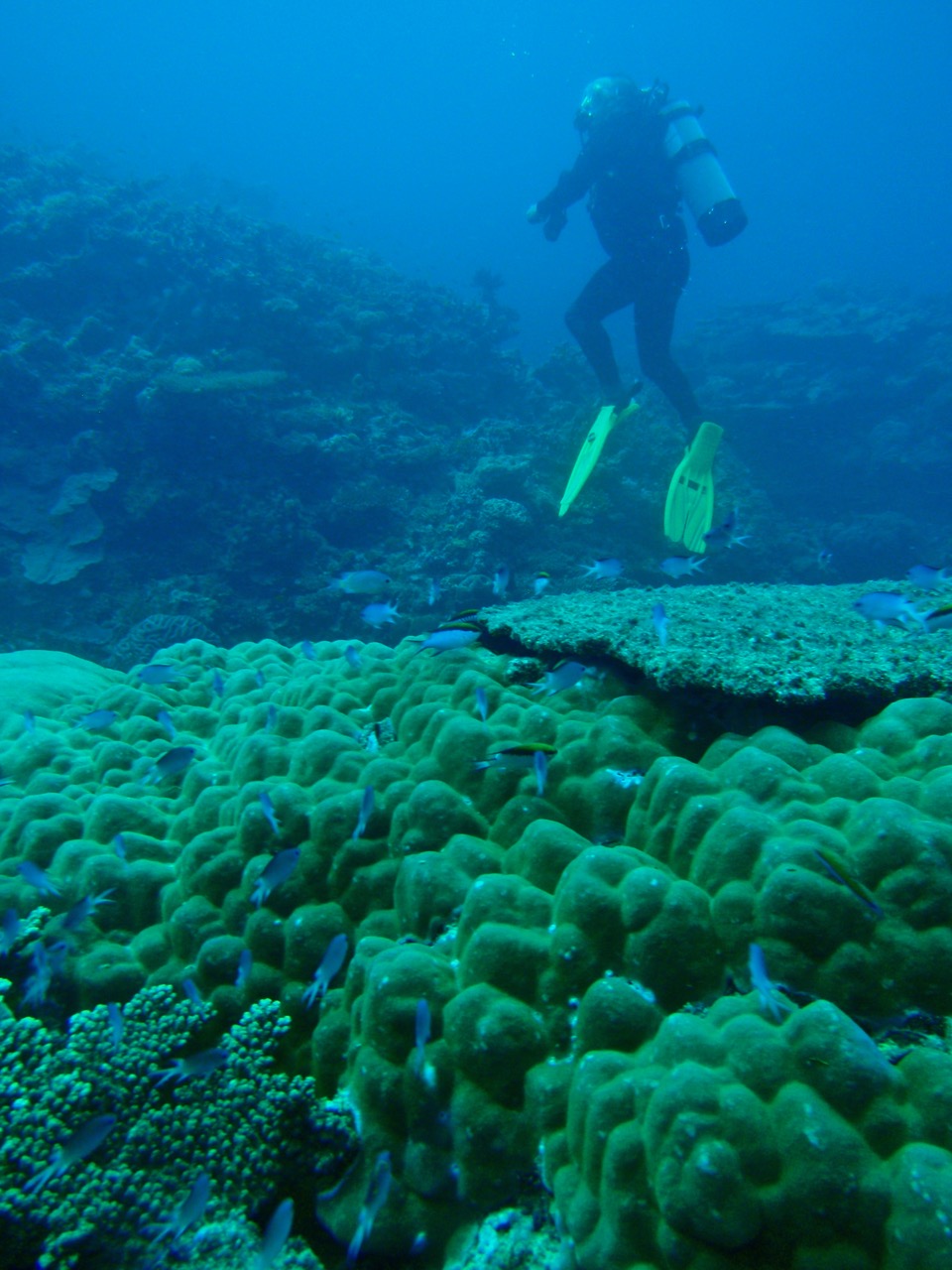
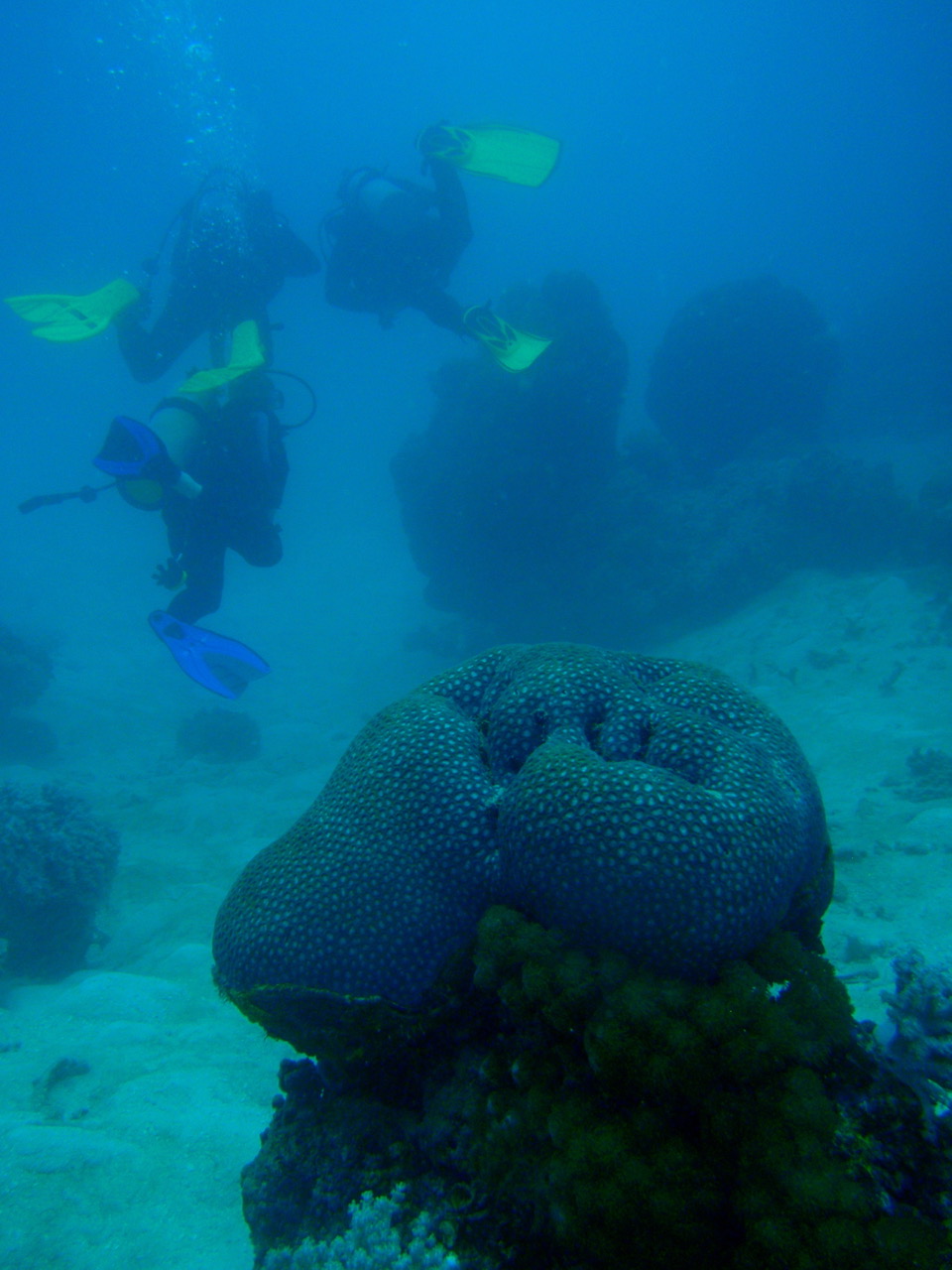
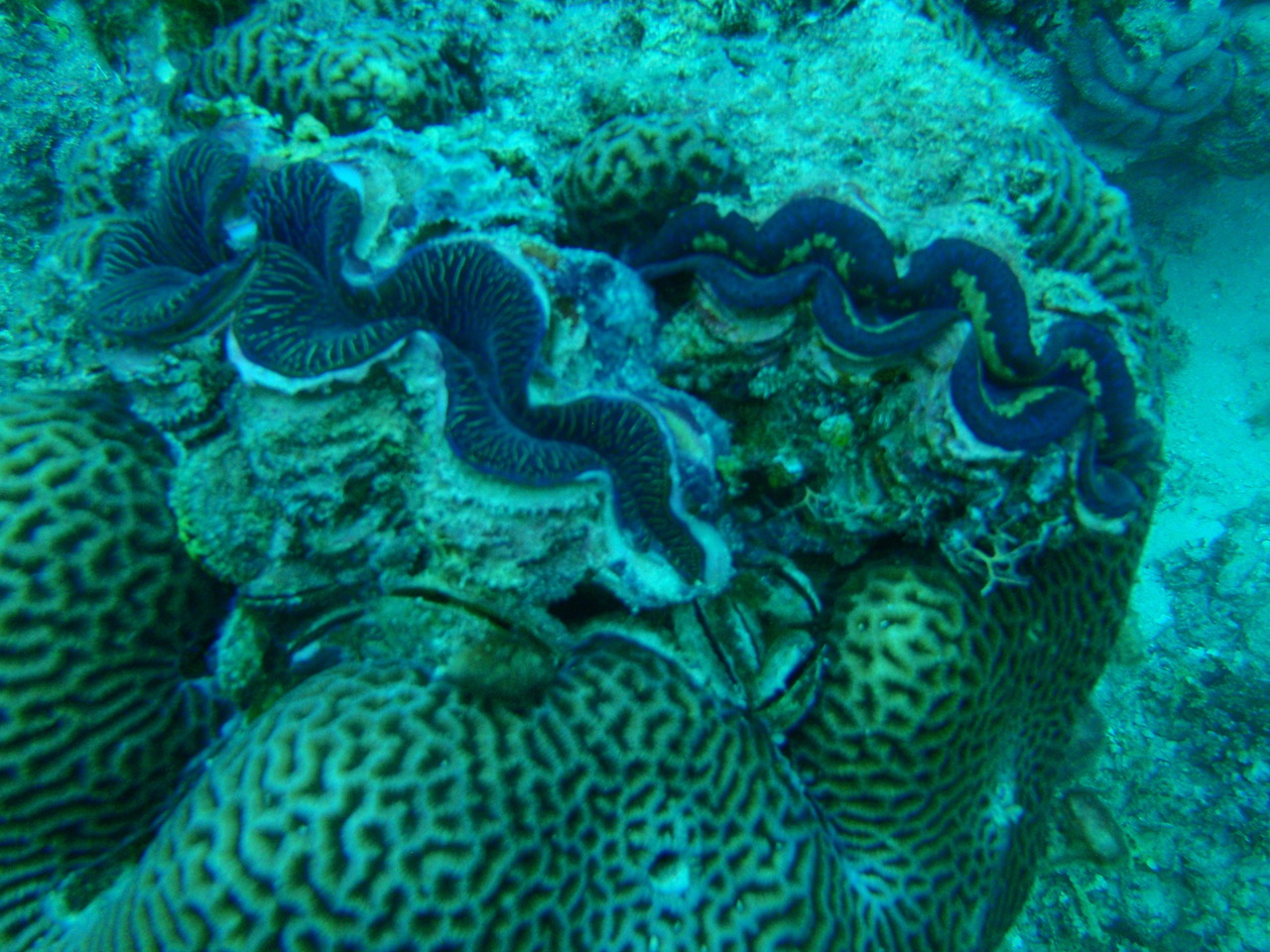
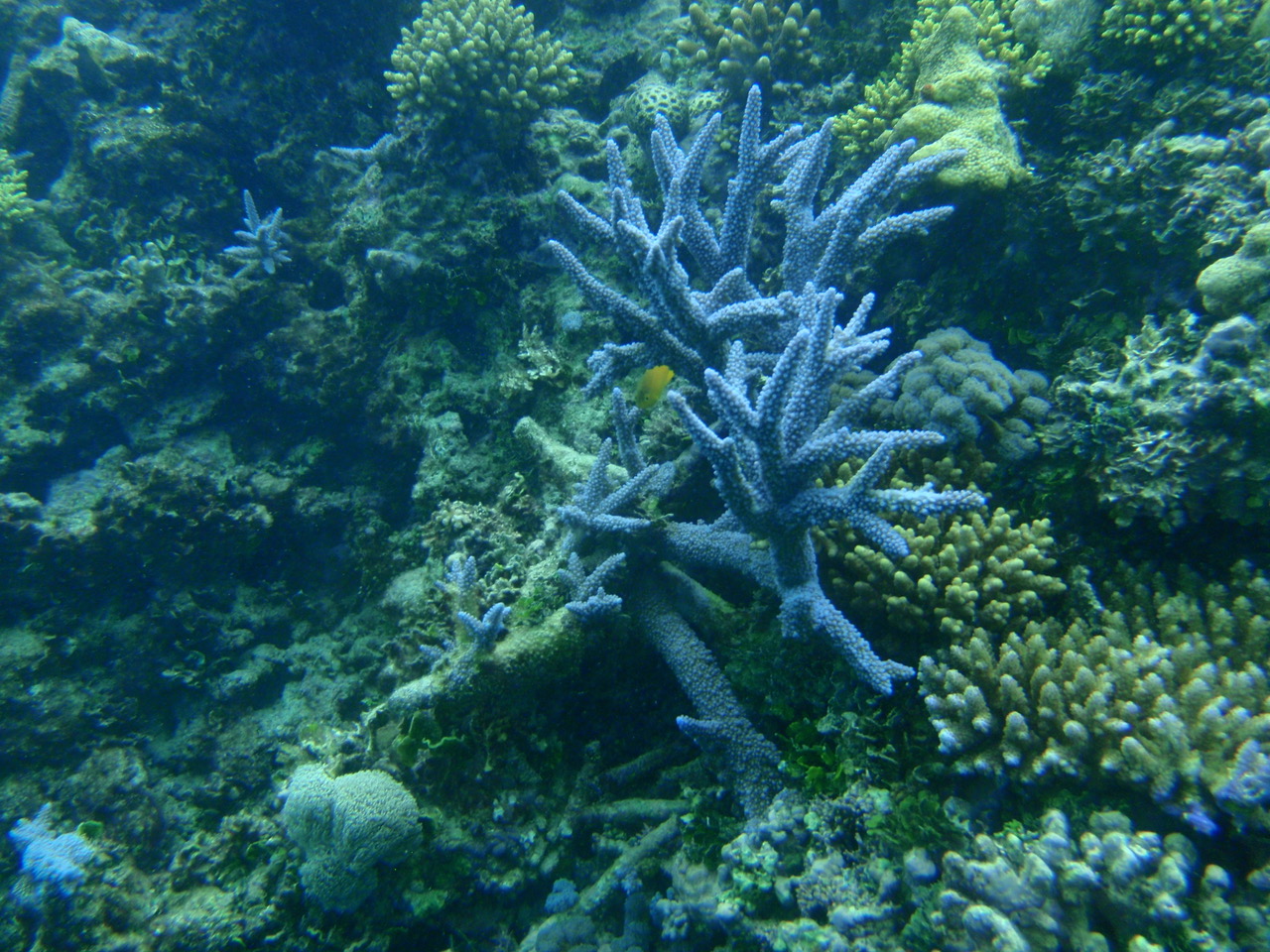
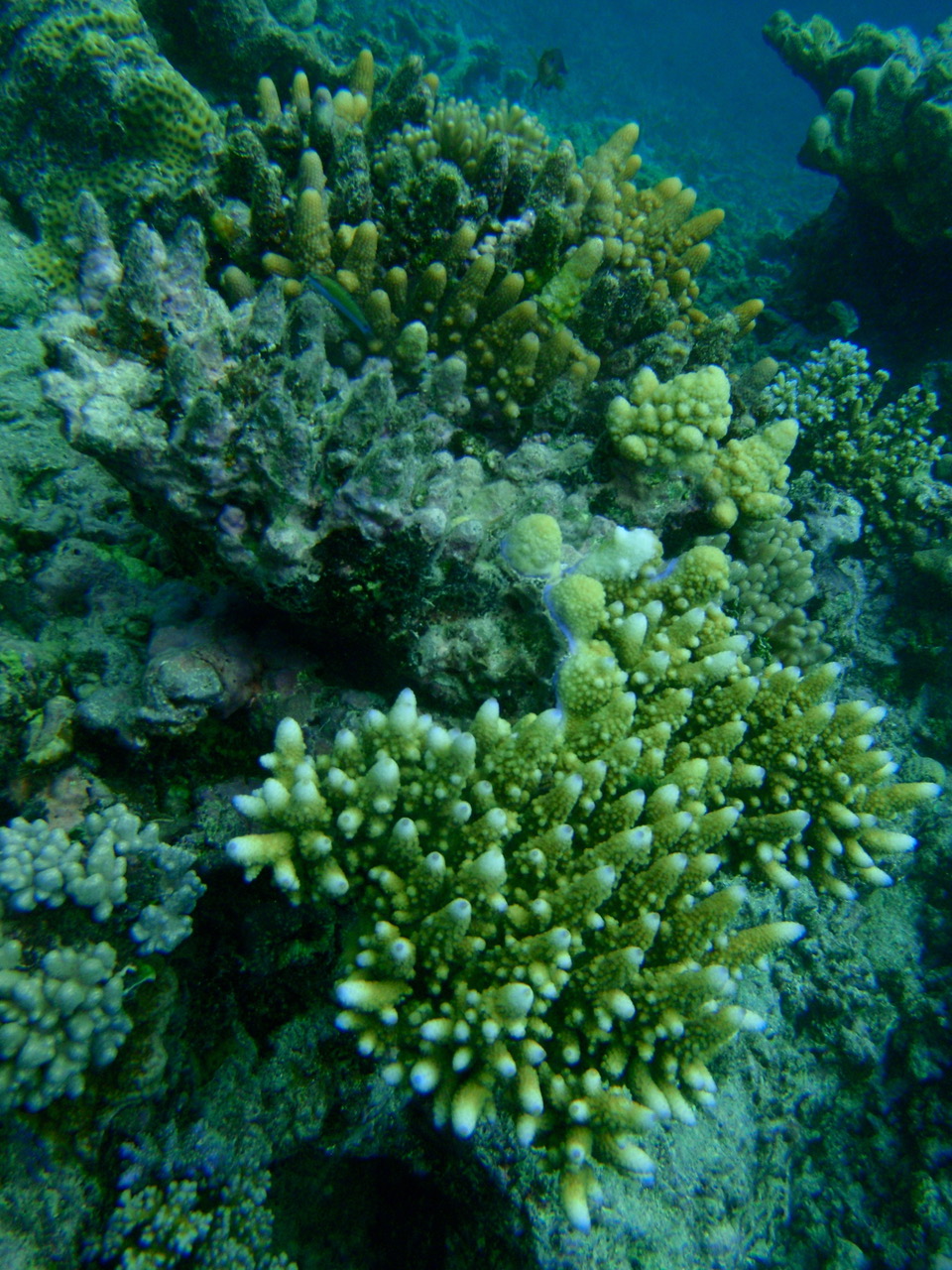
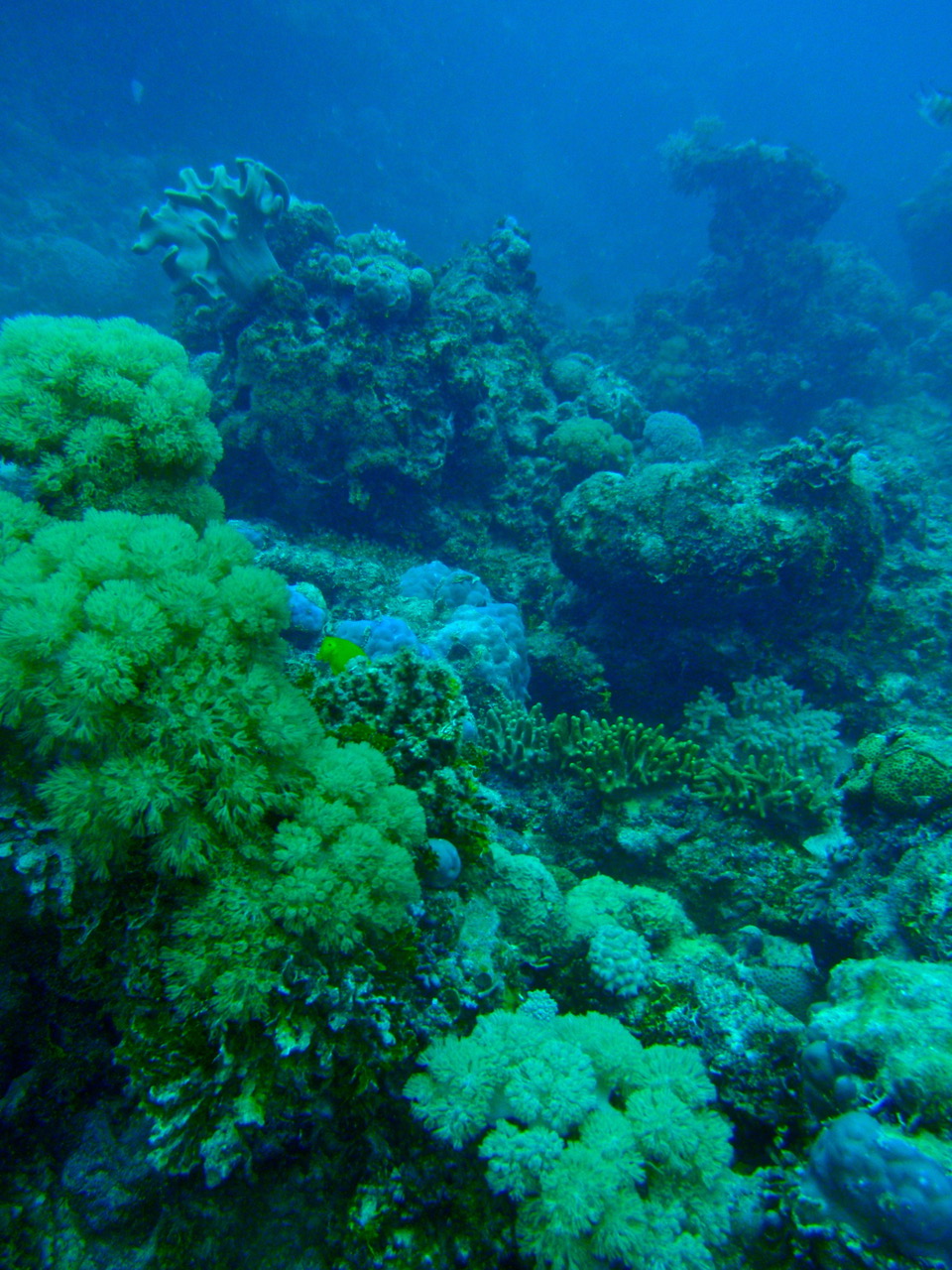
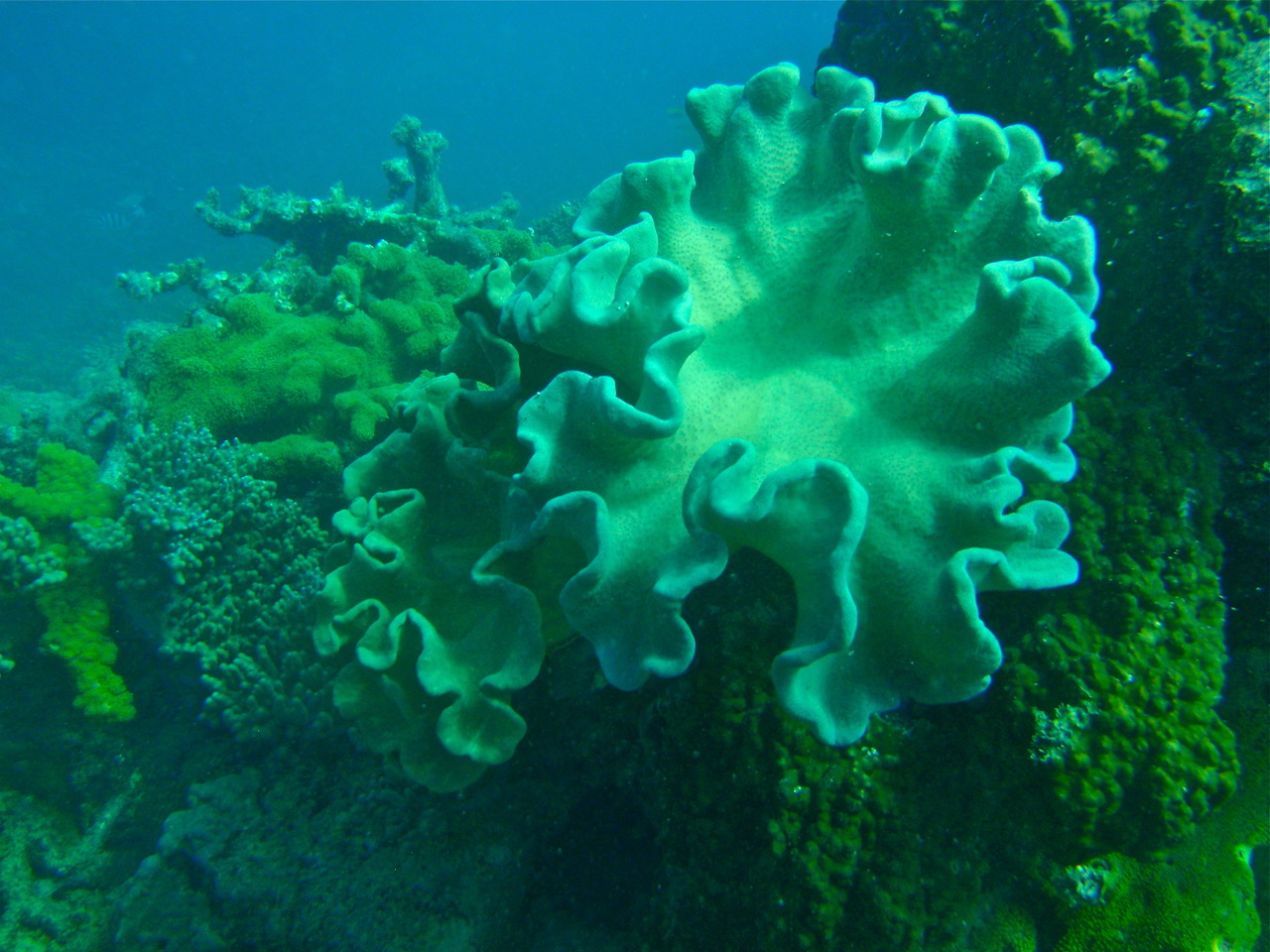
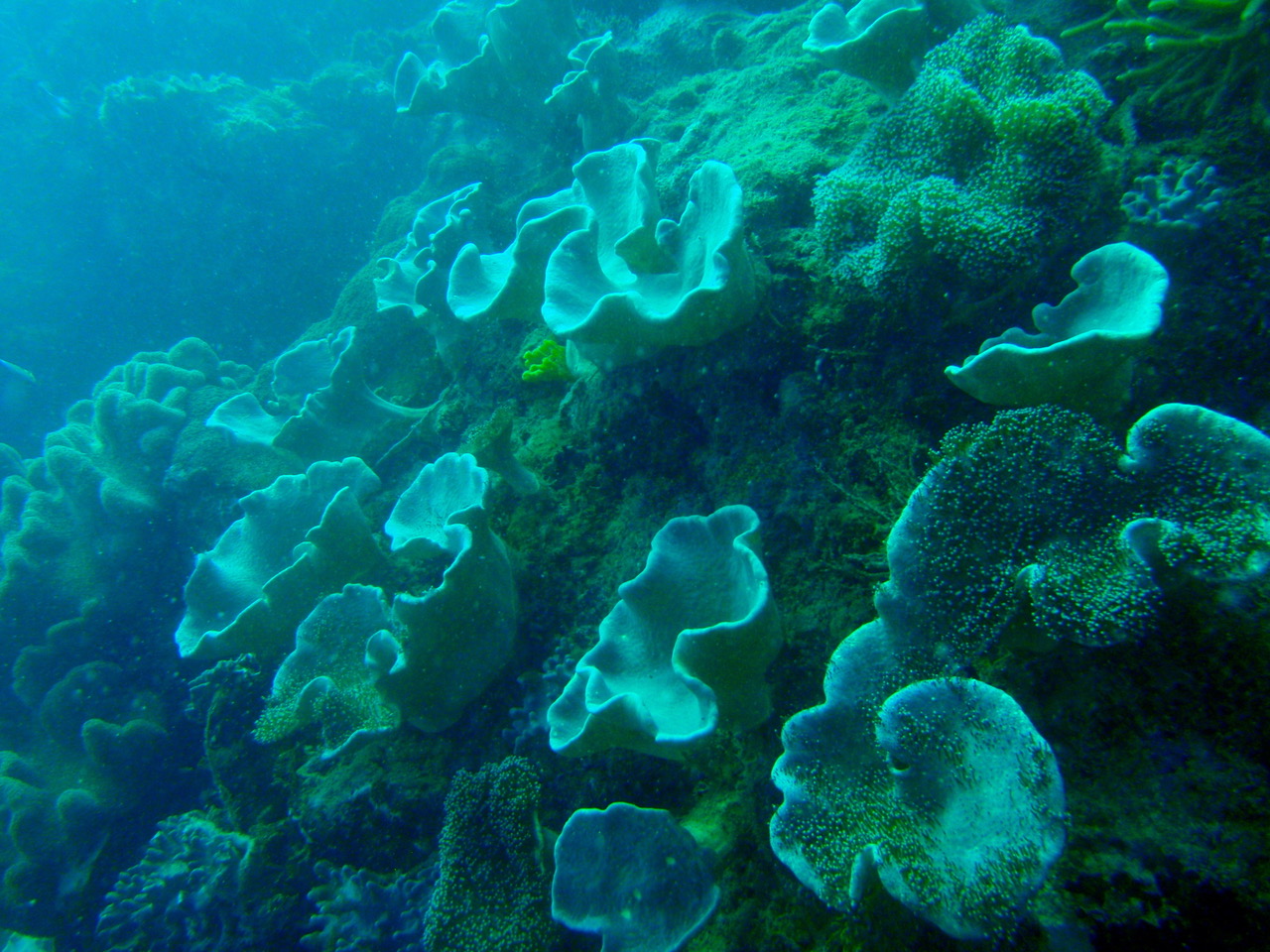
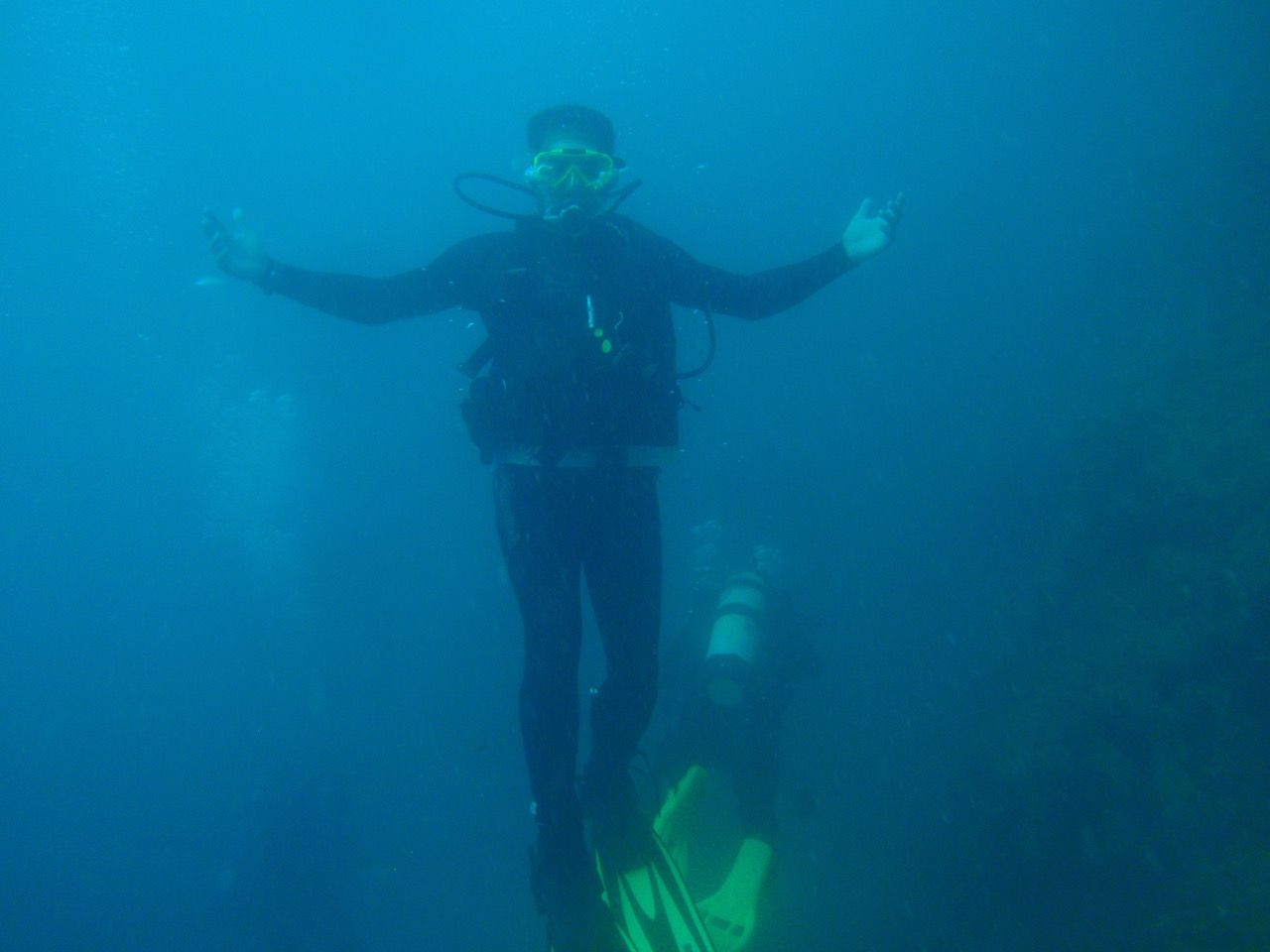
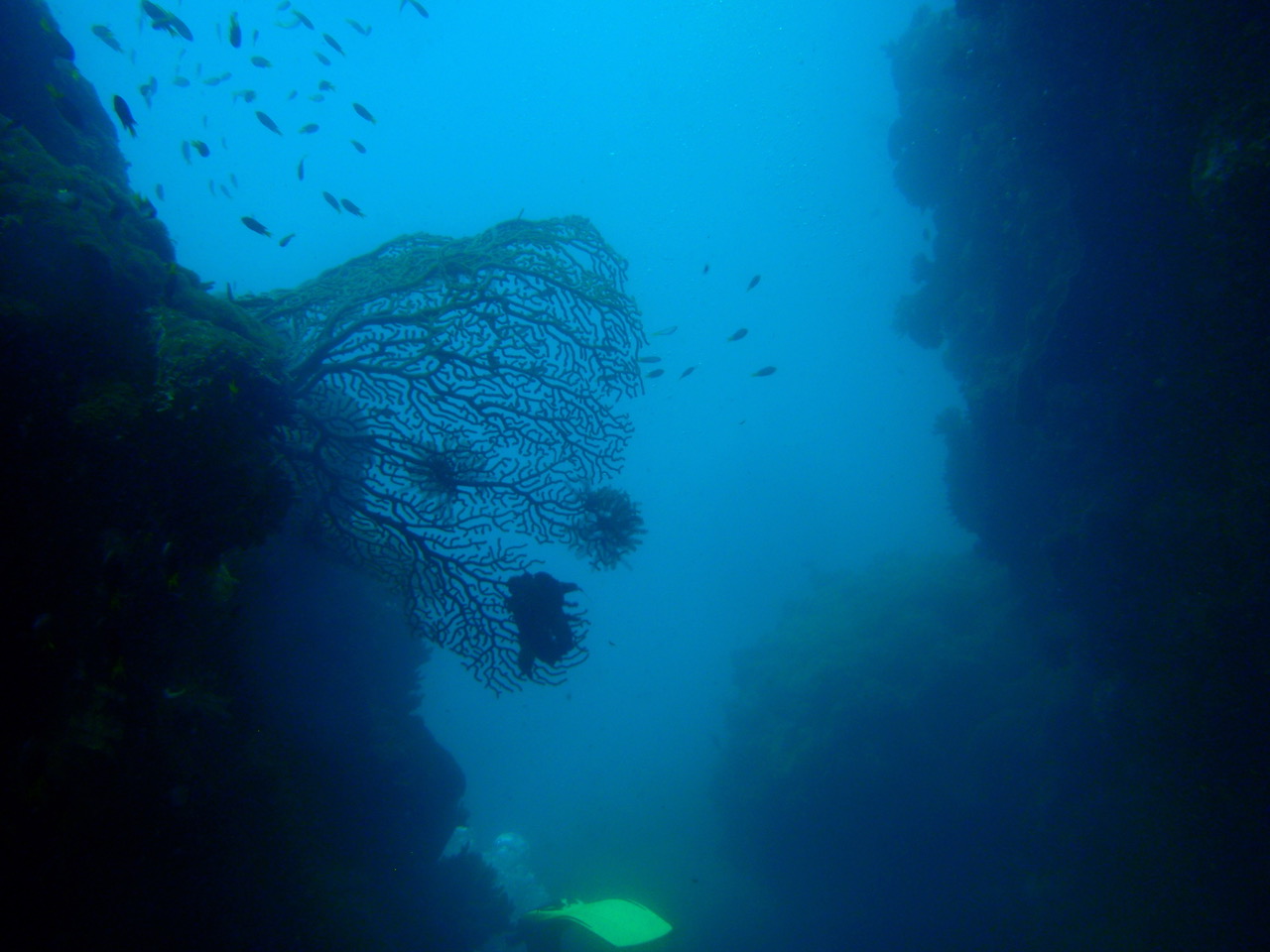
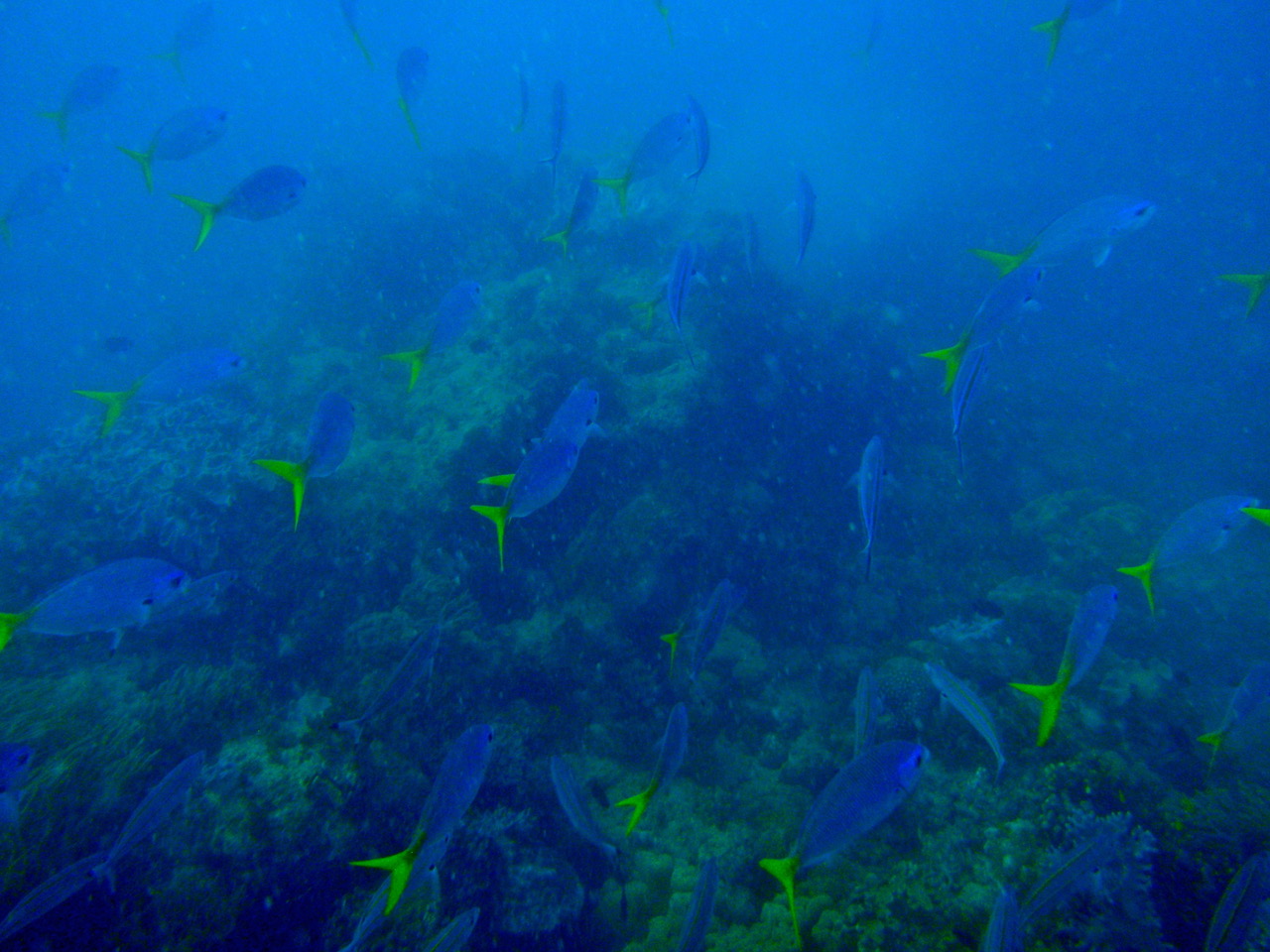
    Here are a few pictures.

  • 5 days, 7 dives

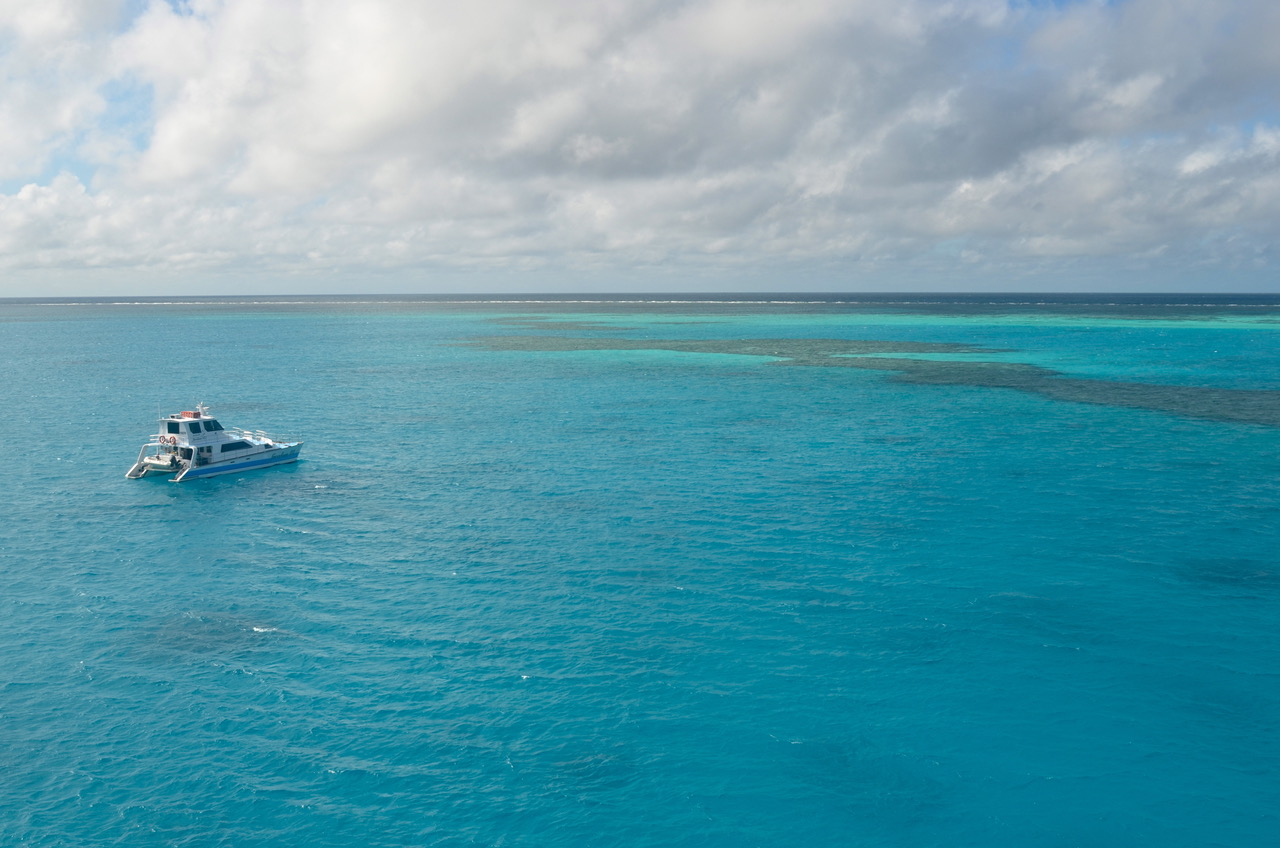
    Our first three dives were off Bait Reef, 30 miles from the Airlie Beach, on the outer section of the Great Barrier Reef. Here the water was clearer than near shore. Bait Reef stays entirely under water.

    Our first dive was at night, a disconcertingly amazing experience. Never really knowing where you are, or what is just outside the beam of your torch is eerie. We were surrounded by a school of 3 to 5 foot long tuna. They would dart into the light and just as quick burst away. They would playfully dart into the light, come right up next to you, and then quickly burst away and after five feet they would be out of the light.

    Second up was a wall dive. A sheer vertical wall took us down to 90 feet; Justin sunk to 100. From there we meandered and drifted along the wall, slowly making our way shallower and through gullies and overhangs and swim throughs.

    Third was a shallower dive around what are called the Stepping Stones, seven pillars that vertically rise from 15 meters up to within 1 meter of the surface.

    We then had to unfortunately leave Bait Reef without visiting nearby reefs, as a front moved in bringing with it 25 -30 knot winds. The winds whipped the water across the reef and made for a terrible place to hang out. Bobbing and swaying, we labored to get the dinghy out of the water and make for calmer anchorages.

    At Hook Island, we dove the Western tip of Butterfly Bay, an enjoyable outing, where Justin spied a small shark.

    We then dove on the eastern side of Manta Ray Bay, unfortunately spying no Manta Rays. The season for them is May through September, but we haven’t been lucky enough to catch a glimpse of one yet.

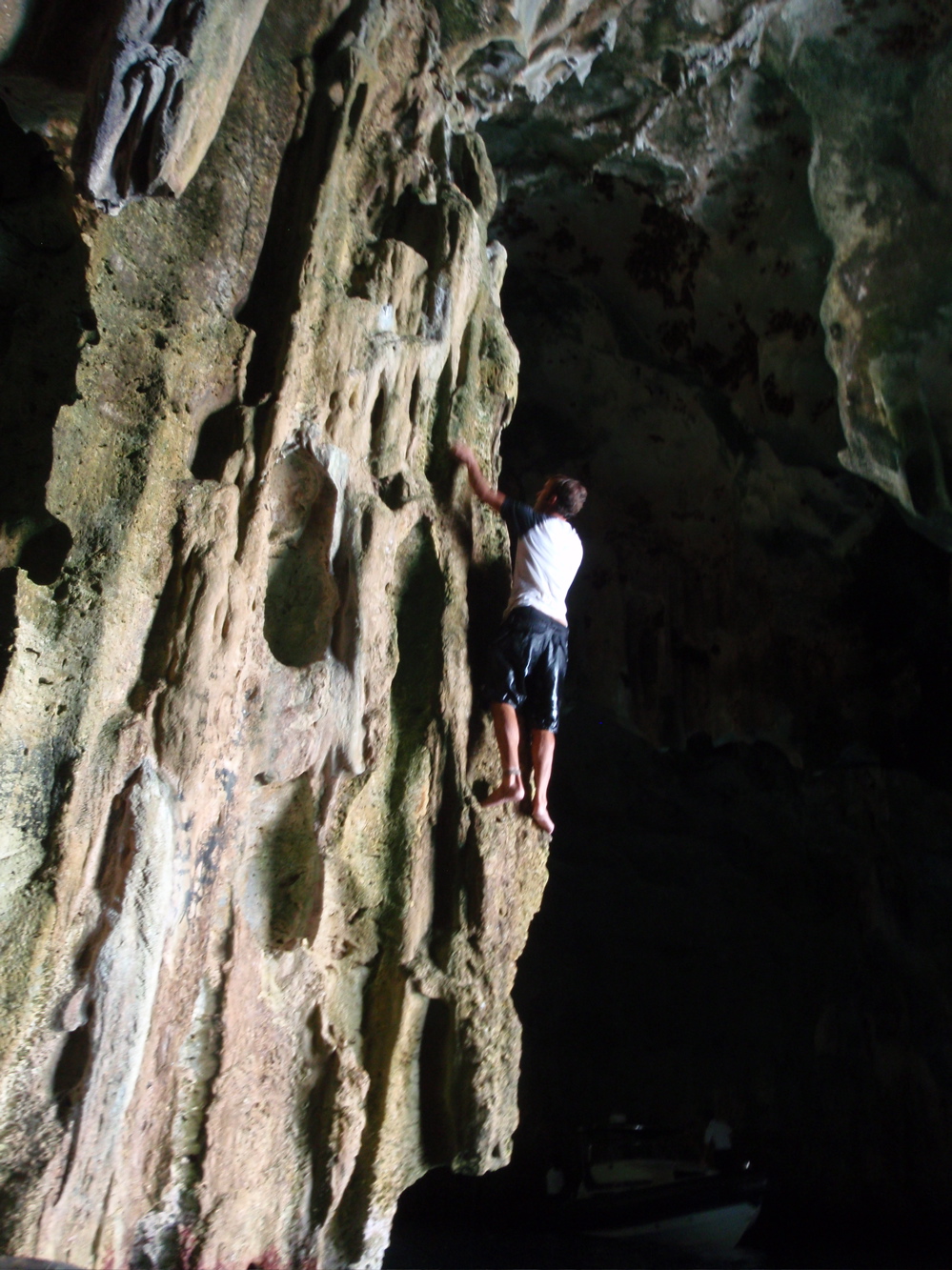
    The west side of Pinnacle Bay was next, adjacent to a rock-cliff named the wood pile that begs to be the site of some cliff diving and which I spent an afternoon scrambling and doing a little climbing on. An awesome 10 foot roof crack juts out over the water; a better climber than me would love having a go at it. I just admired it and wished I was a better climber. This dive was a bit disappointing with respect to fish, coral and visibility, given it’s hype in various guidebooks. It did have, however, some fantastic coral formations, huge overhangs, deep slots to swim through and a couple of tunnels. I spied one tiny tunnel with a sliver of light coming through it. I motioned for Justin to come check it out and jokingly hand signaled for him to swim up it. To my surprise, he took me up on it and started to gingerly make his way through. Soon, his fins had kicked up a cloud of dirt as he angled up and through. I ascended along the coral watching bubbles filter up through what seemed to be an impenetrable mass of coral. Justin was nowhere in sight. I then crested over a hump of coral and there was Justin, his upper body poking out of the end of the tunnel, as he gingerly twisted and squeezed through the last, tightest spot.

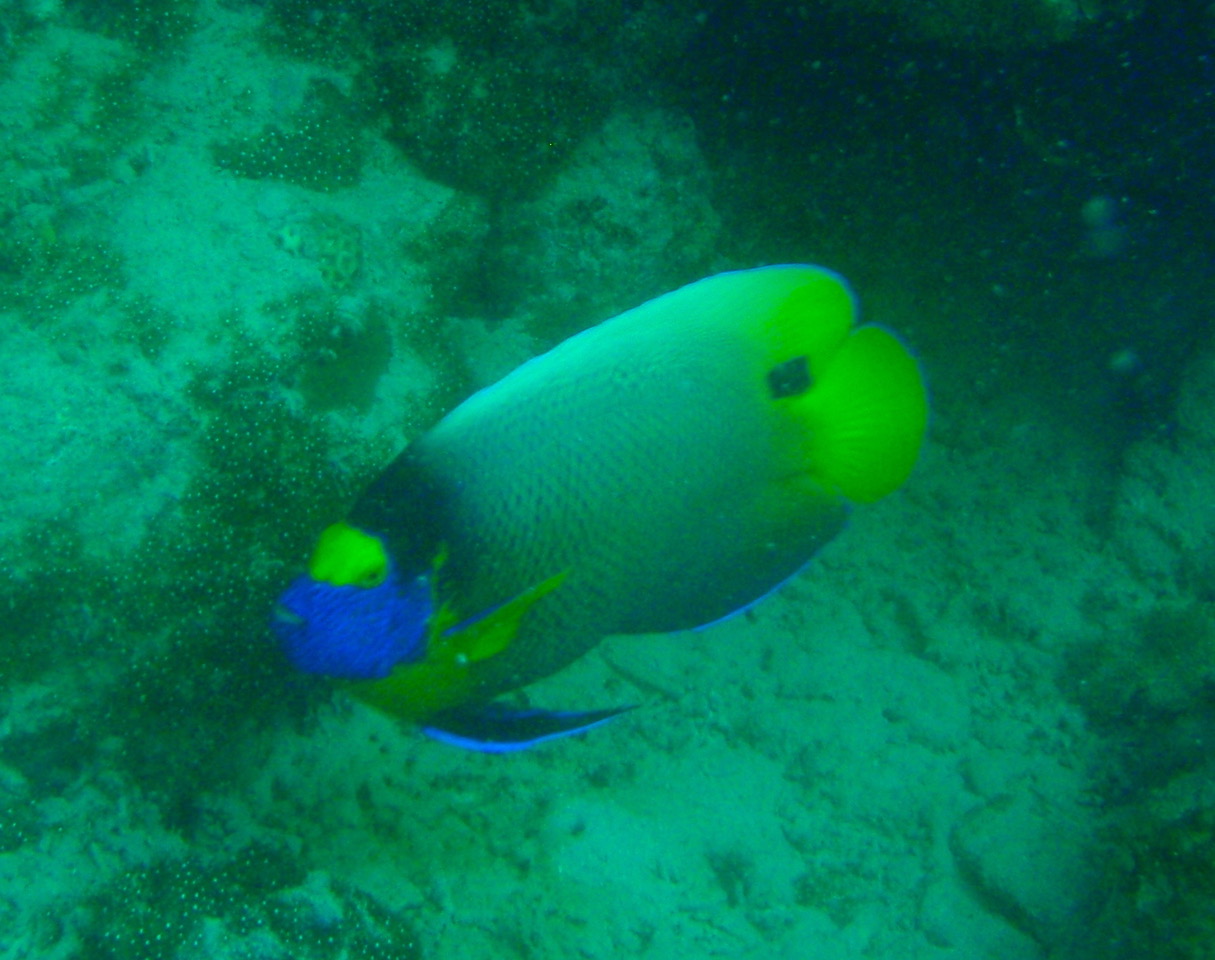
    Finally, we dove the eastern side of Pinnacle Bay, around the Pinnacles. This dive, combined with the previous one, are supposed to be the best in the main islands of the Whitsundays. On both, as in most dives in Australia, I continue to be disappointed in the visibility. Live coral was also not particularly present on this dive, but formations within the coral were. High narrow slots abounded, two in particular were reminiscent of the slot canyons of Utah, 8 feet wide, 25 feet high slices through the coral made for fun exploring. Another big highlight was seeing the 6 foot long turtle. I immediately thought of Finding Nemo as it glided along in the current. I saw a Moray Eel, a disgusting looking creature. And I nearly had to adapt a fish; an angel fish, sometimes accompanied with his three friends, swam within 10 feet behind and around me for over 20 minutes of our dive.

    Huge thanks to Brian on Furthur who has been filling our tanks for us. Diving and hanging out with him and Susan has been a great time over the last five days.

  • Justin brings the 2-step to Australia

    We are currently at Airlie Beach, a super popular backpacker stop, on the mainland across from one of the most popular sailing grounds in Australia, the Whit Sundays. Justin and I went out on a Tuesday night and didn’t make it back to the boat until 2:30 am. Fun times were had. Lots of beer, super-sized Jenga, dancing in the streets. Huge hangover on my part.

    And in homage to Greg Sutera, Justin brought the 2-step to Australia.

  • What to do while sailing along at 2.5 knots

    This post backtracks and refers to events that happened on May 2nd.

    We left Middle Percy Island noon on May 2nd. Anxious to get to the Whitsunday’s, famed to be the best sailing grounds of Australia, we had spent only one night on Middle Percy, a beautiful though nearly completely deserted island. It’s one claim to fame is a hut with various sailing paraphernalia from the last 50 odd years. Every boat it seems, leaves a little artifact and quite a collection has built up.

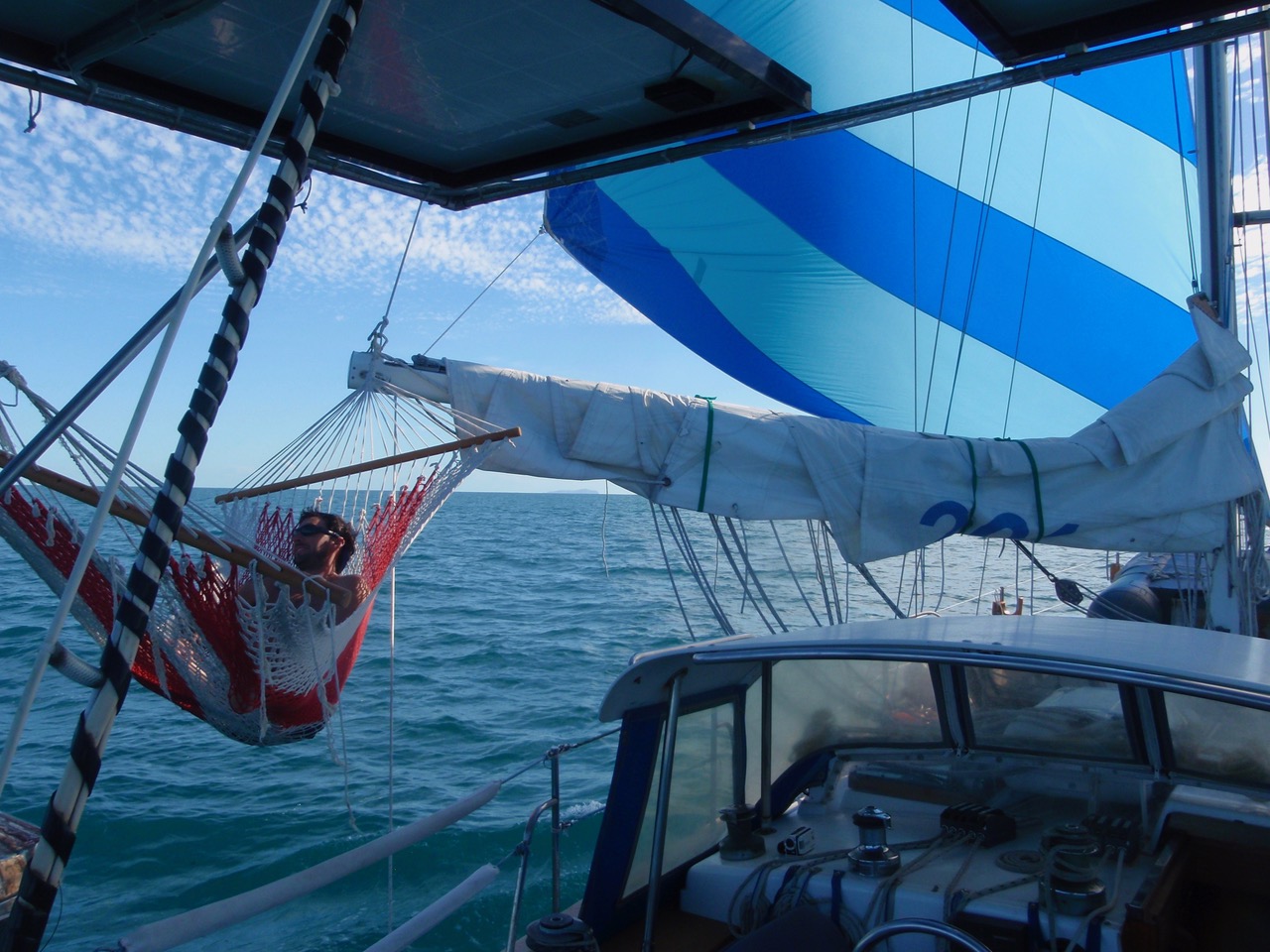
    Anxious though we were, the wind was not so in a hurry. With both the drifter and jib up we slowly putted along on the glassiest of seas barely breaking 2 knots. We already knew we were in for an overnight sail, and so I didn’t feel like turning on the engine.

    We spent the time in various ways.

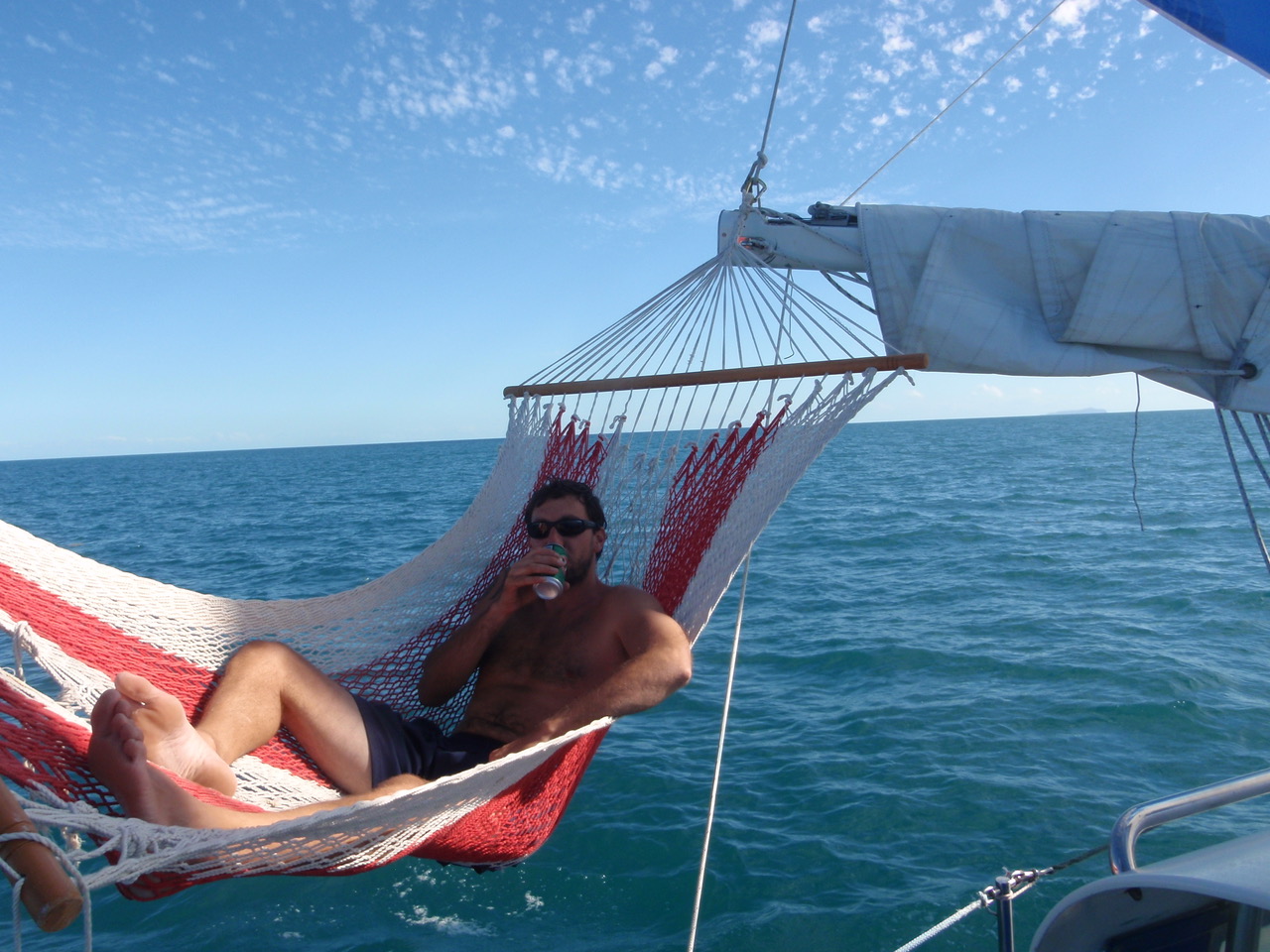
    First and foremost, Justin cracked a beer at precisely noon to celebrate our speedy passage making.

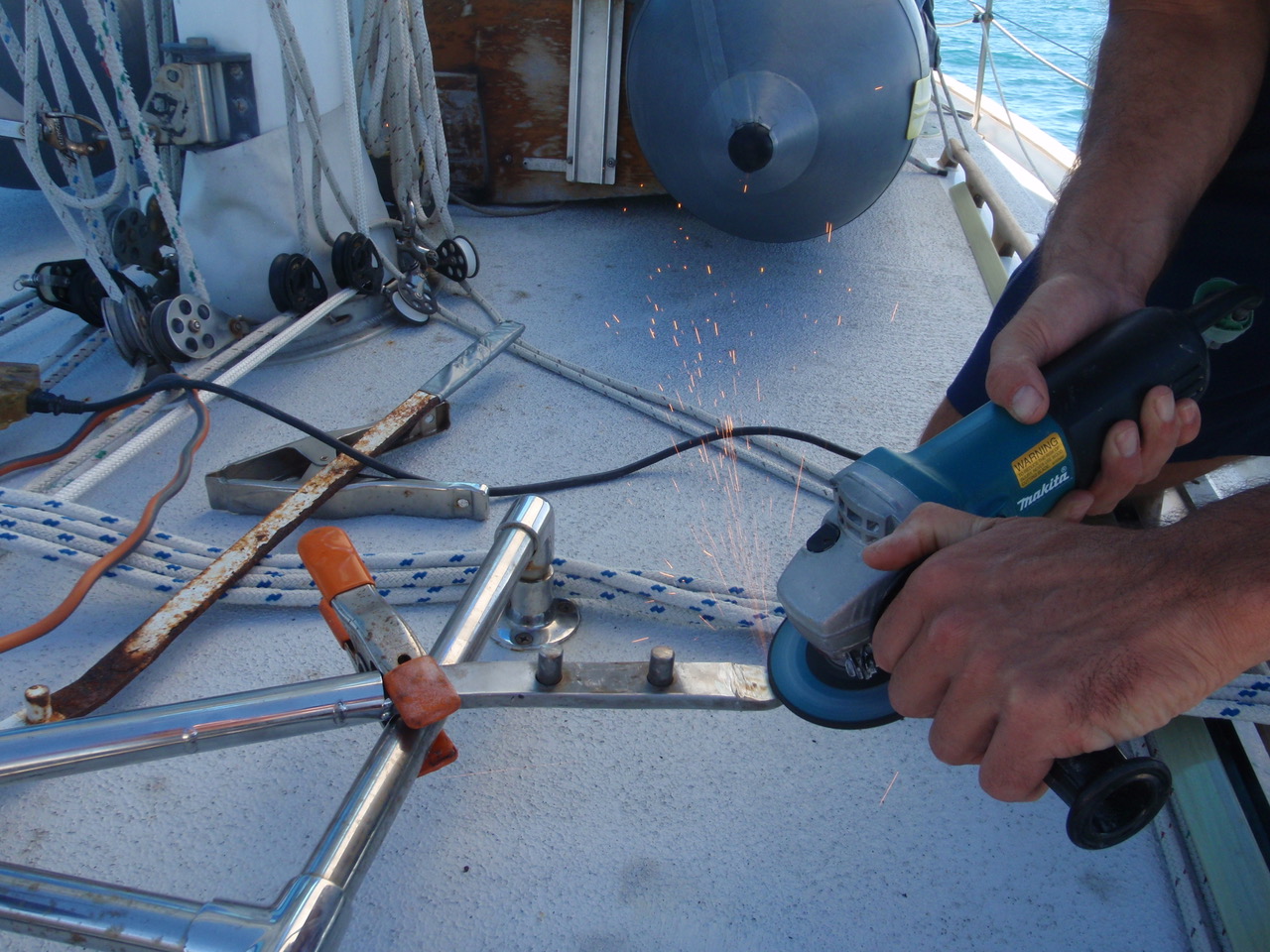
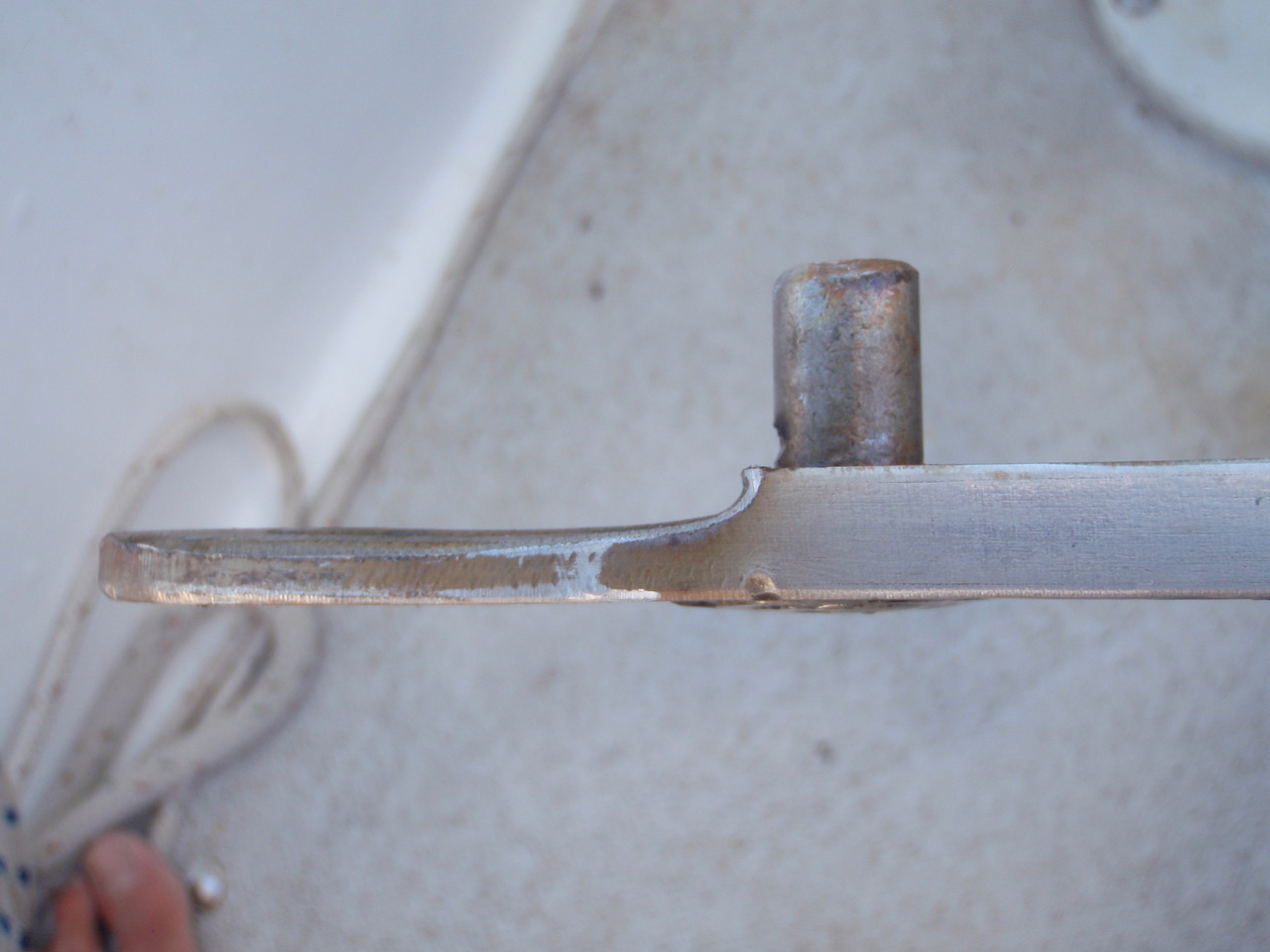
    spent some time grinding on our new (for a second time) anchor windlass handle. A welder in Bundaberg charged me an obscene amount for a new handle and then attached a piece that was 50% too thick to fit into the windlass. Alas, I discovered this 50 miles away at Lady Musgrave when we tried to anchor. To date we’e made do with our dilapidated rusting back-up until now. No more. With no rocking and no boats around, I set about to grinding.

    Justin made me lunch.

    We relaxed with more beers at two in the afternoon, a gentle breeze at our backs, enough to keep us cool, but not enough to push us any faster than 2.5 knots.

    Justin played some video games.

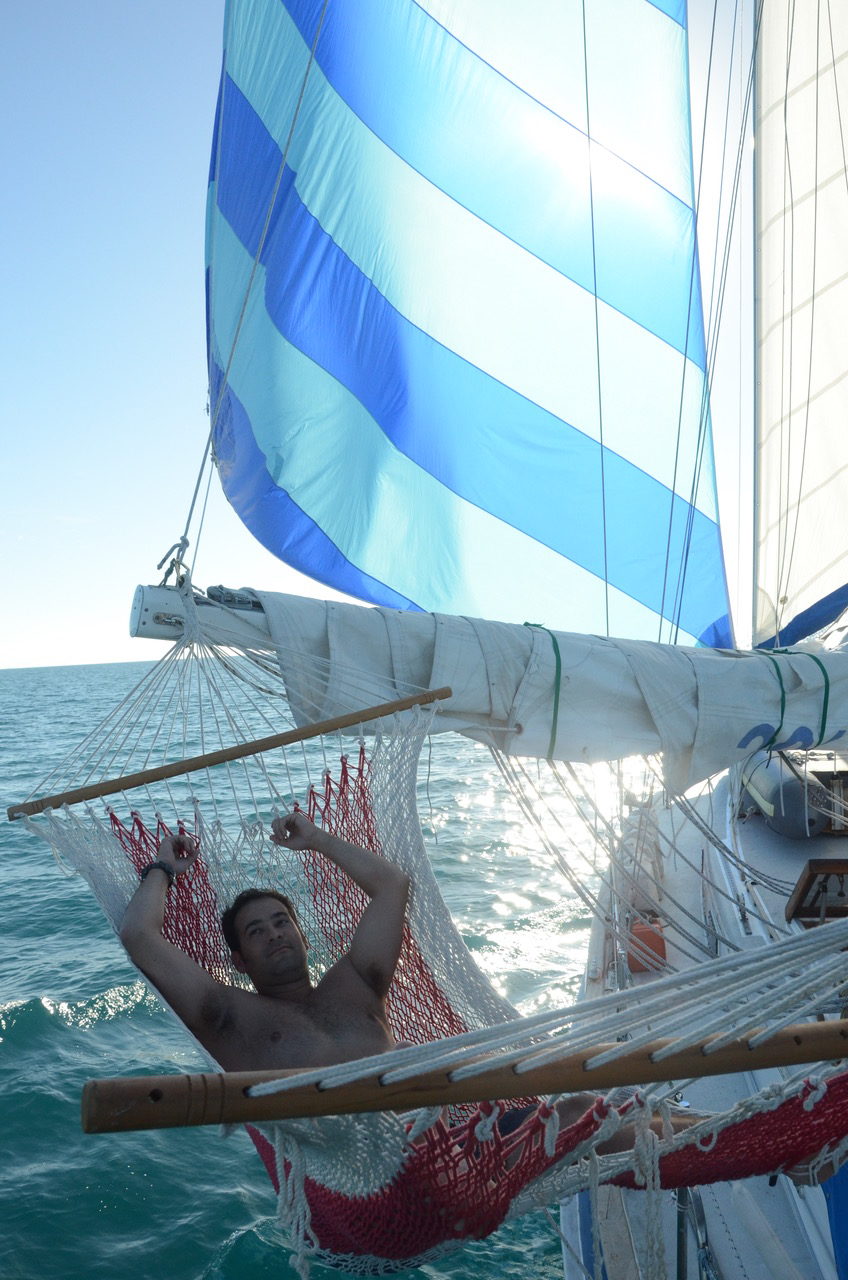
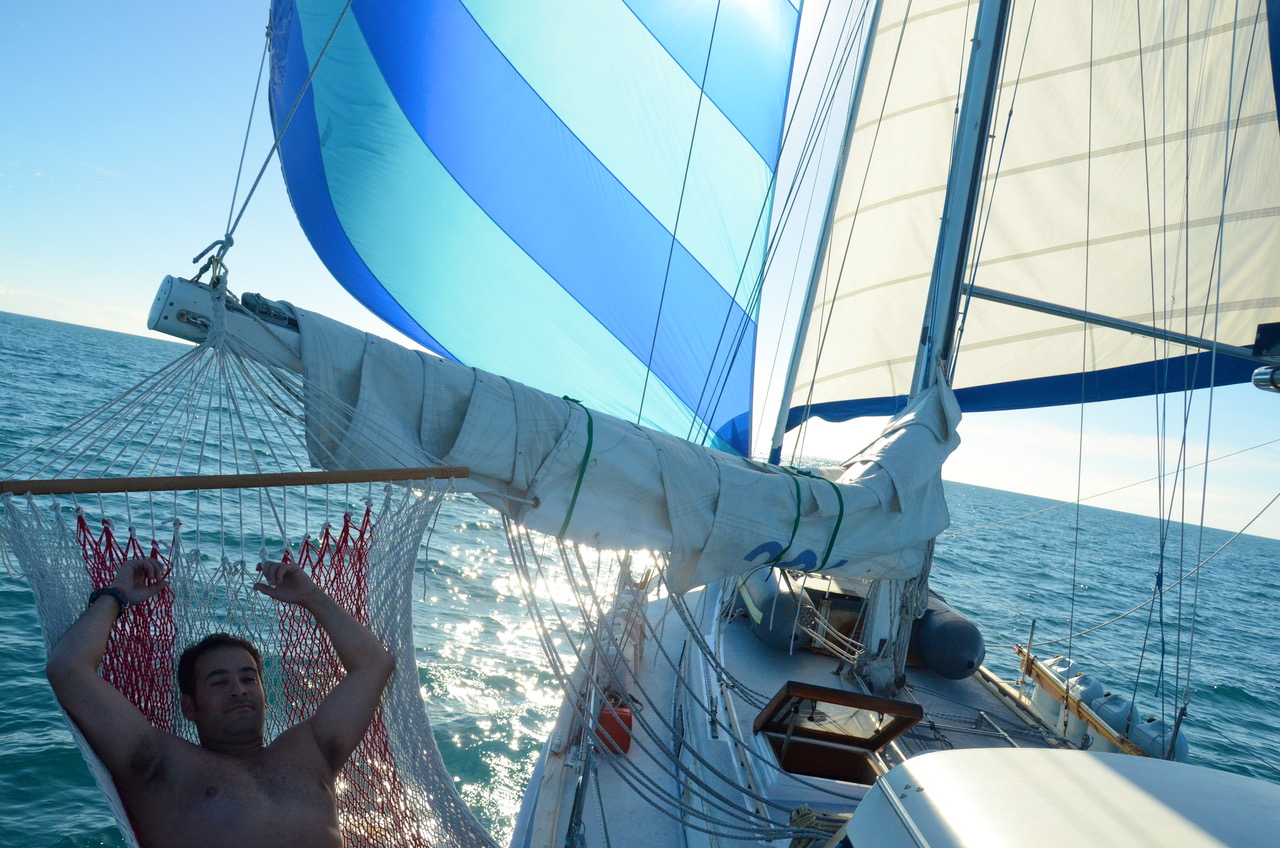
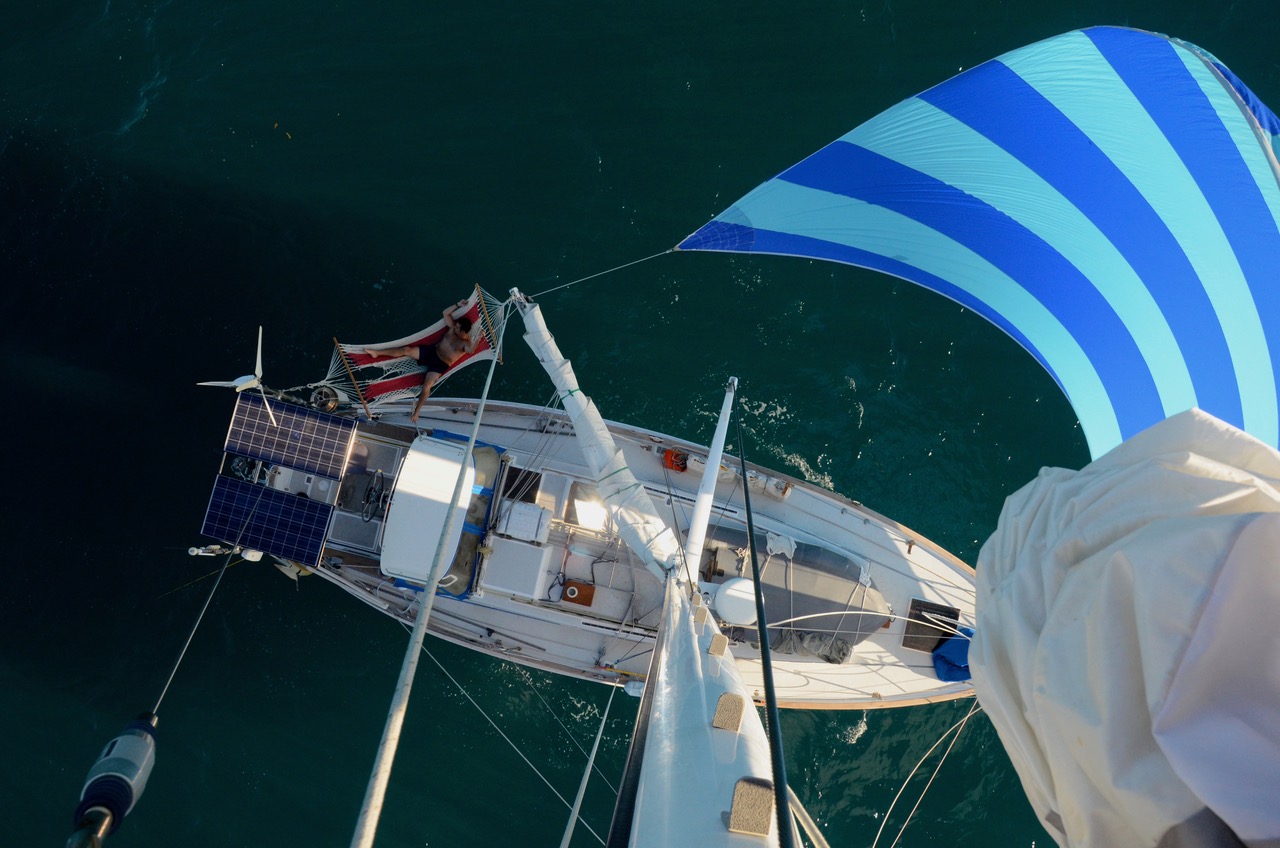
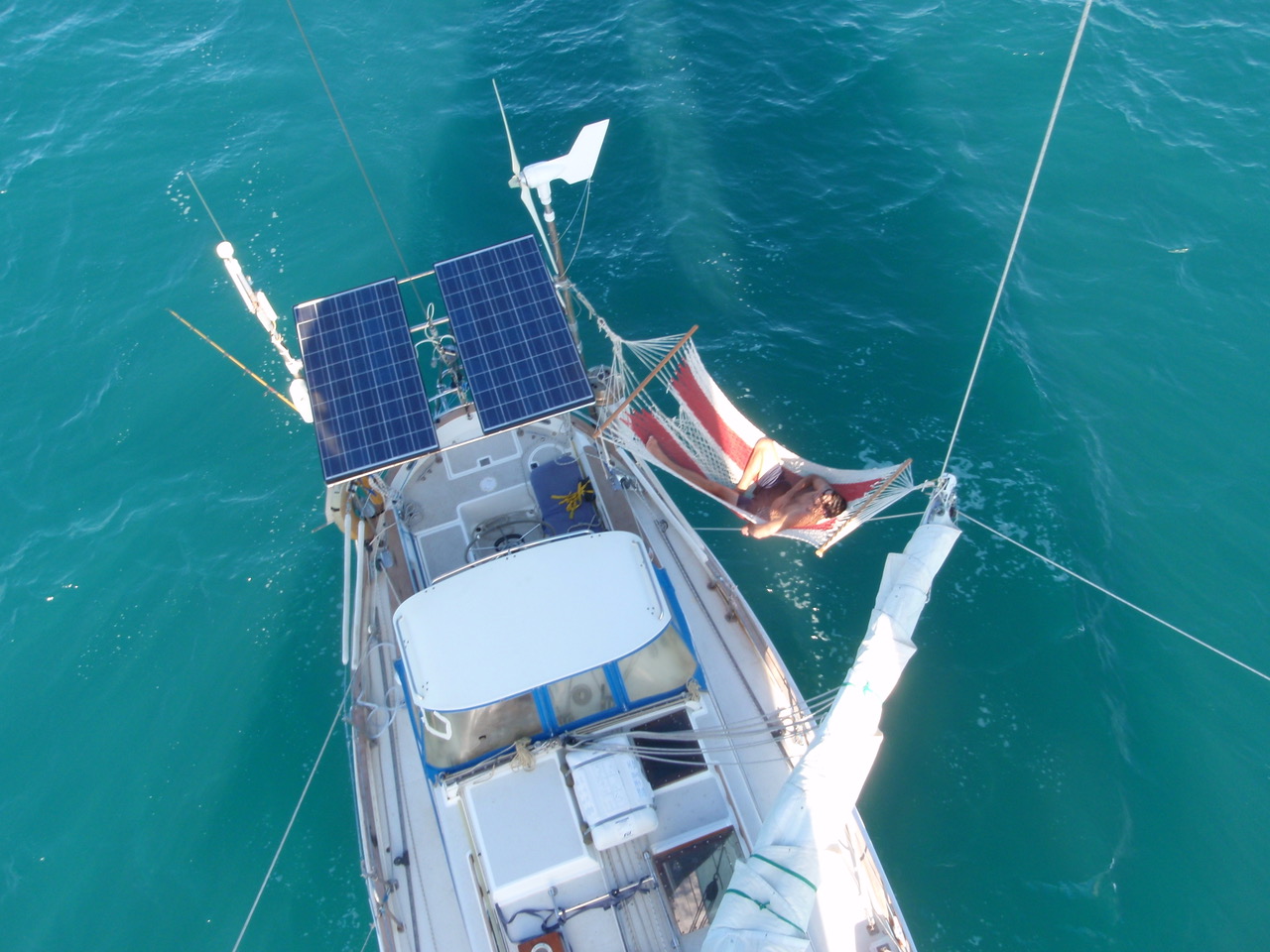
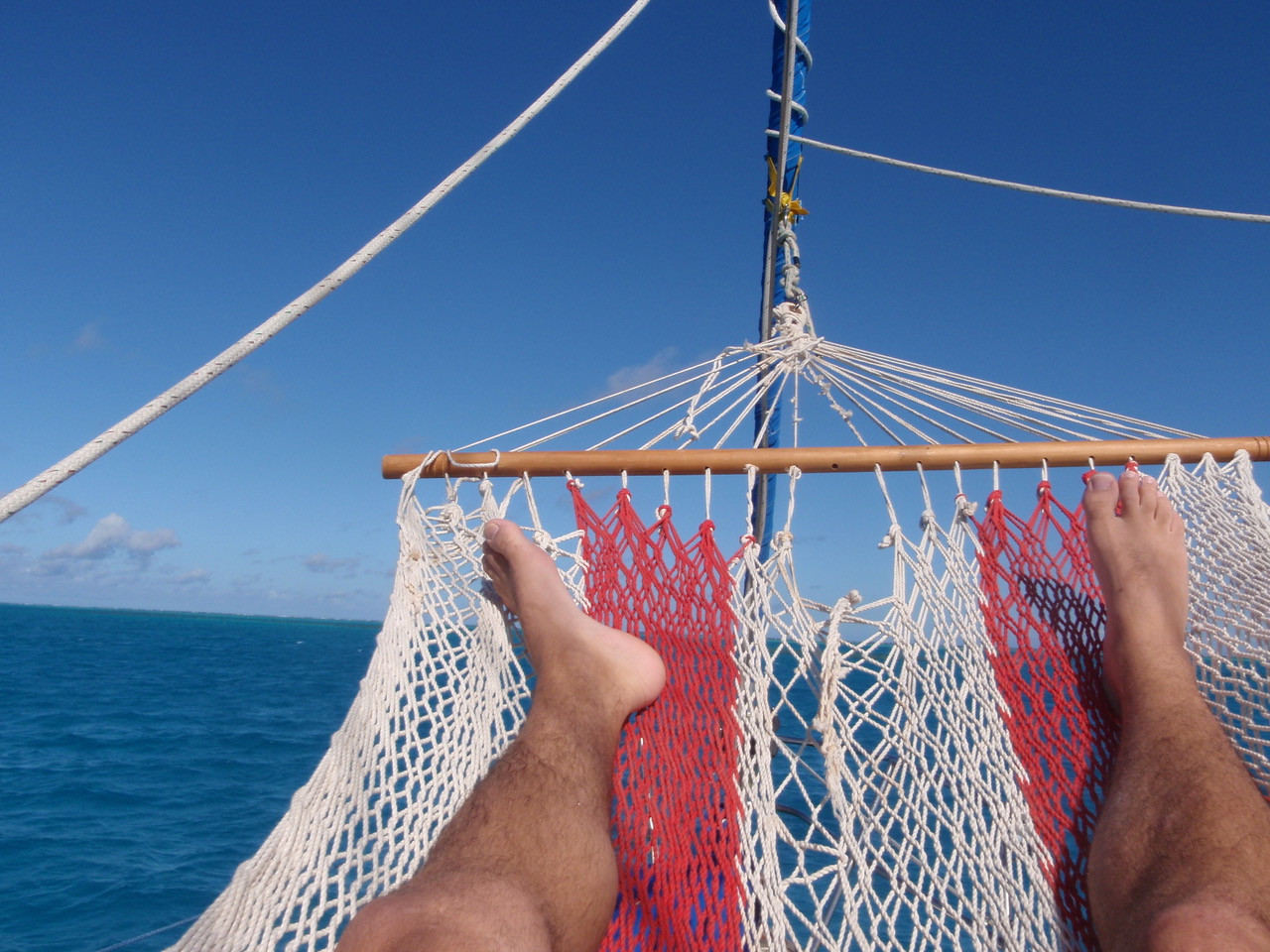
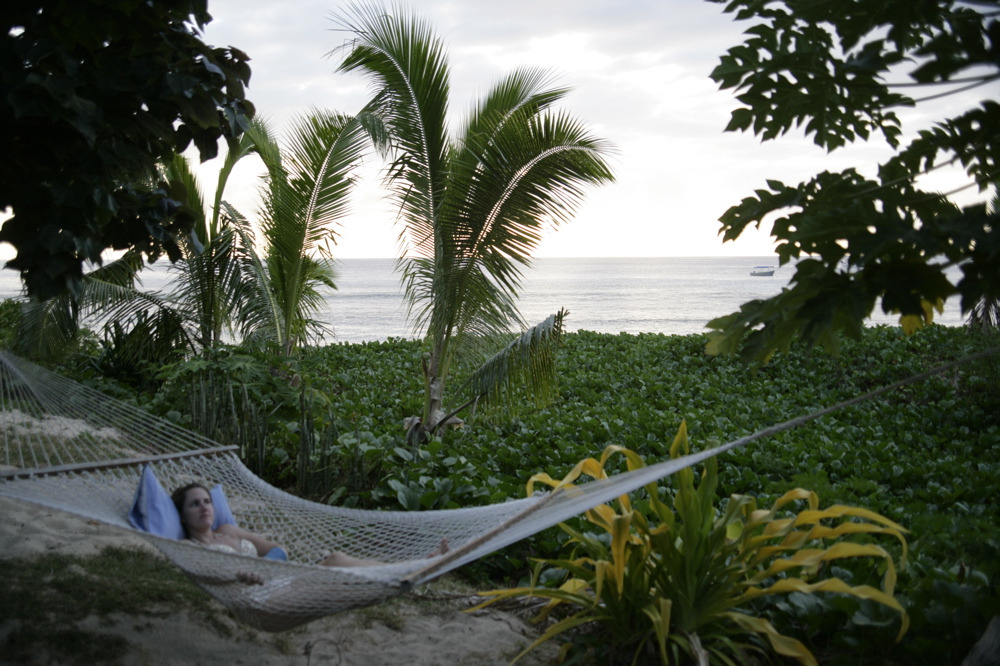
    And finally, I set about to thinking how I could rig up the hammock. I normally set it up on the forestay, (the wire holding up the mast in the front of the boat) but since the jib was rolled out, this wasn’t possible. See pictures below for my set-up. As I lazily swayed in the hammock, drinking a beer and watching the water meander underneath me, I may or may not have thought about how things couldn’t get much more relaxed.


  • Lady Musgrave

    This post backtracks some and talks about events that happened April 21st to April 25th.

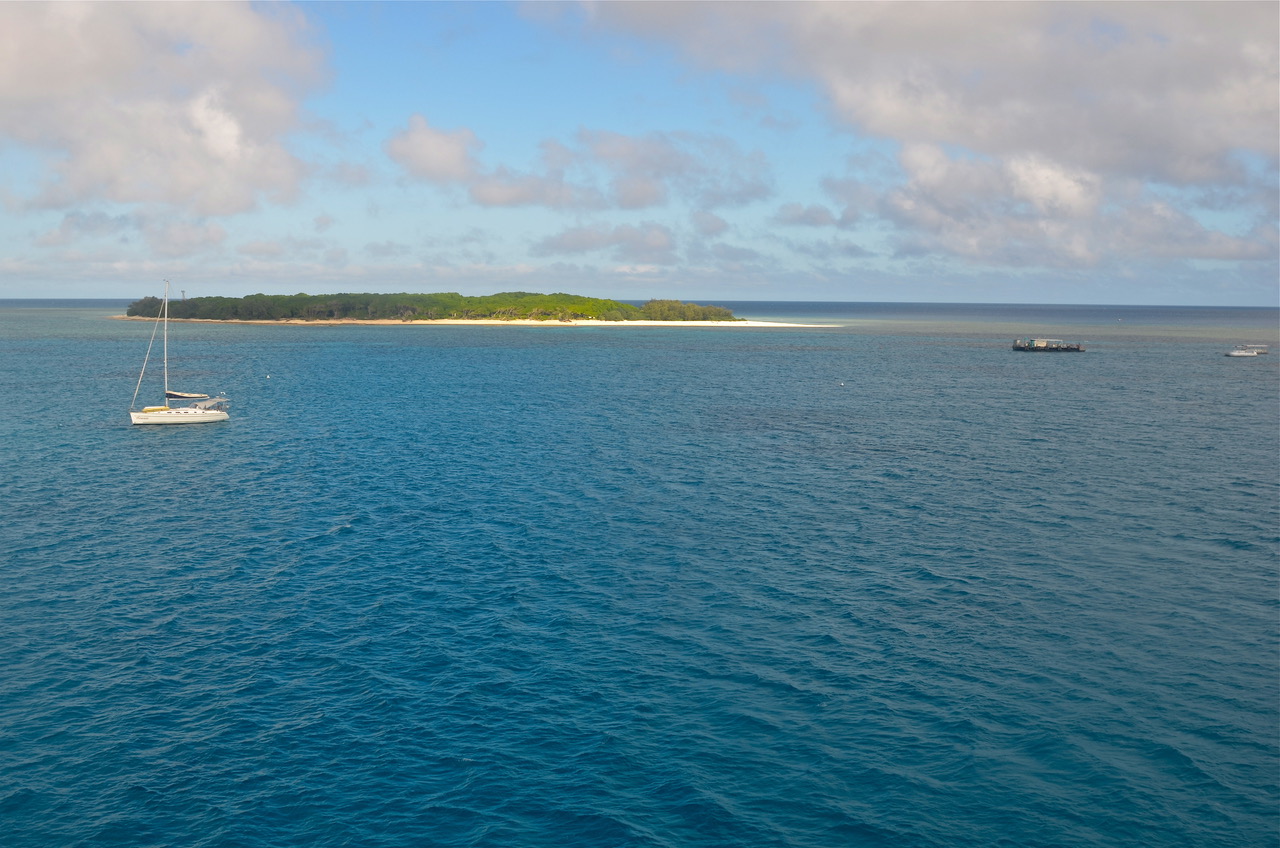
    The first truly tropical awesome place that we’ve been to since Justin arrived was Lady Musgrave Island. It is at the southern end of the Great Barrier Reef, a mere 30 miles offshore, 50 miles from where we sailed from Bundaberg. A tiny cay of sand and trees 600 yards wide juts up out of the ocean with a small two mile wide fringing reef surrounding it. The Tuomotus, where I first joined the boat were similar (though this was even smaller) and as I wish I could have spent another month there, I was in love with the place before we even got there.

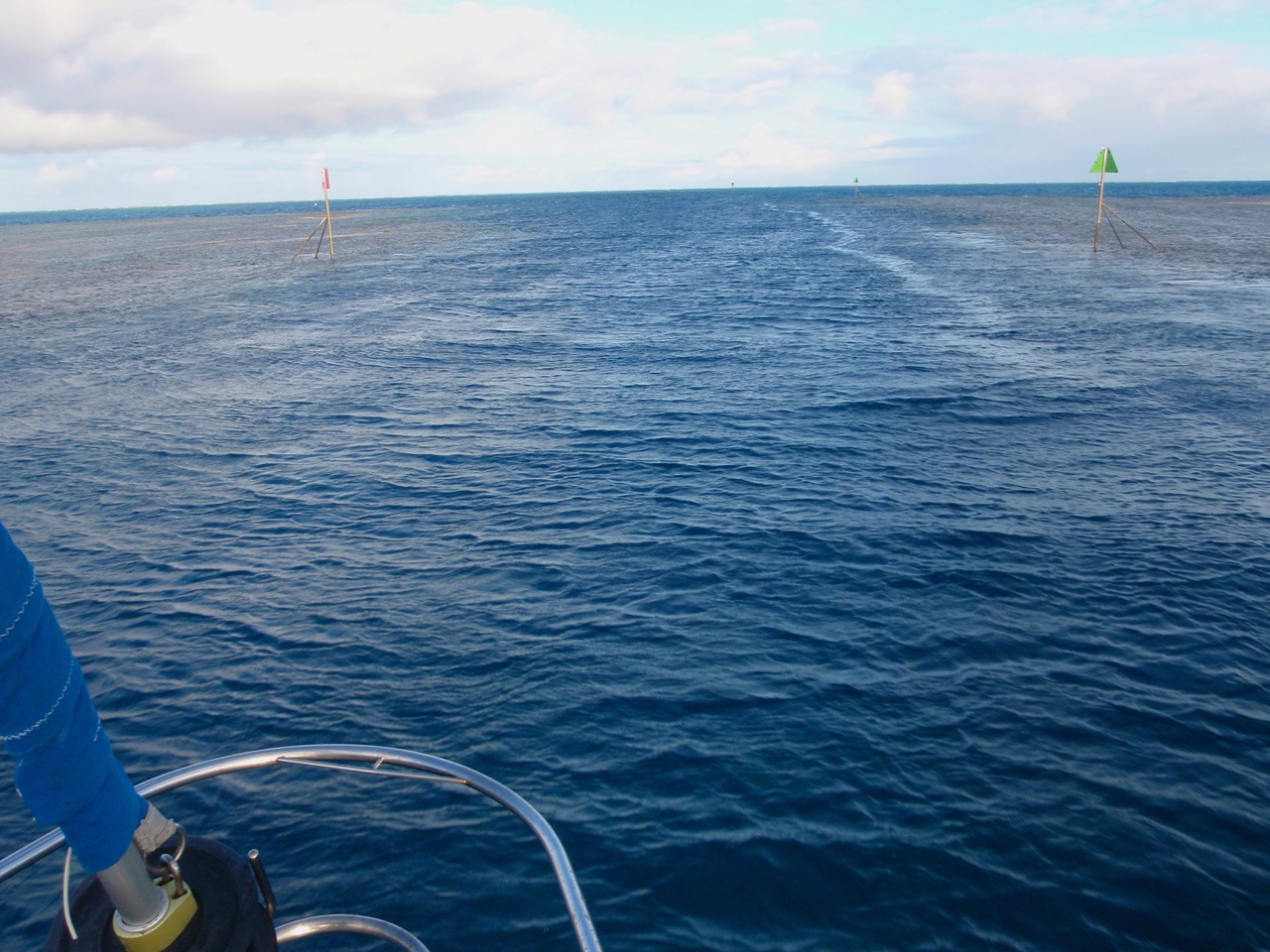
    The entrance through the coral reef was rumored to be blasted out with dynamite years ago by guano harvesters. Goats were introduced on the island in case of shipwrecks. Jonny would be glad to know they have since been eradicated. I was nervous entering the coral ring, the pass felt extremely narrow, much narrower than anything in the Tuomotus or anywhere I’d been. Running aground here would be disastrous as it would mean impacting and potentially sinking on hard, sharp coral, not the soft forgiving sand I’ve hit twice now in the last month. I had left the drifter pole up after pulling the sails down and I swear it seemed like it’s 20 foot length was able to overhang the obvious shallow edge of where the pass had been blasted out. Nerve-wracking, but we made it through.

    Inside was beautiful glistening water. The Pacific Ocean crashed all around against a ring of fringing reef that, save the tiny cay, remained just two or three feet underwater. The water was brilliant turquoise and blue. We relaxed. We snorkeled. We spear-fished. We meandered around the island. We lazily swung in the hammock.

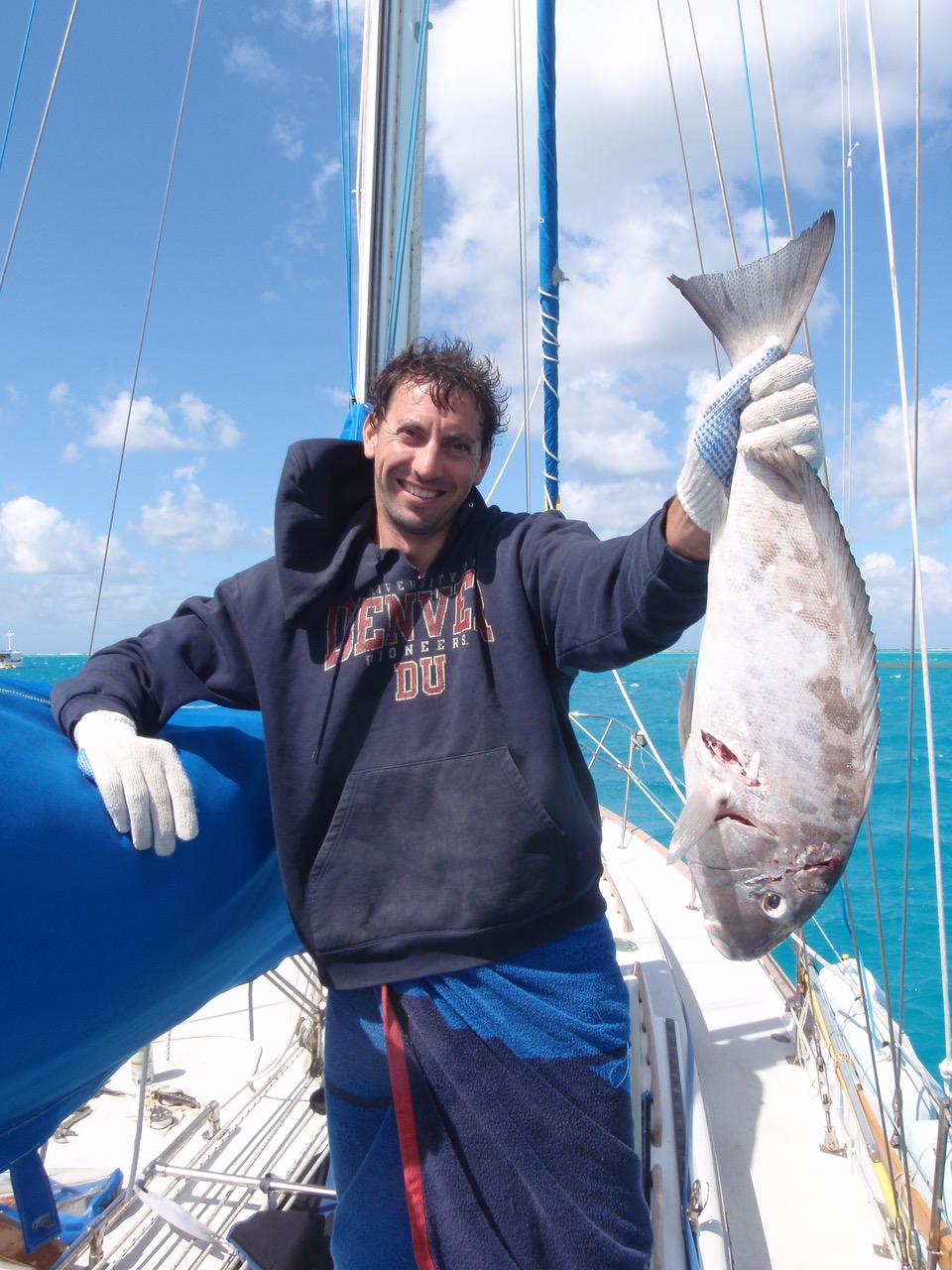
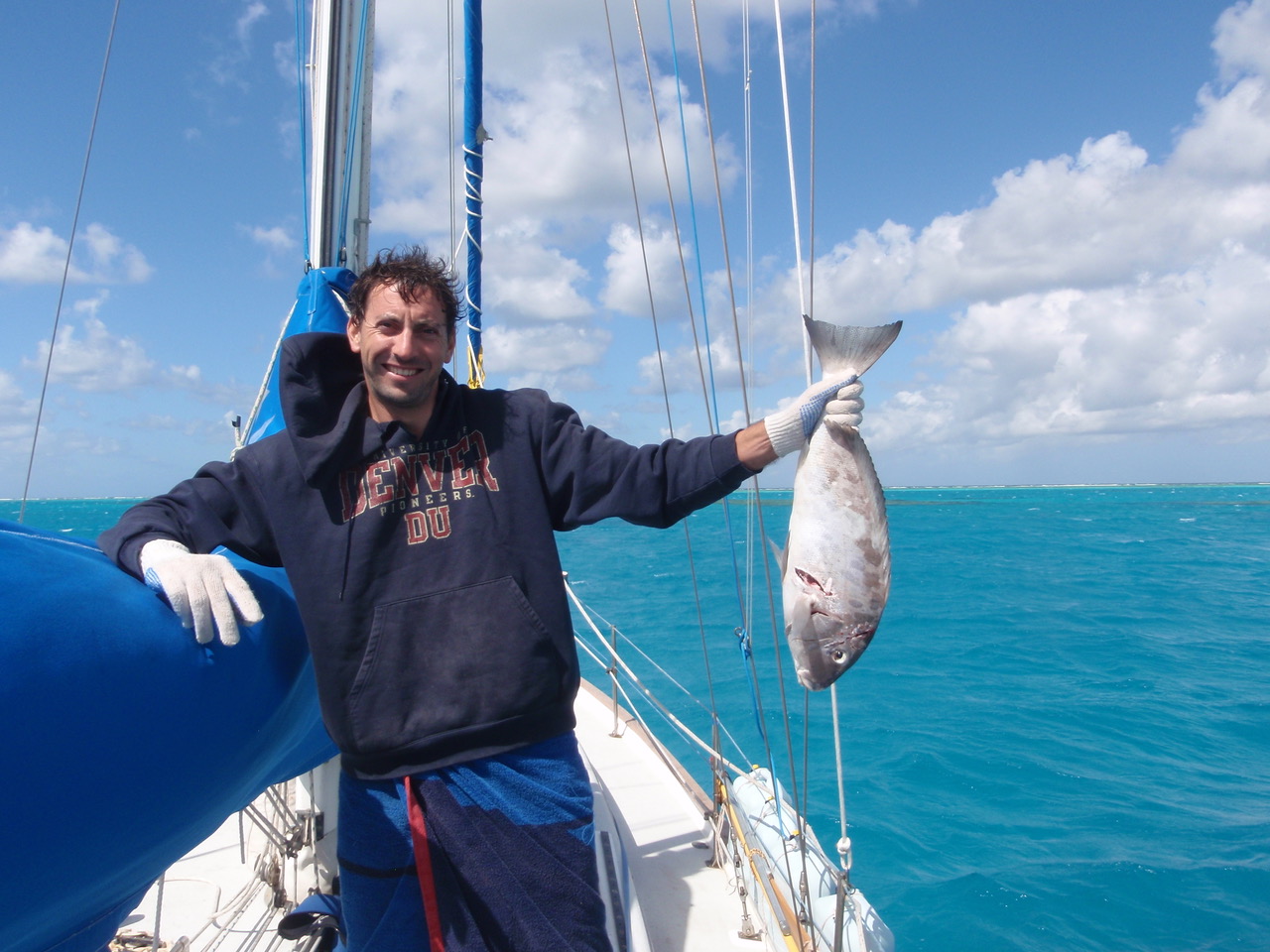
    Our spear fishing adventure was short. I bagged one smaller sized fish within a few minutes. Justin then said he had spied a bigger fish. I asked if he wanted to take a shot at it. He dove down to within three feet of it… the fish didn’t budge… and then Justin surfaced without firing. He had forgotten to undo the safety!  Back down he went, the fish hadn’t moved an inch, and with one shot from three feet away, one-shot wonder Justin bagged what is easily the biggest fish that someone on Syzygy has caught. King’s to Justin today!

    Justin, however, doesn’t really eat fish, so I spent the next two hours trying to gut and clean them. My fish only produced a small amount of meat, but Justin’s… Justin’s provided two beautiful large fillets. He gamely tried a few small bites of what I cooked up, but in the end sided with Ramon for dinner that evening. I dined on fish in a lemon butter sauce, fish in a sweet chili reduction, and fish teriyaki. Thank you Justin!

  • Agh, that’s disgusting

    Justin and I managed some last minute work on the boat.  I worked.  Justin filmed.  O.K., he did some work.  Off camera of course.  Here we battle a small issue in the galley.

    Note: Of Matt, I only make fun.  It is only because of the thousands and thousands of hours that Matt labored on Syzygy that I am able to sail her here in Australia. I jest because it is so obviously hilarious to think Matt somehow did not maintain Syzygy to the highest of standards.

  • Boys will be Boys

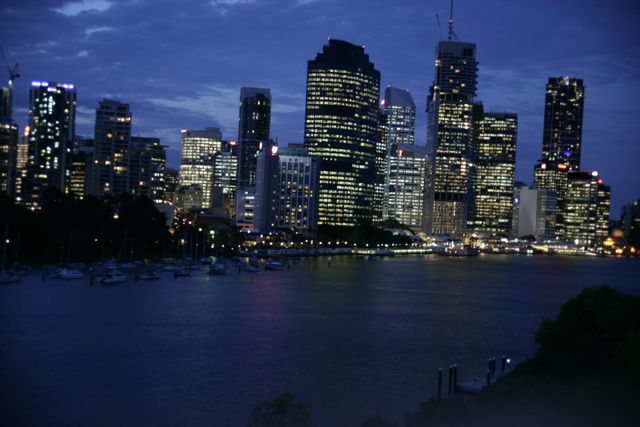
    I would like to extend a thoroughly vigorous thank-you to Richard Switlick, Chris Reardon, Kevin Tompsett, and Philippe Boujon, who provided the drink-link funds for Jon and myself to enjoy a correspondingly vigorous evening of refreshing alcoholic beverages.  Additionally, Karen expresses her appreciation for the quiet evening of solitude that she enjoyed while we were on the town. Thank you friends!  I regret that we do not have any pictures of the event, but I have included a great shot that Jon took of the city as it appears from our ferry stop–exactly as it appeared as we entered downtown in search of some fine Belgian beers.

    Upon hearing of our male-beer-evening, a female cruising friend living down the dock from us commented that the sole topics of conversation among single men when lacking female company seem to be 1) women and 2) alcohol. Given that we are no longer single (I am married; Jon is in a relationship), she was curious about exactly what we might discuss.  A ready defense of the quality of our conversation jumped to the tip of my tongue, because I recalled that on the evening in question we had an unusually philosophical back and forth for at least two hours.  I paused before answering, however, when I realized that we had started the event at 4 and continued until 1–a duration of 7 hours–minor mental calculation says that 2 out of 7 hours is not a significant portion.  Upon further reflection, I recalled a spirited debate regarding the top three brands of each and every type of liquor present on the shelves of the bar.  And what else did we talk about? Oh, right.

    I was forced to admit that the primary topics of mature non-single male conversation remain 1) women and 2) alcohol. At the same time, I regret nothing and make no apologies.

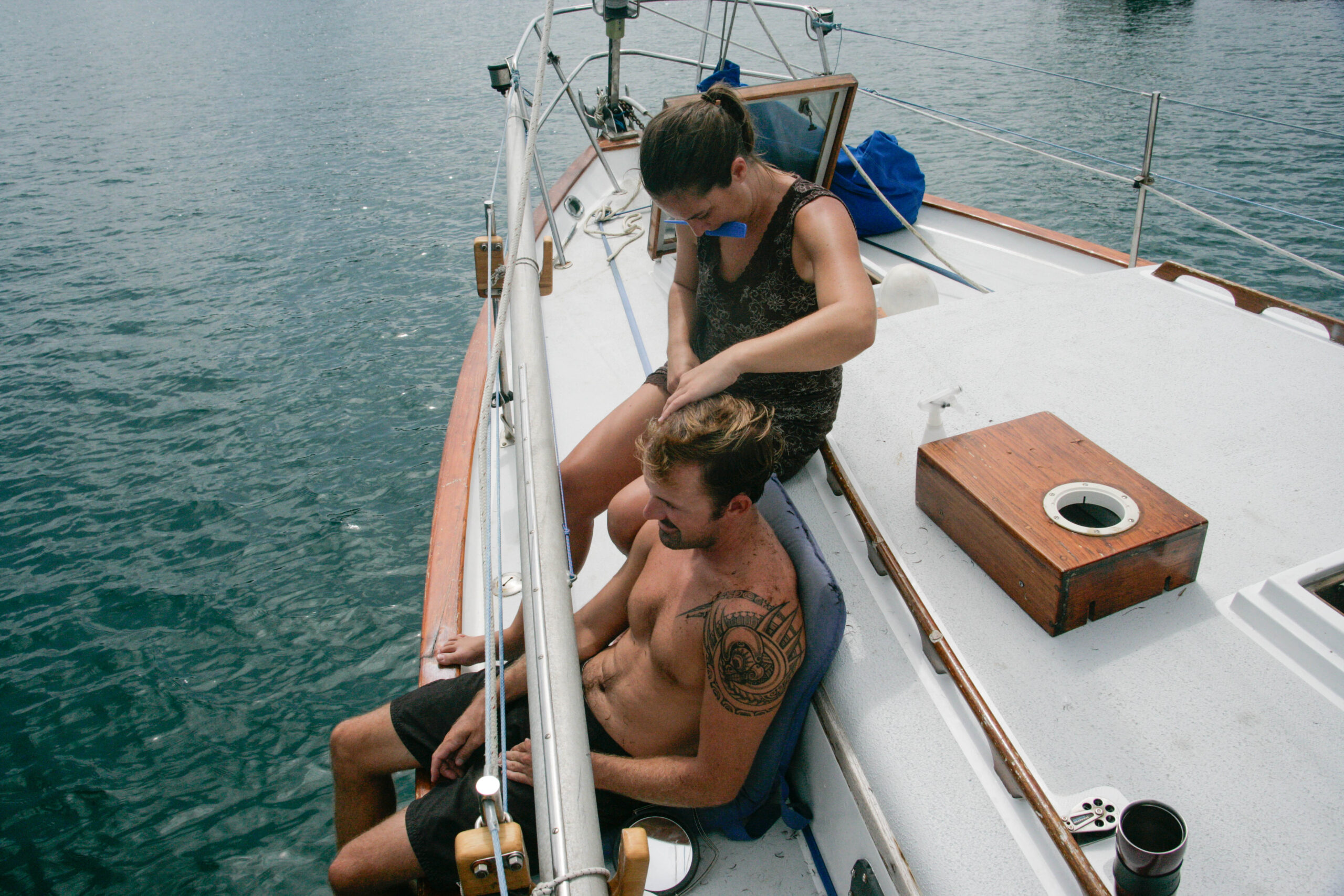
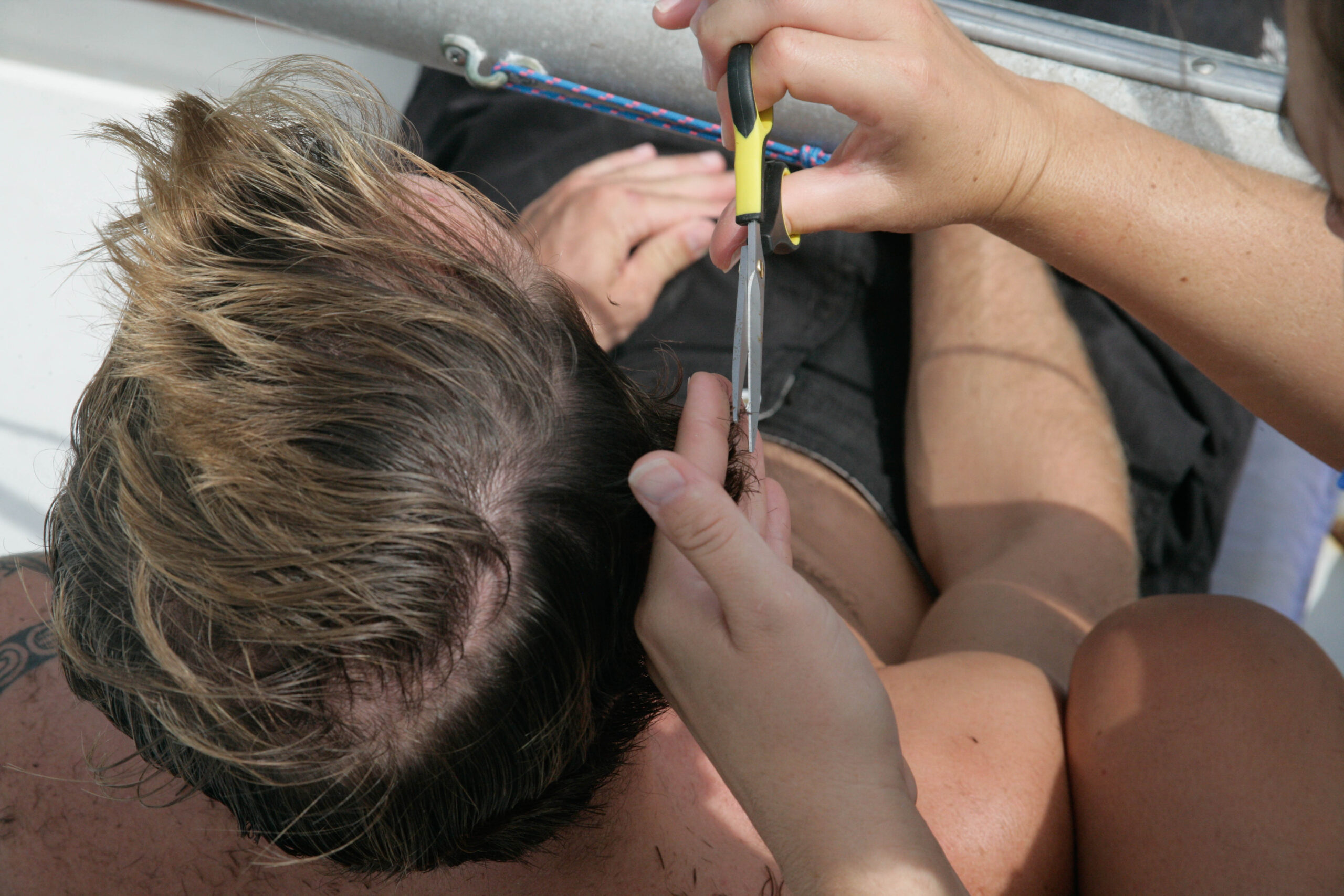
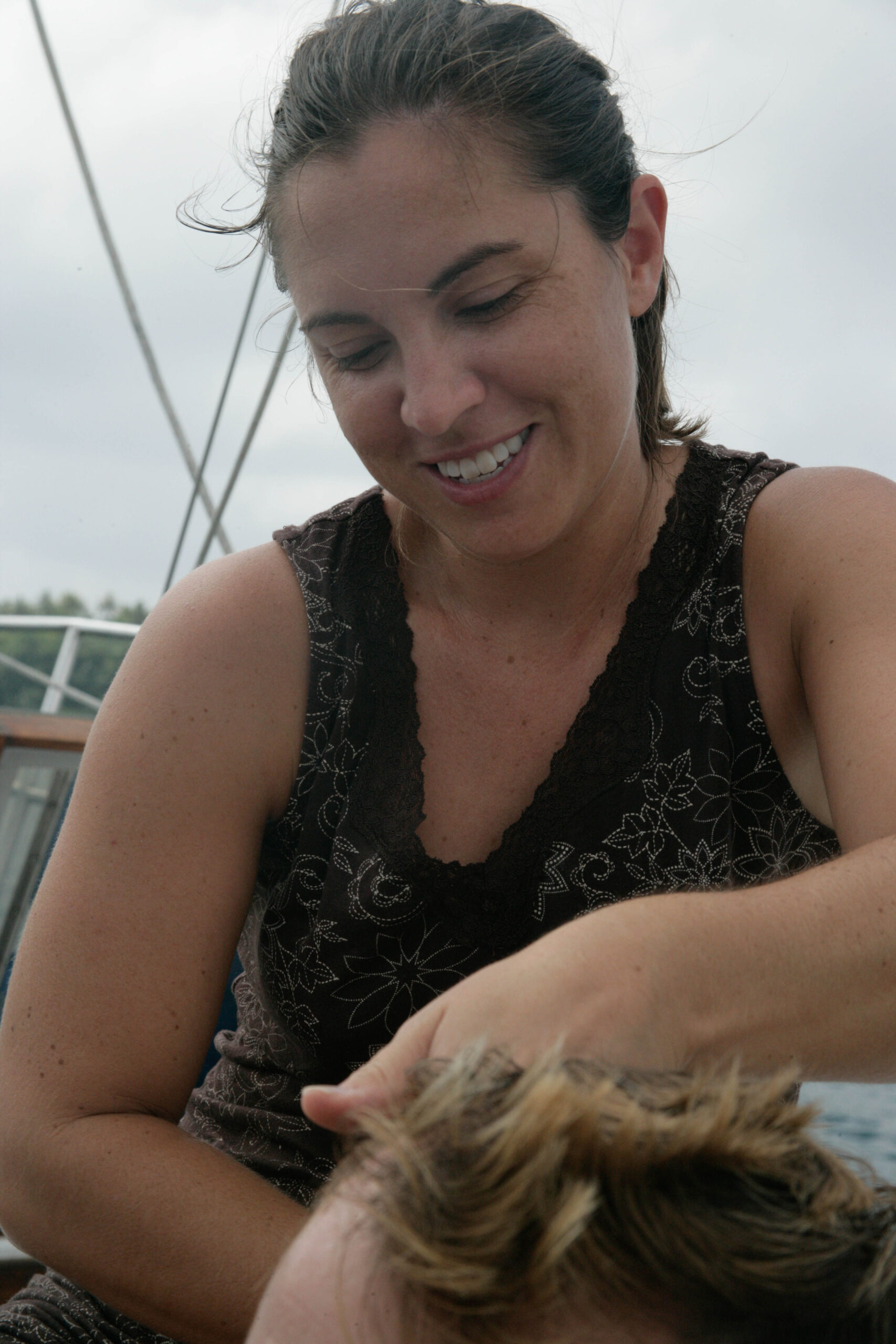
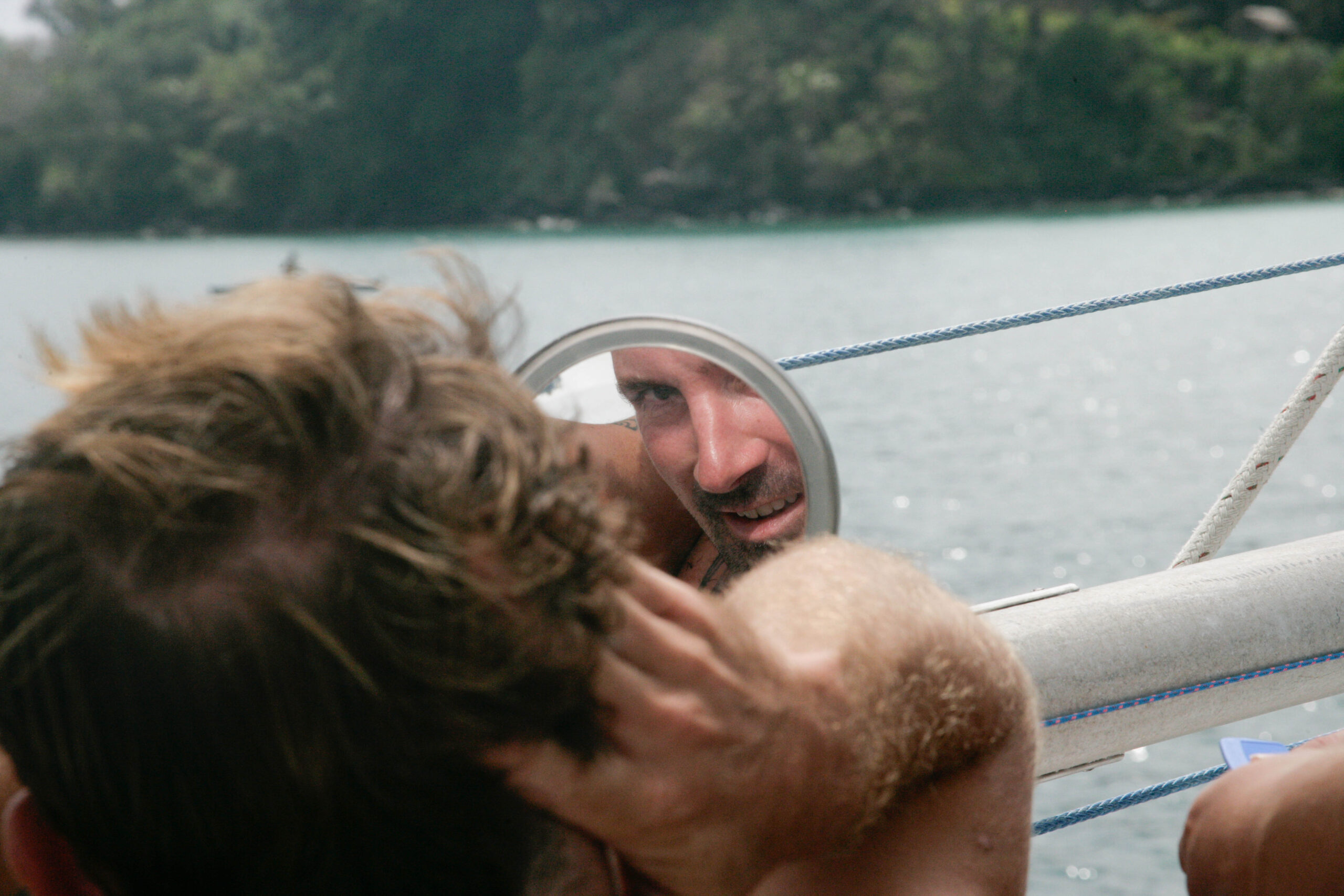
    For another exhibit of male arcana, I present the preferred method for one dude to cut another dude’s hair.  I think you will agree with me that it is a paragon of efficiency: note in particular the minimal amount of male-male contact and the utter lack of escaping stray hair.

  • Mt. Yasur

    Our sail from Fiji to Tanna Island, a southern island in Vanuatu, lasted for four days.  The passage was not unpleasant, but it took me a couple of days to get over a lethargic feeling of seasickness.  The last two days, however, I felt fantastic, and I remember thinking ‘I’d forgotten that passage making was enjoyable!’

    I have to remind myself of that feeling repeatedly so as to give it more prominence in my memory, because most of the time, passage making is not enjoyable.  Like our three day bash into confused seas and high winds from Tanna to New Caldonia where all I felt like cooking or eating was Ramon and a general malaise infused my entire being.

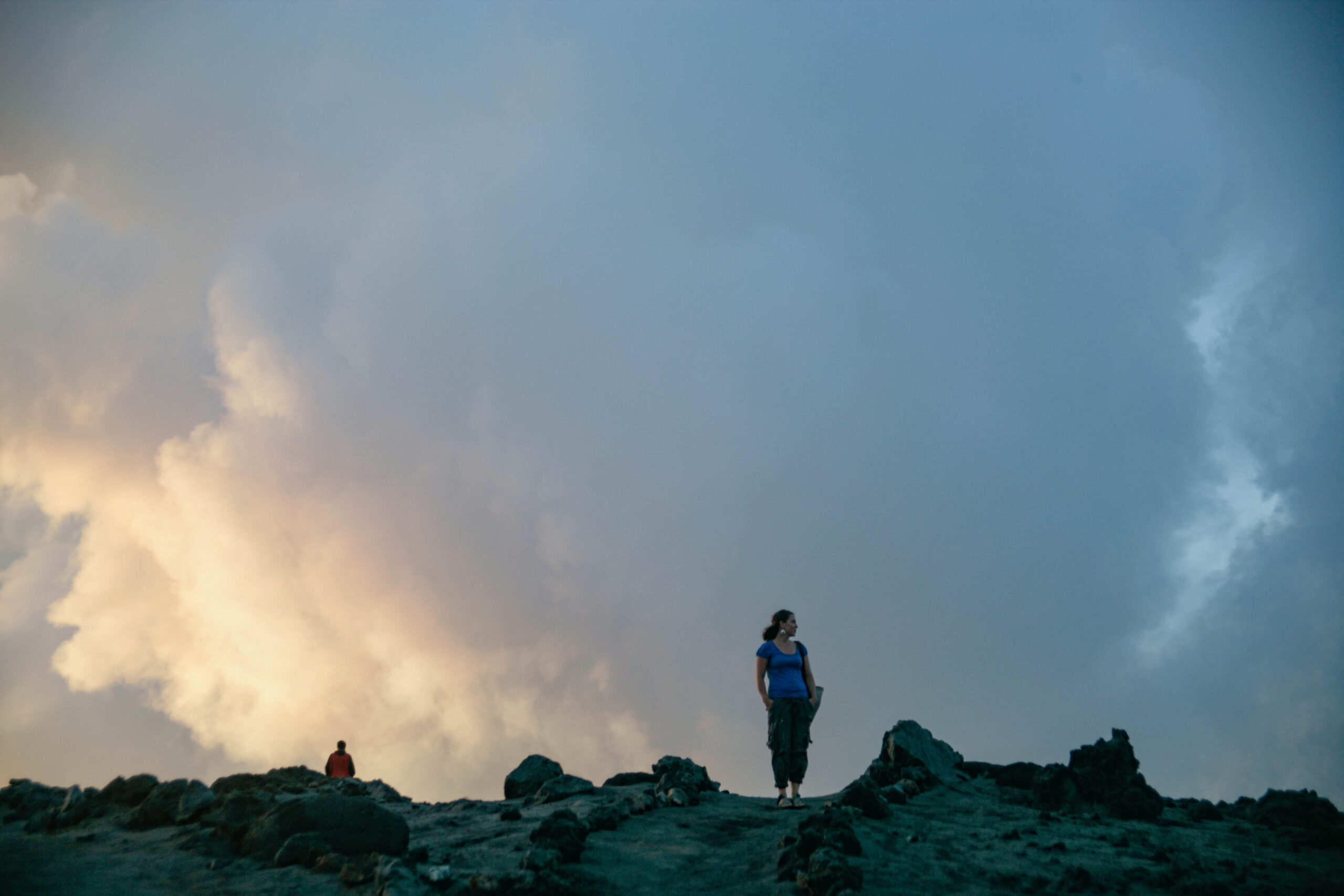
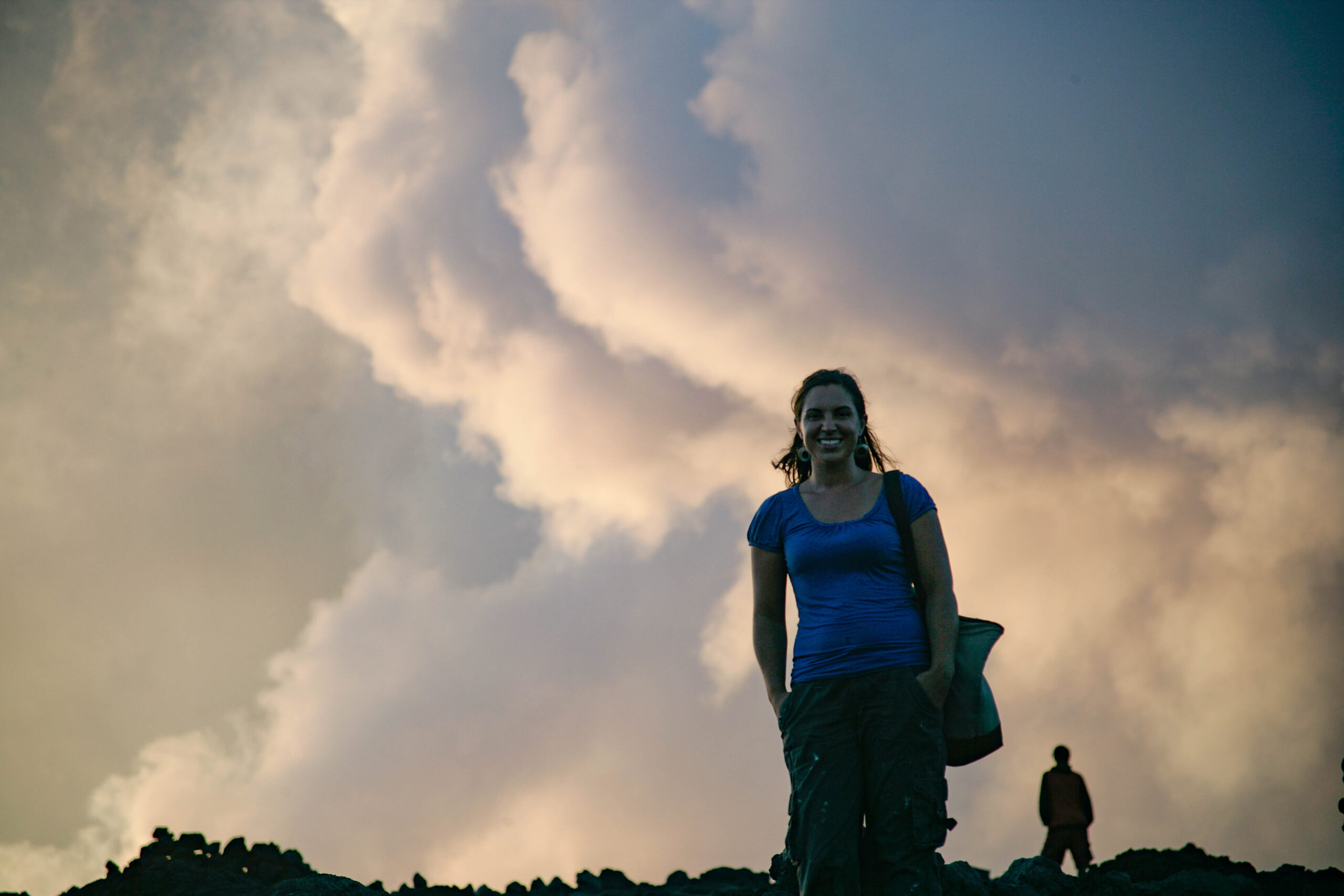
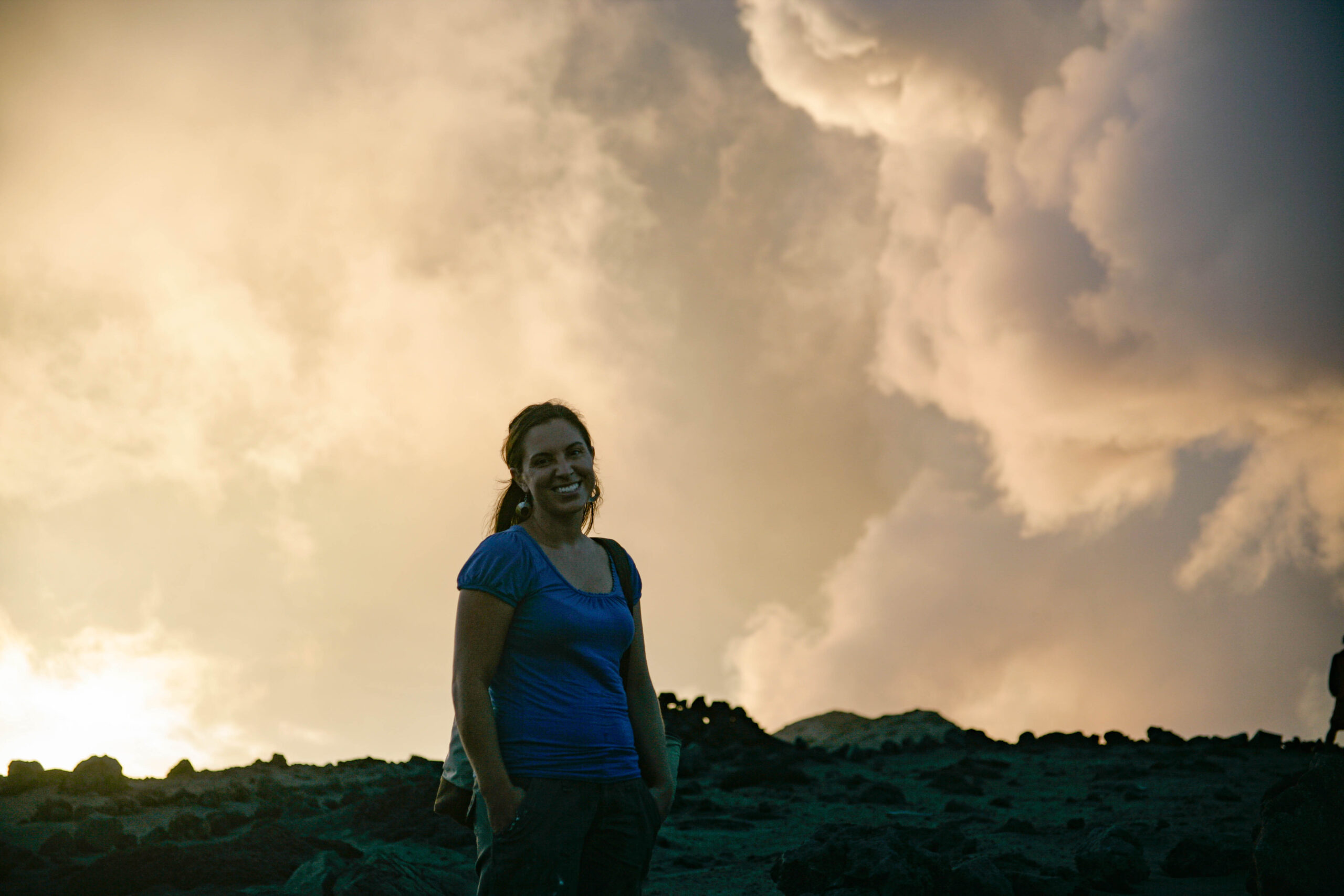
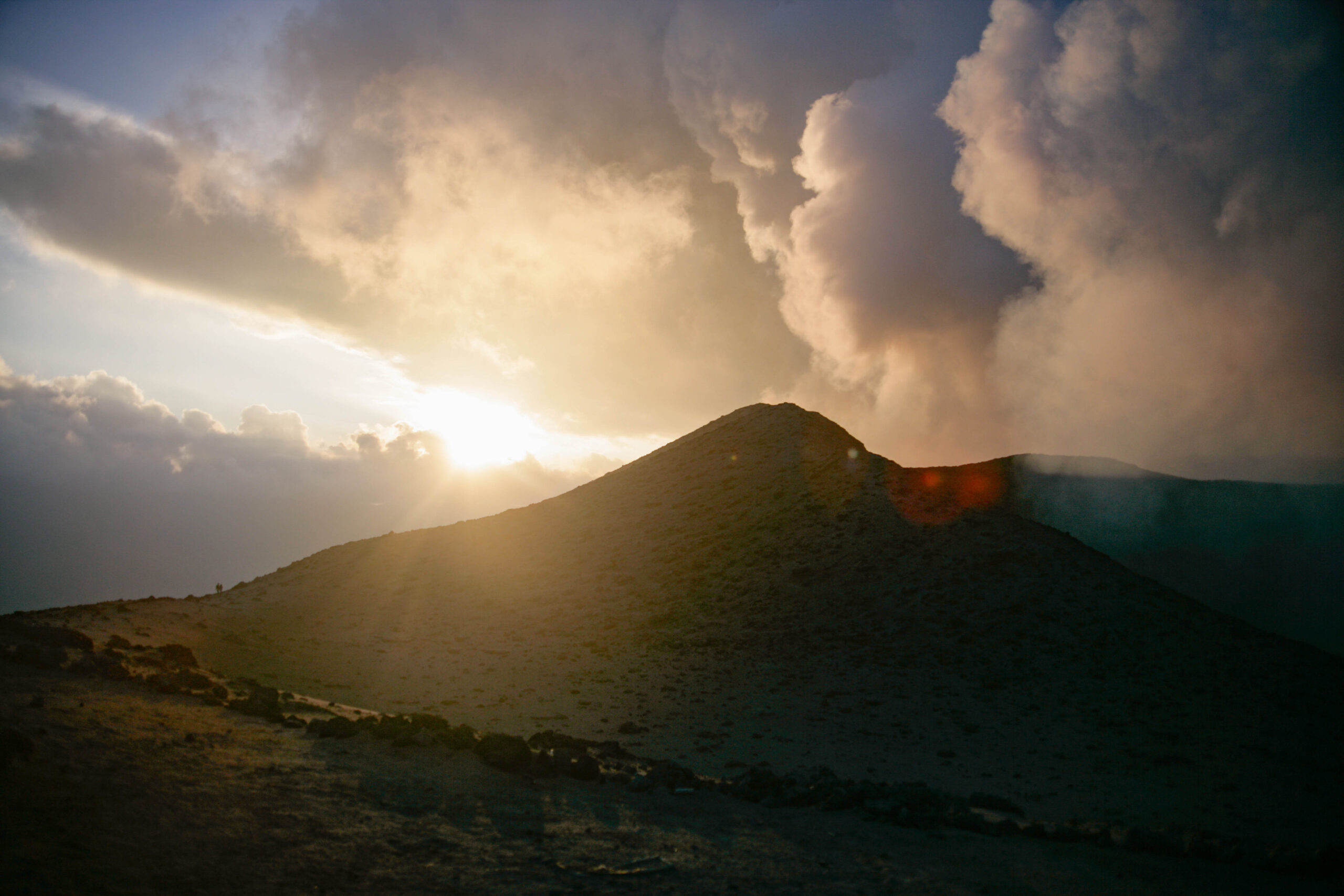
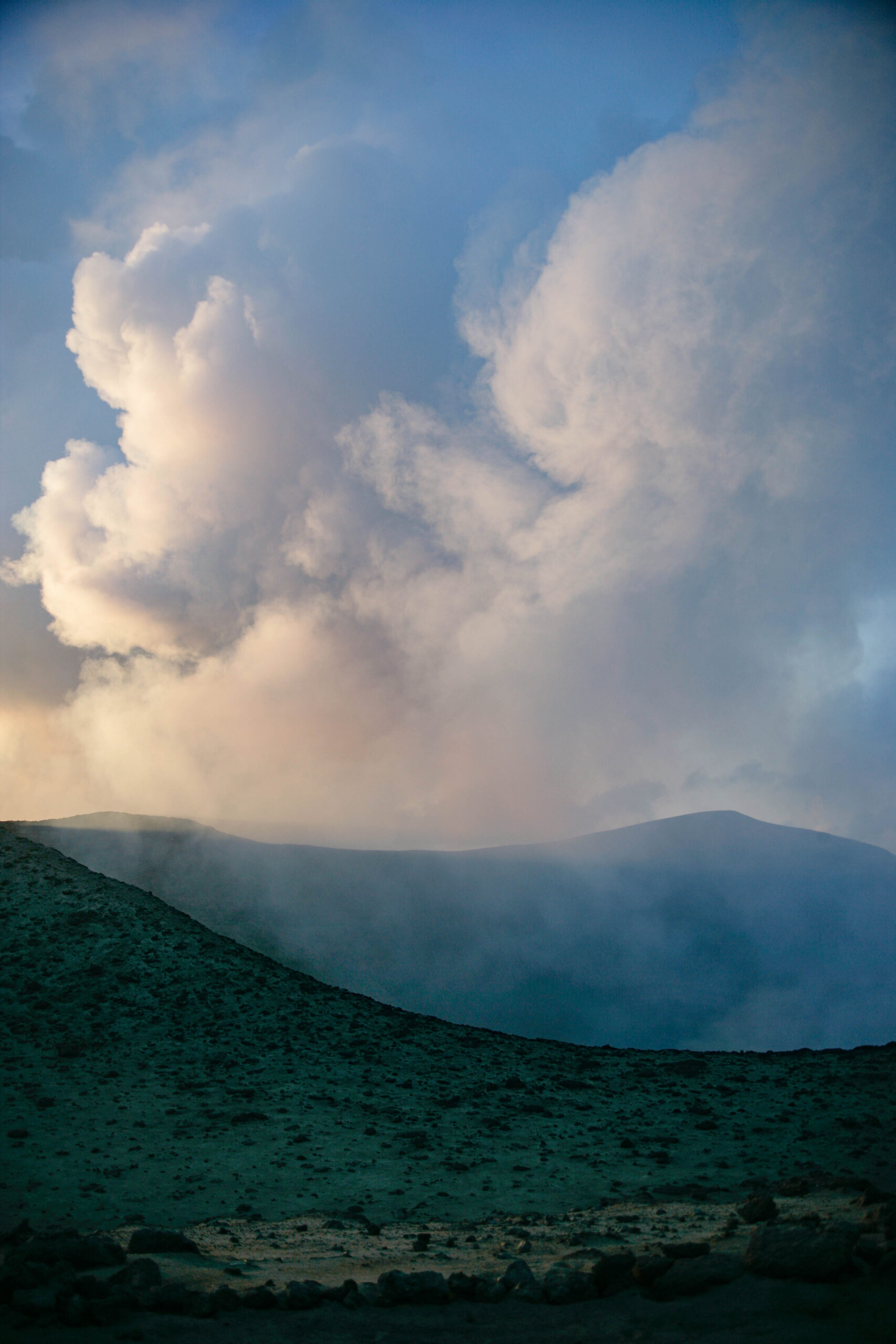
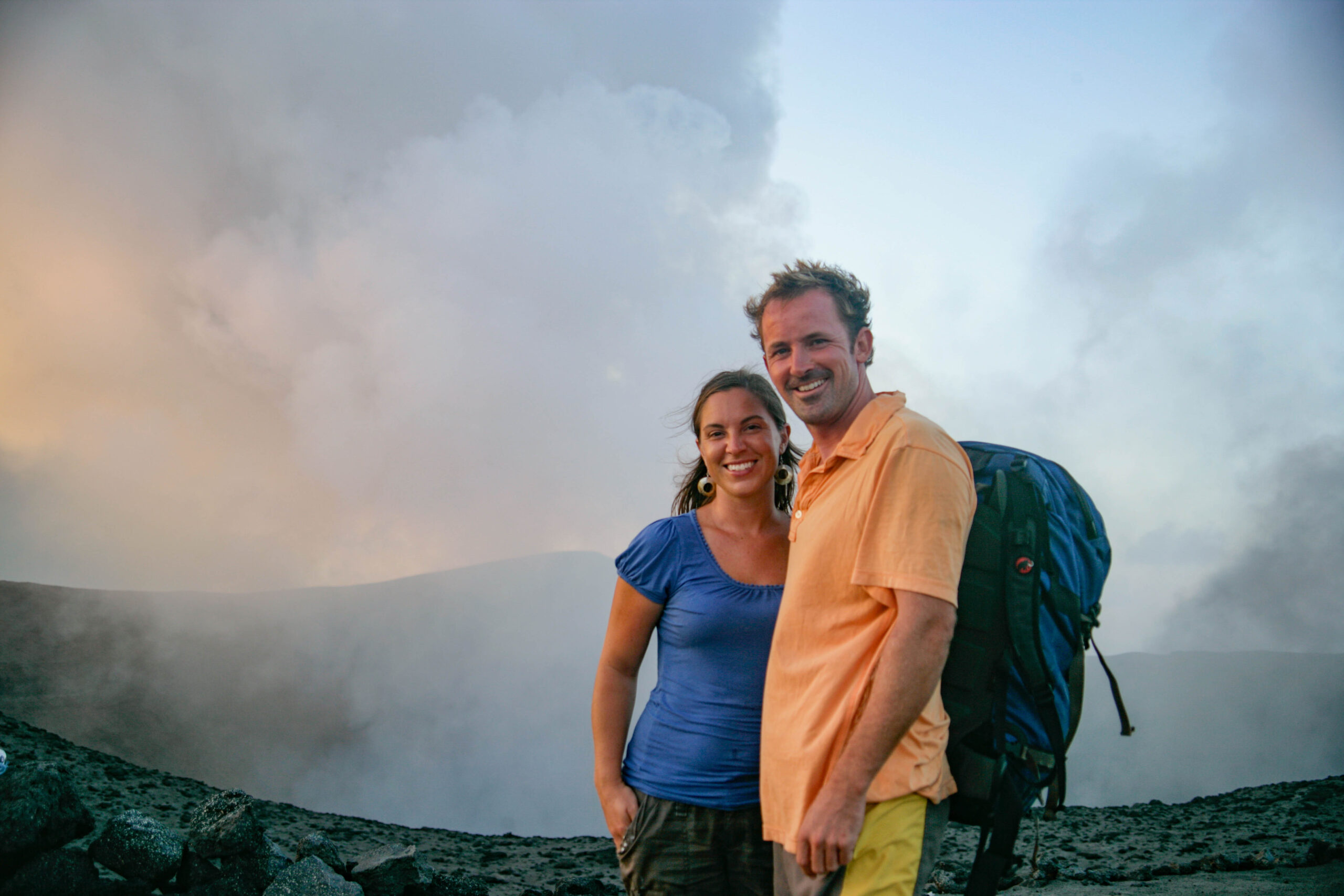
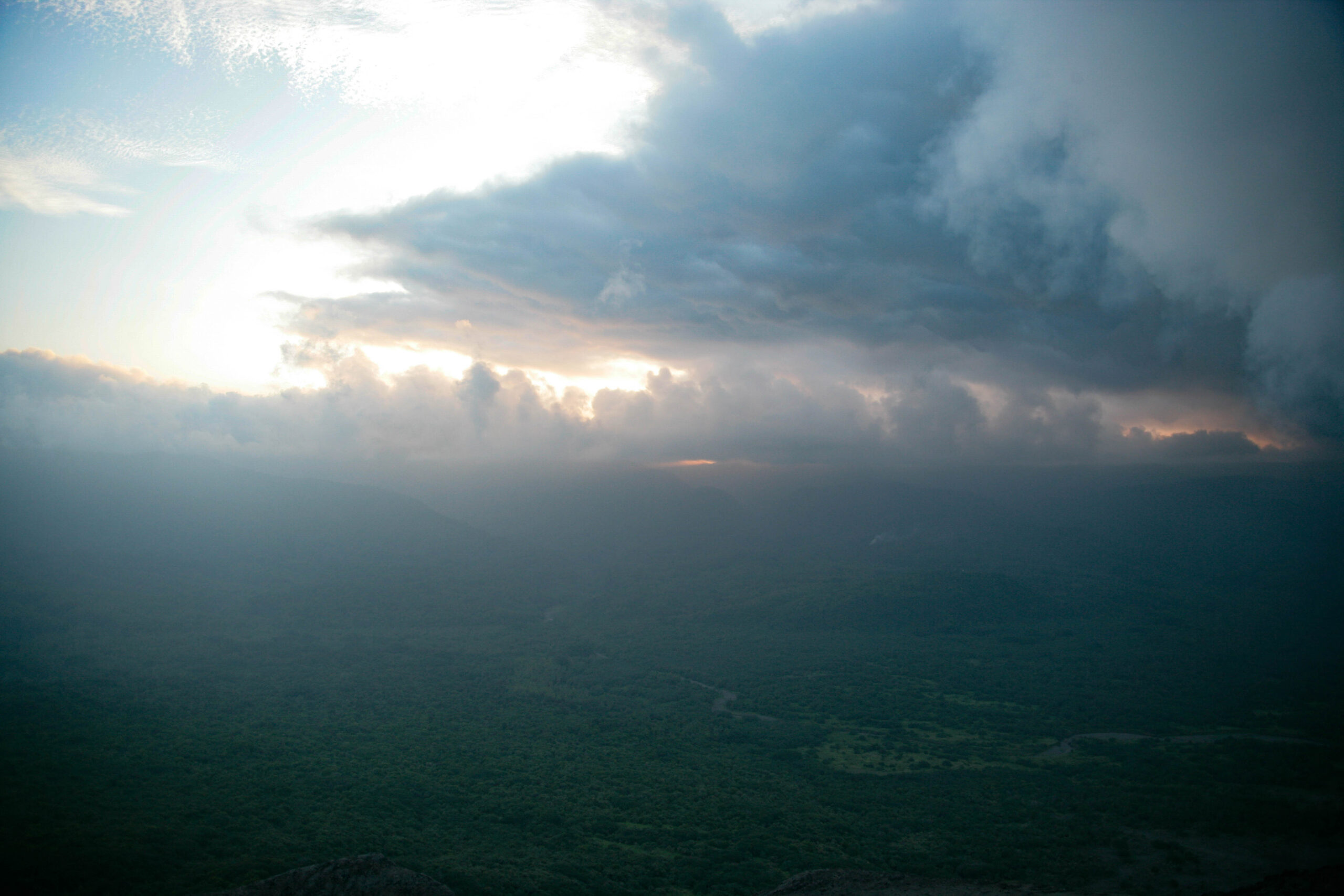
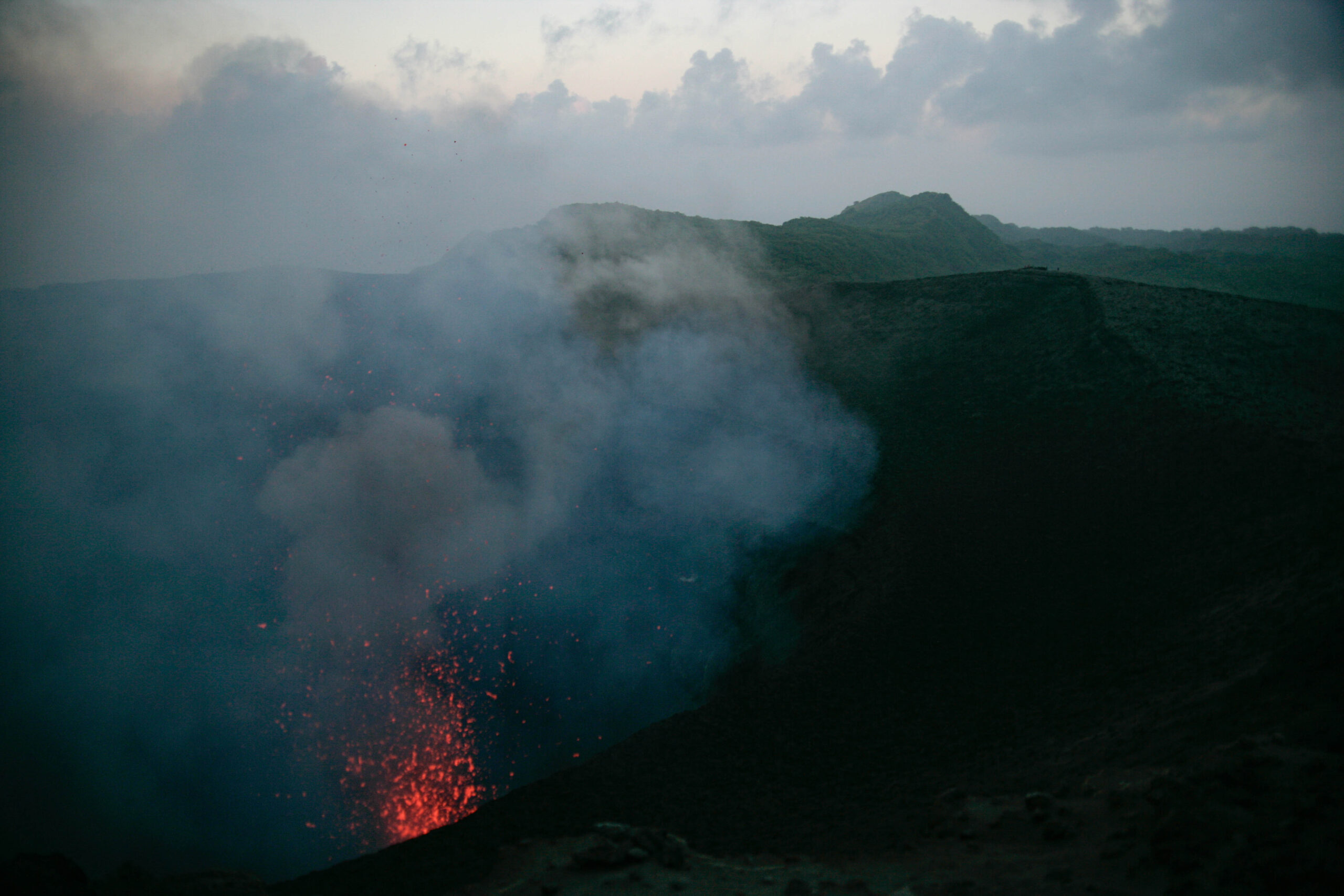
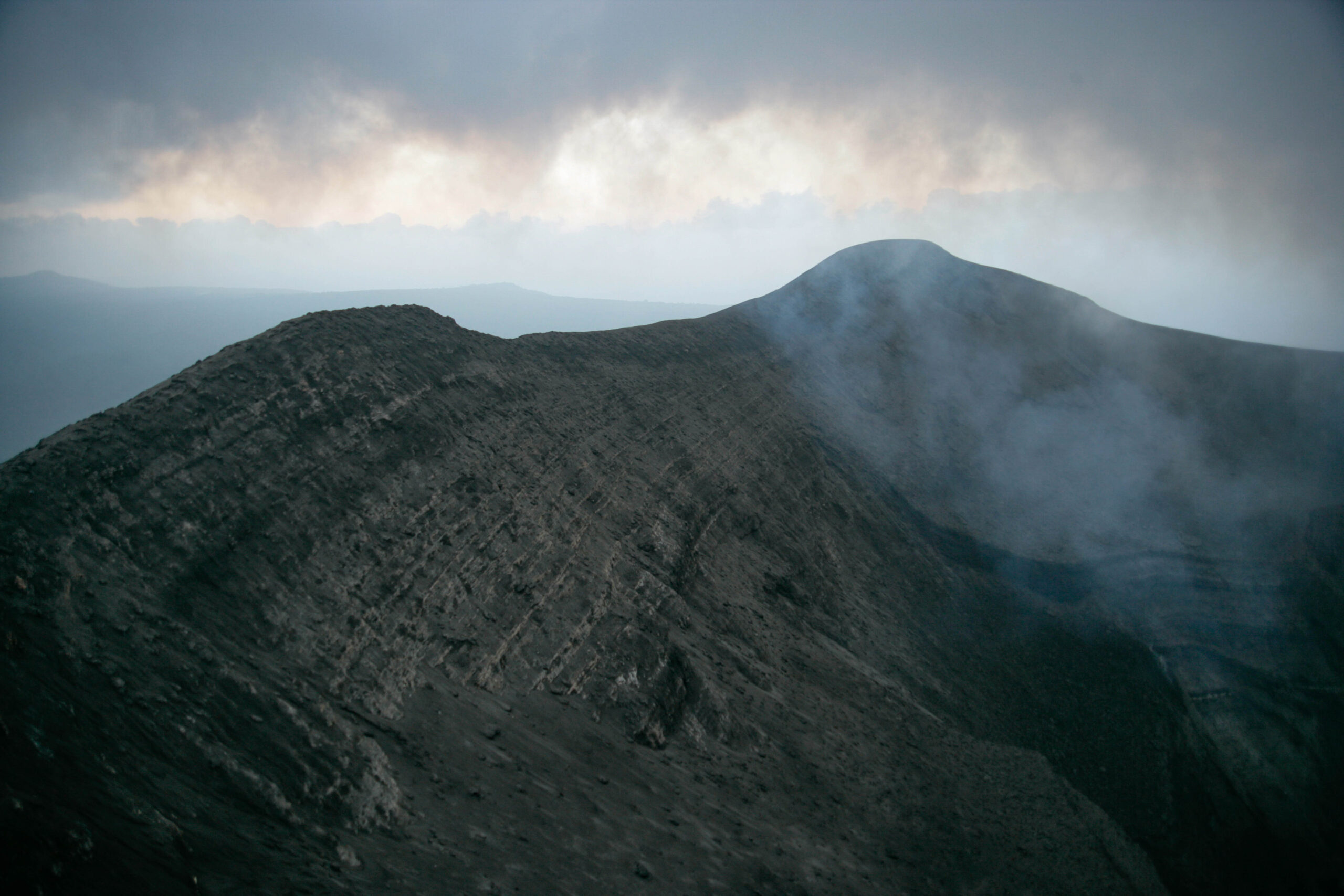
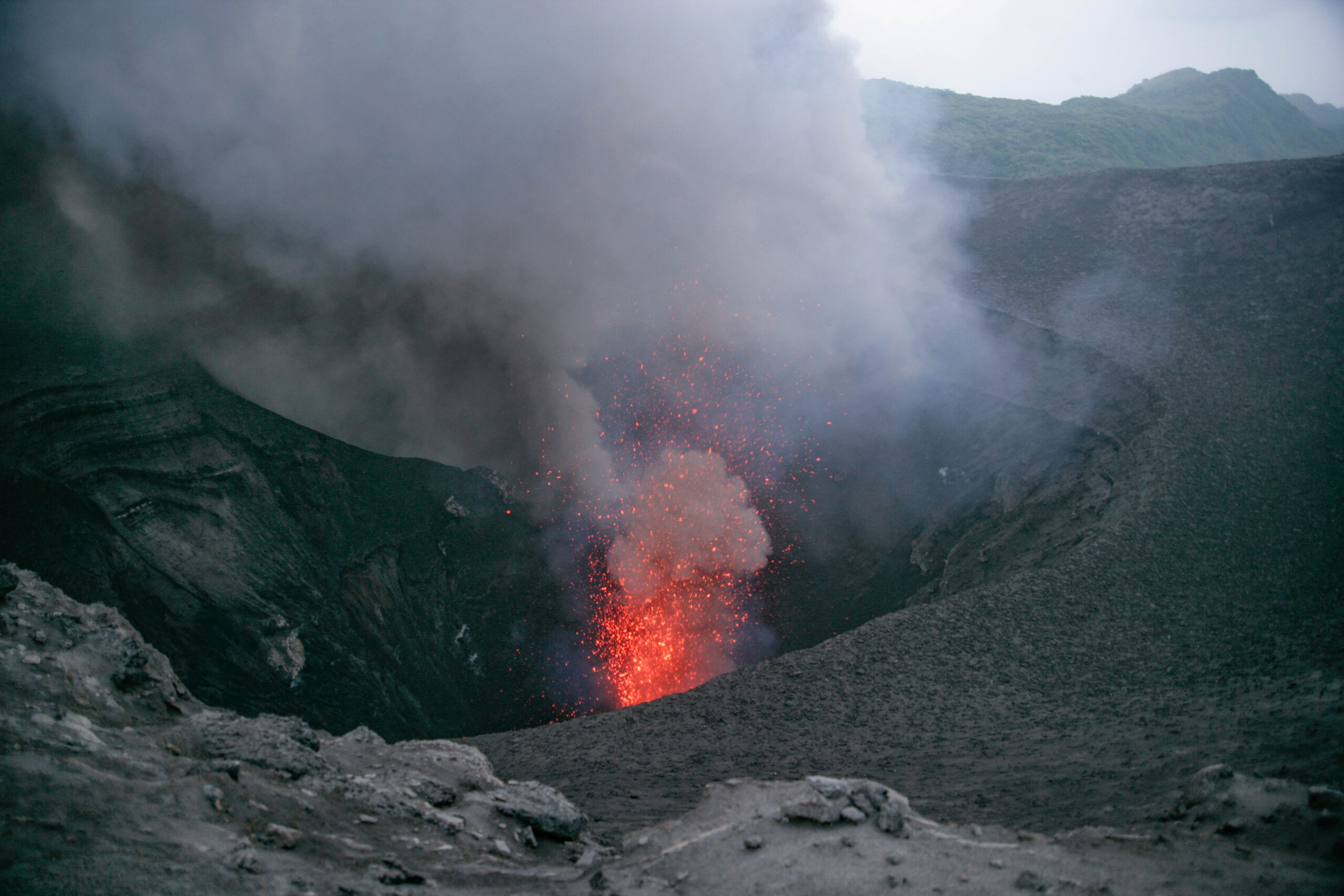
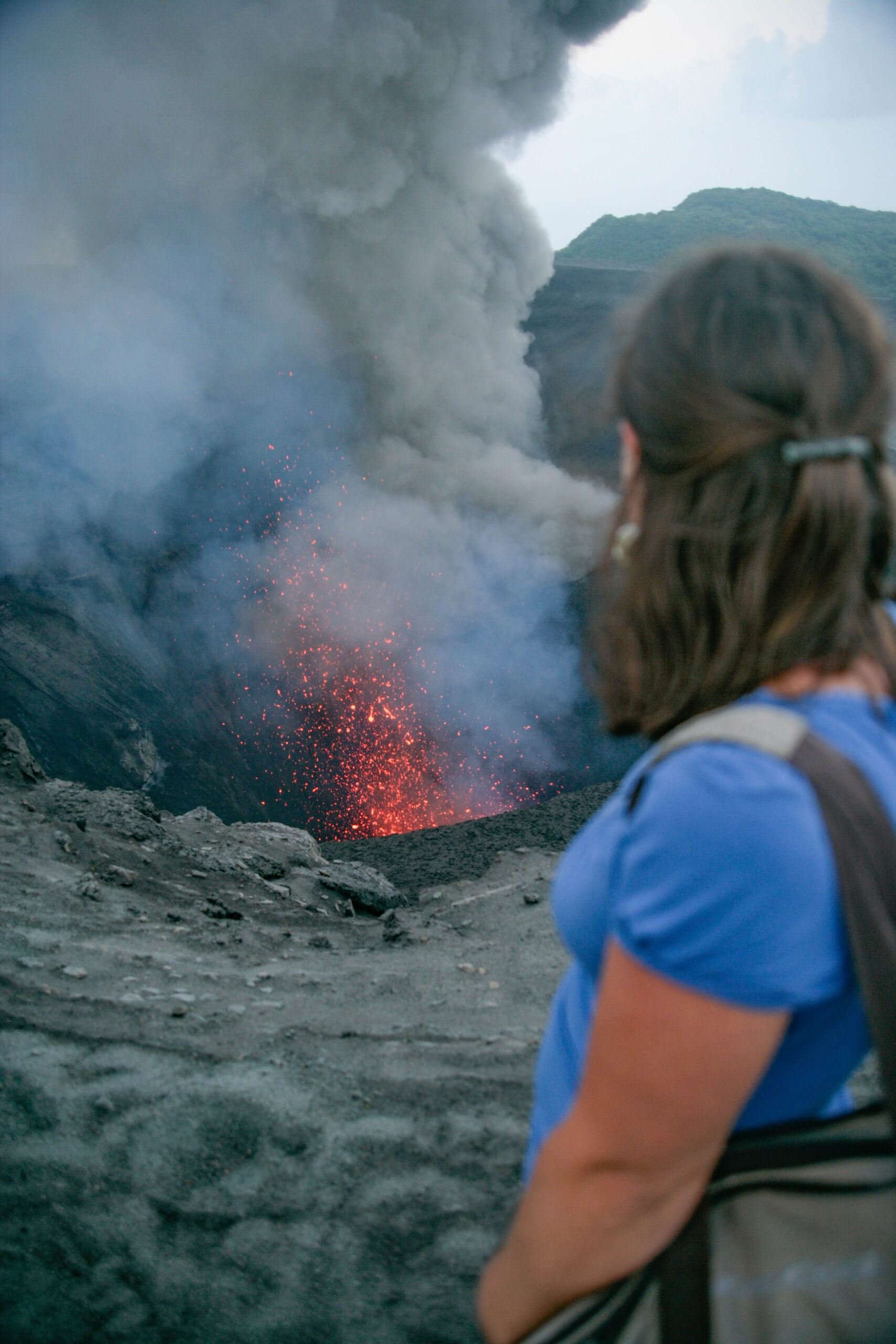
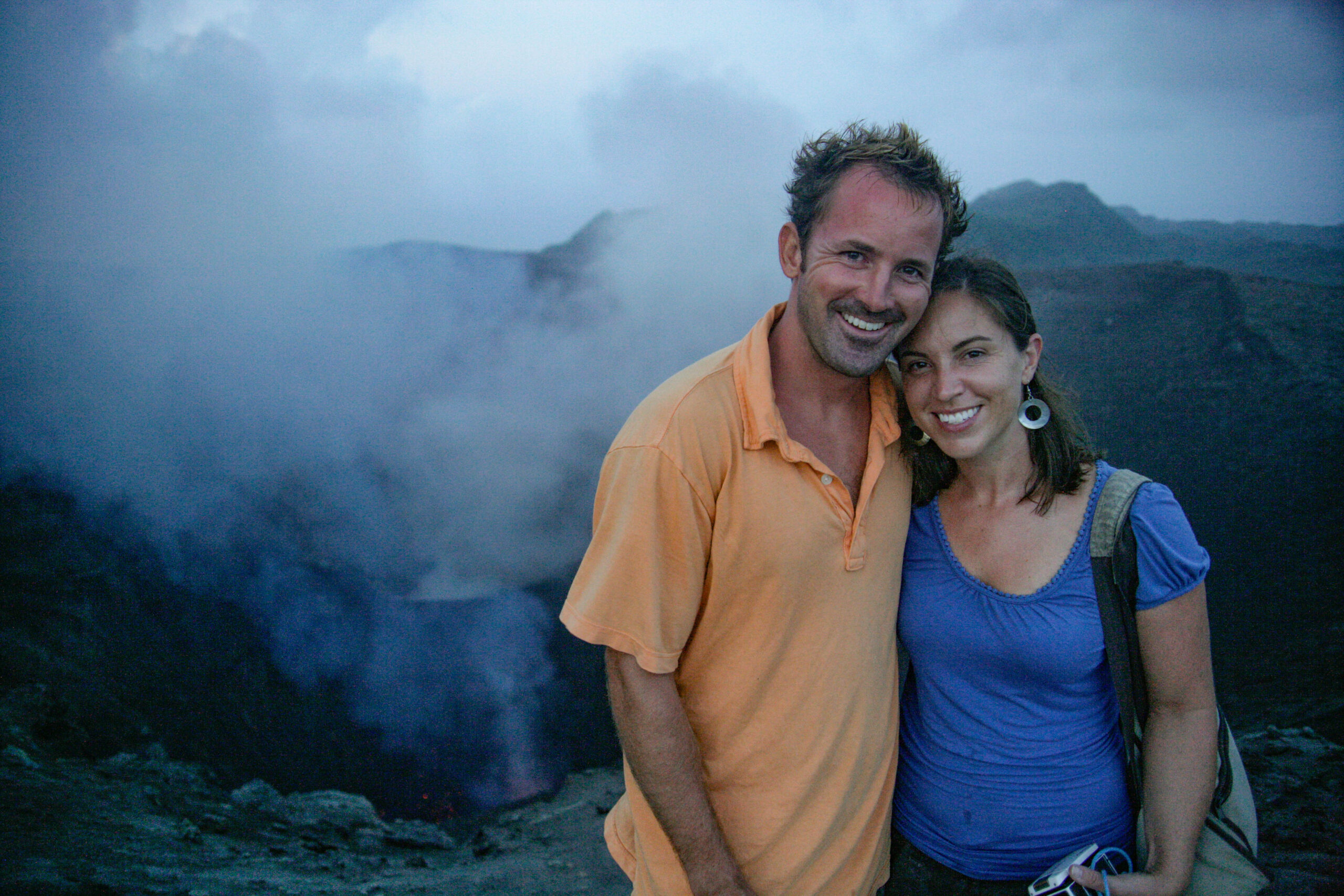
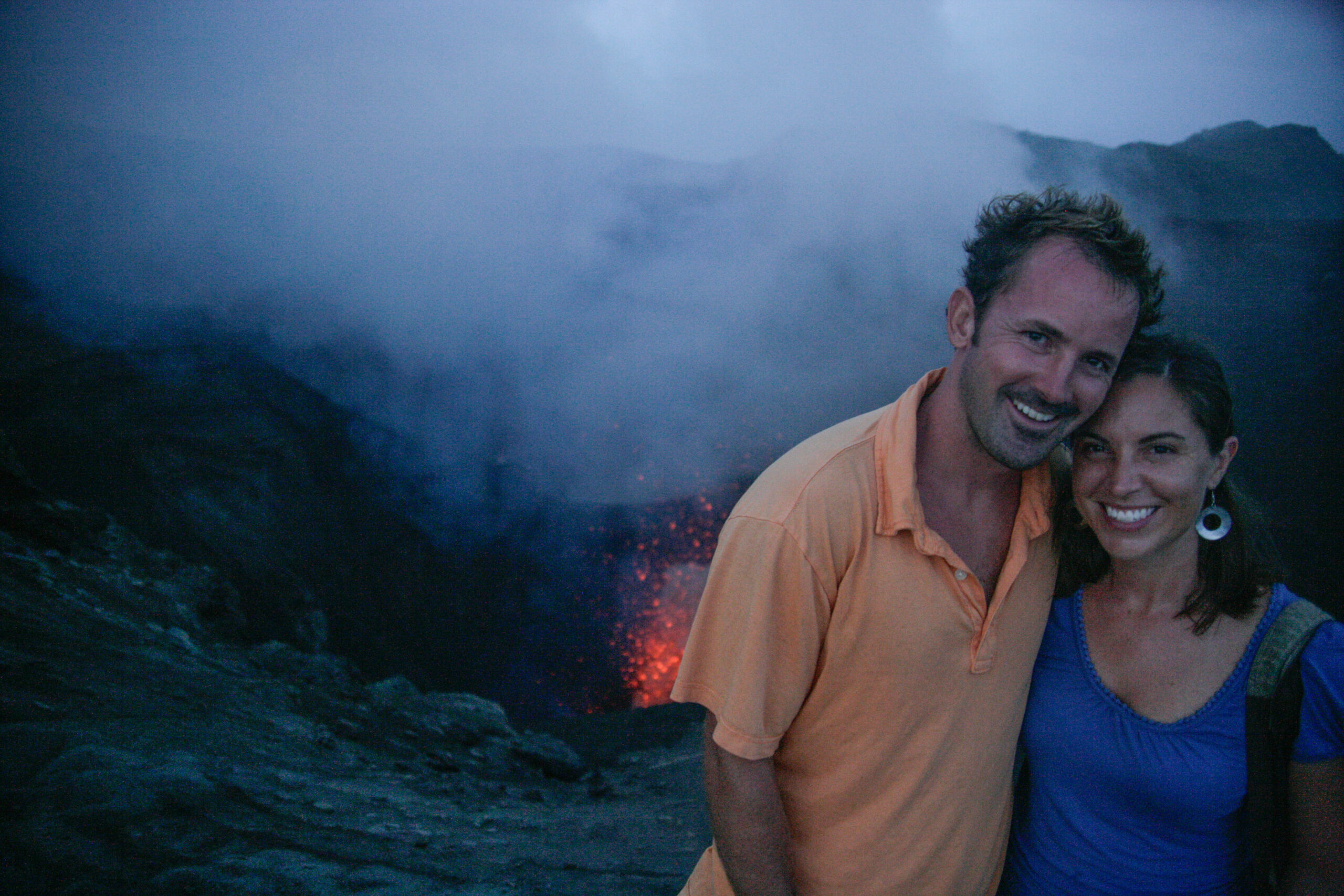
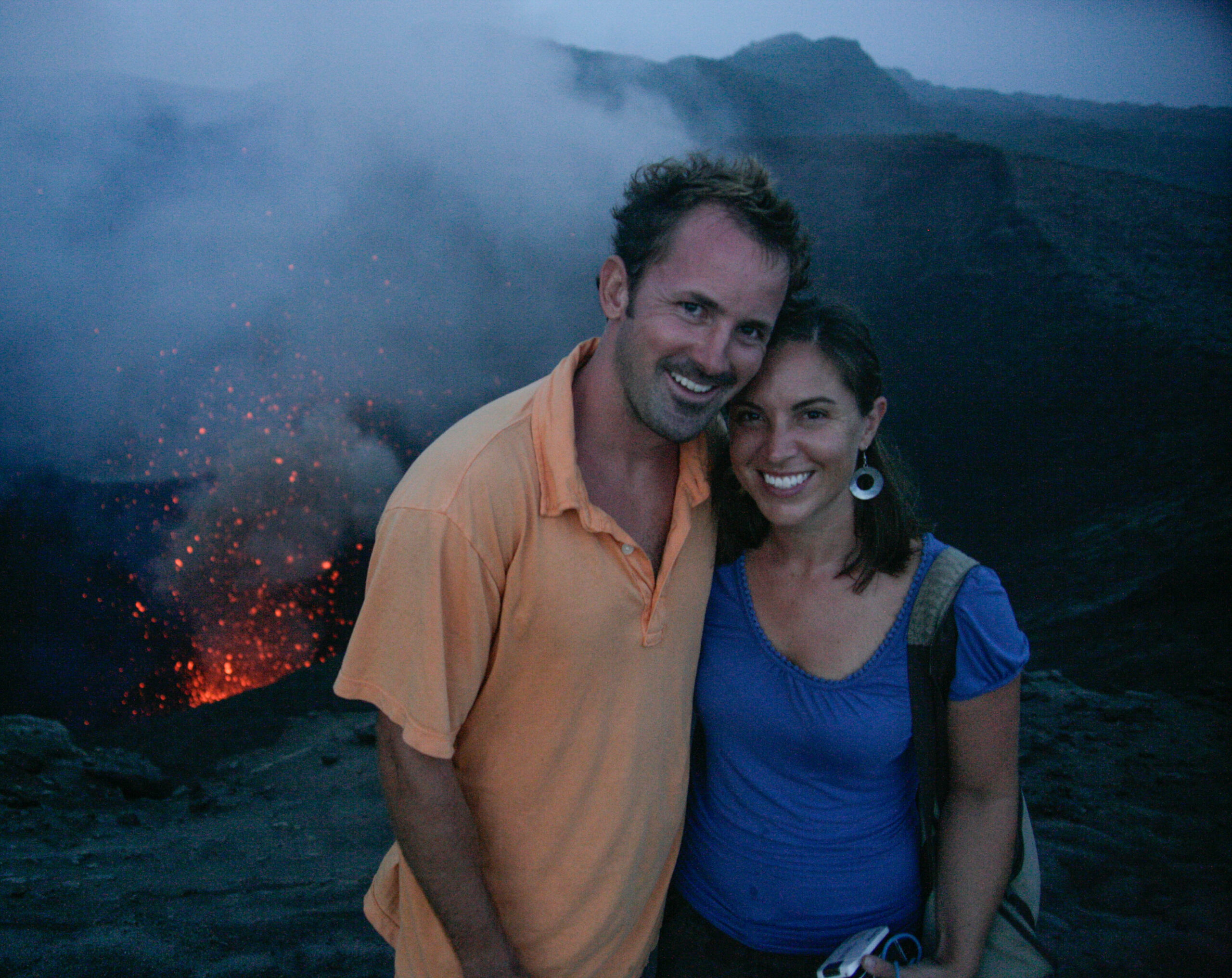
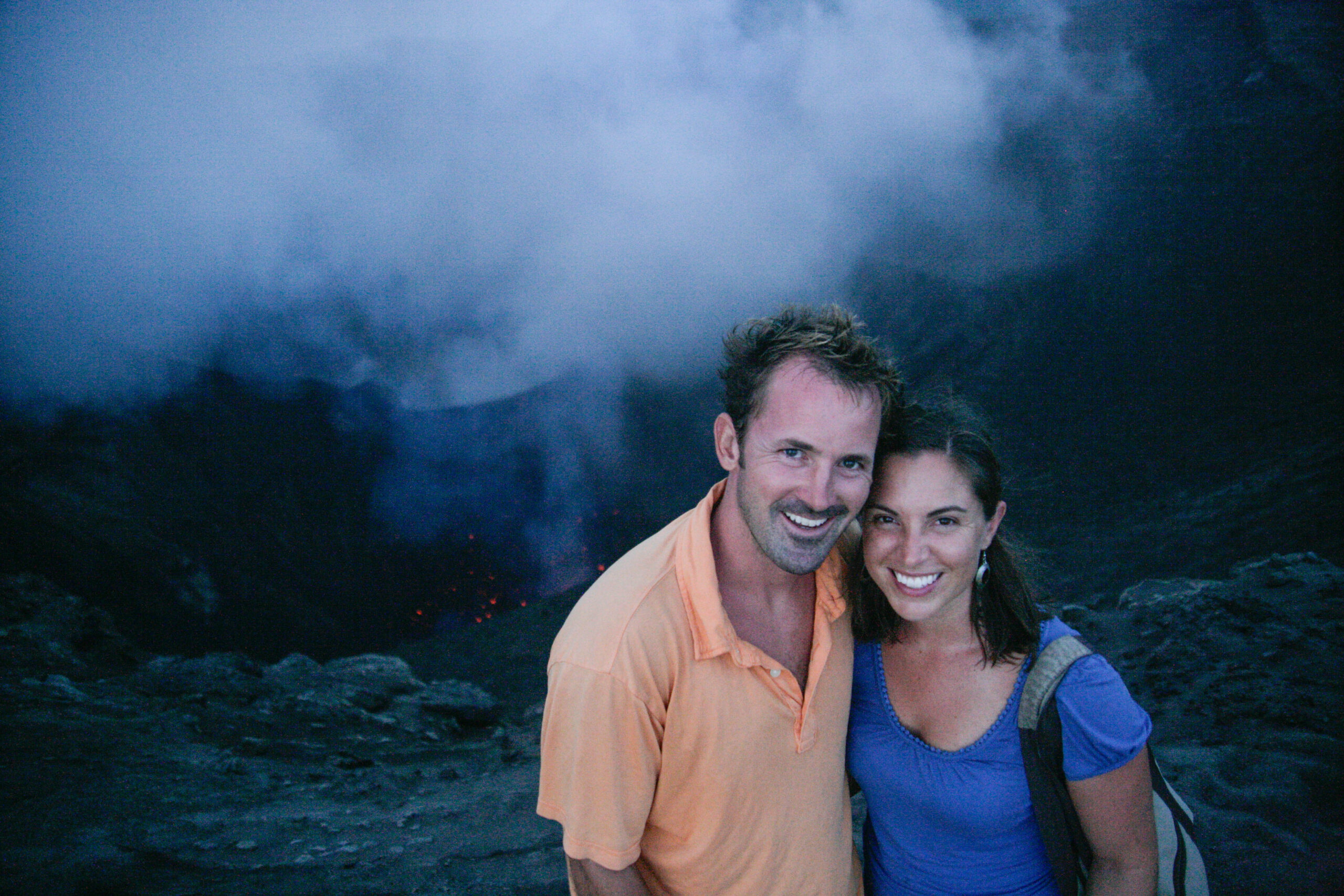
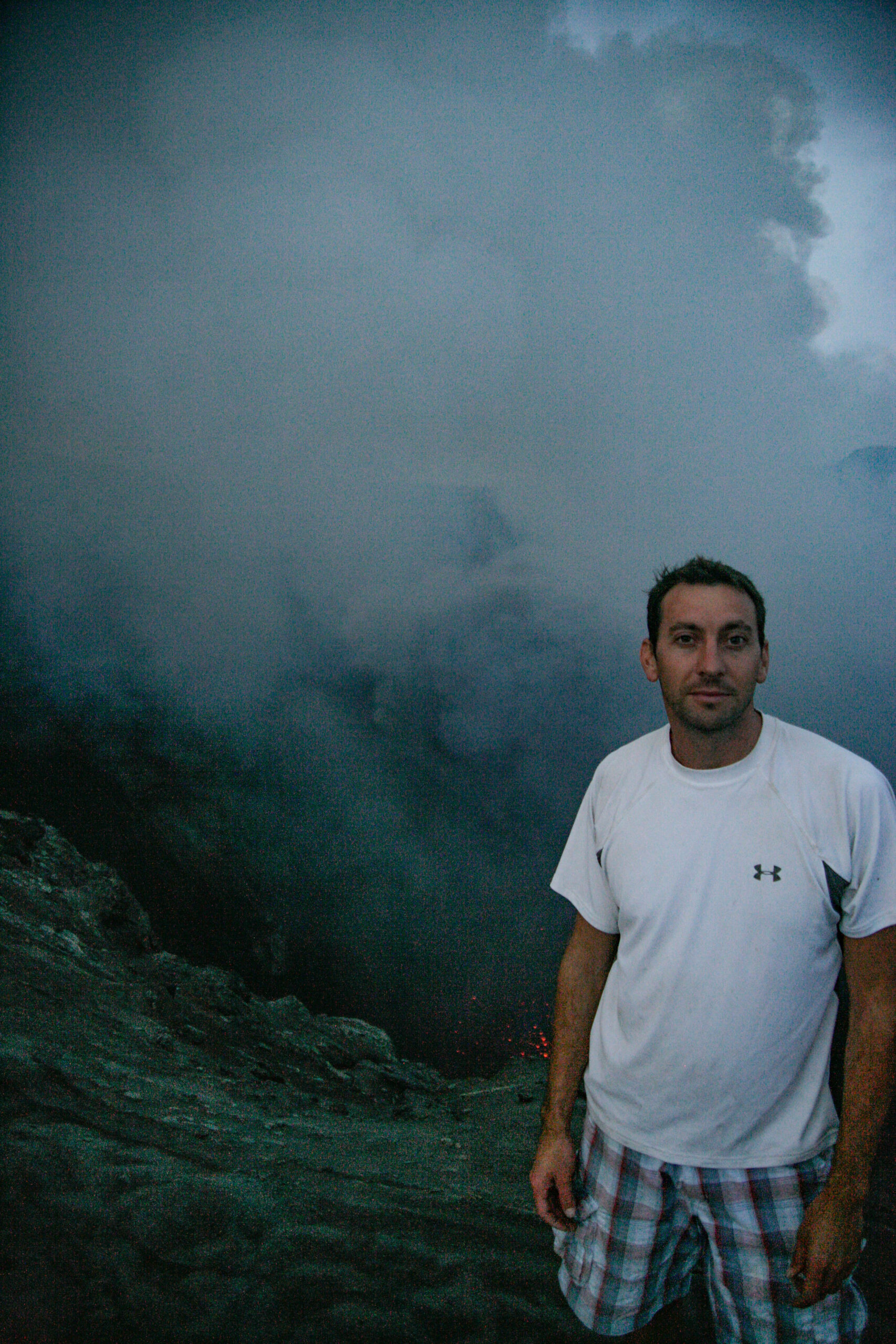
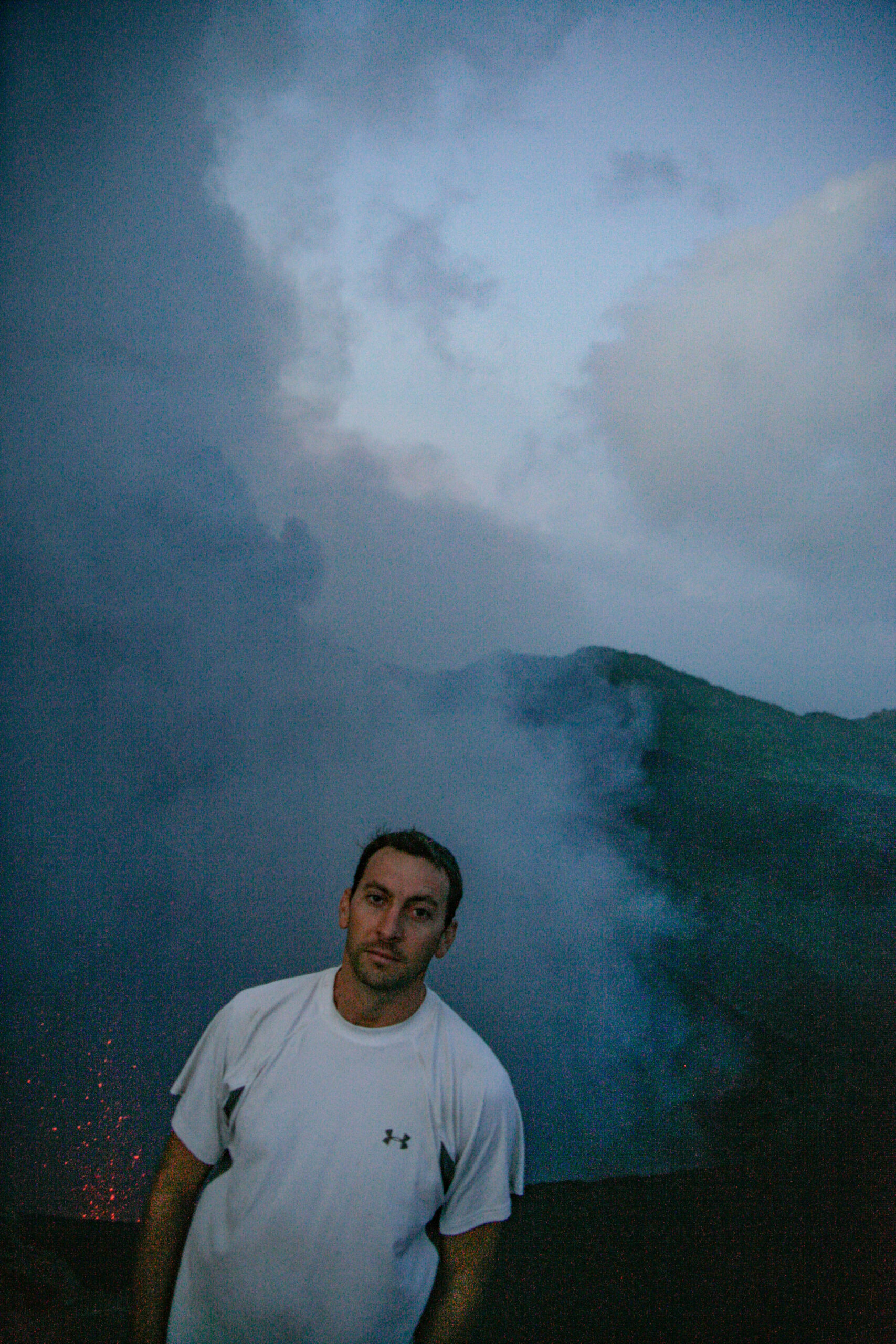
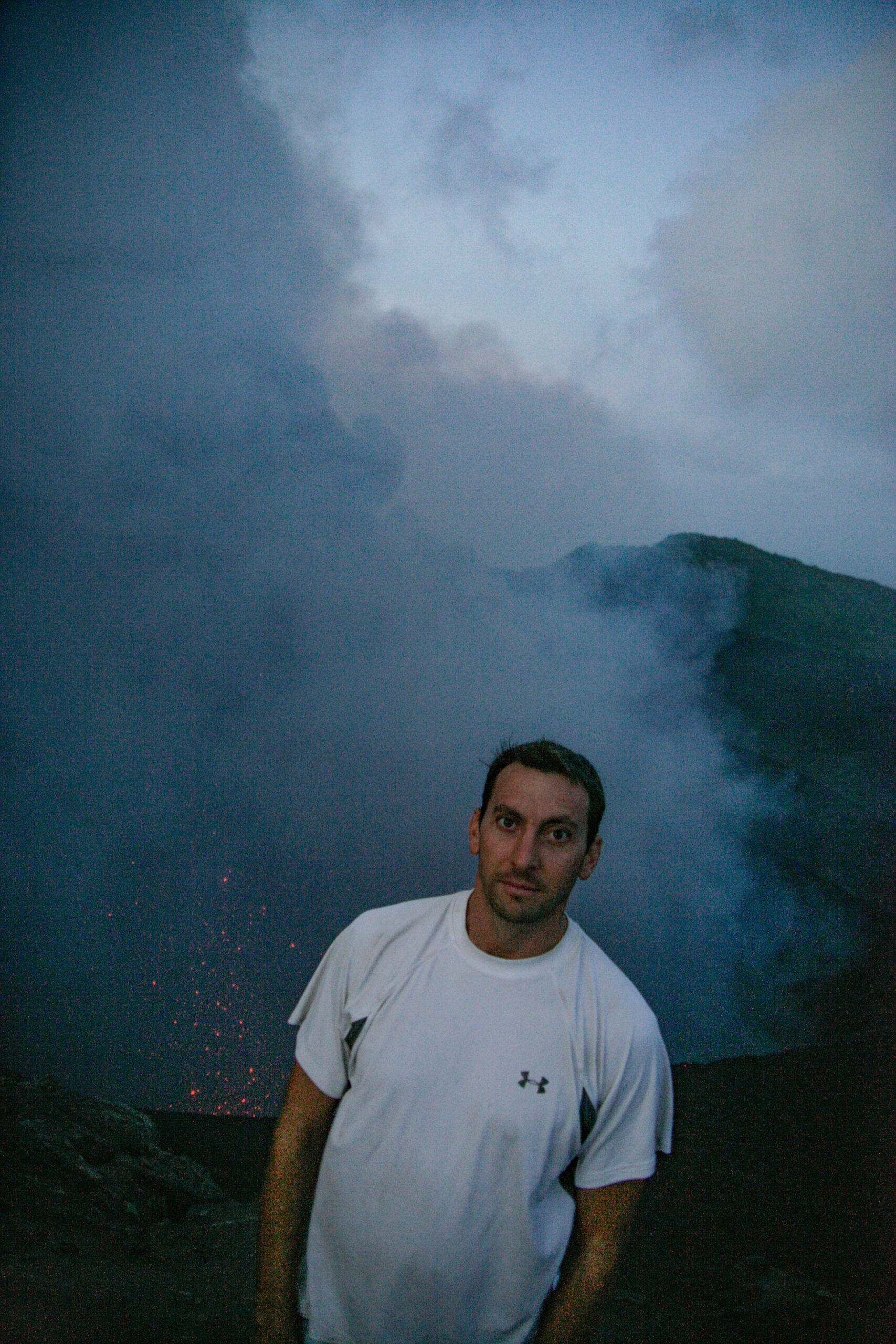
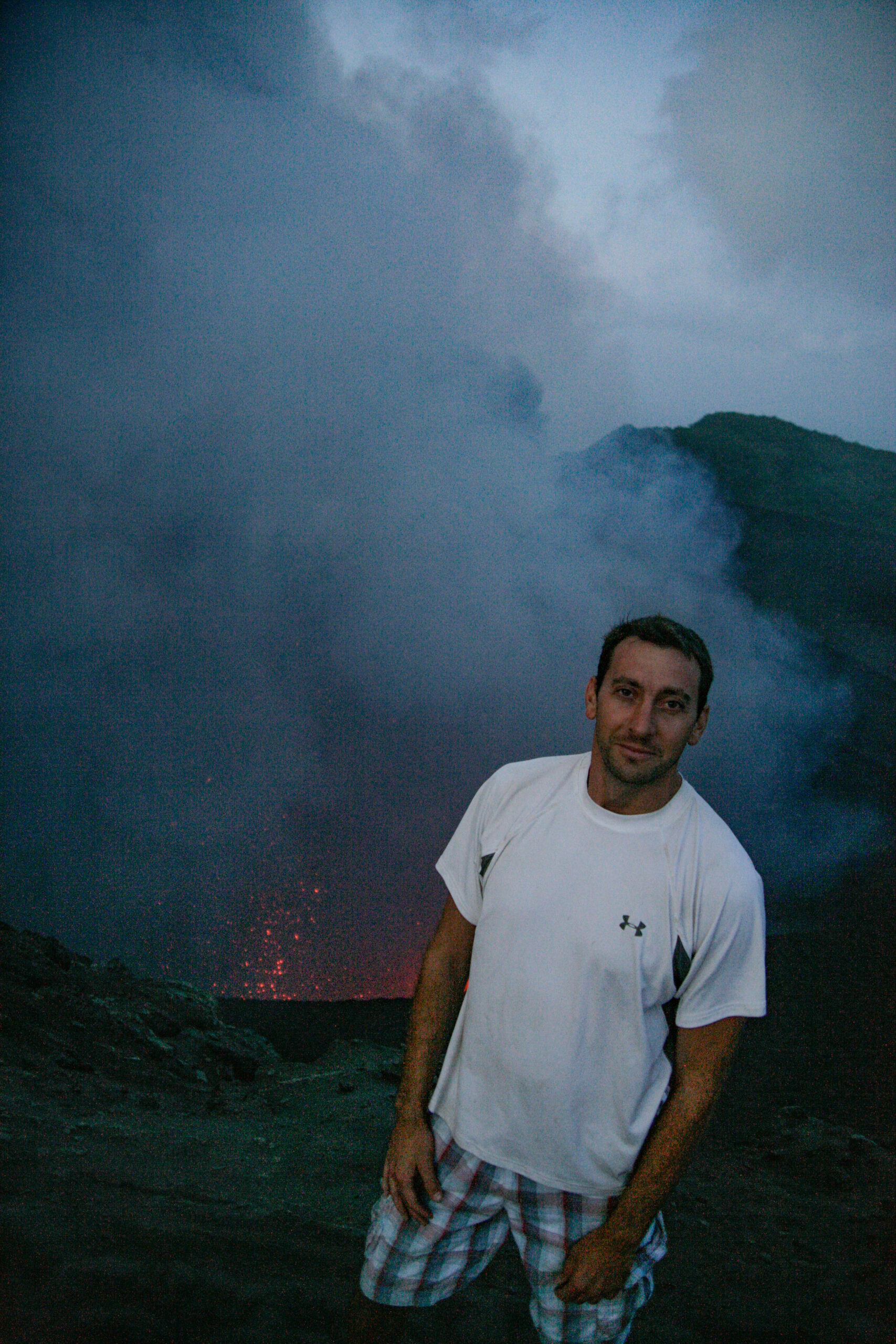
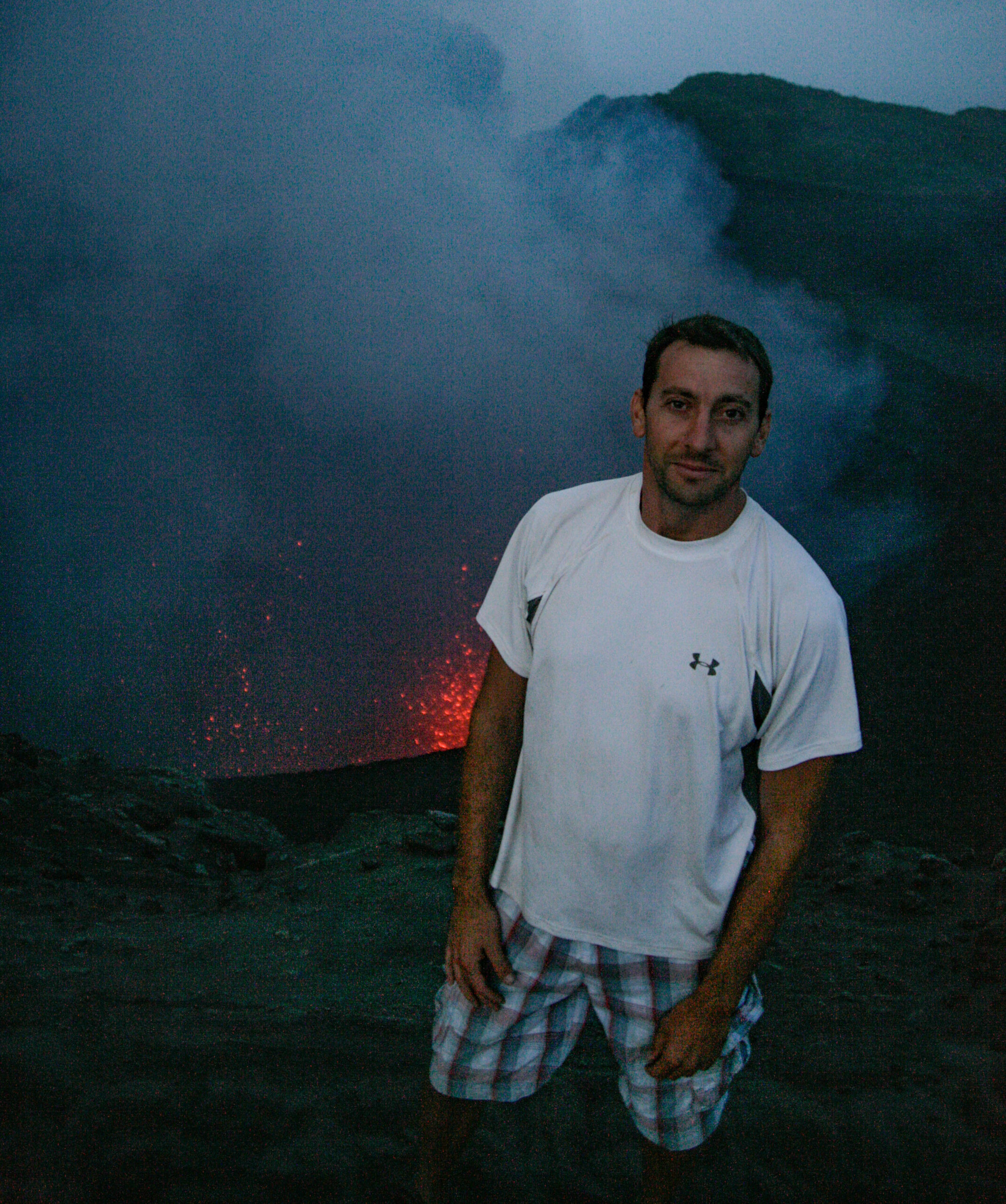
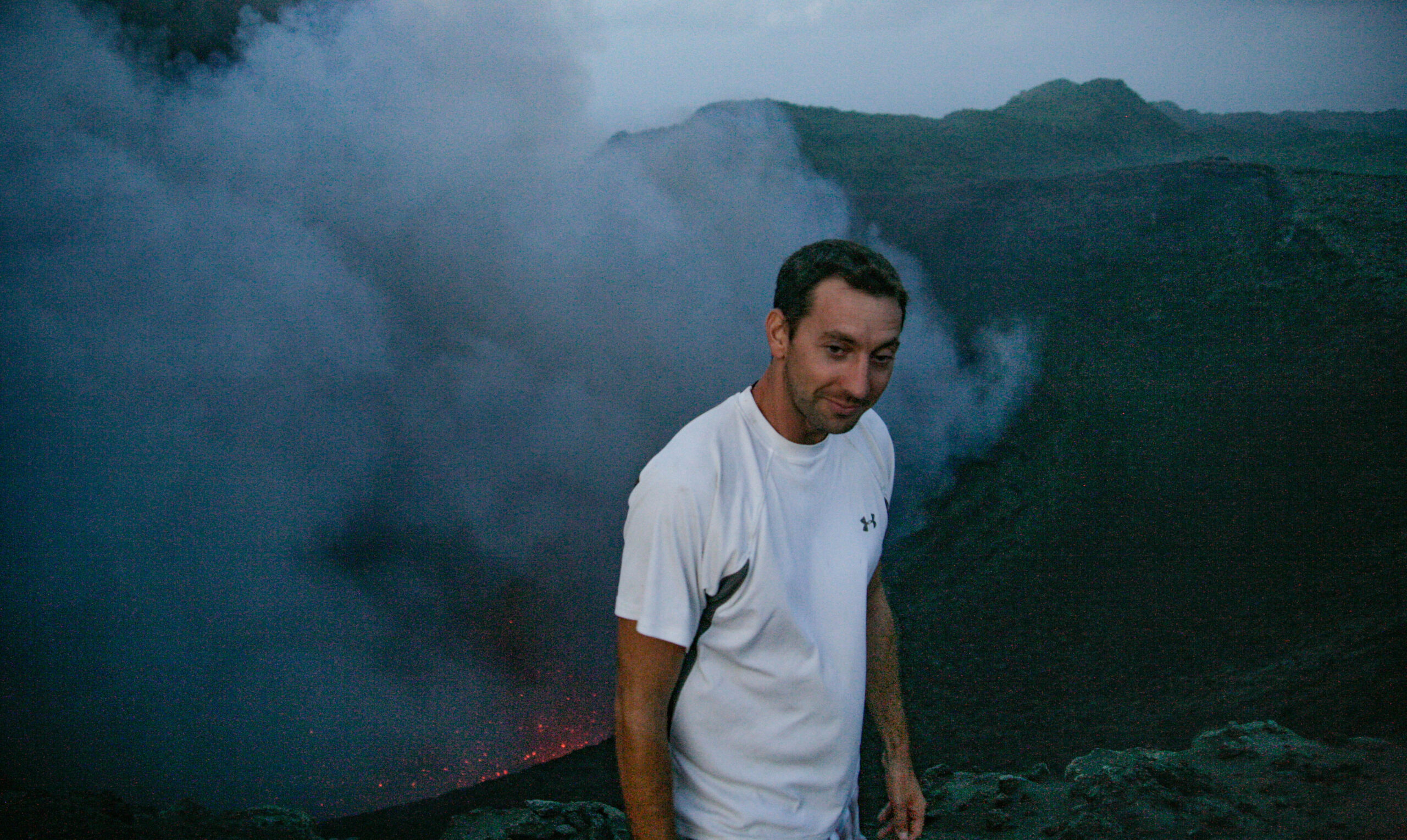
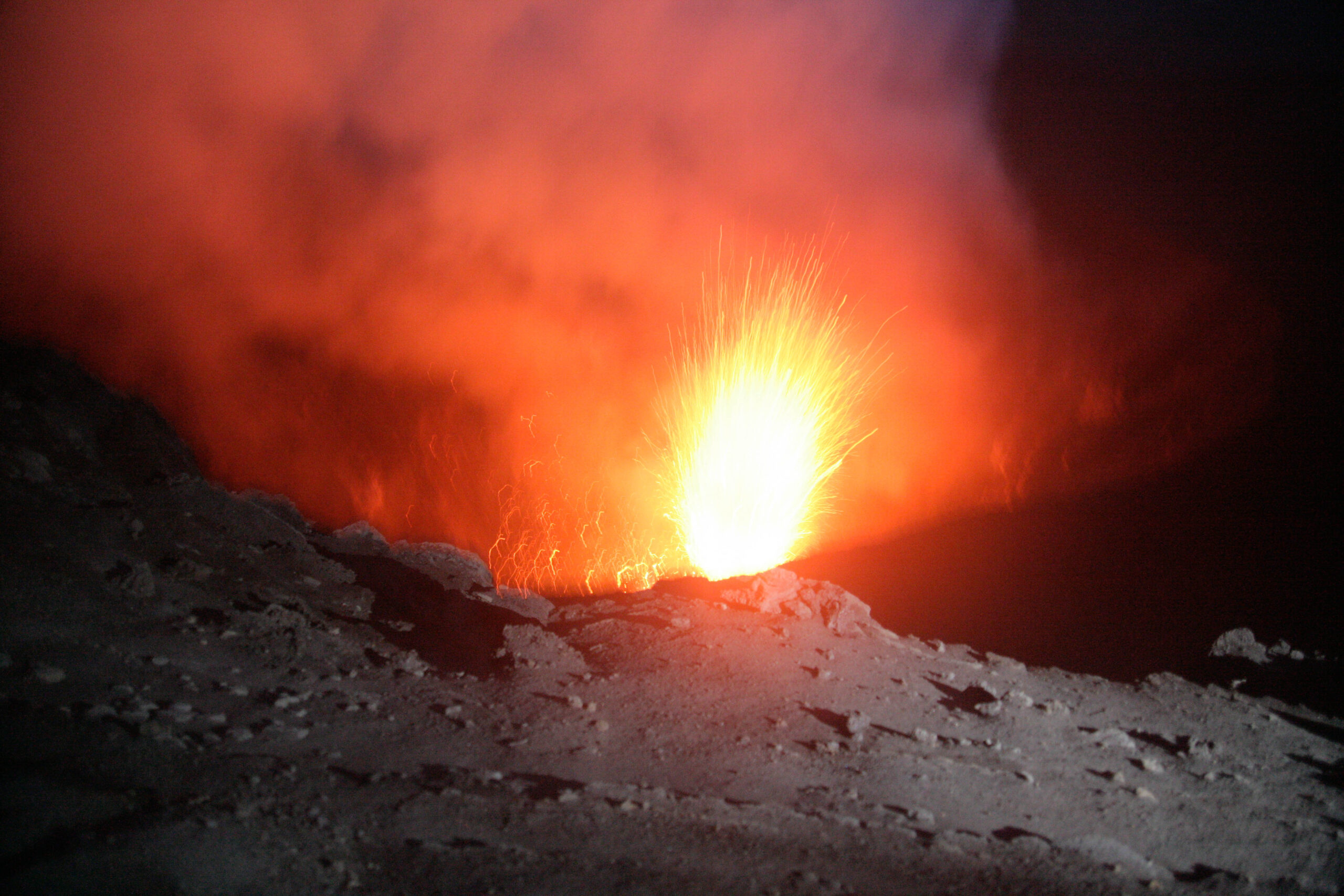
    The last stretch of sailing to Tanna happened at night.  We were forty miles away when I took over the watch at midnight.  Two hours later we were thirty miles away and I noticed a glow on the horizon.  The mysterious glow seemed to hover over the island, like the lights of a metropolis from a distance in the evening, though a metropolis we certainly were not approaching.  The mysterious glow was why we were here.  The mysterious glow was from the boiling molten magma in the crater of an active volcano.  Our plan was to stand on the rim of this rumbling, lava- spewing, debris-belching beast.  Mt. Yasur.

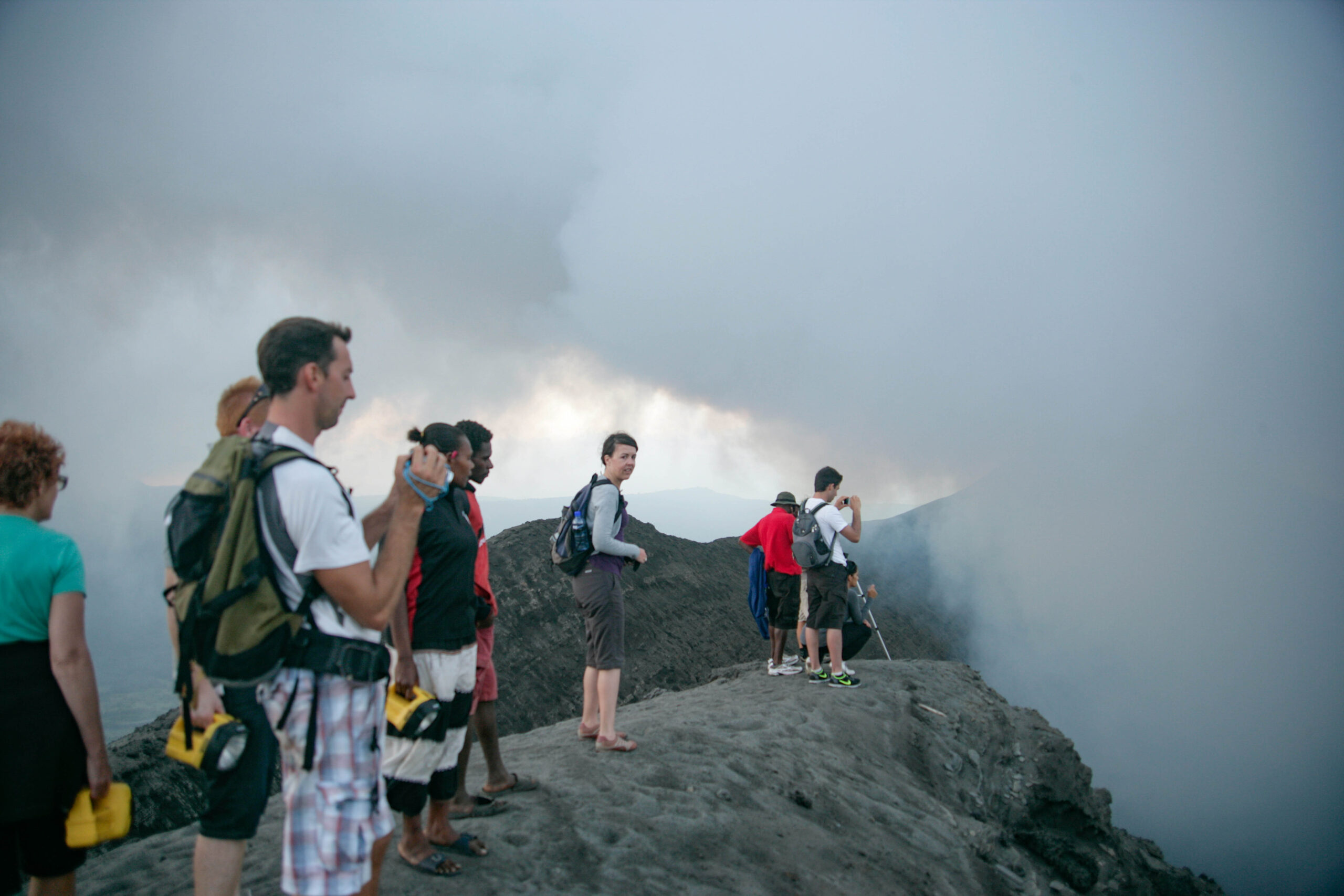
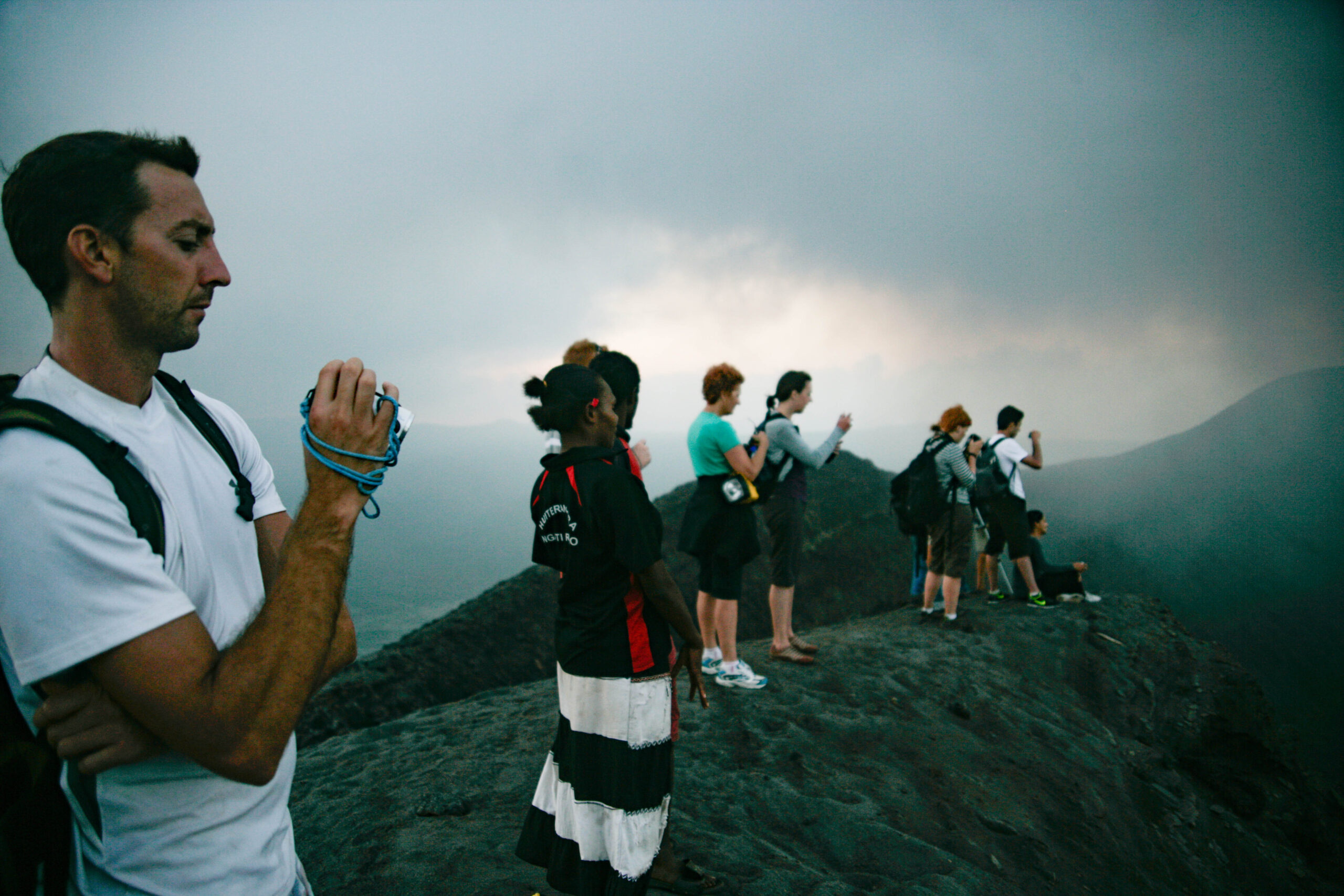
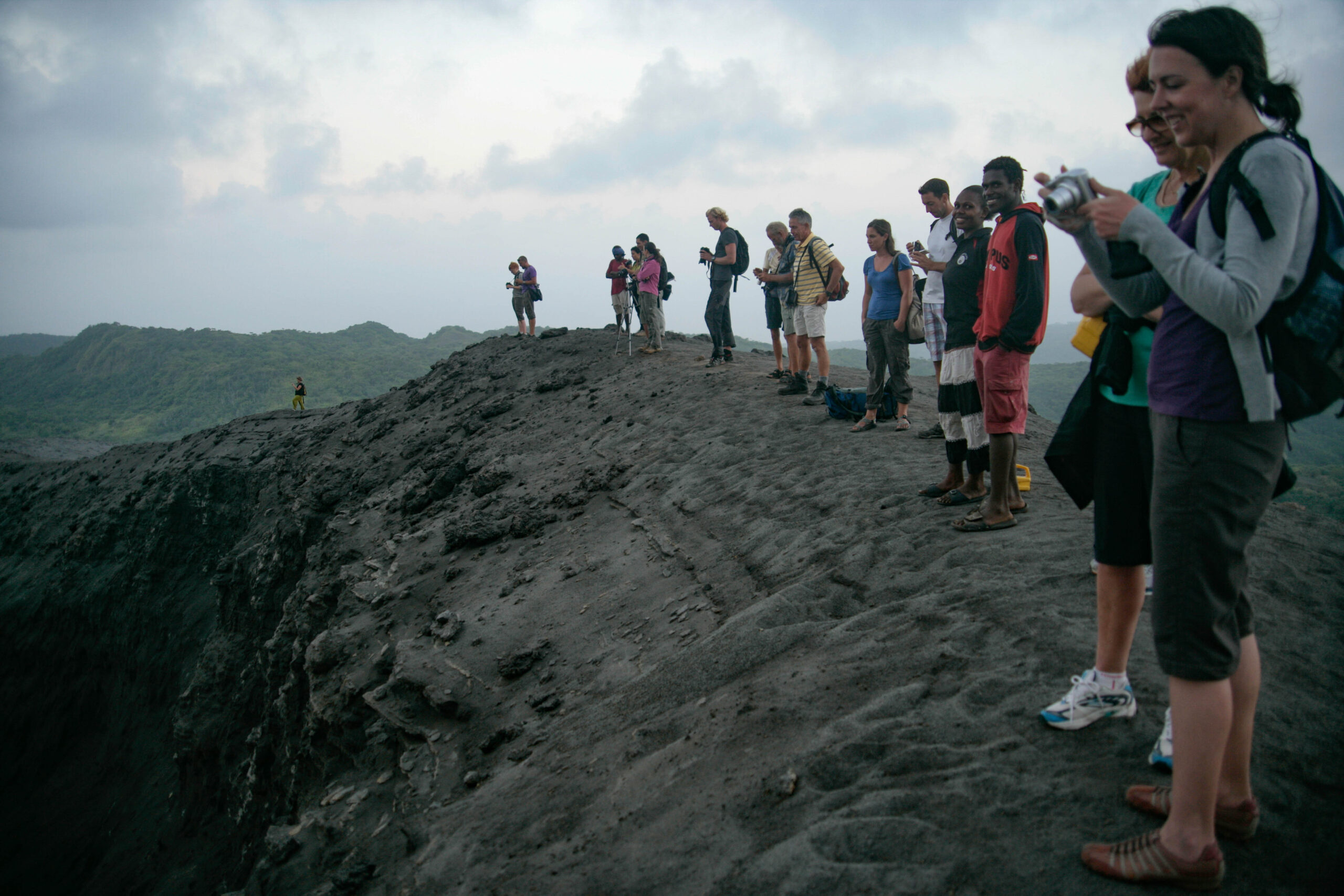
    Us and, as it turns out, 40 of our not-so-closest tourist friends.

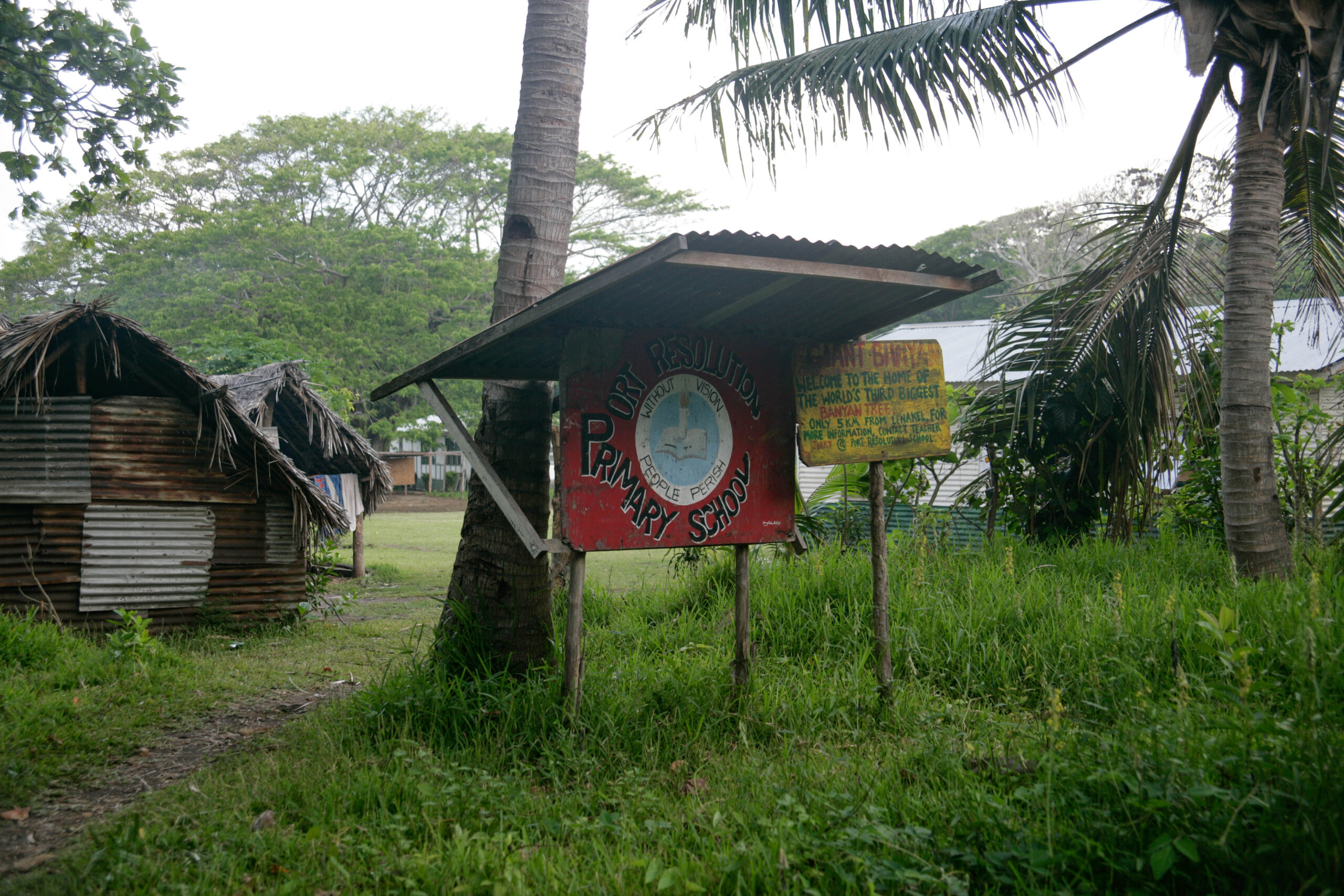
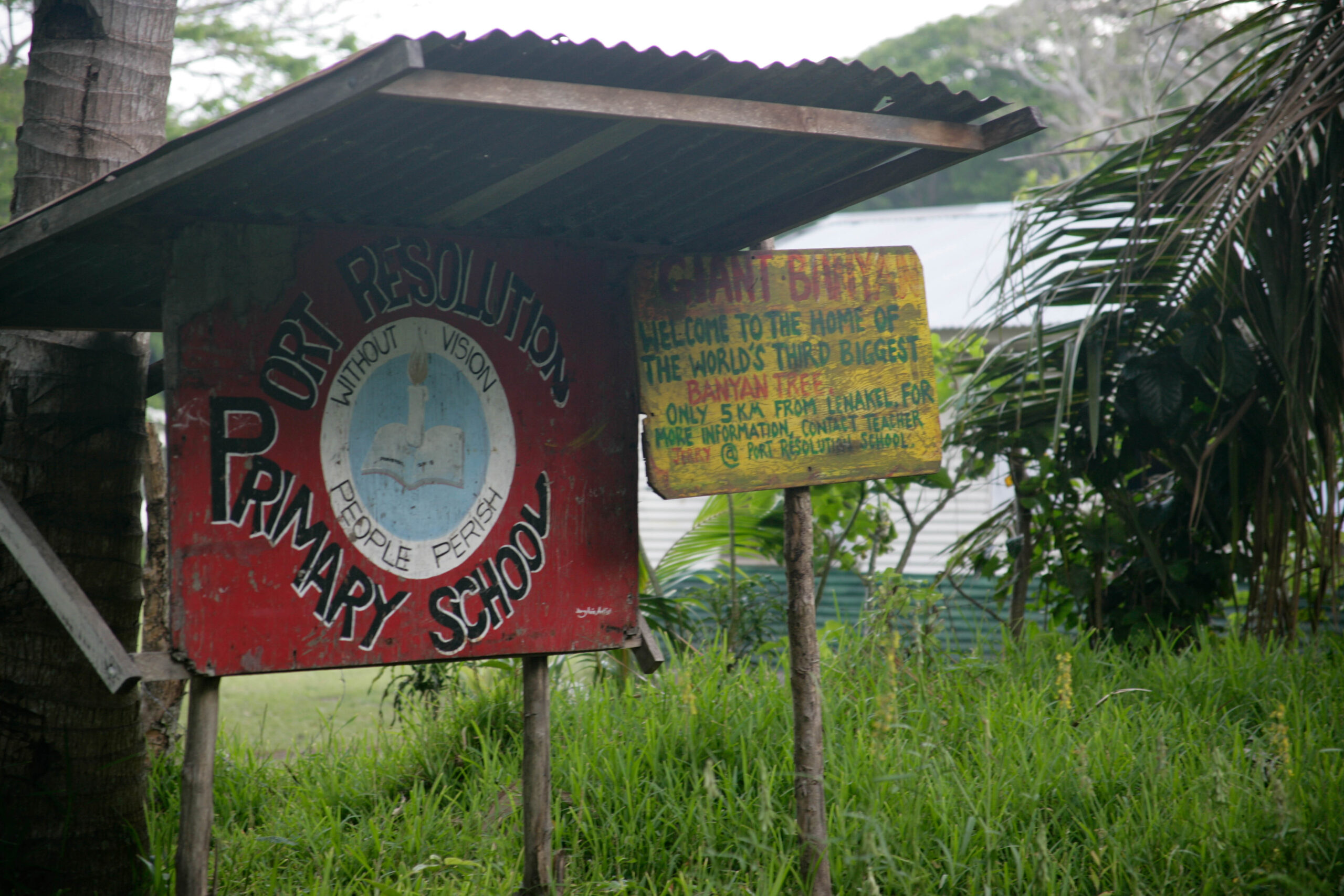
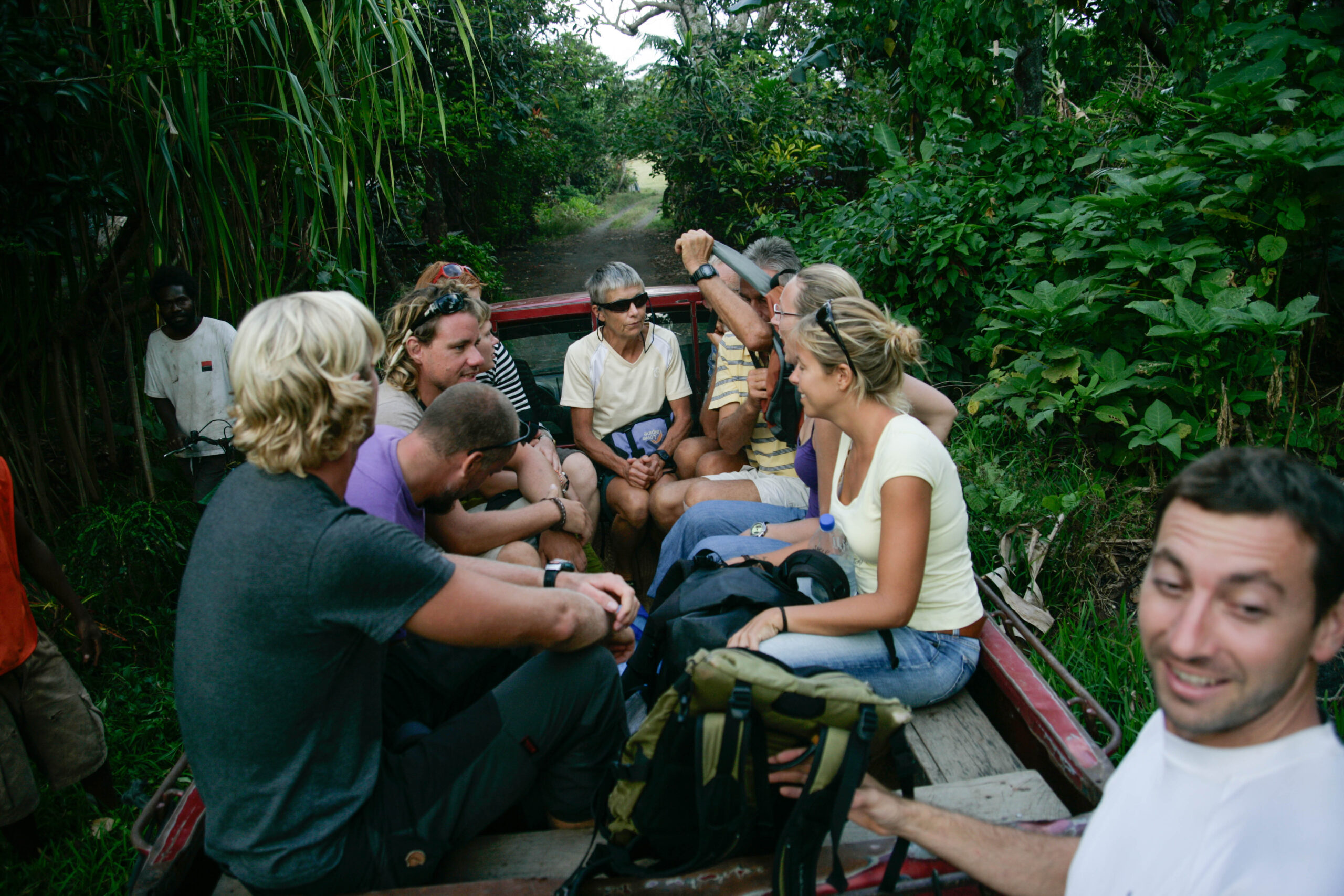
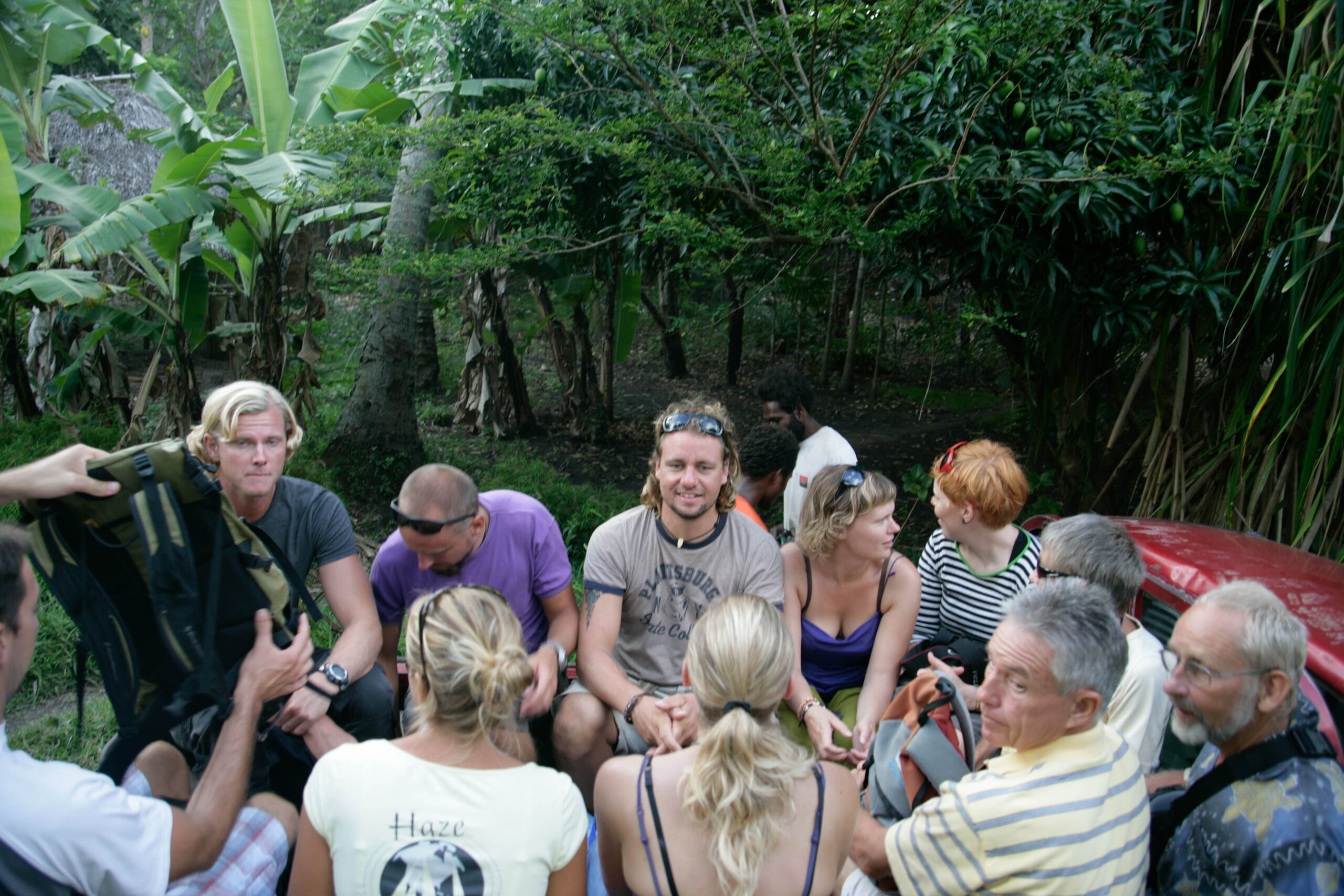
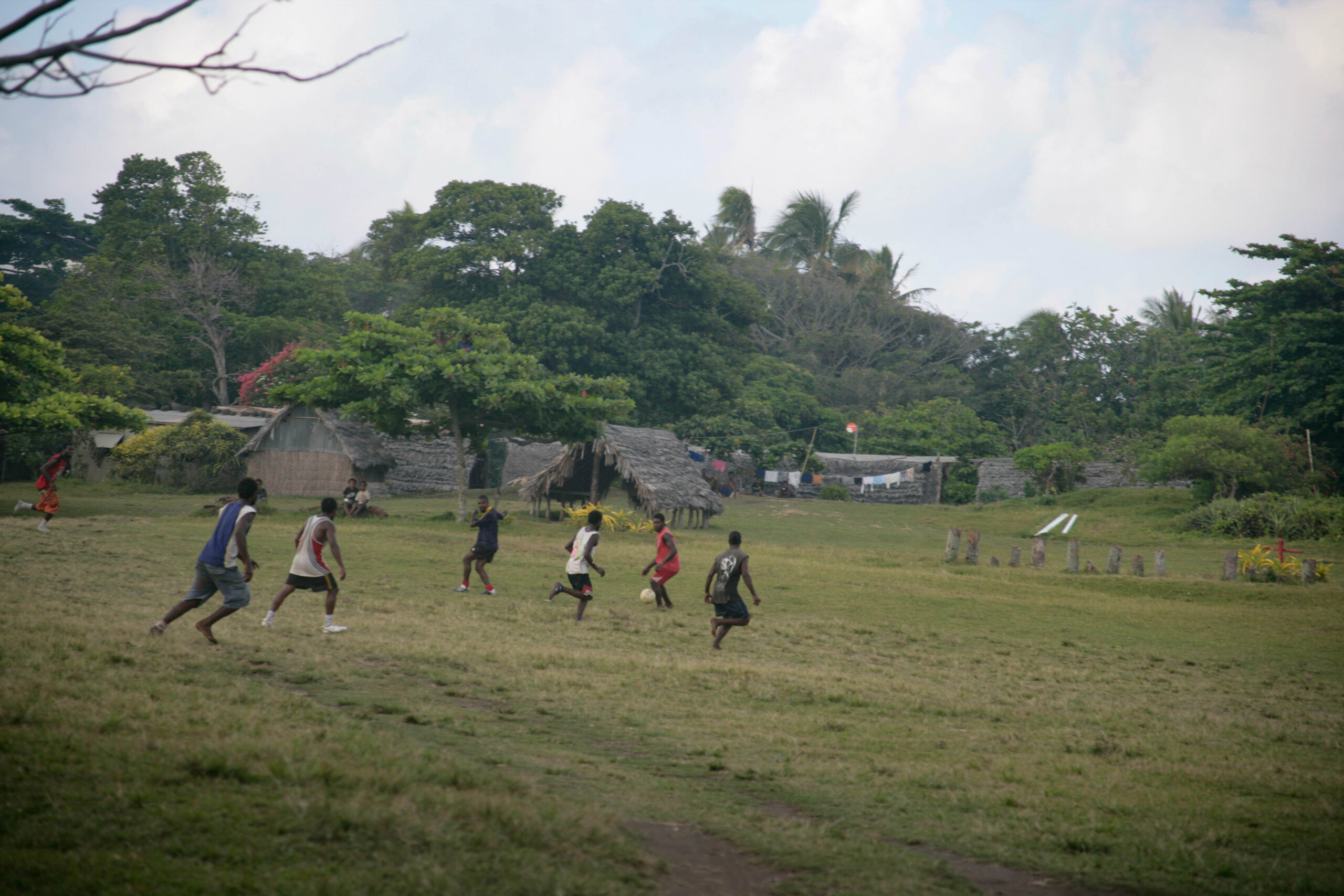
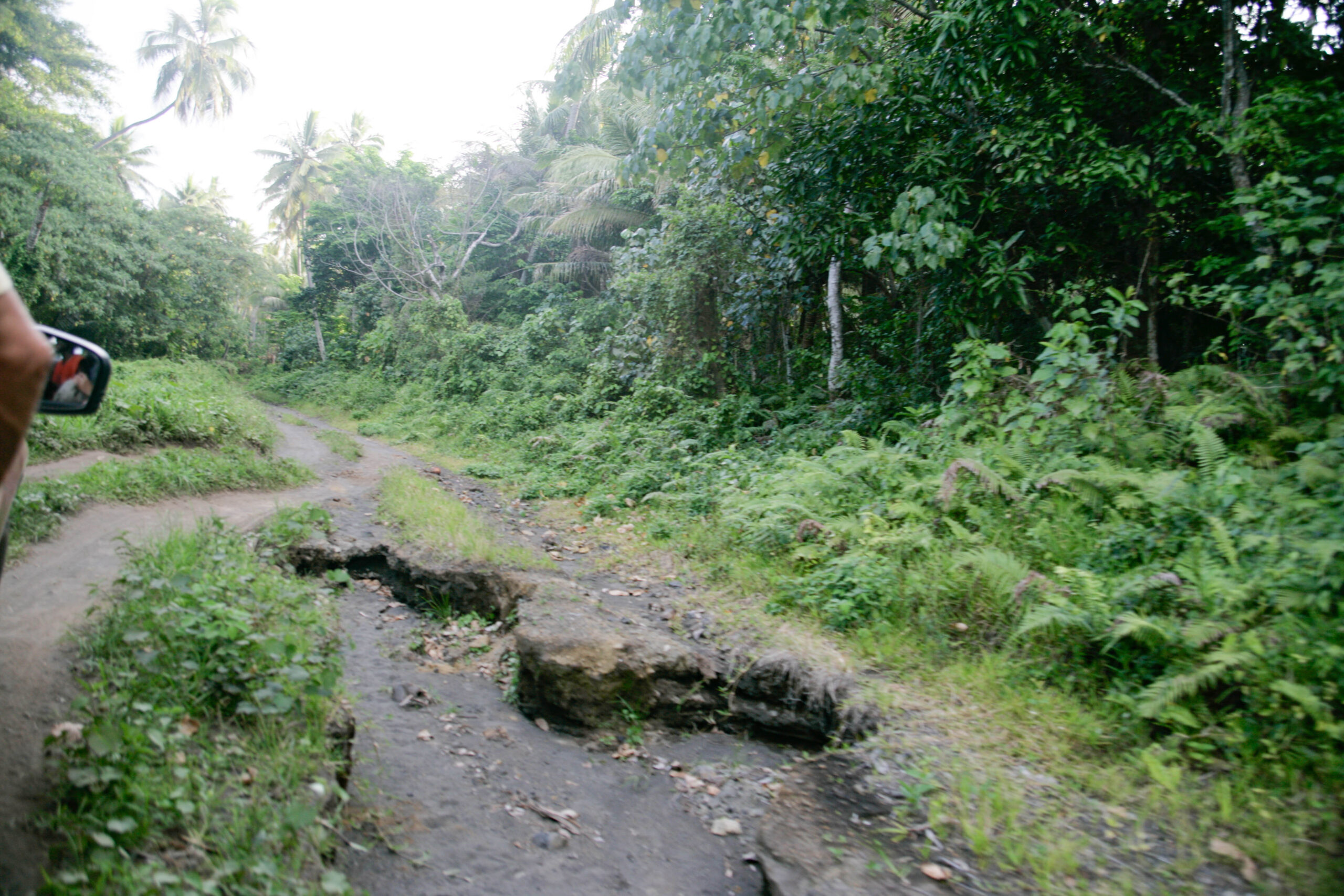
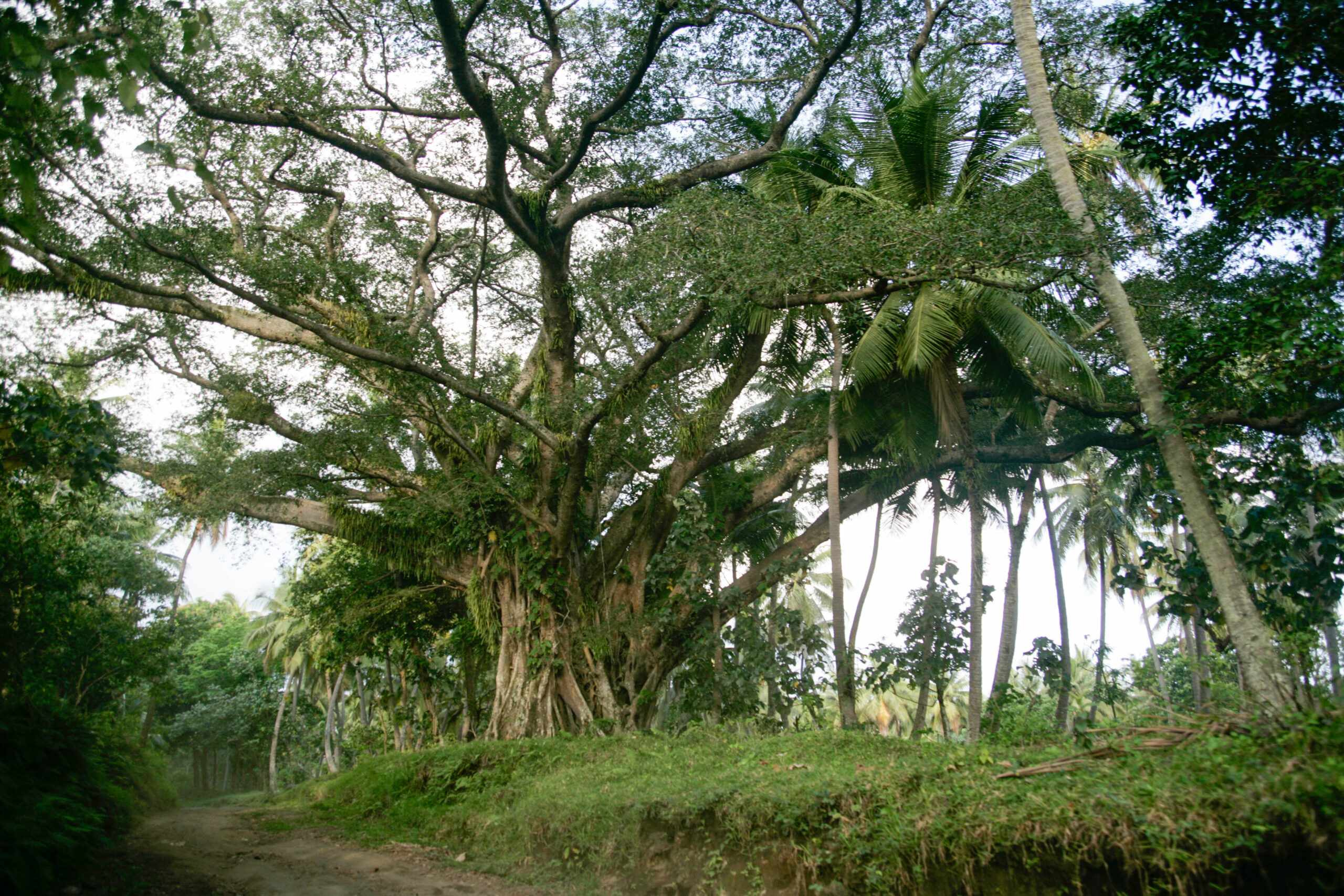
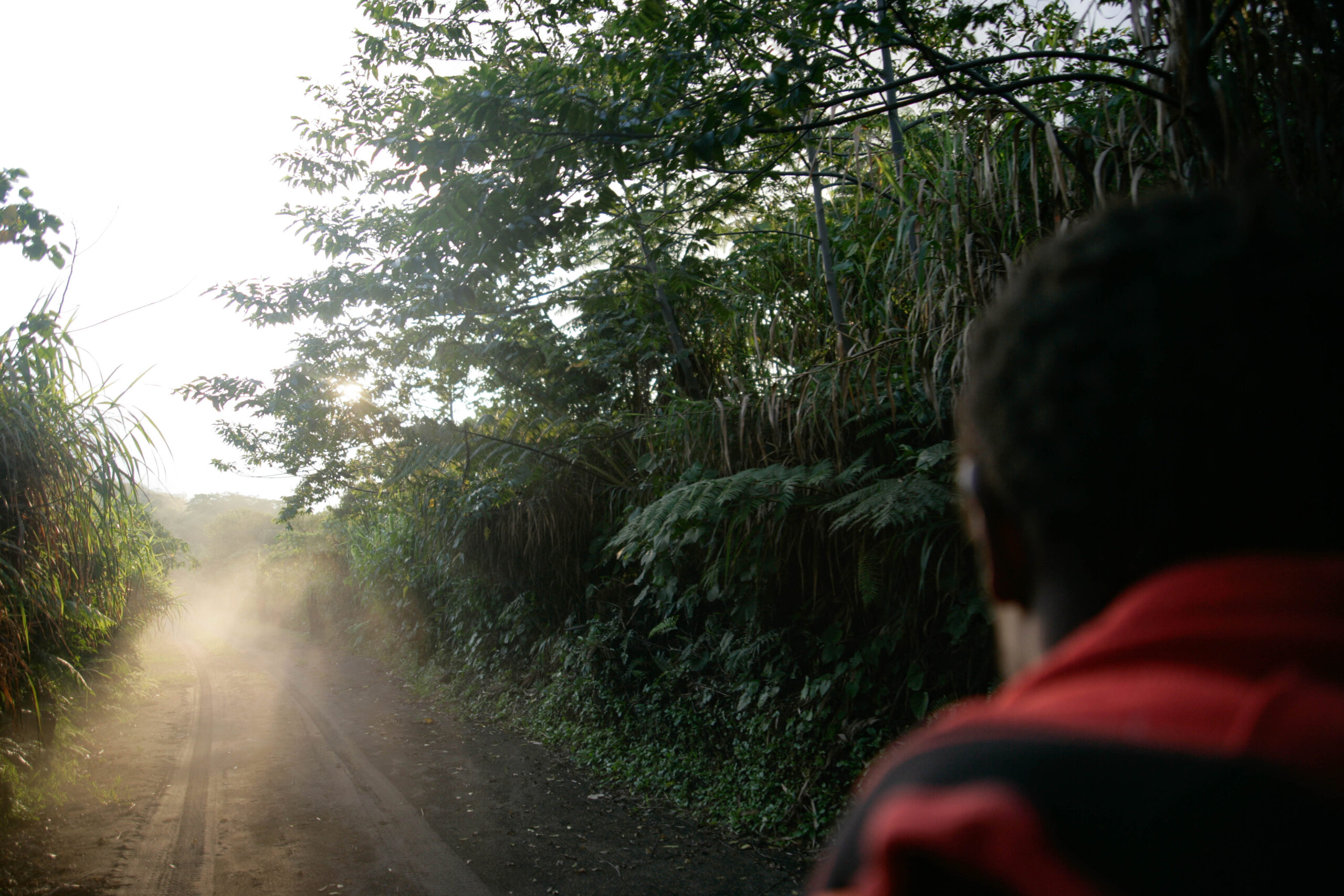
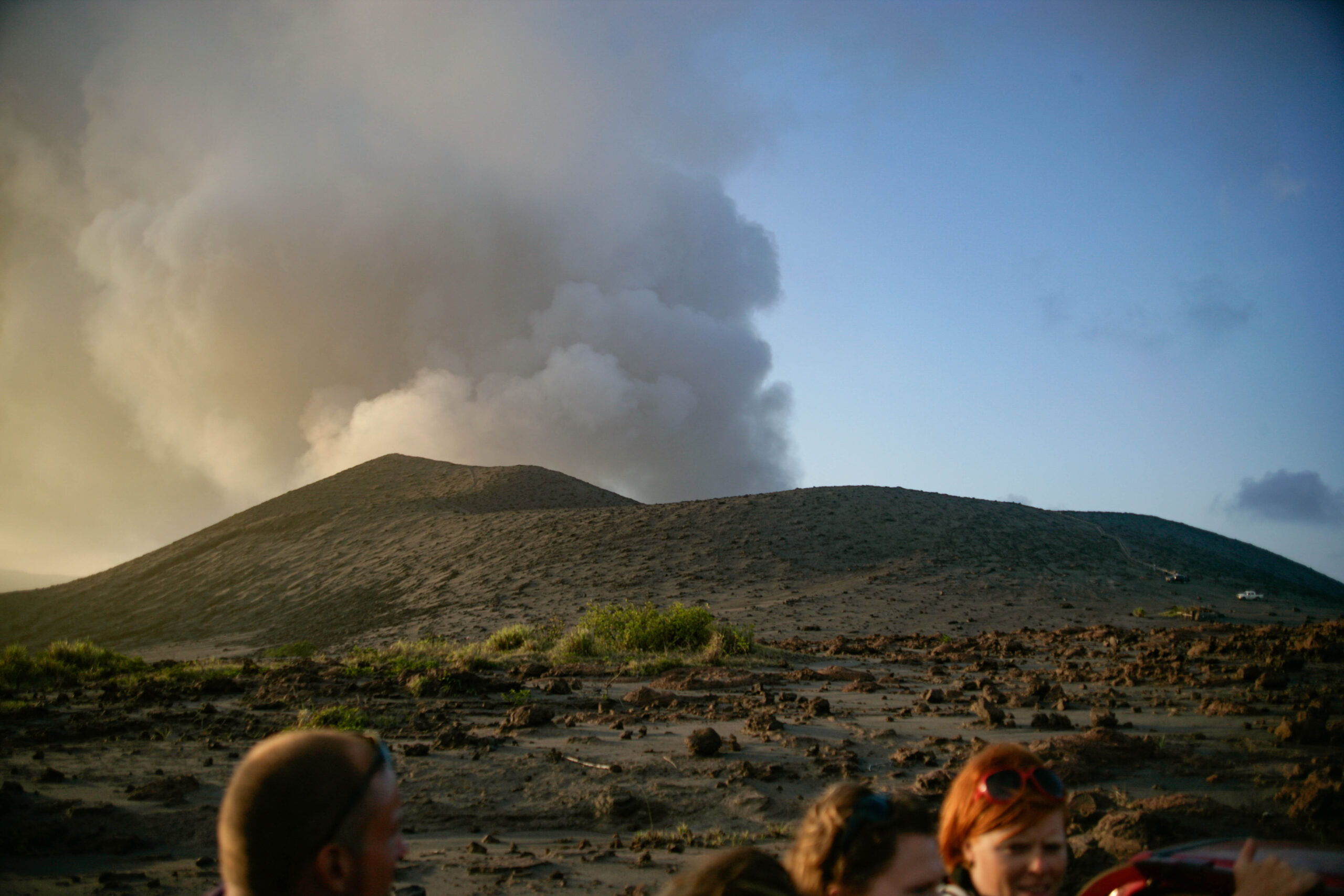
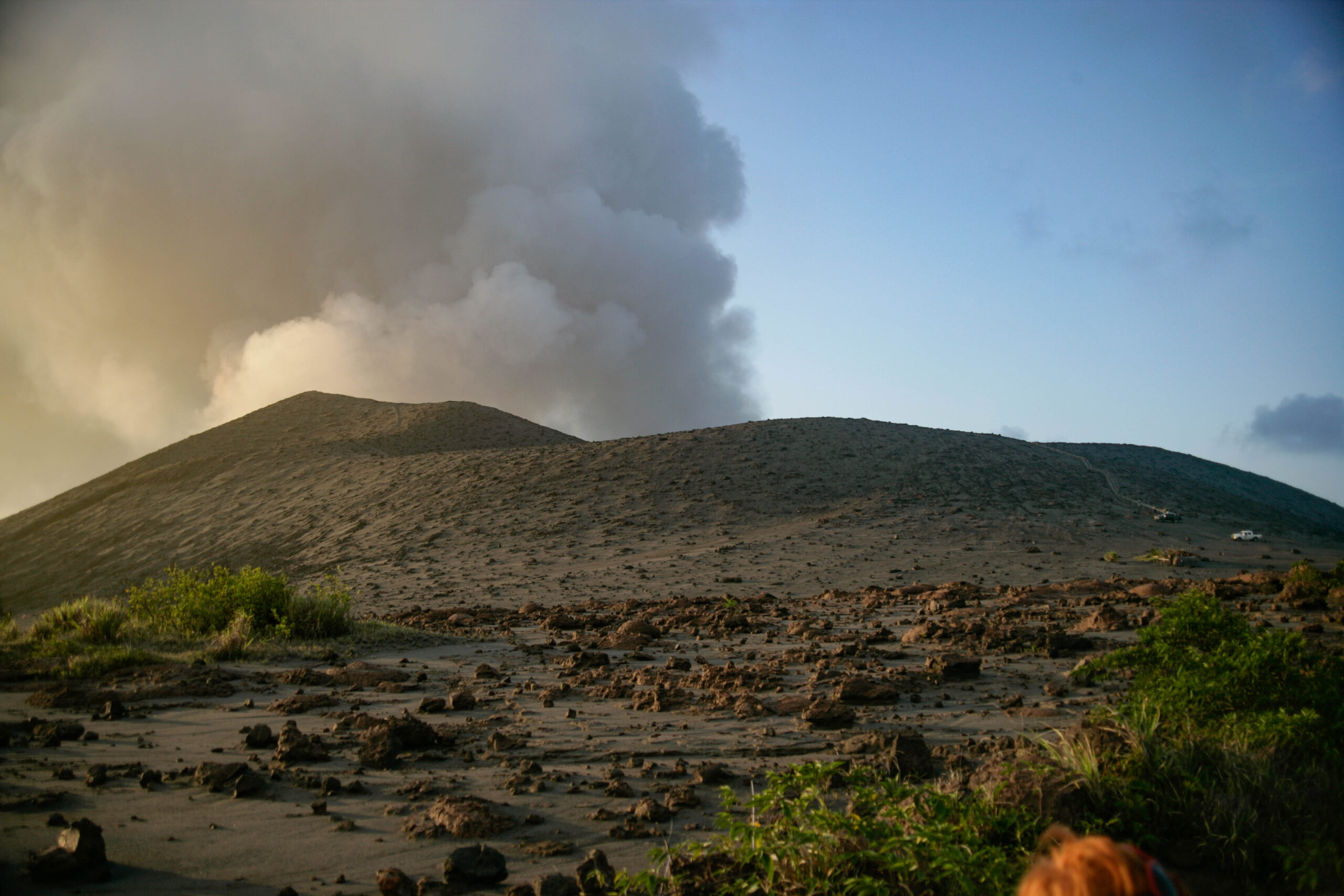
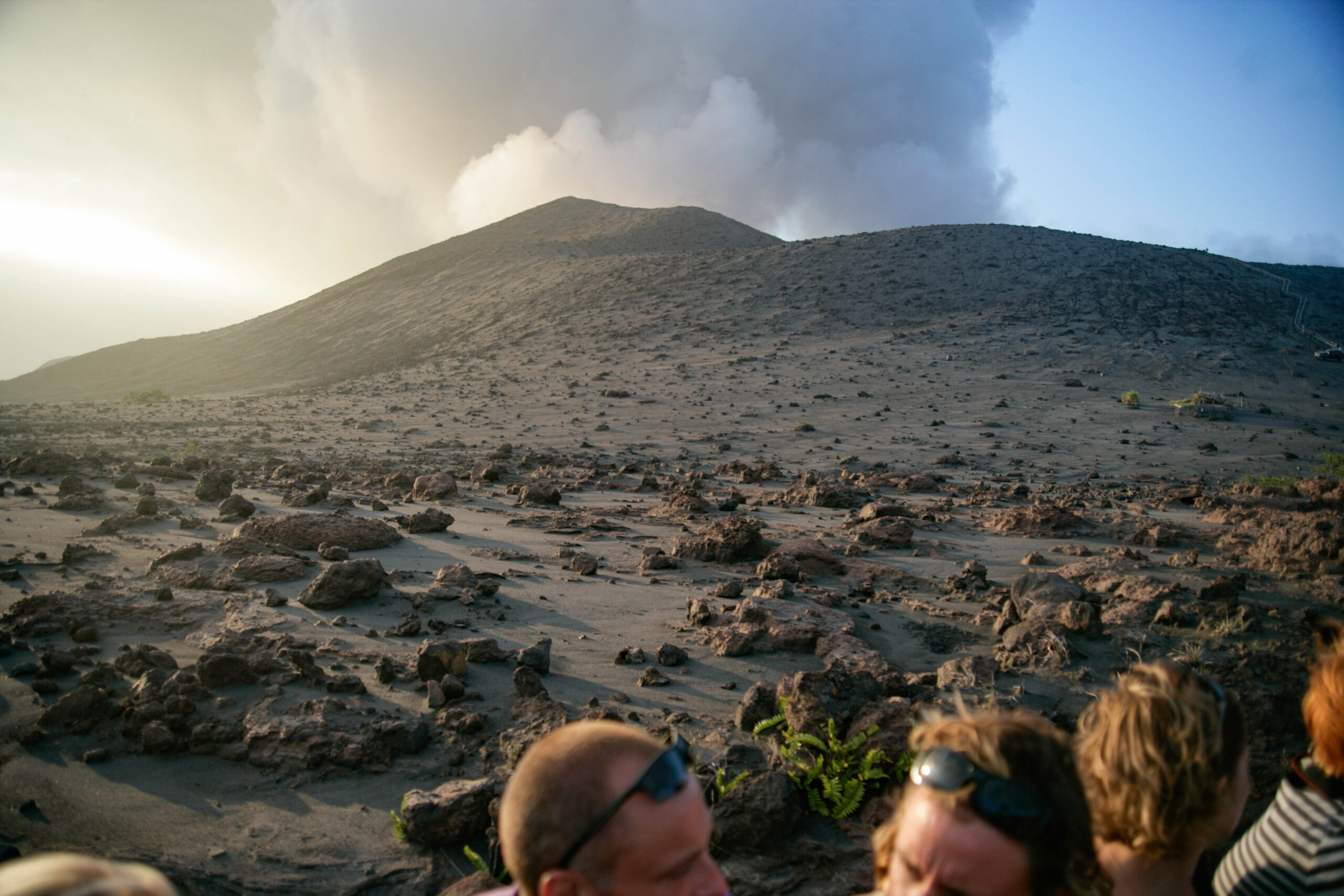
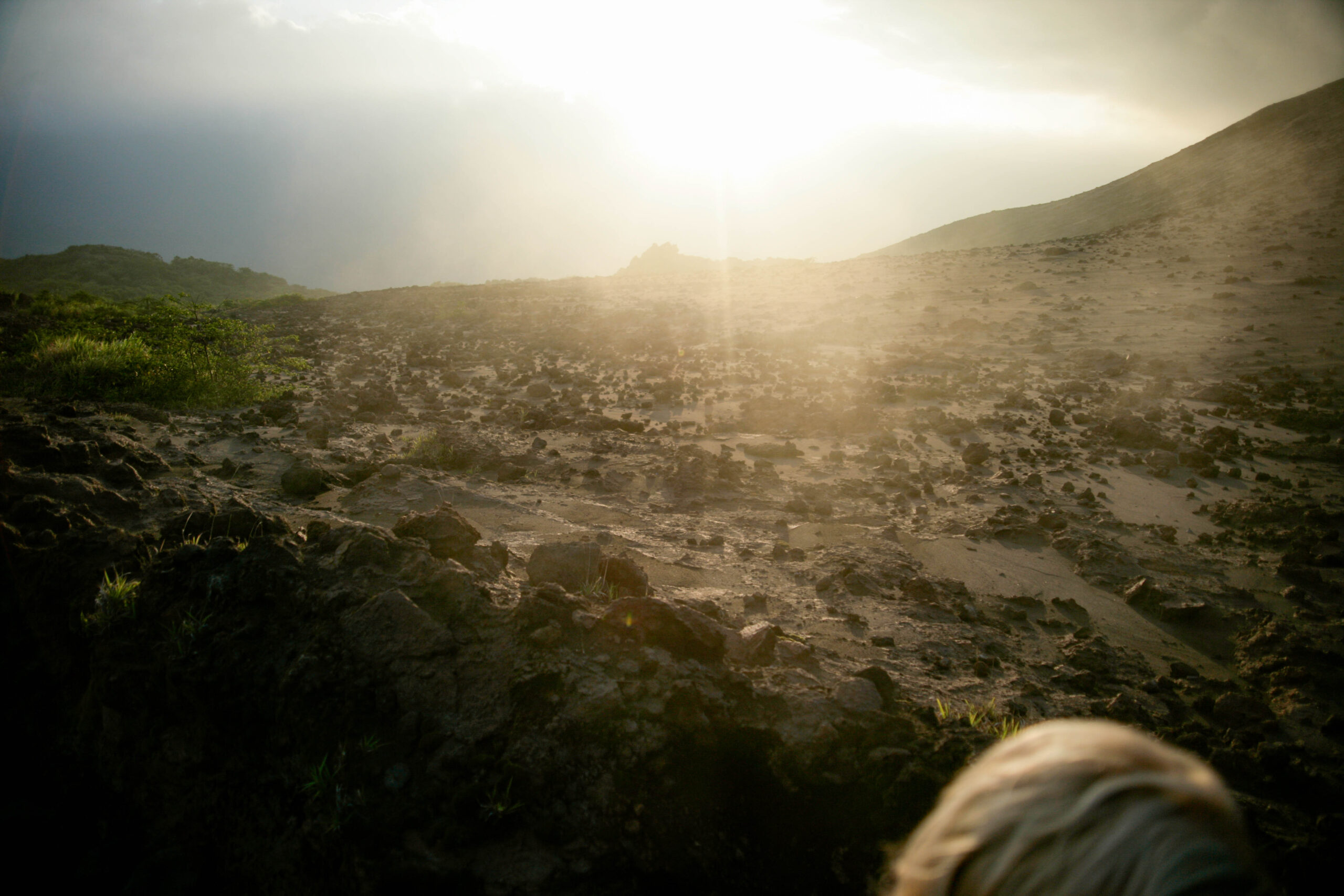
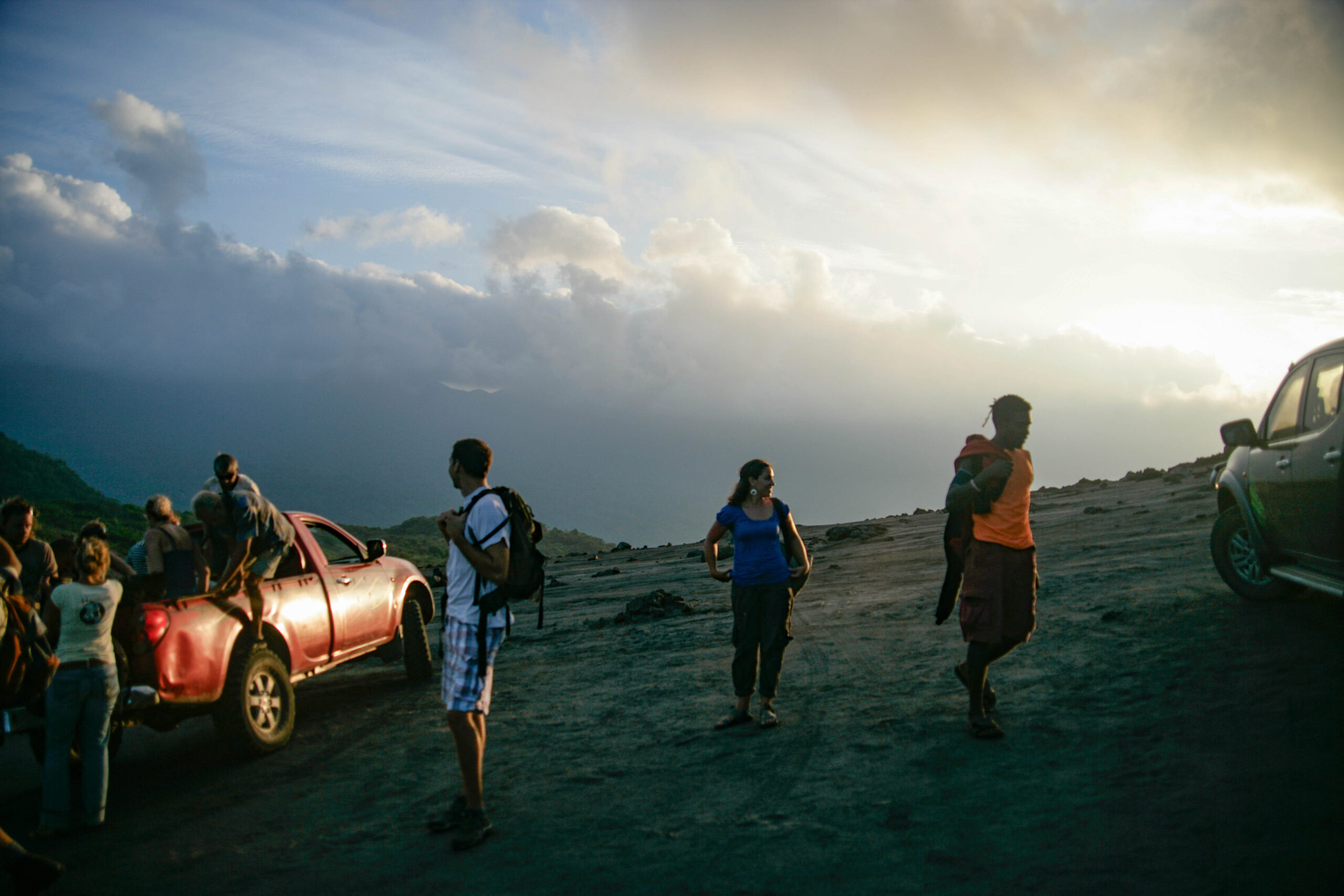
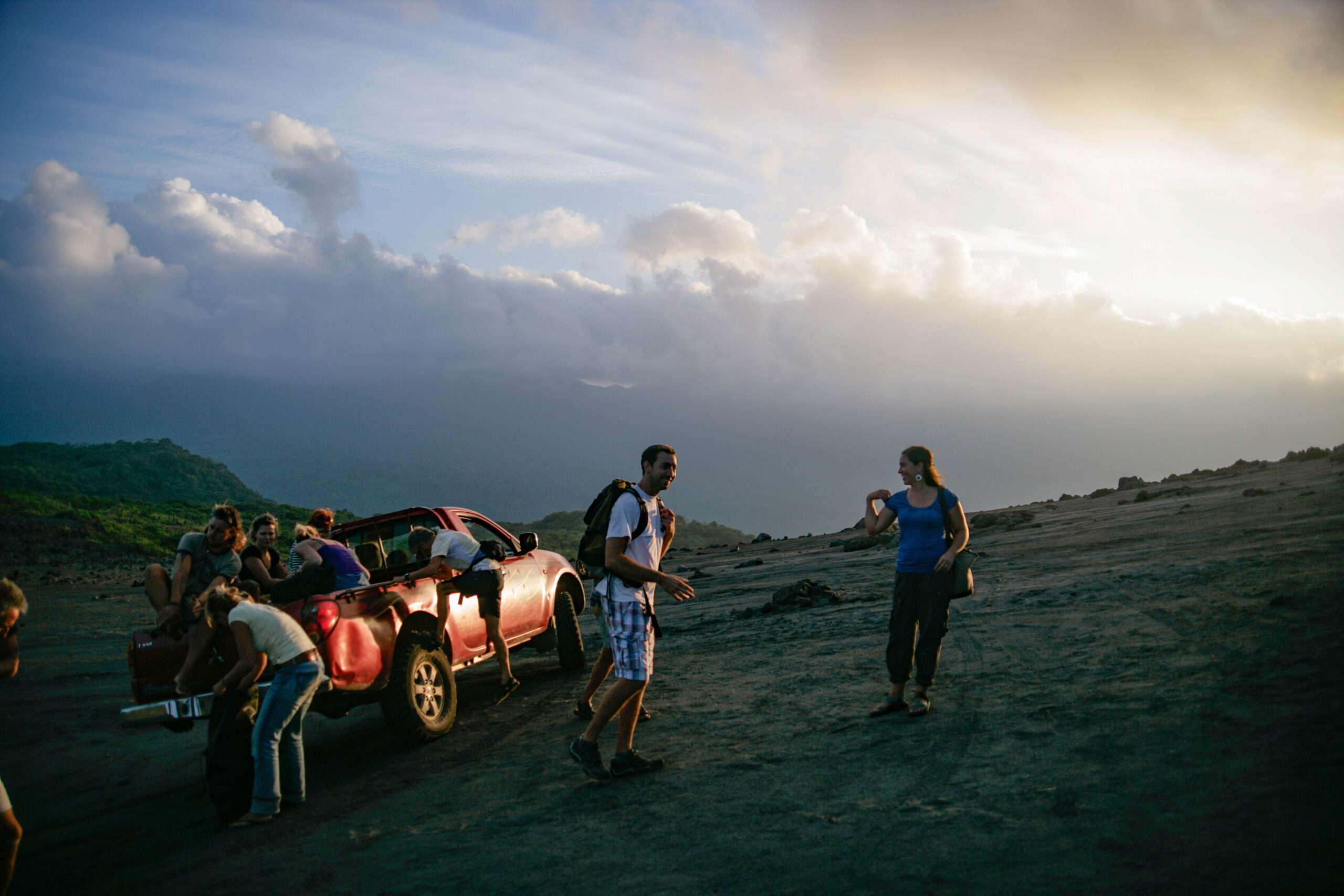
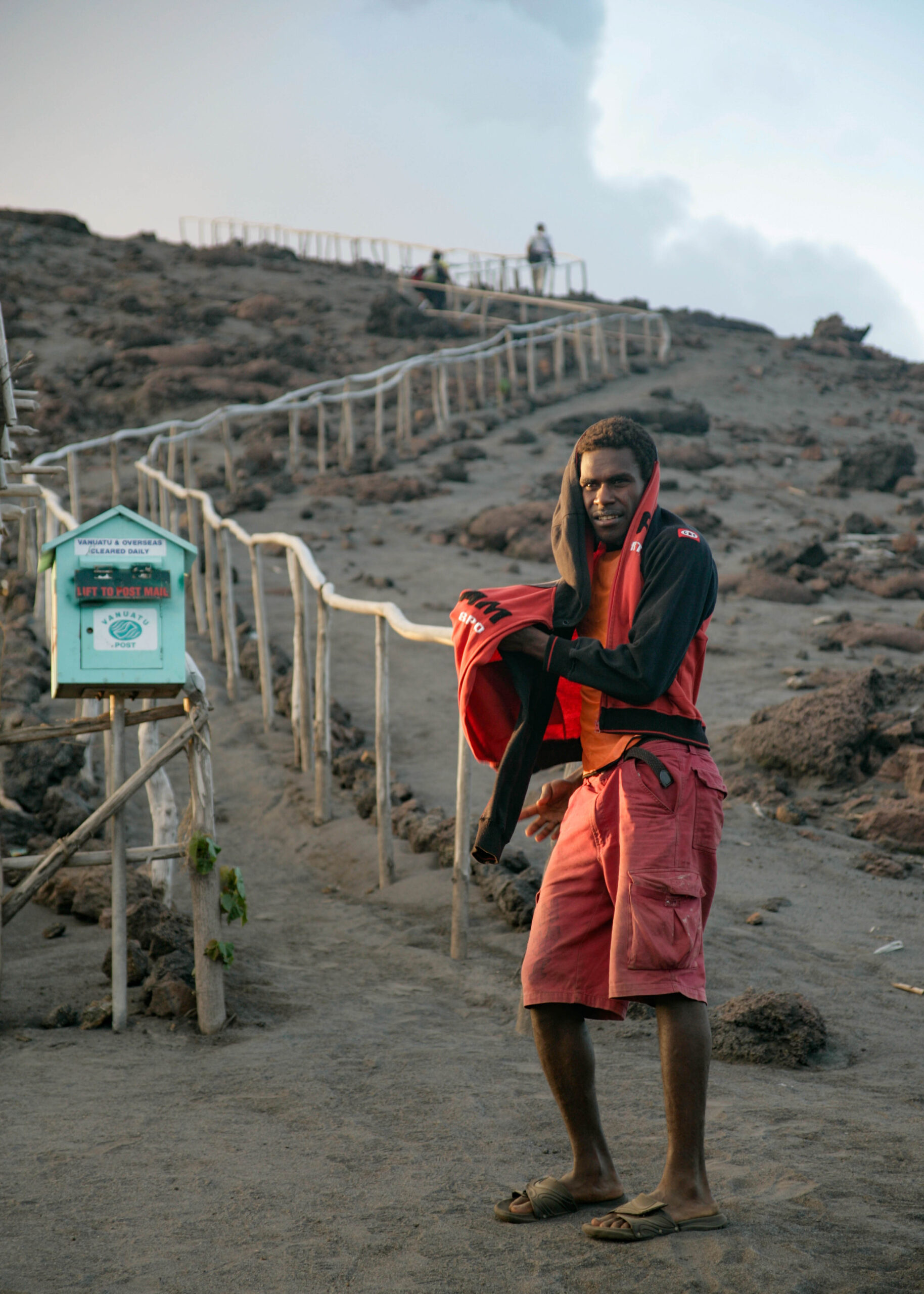
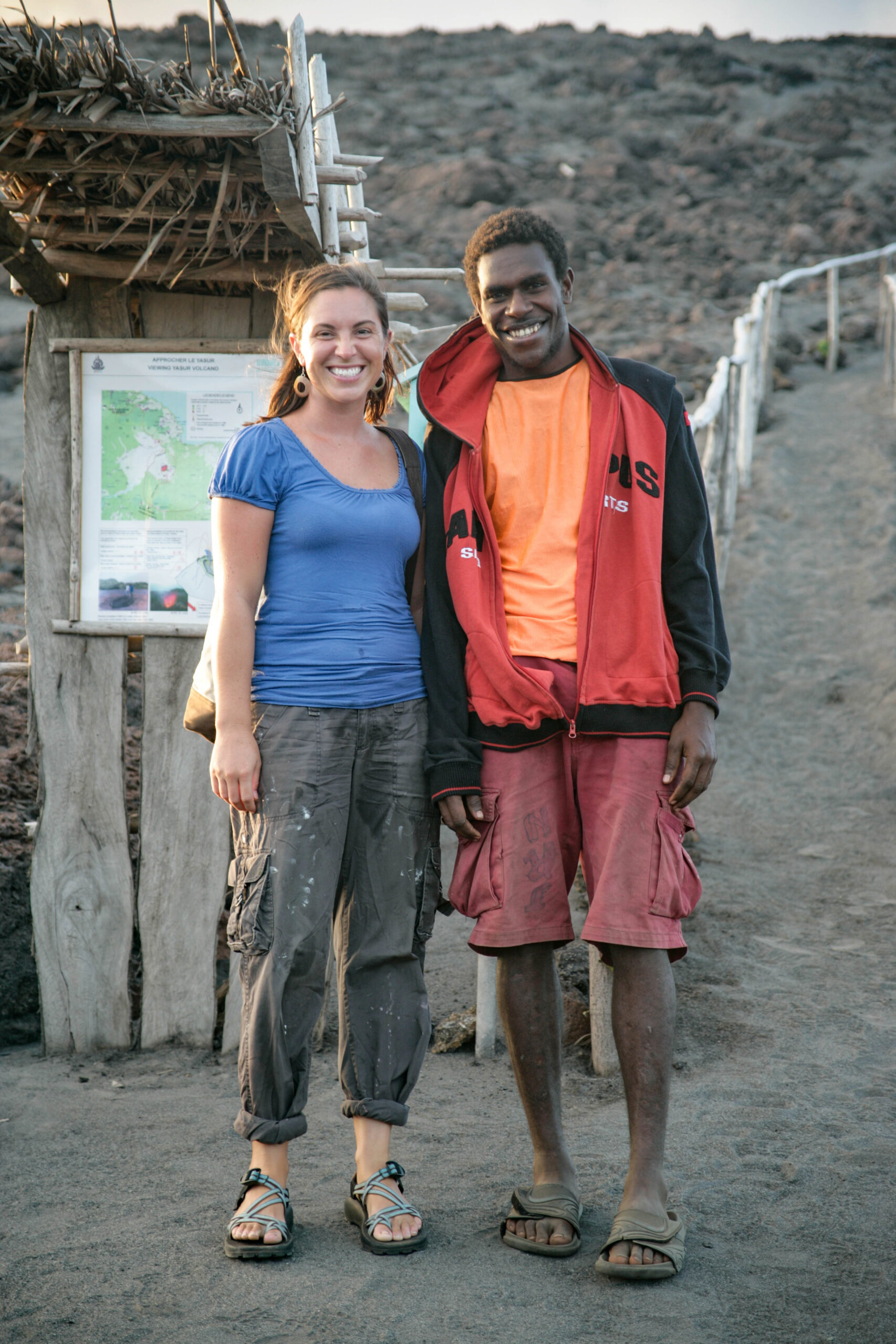
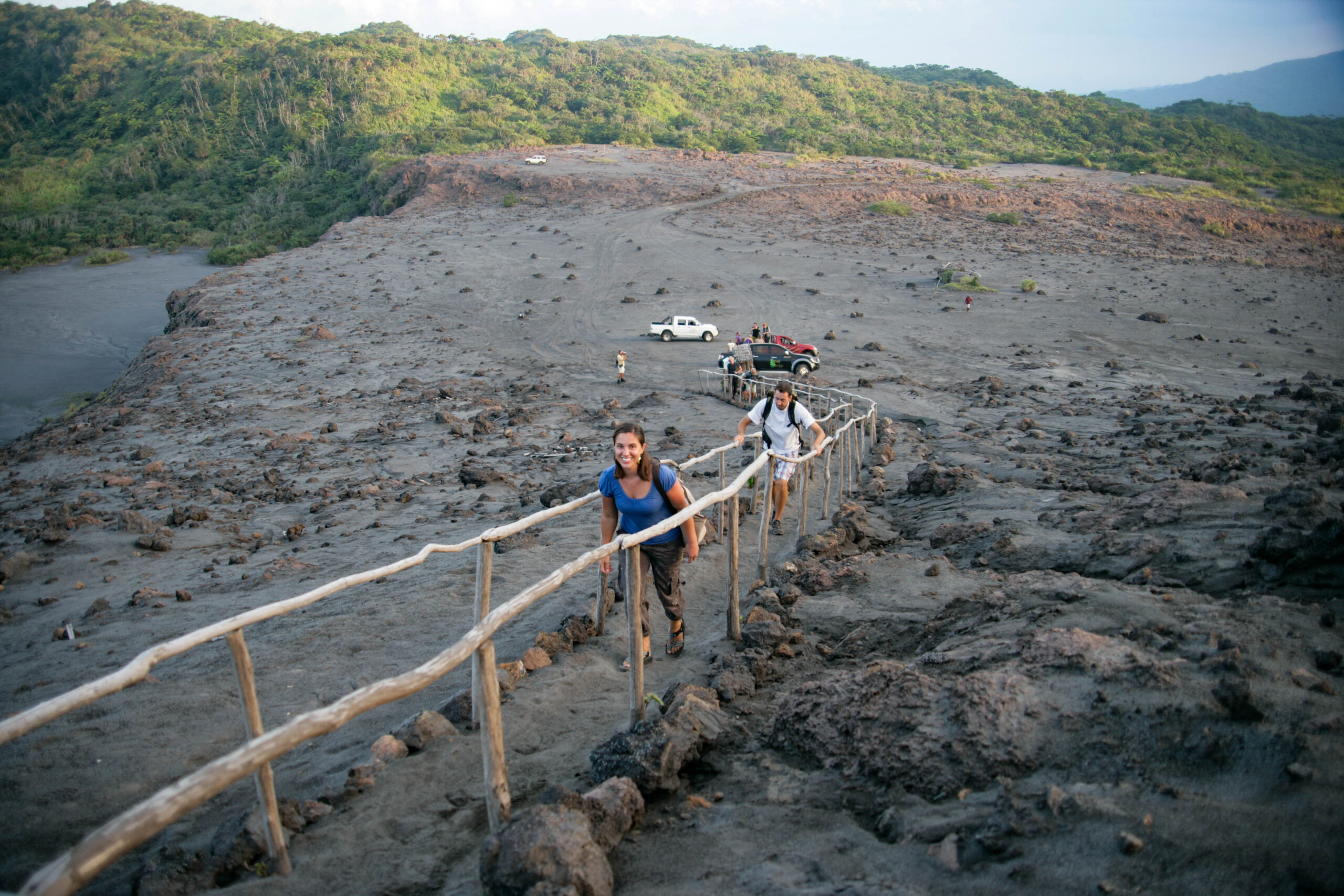
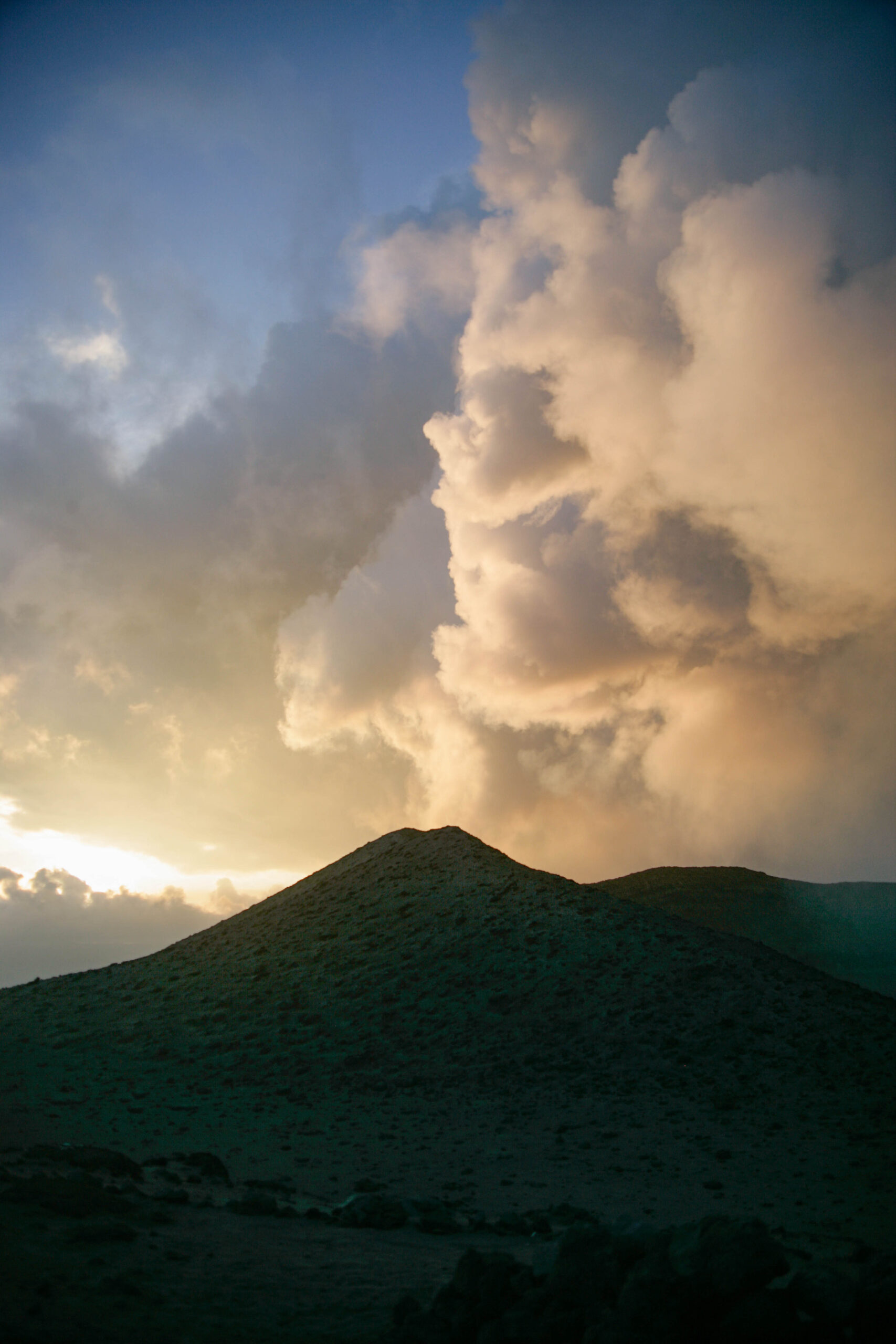
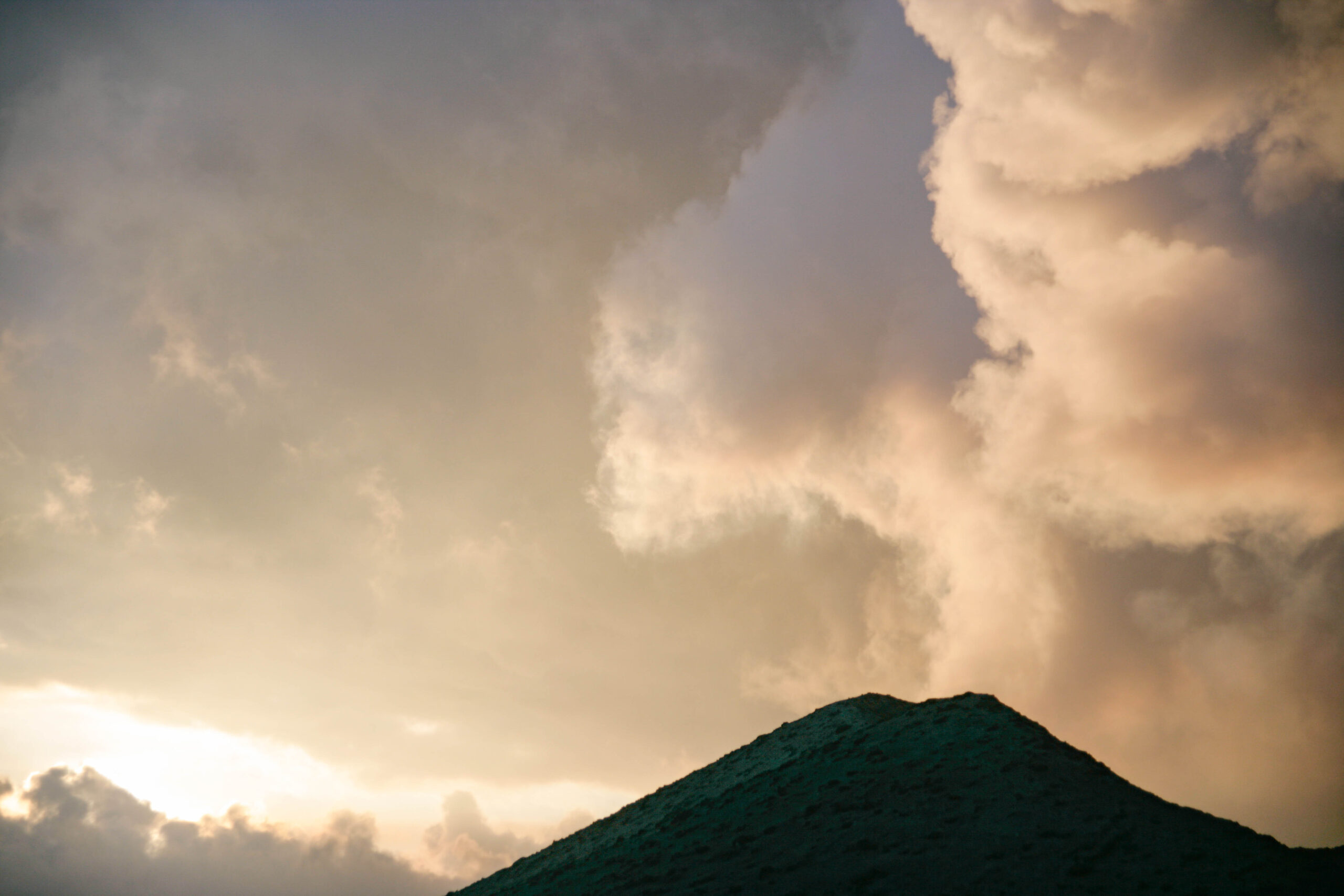
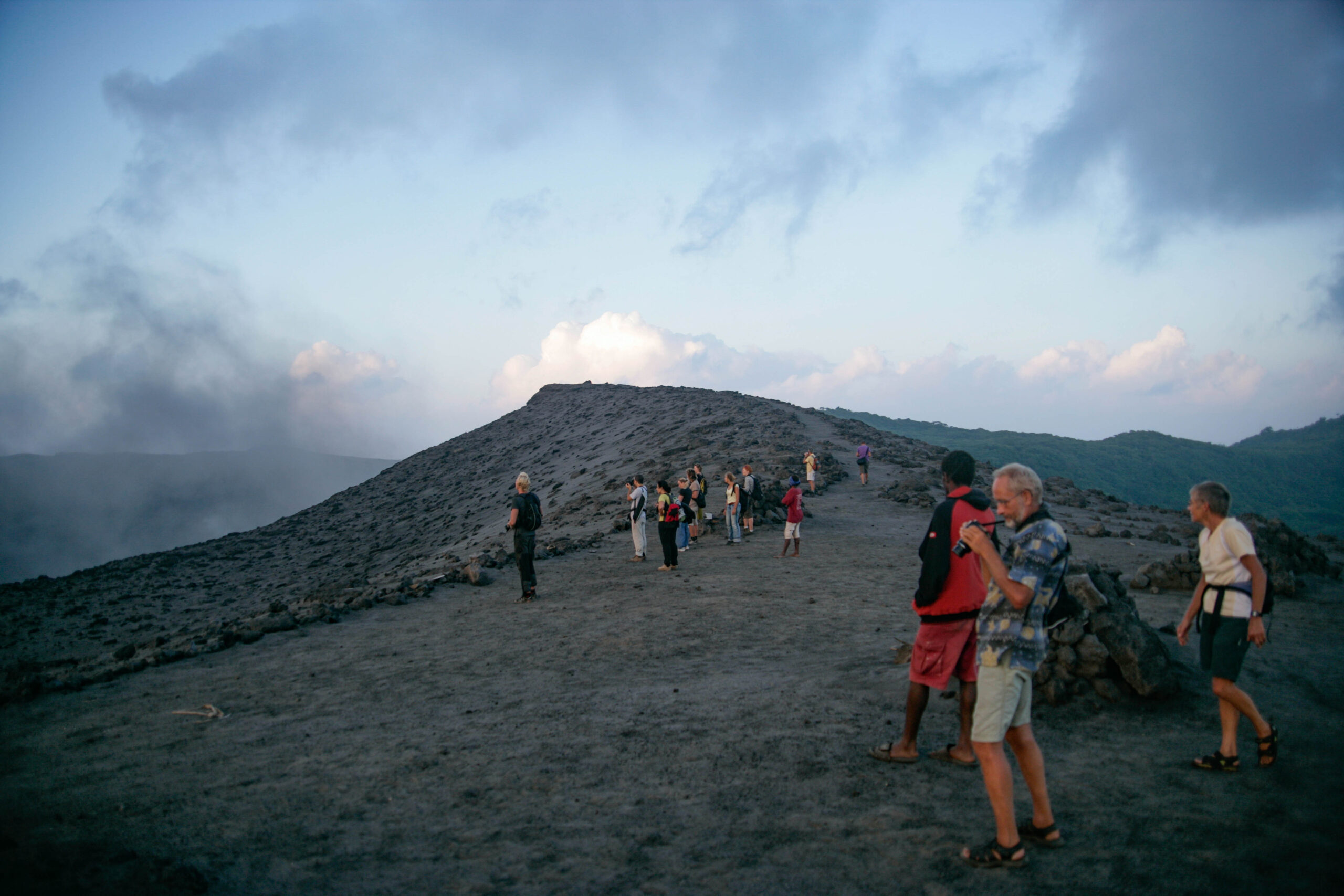
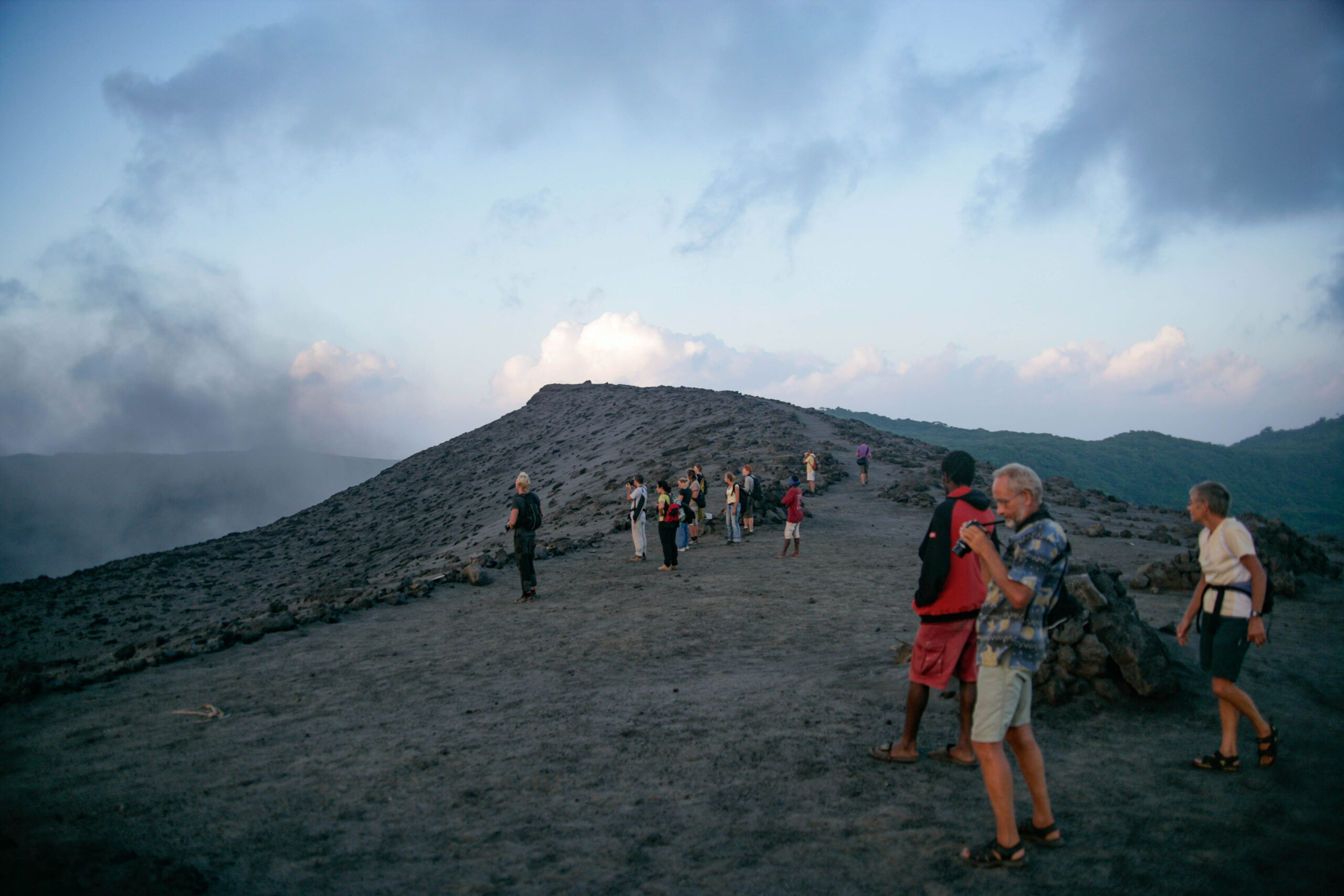
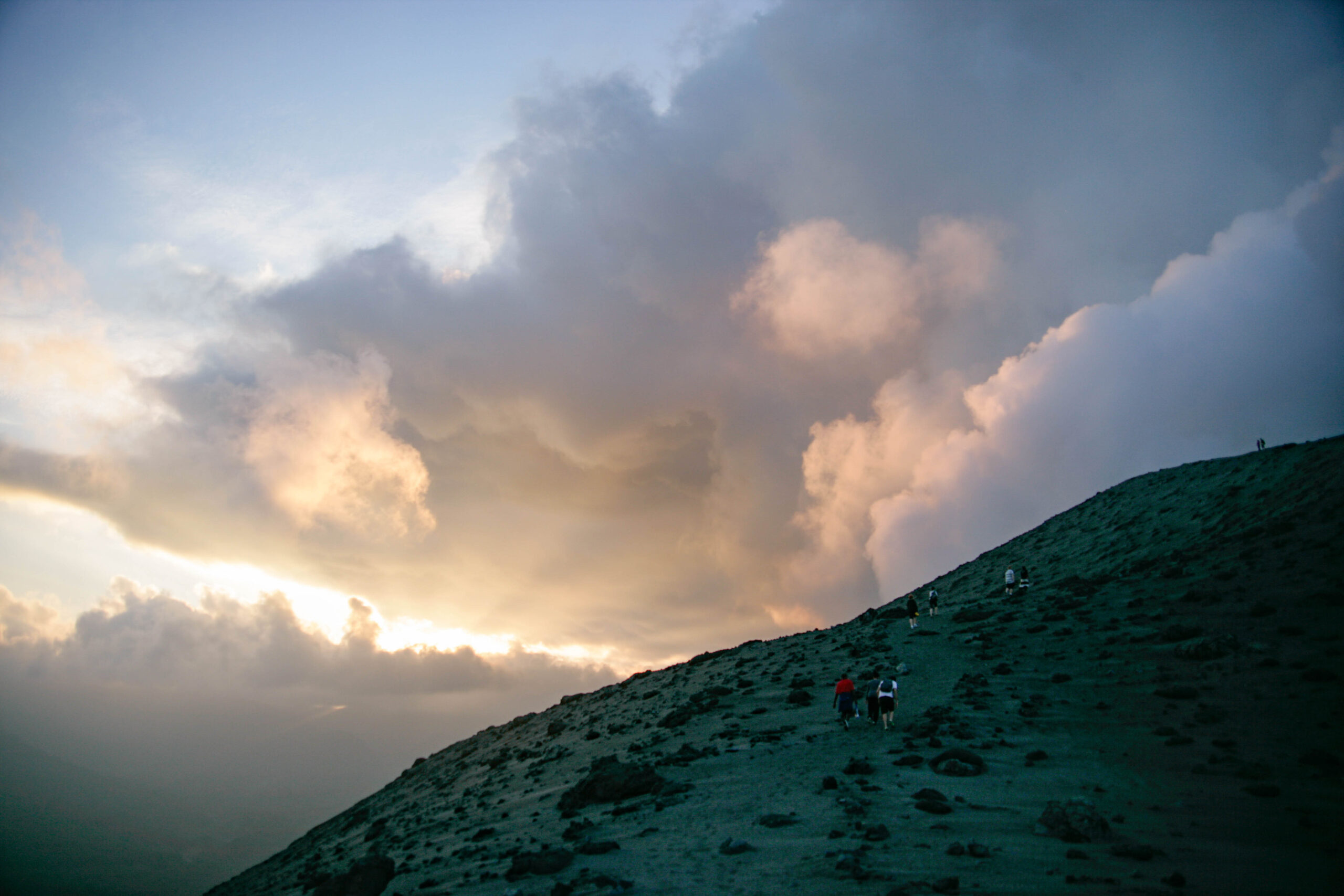
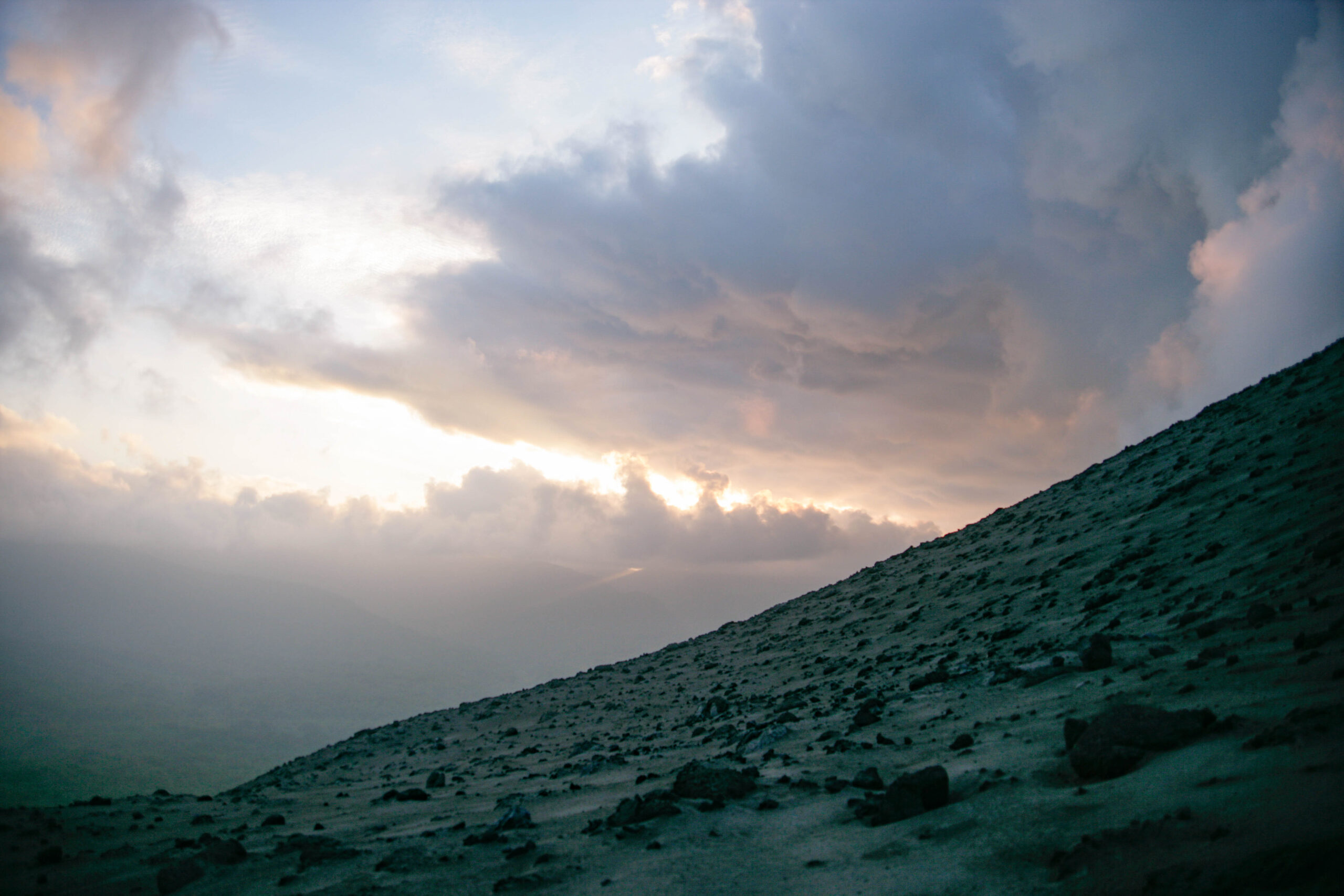
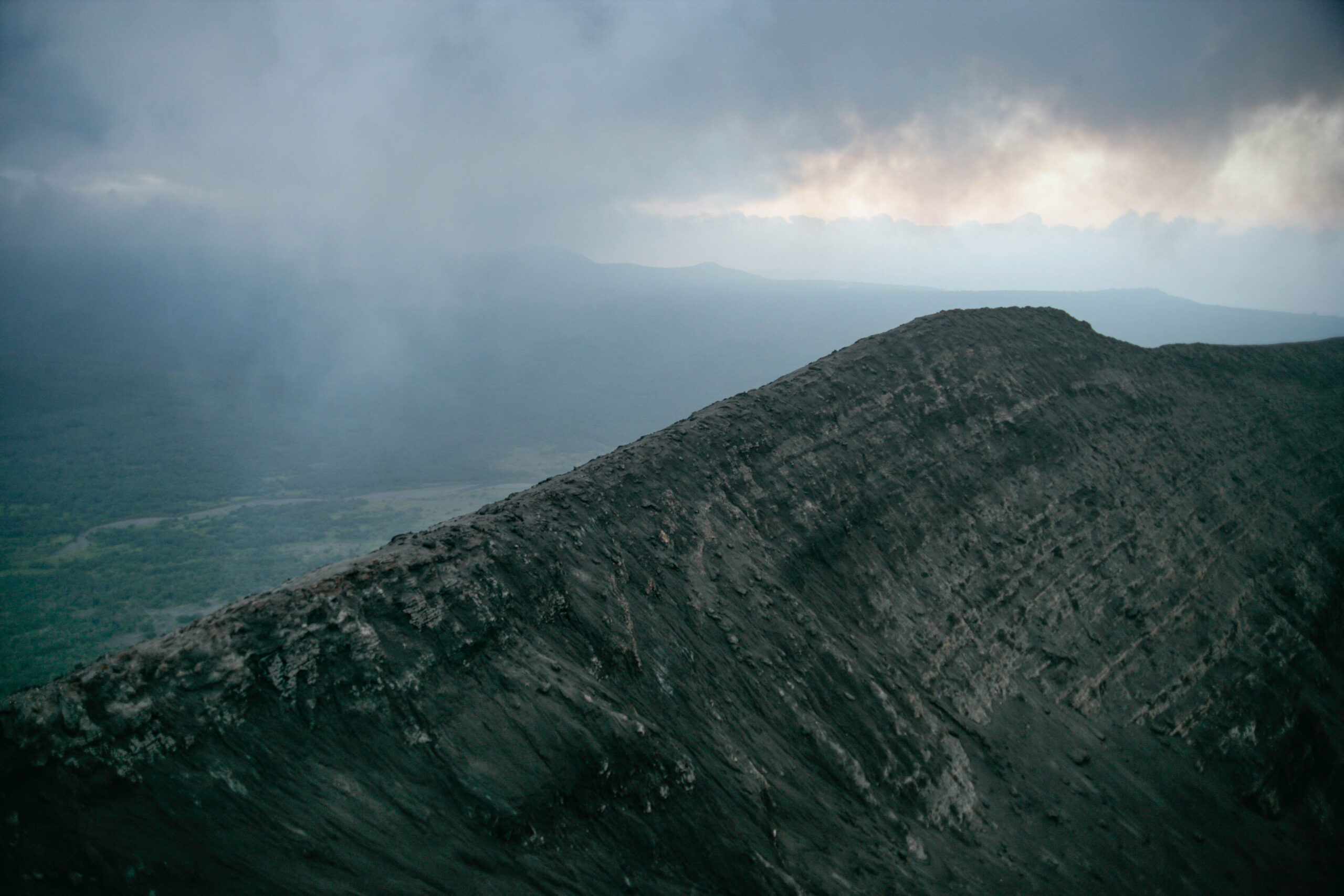
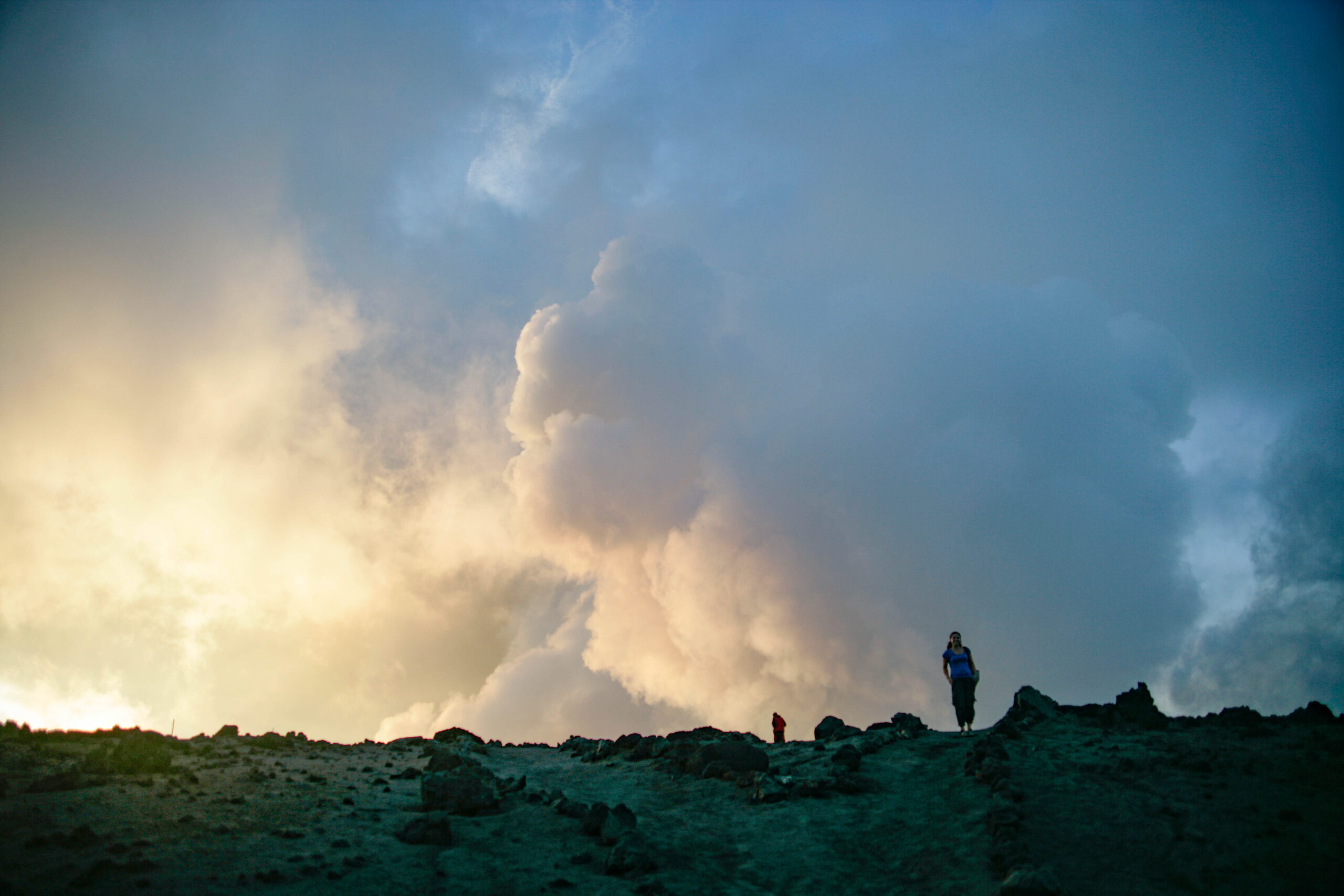
    We traveled by pick-up truck which somehow managed to transport thirteen people there, winding through a veritable four wheel drive jungle road.  Tiny villages occasionally dotted the sides of the road, and we passed clearings were Vanuatians were playing soccer.  There were many tree-houses, full-fledged houses not like little kid versions,  the banyan trees being enormously large; I saw one that had a spiral staircase ascending around the 20 foot diameter trunk system.  Other banyans had a multitude of tree limbs that jutted for 100 feet away from the center.  Once the road began it’s climb up the sides of the volcano however, the jungle quickly gave way to drier and drier conditions, until we were in a veritable wasteland.  It was about 5 pm, the sun was casting a terrific eerie light and the smoke and ash billowing from the volcano added a layer of depth to the color of the skyline.

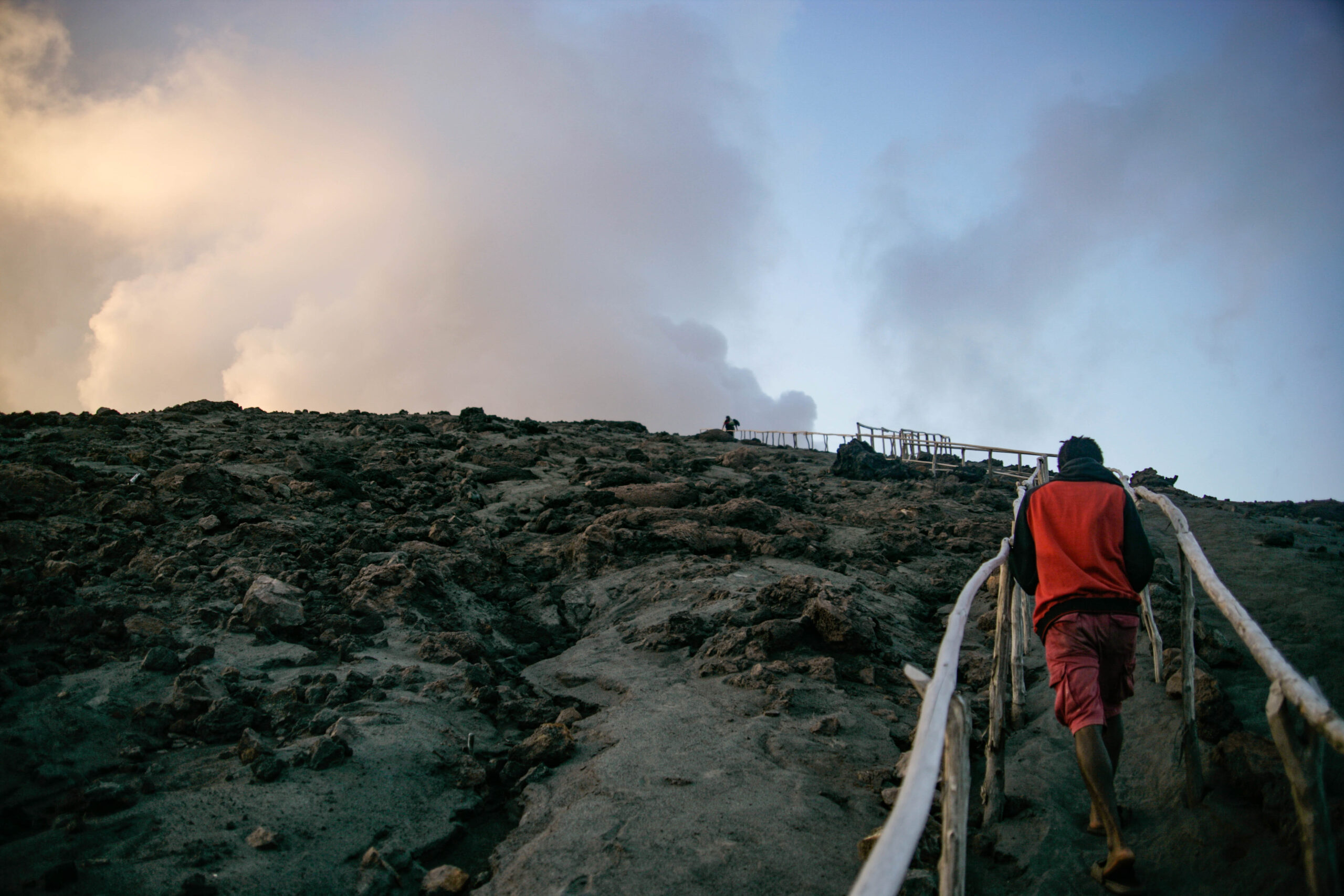
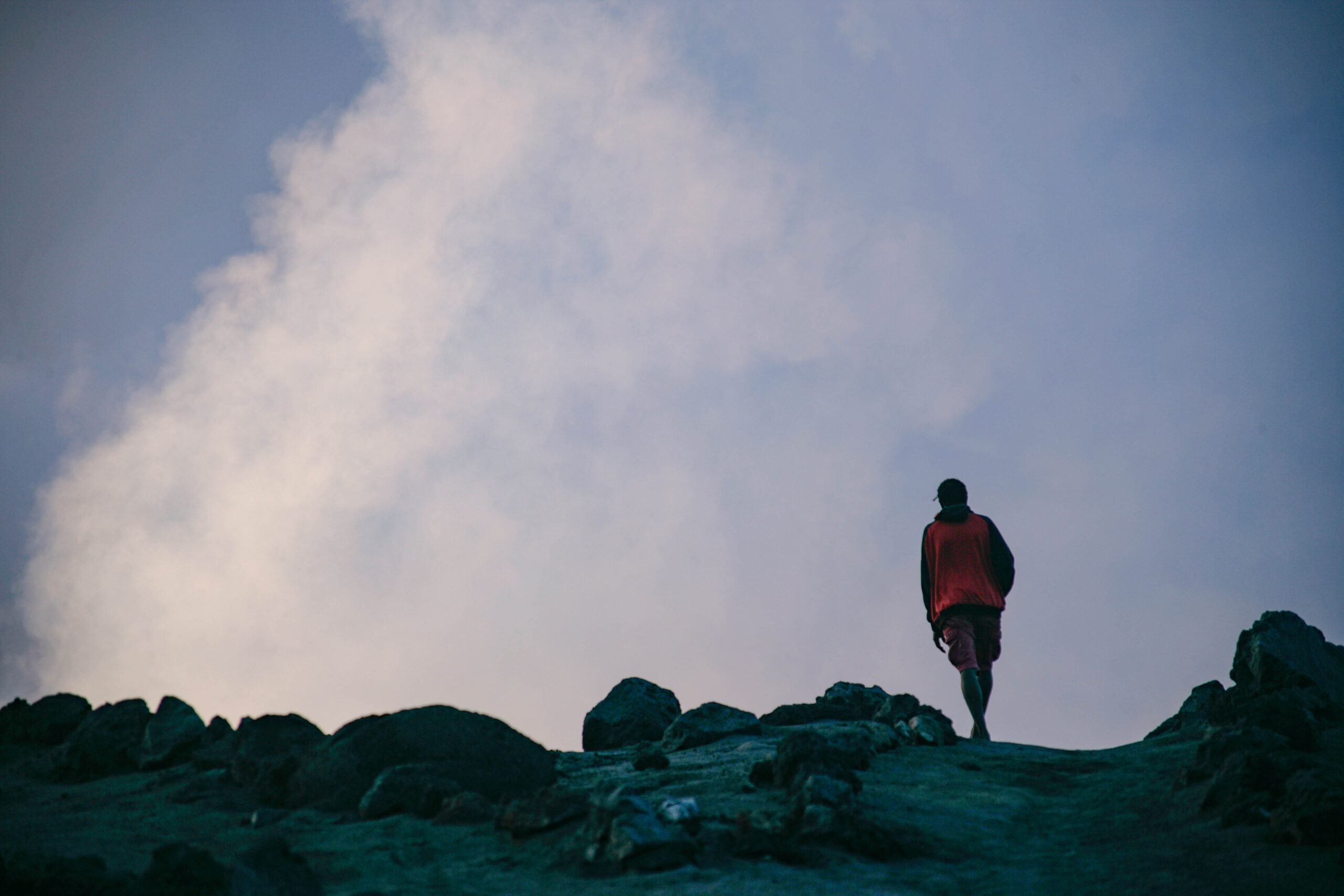
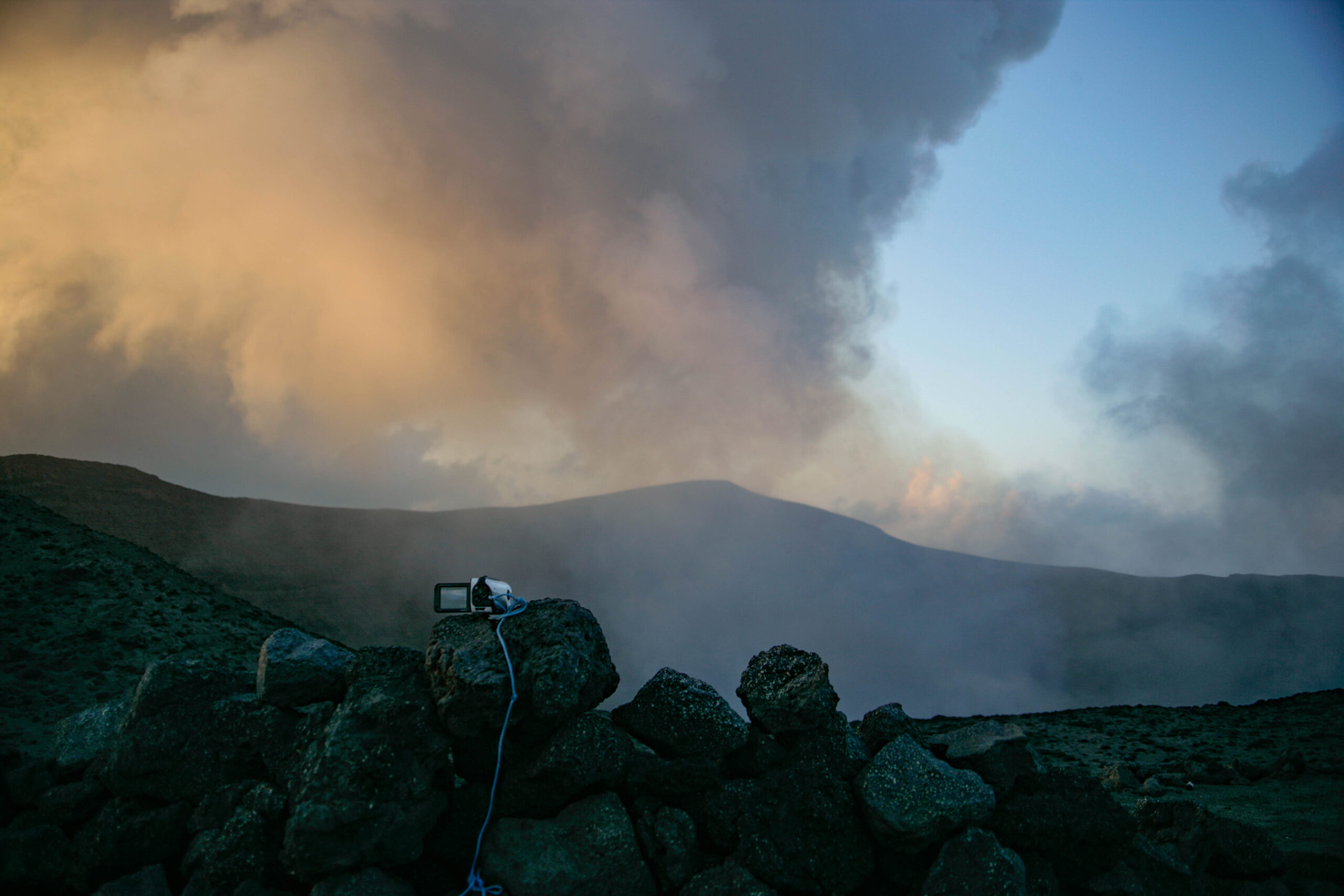
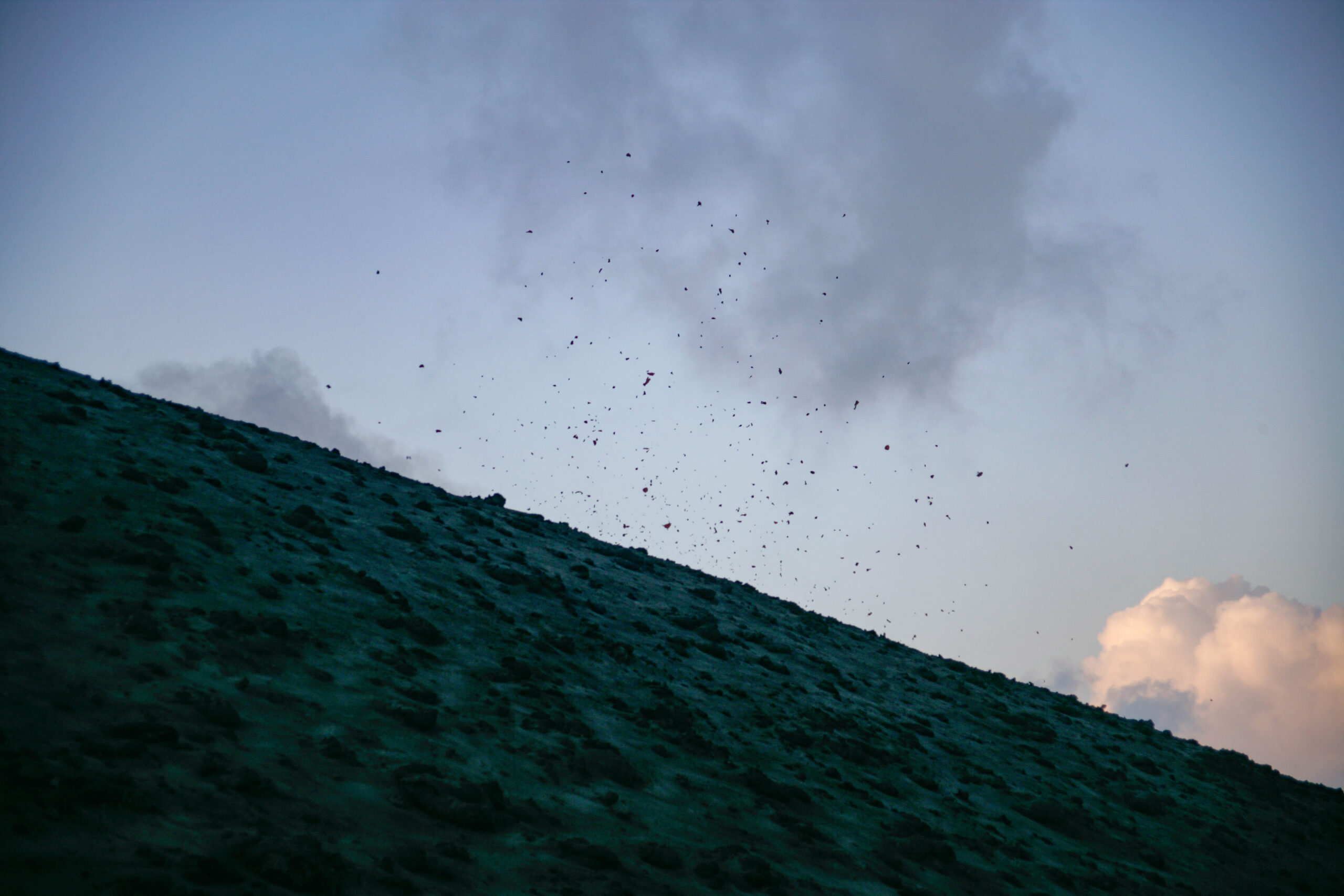
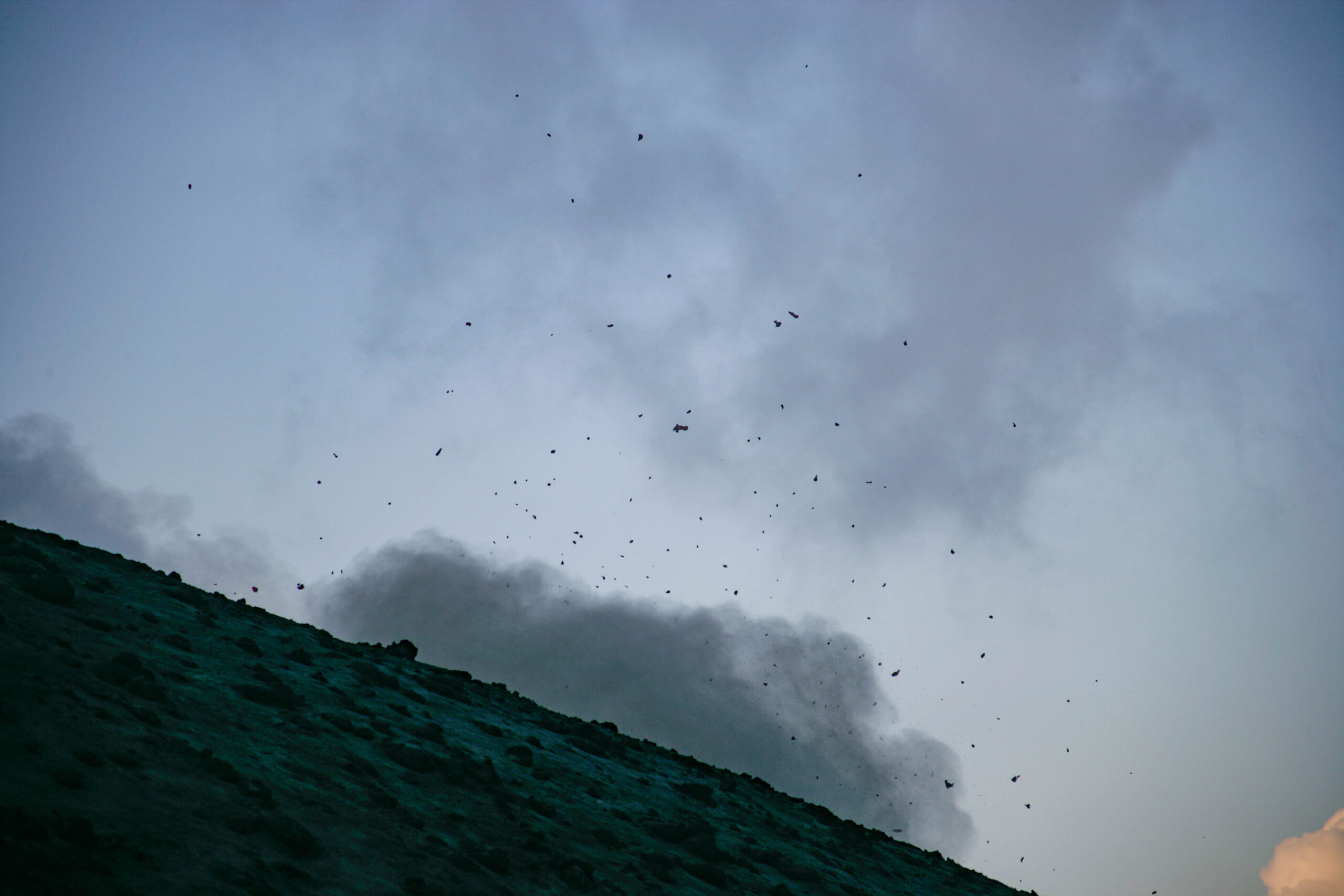
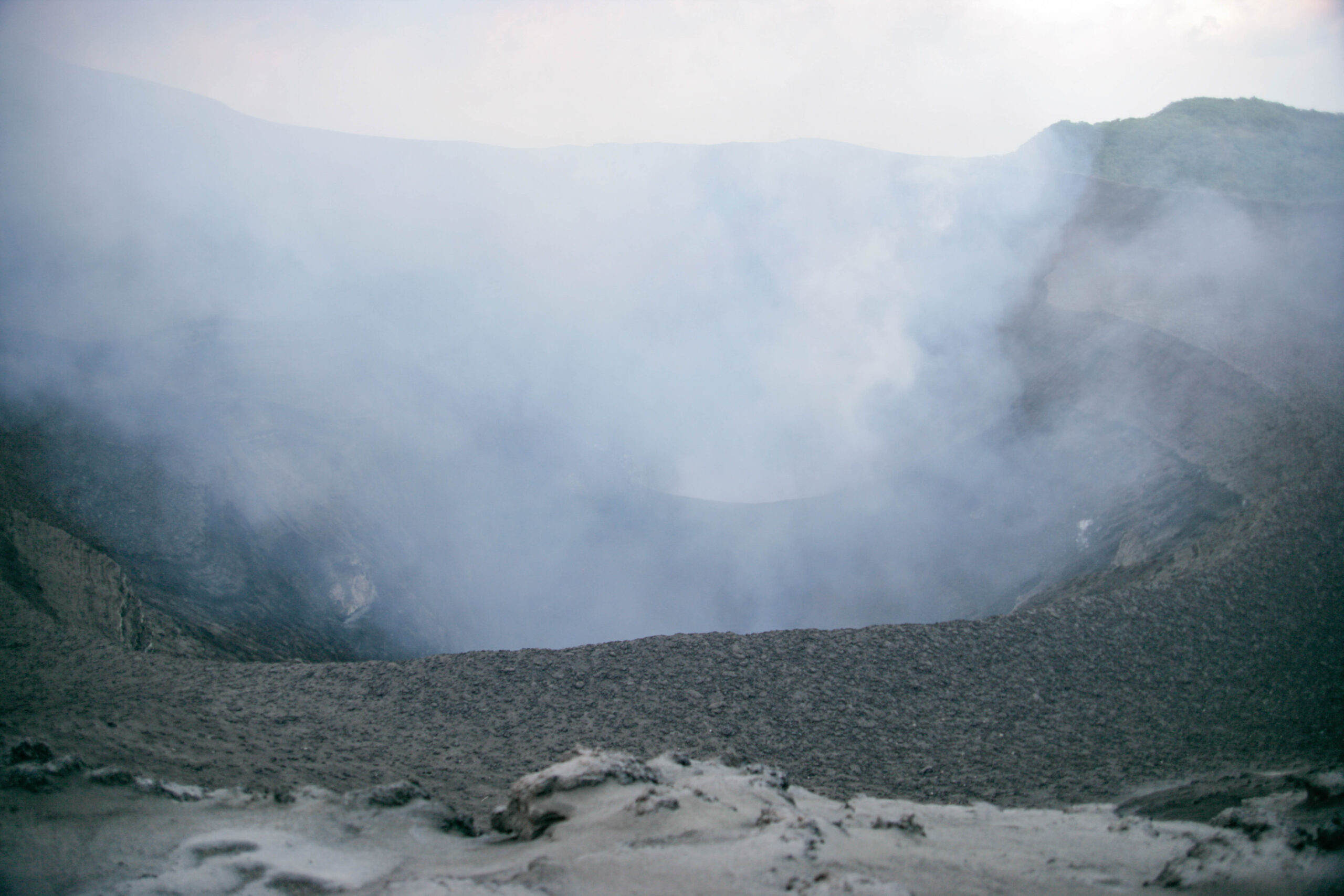
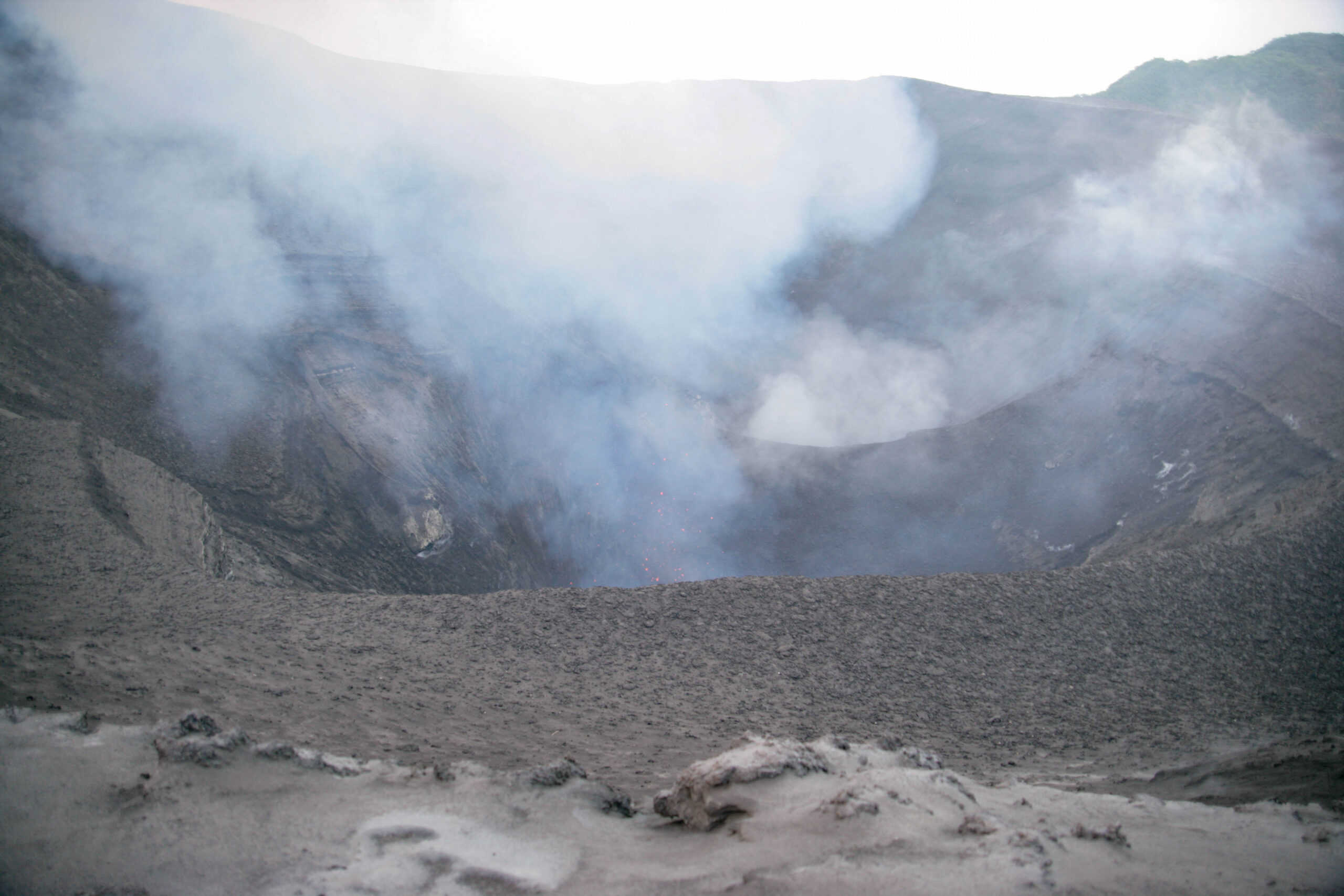
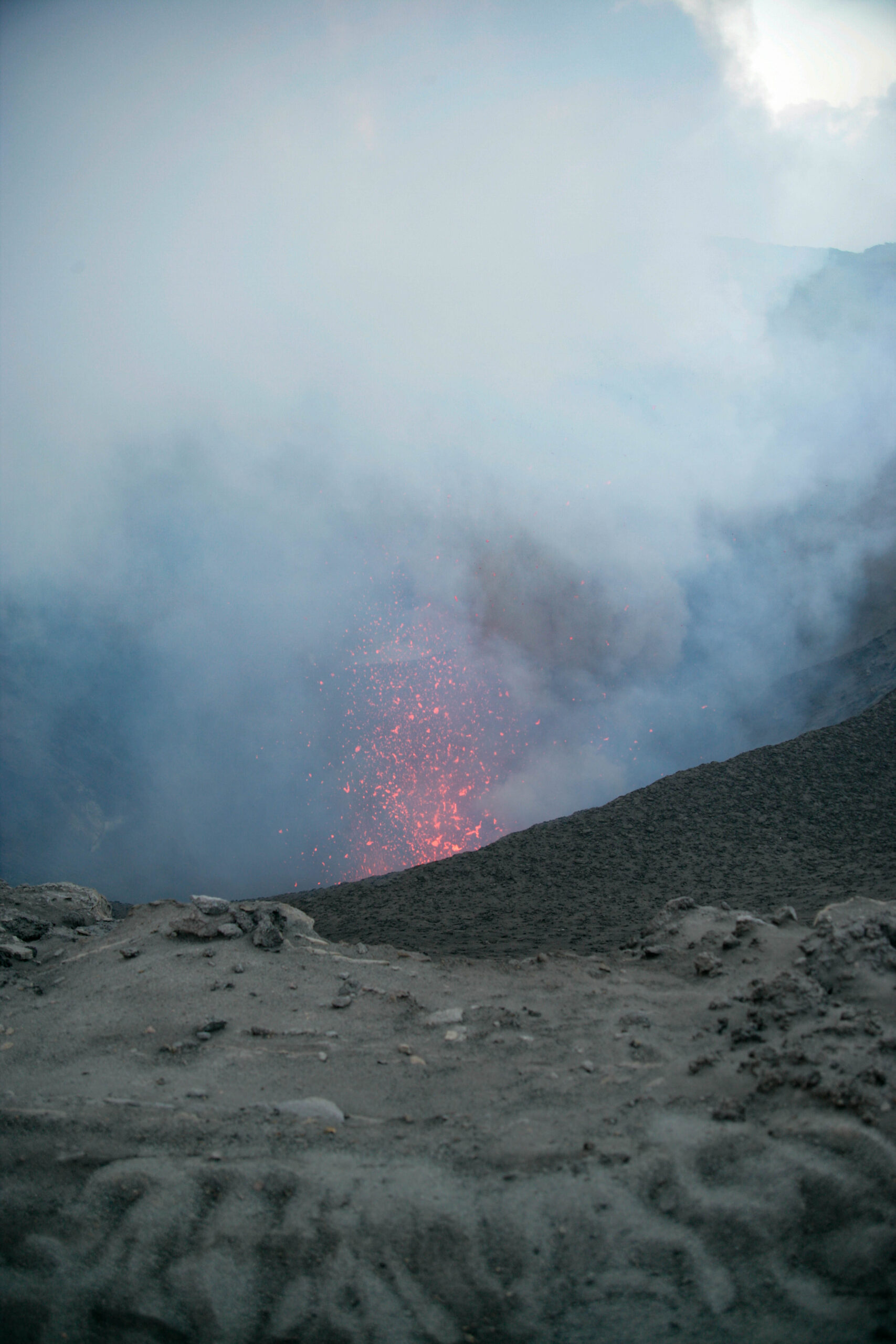
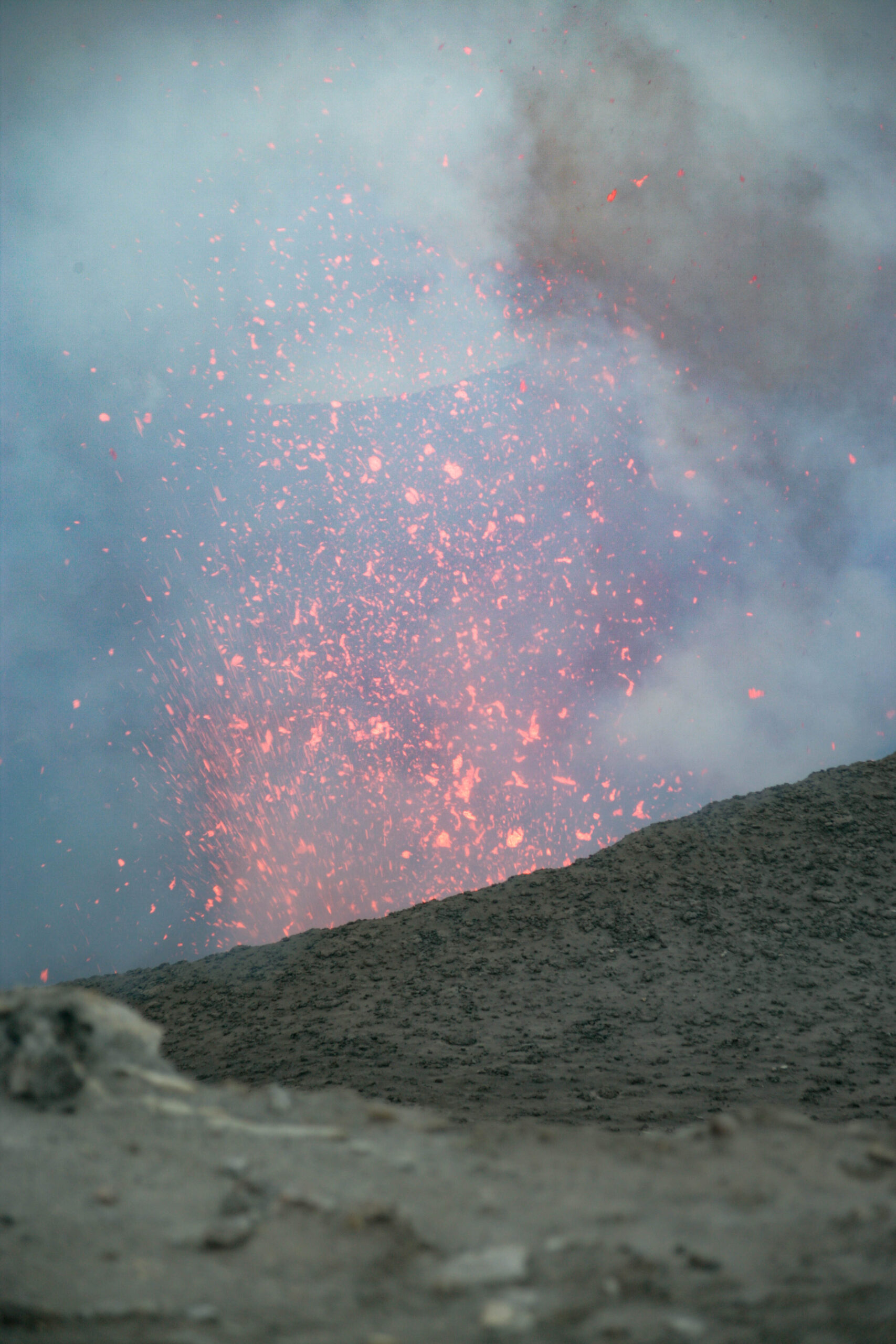
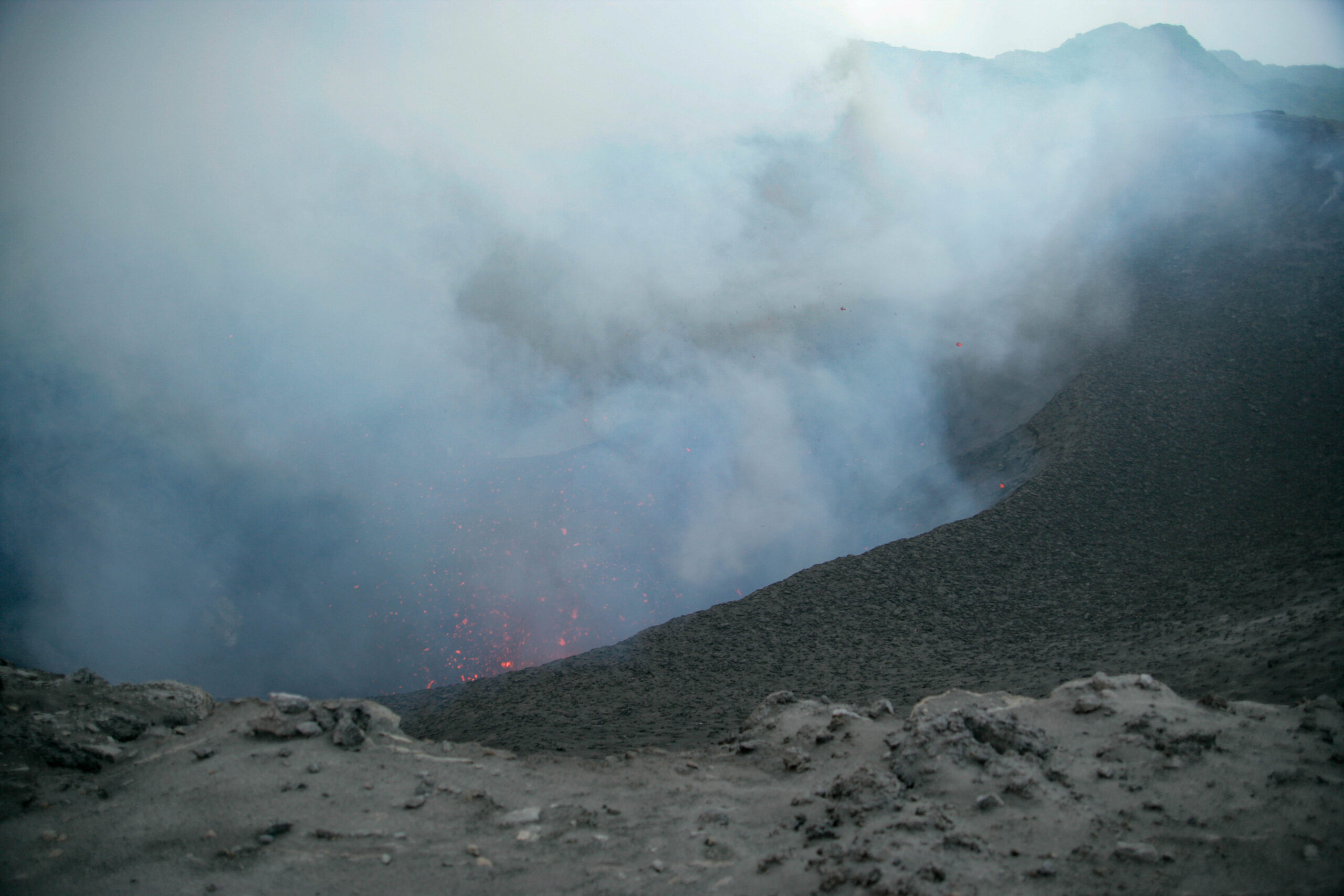
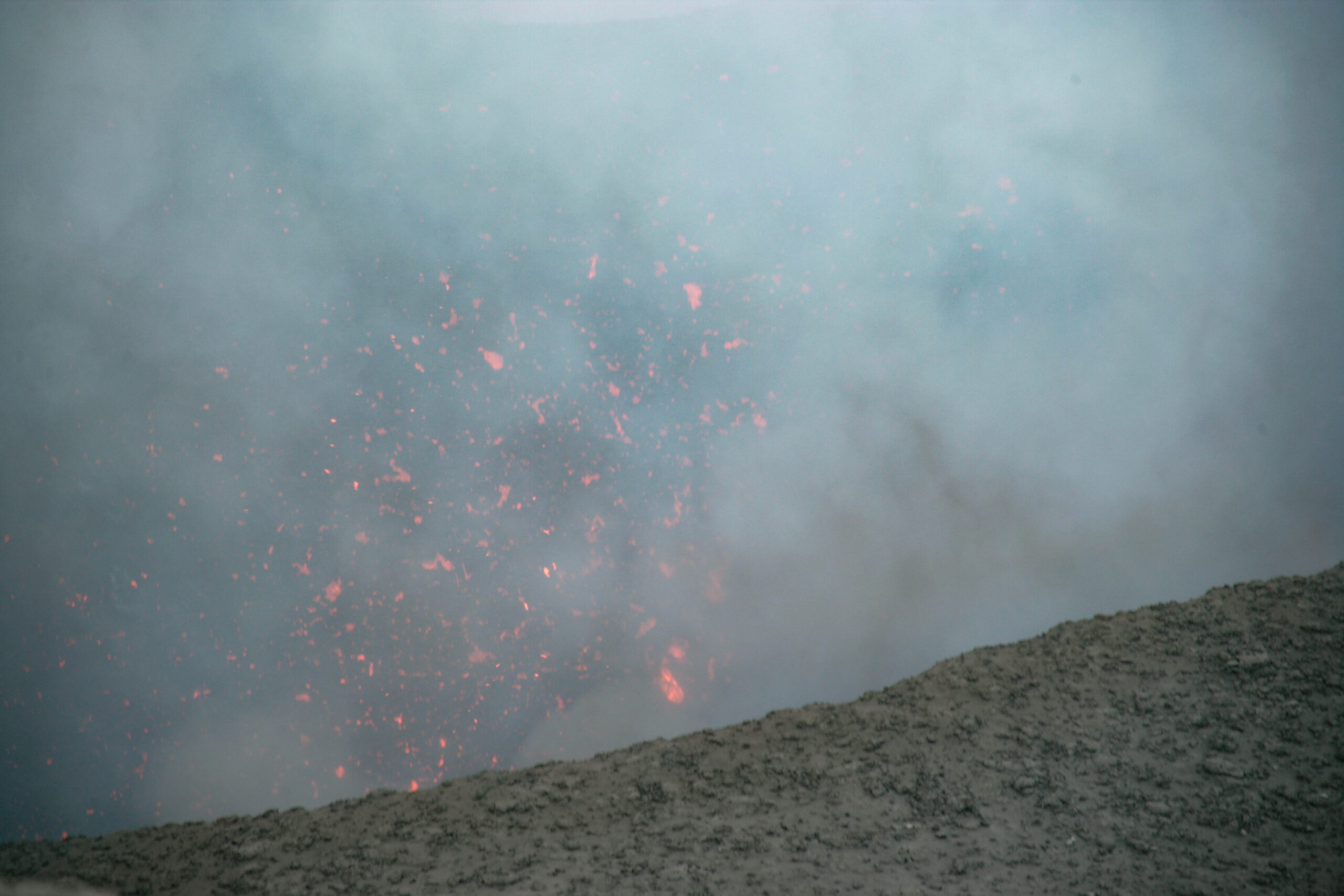
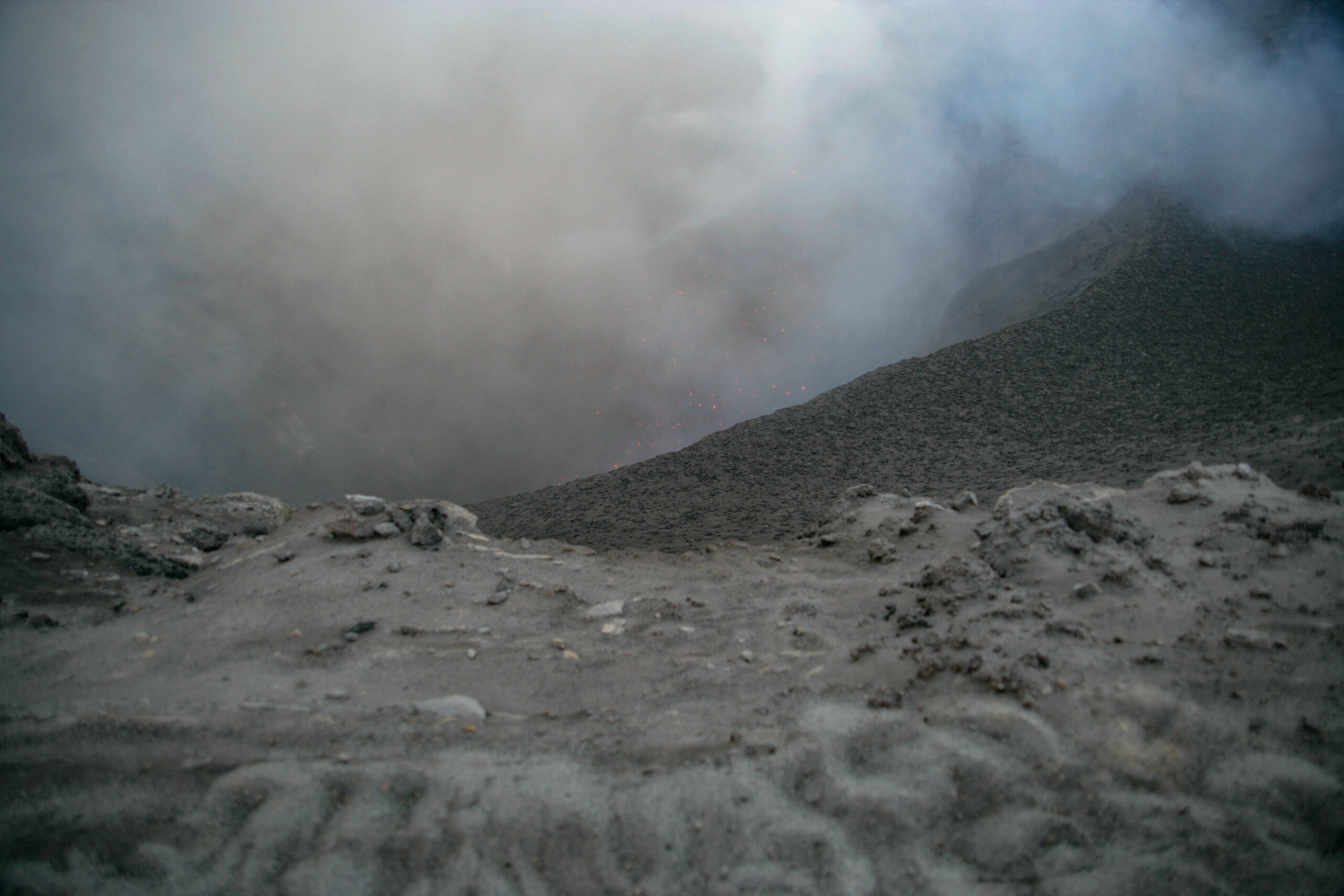
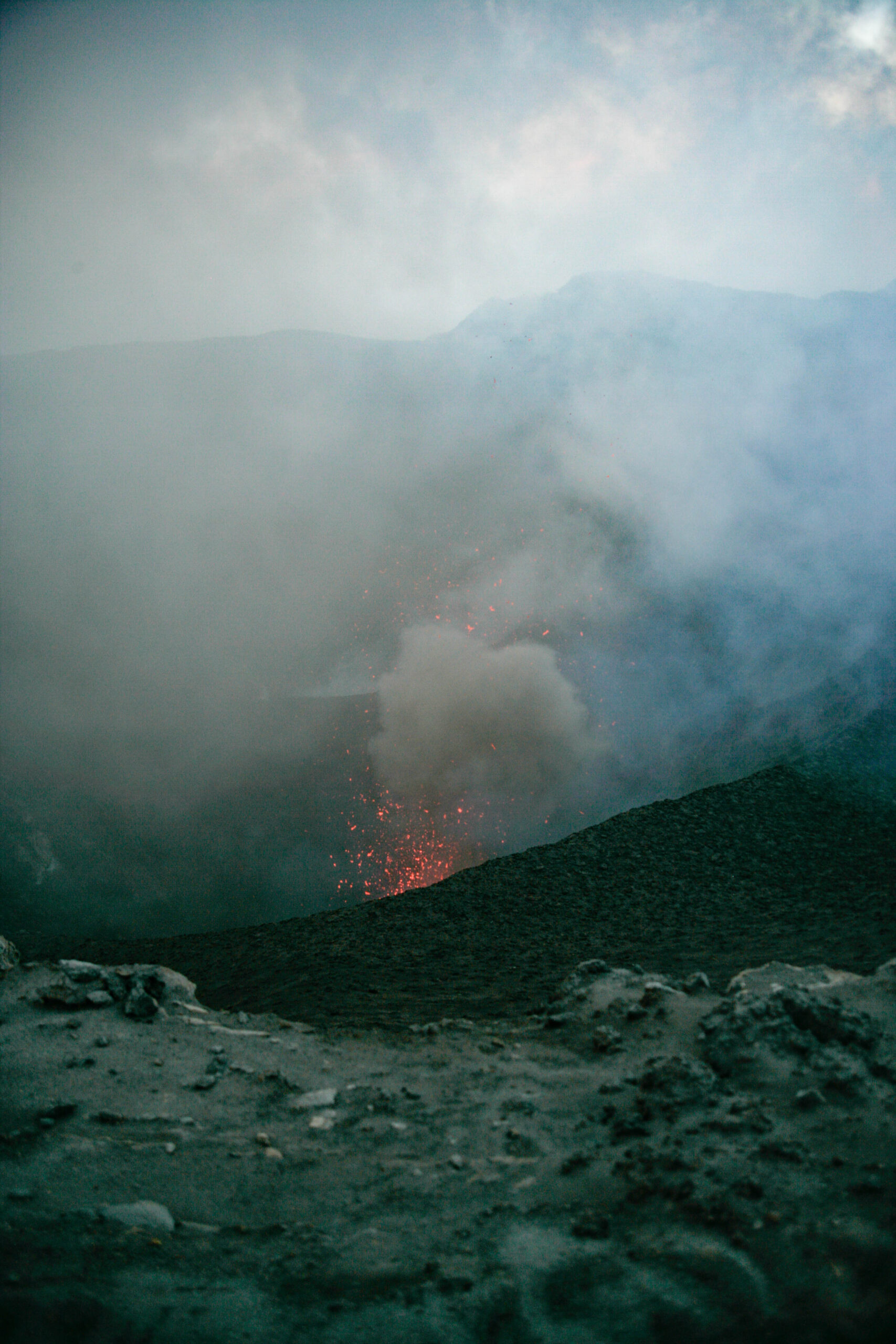
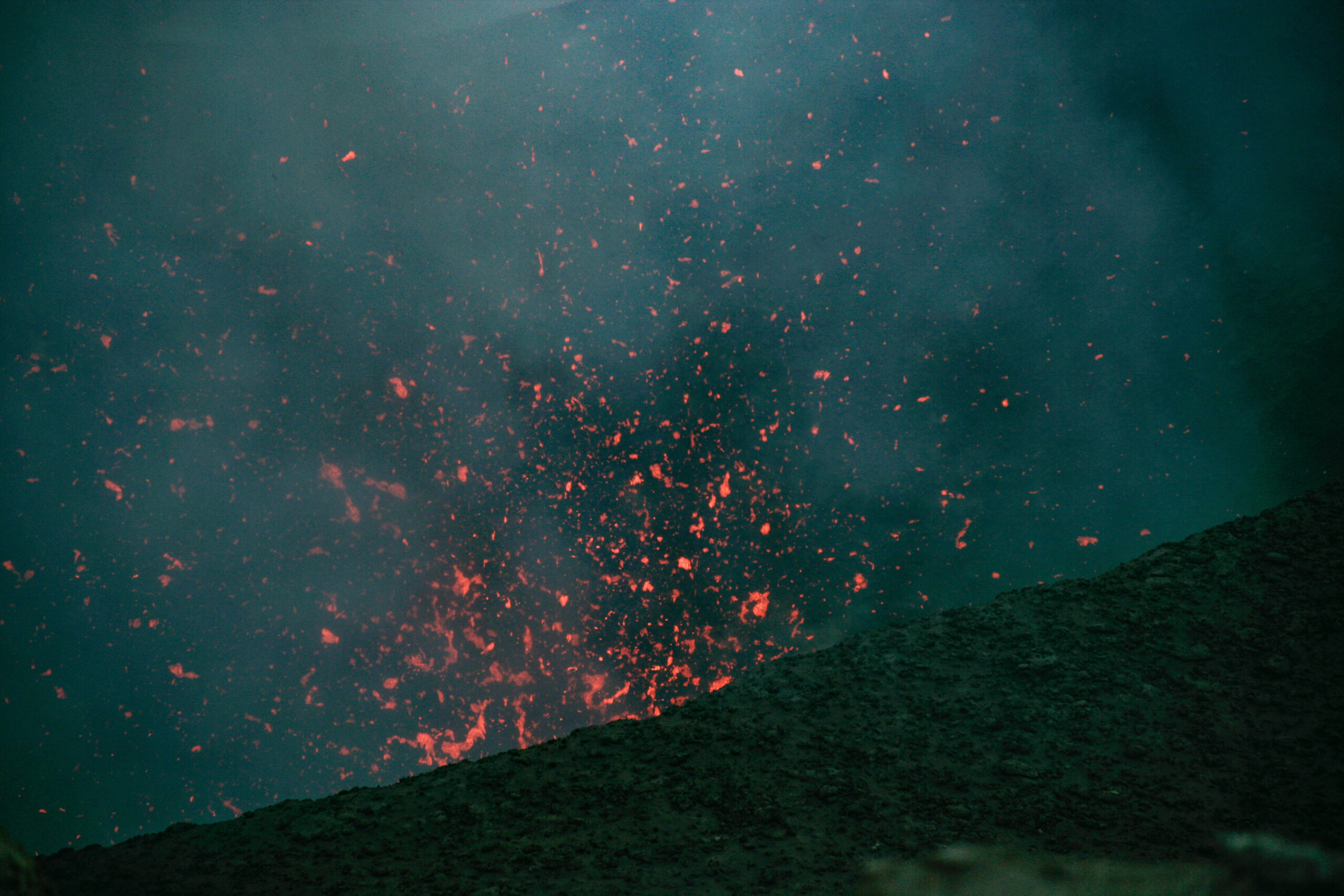
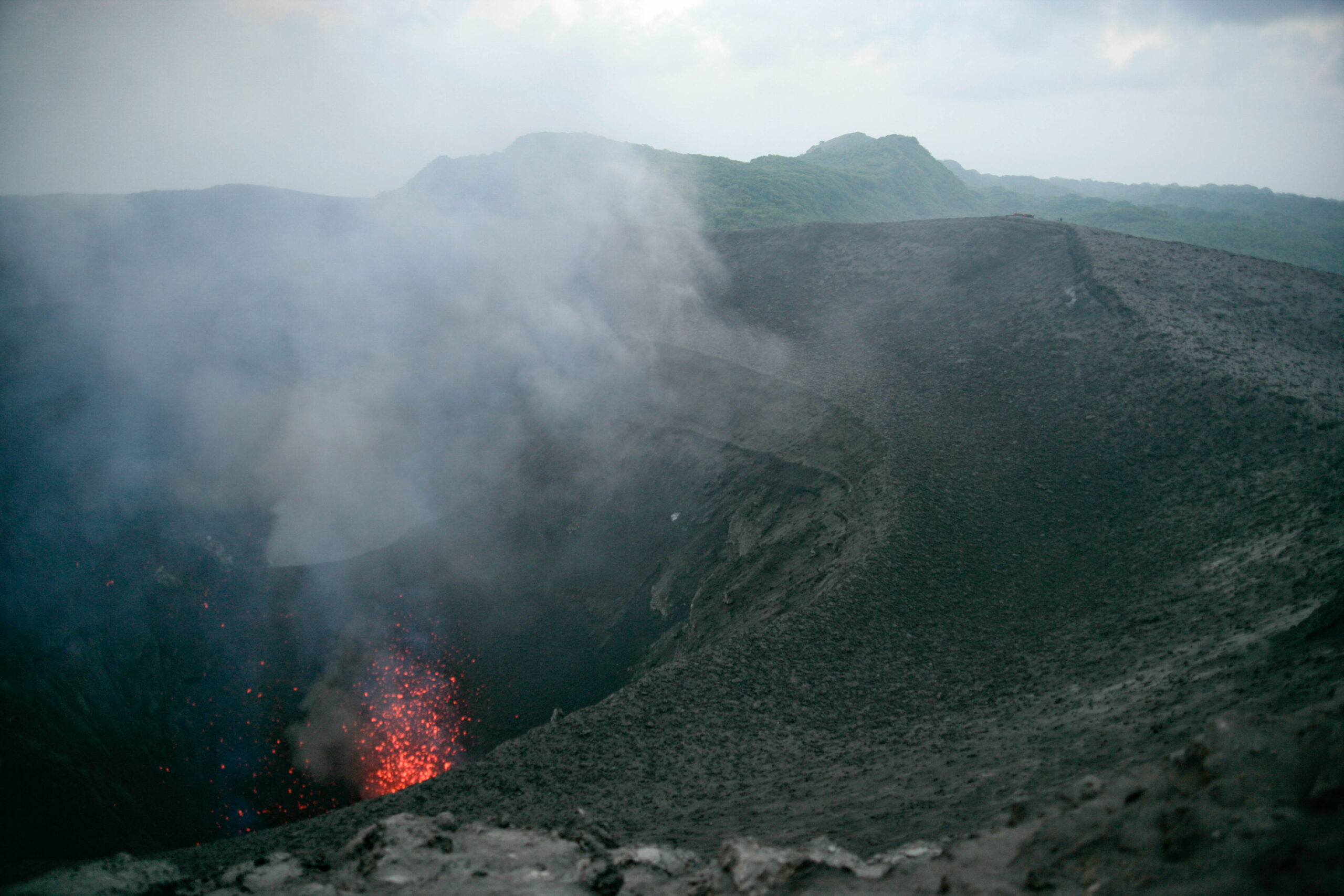
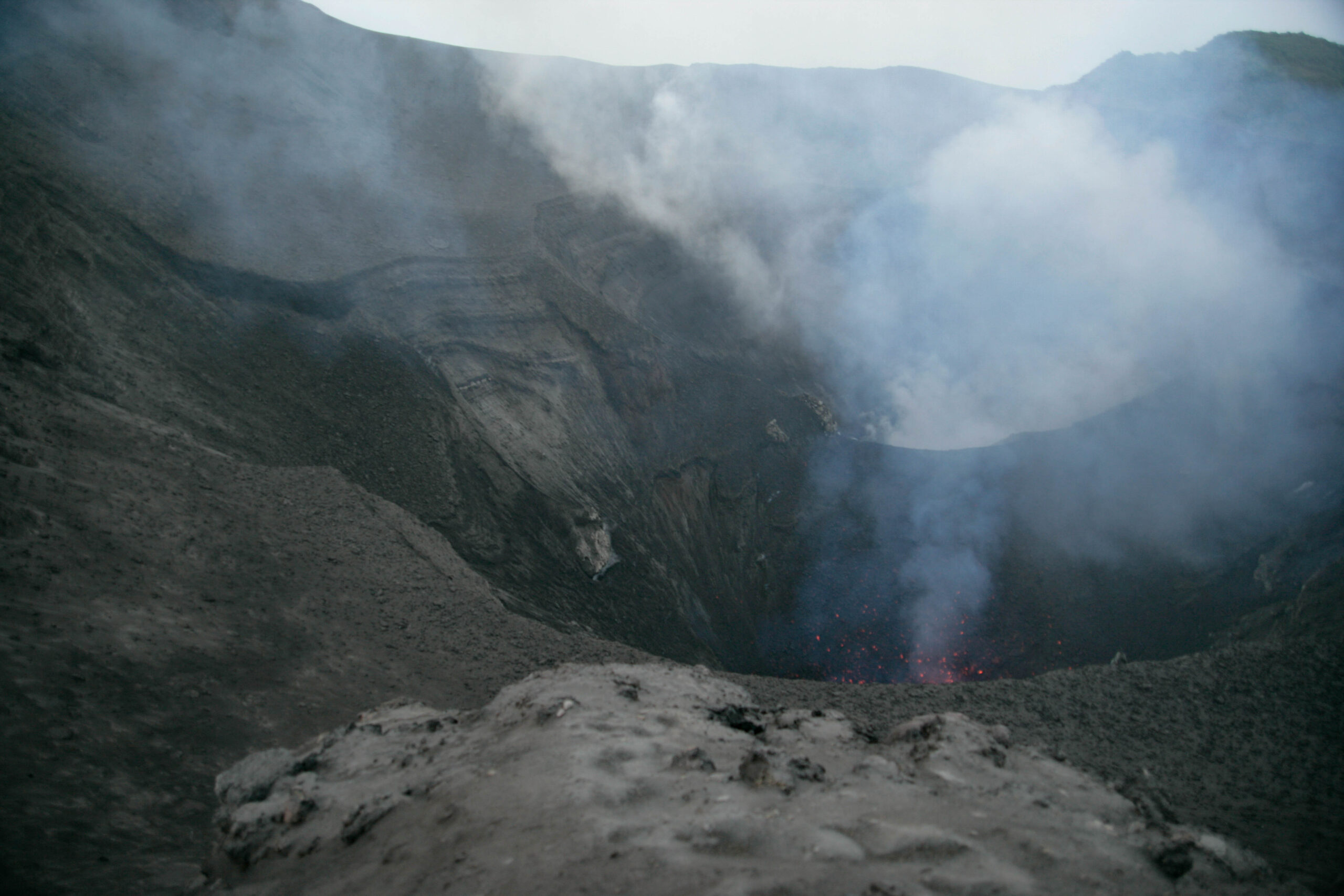
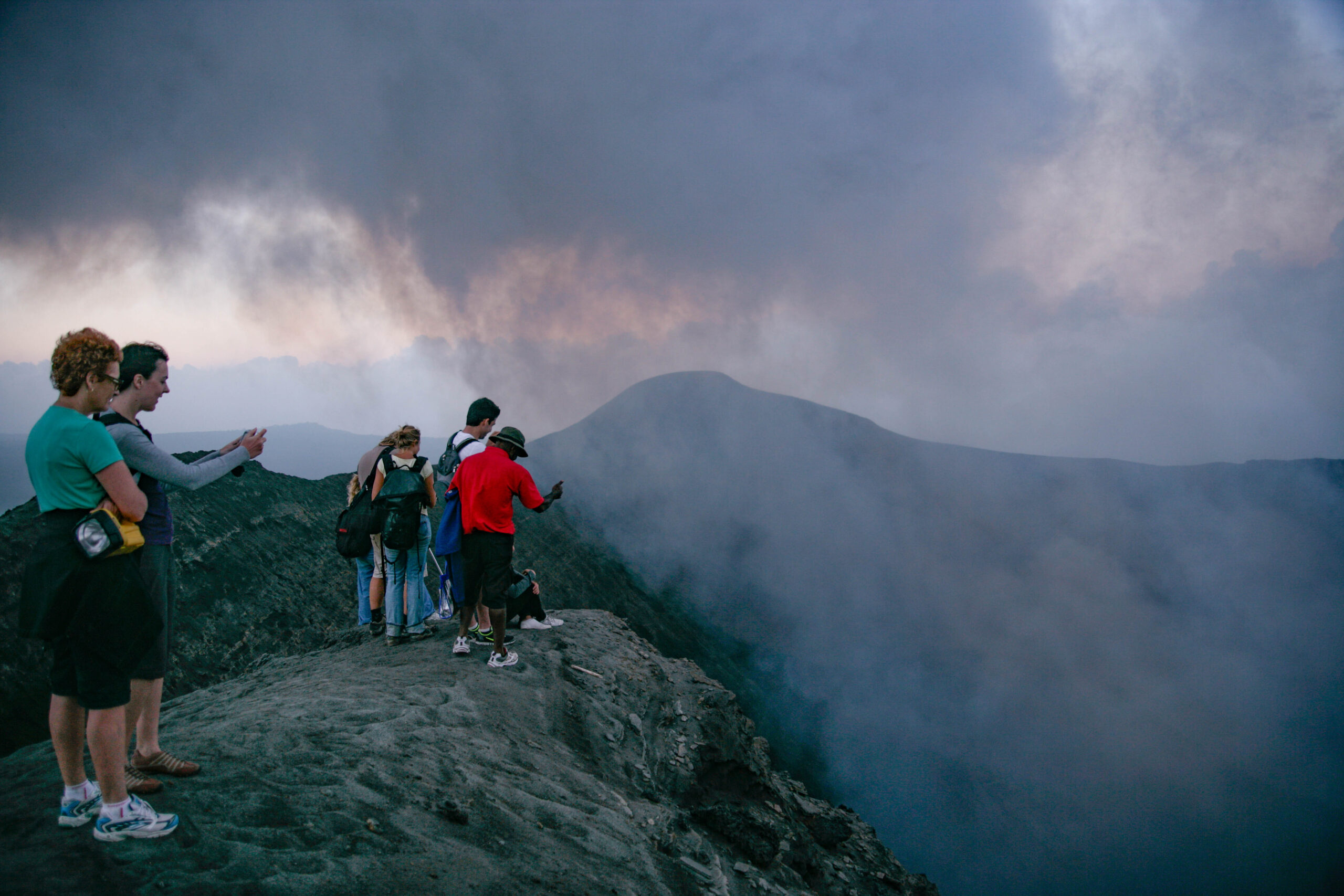
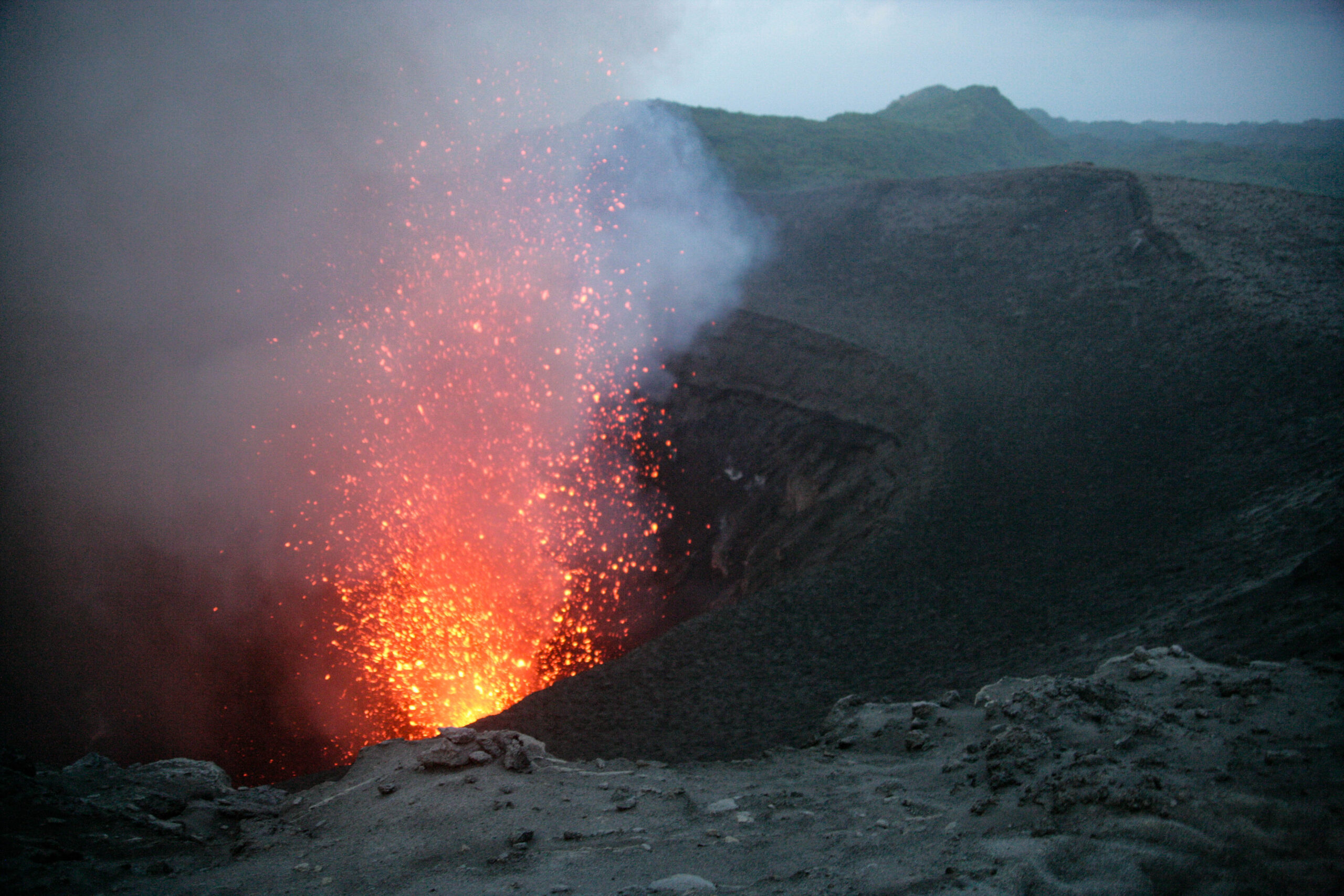
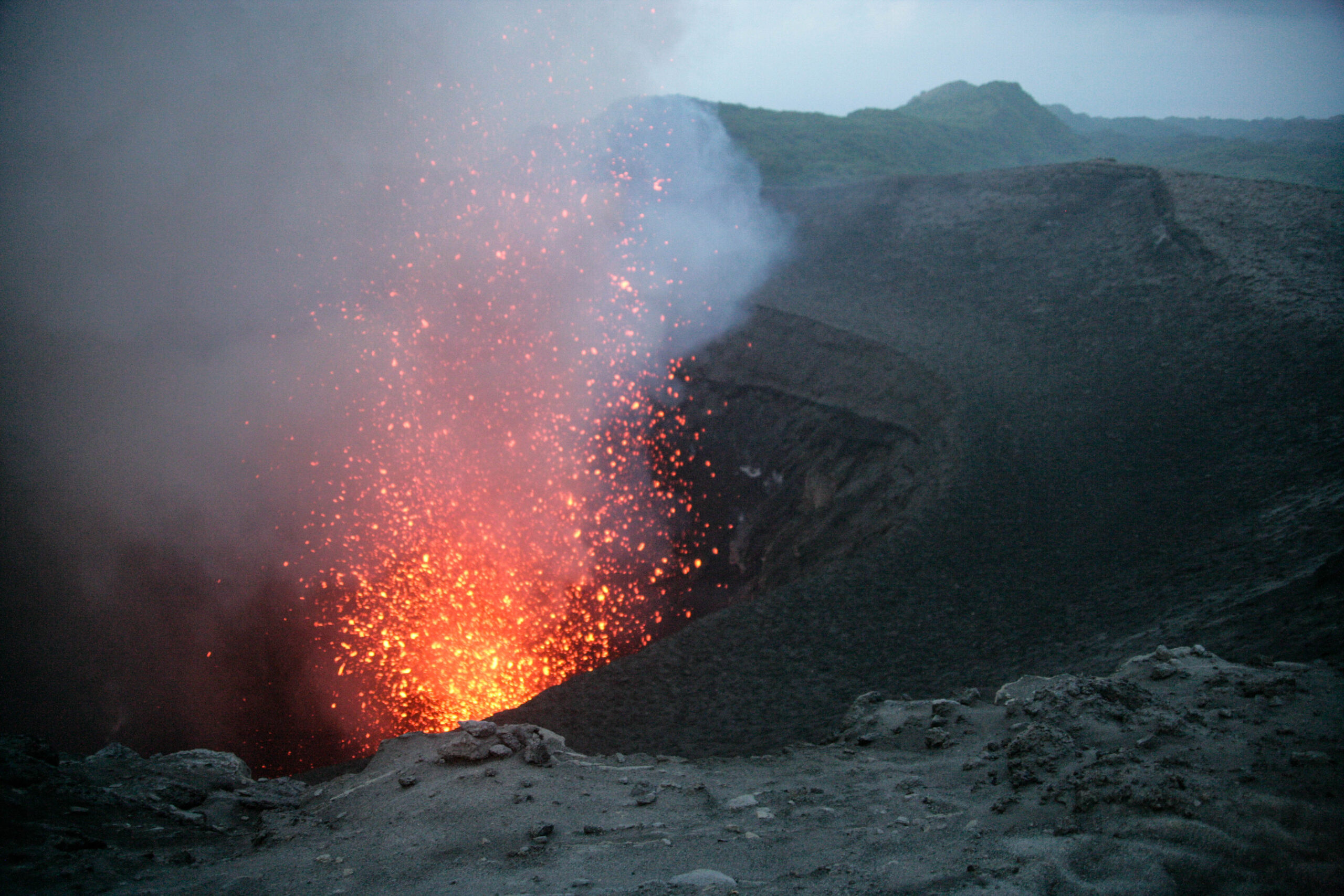
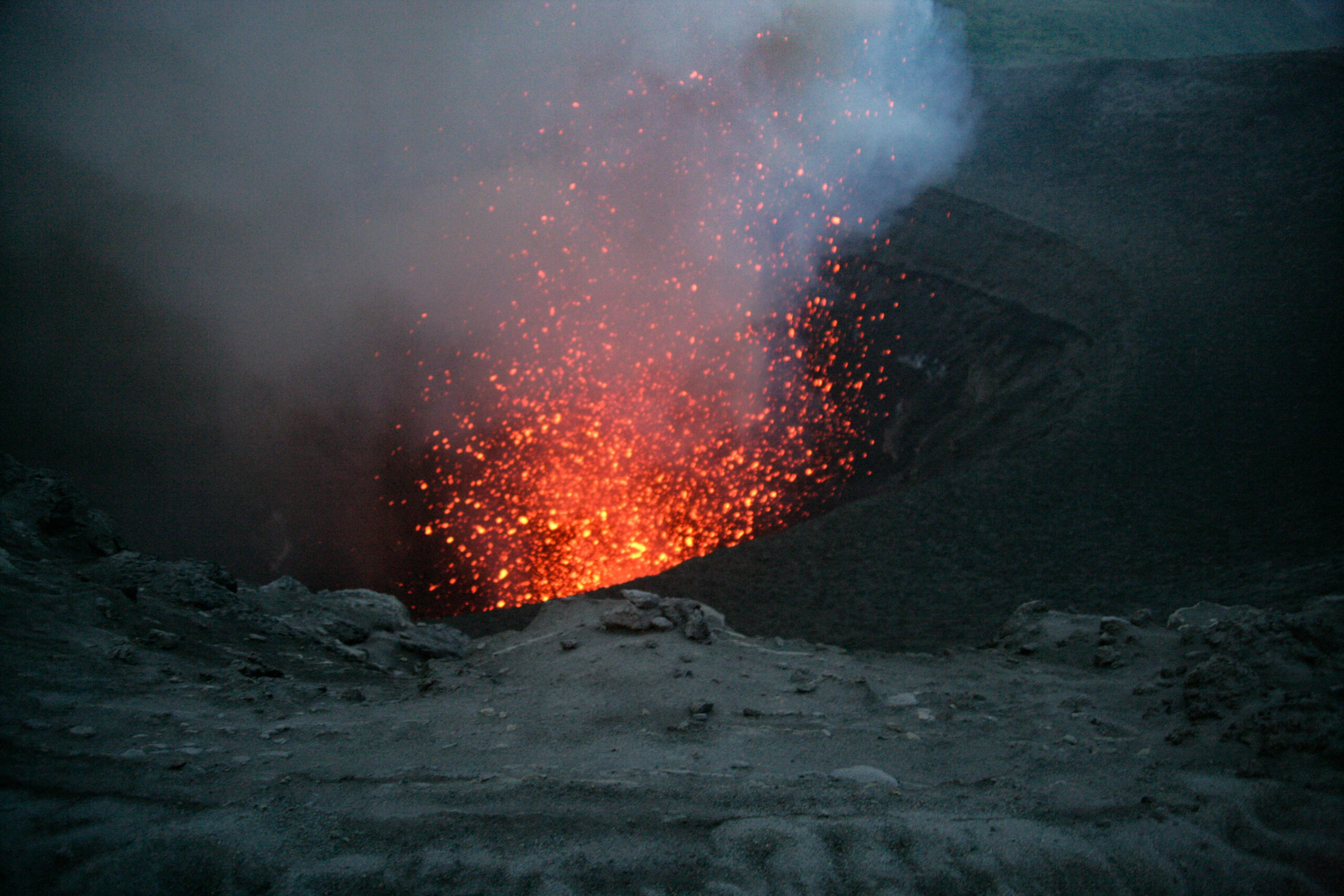
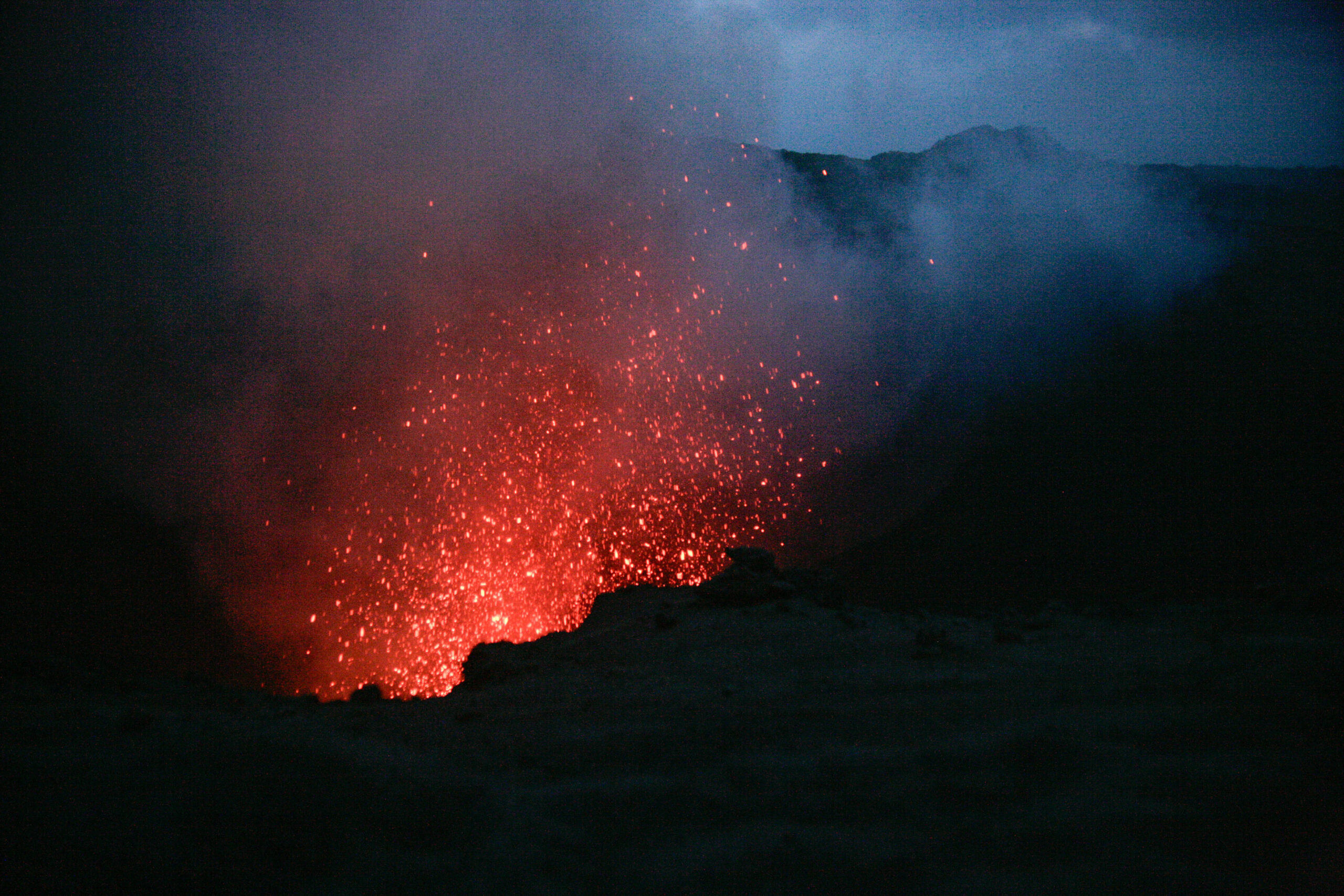
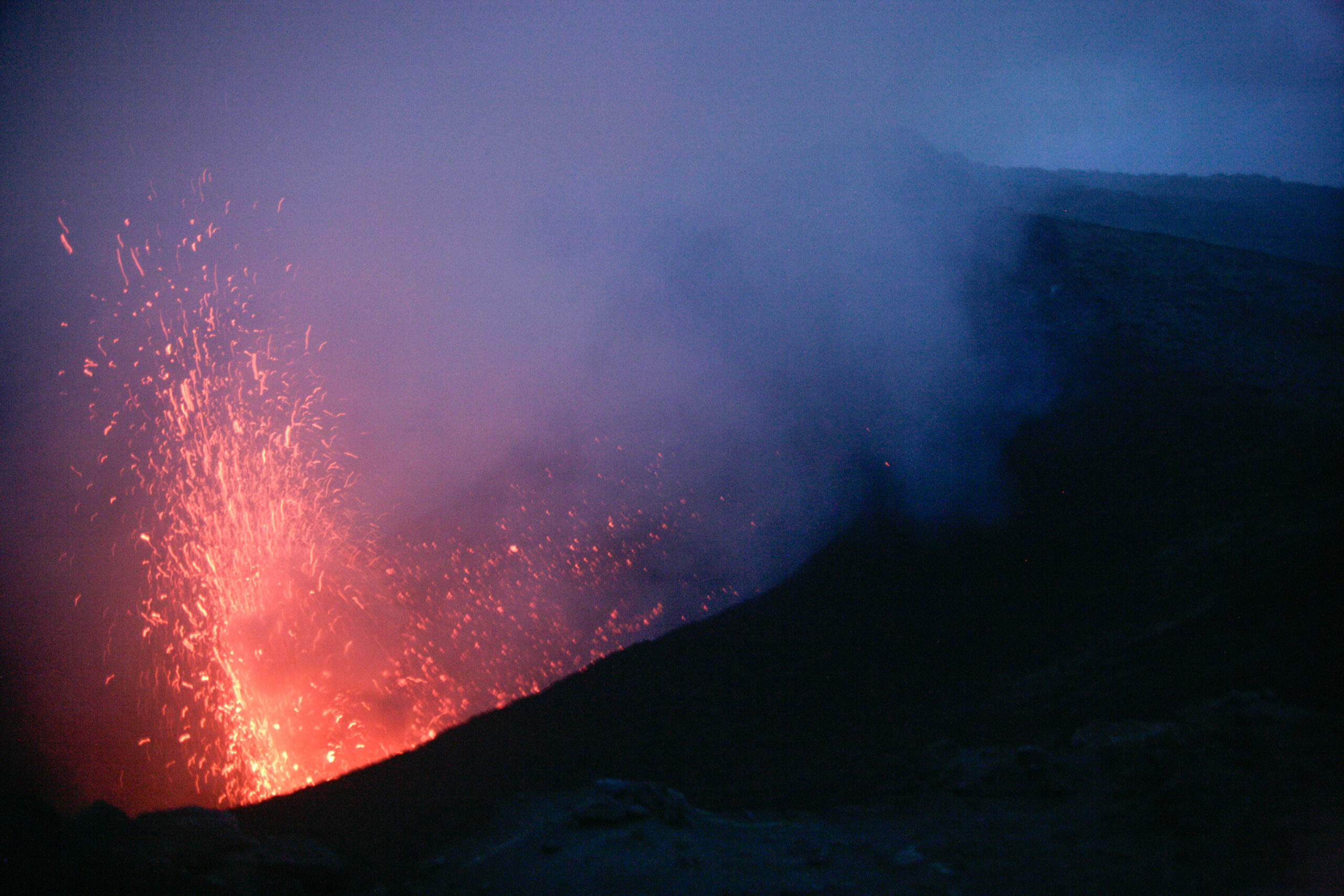
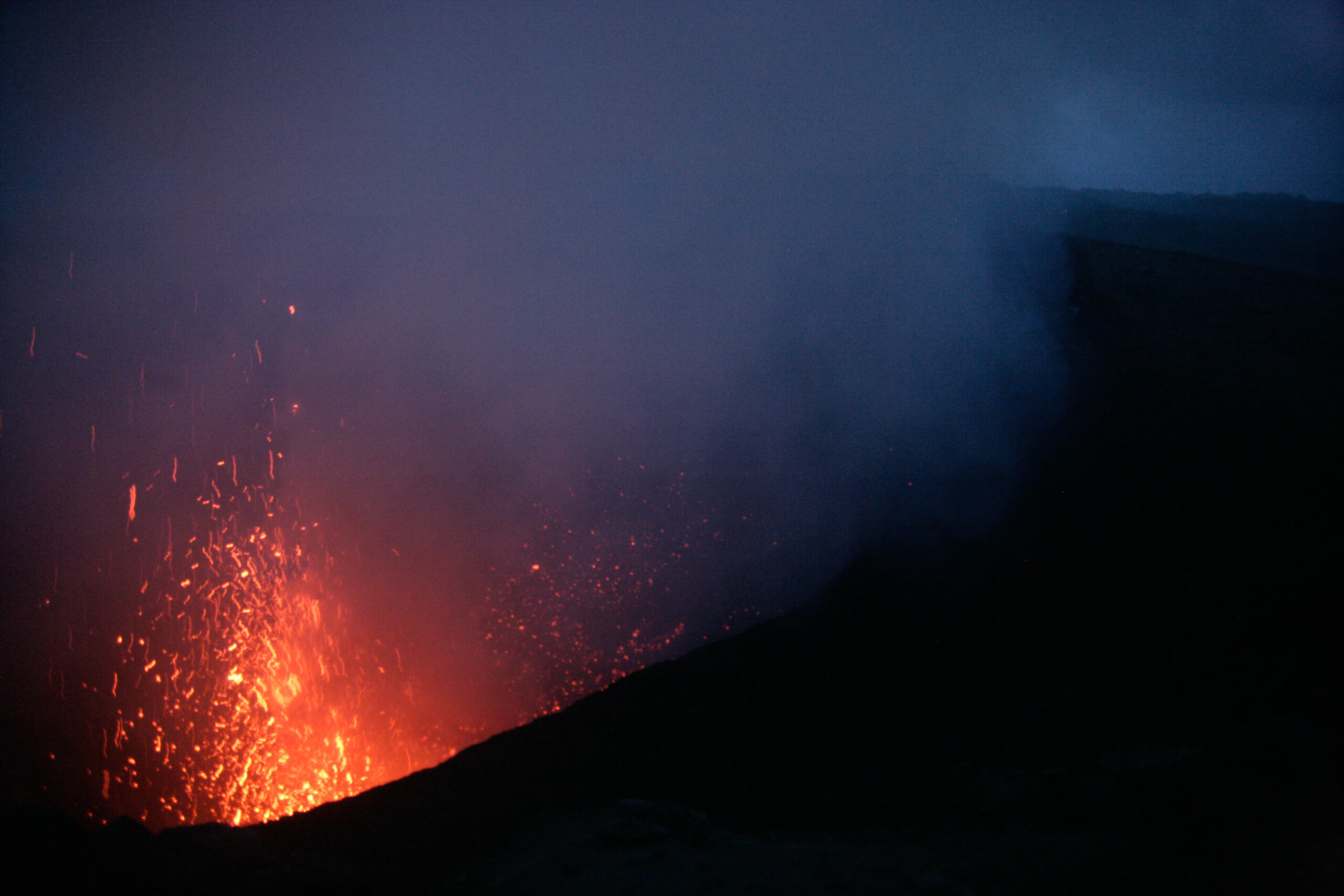
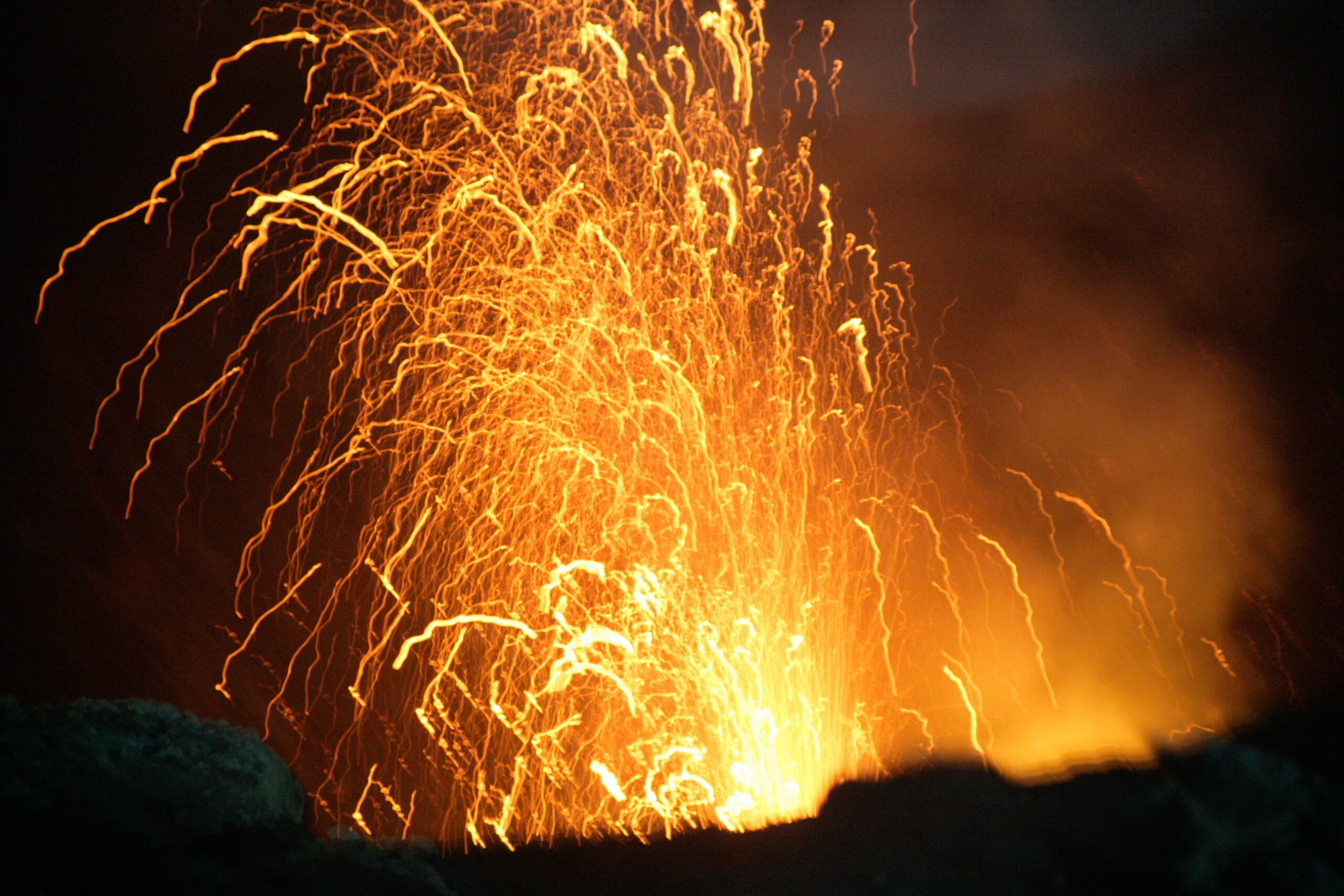
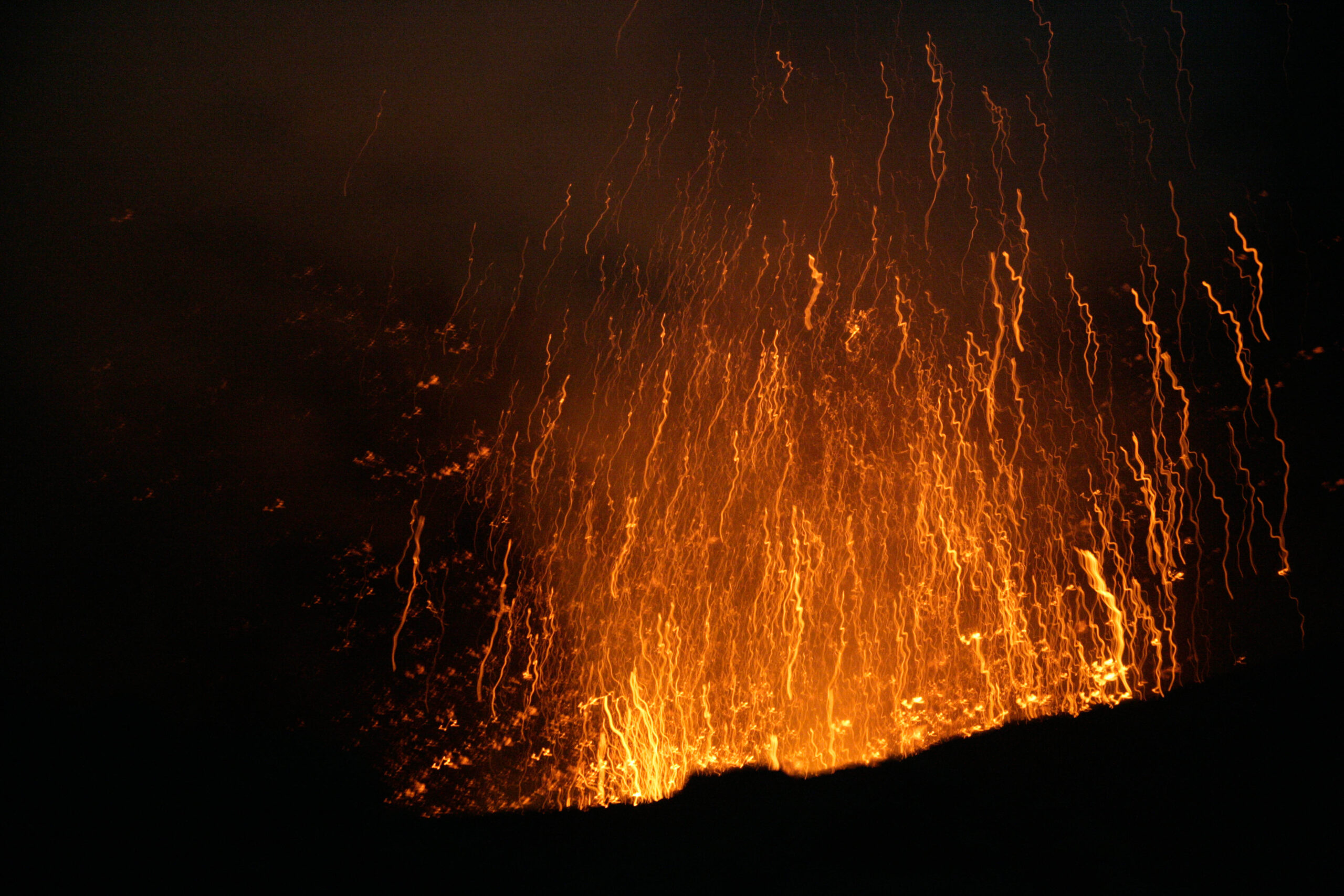
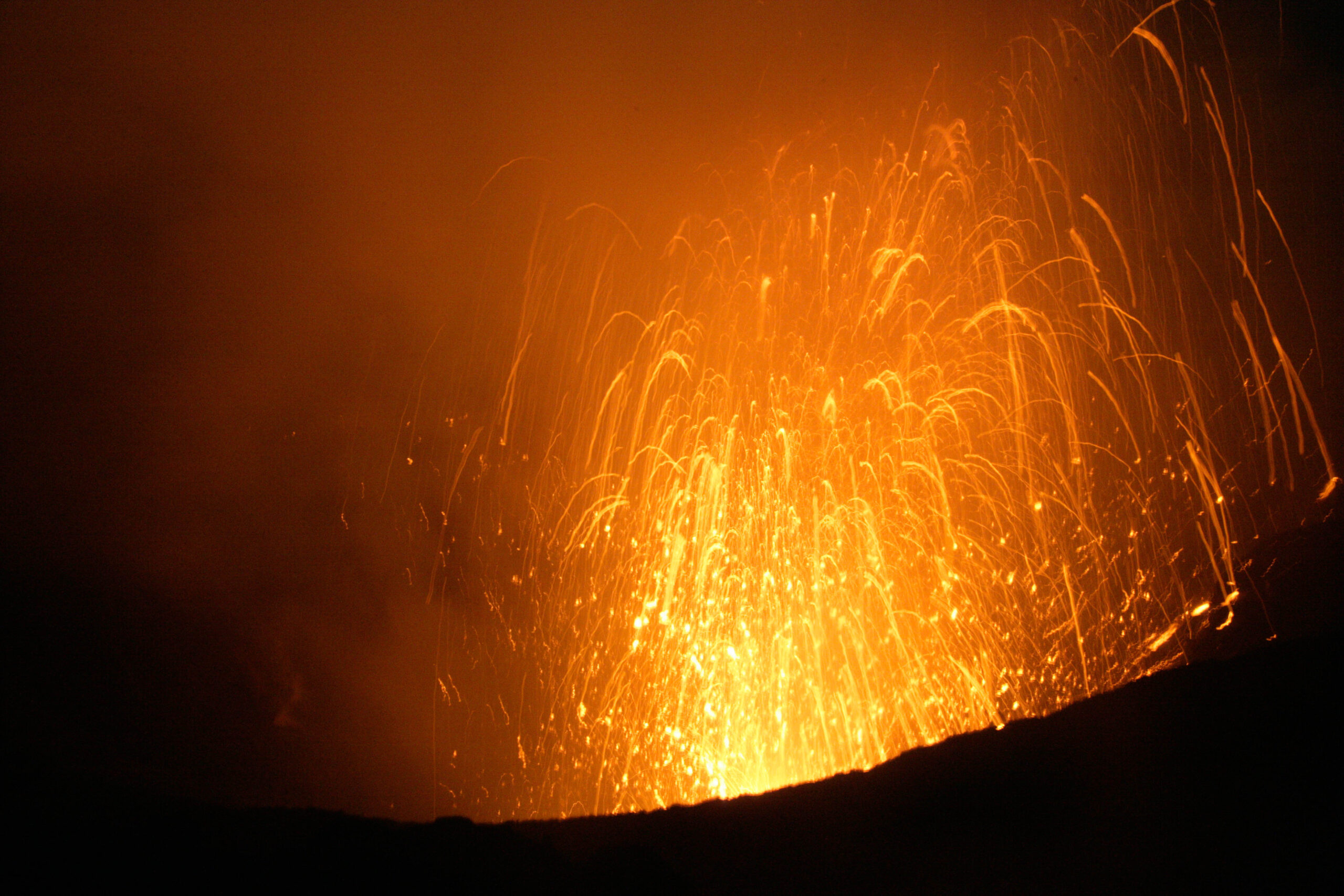
    We made the final climb to the rim of Mt. Yasur and peered over.  The edge sloped away at 45 degrees and then a few hundred feet away, cut down steeper, hiding the actual bottom.  Smoke puffed out at random intervals.  Sulfur filled the nostrils with an acrid stench.  Booming sounds of explosions and rumblings echoed up.  And the ground.  The ground shook when a large explosion would deafen the air sending a shock-wave of sound and air streaming past.  Projectiles shot up above the level of the rim.

    Someone asked our guide if you could see the actual magma pit from any vantage point on the rim, and he replied they wouldn’t take tourists to those places.  If you can see the magma pit, the guide said, that means it could shoot something directly at you and you were vastly more likely to be in the path of flying debris.

    Our guide held us where we initially gained the rim for a few moments as he stared into the pit of the volcano.

    “Can we hike higher along the rim?” he was asked.

    “We must wait for a moment.”  he replied.

    “For what?”

    “I must see which which way the volcano is shooting debris today.”

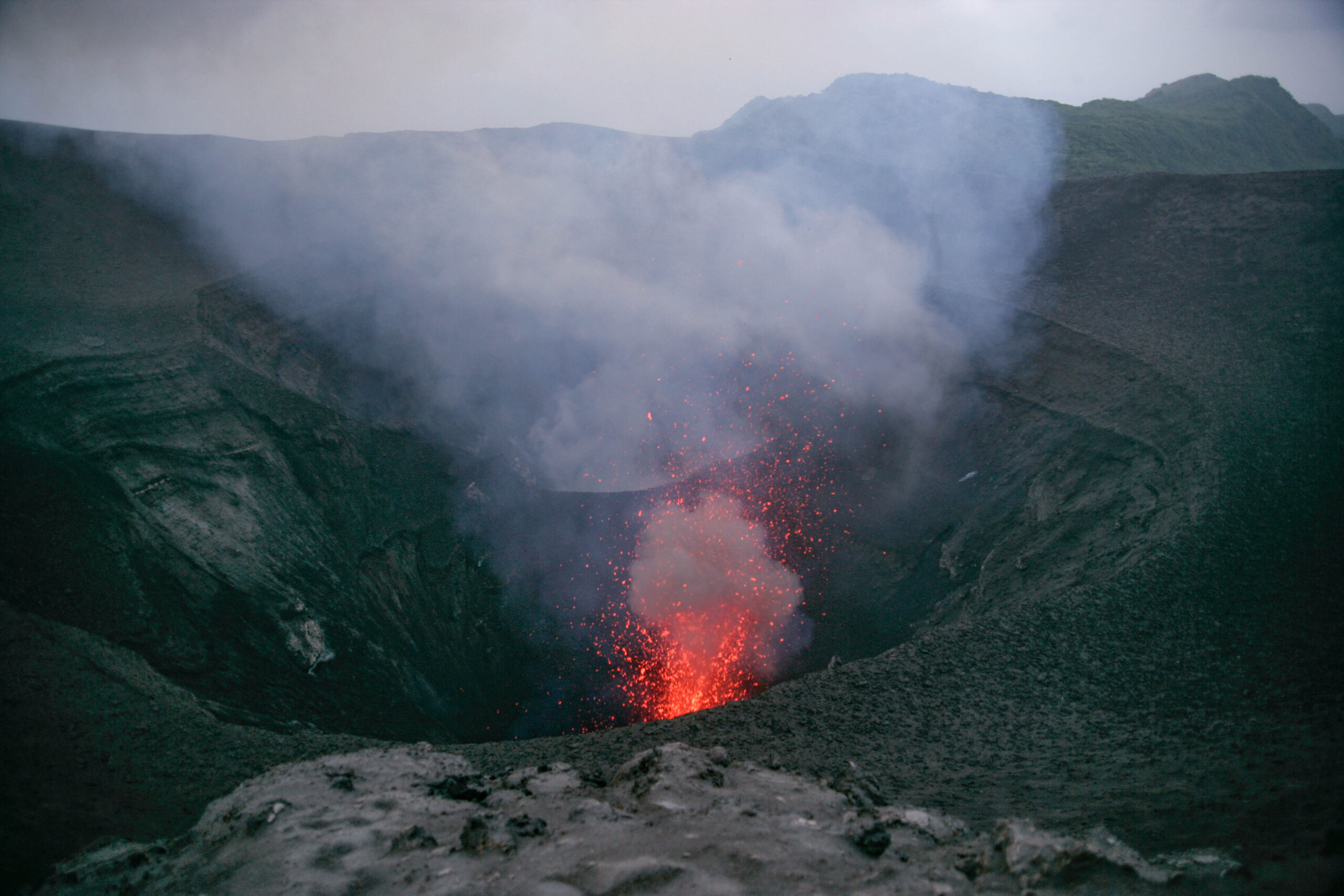
    And shoot it did.  A few minutes later it exploded, and the senses were assaulted with the acrid smells, booming sounds, sights of billowing smoke and projectiles, and feel of a shuddering ground and shockwave of air.  One got the feeling that nature was very much in charge here.

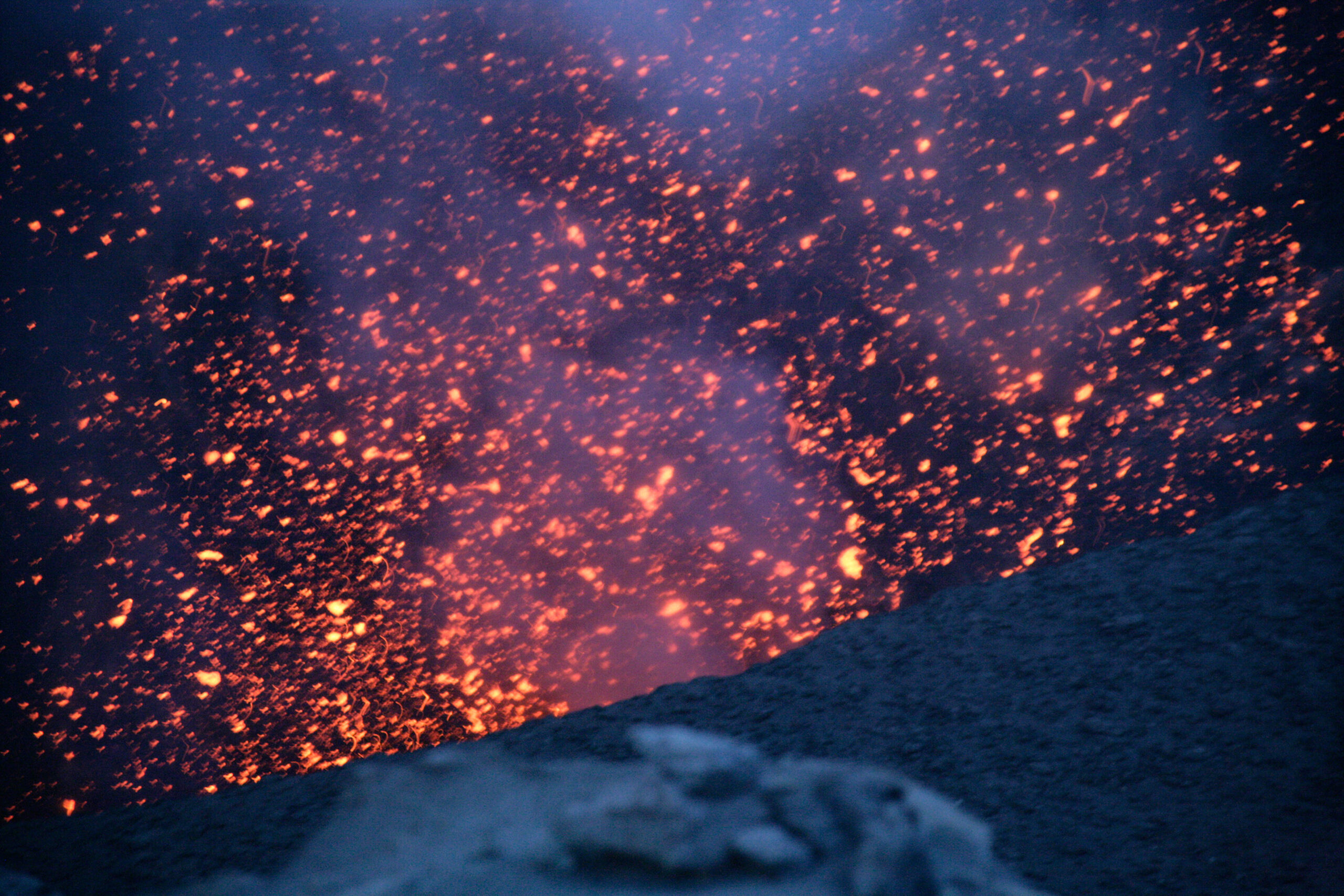
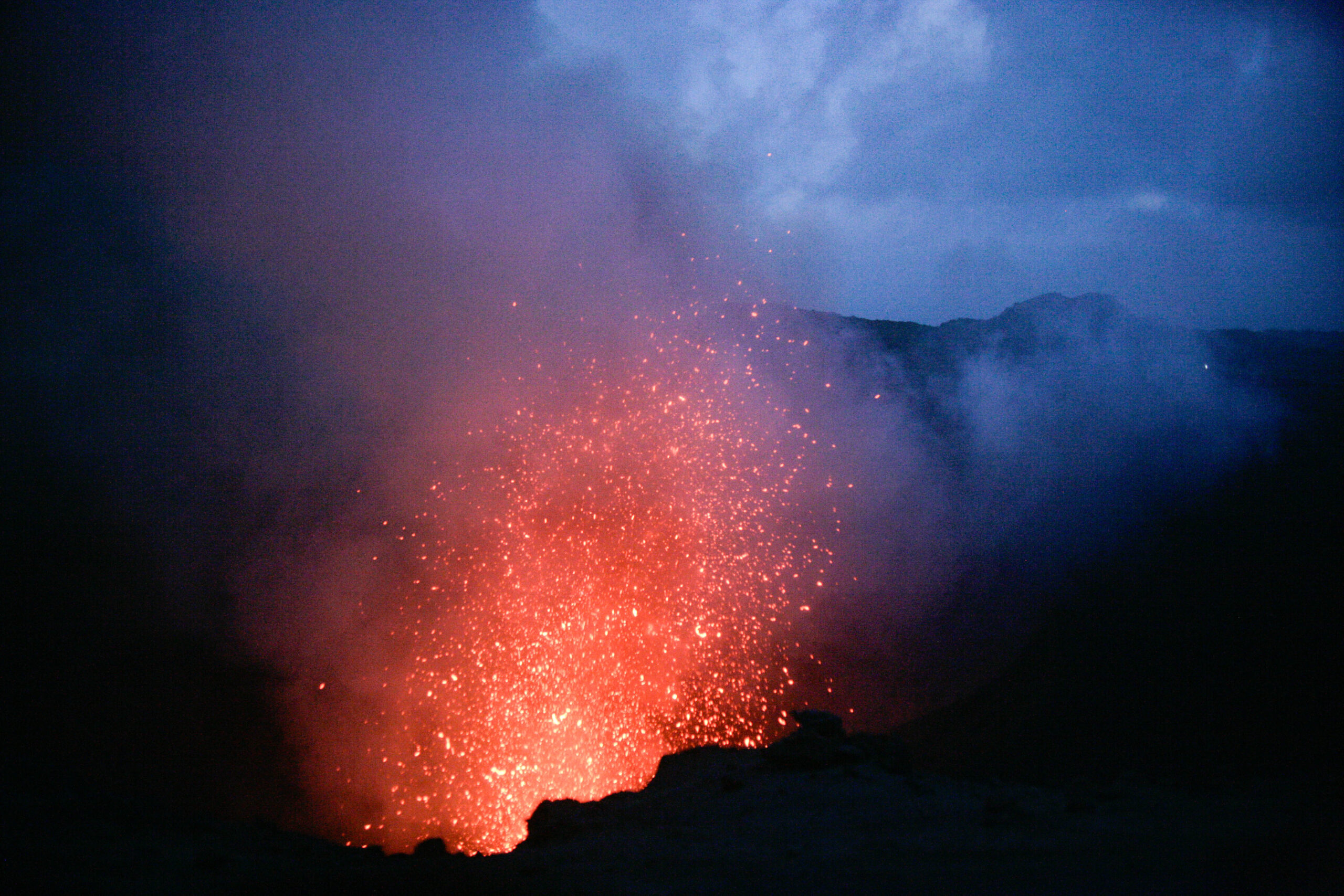
    Our guide then led us higher on the rim of Mt. Yasur.  The random and intermittent explosions continued, but now with a better angle to see, we were witness to lava exploding forth, sending showers of molten rock high into the air and spreading red hot glowing debris over a vast area of the inner slopes.  As the sun set behind us, the scene became even more impressive as the glowing became more brilliant.  Glowing debris from even the smallest explosions could now be seen more easily.  And when the largest explosion yet erupted, it was simply awesome.

  • Vanuatu and Mt Yasur volcano

  • Vanuatu Kava

    Vanuatu kava is stronger than Fiji kava.  20 shells of Fiji kava and mostly what I felt was bloated.  2 shells of Vanuatu kava…. mmmm mellow.  mmmm numb mouth.  mmmm slurred speech.  mmmm difficulty in concentrating on anything other than mindless action movies, like Daniel Craig as James Bond in Casino Royale.

    As Matt, Karen and I were waiting for the small pickup truck that would take us and eleven other people up to the active volcano on Tanna Island in Vanuatu, Matt inquired of Stanley about kava.  Stanley, a native Vanuatu-ian, (he must have another, non-English, Vanuatu name) was responsible for setting up the transportation and seemed to be well connected in the village.  Stanley said he could get us some kava.  This was perfect as we didn’t think we would have time to visit a nakamal, a place where they serve kava in Vanuatu, after seeing the volcano.  And we would be leaving for New Caldonia the next day.

    Stanley asked Matt how much kava we would like.

    “Well how much would a liter cost?” Matt replied.

    “100 vatu.”  Stanley replied.  This was about one dollar.

    “We’ll take four liters,”  I told Stanley.  I was tempted to ask for three times that amount.  We’d have enough kava to last us a year or more!

    When we returned from the volcano, Stanley had our kava.  Unfortunately it was only half a liter of kava.  Somewhere in the verbal communication something got lost or mistranslated.  Resigned to our meager amount of kava and unwilling to try and figure out why it was so much less than we expected, we took our kava back to the boat.  Whereupon, at the boat, we began to drink it.

    The guidebook we have says you should drink kava on an empty stomach to heighten its effects.  My forays into alcoholic consumption have confirmed this is a good technique for enhancing effects of mind altering substances, so I believe it and Matt and I abstained from eating dinner for two hours while we drank some kava.

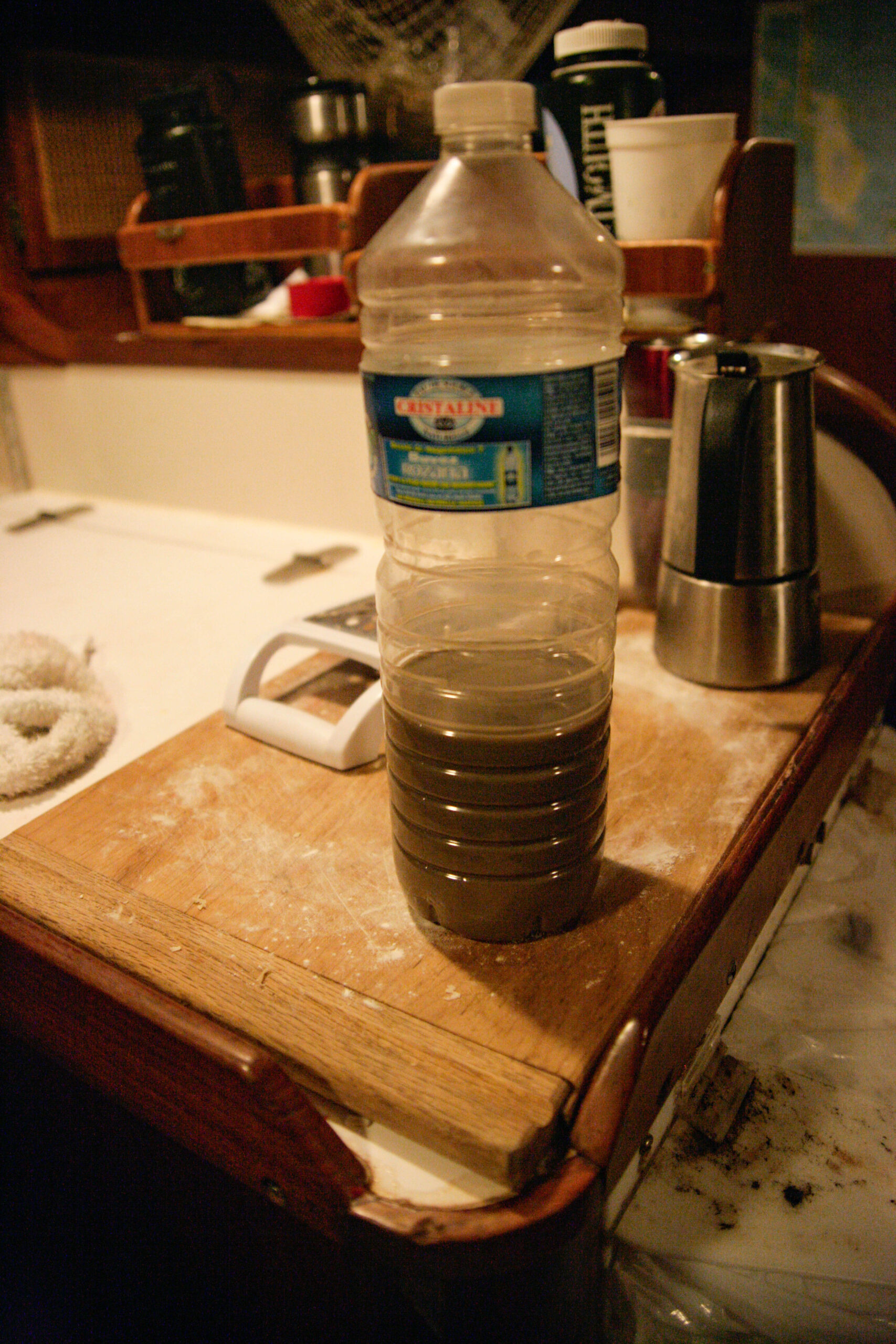
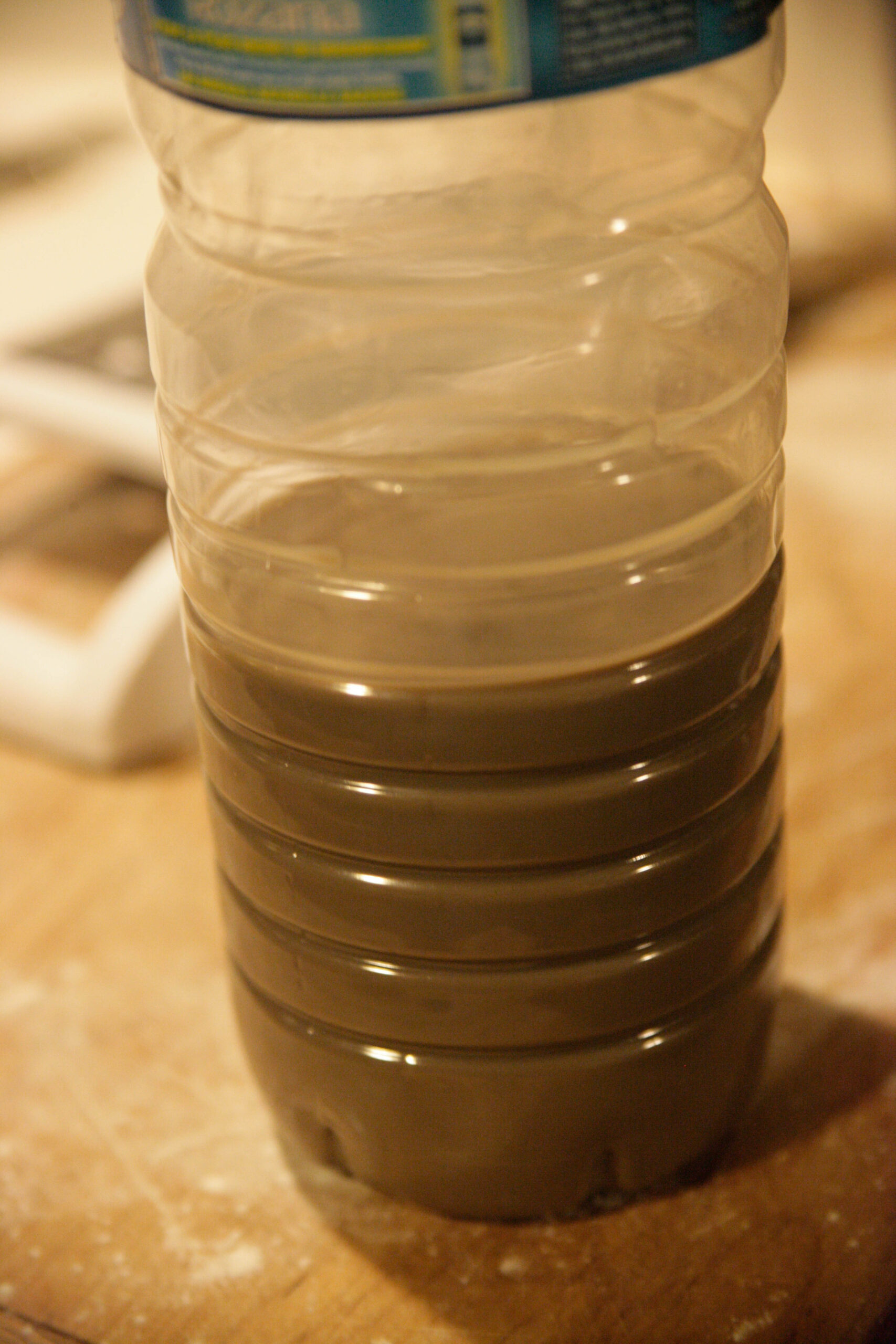
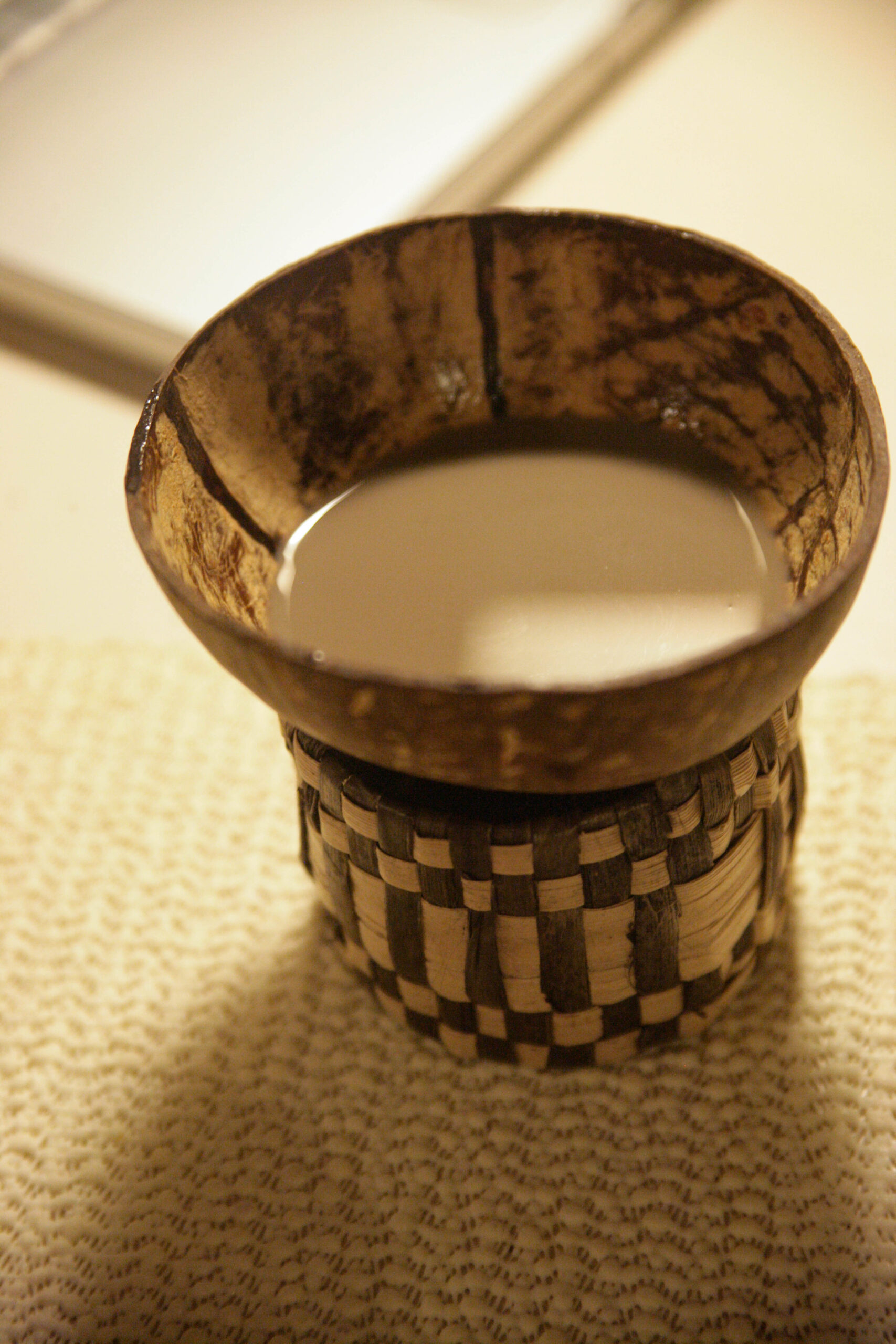
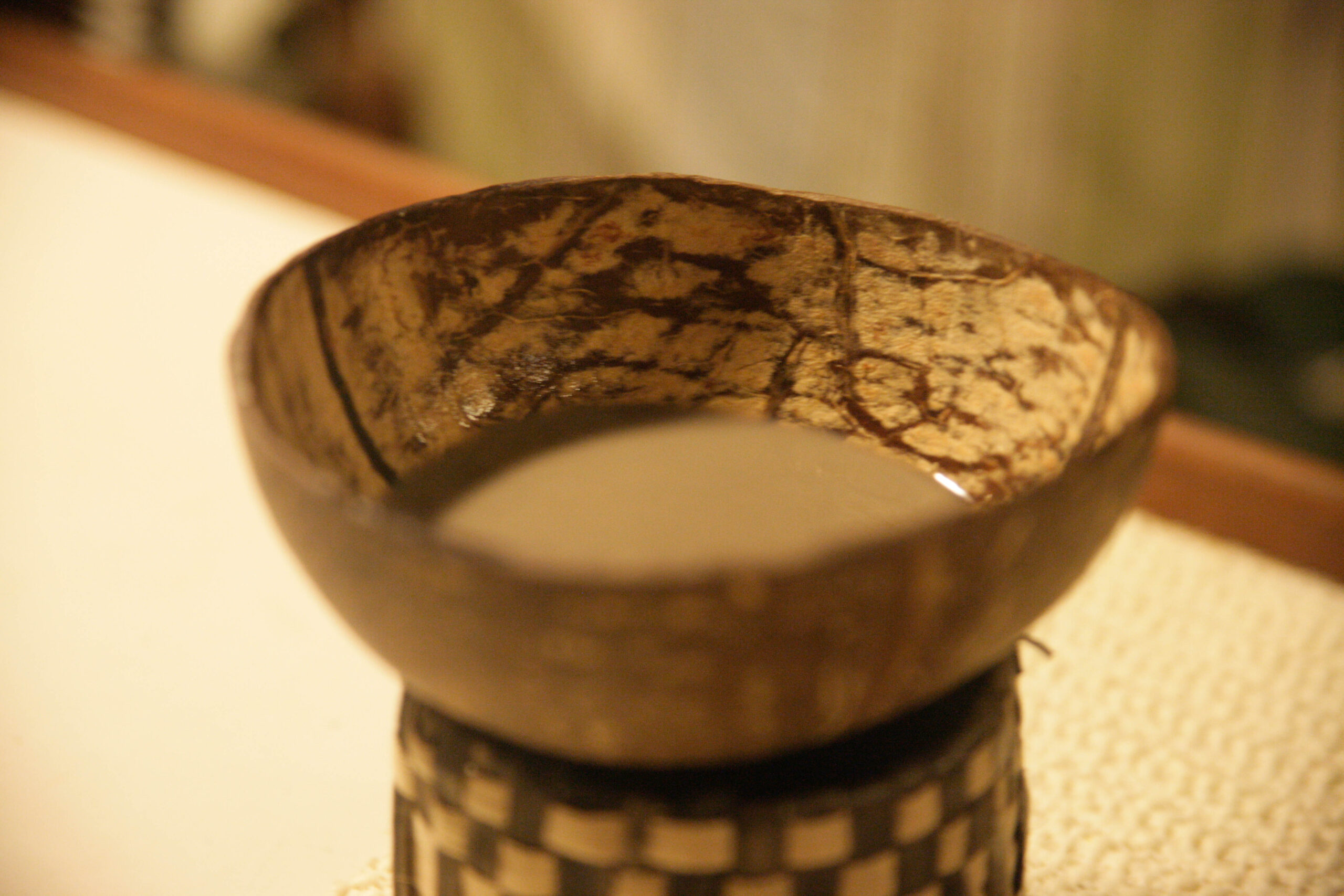
    To drink it right, we broke out the shells I had purchased in Fiji.  We poured the kava into them; the kava looked more thick than Fijian kava.  In Fiji after pounding dried brown roots and adding water, they strain the liquid through cheesecloth.  In Vanuatu, they grind green roots and do not strain it.  I hope they grind it and don’t mash it in their mouths.  The different texture did not change the taste, it still was dirty bath water, but now with a little more viscus thickness to it.  Texture-wise, think whole milk versus water.

    We drank one shell, and Matt started in immediately on another.  “Why not go for the full effect?” he reasoned.  I followed a little behind.  After two shells, I felt mellow, a numb mouth, slurred speech and difficulty concentrating.  If I focused hard, I could force myself to talk normal, or at least what I presumed sounded more normal.  But if I just let aimless ramblings come forth, I felt like I was slurring my words and my mouth wasn’t functioning the way it normally would.  It was fun.

    Matt lapped me in kava consumed, and I handed off my last 1/2 of a shell to him to boot, as he was saying there didn’t seem to be much effect.  I wonder if he was simply focusing harder on what might be happening, his more analytic nature trying to quantify and categorize the effect, but consequently forcing out or marginalizing those effects by the act of analyzing them.  Analogous to quantum mechanics, perhaps you can’t analyze the effect without changing the effect.  The physicist in Matt defeated by the physics of it.

    In the end, Matt lopped on a couple of shots of prime fine Scotch, and this he paid for dearly over the next 24 hours as we began our sail to new Caldonia.  Kava and alcohol apparently don’t mix.

  • Drink Link Updated

    The drink tab has been significantly updated to actually show pictures of us drinking. We thank all of you who have contributed, some of you have been overwhelmingly generous, and before I get into my shtick, we do truly appreciate all of you.

    To the 15 of you who contributed before I (Jon) joined in June, I will get pictures soon from Matt of the inebriation you sponsored, and you too will get your day in the blogosphere contributing to an unhealthy non-tax-deductible cause. Not all of the people who have contributed since June are listed in the drink tab. Don’t worry, it is our fervent desire and plan to continue with our up-until-now well executed plan of steady alcoholic consumption. We are embarrassed at our lag time with posting thanks and pictures, but generally blame it on you and the intoxication you made possible, and hope you will forgive us by buying us beer.

    JONATHON

  • Kava

    (This post refers to events that happened throughout our stay in Fiji, though primarily Sept. 14th, 16th,  and Oct. 3rd)

    Kava is a narcotic.  That it is a narcotic with only the slightest tiniest itsy-bitsy of narcotic effects to make one think ‘why bother?’ doesn’t deter the Fijians from passing time downing gallons of it, one coconut shell at a time.  That it tastes like dirty bath water is also not a deterrent.  For some reason neither is the fact that, in Fiji, the traditional preparation is for young boys to thoroughly chew on the pepper root, fully masticating it, spit it out, mix with luke warm water in the tanoa (the traditional container, an artistically carved wooden bowl on four legs) and serve via coconut shell.  Thankfully, the traditional preparation is no longer practiced except perhaps in the remotest of villages.  Every time I drink kava I make it a point to convince myself of this last bit.

    I felt required by my compunction for experiencing local culture to try kava.  I also have a compunction for trying new mild (mild-only!) narcotics.  So when, on our first day ashore in Lautoka, I found myself wandering the market alone, I knew I would immediately get a chance.  City markets, the one in Lautoka in particular, are where men hang out.  And wherever men hang out in Fiji, there is probably a kava bowl being passed around.

    In the market, I walked by dozens of yaqona vendors.  Yaqona is the dried but unmasticated (nowadays they more hygienically pound it) pepper root.  I learned later a longer root indicates a more aged pepper plant and in turn better kava.  Kava apparently is like wine, and gets better with age.  Two or three years is young but frequently used, five years is better.  Most of the yaqona at the market was about 18 to 24 inches, though I saw some four foot stuff that was artistically bundled into something resembling modern art.  Next to the vendors were the drinkers, twenty tables under a tent, all filled with men lazily sitting around.  At the first table I walked by, a man named Mesake cried out “Bula!” and invited me to join them at the table drinking grog.  The Fijians are extraordinarily nice; what else could I do but accept?

    Despite being far removed from the traditional ceremony, Fijians still retain some aspects of the traditional kava ceremony.  Namely, they clap.  Guide books will say you have to clap exactly once before being handed the coconut shell of kava and after handing the shell back, clap exactly three times.  The claps should be proud, with an exaggerated motion.  While this might be true in the remotest villages,  I’m here to tell you, in the markets, pool halls, resorts and backpacker camps where I drank the grog, you can feel free to clap an indiscriminate number of times, loudly or softly, shyly or ostentatiously.  The only thing in common to all the places was the rhythm or pacing of the clapping. Think the pacing in a rock-paper-scissors game, slow it down just a touch, and you’ll about have it.  Certainly not standing-ovation-at-the-theater style.  At the pool hall, they simply pat a leg at the requisite speed.  When I asked why, laziness was attributed.

    Mesake offered me a shell, and as I had read up on kava drinking, I knew about the clapping and that when I drank it, the kava is supposed to go down in one smooth go.  There are about three to five ounces of liquid in a normal shell, so anyone with experience from college shot-gunning a poor-tasting American light beer should have no problems smoothly drinking this poor-tasting sandy bath-water concoction.

    I handed Mesake back the shell and thought, ‘maybe sandy bath-water isn’t so bad?’  My tongue went slightly numb, and with the two or three subsequent bowls the tiny tingling extended around my mouth and throat.  That was about it for effect, just some tingling, maybe some numbness.  The bowl went around, celebrating my joining the table.  Ten or fifteen minutes would go by and then the person in charge of the kava tanoa at the table would decide it was time for more kava and start passing the shell around again.  The time in between passed with Mesake and a woman seated across from me, Paulini, telling me about Fiji at large and more particularly the villages they were from in the Yasawa’s.  They gave me the names of people they knew or were related to in the villages they were from and insisted I ask for them when I arrived there.  Alas, we never made it to those villages, but the kindness was indelible.

    I drank some kava again in the Nadi market while wandering around there with Allison.  I secretly presumed there would be grog there, that we would have a chance to try and wanted to see if she would.  And so we walked around longer than necessary as I tried to locate some kava drinking.  She demurred this time, hesitant at the cleanliness of the whole operation, which admittedly is suspect.  I can’t fault her on this point.  The same coconut shell is passed to everyone: one person drinks, and the shell is immediately dipped back into the kava in the tanoa and handed to a next person.  They certainly don’t clean the coconut shell in between uses.  She was, however, up for it at the welcome ceremony at Octopus Resort and she reported that yes, like pretty much everyone else, she thought it tasted like bath water and didn’t particularly like it.  I however, was developing quite a curiosity for it.

    Two and a half weeks later, I went to Nadi International Airport with Allison to trade goodbyes and other newly learned Fijian.  She and I had had a fantastic time together, and I was certainly sad at the thought of not seeing her again for three months or so.  The taxi was headed back to a dorm room bed at the awkwardly named Nadi Bay Resort Hotel (comfortable beds and amazing food… best kokonda in Fiji!) It occurred to me that what better way to spend a melancholy evening than around a kava bowl.  I redirected the taxi to someplace where they drink kava.

    I ended up in downtown Nadi at a pool hall.  A pool hall is somewhat of a misnomer as it invokes images of a location filled with pool tables, a dozen of them, maybe two dozen or more.  This place was certainly packed with pool tables, you had to nearly sit on one table to take a shot on another.  But there was just two tables.  I walked in warily but like I belonged and saddled onto a wall to check the place out.  All the way on the opposite side of the pool hall, eight feet away, a Fijian flagged me over and handed me a bowl of kava.  His name was Ben.

    After another bowl of kava, the owner of the pool hall, Sue who also happened to be, I’m pretty sure, a prostitute who propositioned me, motioned I should put money down to play at the only table with action going.  It was a challenge table so you had to beat the previous winner, currently a young teen who had been winning ever since I walked in and was dispatching people quickly.  So I did, and played one of the best games of my life, banks, combinations, strategy, and a little luck.  One of those inspired moments of pool that only come after a couple of beers have steadied your hand and your gaze; instead of beer though, this time it was kava.  While playing, we would trade back and forth a few shots, I’d have a cup of kava.  In the end, I won and the kid stormed out perhaps upset that the popeye (white foreigner.  I hope not derived from the silly cartoon) drinking kava, when he was too young too, had run him off the table.  A couple more games saw me lose and I went to the bench to talk with Ben and another Fijian Joe about Fiji.  I bought some of the powdered yaqona for us to have more kava after we finished what was in the tanoa.  Interestingly, their tanoa was definitely not a traditional one.  Instead it was a flimsy blue plastic dish.  Flimsy like two-liter coke bottle plastic.  After ten bowls of kava I decided it was time to leave.  Sue asked if I wanted company; I politely declined and left to find a taxi.

    Back at the hotel, lo and behold what do I walk in on but the bartender, a couple of his friends, the security guard and a couple of patrons around a kava bowl.   I earn an invitation.  One guy is from Kiribati on a fishing boat.  Another’s name is Damian, and after hearing I have a yacht, is interested in crewing to Australia.  Two hours go by, and with the security guard in charge of the kava bowl, everyone is consuming plenty.  After another ten bowls, I’m feeling woosy, almost certainly though, from it being 3 am, five hours after I normally go to bed these days, and not from the twenty or more bowls of kava I consumed.

    The next day, I woke up early.  No hangover.  No residual effects.  There weren’t really any effects at the time either.  Which makes you wonder, if there’s no effect from drinking poor tasting dirty bath water, than why drink poor tasting dirty bath water?  My curiosity with Fijian kava was killed and I haven’t had it since.

    Vanuatu kava, on the other hand….. two bowls lays a wallup, four bowls and you won’t be able to walk.  We’ll soon find out.
  • Jon. From the Yacht.

    this post refers to events which primarily happened September 18th-21st)

    “Did you notice how the masseuse, she giggled after saying -You must be Jon.  From the yacht.-”  I asked Allison after we emerged from our respective massages at Octopus Resort on Waya Island in the Yasawa island group of Fiji.

    “Do you remember me telling you earlier today that everyone here calls you that phrase?” she dryly replied.

    I protested that she hadn’t; she reminded me that she had today, and yesterday as well, and gave details to substantiate.  I had to concede.

    I sighed a popular refrain of her visit here, “You’re right Allison,” and I think as I said it, she smirked.

    In Fiji, a distinct classification between places to stay on the outer islands is the location is either a resort or it is a backpacker’s camp.  On the outer islands, there are few or no places in between.  Names can be deceiving as many backpacker camps will insert resort into their name as linguistic facade.  I have been unable to divine a hard rule to classify resorts from camps, but have settled on three guiding characteristics.  Backpacker’s camps have all three; resorts can sometimes have one, though in the end being classified as a resort is still no indicator you will enjoy yourself there.  1)  Backpacker’s camps are cheap.  2)  Backpacker’s camps have communal meal times where everyone has to eat each meal within a prescribed.  These times are normally shorter than is convenient to my style of lazy relaxation, ie. Breakfast is 7-9, lunch: 12-2 and dinner 6-8.  More importantly, tables at which to eat are also communal.  3)  Backpacker’s camps have some, but usually not exclusively, communal living space.  Dorms, mmm, fun.

    So by this system, Octopus Resort is classified as a backpackers camp, though given it’s priciest accommodations, one could claim it fails #1. Lonely Planet agrees with the outcome of my classification scheme in this instance, though it does say: “Compared with your average Yasawa backpacker camp, Octopus is more than a few notches up the coconut tree in terms of quality and yet still retains its unpretentious charms.”

    A few coconut fronds indeed.  After a day wandering Nadi, followed the next day by a sail to Beachcomber Island (a tiny speck of sand with a decidedly youthful backpacker camp) and anchoring off Beachcomber that night, we sailed/motored our way to Waya Island.  At Waya, Matt dinghied us into the resort.  We arrived to large booms of “Bula!” The ubiquitous greeting of hello in Fiji, which all tourist-minded businesses yell towards new guests or passerby.  At the resort desk, I said I was Jon, and was interrupted with, “Ah, yes, Jon.  Jon from the yacht.”  Yes, I replied, I am Jon from the yacht.  On our reservation, I had put that we would be arriving by sailboat, and would not require the customarily included transportation from Nadi, and it only would make sense that the front desk would know me as such, I reasoned.

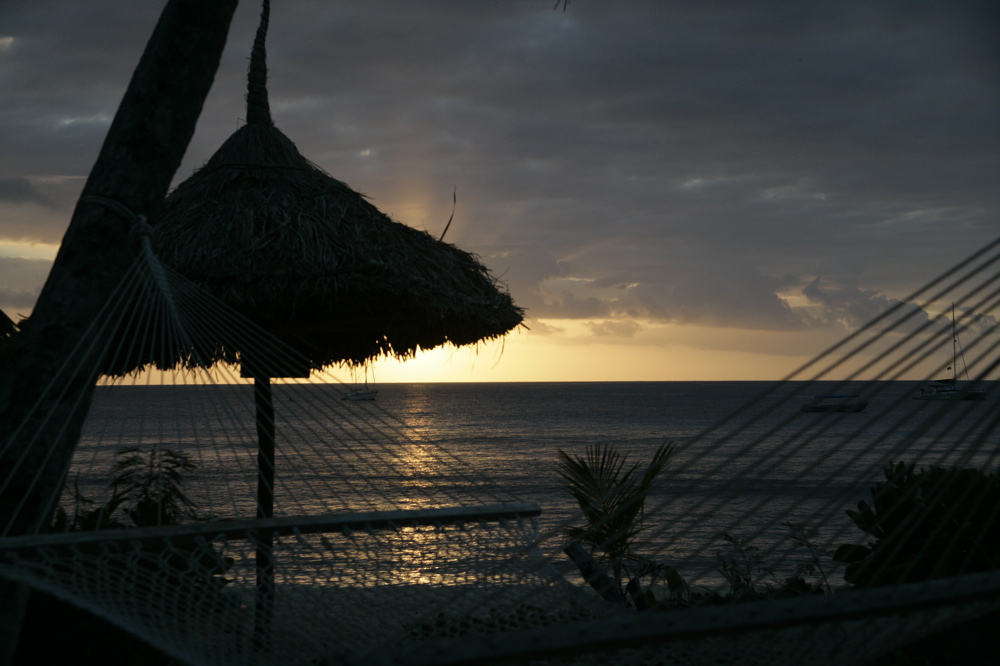
    Checked in, we relaxed at our private bure, (no dorms for us, I already did college) for a while before a welcome ceremony for anyone who arrived today.  The bure was ocean-side and we watched the sun set over the Pacific Ocean from the hammock that hung not ten feet away from our little porch.  The welcome ceremony involved kava, a drink I had begun to enjoy.  After the welcome ceremony was over I stuck around.  Seated around the kava bowl, I talked with the Fijians who had run the kava ceremony and who were now idly playing a small guitar, singing, drinking kava or passing it to others.  After a question one of them couldn’t field, he turned to another man, who turned out to be the resort manager.  He asked if I arrived today and after I replied yes and motioned to Syzygy anchored a quarter a mile away, he intoned, “Ah, you are Jon.  From the yacht.” As he spoke, he nodded knowingly and the corners of his lips turned up in a smile.  This may have been from the kava.

    That evening I approached the bar with two bottles of wine for the bar to hold on to, I had brought them from Syzygy and you were not allowed to keep any food and drink in your rooms.  (the single small downside of Octopus is it seems a few mice scurry about the resort).  The bartender said he would certainly hold onto them for me and asked where I had gotten them.  I said I had brought them from my sailboat when we arrived today.  “Ah! You are Jon!  From the yacht!”  “Yes,” I smiled, “I am Jon from the Yacht.”  “Of course we can hold this for you!” he said smiling.  They do this for everyone by the way.  Allison and I would saddle up to the bar many times over the next three days drinking a variety of concoctions.  Their pina colada was good; their mojito (called a wayan mosquito) just didn’t stand up to ones I make at parties (and written about in magazines, no lie).  It was a espresso-ice cream-frangelico combination though that we went back for again and again and again.  Delicious.

    The waitress at our lunch the next day… same thing, “Ah, you are Jon.  From the yacht.”  Replete with little giggle.  When I asked another staff person at the front desk about a special lobster dinner I had booked when making our reservation, she replied, “Lobster dinner? You must be Jon! From the yacht.  Sabrina, this is Jon from the yacht, who gets the lobster dinner.  Can you help him schedule it?” And then all 4 women in the office I swear tried to hide a little giggle.  At the lobster dinner, our server came up to our table and exclaimed, “Bula! You are Jon.  Yes? From the yacht?”  I had finally caught on to the pattern.  Allison noted it the first time I believe.

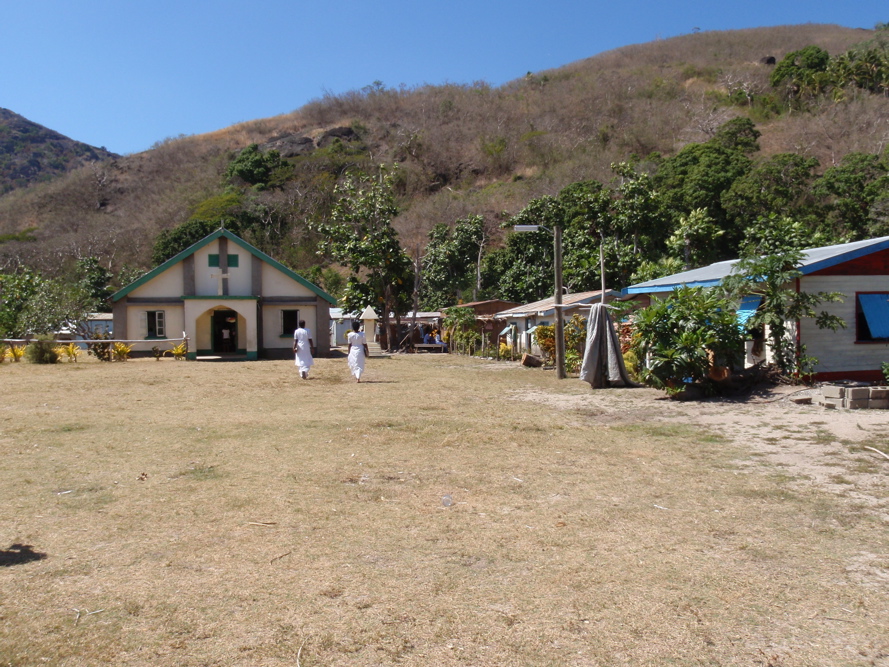
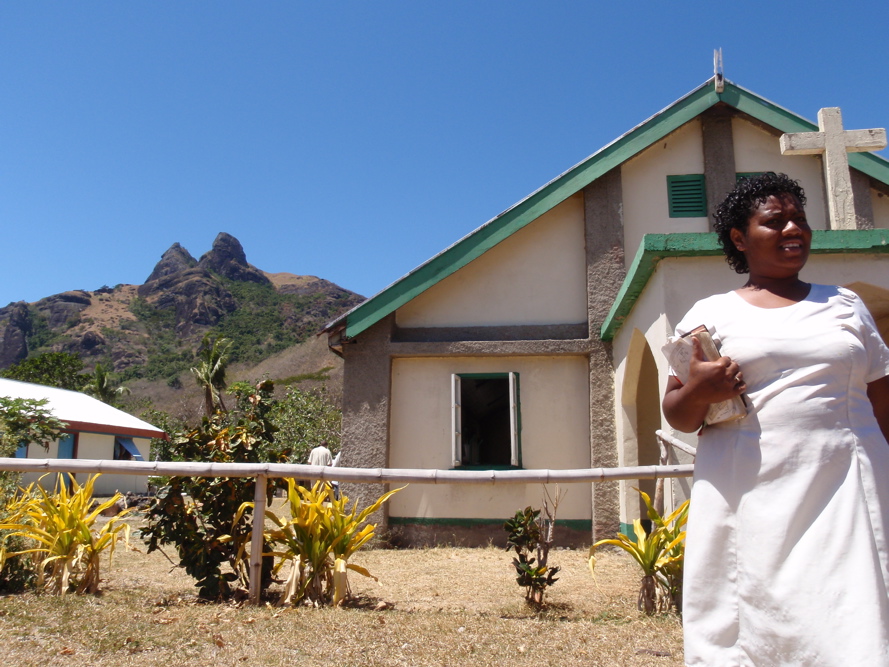
    Octopus is a laid back resort, there are a variety of activities to choose from, but the staff is supportive of being fabulously lazy.  Pool, dive shop, great snorkeling right off the beach, inexpensive, good food (lunches are best, and the lobster dinner is totally worth paying for)  traditional village visits.  On one of those village visits, Allison and I took the opportunity to go to a church service as Fijian village culture is renowned for church services with beautiful singing.  The Methodist service was quite impressive, if a touch awkward (for me) when many of the tourists (with the permission of our local guide) were taking pictures of the service.

    Octopus Resorts is an amazing place to stay.  If you visit Fiji, I highly recommend staying there.

  • Tonga can be fun too!

    (refers to events on September 5th and 7th)

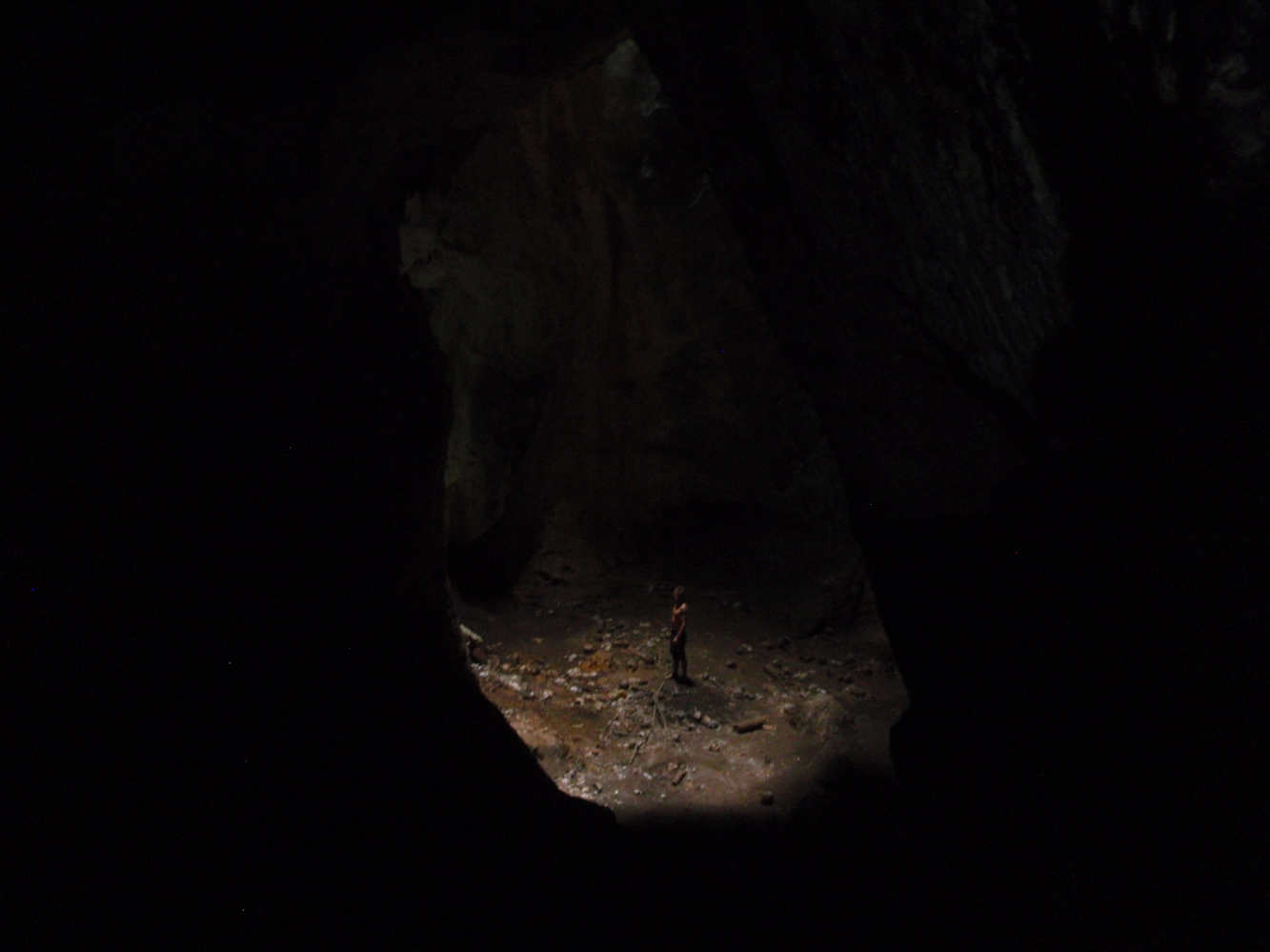
    Swallows cave and Mariners cave in Tonga were amazing.  Along with exploring these two caves, the last three days we were in Tonga we also snorkeled what is widely regarded as some of the best coral reefs in all of the Vava’u island group, and I hiked/bushwacked to a deserted beach (barefoot as it was a spontaneous decision after swimming to shore).  So our last days in Tonga were busy and packed with fun.

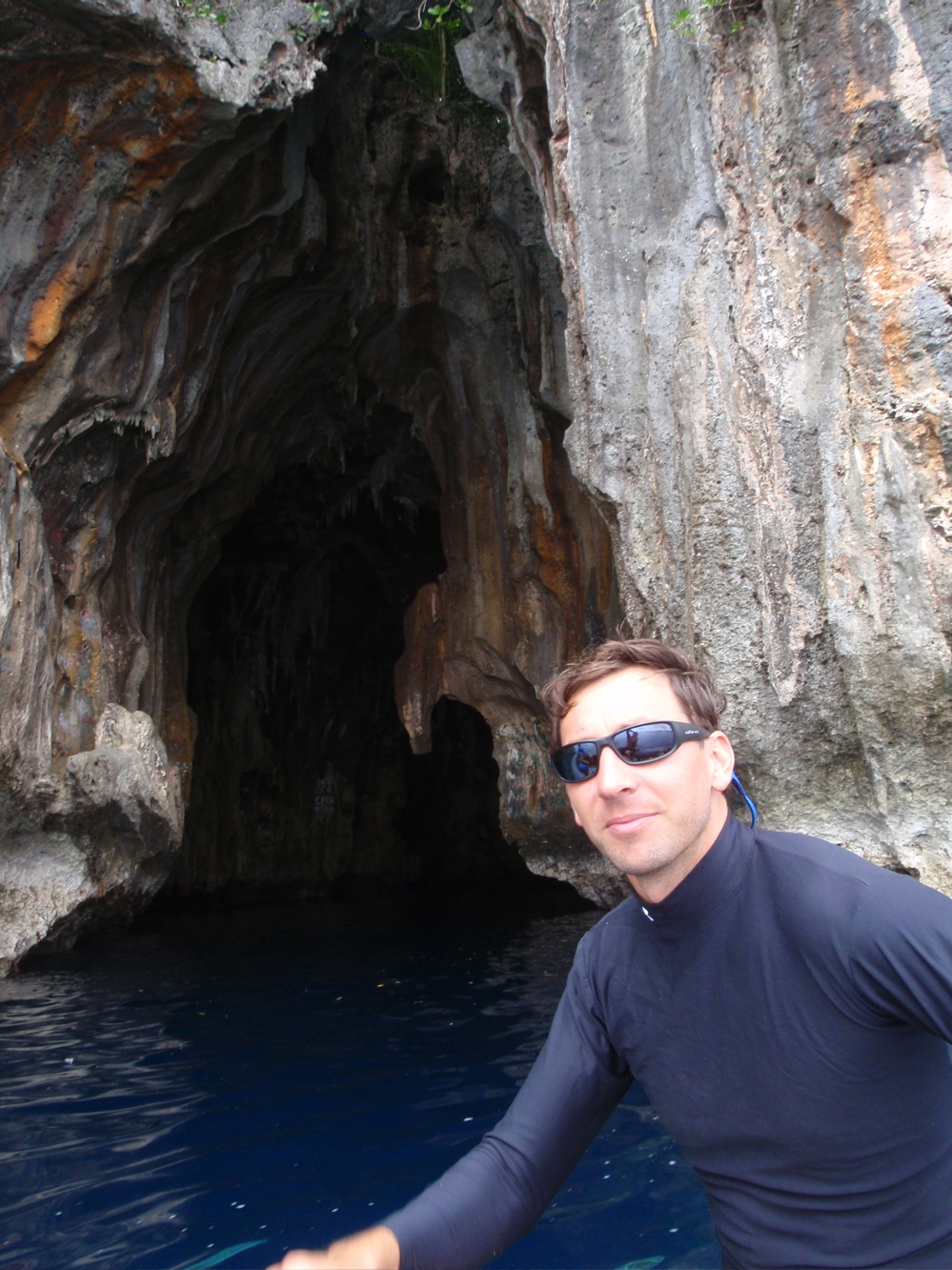
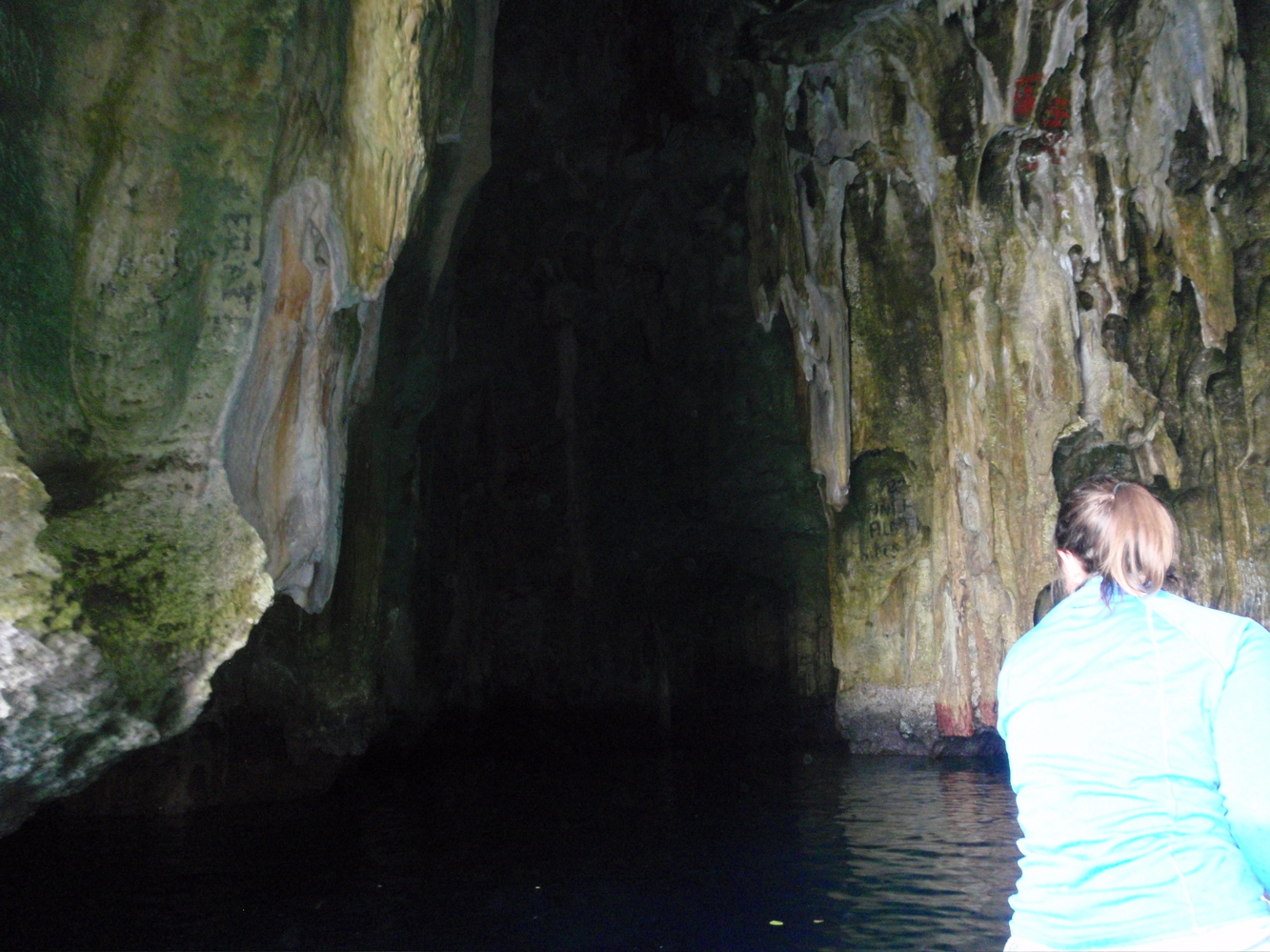
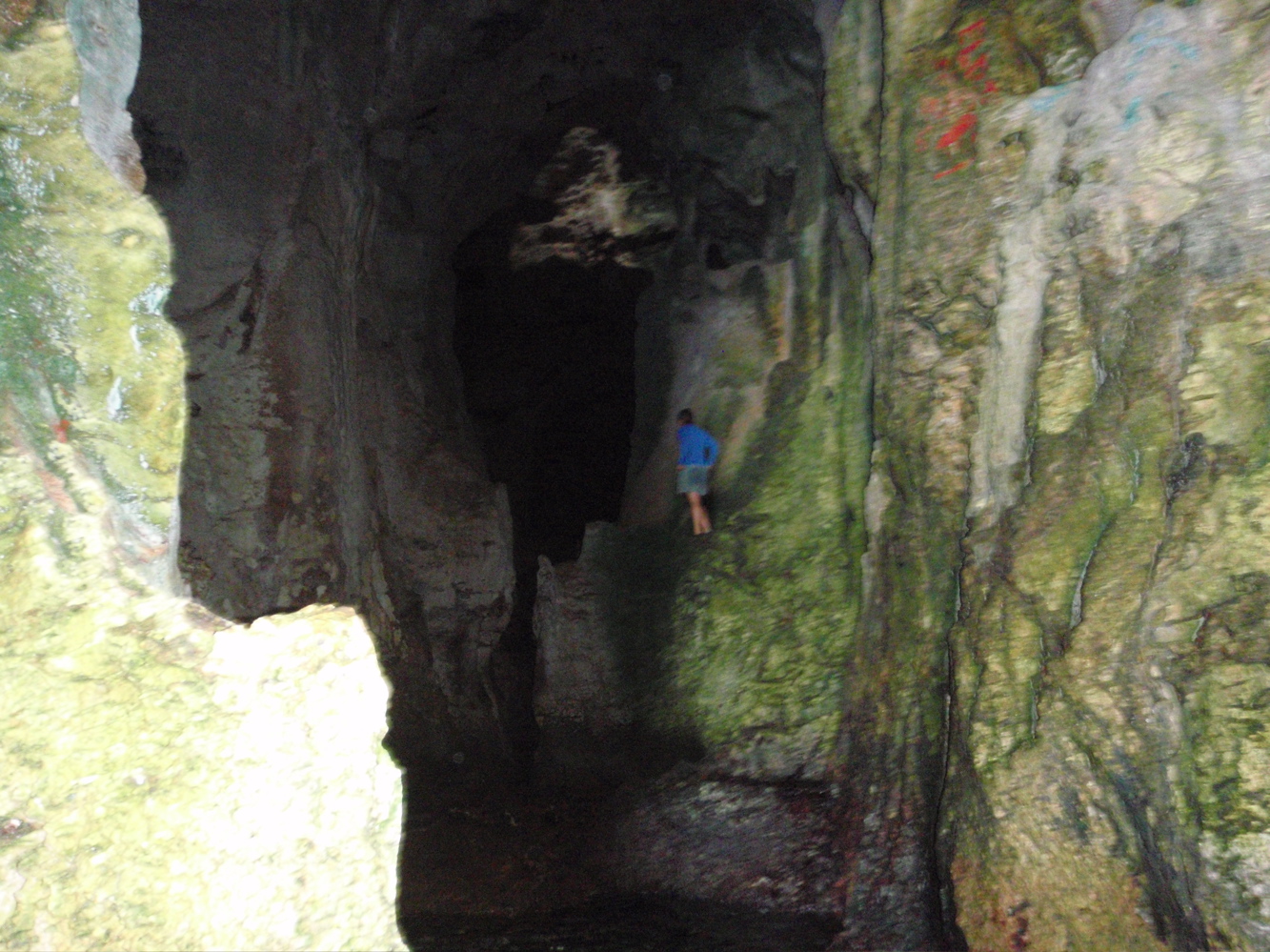
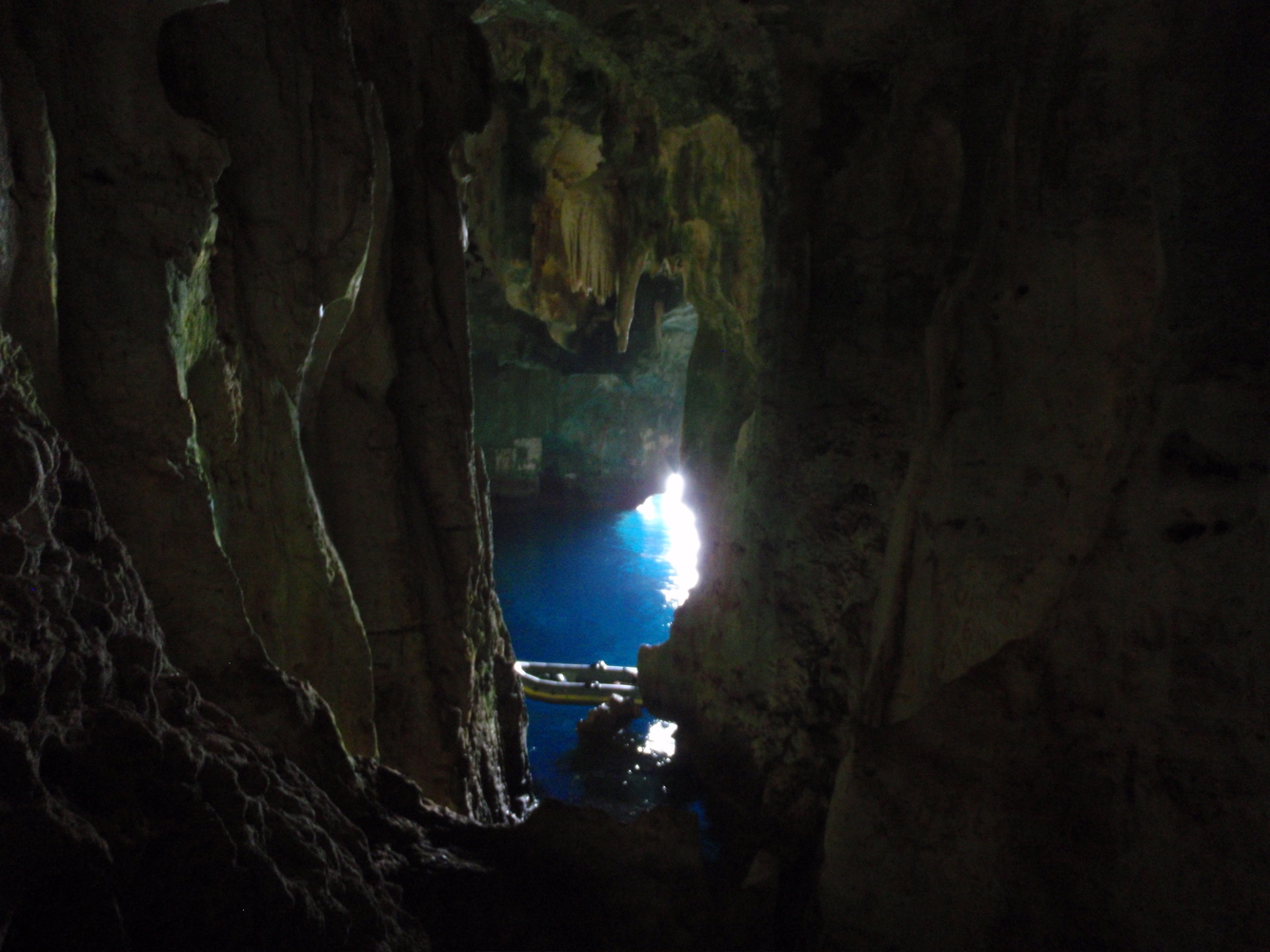
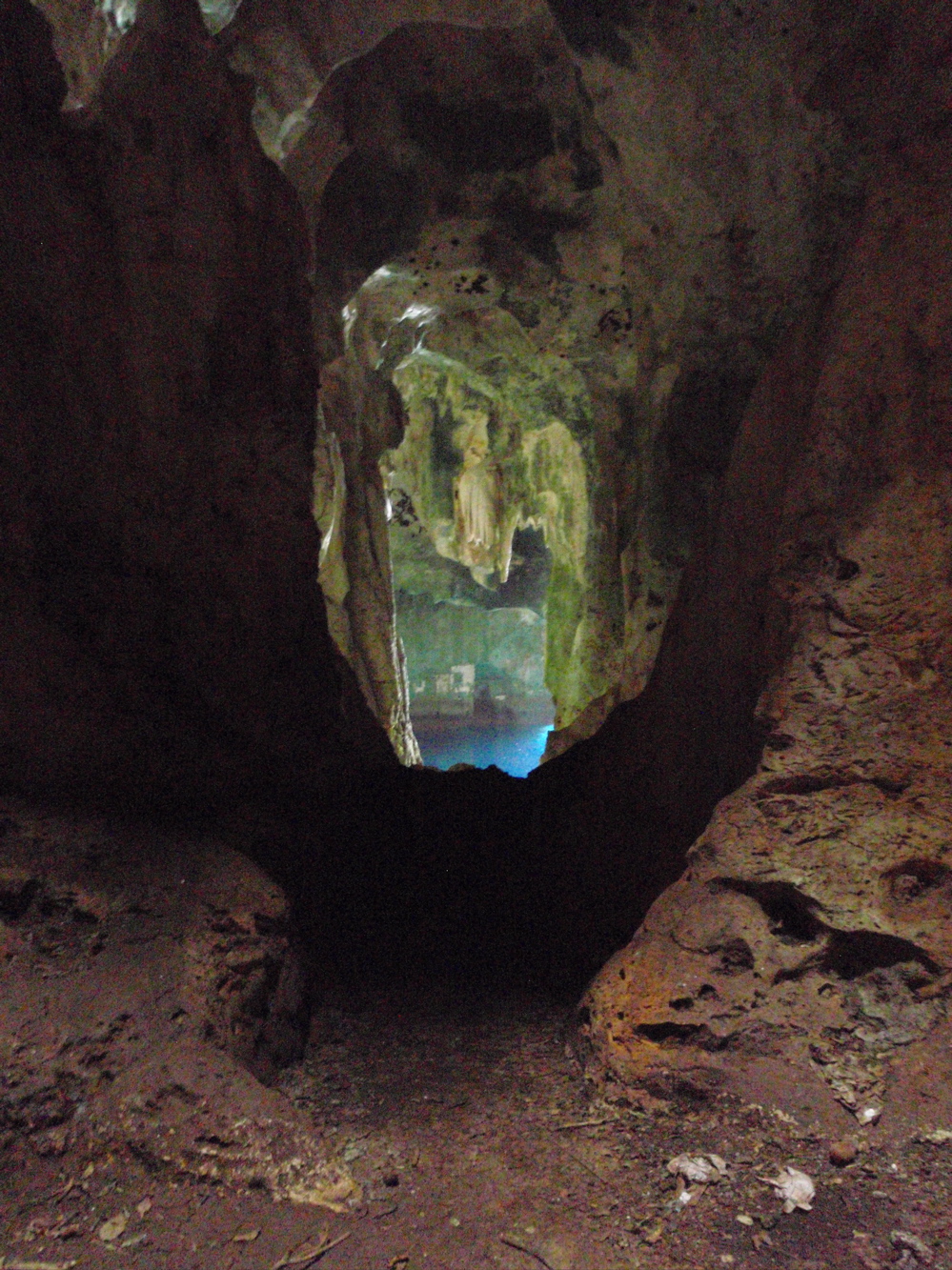
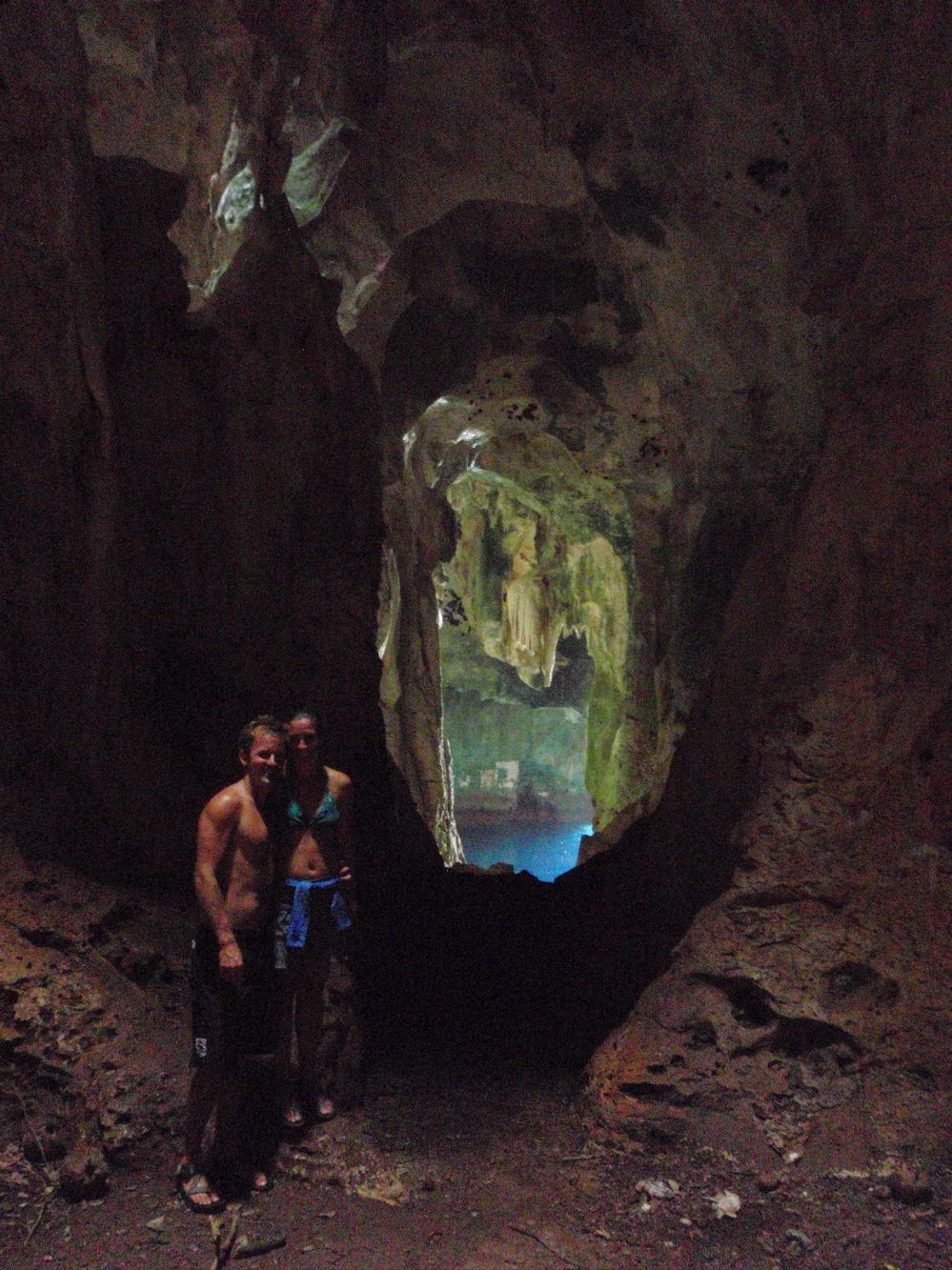
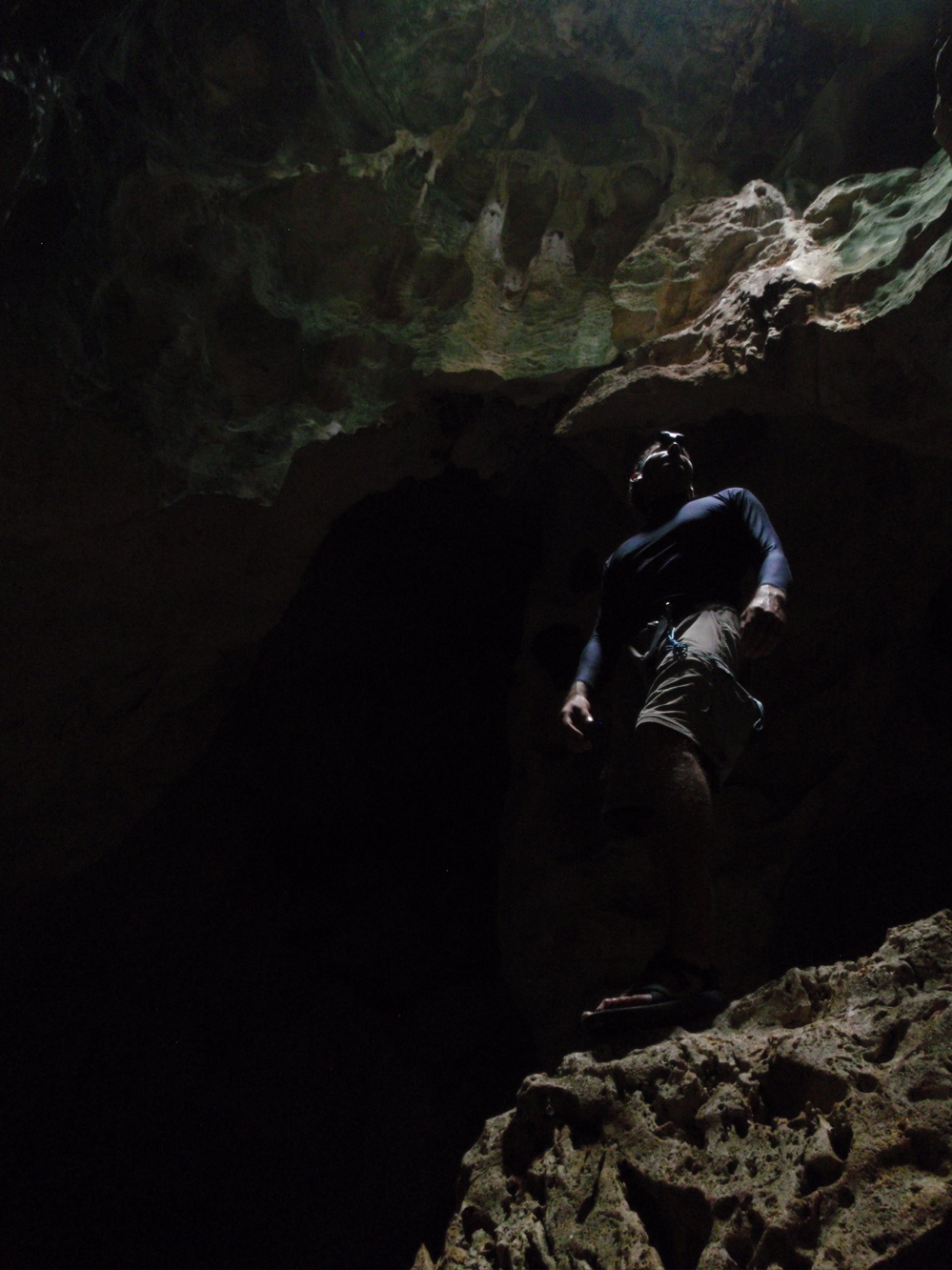
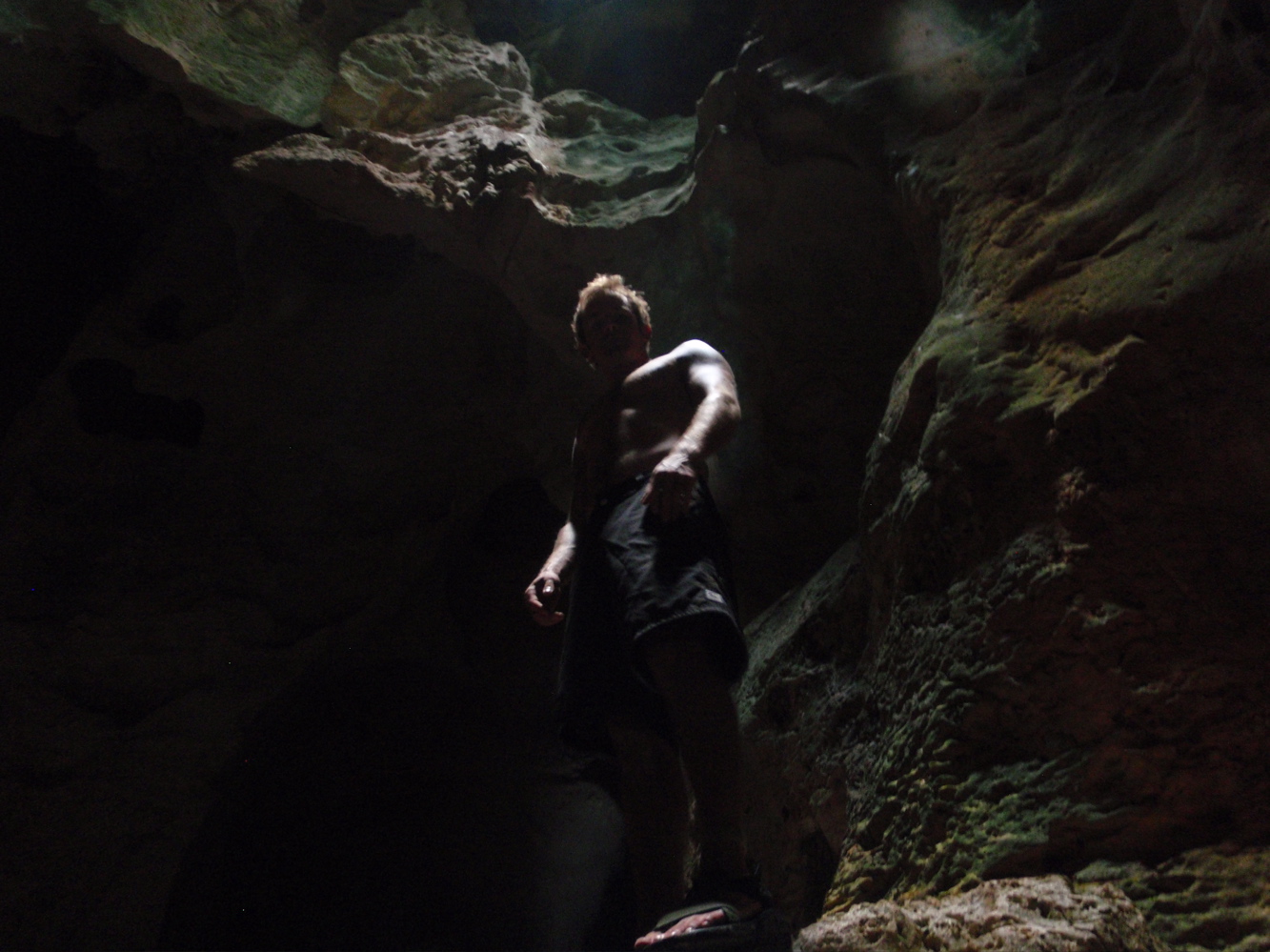
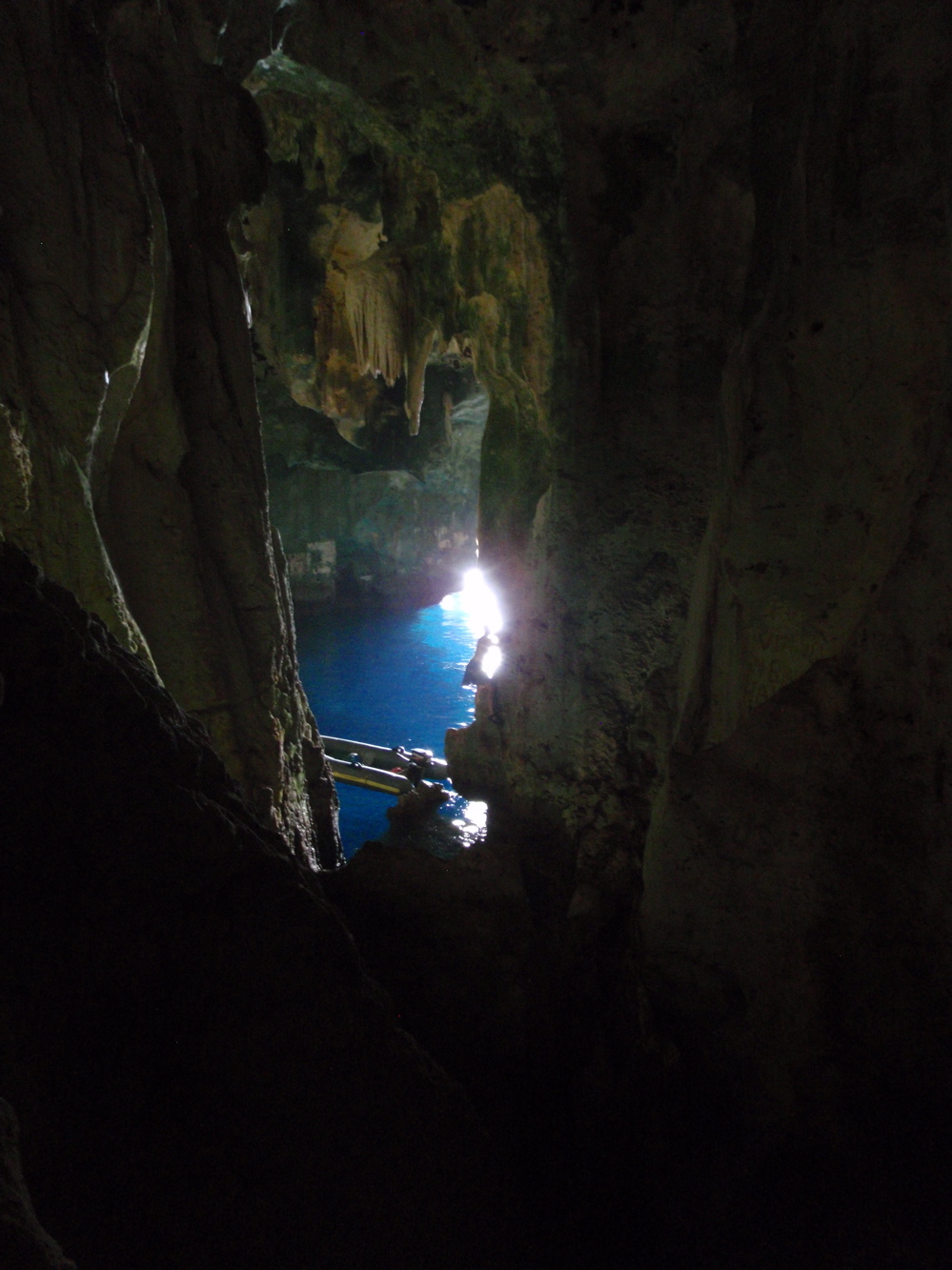
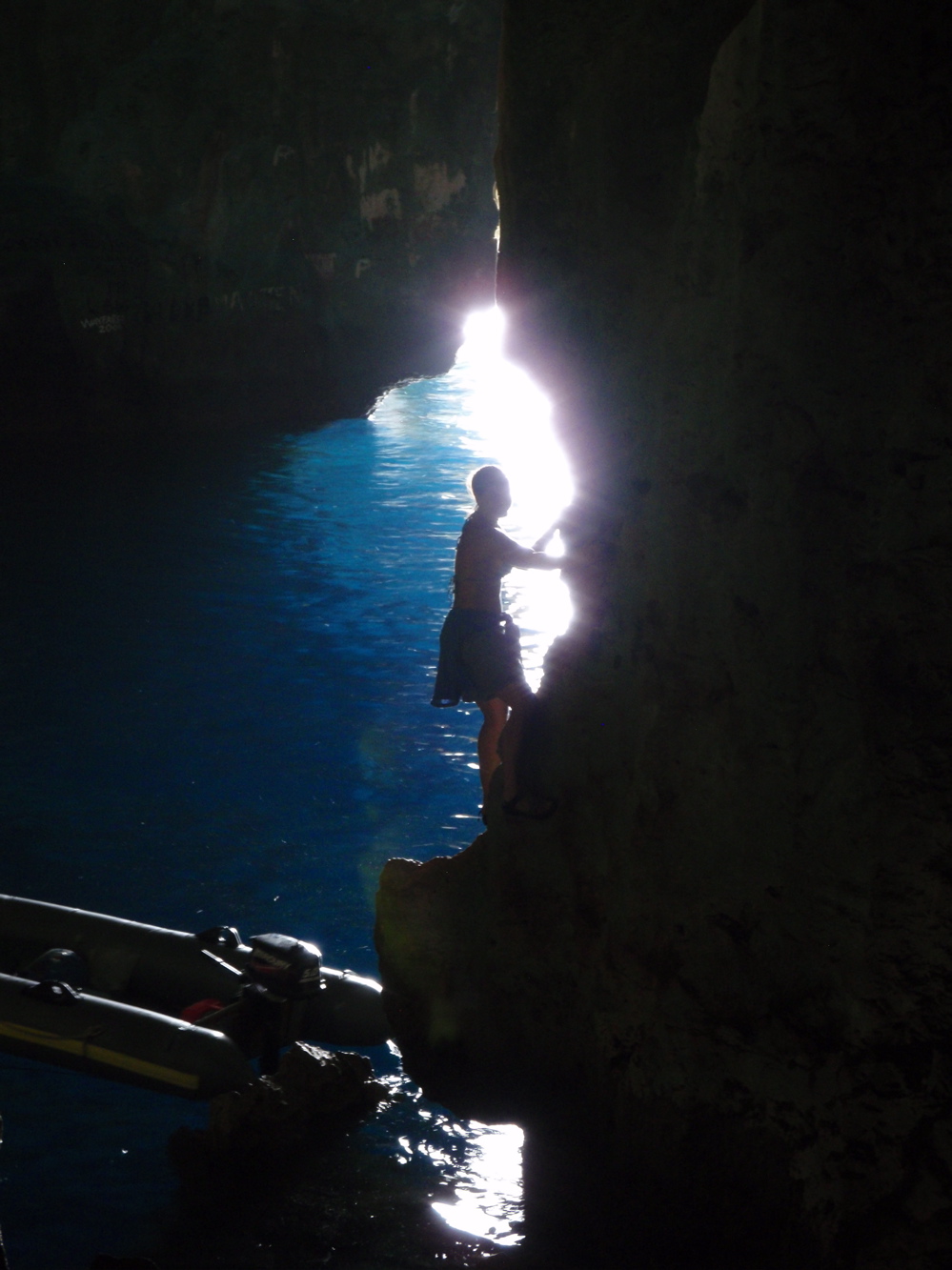
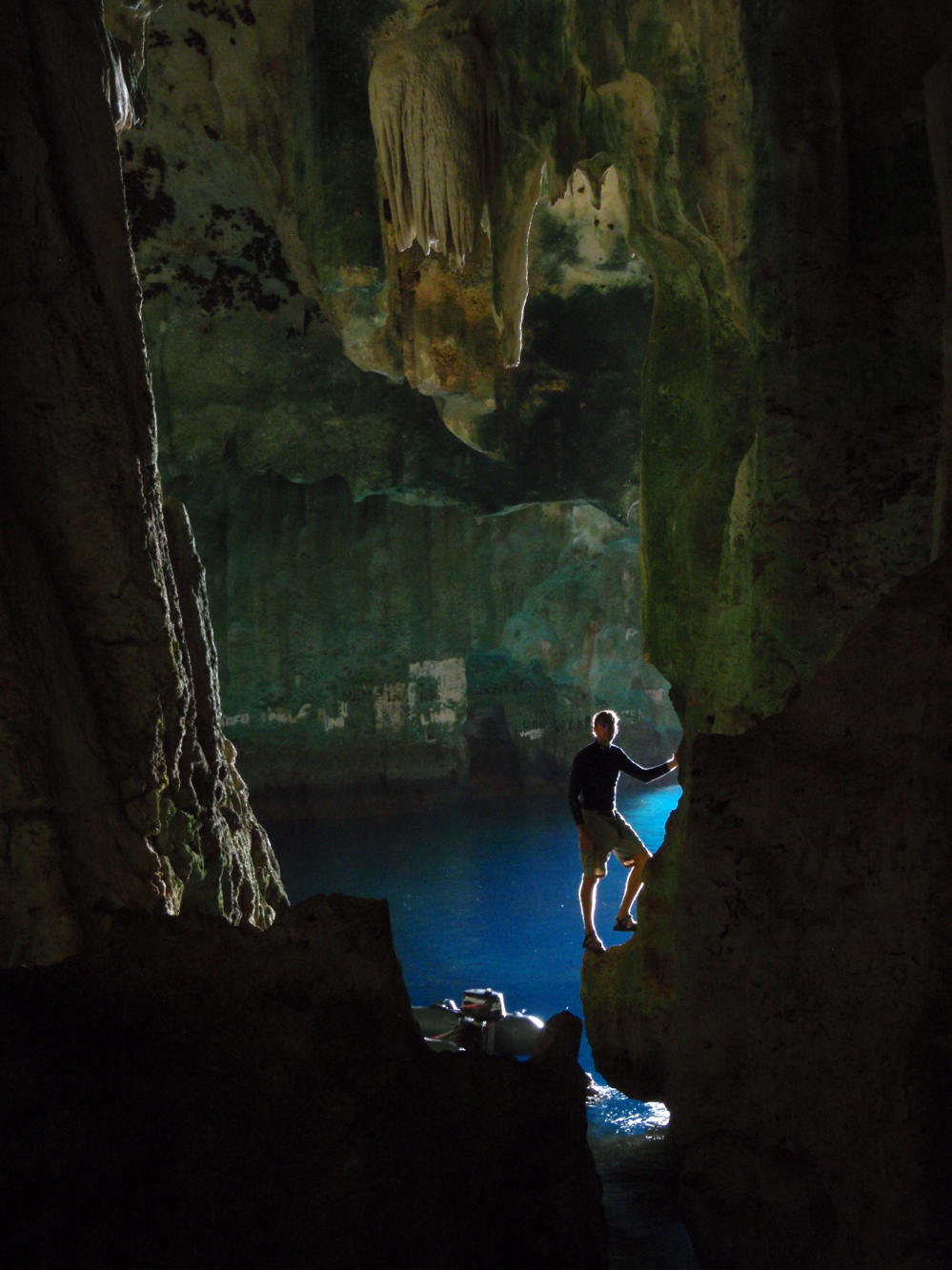
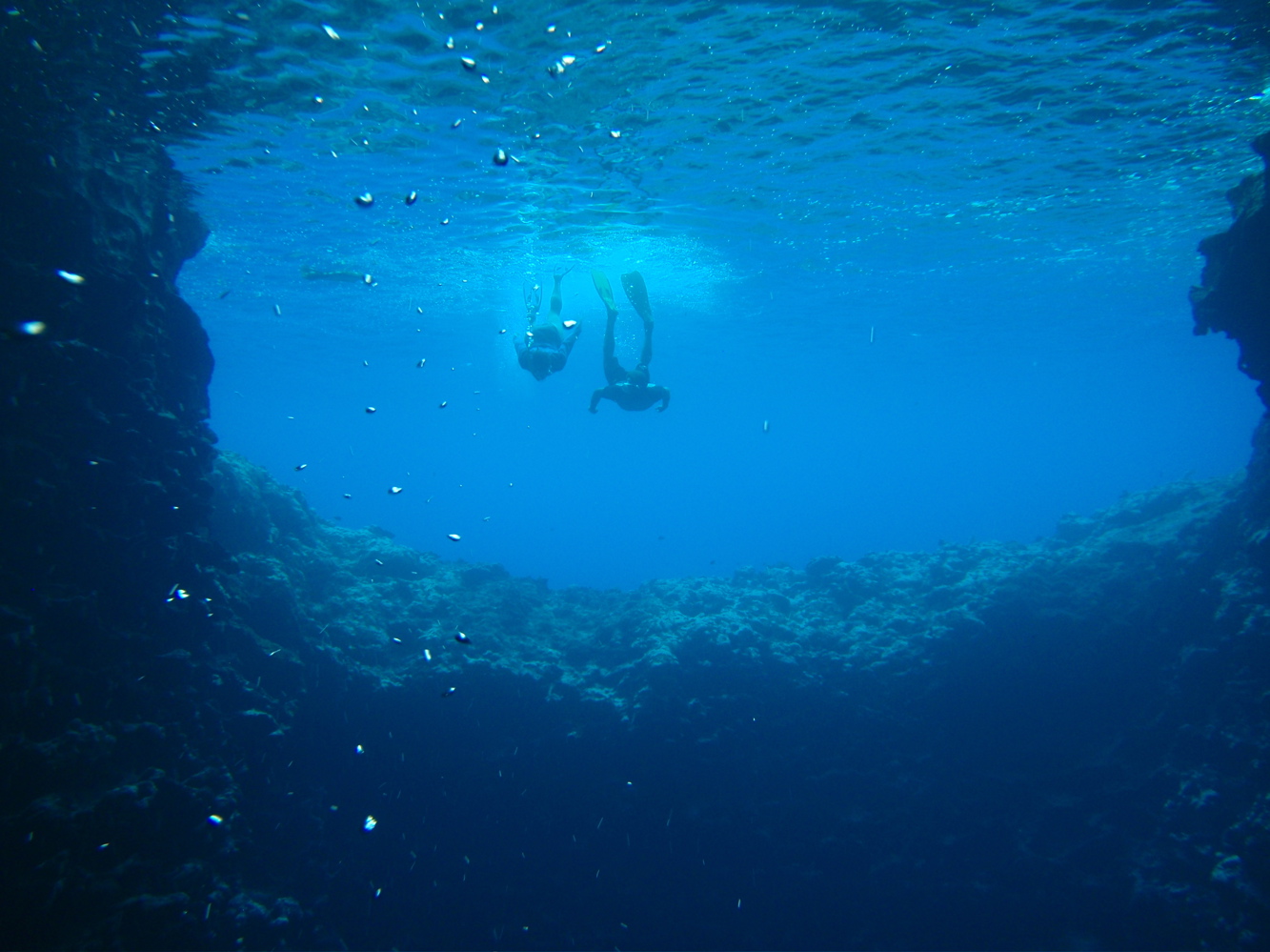
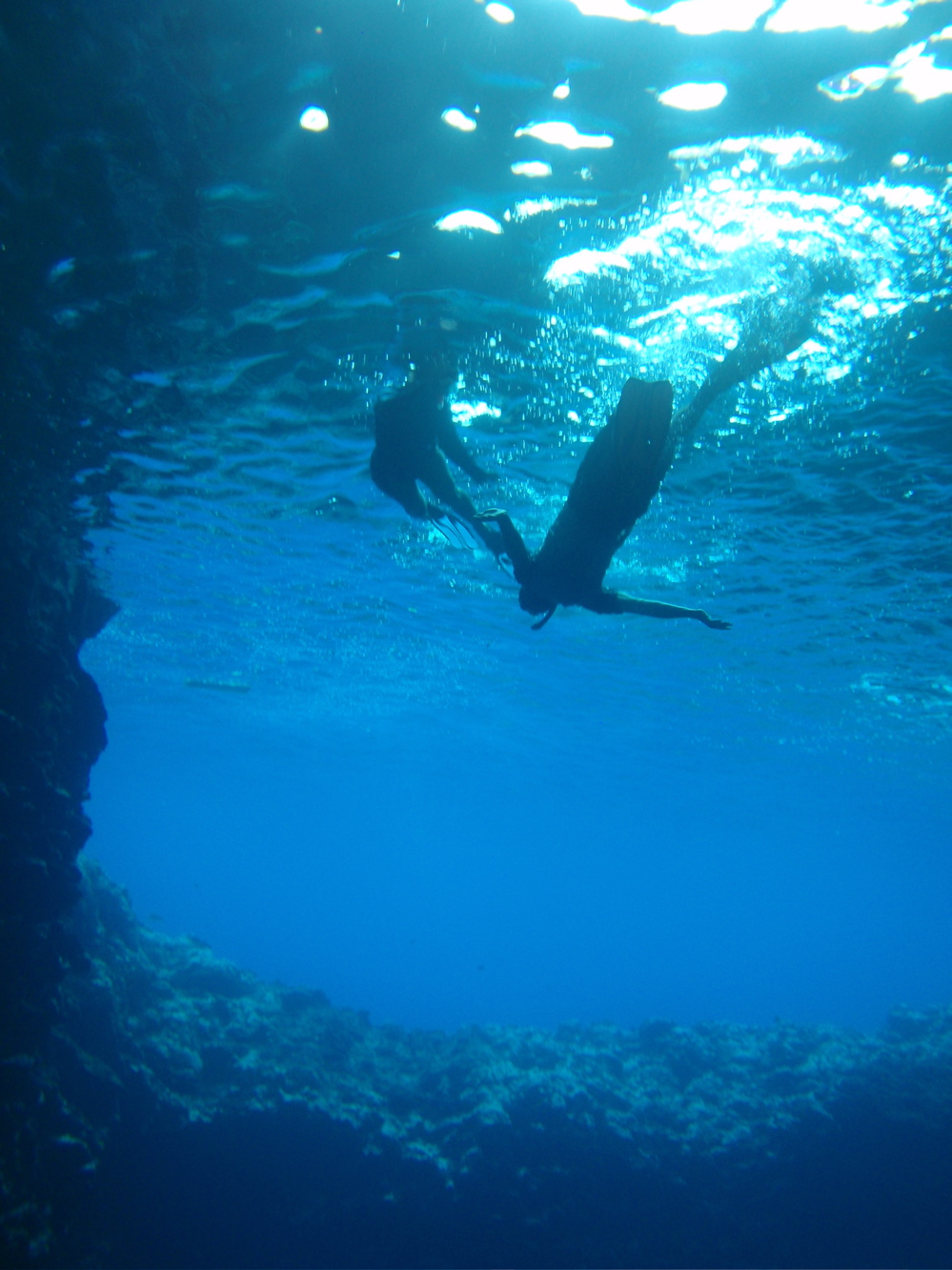
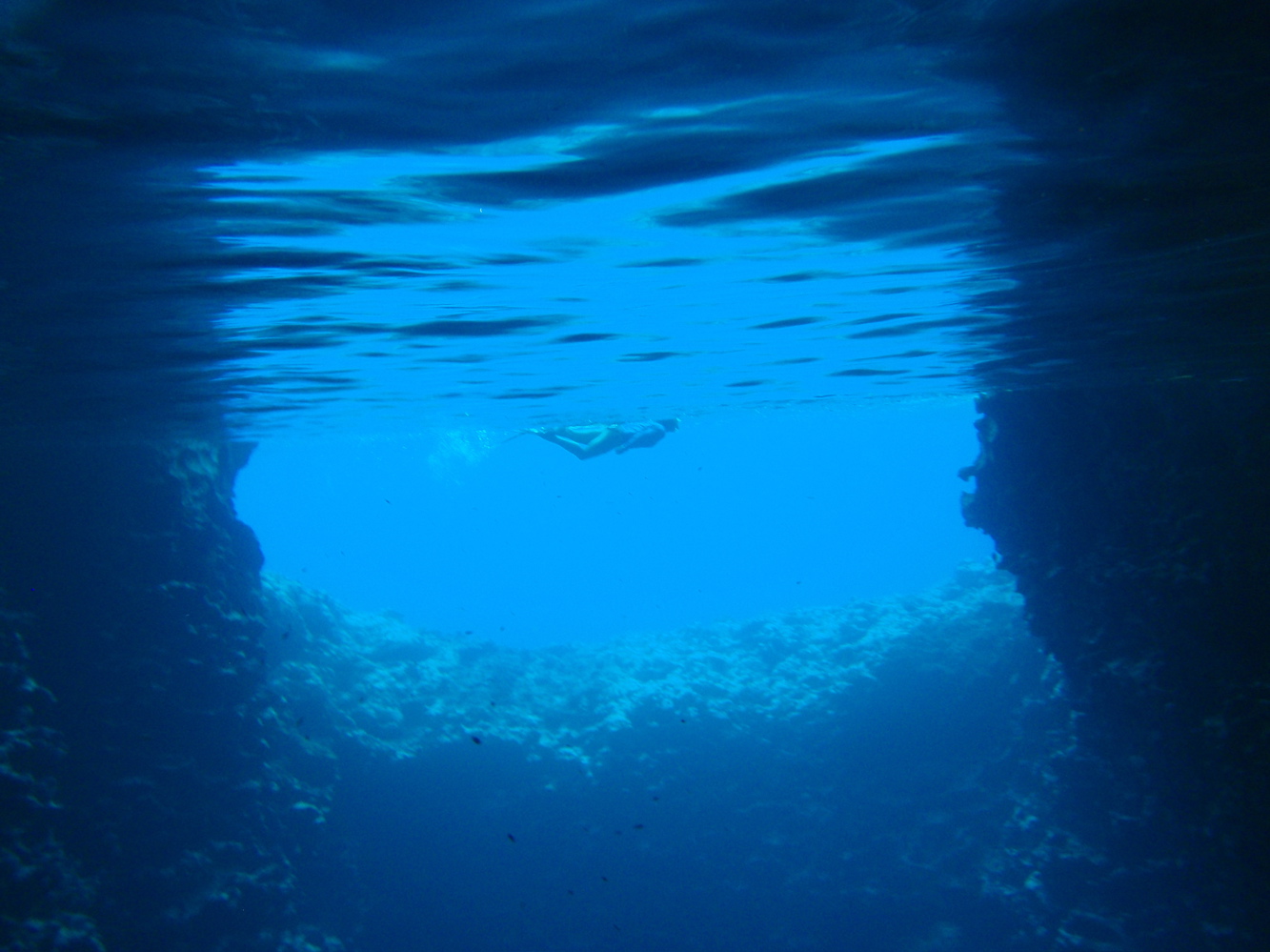
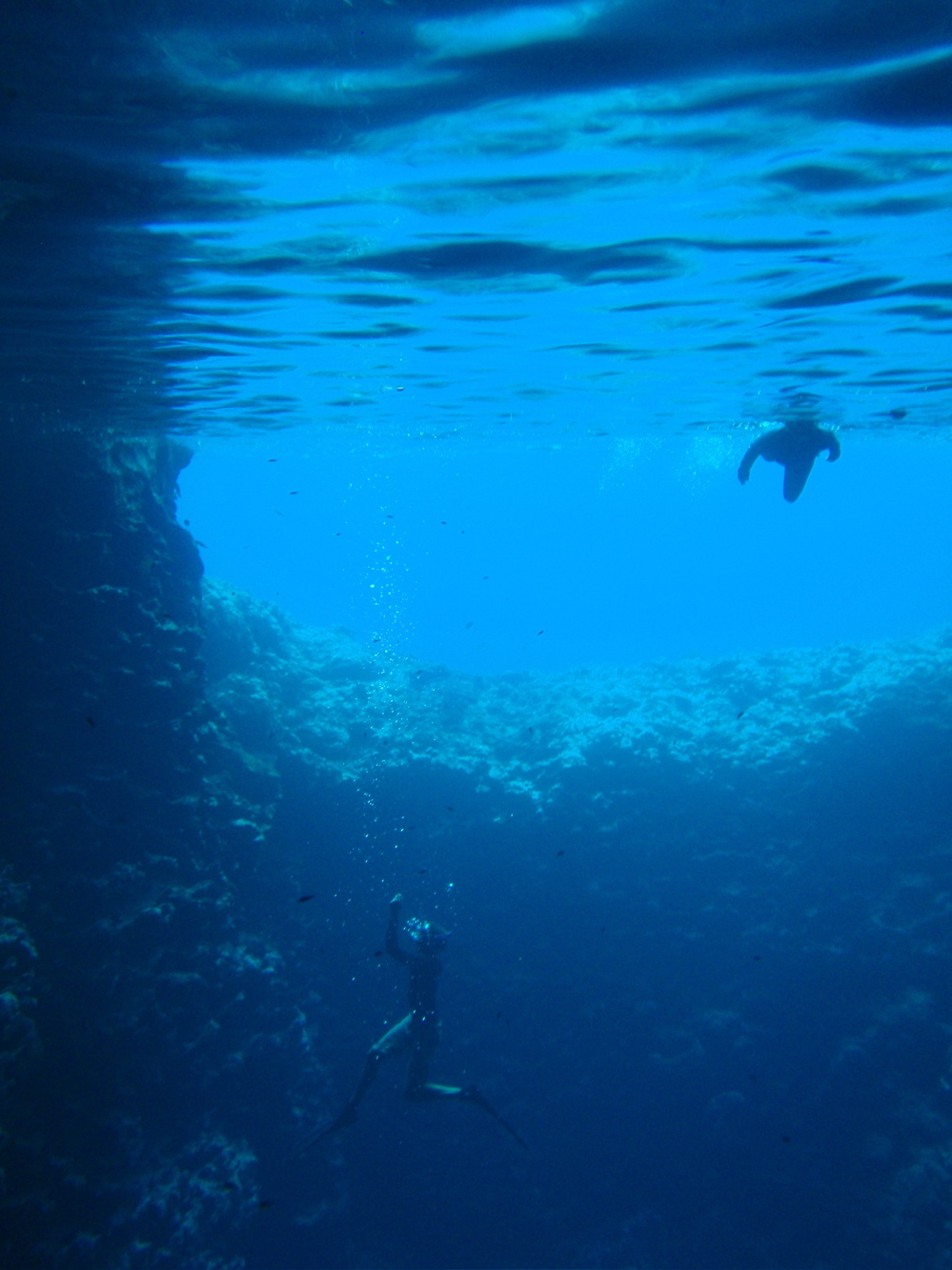
    Swallows cave is a enormous 50 foot high entrance in a limestone cliff at sea level on the northern tip of Kapa.  The dinghy fit easily and with it, we explored all the recesses of the cave we could.  The water was crystal clear and you could see the bottom with crazy limestone towers and arches, albeit completely bereft of life.  The urge to explore continued to pull and we tied up the dinghy to some limestone and continued walking back into the cave.   Scrambling/climbing skills proved useful to avoid a bit of water.  Midway through the cave it opened into an enormous cavern which had a small opening to the sky.  Long ago, important chiefs would lower down guests and food 100 feet through this small ten foot wide hole and hold feasts.

    After exploring the recesses of the cave as much as we could, we arrived back at the dinghy.  It was time to explore the water, which we did after only a tiny bit of hesitation due to the four foot long sea snake we had seen on the scramble back to the dinghy.  Sea snakes are, apparently, quite venomous, though their mouths are too small to bite you.  I’m thinking, surely they can get their mouths around a pinkie finger or something?  Wouldn’t that be awful.

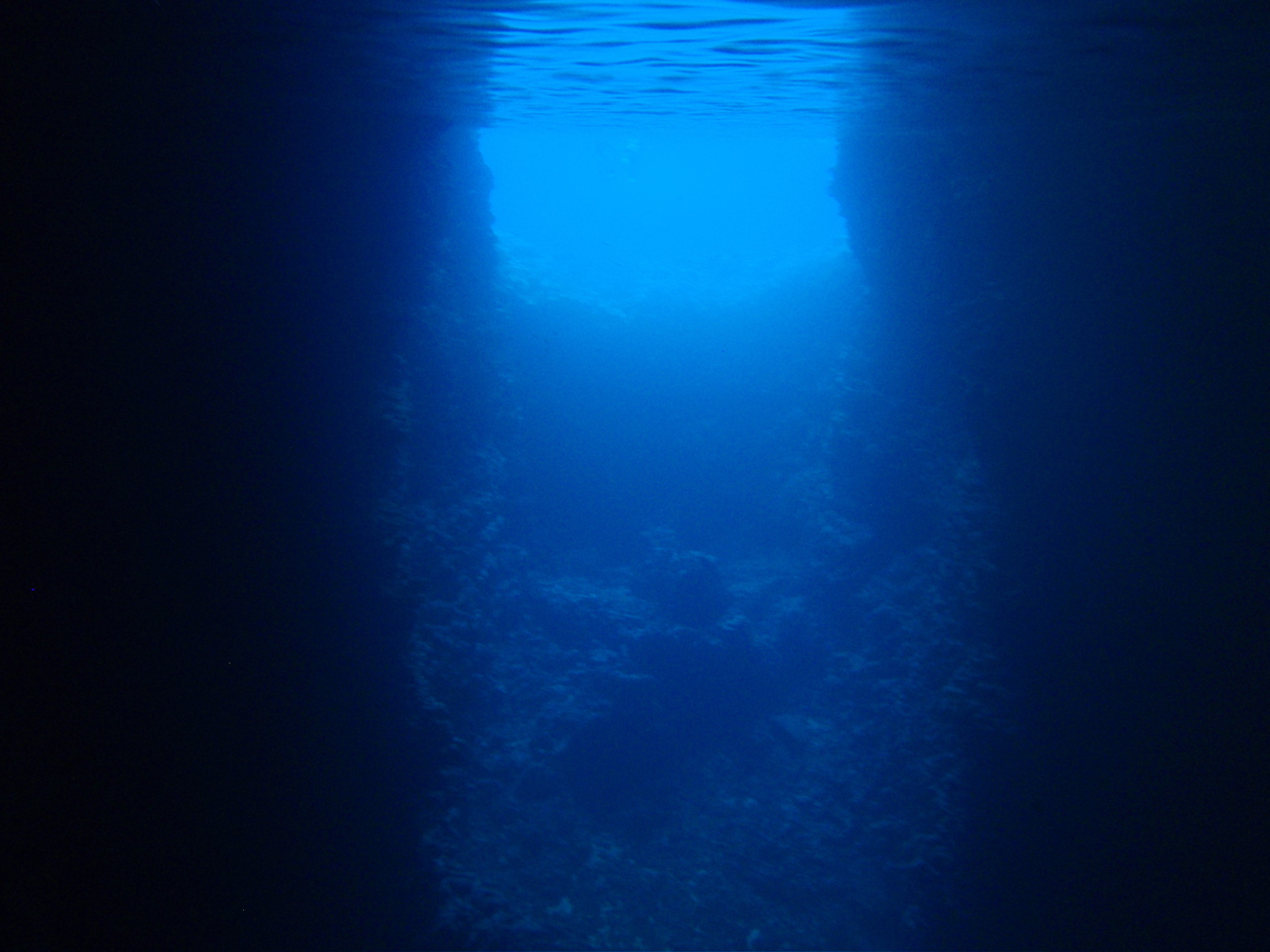
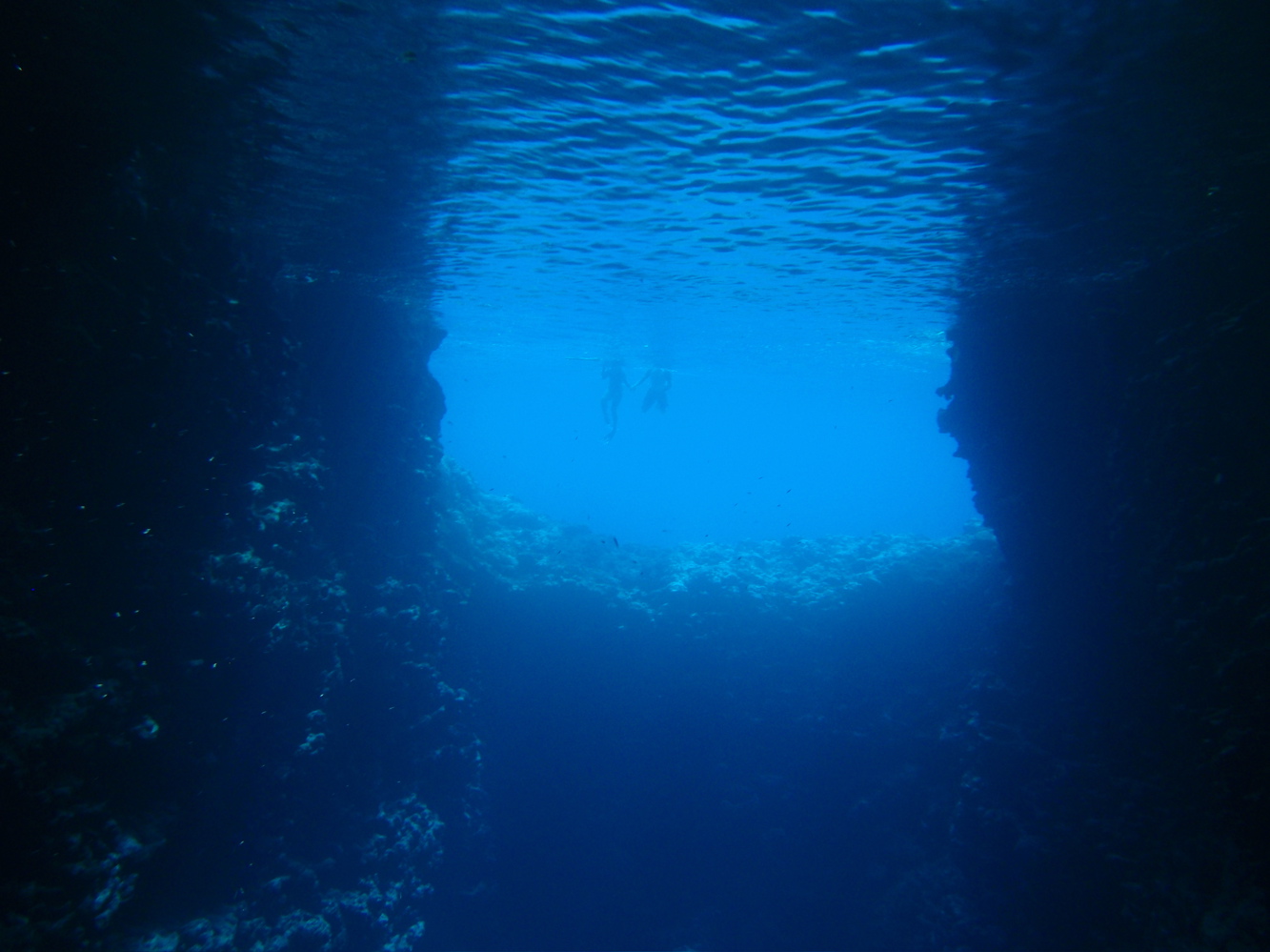
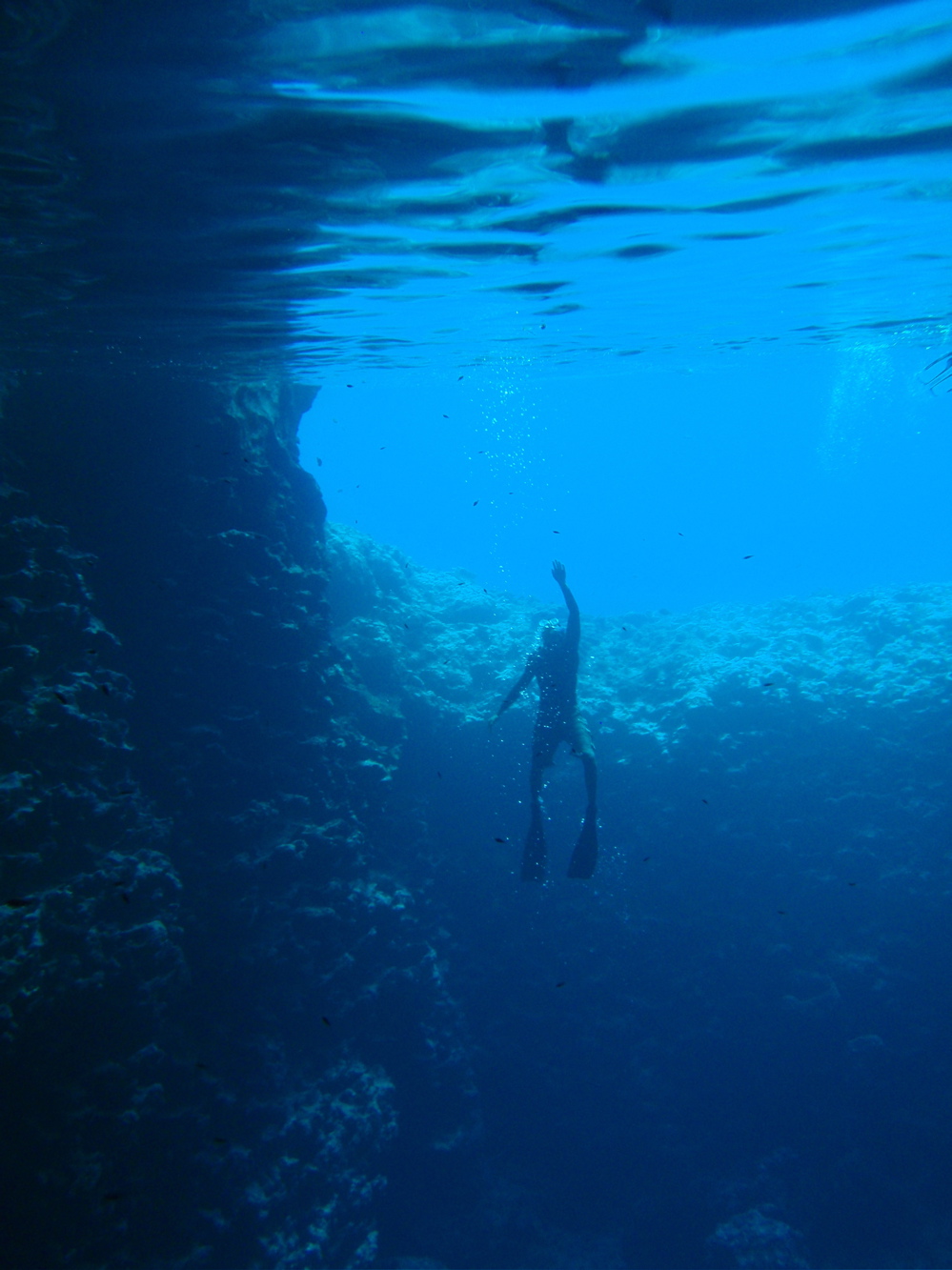
    Under water was perhaps even more beautiful, limestone pillars jutting up 30 feet from the bottom, arches and tunnels had formed underwater.  Towards the entrance was beautiful, and we took many pictures of us silhouetted against the bright sun.

    The next day, we went out to the coral gardens west of the reef between the islands of Vakaeitu and Nua Papu, which will enjoy its own post.  The day after snorkeling, on our way out of Tonga, we stopped at Mariner’s cave on the northern point of Nua Papu, a 1/2 a mile south of the narrow pass between Kitu and Nua Papu.  For some reason, we decided to go through this narrow pass.  Our charts show it to be 97 yards wide, a football field, which might seem like plenty of space when our boat is only 4 yards wide.  97 yards felt like 97 feet as turbulent water mixed about and strong currents pushed our tiny boat around.  I can’t throw a rock 1/2 a football field, but I just knew I could easily hit the shores with even a modest try.  Yet through this narrow pass we engined our way.

    We then slowly motored the 1/2 a mile along the coast of Nua Papu, looking for the coconut tree on the ridge line and the dark orange patch on the vertical cliff face that would mark the entrance to Mariner’s cave.  Mariner’s, you see, is not visible from above the surface of the water.  You must swim under water through a tunnel in the limestone and surface again inside the island to find Mariner’s cave.  At the correct spot, the water was a dark hue of blue, and you could faintly see the outlines of the limestone entrance underwater.

    Matt and I jumped off to explore, while Karen stayed aboard and motored about.  The cliffs drop off sharply into the water and plunge straight down for over a hundred feet.  There was no anchoring to be had anywhere near by, so someone would have to stay with the boat.  We poked around the entrance diving down into the water just to look at it first.  The entrance stretched from six feet under water to fifty and was another thirty feet wide, creating an enormous underwater passageway.  And as we swam through, you could turn to face up and watch your bubbles pooling on the limestone underwater, most scurrying across the surface finding their way to the air’s edge on either side of the passageway, some becoming trapped there in tiny crevices.

    After a fifteen foot long swim, the longest fifteen feet I’ve ever swam underwater, we emerged inside Mariner’s cave.  It was much darker than Swallows, an eery blue light coming only from the passage way from where we came.  With our dive flashlight, we scanned through this much smaller cave and found little more to explore through like Swallows.

    To Matt’s glee though, clouds were spontaneously forming inside the cave.  When the surge from the ocean outside rises up, the water inside the cave rises as well.  As their is no other entrance or escape for air, the volume available to the air decreases.  This increases the air pressure and causes water vapor to condense out of the air and effectively form a cloud.  The mist would slowly build as water surged in and what was once visibility dropped from the hundred feet or so across the length of the cave to only a few feet as everything faded, hidden in the mist.  With a quick snap though, when the water turned and began to draw out, the process reversed, but instead of the slow building of mist, it quickly snapped away.  This repeated itself with every surge, though the random larger surges of the ocean created the effect more spectacularly.

    We exited, and just for fun, I swam back and forth through the passage way from oceanside into the cave and back a couple more times.  I then rejoined the boat, to allow Karen to go through the caves.  And with that, at around 2 pm, when all we really wanted was a beer, we began the five day passage to Fiji, saying goodbye to a Tongan experience that was extremely frustrating but ultimately rewarding and unforgettable.

  • Waterproof Camera, May You Rest in Peace

    (this post refers to events that happened on September 6th)

    I have a litany of electronics that I have ruined because they were not waterproof and I took them near water.  Two video cameras, one camera.  Two phones.  A jump drive.  So I was overjoyed to have purchased a waterproof camera to use on this trip, where I’m surrounded by water.

    The Olympus Stylus Epic 1030SW.  Waterproof to 10 feet.  SHOCKPROOF to 6 feet.  It was awesome!  No worries about getting it wet.  Spray from sailing was no concern.  Wet trips in the dinghy no concern.  Swimming on the surface was no concern.

    I failed however, to properly be concerned about diving down to beyond ten feet to take pictures.

    And so the last pictures my camera managed to take were of Swallows Cave.  Which was spectacular.

    And almost worth the price a new camera will cost.  Allison brought one out that was quite enticing… The Olympus u-tough 8000, only available outside America.   And Olympus has another, its newest version, the Olympus Stylus tough-8020!  Shizamm!

    Anyway, here are pictures from Swallows Cave.

  • Determined snorkeling

    (this post refers to events that happened on September 6th)

    In between going to Swallows Cave and Mariners Cave, we went out to the coral gardens west of the reef between the islands of Vakaeitu and Nua Papu.    The founder of Moorings, a world wide sailboat chartering company, was quoted as saying the following upon snorkeling here:  “Any reef I look at after this one will appear dead to me.”  Apparently it was going to be colorful.  I figure she has done a fair bit of snorkeling in her day in exotic locations, what with setting up a world wide sail-chartering company and all.  So we were determined to see it.

    And we needed to be determined, because it wasn’t easy.  As we approached, the tide was low and you could walk across drying reef from Vakaeitu and Nua Papu.  Waves were hitting the western side of the reef where we needed to enter the water.  Now, this wasn’t like walking down a gently sloping sandy beach through waves to enter the water, maybe a few obsticles around.   Water was surging back and forth across deep channels cut into the reef, creating a strong tidal motion back and forth.  Later, when in the water, the tidal surge would push you towards the reef edge sometimes upwards of 6 feet and you would zoom along with the fish who were also pulled by tidal surge, the coral below you skimming by showing your nearly uncontrollable progress, only to be tugged back away as the tidal surge drew away, and you and the fish would again go zipping along back out to where you started.

    Matt was the first to attempt to enter, walking out a peninsula of reef as far as he could.  Waves pushed water all around his feet, and balance on the slippery wet reef was precarious.  Spray from larger waves would kick up around him occasionally.  The timing needed to be just right, and when a surge came in, raising the water level within the slots between the reef, Matt stepped off the peninsula of reef and into the water.  He immediately began swimming quickly away from the reef as the surge receded to avoid being unavoidably pushed back into the reef when it surged back inland again.

    Karen and I followed repeating the process.  She and I had both worn our Chaco sandals, as opposed to Matt cavorting around in his bare feet, which I think made walking the reef slightly less painful.  Carrying the sandals while snorkeling was a small price to pay for less damage to the feet.  How his feet weren’t covered in cuts I don’t know.

    The snorkeling was worth it, not just a spot of coral here and patch there as is typical of most places.  This was a huge continuous tract of coral unbroken the entire third of a mile between Vakaeitu and Nua Papu and which looked to go on longer in both directions.  From five feet in depth, as it slowly angled down to 75 feet in depth, there was beautiful coral the entire way.  It was unfortunately partly cloudy but when the sun cut through the clouds and shown onto the coral, it burst with color, a vibrancy we had not seen anywhere in the South Pacific.  It was a stunning display.  Coral fans stretched 12 feet wide, larger than I had ever seen.

    We lazily swam the 1/3 of a mile from where we entered at the edge of Vakaeitu.  I had never enjoyed snorkeling for so long.  Then once reaching near the Nua Papu shore, we turned around and pushed back to our entrance/exit point, hoping that getting out of the water would prove easier and less scary than getting in.  It was not.

    I initially tried taking off my flippers to put on my Chaco’s, reasoning that with footwear I would more easily be able to get my feet on the reef and walk out.  Walking with flippers is best done by clowns with experience in such things, and while I may be clownish, I have little experience in such things.  But once I took the flippers off, I had no mobility and propulsion in the water, and I needed both to judge the surge as it pushed you towards the reef and then pulled you away.  So back on went the flippers.  I edged closer and closer to the reef, and on a final surge put my feet up on the edge of one of the peninsulas of reef that jutted away and grabbed on with my hands.  Water was at my waist and was in the lull between the surge in and the draw out.  I tried to move my feet up higher, but the flippers tripped me up.  And then the water turned and drew out.  Water rushed out the slot in the reef of which I was on the edge of and moved with a terrific force so that all I could do was simply hold on.  At the lull at the bottom I again tried to move and the flippers again tripped me up.  A larger surge then the one I landed with came in; the higher water pushed me off balance knocking my hands off the reef causing me to reflexively grab at anything I could hold.  I moved up the side of the reef bit, half crawling, half climbing up a couple of feet.  Another surge drew out and then came back in, sucking at my legs trying to pull me away from the reef, then pushing me off balance towards the slot in the reef the tidal surge pushed into each time.  I was desperate to be able to effectively move my legs and so took one flipper off and then another tossing them to Matt who was on higher ground.  With flippers off, I endured another larger swell knocking me off balance and then pulling me hard.  At was on top of the peninsula of reef at this point, effectively horizontal ground, but the tide was higher and water easily washed over the peninsula point and so despite being on all fours, crawling, when the tide drew out, I was holding on like I might while rock-climbing, such was the force of the water sweeping out.
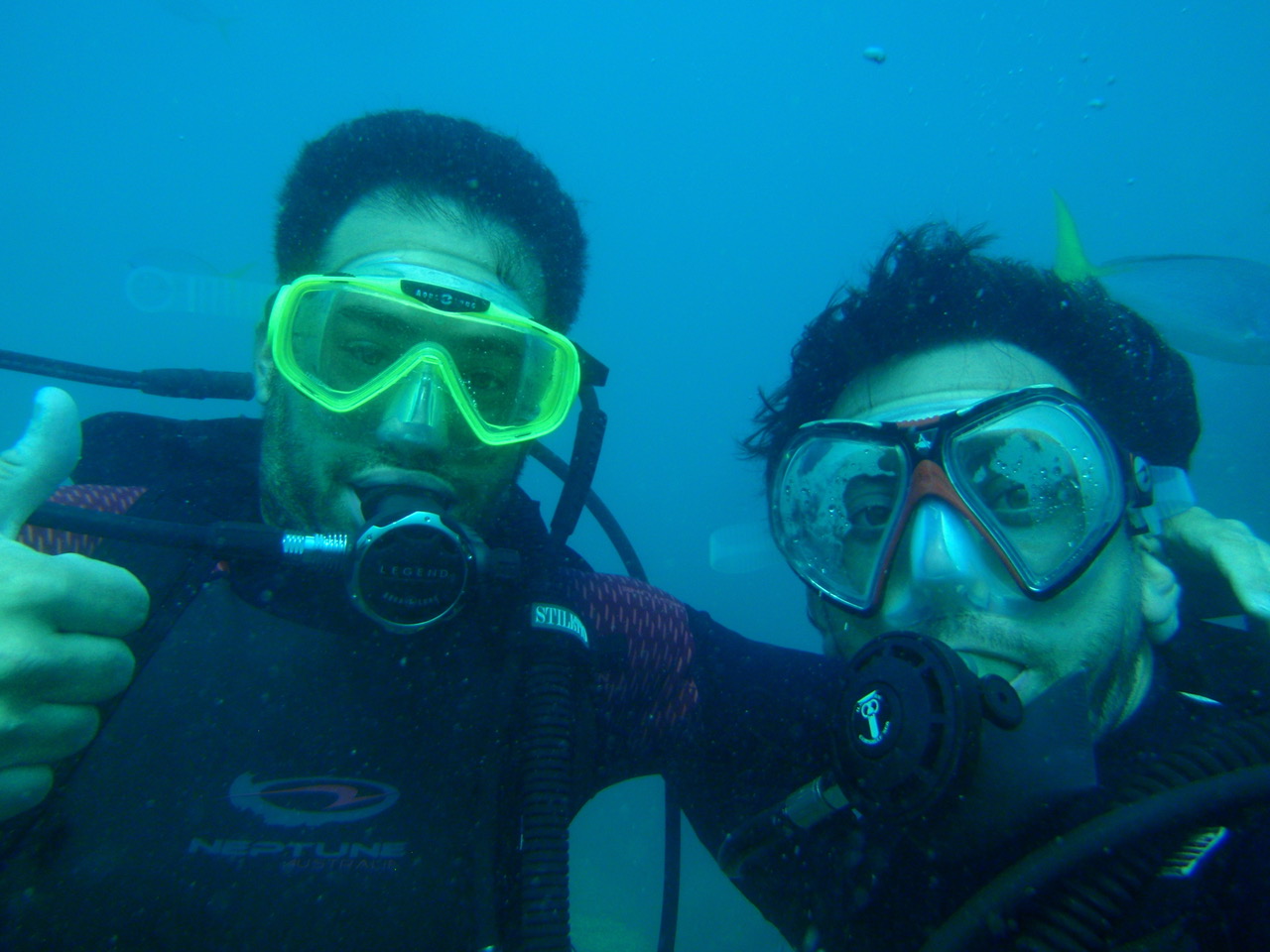
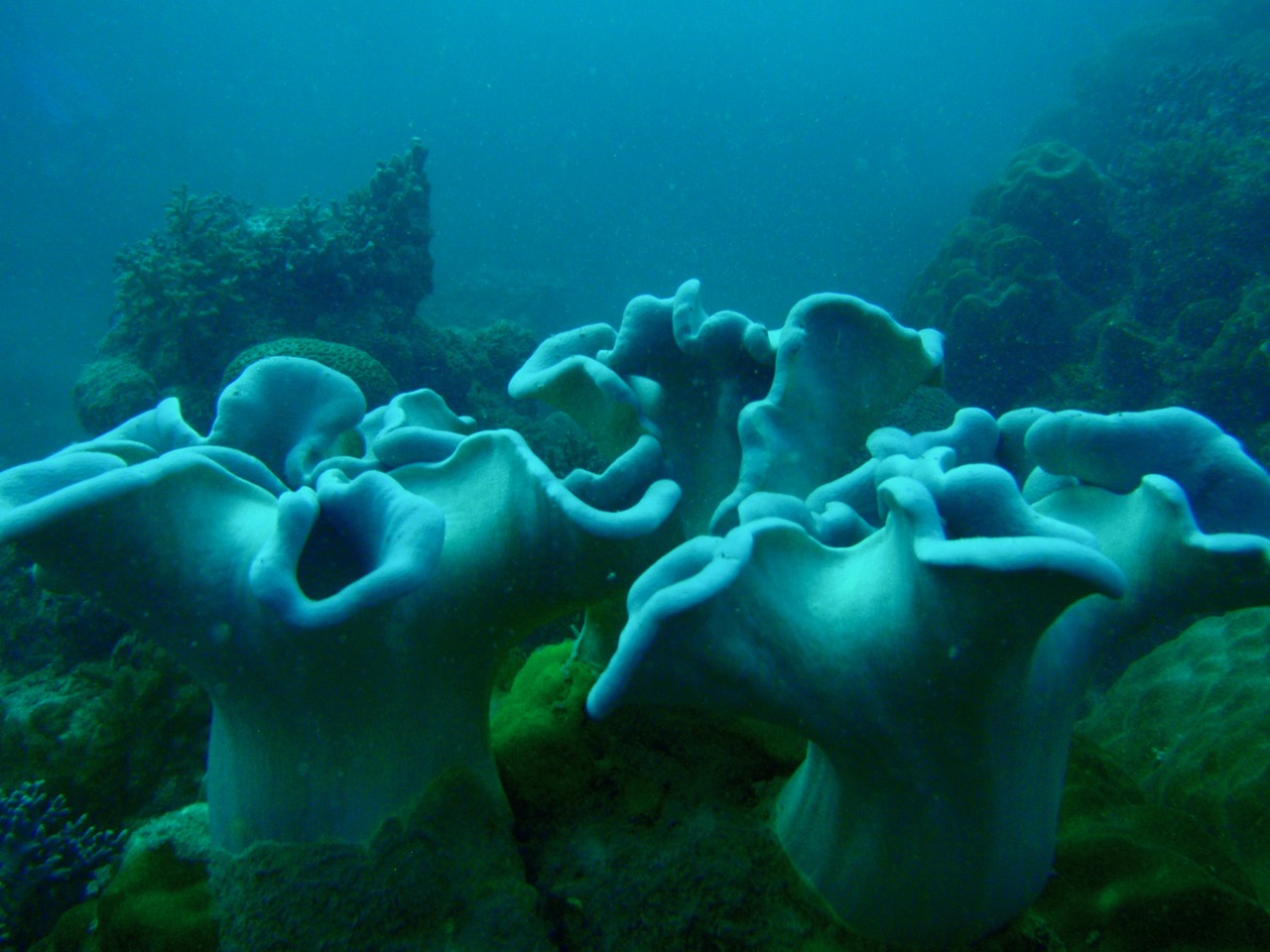
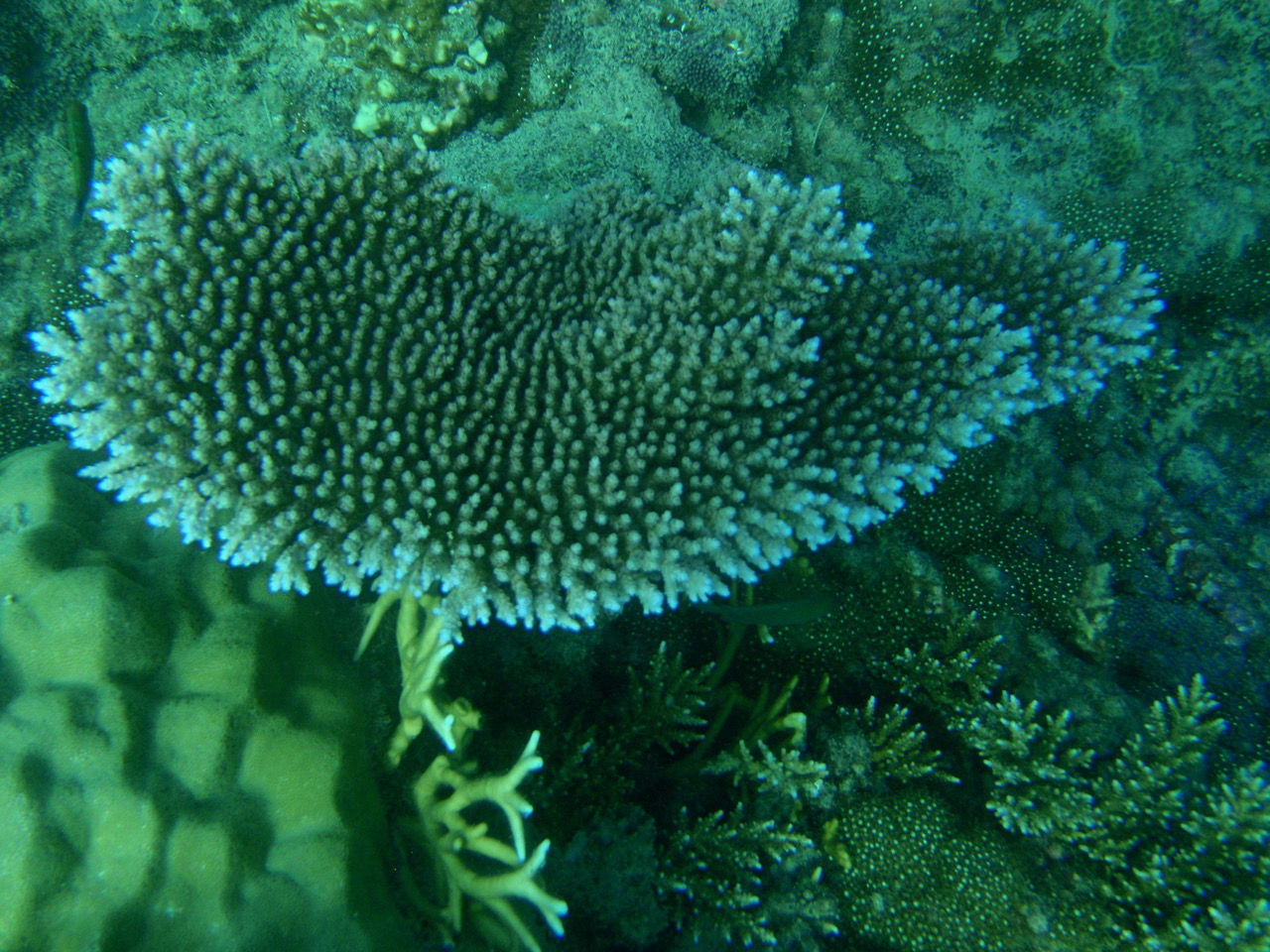
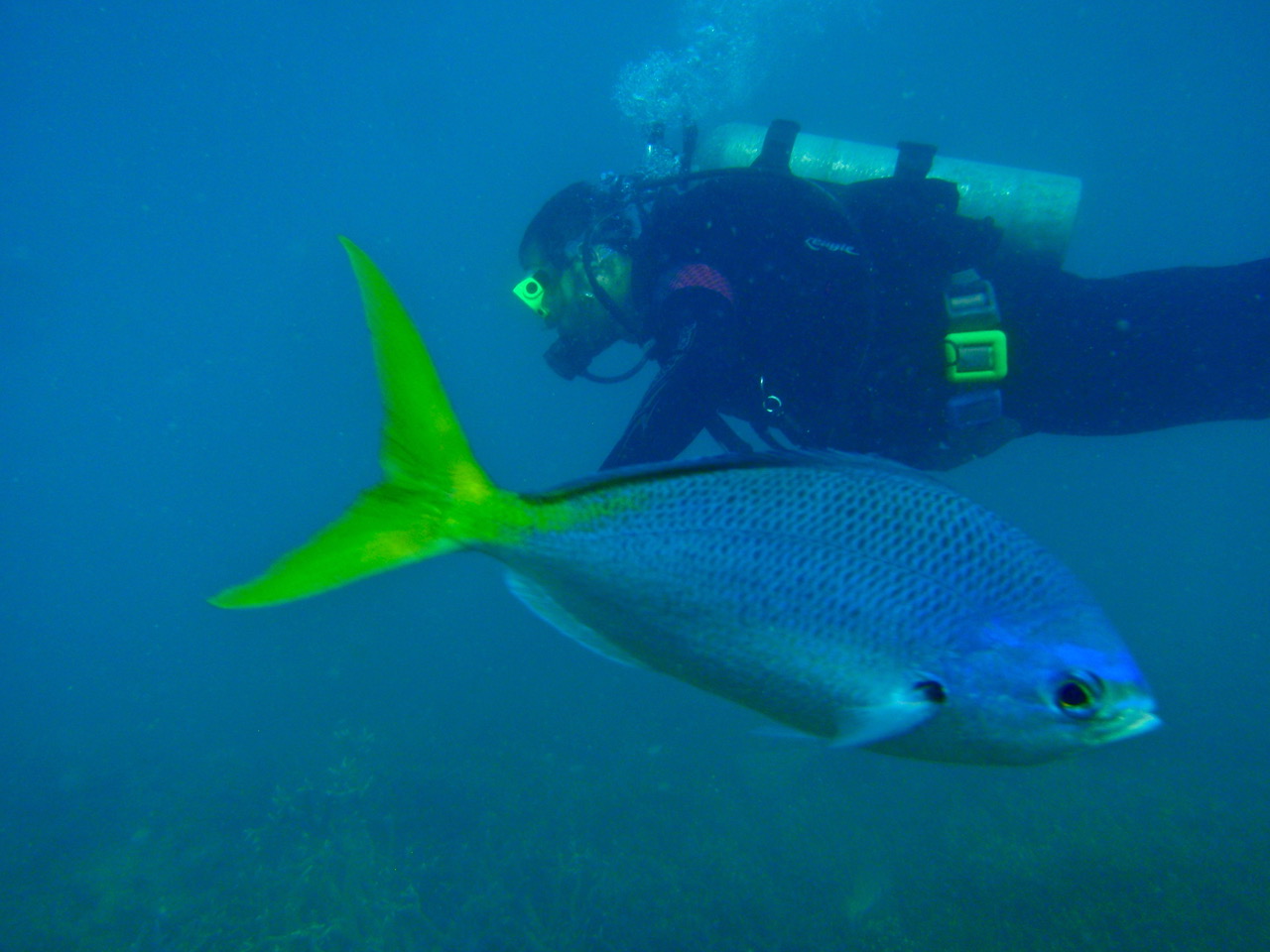
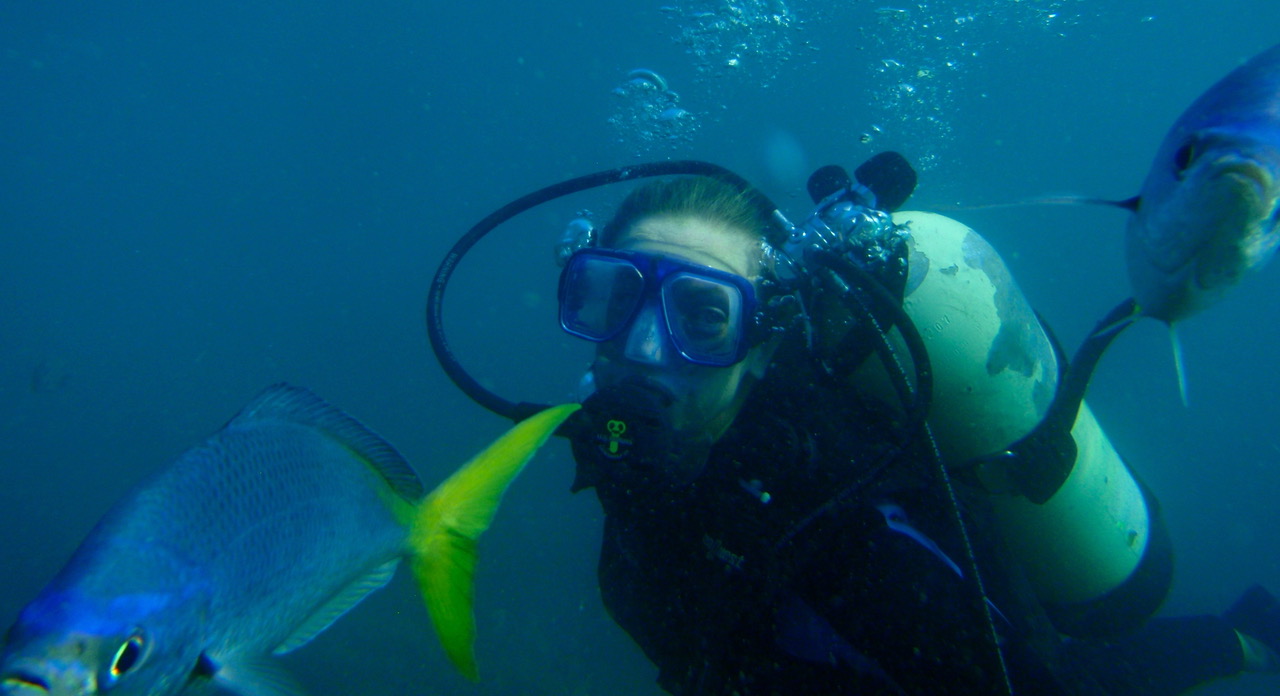
    Once Karen was out as well, I assessed the damage.  A half a dozen coral cuts on my hands, a couple more on my ankles and knees.  A price to be sure for the best snorkeling we’ve done.