Syzygy Sailing

Bought a boat, fixed a boat, sailed to Australia, sold the boat.

Category: humorous

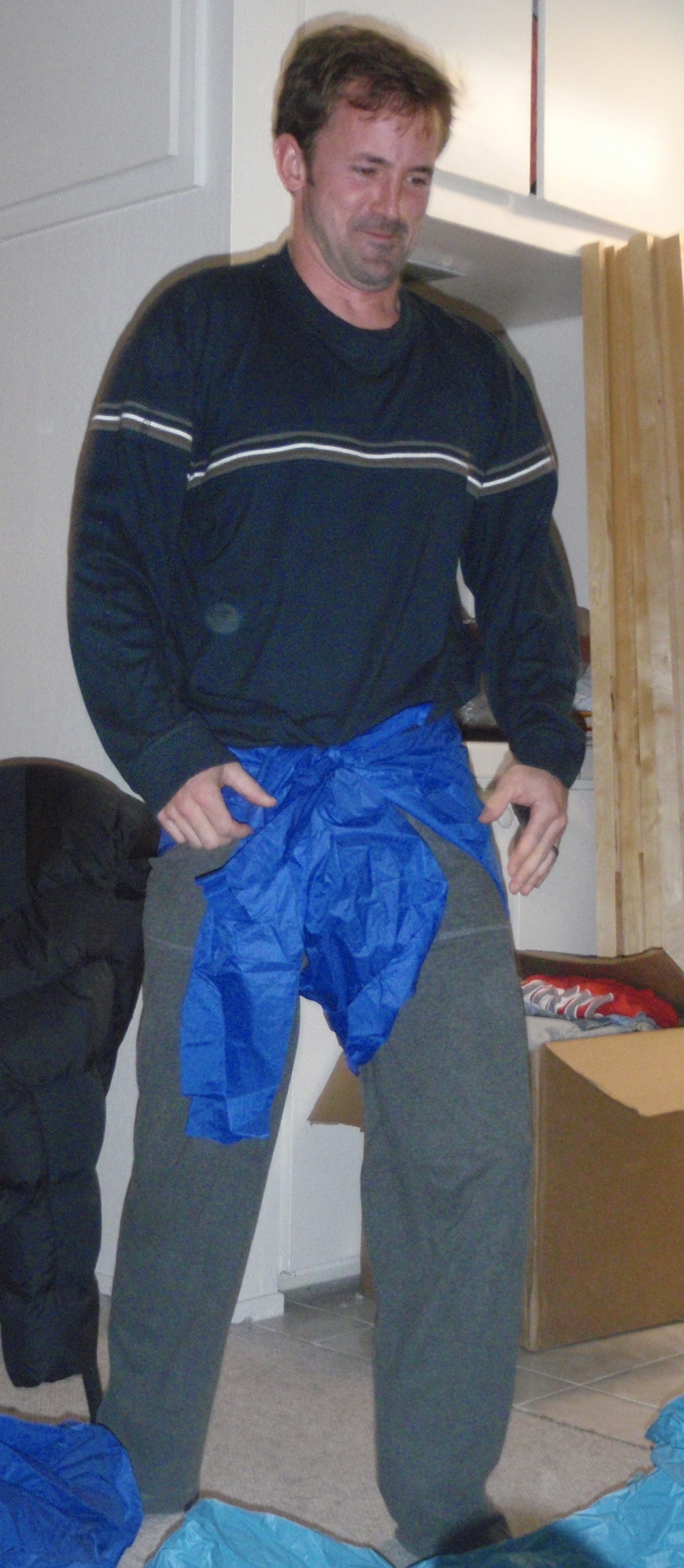
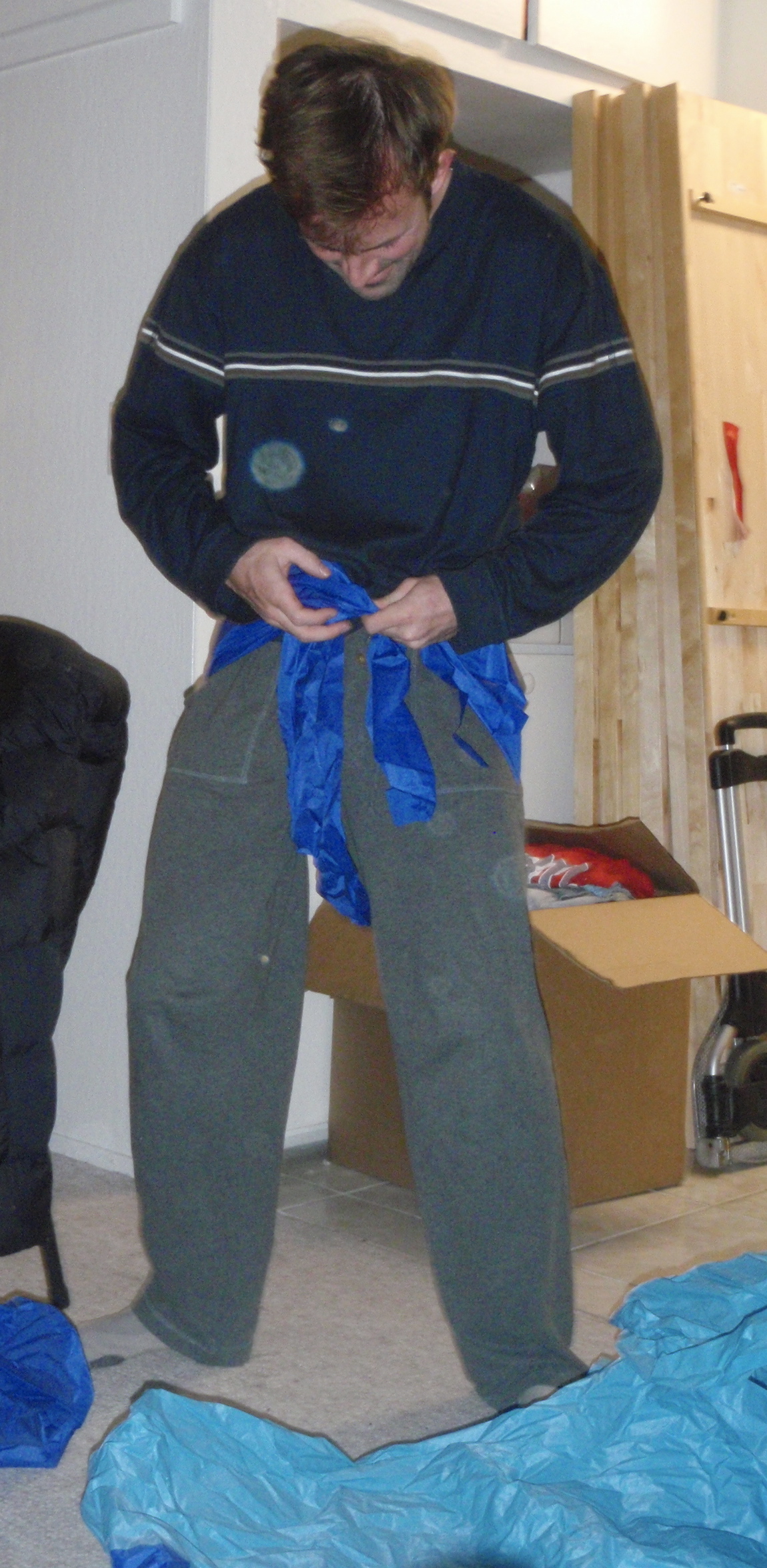
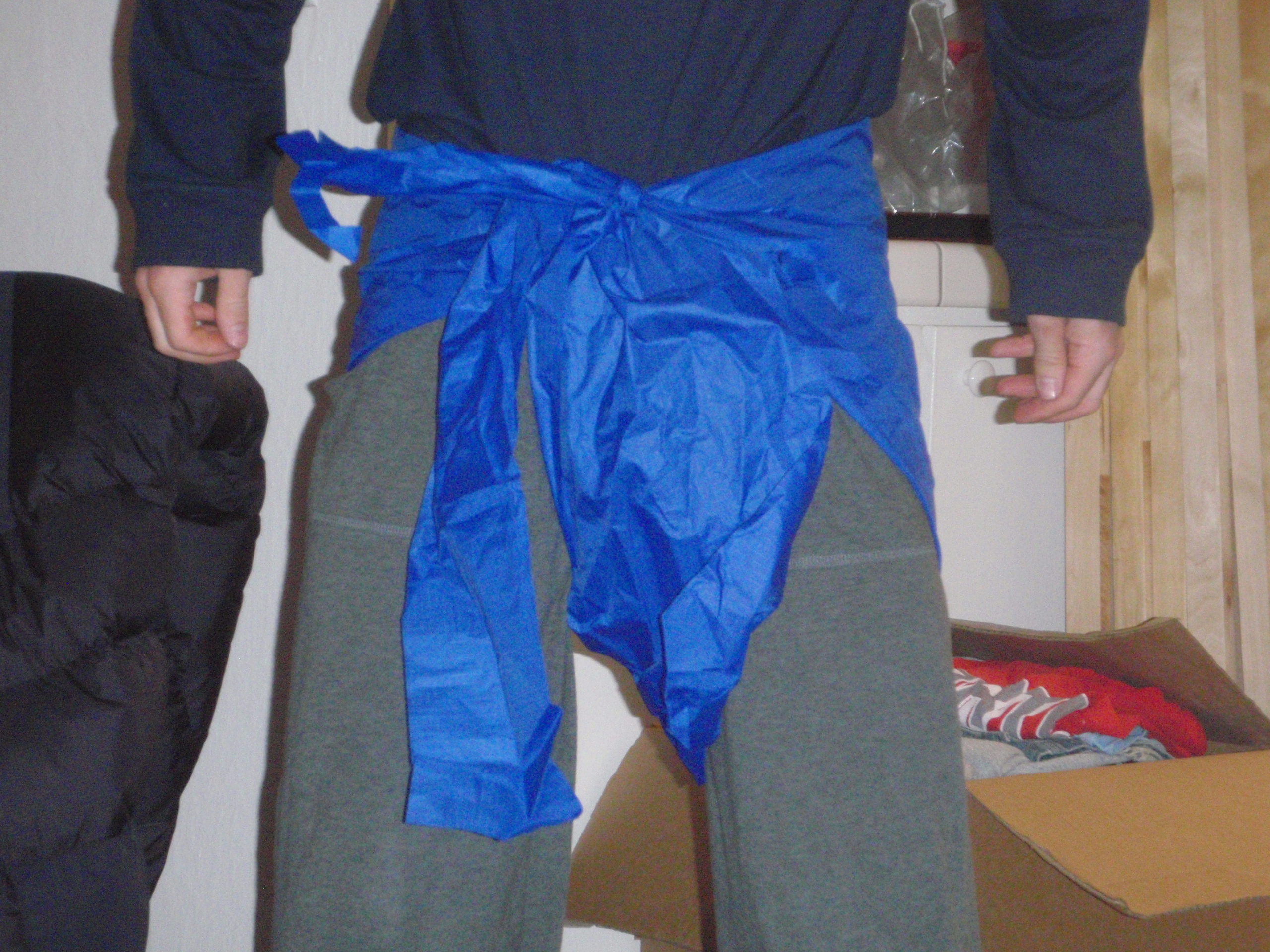
  • Justin brings the 2-step to Australia

    We are currently at Airlie Beach, a super popular backpacker stop, on the mainland across from one of the most popular sailing grounds in Australia, the Whit Sundays. Justin and I went out on a Tuesday night and didn’t make it back to the boat until 2:30 am. Fun times were had. Lots of beer, super-sized Jenga, dancing in the streets. Huge hangover on my part.

    And in homage to Greg Sutera, Justin brought the 2-step to Australia.

  • The Nanny State

    Australia is a nanny state, the state of Queensland being the worst. They have government regulations for everything. You aren’t allowed to work on your own refrigeration system and you can’t buy refrigerant you could get at any auto store in the States. You need a license and certifications to be hired to make espresso. Australia won’t let you refill American approved air scuba cylinders. Doesn’t meet their standards. To serve alcohol you have to take a mandatory four day course. Its the law that you have to get a specific scuba diving physical before you can take a scuba diving certification course. And Australians seem to love it. They seem to love following rules. And are aghast at the notion that maybe government doesn’t need to baby their citizens. Everyone drives the speed limit.

    One aspect, however, of the nanny state will please my parents, even if it is annoying to me. Boats are required to check in with the Coast Guard as they move from one Coast Guard region to the next. This happens about every 10 miles. I’ve heard boats checking in with Coast Guard just to move from one side of an three mile wide island to the other. You are required to give your origin, destination and approximate arrival time, boat registration number, number of people on board, We have dutifully checked in with the Coast Guard as we have travelled north. Other boats have told us they found us particularly humorous when we would call for a particular Coast Guard, only to have to switch to calling for “Any Coast Guard in Range!” Our VHF it seems is not particularly powerful.

    Here is Justin having some fun. Doing his best Australian voice impression and checking in with the Coast Guard.

    Romeo that.

  • What to do while sailing along at 2.5 knots

    This post backtracks and refers to events that happened on May 2nd.

    We left Middle Percy Island noon on May 2nd. Anxious to get to the Whitsunday’s, famed to be the best sailing grounds of Australia, we had spent only one night on Middle Percy, a beautiful though nearly completely deserted island. It’s one claim to fame is a hut with various sailing paraphernalia from the last 50 odd years. Every boat it seems, leaves a little artifact and quite a collection has built up.

    Anxious though we were, the wind was not so in a hurry. With both the drifter and jib up we slowly putted along on the glassiest of seas barely breaking 2 knots. We already knew we were in for an overnight sail, and so I didn’t feel like turning on the engine.

    We spent the time in various ways.

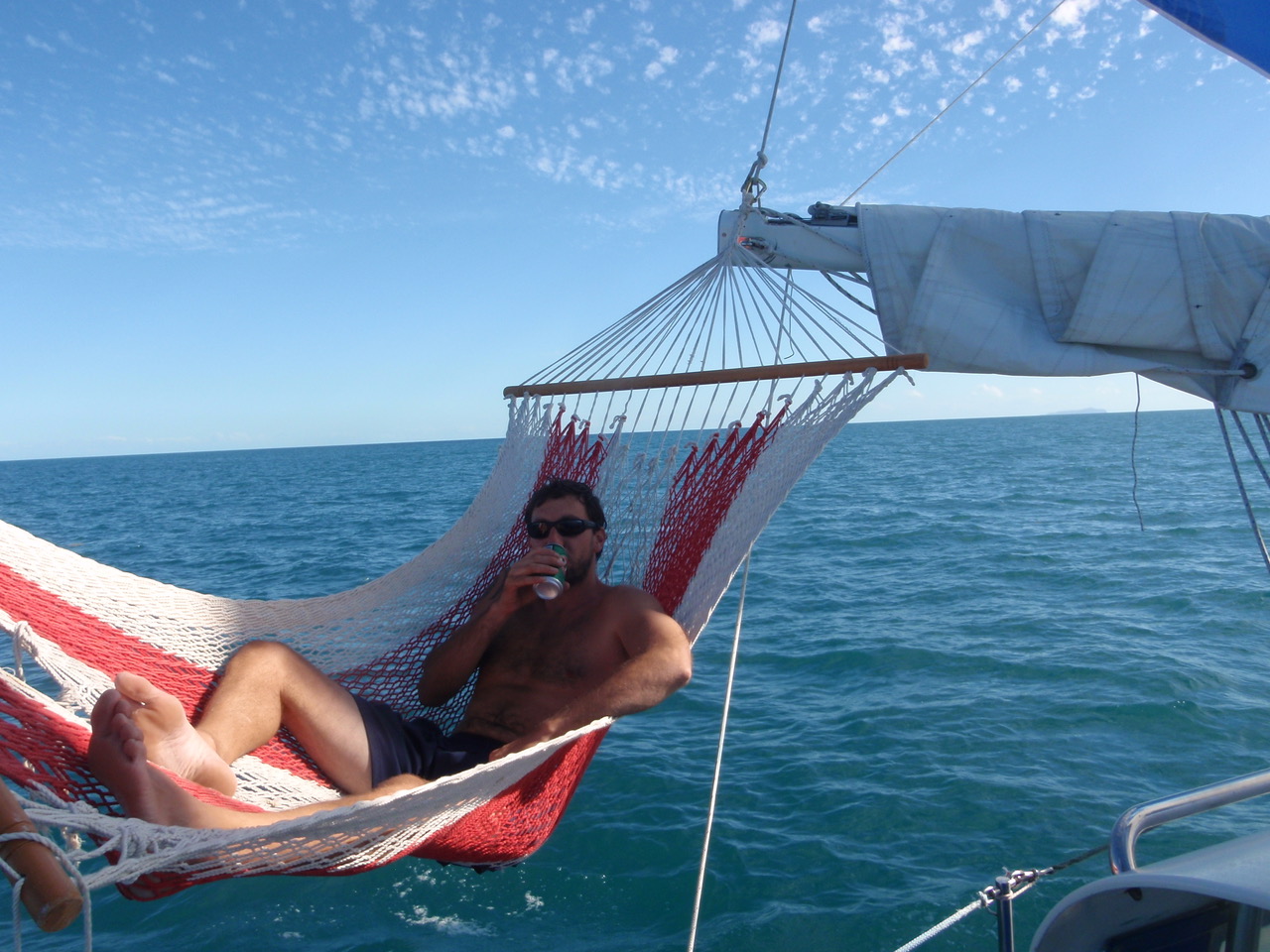
    First and foremost, Justin cracked a beer at precisely noon to celebrate our speedy passage making.

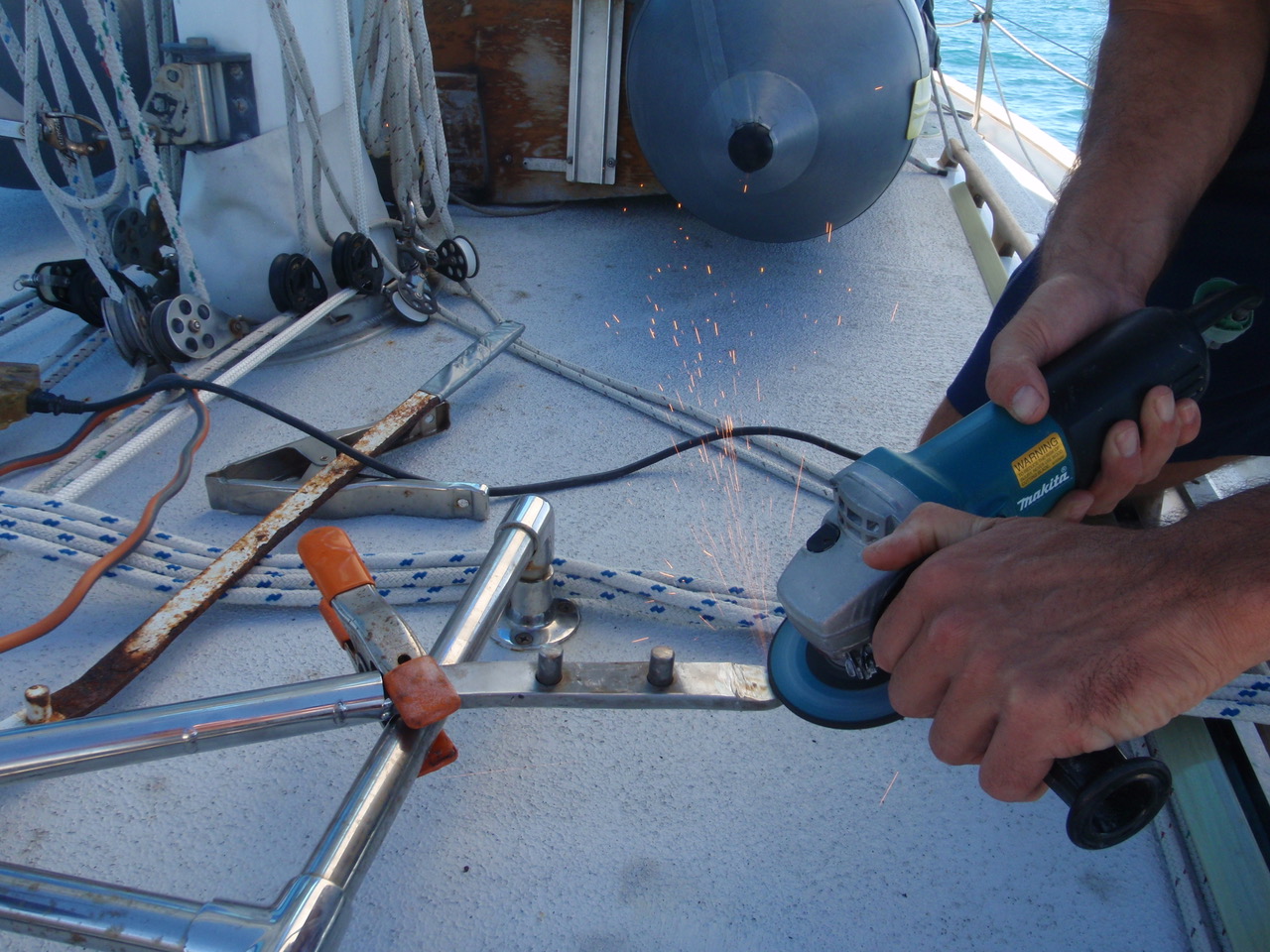
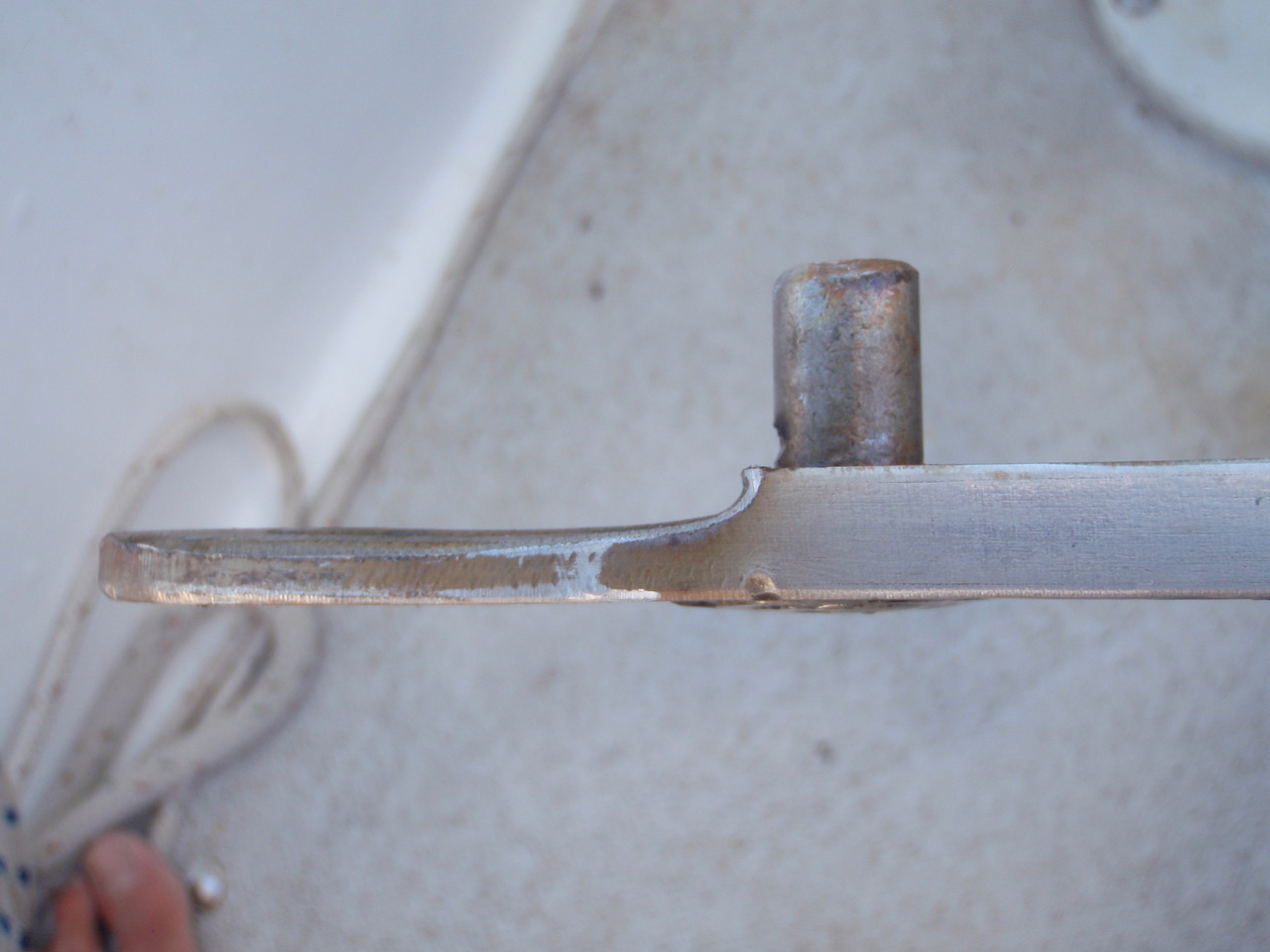
    spent some time grinding on our new (for a second time) anchor windlass handle. A welder in Bundaberg charged me an obscene amount for a new handle and then attached a piece that was 50% too thick to fit into the windlass. Alas, I discovered this 50 miles away at Lady Musgrave when we tried to anchor. To date we’e made do with our dilapidated rusting back-up until now. No more. With no rocking and no boats around, I set about to grinding.

    Justin made me lunch.

    We relaxed with more beers at two in the afternoon, a gentle breeze at our backs, enough to keep us cool, but not enough to push us any faster than 2.5 knots.

    Justin played some video games.

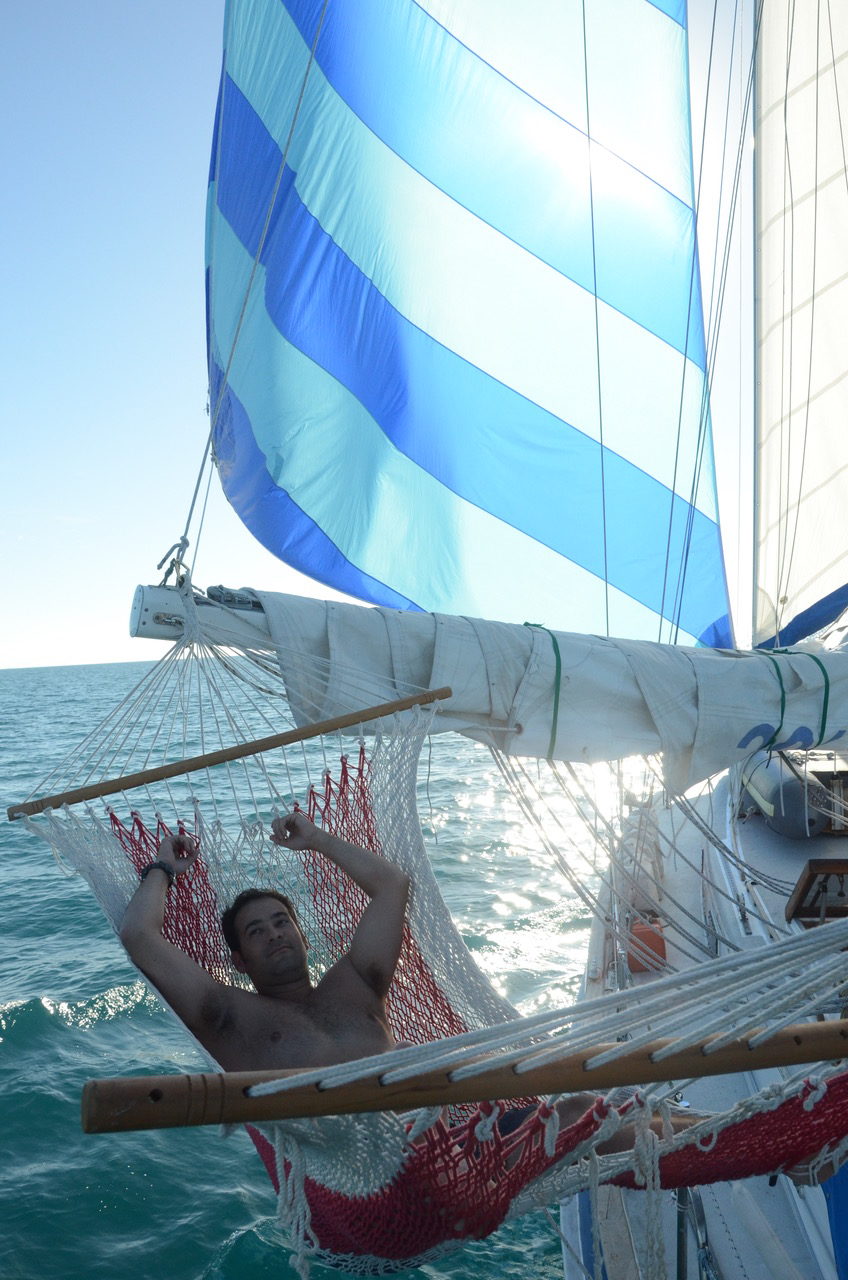
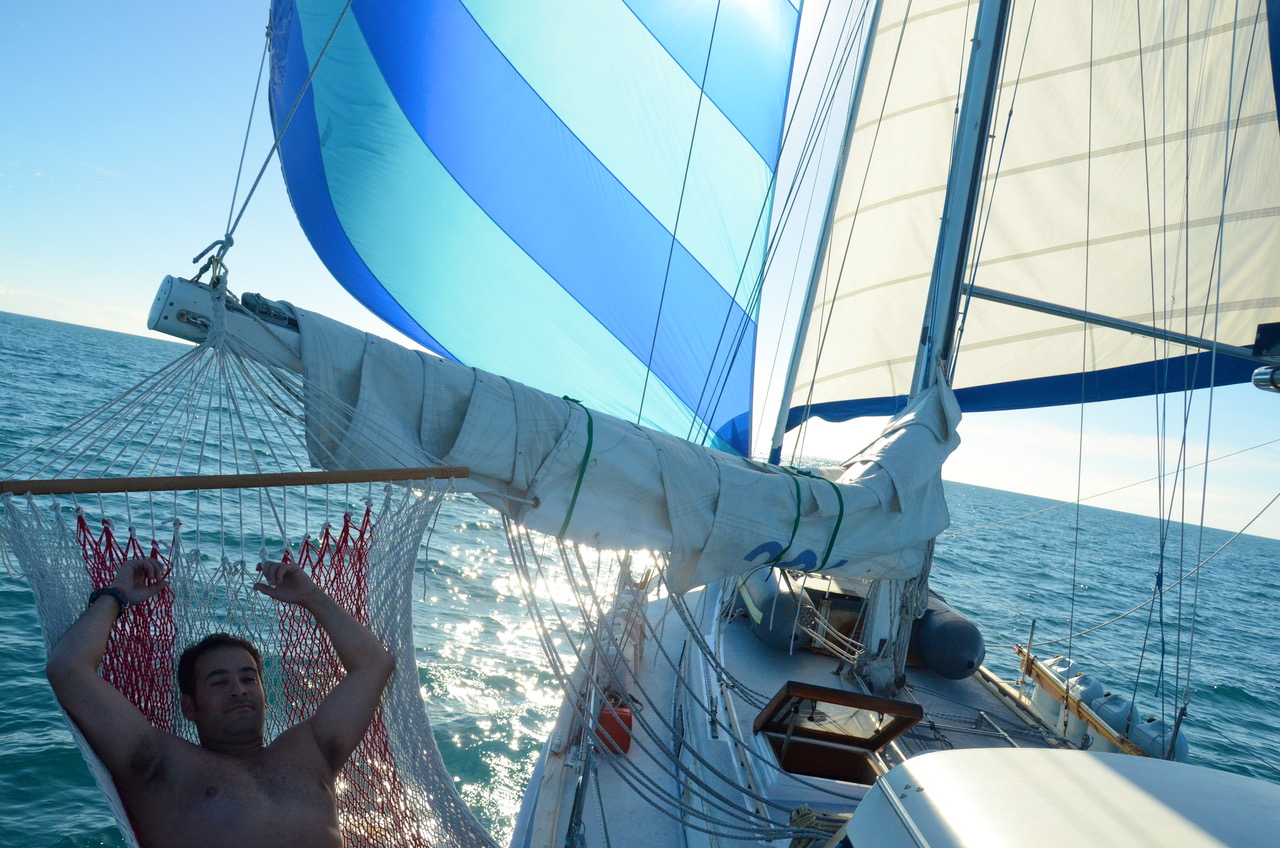
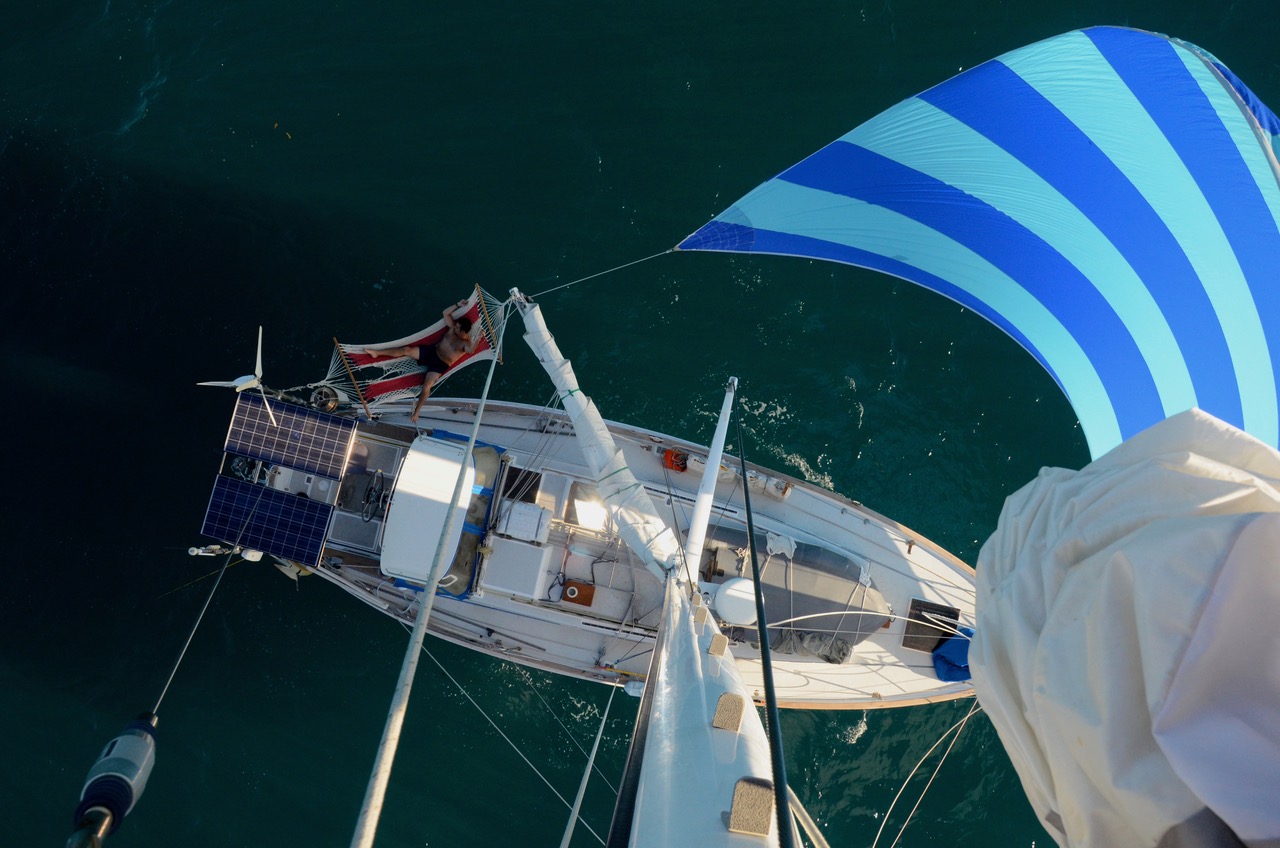
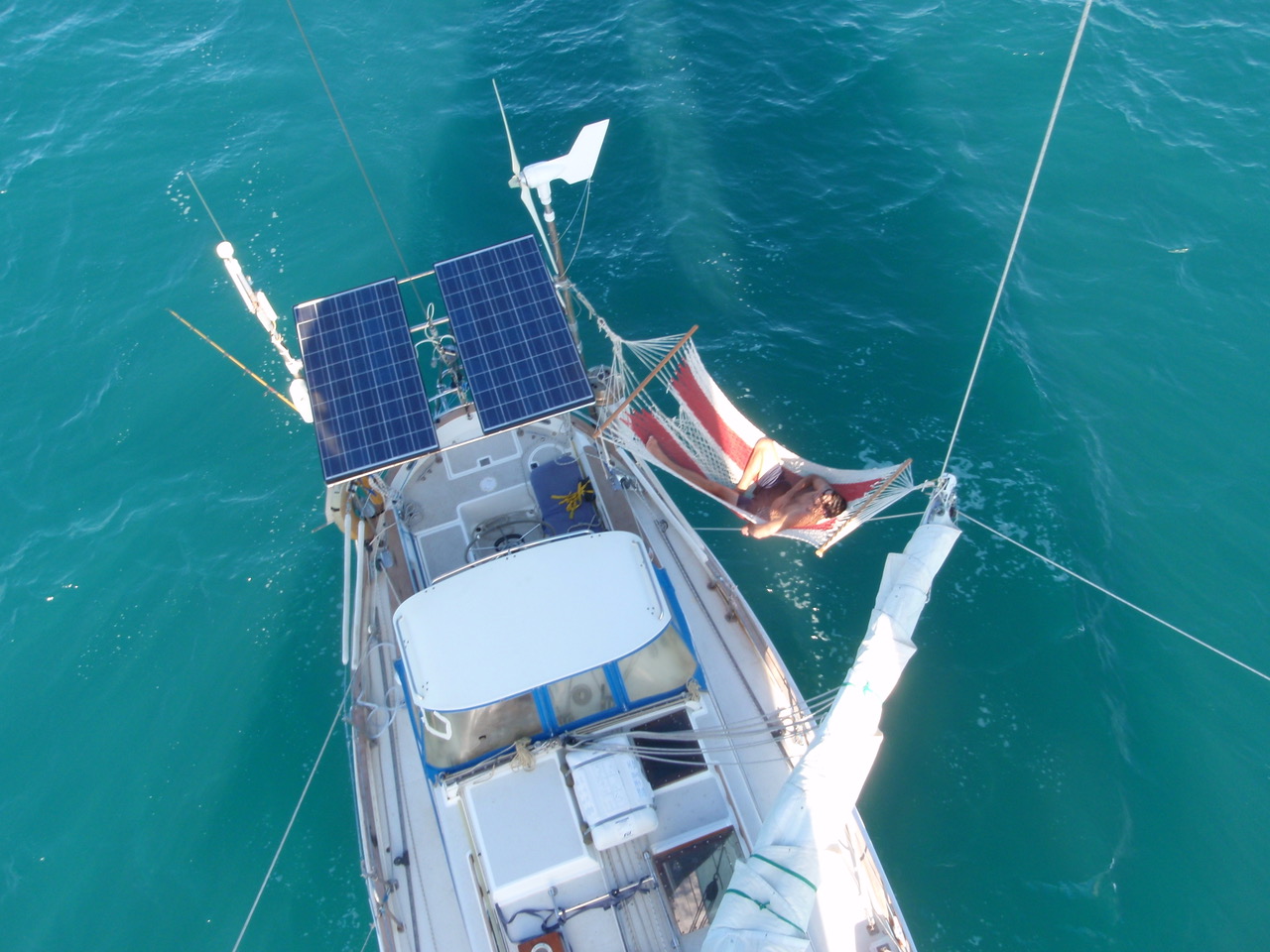
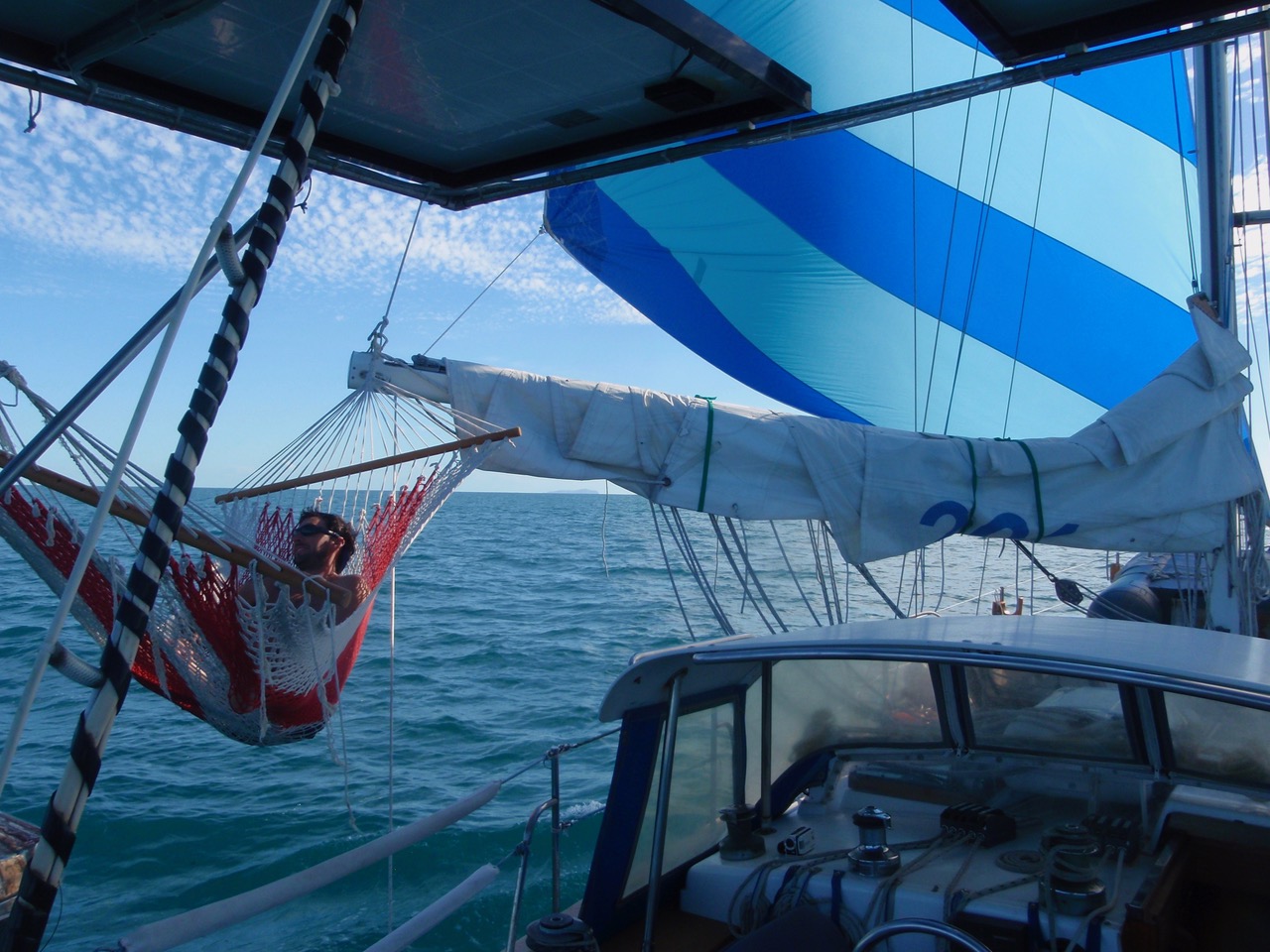
    And finally, I set about to thinking how I could rig up the hammock. I normally set it up on the forestay, (the wire holding up the mast in the front of the boat) but since the jib was rolled out, this wasn’t possible. See pictures below for my set-up. As I lazily swayed in the hammock, drinking a beer and watching the water meander underneath me, I may or may not have thought about how things couldn’t get much more relaxed.


  • Justin has been Promoted

    I would like to inform everyone that Justin has been promoted. When Justin joined sv Syzygy, he was given the title of deck swabby. I had previously been through the rank of swabby and had been glad to be rid of it. Justin too labored under the unfair disdain from his fellow crew which accompanies the label.

    I would like to announce however, that Justin’s new title is deck swabby/cook.

    Despite repeatedly quoting Stephen Siegal in Under Siege, “Nah. I’m just a cook. [whispering] Just a lowly, lowly cook,” Justin has shown a high degree of enthusiasm and has taken to the role of cook with relish. In fact, since Justin joined the boat, I have only cooked one or two meals. Justin, as cook, is a god-send.

    His favorite is a stir-fry with sweet chili sauce. He also makes a mean egg and sauteed potato hash. His ramon, with cucumber and a can of chicken, is fucking incredible.

    Congratulations, Justin, you are now ‘just a lowly cook’. slash deck swabby.

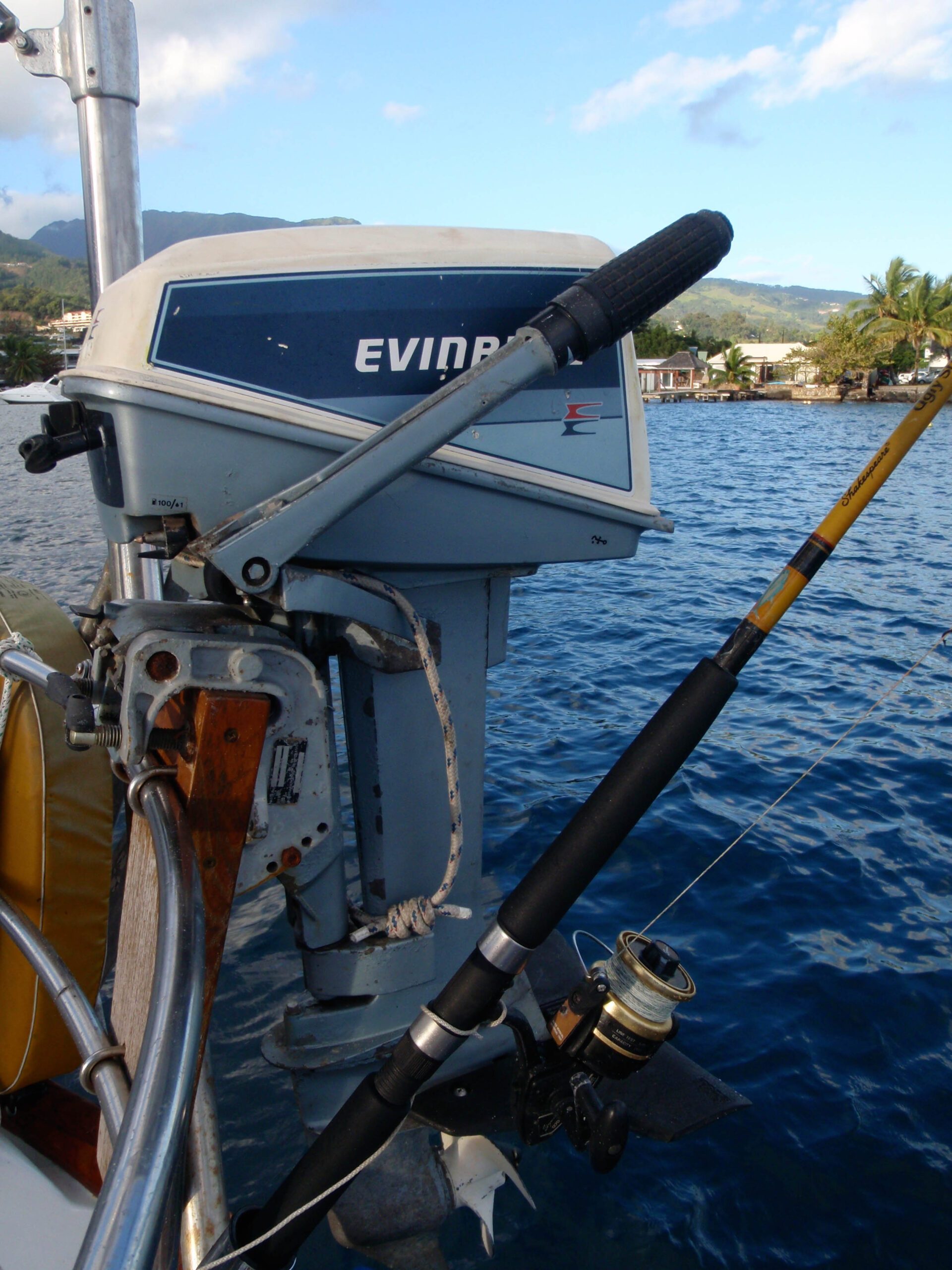
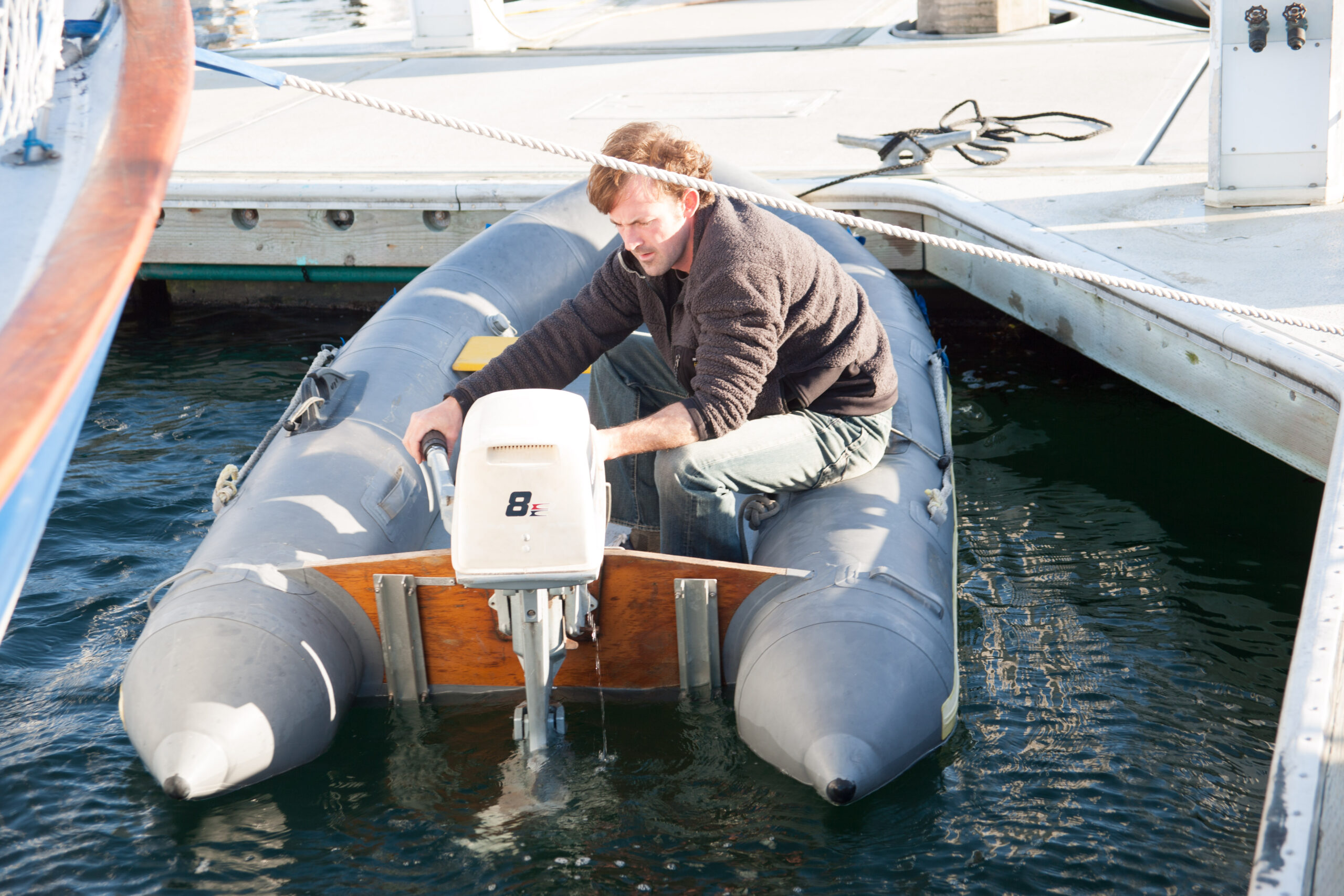
    Post-note: Justin has also applied for the position of dinghy helmsman. However, the first time he took the dinghy out for a little joy ride the engine stalled repeatedly on him. He still needs some practice, but I’m confident that another promotion is in his future soon.

  • Temporarily Indefinitely

    “How long are you going to be in Bundaberg?” asked Ducan over some beers at a pub in Bundaberg. Justin replied, “temporarily, indefinitely.”

    The three days prior to arriving in Bundaberg, a city renowned for brewing an exceptional rum, we had been running our engine for five or six hours a day. There was just no wind or we were in a place so narrow that I didn’t want to be sailing. The Great Sandy Straights just south of Bundy, while serenely beautiful, were tough to navigate, so the engine was on the entire time. More posts later about fun we had there. At least we knew the engine fabulously.

    Until the day after we got to Bundaberg and tried to move away from the obscene $50 a night marina we were staying at. Then our engine decided not to start. Two hours of investigation revealed nothing and at that point Kate, our supremely gracious and generous friend here in Bundy, arrived to take us back to her place for hot showers and beds. Another $50 to the Bundaberg port marina. They would get at least another $150 dollars when all is said and done.

    The next morning Justin and I arose early and headed back to boat. Since the engine was cranking but wouldn’t fire, I suspected air in the fuel lines, something Matt confirmed in some e-mails I traded with him.

    Getting air out of the lines is supposed to be relatively straight forward. Follow a few steps and they should be cleared of air and the engine should start. Air may however, leak back in once the engine is turned off. Finding and permanently fixing an air leak is a confounding, vexing, frustrating and all-together potentially miserable experience. But I digress…. simply getting air out of the lines is supposed to be a relatively straight forward process.

    First: open the bleed screw on the primary filter currently being used (we have two of them) and use the pump on the primary filter to pump fuel though the filter. Air bubbles should come out of the bleed screw and when they stop then there is no air from the tank to the primary filter.

    First problem: fuel began leaking out of the other primary filter bleed screw.

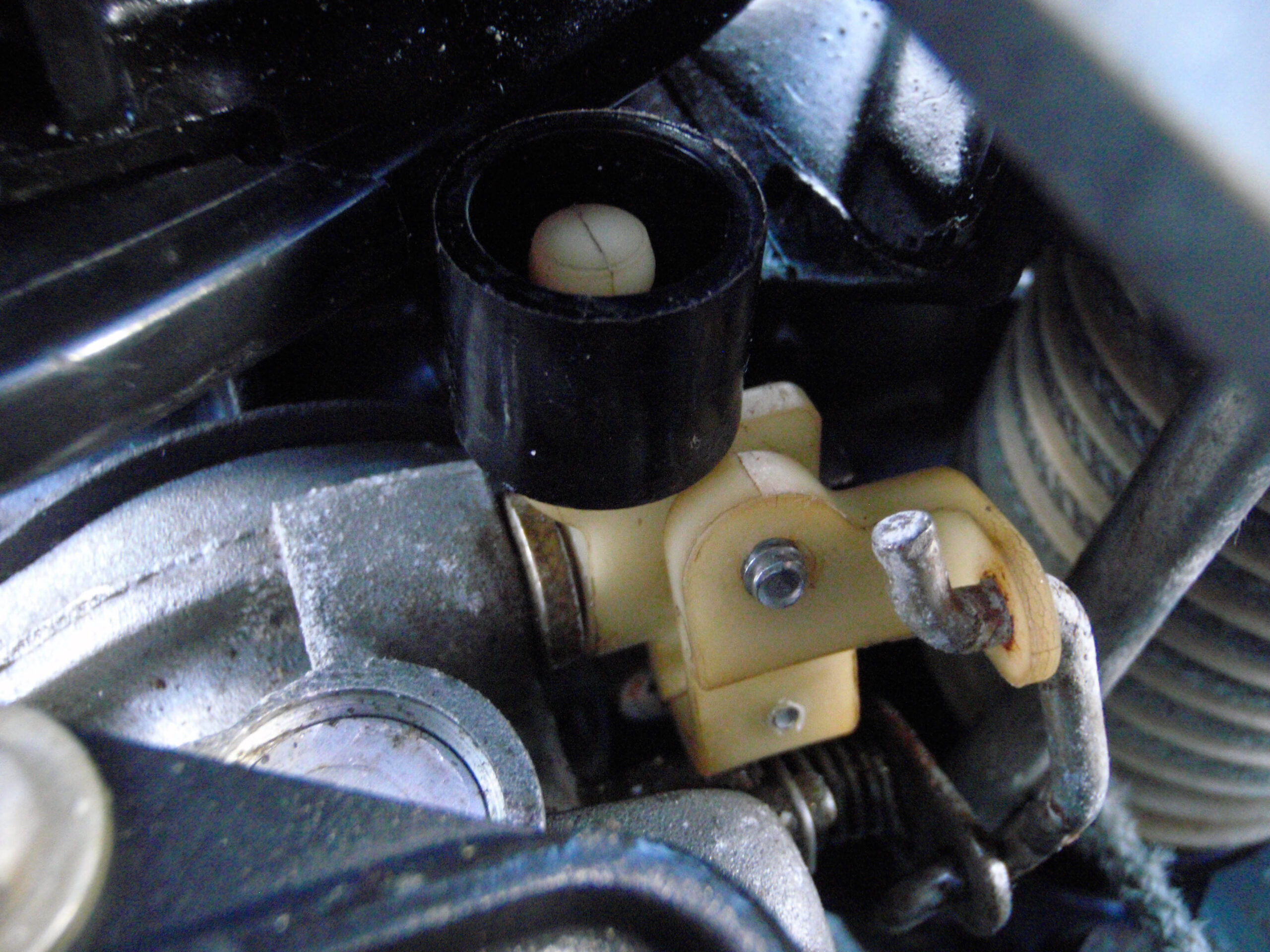
    This was not surprising or unexpected as the bleed screw on said filter is a plastic piece of shit bolt that is basically stripped and deserves to melted down and turned into a children’s toy where it can cause joy instead of the frustration and ire it caused me. I had temporarily fixed this six months ago by wrapping it with plumbers tape and I again painstakingly cut some plumbers tape in half and wrapped it around about a dozen times all the while mumbling under my breath curses at it. Two days later I would buy a nice new metal bolt and declare victory on something Matt and I knew we should have done two years ago.

    Simultaneous first problem: fuel began leaking from above my head.

    This was surprising and unexpected. Instead of mumbling curses under my breath, this elicited an audible, “where the fuck is that coming from?” I was apparently too eager on the pumping at the primary fuel filter and was forcing fuel out via our vacuum gauge. There is a line running from the fuel system to the back of this gauge so that it can measure fuel pressure. There was no hose clamp on the line for some reason, just a tube pushed onto a nipple in the back of the gauge. I zip-tied it for now, and should hose clamp it later.

    Second step: open nut on fuel line exit at secondary fuel filter and using lift pump, pump diesel out until any air bubbles go away.

    Second problem: fuel began streaming out of the secondary fuel filter, which I had just changed. I must now mash and squeeze and contort my body over the engine so that I can better see the secondary fuel filter and put the o-ring and the filter on correctly. My head is now inches away from where two years ago I had jump started the engine via my body when I connected the alternator to the starter motor or solenoid, (I’m still not entirely sure what happened back then). Having the engine start unexpectedly, with me lying on top of it, because current had gone through either me or a tool I was holding, was not an experience I wanted to repeat. Thirty minutes later, the secondary fuel filter is finally on appropriately with a mild stream of obscenities.

    Third step: open fuel line leading to fuel injection pump and using the lift pump, pump diesel out until any air bubbles go away.

    Third problem: No fuel will come out. I can hear fuel running through the system and returning to the fuel tank, but no fuel comes out here. I give up and move on, with a pointedly loud set of damnations for the engine.

    Fourth step: open bleed screw on fuel injection pump and using the lift pump, pump diesel out until any air bubbles go away.

    Fourth problem: The bleed screw is located in another screw, lets call it the ‘stupid screw’ which goes into the pump. When I try to loosen the bleed screw, it seems to be seized to the stupid screw, and instead the stupid screw loosens. The bleed screw is specifically made so that when loosened, only a small amount of fuel comes out. The stupid screw is not. Lots of diesel now comes out as I fumble around trying to find the wrench that will appropriate tighten the stupid screw and not just tighten the bleed screw further into the stupid screw. I get it to work right with additional wrenches as I ponder what cancer I am bringing upon myself with diesel dousing my hands. I am also cognizant that neighboring boats might have head the stream of invectives I direct at the engine.

    Fifth step: Crack open each injector nut, there are four, and crank the engine with the throttle open. If bubbles appear, the engine has not been appropriately bled and the process must be repeated.

    Fifth, six, and seventh problems: The fifth and sixth problems are that two injector nuts leak air, so I have to repeat everything. The seventh problem will vex me for three more days. Instead of the injector nut opening, the injector adapter (some stupid adapter piece between the injector nut and the injector) comes loose and will not retighten. The injector nut will also not break free. Over the next two days this illicit roars of hell-fire, and I begin to scare Justin with a series of imitations of an 8 year old’s temper tantrums. I should be mildly embarrassed but the engine has gotten the better of me.

    So we are now in Bundy, the rum city of Australia temporarily, but indefinitely. At least I can drown my sorrows in rum.

    post script: The problem was finally fixed upon pulling off the fuel line, purchasing a new injector nut, reassembling, and bleeding the engine multiple times. The engine has now been running perfectly for the last month. You can read a different take on this and more about the resolution on our maintenance blog here.

  • Agh, that’s disgusting

    Justin and I managed some last minute work on the boat.  I worked.  Justin filmed.  O.K., he did some work.  Off camera of course.  Here we battle a small issue in the galley.

    Note: Of Matt, I only make fun.  It is only because of the thousands and thousands of hours that Matt labored on Syzygy that I am able to sail her here in Australia. I jest because it is so obviously hilarious to think Matt somehow did not maintain Syzygy to the highest of standards.

  • Boys will be Boys

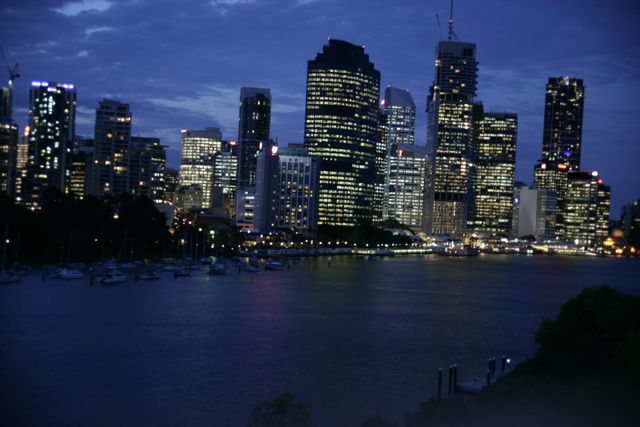
    I would like to extend a thoroughly vigorous thank-you to Richard Switlick, Chris Reardon, Kevin Tompsett, and Philippe Boujon, who provided the drink-link funds for Jon and myself to enjoy a correspondingly vigorous evening of refreshing alcoholic beverages.  Additionally, Karen expresses her appreciation for the quiet evening of solitude that she enjoyed while we were on the town. Thank you friends!  I regret that we do not have any pictures of the event, but I have included a great shot that Jon took of the city as it appears from our ferry stop–exactly as it appeared as we entered downtown in search of some fine Belgian beers.

    Upon hearing of our male-beer-evening, a female cruising friend living down the dock from us commented that the sole topics of conversation among single men when lacking female company seem to be 1) women and 2) alcohol. Given that we are no longer single (I am married; Jon is in a relationship), she was curious about exactly what we might discuss.  A ready defense of the quality of our conversation jumped to the tip of my tongue, because I recalled that on the evening in question we had an unusually philosophical back and forth for at least two hours.  I paused before answering, however, when I realized that we had started the event at 4 and continued until 1–a duration of 7 hours–minor mental calculation says that 2 out of 7 hours is not a significant portion.  Upon further reflection, I recalled a spirited debate regarding the top three brands of each and every type of liquor present on the shelves of the bar.  And what else did we talk about? Oh, right.

    I was forced to admit that the primary topics of mature non-single male conversation remain 1) women and 2) alcohol. At the same time, I regret nothing and make no apologies.

    For another exhibit of male arcana, I present the preferred method for one dude to cut another dude’s hair.  I think you will agree with me that it is a paragon of efficiency: note in particular the minimal amount of male-male contact and the utter lack of escaping stray hair.

  • Drink Link Updated

    The drink tab has been significantly updated to actually show pictures of us drinking. We thank all of you who have contributed, some of you have been overwhelmingly generous, and before I get into my shtick, we do truly appreciate all of you.

    To the 15 of you who contributed before I (Jon) joined in June, I will get pictures soon from Matt of the inebriation you sponsored, and you too will get your day in the blogosphere contributing to an unhealthy non-tax-deductible cause. Not all of the people who have contributed since June are listed in the drink tab. Don’t worry, it is our fervent desire and plan to continue with our up-until-now well executed plan of steady alcoholic consumption. We are embarrassed at our lag time with posting thanks and pictures, but generally blame it on you and the intoxication you made possible, and hope you will forgive us by buying us beer.

    JONATHON

  • Kava

    (This post refers to events that happened throughout our stay in Fiji, though primarily Sept. 14th, 16th,  and Oct. 3rd)

    Kava is a narcotic.  That it is a narcotic with only the slightest tiniest itsy-bitsy of narcotic effects to make one think ‘why bother?’ doesn’t deter the Fijians from passing time downing gallons of it, one coconut shell at a time.  That it tastes like dirty bath water is also not a deterrent.  For some reason neither is the fact that, in Fiji, the traditional preparation is for young boys to thoroughly chew on the pepper root, fully masticating it, spit it out, mix with luke warm water in the tanoa (the traditional container, an artistically carved wooden bowl on four legs) and serve via coconut shell.  Thankfully, the traditional preparation is no longer practiced except perhaps in the remotest of villages.  Every time I drink kava I make it a point to convince myself of this last bit.

    I felt required by my compunction for experiencing local culture to try kava.  I also have a compunction for trying new mild (mild-only!) narcotics.  So when, on our first day ashore in Lautoka, I found myself wandering the market alone, I knew I would immediately get a chance.  City markets, the one in Lautoka in particular, are where men hang out.  And wherever men hang out in Fiji, there is probably a kava bowl being passed around.

    In the market, I walked by dozens of yaqona vendors.  Yaqona is the dried but unmasticated (nowadays they more hygienically pound it) pepper root.  I learned later a longer root indicates a more aged pepper plant and in turn better kava.  Kava apparently is like wine, and gets better with age.  Two or three years is young but frequently used, five years is better.  Most of the yaqona at the market was about 18 to 24 inches, though I saw some four foot stuff that was artistically bundled into something resembling modern art.  Next to the vendors were the drinkers, twenty tables under a tent, all filled with men lazily sitting around.  At the first table I walked by, a man named Mesake cried out “Bula!” and invited me to join them at the table drinking grog.  The Fijians are extraordinarily nice; what else could I do but accept?

    Despite being far removed from the traditional ceremony, Fijians still retain some aspects of the traditional kava ceremony.  Namely, they clap.  Guide books will say you have to clap exactly once before being handed the coconut shell of kava and after handing the shell back, clap exactly three times.  The claps should be proud, with an exaggerated motion.  While this might be true in the remotest villages,  I’m here to tell you, in the markets, pool halls, resorts and backpacker camps where I drank the grog, you can feel free to clap an indiscriminate number of times, loudly or softly, shyly or ostentatiously.  The only thing in common to all the places was the rhythm or pacing of the clapping. Think the pacing in a rock-paper-scissors game, slow it down just a touch, and you’ll about have it.  Certainly not standing-ovation-at-the-theater style.  At the pool hall, they simply pat a leg at the requisite speed.  When I asked why, laziness was attributed.

    Mesake offered me a shell, and as I had read up on kava drinking, I knew about the clapping and that when I drank it, the kava is supposed to go down in one smooth go.  There are about three to five ounces of liquid in a normal shell, so anyone with experience from college shot-gunning a poor-tasting American light beer should have no problems smoothly drinking this poor-tasting sandy bath-water concoction.

    I handed Mesake back the shell and thought, ‘maybe sandy bath-water isn’t so bad?’  My tongue went slightly numb, and with the two or three subsequent bowls the tiny tingling extended around my mouth and throat.  That was about it for effect, just some tingling, maybe some numbness.  The bowl went around, celebrating my joining the table.  Ten or fifteen minutes would go by and then the person in charge of the kava tanoa at the table would decide it was time for more kava and start passing the shell around again.  The time in between passed with Mesake and a woman seated across from me, Paulini, telling me about Fiji at large and more particularly the villages they were from in the Yasawa’s.  They gave me the names of people they knew or were related to in the villages they were from and insisted I ask for them when I arrived there.  Alas, we never made it to those villages, but the kindness was indelible.

    I drank some kava again in the Nadi market while wandering around there with Allison.  I secretly presumed there would be grog there, that we would have a chance to try and wanted to see if she would.  And so we walked around longer than necessary as I tried to locate some kava drinking.  She demurred this time, hesitant at the cleanliness of the whole operation, which admittedly is suspect.  I can’t fault her on this point.  The same coconut shell is passed to everyone: one person drinks, and the shell is immediately dipped back into the kava in the tanoa and handed to a next person.  They certainly don’t clean the coconut shell in between uses.  She was, however, up for it at the welcome ceremony at Octopus Resort and she reported that yes, like pretty much everyone else, she thought it tasted like bath water and didn’t particularly like it.  I however, was developing quite a curiosity for it.

    Two and a half weeks later, I went to Nadi International Airport with Allison to trade goodbyes and other newly learned Fijian.  She and I had had a fantastic time together, and I was certainly sad at the thought of not seeing her again for three months or so.  The taxi was headed back to a dorm room bed at the awkwardly named Nadi Bay Resort Hotel (comfortable beds and amazing food… best kokonda in Fiji!) It occurred to me that what better way to spend a melancholy evening than around a kava bowl.  I redirected the taxi to someplace where they drink kava.

    I ended up in downtown Nadi at a pool hall.  A pool hall is somewhat of a misnomer as it invokes images of a location filled with pool tables, a dozen of them, maybe two dozen or more.  This place was certainly packed with pool tables, you had to nearly sit on one table to take a shot on another.  But there was just two tables.  I walked in warily but like I belonged and saddled onto a wall to check the place out.  All the way on the opposite side of the pool hall, eight feet away, a Fijian flagged me over and handed me a bowl of kava.  His name was Ben.

    After another bowl of kava, the owner of the pool hall, Sue who also happened to be, I’m pretty sure, a prostitute who propositioned me, motioned I should put money down to play at the only table with action going.  It was a challenge table so you had to beat the previous winner, currently a young teen who had been winning ever since I walked in and was dispatching people quickly.  So I did, and played one of the best games of my life, banks, combinations, strategy, and a little luck.  One of those inspired moments of pool that only come after a couple of beers have steadied your hand and your gaze; instead of beer though, this time it was kava.  While playing, we would trade back and forth a few shots, I’d have a cup of kava.  In the end, I won and the kid stormed out perhaps upset that the popeye (white foreigner.  I hope not derived from the silly cartoon) drinking kava, when he was too young too, had run him off the table.  A couple more games saw me lose and I went to the bench to talk with Ben and another Fijian Joe about Fiji.  I bought some of the powdered yaqona for us to have more kava after we finished what was in the tanoa.  Interestingly, their tanoa was definitely not a traditional one.  Instead it was a flimsy blue plastic dish.  Flimsy like two-liter coke bottle plastic.  After ten bowls of kava I decided it was time to leave.  Sue asked if I wanted company; I politely declined and left to find a taxi.

    Back at the hotel, lo and behold what do I walk in on but the bartender, a couple of his friends, the security guard and a couple of patrons around a kava bowl.   I earn an invitation.  One guy is from Kiribati on a fishing boat.  Another’s name is Damian, and after hearing I have a yacht, is interested in crewing to Australia.  Two hours go by, and with the security guard in charge of the kava bowl, everyone is consuming plenty.  After another ten bowls, I’m feeling woosy, almost certainly though, from it being 3 am, five hours after I normally go to bed these days, and not from the twenty or more bowls of kava I consumed.

    The next day, I woke up early.  No hangover.  No residual effects.  There weren’t really any effects at the time either.  Which makes you wonder, if there’s no effect from drinking poor tasting dirty bath water, than why drink poor tasting dirty bath water?  My curiosity with Fijian kava was killed and I haven’t had it since.

    Vanuatu kava, on the other hand….. two bowls lays a wallup, four bowls and you won’t be able to walk.  We’ll soon find out.

  • Diving in Fiji

    (This post refers to events that happened September 21st and 25th)

    I had designs to dive on beautiful reefs and coral bommies in Fiji while our guests were here.  Fiji is proclaimed as the soft coral capitol of the world.  I don’t even know the difference between hard coral, soft coral and mean coral but ‘capitol of the world….’ That must be good right? Alas, a broken wrist prevented Allison from being able to dive.  And while we did some great snorkeling, I never motivated to pull out the dive gear to dive while others snorkeled.  I am motivation-less when it comes to diving.  It’s also hard to bring along the dive gear in the dinghy when five other people are in there as well.  Dive gear being bulky and all.

    So while I never dove while others were snorkeling above me, or dove down to see beautiful coral, I did do two dives, both alone and to mundane non-beautiful things.

    The first dive was just off Octopus Resort on Waya, the day Gary and Anna arrived.  I am willing to bet large sums no one had ever dove my dive site, and so I feel empowered to give it a name. The dive plan was to head straight down to the bottom, a depth of forty-five feet.   Swim with the current along the bottom for sixty feet.  Then shift in one direction perpendicular where you just swam by about 8 feet.  Then swimming parallel to your original track, swim back to where you started.   Due to large amounts of silt, visibility was a mere fifteen feet.  During the quarter of an hour dive I saw no fish. The bottom was flat sand, bereft of any life or even a rock to break the monotony of the bottom.  Completely bereft save one item.  Matt’s snorkel mask.  The one item I was looking for.  This dive site is named Matt’s Mask.  I would not recommend this dive as the major attraction to the dive is no longer there.  I felt compelled to take it with me.  (As an aside, the snorkeling off Octopus Resort is excellent, we were anchored a bit away from it)

    The next dive site was located off Navadra Island.  There was actually some particularly nice coral to look at just a little ways away, in predominantly twenty feet of water or less.  Allison was up above snorkeling, so why bother dinking around in twenty feet once I was done with the dive’s purpose?  That purpose being to retrieve our $800 Fortress stern anchor because the line attached to the anchor had chaffed through during the night.  This dive lasted just over five minutes as our GPS point of the anchor location was exactly on.  The dive plan consisted of going down to the bottom at fifty feet.  Visibility was only thirty feet; the water was cloudy here, though near the better snorkeling, visibility seemed improved.  Once at the bottom, dig up the anchor which is excellently embedded in sand, two feet away from the large coral reef which chaffed the line.  This will reduce visibility to six inches, so digging must be done by feel.  And you will not see approaching sharks, which are probably large 25-foot man eating ones.  I don’t know if there were sharks approaching, visibility was six inches, but I assume there were.  None, thankfully, penetrated the six inch visual field.  None, not even tiny reef sharks, actually penetrated the entire visual field of anyone that day during a combined four plus hours of snorkeling.  While my visibility was six inches though, I am sure the man-eaters were approaching rapidly.

    Once the anchor is dug up, tie on a line to the anchor and return to the surface.  Job completed.

    Another two dives bring my total to an impressive six dives in the last five months.  Seven dives, if you include the pool in Denver where I took the refresher course.  Other things have taken my time, energy, focus, and enjoyment.  Perhaps Australia will bring more regular diving!

  • Jon. From the Yacht.

    this post refers to events which primarily happened September 18th-21st)

    “Did you notice how the masseuse, she giggled after saying -You must be Jon.  From the yacht.-”  I asked Allison after we emerged from our respective massages at Octopus Resort on Waya Island in the Yasawa island group of Fiji.

    “Do you remember me telling you earlier today that everyone here calls you that phrase?” she dryly replied.

    I protested that she hadn’t; she reminded me that she had today, and yesterday as well, and gave details to substantiate.  I had to concede.

    I sighed a popular refrain of her visit here, “You’re right Allison,” and I think as I said it, she smirked.

    In Fiji, a distinct classification between places to stay on the outer islands is the location is either a resort or it is a backpacker’s camp.  On the outer islands, there are few or no places in between.  Names can be deceiving as many backpacker camps will insert resort into their name as linguistic facade.  I have been unable to divine a hard rule to classify resorts from camps, but have settled on three guiding characteristics.  Backpacker’s camps have all three; resorts can sometimes have one, though in the end being classified as a resort is still no indicator you will enjoy yourself there.  1)  Backpacker’s camps are cheap.  2)  Backpacker’s camps have communal meal times where everyone has to eat each meal within a prescribed.  These times are normally shorter than is convenient to my style of lazy relaxation, ie. Breakfast is 7-9, lunch: 12-2 and dinner 6-8.  More importantly, tables at which to eat are also communal.  3)  Backpacker’s camps have some, but usually not exclusively, communal living space.  Dorms, mmm, fun.

    So by this system, Octopus Resort is classified as a backpackers camp, though given it’s priciest accommodations, one could claim it fails #1. Lonely Planet agrees with the outcome of my classification scheme in this instance, though it does say: “Compared with your average Yasawa backpacker camp, Octopus is more than a few notches up the coconut tree in terms of quality and yet still retains its unpretentious charms.”

    A few coconut fronds indeed.  After a day wandering Nadi, followed the next day by a sail to Beachcomber Island (a tiny speck of sand with a decidedly youthful backpacker camp) and anchoring off Beachcomber that night, we sailed/motored our way to Waya Island.  At Waya, Matt dinghied us into the resort.  We arrived to large booms of “Bula!” The ubiquitous greeting of hello in Fiji, which all tourist-minded businesses yell towards new guests or passerby.  At the resort desk, I said I was Jon, and was interrupted with, “Ah, yes, Jon.  Jon from the yacht.”  Yes, I replied, I am Jon from the yacht.  On our reservation, I had put that we would be arriving by sailboat, and would not require the customarily included transportation from Nadi, and it only would make sense that the front desk would know me as such, I reasoned.

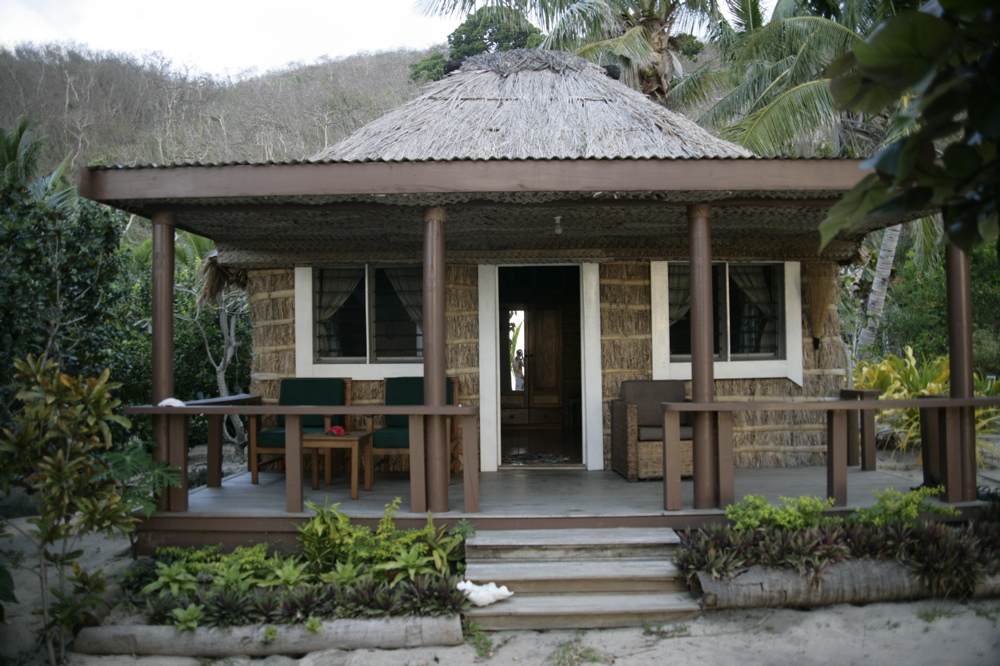
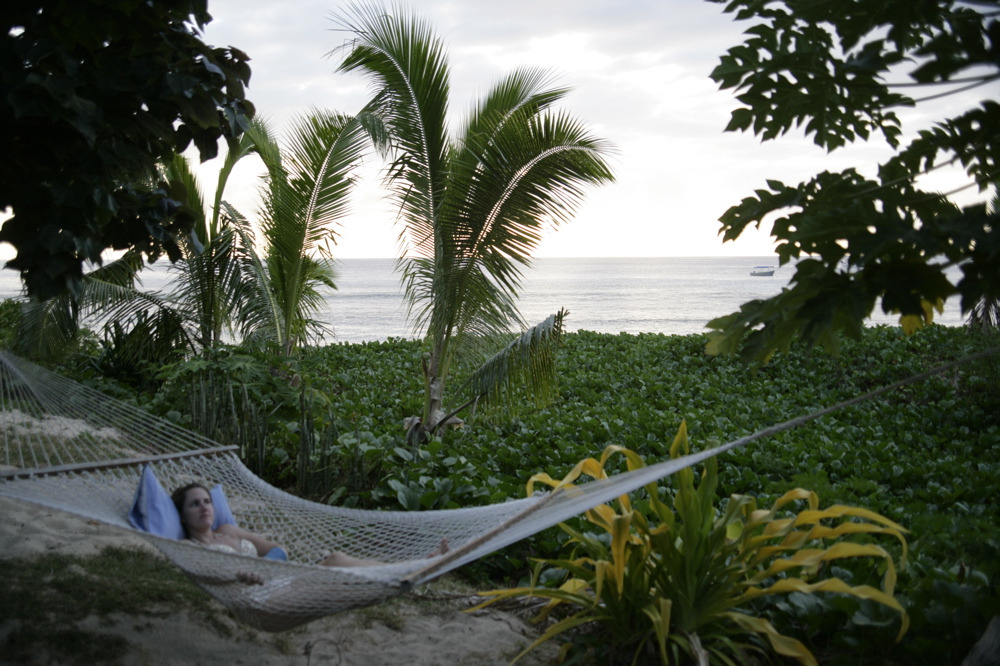
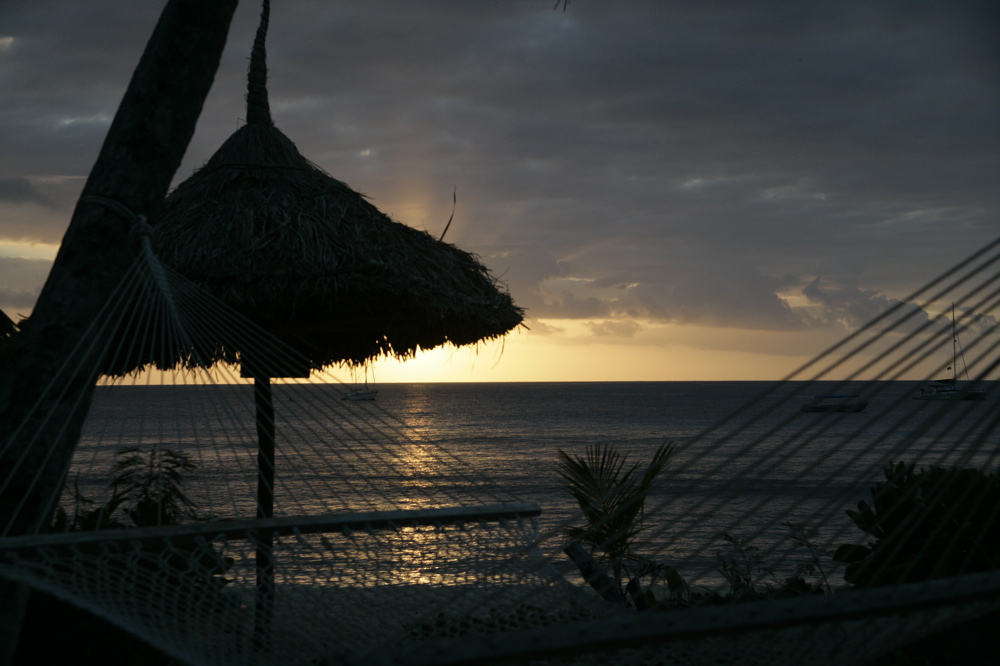
    Checked in, we relaxed at our private bure, (no dorms for us, I already did college) for a while before a welcome ceremony for anyone who arrived today.  The bure was ocean-side and we watched the sun set over the Pacific Ocean from the hammock that hung not ten feet away from our little porch.  The welcome ceremony involved kava, a drink I had begun to enjoy.  After the welcome ceremony was over I stuck around.  Seated around the kava bowl, I talked with the Fijians who had run the kava ceremony and who were now idly playing a small guitar, singing, drinking kava or passing it to others.  After a question one of them couldn’t field, he turned to another man, who turned out to be the resort manager.  He asked if I arrived today and after I replied yes and motioned to Syzygy anchored a quarter a mile away, he intoned, “Ah, you are Jon.  From the yacht.” As he spoke, he nodded knowingly and the corners of his lips turned up in a smile.  This may have been from the kava.

    That evening I approached the bar with two bottles of wine for the bar to hold on to, I had brought them from Syzygy and you were not allowed to keep any food and drink in your rooms.  (the single small downside of Octopus is it seems a few mice scurry about the resort).  The bartender said he would certainly hold onto them for me and asked where I had gotten them.  I said I had brought them from my sailboat when we arrived today.  “Ah! You are Jon!  From the yacht!”  “Yes,” I smiled, “I am Jon from the Yacht.”  “Of course we can hold this for you!” he said smiling.  They do this for everyone by the way.  Allison and I would saddle up to the bar many times over the next three days drinking a variety of concoctions.  Their pina colada was good; their mojito (called a wayan mosquito) just didn’t stand up to ones I make at parties (and written about in magazines, no lie).  It was a espresso-ice cream-frangelico combination though that we went back for again and again and again.  Delicious.

    The waitress at our lunch the next day… same thing, “Ah, you are Jon.  From the yacht.”  Replete with little giggle.  When I asked another staff person at the front desk about a special lobster dinner I had booked when making our reservation, she replied, “Lobster dinner? You must be Jon! From the yacht.  Sabrina, this is Jon from the yacht, who gets the lobster dinner.  Can you help him schedule it?” And then all 4 women in the office I swear tried to hide a little giggle.  At the lobster dinner, our server came up to our table and exclaimed, “Bula! You are Jon.  Yes? From the yacht?”  I had finally caught on to the pattern.  Allison noted it the first time I believe.

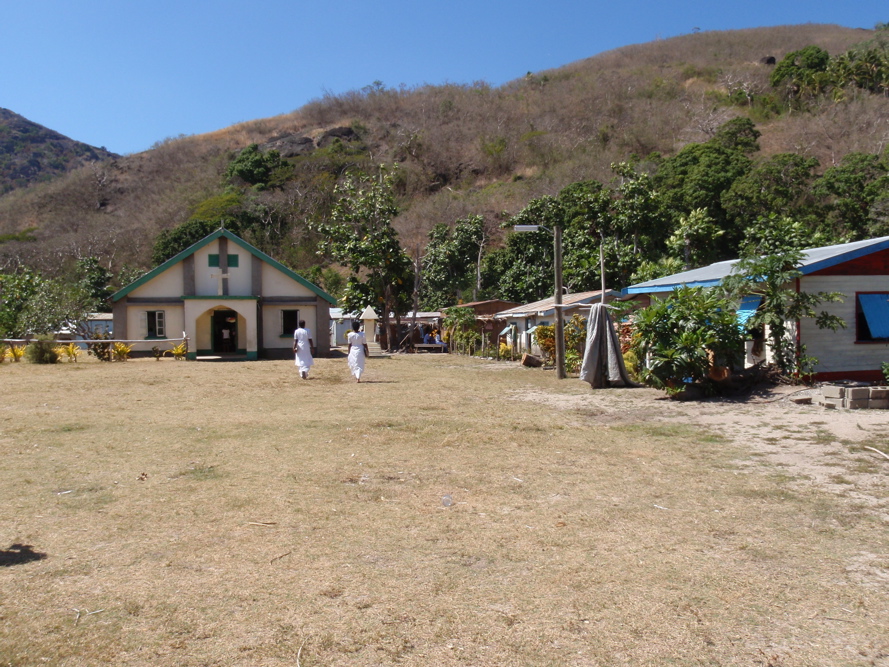
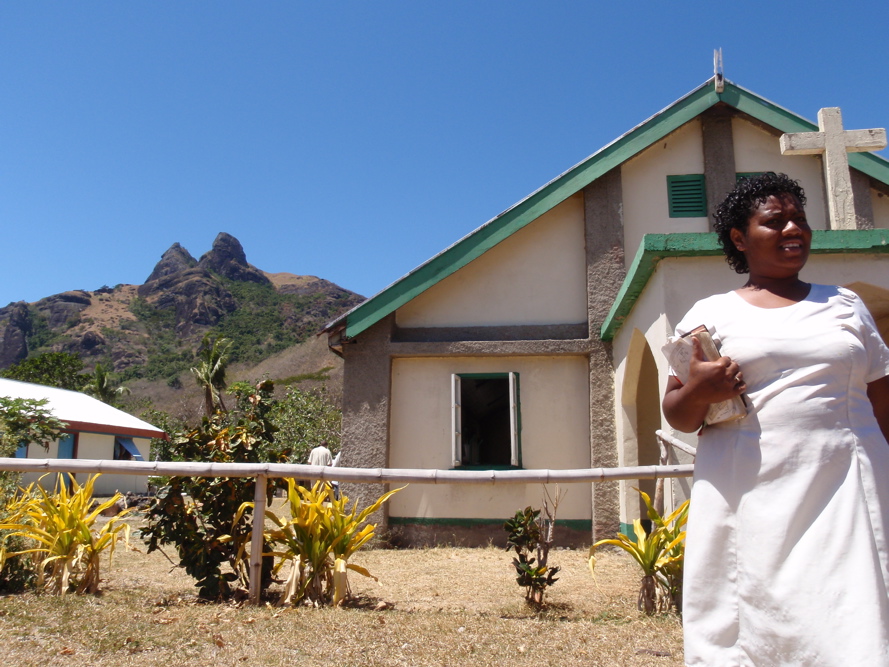
    Octopus is a laid back resort, there are a variety of activities to choose from, but the staff is supportive of being fabulously lazy.  Pool, dive shop, great snorkeling right off the beach, inexpensive, good food (lunches are best, and the lobster dinner is totally worth paying for)  traditional village visits.  On one of those village visits, Allison and I took the opportunity to go to a church service as Fijian village culture is renowned for church services with beautiful singing.  The Methodist service was quite impressive, if a touch awkward (for me) when many of the tourists (with the permission of our local guide) were taking pictures of the service.

    Octopus Resorts is an amazing place to stay.  If you visit Fiji, I highly recommend staying there.

  • How Embarrassing

    (this post refers to events that happened on September 14th)

    We ran aground.  It wasn’t our fault.   We were within the channel markers, so perhaps Port Denarau was to blame for faulty markers.  We were giving a little space to a high speed catamaran that impatiently steamed by us, so perhaps South Seas Sailing is to blame.  Visibility into the water was zero feet, so perhaps god was to blame.

    Anyway you slice it, we ran aground.  Thankfully, it was a slow, easy, decrease in speed to zero, dirt and mud gently easing us to a stop.  Hard coral or rock would have been more jarring and unforgiving to our boat.

    As the high speed catamaran passed, the crew were motioning to come closer to them, a motion which is not at all clear as to its intent when viewed from fifty yards away.  We had turned slightly to port to cede more room to them, their large boat and their large wake, but when I realized what they were motioning for, I quickly tried to turn to starboard and sped up a touch.  Neither helped, and we gently came to a rest.

    Matt sprung into action, quickly getting out 200 feet of line, jumping into the dinghy which we happened to be pulling behind us, and clipping out orders for Karen and I to follow.  Get the anchor off it’s mount.  Tie the line to the anchor.  Move the line to the bow roller.  Tie on another line.  And with that off he zoomed with the anchor into the middle of the channel where he dropped the anchor.  Back at the boat, with Karen at the helm, it fell to me to pull us through the mud towards the anchor.  Pulling us primarily forward would allow us to use the engine to help propel us forward, assuming the mud wasn’t all the way up to the prop.  When I had pulled as much as I possibly could, we then wrapped the line around the anchor windlass and with Karen tailing, I cranked away, pushing and pulling the lever on the anchor windlass with all my might trying to pull us closer to the anchor Matt had dropped, and hopefully not simply pulling the anchor closer to us.

    We were inching closer when we caught a break.  A mid-size troller was exiting from the marina through the channel.  We tried hailing them to warn them of our anchor in the middle of the channel but they didn’t respond.  They did however, increase speed which through up a larger wake.  The larger wake allowed our boat to rise and break free of the mud.  As we rose, I desperately cranked the line as fast as I could go to get us over deeper water.  And then we were free.

    It was over in less than ten minutes, and Matt was particularly proud of our fast reaction that led to getting freed.  But we got stuck in the mud.  How embarrassing.

  • Waterproof Camera, May You Rest in Peace

    (this post refers to events that happened on September 6th)

    I have a litany of electronics that I have ruined because they were not waterproof and I took them near water.  Two video cameras, one camera.  Two phones.  A jump drive.  So I was overjoyed to have purchased a waterproof camera to use on this trip, where I’m surrounded by water.

    The Olympus Stylus Epic 1030SW.  Waterproof to 10 feet.  SHOCKPROOF to 6 feet.  It was awesome!  No worries about getting it wet.  Spray from sailing was no concern.  Wet trips in the dinghy no concern.  Swimming on the surface was no concern.

    I failed however, to properly be concerned about diving down to beyond ten feet to take pictures.

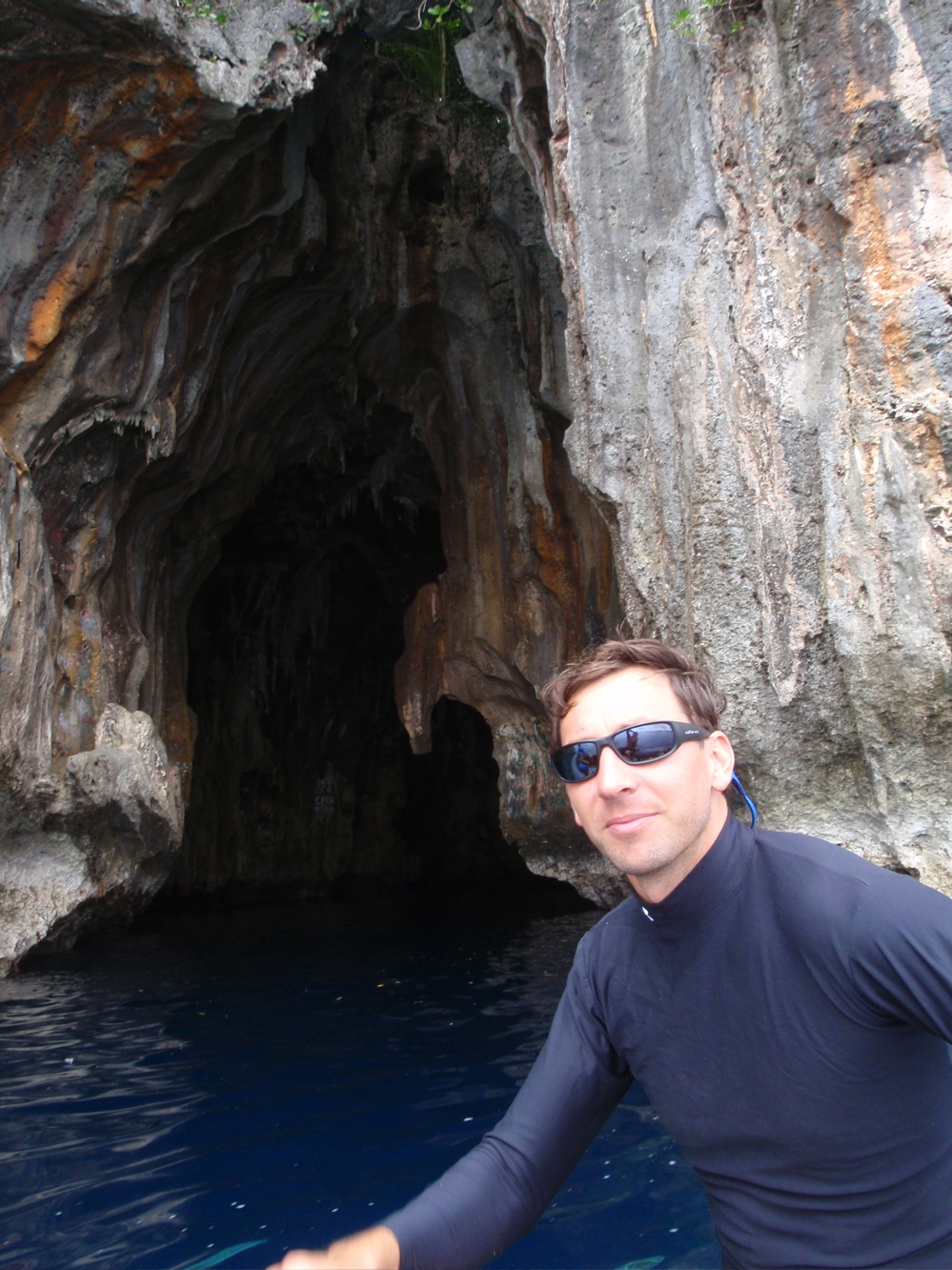
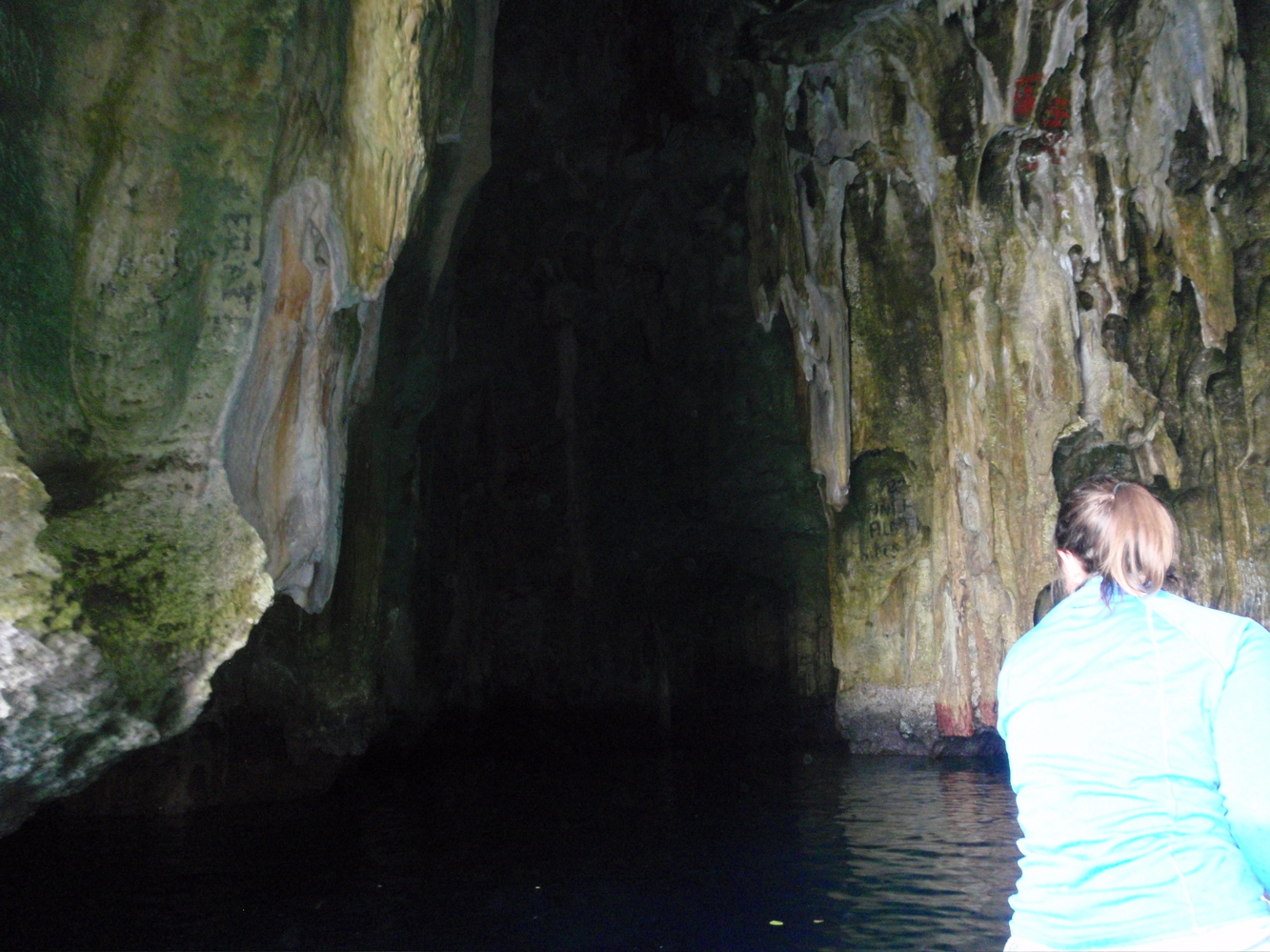
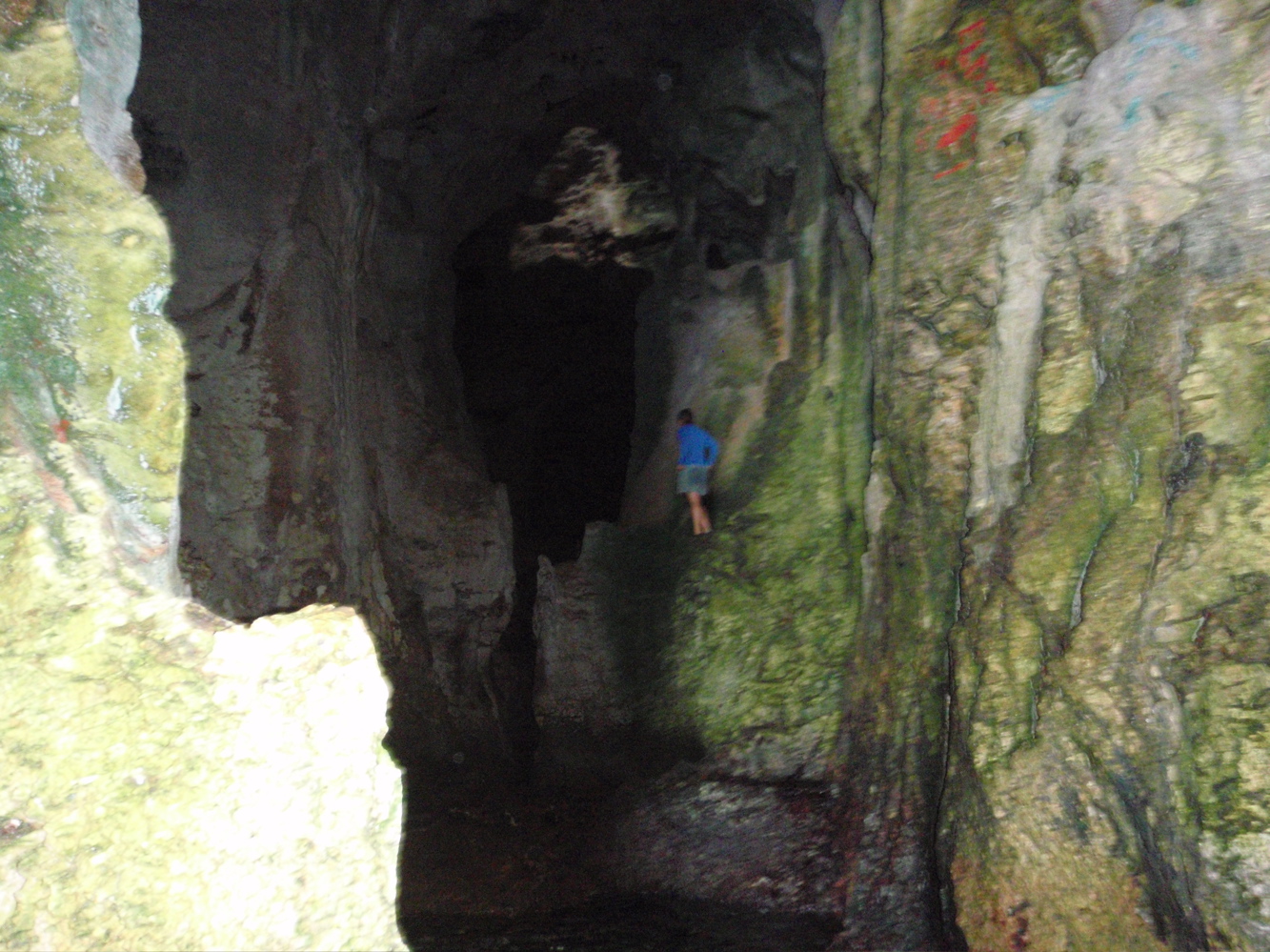
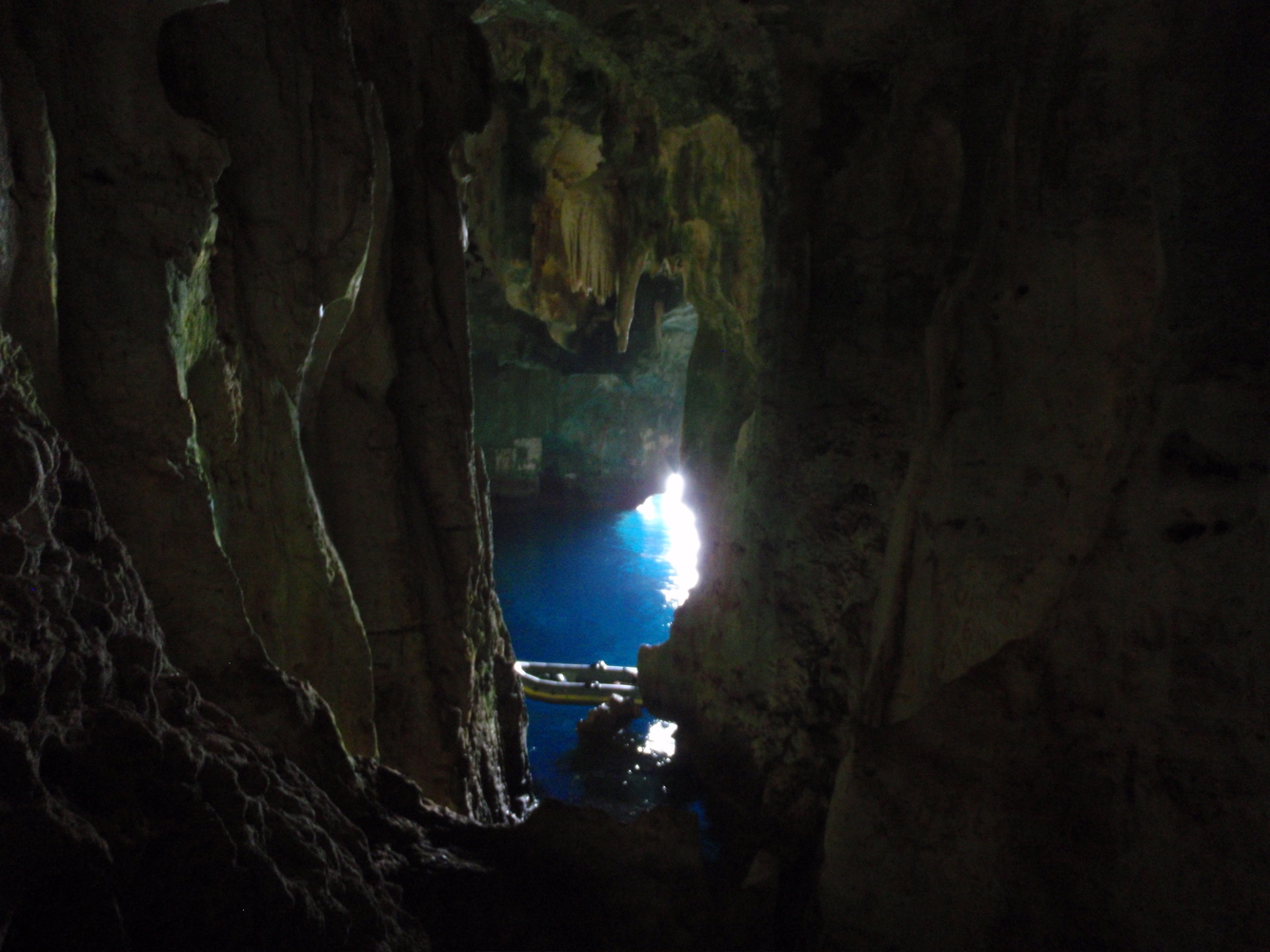
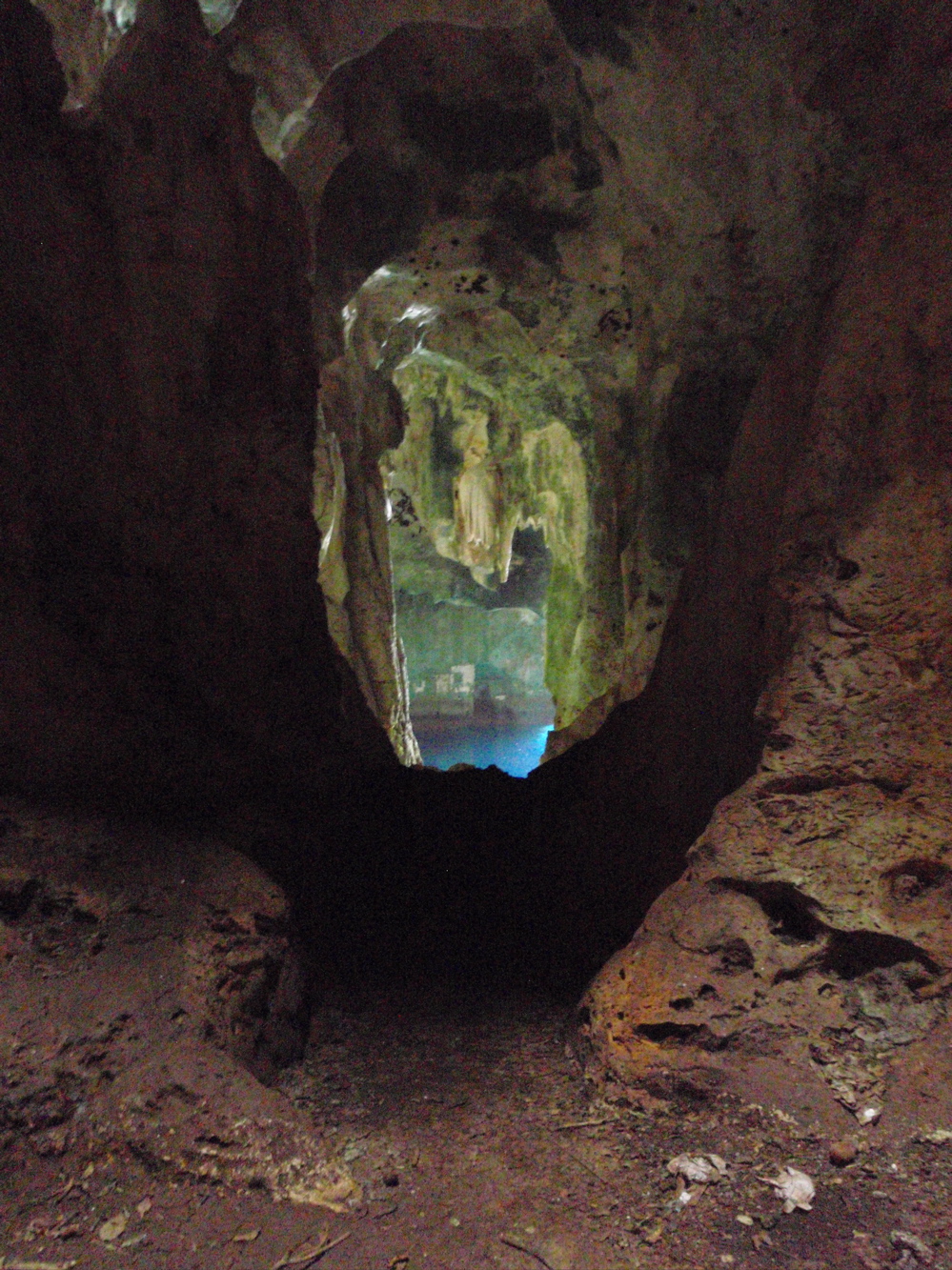
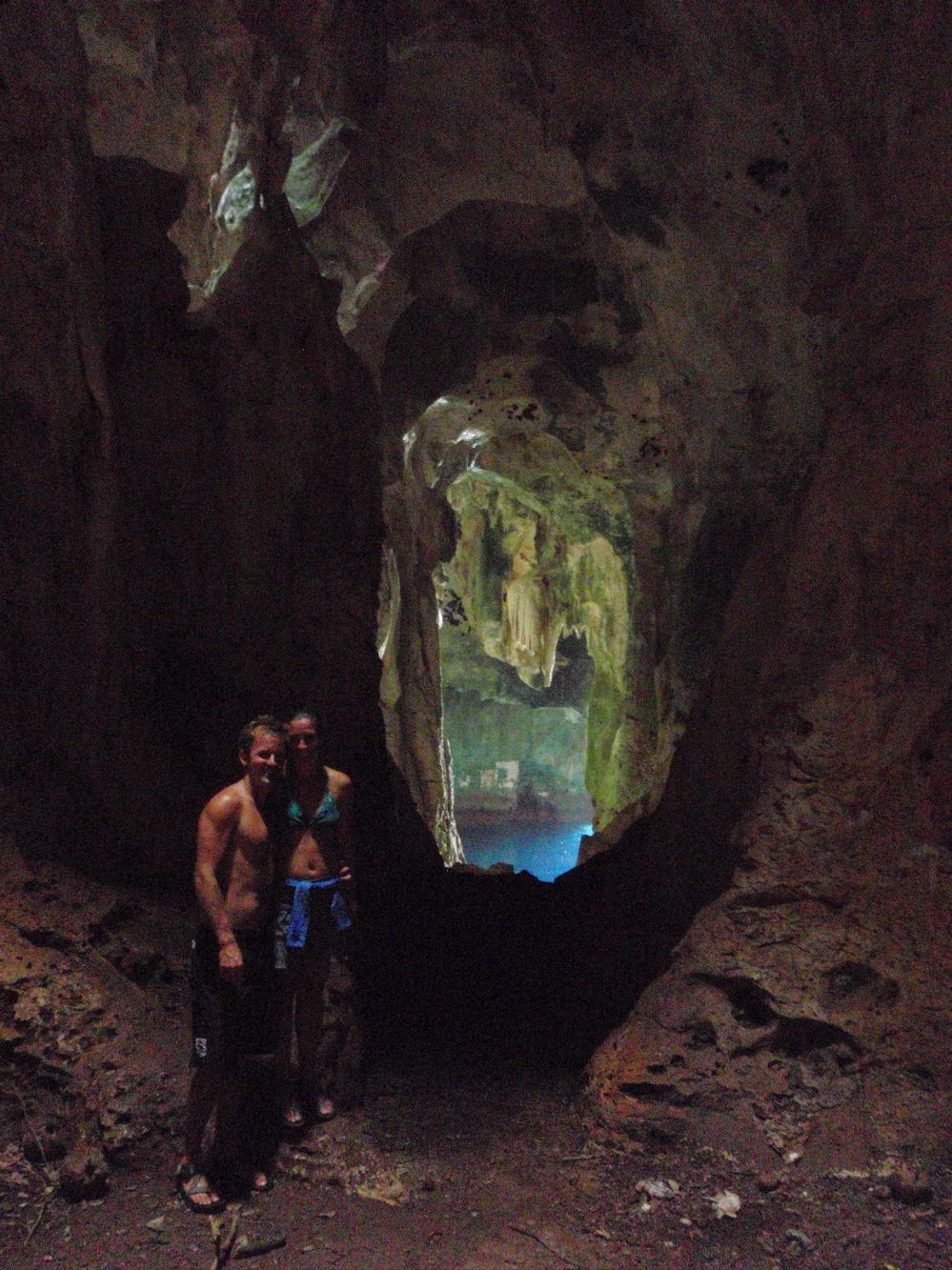
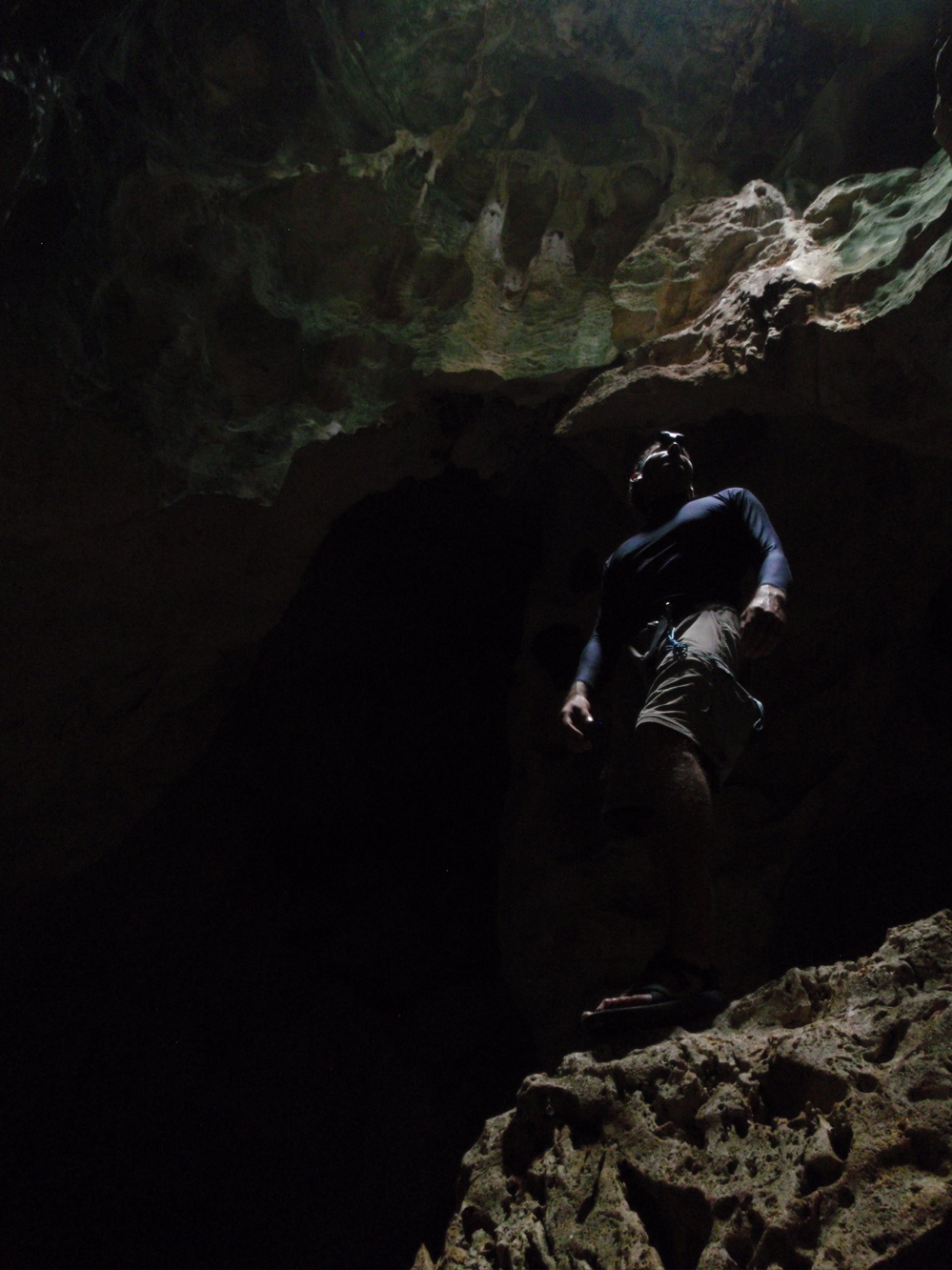
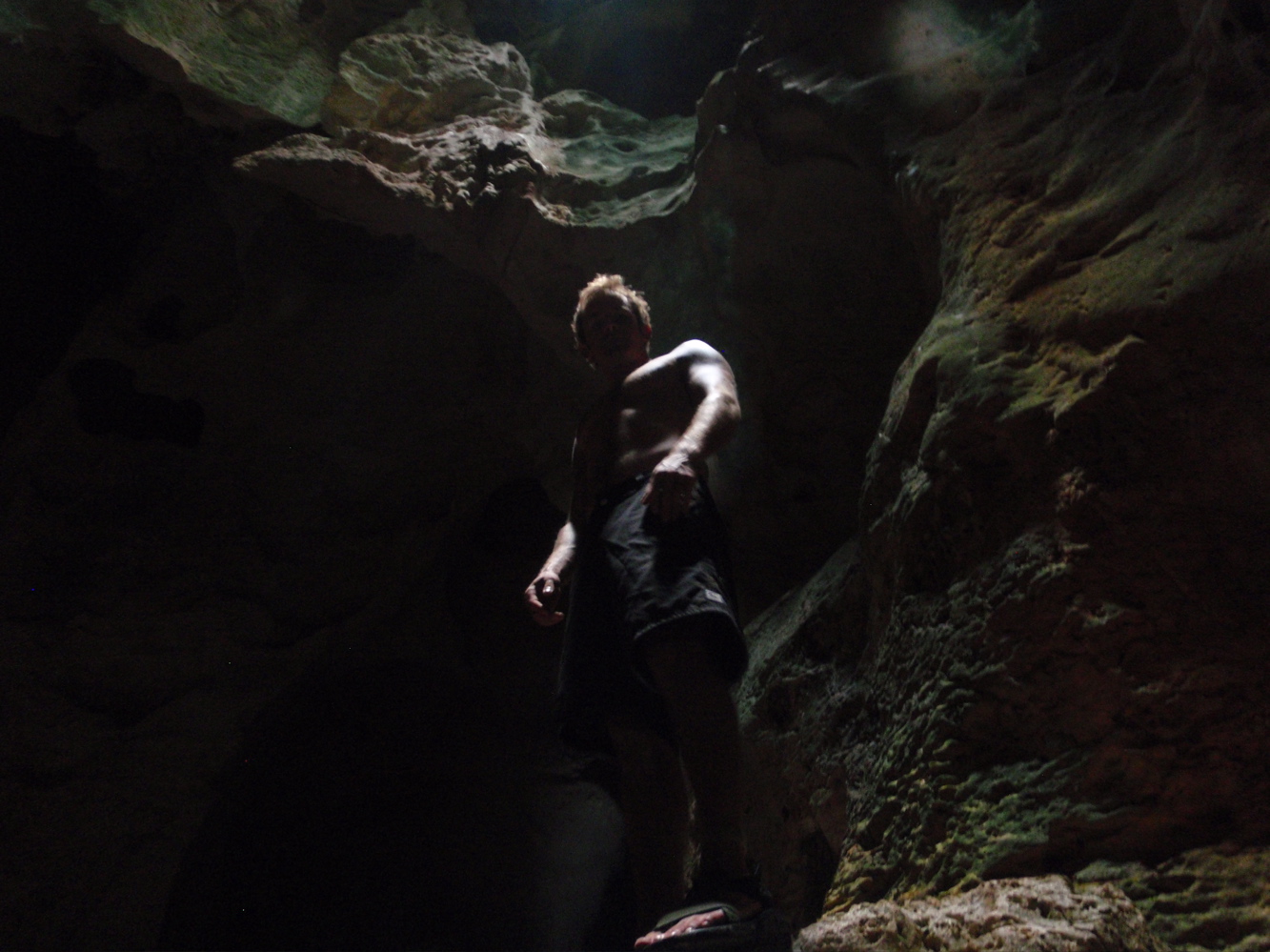
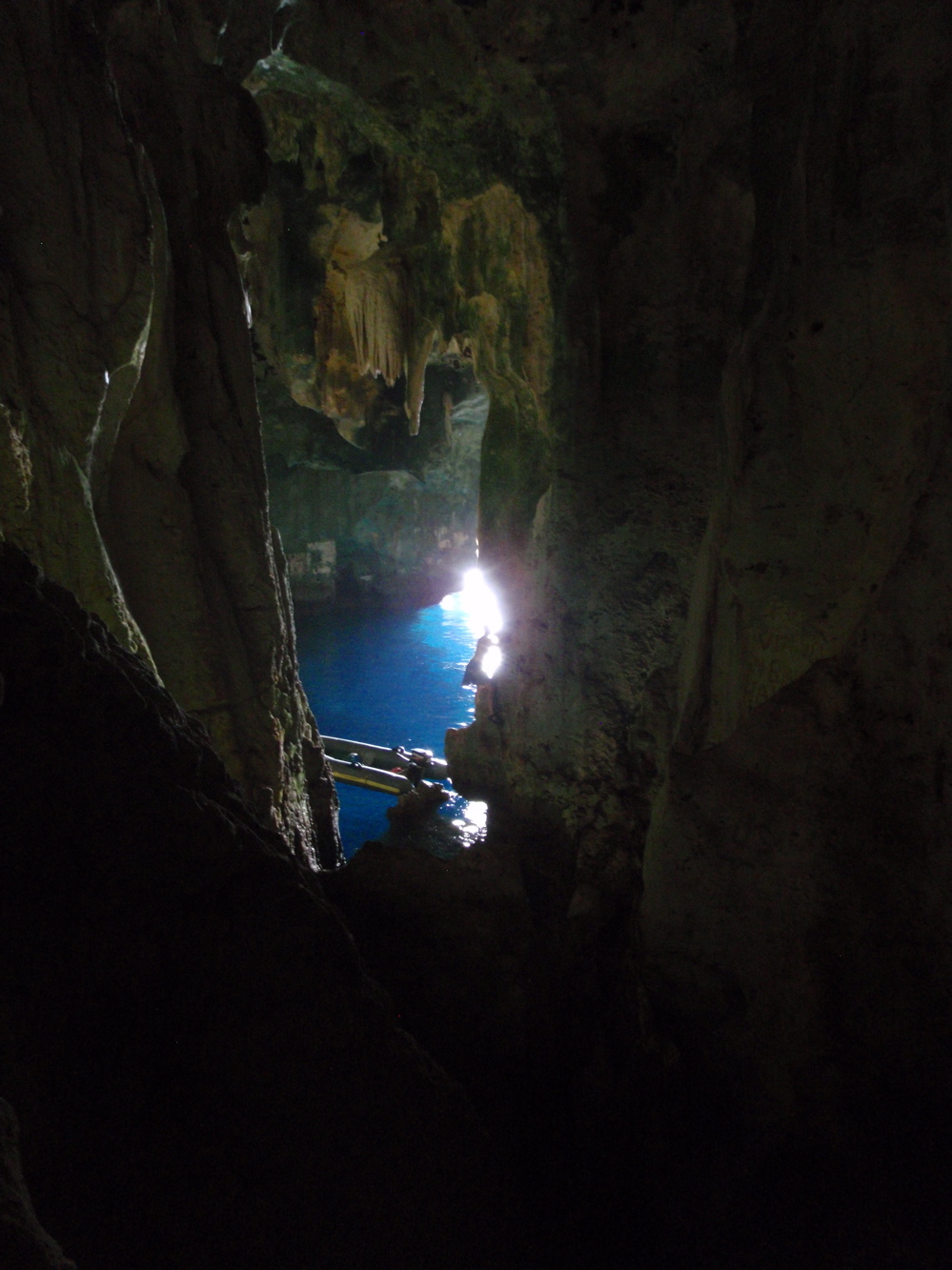
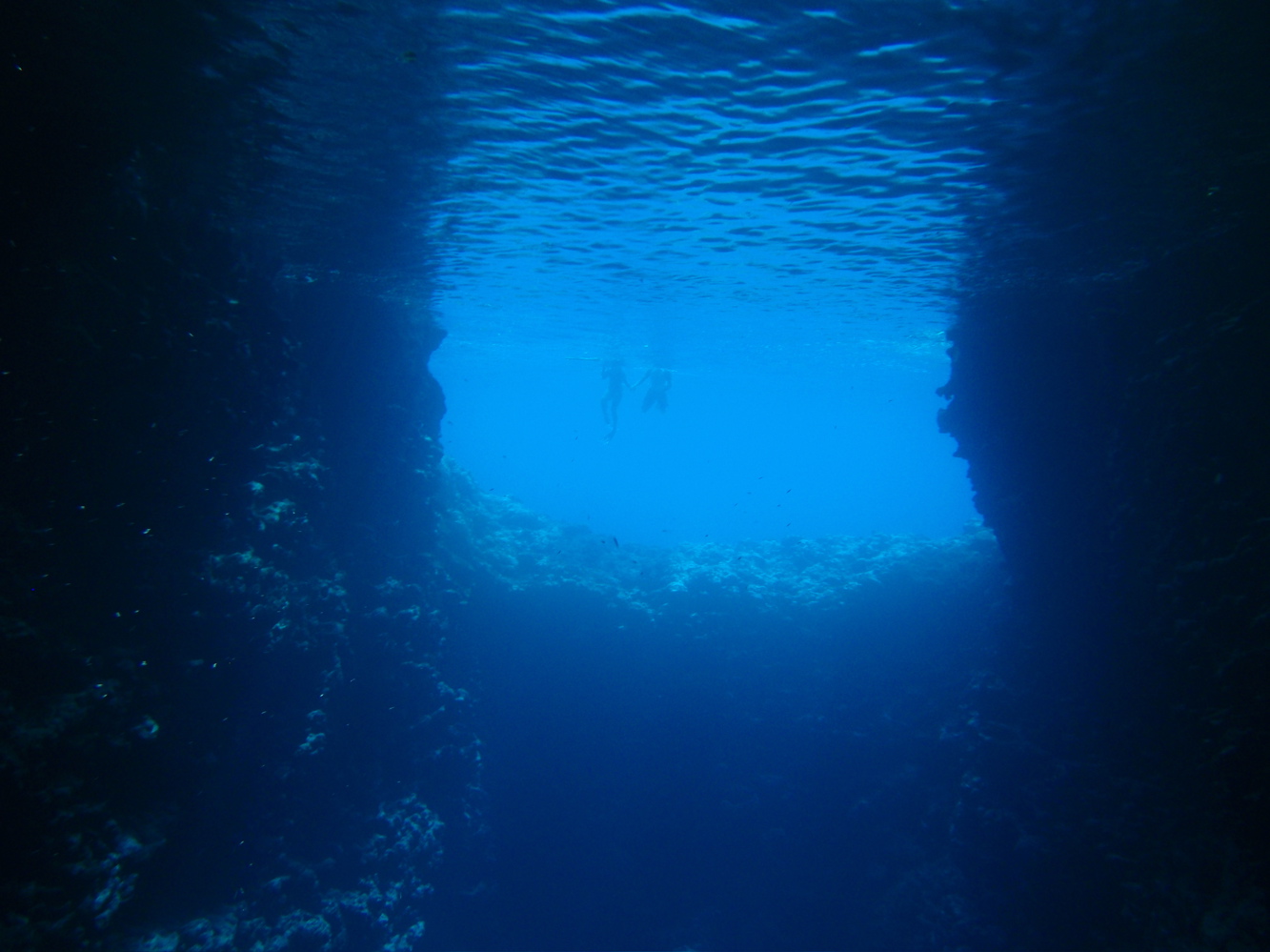
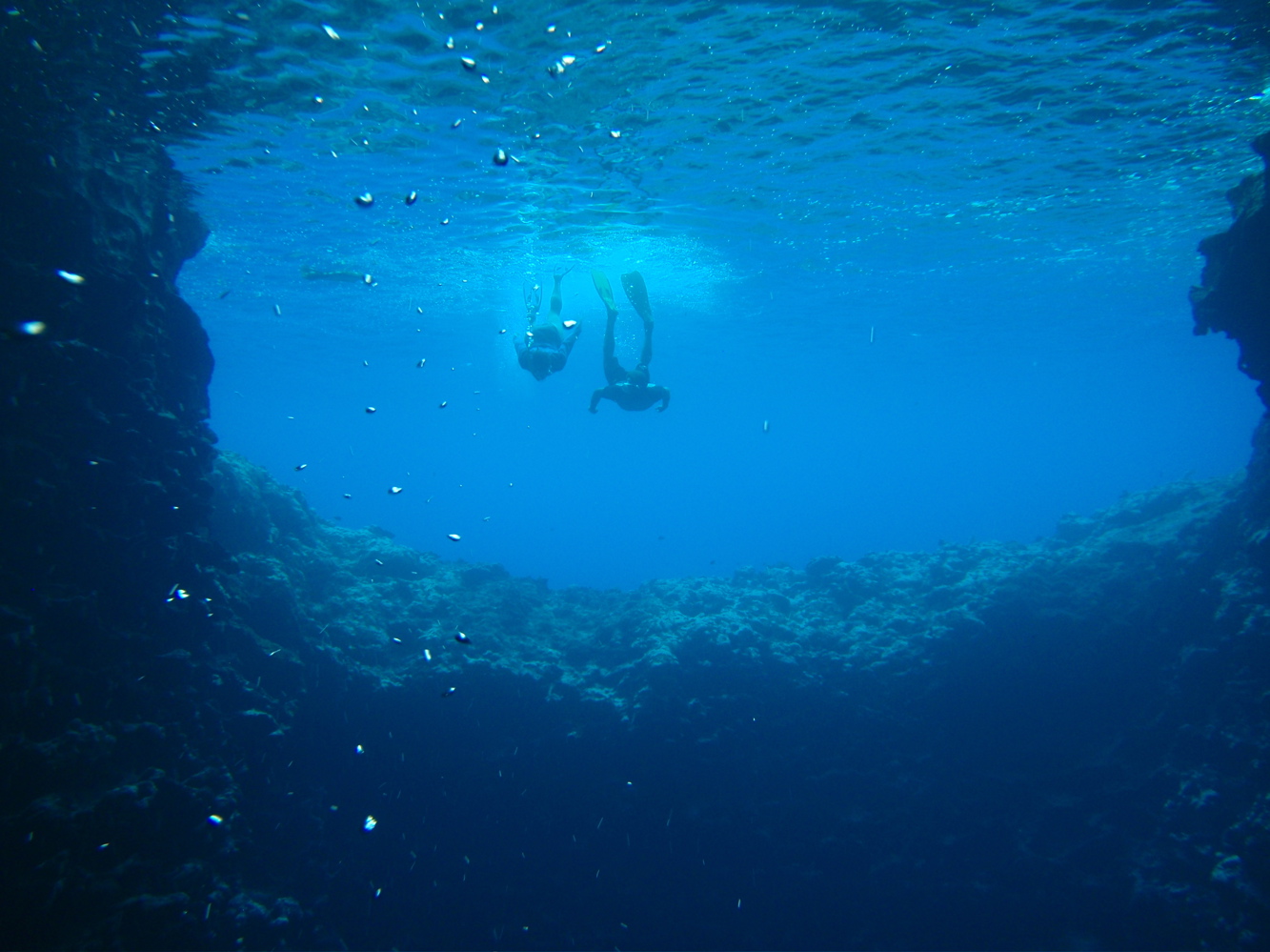
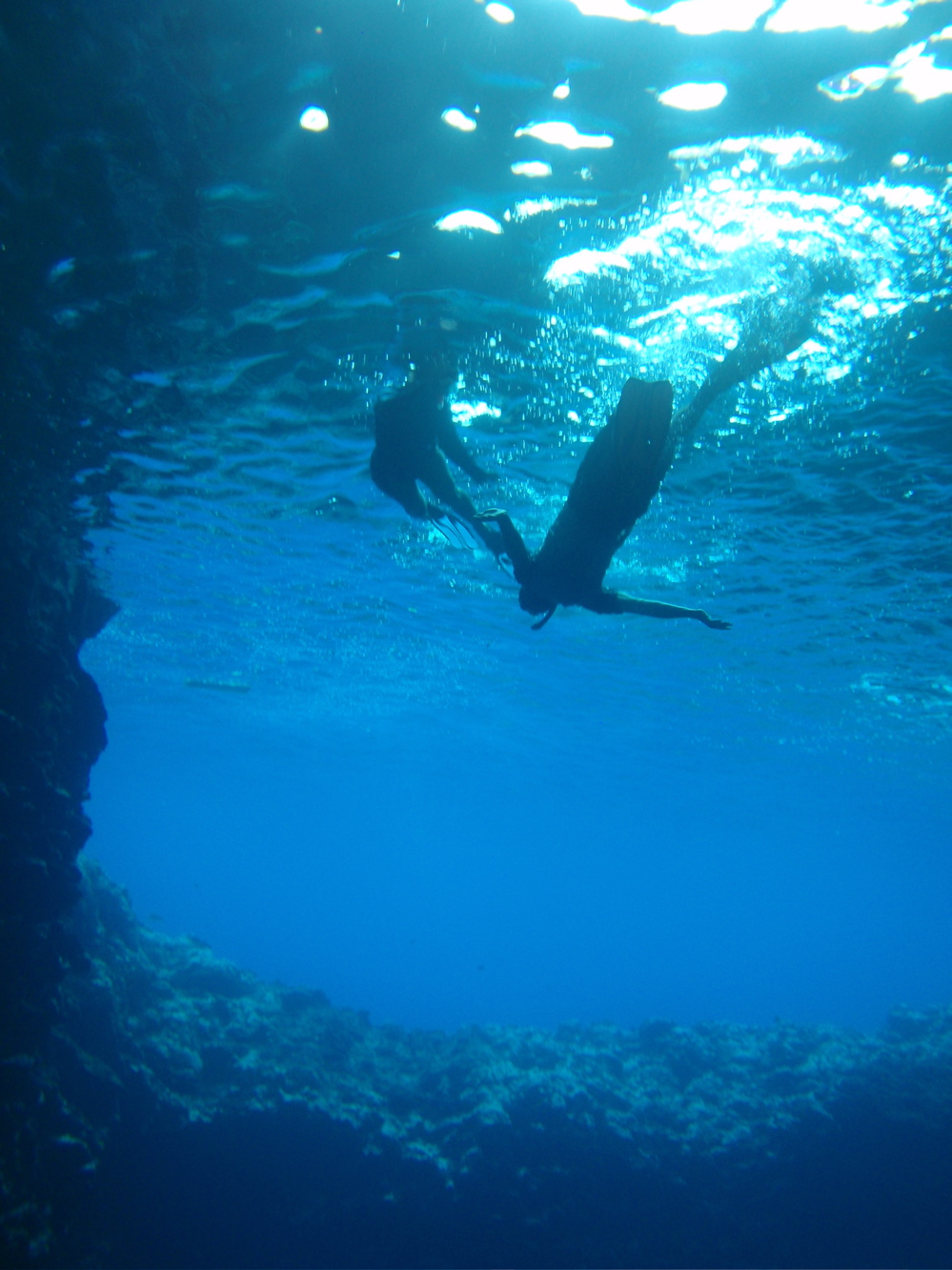
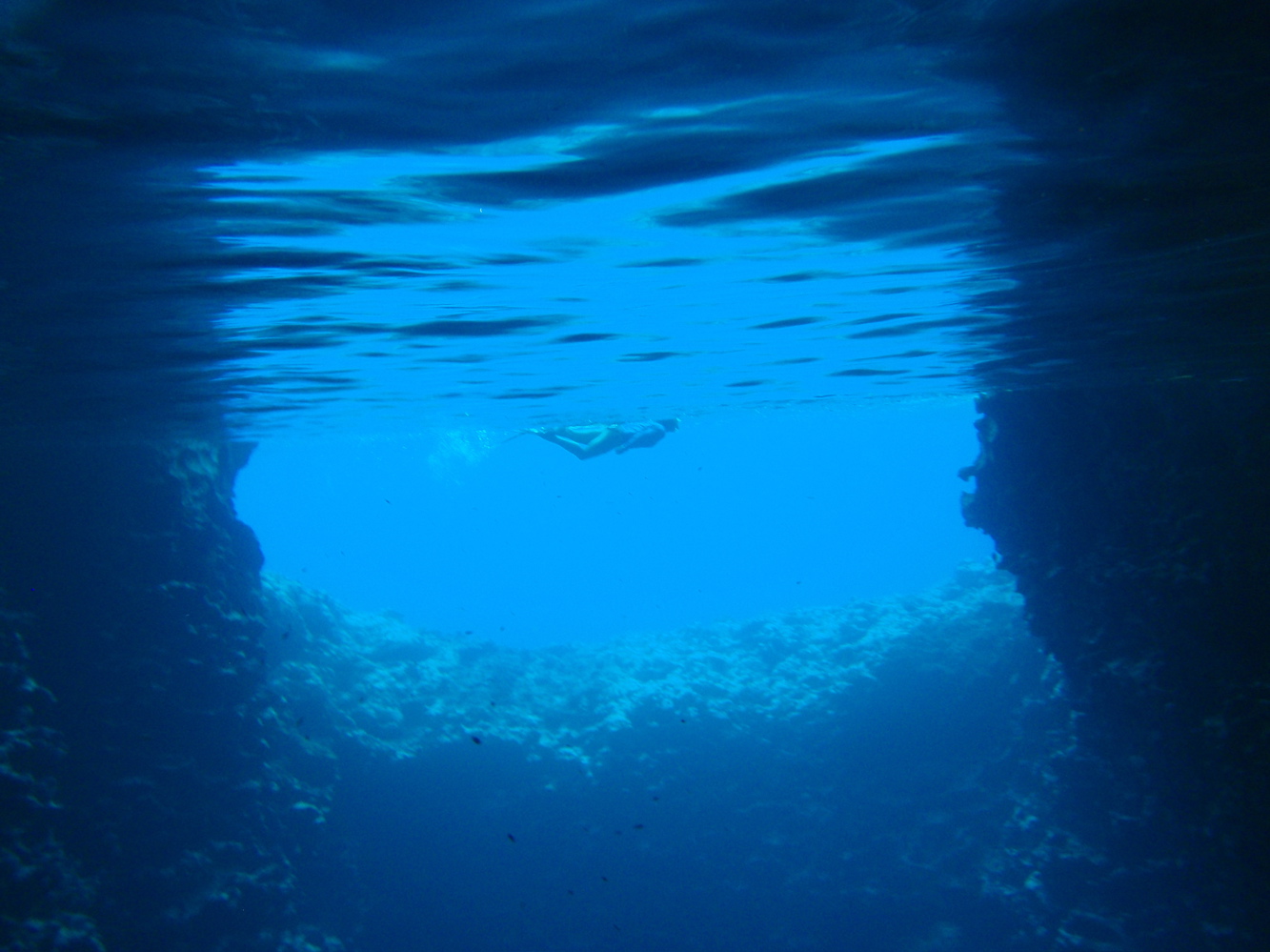
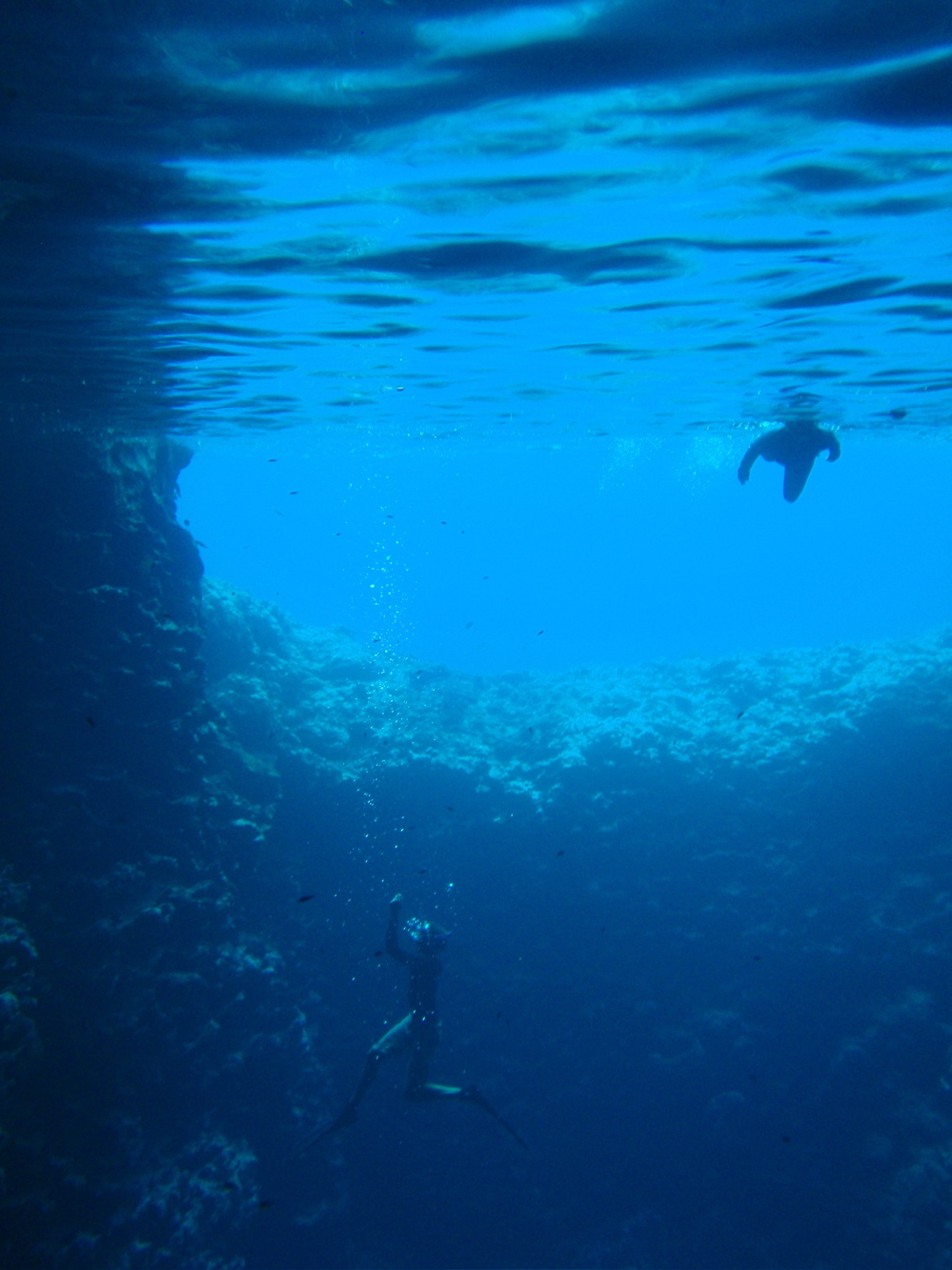
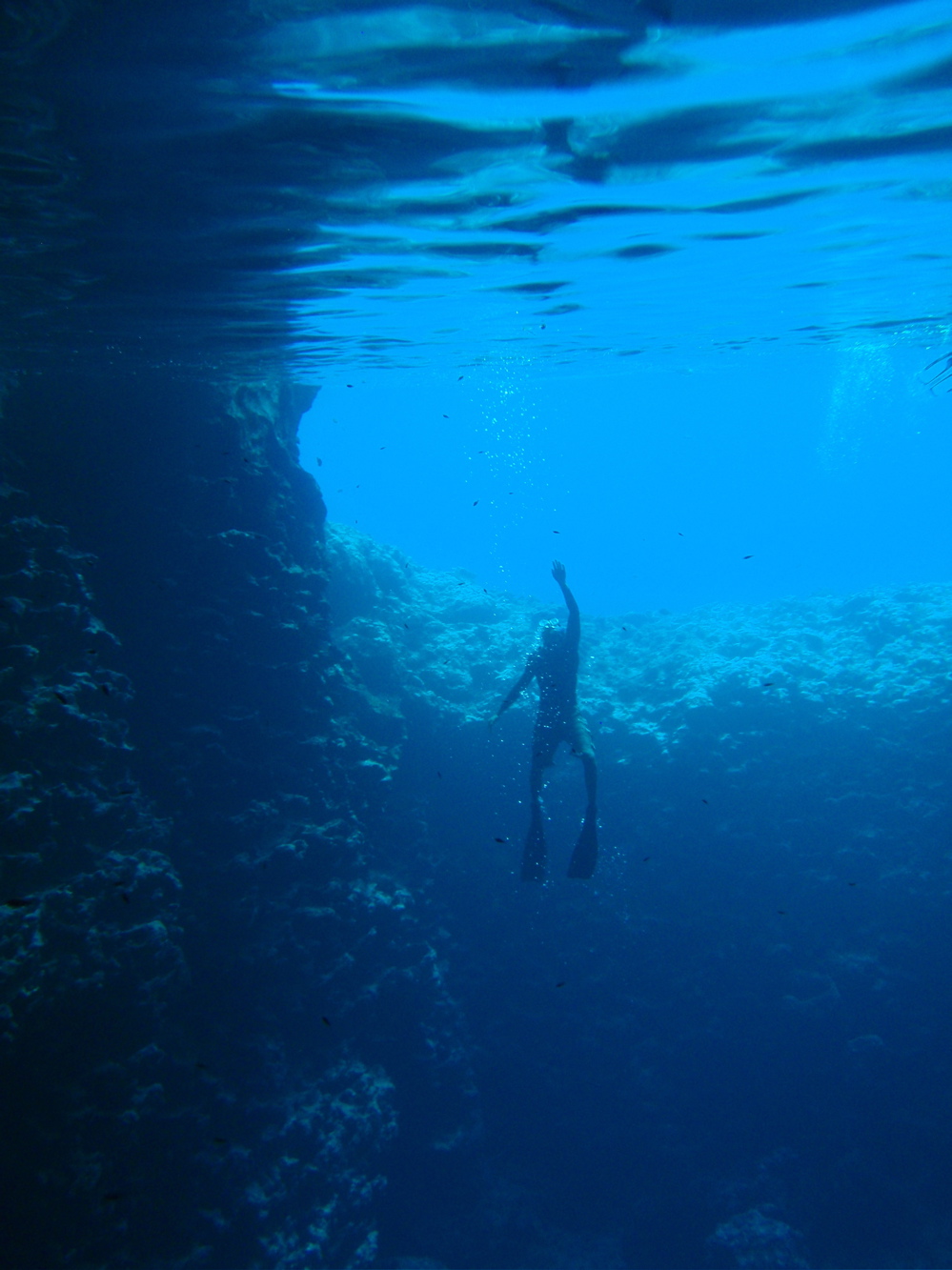
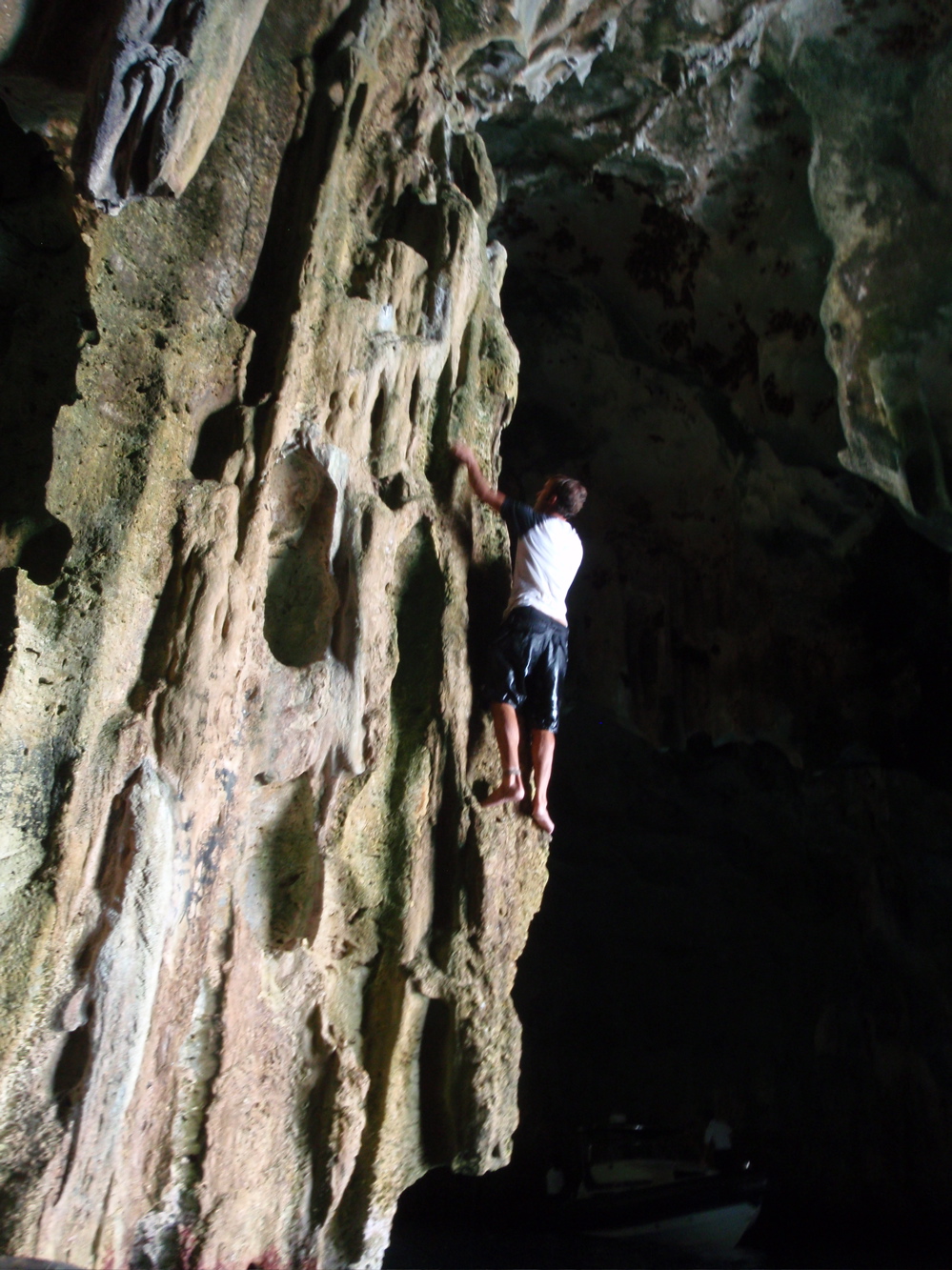
    And so the last pictures my camera managed to take were of Swallows Cave.  Which was spectacular.

    And almost worth the price a new camera will cost.  Allison brought one out that was quite enticing… The Olympus u-tough 8000, only available outside America.   And Olympus has another, its newest version, the Olympus Stylus tough-8020!  Shizamm!

    Anyway, here are pictures from Swallows Cave.

  • Misadventures with Slurpy Part 3

    Part 3

    (refers to events on July 11th)

    “Syzygy, Syzygy, this the Gendarmarie.”  cracked the VHF in a heavy and thick French accent.  So thick, it was almost impossible to tell they were calling us.  My heart quickened as I glanced at Karen while answering.

    “Gendarmarie.  this is Syzygy.  Want to go up one?”  I said, asking if they wanted to go to another channel.  They didn’t understand.

    There was only one reason I thought they could be calling however.  They must have our dinghy!

    “Syzygy.  We haz yur zodiac.”  Sweet!!!!!

    The gendarmarie wanted us to report to them immediately.  Apparently, we were supposed to check in with them four days ago when we arrived in Rangiroa.  Technically we were outlaws.  Outlaws in the land of Rangiroa.  But they were pretty laid back about it.  They were, however, now effectively holding our dinghy hostage until we officially checked in.

    We went ashore at 1 pm, the gendarmarie meeting us at the docks.  We were 30 minutes earlier than our scheduled arrival time.  They were a little too in a hurry for me.  We piled into the back of the car, and I couldn’t help but think we must look like fugitives to those whom we passed on the drive.  But they were pleasant enough and once we had officially checked in, the police chief himself took us to the restaurant/pension where our dinghy was.

    And there it was!  Looking perfectly fine.  The engine was still there, though the fuel tank had mysteriously gone missing.  The oars were still there, as was snorkeling gear.  But no fuel tank.  Odd we thought, but if that’s the price, we easily acquiesce to that finder’s cost.

    After a round of drinks, we began to contemplate our return.   There was the matter, however, of how to get the dingy back to our boat.  With no fuel, we couldn’t run the engine, and well, our outboard is a piece of shit anyway and probably couldn’t handle that.  Matt however, thought we could easily row back on our own.  Karen came down on the side of deflating the dinghy and getting a taxi.  I sided with Matt encouraged by appeal that it would be a fun team building exercise.  He seemed jazzed about the idea and so I was for it simply because he was jazzed about something.  So we pushed the dinghy into the water and began to row.

    We rowed and rowed and rowed.  It quickly became apparent this was not going to be an exercise in team-building, but an exercise in futility.  We were taking on more water than we used to; there must be a leak somewhere.  There was no seat through the middle so the rower couldn’t sit properly.  We have miserable oarlocks and soft bottomed dinghy, both of which reduce the ability to row effectively.  We were fighting the current.  We were going against the prevailing wind.  This was a terrible idea.

    After thirty minutes, we had made maybe 100 yards of progress.  I think that is generous. Karen was the first to get out of the dinghy and try to swim along and push the dinghy.  This didn’t work so well.  I took a turn at rowing.  It was miserable.  So then I hopped out, tied the painter line around me and began swimming in front of the boat pulling it along.  With Matt rowing and Karen bailing, this was our best method and we managed to increase our speed to about 300 yards per 30 minutes.  At this rate, it would take us over eight hours to get back to our boat.  Clearly, we were bumfuzzling idiots.  Well, maybe just Matt and me who originally thought this would be fun.  Karen, smartly, had never thought this was a good idea.

    Luckily for us, another couple was motoring nearby in their dinghy looking for someplace to eat.  They took pity on us, and told us they would tow us back to our boat.  THANK YOU!

    It still took us nearly an hour to get back.  Matt insisted we row to help us along.  I’m not sure how much it helped, though it made me feel more in control and helpful.  It also made me feel ridiculous.

    Back at our boat, we begged them to let us thank them with some gift and ended up promising to deliver some movies and books to them in thanks sometime in the next couple of days.  We plopped down in various places on our boat, exhausted both mentally and physically from the ordeal.  The dinghy had yet again gotten the better of us.  So despite that we got the dinghy back to our boat, and could be happy at not having to buy a new dinghy, (the P.O.S. engine might be another thing) it still didn’t feel much like a victory.

    Misadventures part 3: monetary success.  emotional failure.

  • Misadventures with Slurpy Part 1

    (refers to events on July 9th)

    The dinghy has provided a constant source of amusement for us.  Matt and Karen probably would chose a different word from ‘amusement’.  Like ‘hatred’.  This has only increased since I arrived.

    Since we have an inflatable dinghy, it does not deal with rough water well.  A hard bottom dinghy would do better. In rougher water with larger waves, larger being over 6 inches,  a blast of water will spray up over the boat.  The spray only increases with speed and wave height.  Luckily our dinghy, handicapped as it is by a poor engine, never goes very fast.

    I’ve noticed up until this point that to combat this spray, Matt or Karen will stand at the bow and pull up on a line connected to the bow.  The idea is that you pull the bow up so that a: waves more easily pass underneath the dinghy and b: even if they don’t a higher bow will block some of the waves.

    Now, I generally thought this dubious at best.  The bow, in my opinion, seems to get pulled up about one inch.  Better to just grin and enjoy the spray, a reminder that we are not cooped up in an office, working our 40 hour weeks, dressed in slacks and a button down, and paying lots of bills.  However, on one fine day in Rangiroa, I decided to give my hand at trying this, if for no other reason than everyone else on our boat was doing it, so I wanted to be cool too.

    As we pulled away from the dock, I grabbed the line and stood up.  Another boat passes by.  I note the wake (the waves eminating from behind the boat) they create, and think: not a problem.  Their wake reaches us and rocks us side to side.  I then think: this is a problem.  I stumble from side to side, and as there is not much room side to side on our dinghy, I proceed to be clipped in the calf by the sides of the dinghy and tumble backwards overboard.

    Man Overboard!

    I am perfectly O.K. save a bruised ego, and once Matt has ascertained this he immediately starts laughing.  I am not laughing.  Not yet.  I am frantically trying to get things out of my pockets that I don’t want to get wet.  Money.  My journal with months of entries I don’t want ruined.  Two long letters to Allison.  If those get wet, oh I would be so upset.  Hence my franticness.  However, the journal and letters are in a waterproof bag that I had remembered to seal, and the money was in a ziplock.  After fishing those out of my pockets and realizing they were fine, I too laughed at myself, treading water and just laughing.  Two cheapo glasses I had bought so you could look directly at the sun during the solar eclipse are within reach and I grab at them.  The third has already started to float under.  I pull myself back into the dinghy, sopping wet and laughing.

    I take inventory and as Matt is starting to pull away, I realize I’m missing something.  The handheld VHF radio.  The extremely-nice-christmas-present-from-Matt’s-parents handheld VHF.  Matt is displeased.  Both of us without even telling the other simultaneously start trying to take a bearing on land.  If you line up two points, say a pylon and a tree, then you return to this spot you can again line up the pylon and tree and know that you have returned to somewhere along that line.  Do that with another 2 objects, preferably two which form a line perpendicular to the first two, and you have two lines which can only intersect in once point.  Theoretically you can return to the same spot.  As long as you don’t use a mooring ball which might move with a shift in wind and current.  And you don’t forget what you used.  Both of which happened to me.

    After going to the boat to pick up snorkeling gear, we return to where we think I might have fallen in.  I flop out of the dinghy, and swim around, frequently diving down to the bottom, it’s only about 15 feet, looking around.  Matt moves around in the dinghy to scan a larger area, dunking his head in the water periodically.  Ten minutes of searching.  Twenty.  Thirty.  It seems inconceivable to me that we can’t find anything.  I know other things fell out of my pockets.

    And then I see the pair of glasses that had had been out of reach and sank to the bottom.  Here’s the right spot!!  Ten more minutes of searching.  Search time no longer feels fruitless.  The VHF must be here.  I find a coin, 100 francs, about 1 US dollar, bright and shiny.  This must have also fallen out of my pocket.  And there is a AA battery I bought for the GPS.  it must be here.

    And finally there it was.  A swell of relief first then a swell of apprehension.  Would it work?  I pop up out of the water.  The smart thing would have been to take it back to the boat, rinse it with fresh water, let it dry out thoroughly, open it up and continue to ensure proper drying.  I didn’t do that.  It was still on, and so as soon as I popped up on the service and waved to Matt and pushed the boat to call Karen back at our boat.  “Syzygy, Syzygy, this is Jon.”  Karen replied.  It worked.  Thank you to Matt parents for buying such a nice VHF that it withstood being in 15 feet of water for over an hour!  Misadventure part 1: a success!

  • Life in 15 minute intervals

    (concerning events: July 8th)

    When on a passage, the people on board take turns being ‘on watch’.  While on watch, that person is called the helmsman.  They are in charge of sailing the boat, making sail changes if necessary, ensuring the proper course of the boat.  The helmsman can ask other people for help in doing a task.  Other people can take it upon themselves to tinker with sails, look at and adjust the course, etc. etc. if they are so inclined.  The captain (Matt), if he feels like it since he’s the captain gets to do whatever he damn well pleases and tell the helmsman to piss off if wants.  We, thankfully, have a benevolent captain (so far) who makes his requests much more politely.   In the end, particularly through the night, it is the helmsman’s job to make sure the boat doesn’t hit anything.

    My first overnight watch was not particularly exemplary.  I was determined to improve upon this in my next one.  Our passage from Apataki to Rangiroa would provide me with the first opportunity.  I volunteered to take the midnight to 6 am shift .

    Every 15 minutes the person on watch is supposed to at a minimum scan the horizon looking for anything we might run into.  15 minutes is the chosen interval aboard Syzygy as we believe it balances differing factors such as: how far you can see at night, how generally busy with other vessel traffic the area is, human comfort.  We have a wristwatch aboard Syzygy that has an alarm set to ring every 15 minutes.  I would wear it around the band of my headlamp so that it was always extremely close to my ear.  Just in case I was sleeping or simply had my eyes deeply closed.  I would even wear the watch during the day so that if I got busy doing something, when the alarm rang I would be reminded to, at a minimum, look around for other boats, land, check our course, etc.

    Through the night, I noticed my life quickly become wholly defined by that alarm.  I would wait for the alarm before I would do almost anything, so that I would be less likely to be in the middle of something when the alarm rang.  I would plan to do different jobs by the alarm.  “After two alarms I will _____________.”

    Here is my night watch, my life, as defined by those 15 minute intervals.

    11:45 pm – 1200 am
    Look for coffee maker.   Become frustrated at not being able to find it.  Attempt to light stove for coffee.  Continue frustrations at stove for not staying lit at a low flame, optimal for coffee making.  Not processing what Matt is saying to me about his and Karen’s watch because I feel like a zombie and nauseous.  I drink a large glass of juice because I know I need calories but can’t think of anything easy enough to make.  Stomach feels queasy from the rocking motion of the boat as it pitches and rolls 10 degrees to each side.

    12:00 am – 12:15 am
    Coffee finishes boiling.  up on deck listening to Matt.  During the first part of my watch I need to take down the whisker pole, and bring in the fishing lines.  At some point, we will need to heave to as we will have arrived at the entrance to the atoll but don’t want to go through the pass in the dark.  Stomach feels queasy; I think the rolling of the boat has increased to 15 degrees to each side, though I’m probably imagining it.   Eat granola bar for more calories and because a more full stomach usually helps me with seasickness.  Alarm sounds.

    12:15 am – 12: 30 am
    Look around the horizon.  Check course on computer.  Pour coffee into cup. stomach feels awful, it’s not looking good.  Boat is definitely, in my imagination, pitching 20 degrees to each side.  Alarm sounds.

    12:30 am – 12:45 am
    Look around the horizon.  Back down below to add milk and sugar to coffee.   I imagine 30 degree rolling pitches to each side, a roller coaster fun house of nasea.  Realize my stomach is done.  Stomach is rising. Need to get outside immediately.  Get halfway out the companionway, remember that I’m about to drape myself 1/2 off the boat and I’d better clip in. stomach in throat.   Fumble with the tether trying to get clipped in.  It takes ages. Stomach in mouth.  Finally can step on deck knowing I’m tethered.  Stomach in mouth, mouth forcibly closed to prevent a god awful mess in the cockpit.  Fall into the jack lines, stomach exiting.  Sit down on the boat, stick my head between the jack lines into a nice comfortable position and continue to throw up into a dark sea.  I have to time my events with the rolling of the boat so as not to coat the sides of the hull.  I’m not very good at this.  Alarm sounds.

    12:45 am
    I give the alarm the bird, heave one more time and then drag myself up to look around.  Nothing like taking a break from throwing up to look around for boat traffic.  Fuck me.  I then go back to the rail to hang out and watch water flow by the boat.  It’s quite a sight.  Mysteriously dark, the swell rising and falling.  I listen to all the unique sounds that happen.  Waves hitting up against the hull.  The rush of water as we accelerate down the face of the wave.  The ripples it makes as our boat cuts through at 6 knots.  Light glistens off the surface particularly from the moon.  Parts are eerily smooth, like an oil slick.  Others are little whirlpools, particularly as it eddies off the back of our boat.   Sea sickness seems to have gone away and I actually feel much better.  Alarm sounds.

    1:00 am
    Look around.  Get some water swish it around my mouth.  Back to the rail to watch some more water.  Able to sit up comfortably and look up at the stars.  The stars are a treat.  There are thousands, millions of them.  On a cloudless, moonless night, the faintest stars are visible barely there to the straining eye.  The brightest gleam dominantly.  A milky way band stretches prominently across the sky.  All new southern hemisphere stars to gaze at and wonder about.  I know none of the constellations like I do in the Northern hemispere.  A week later, safely at anchor and feeling much better, I’ll start making up names for constellations.  A particular group of three forming a triangle gets called Allison.   Tonight though, I just stare at them, looking at different ones as they glisten differently, sparkle with this color or that.  A shooting star darts by, long enough so that I only see it in my peripheral vision, have time to move my head and eyes to focus on it and it is still goes for another second.  Very cool.  Alarm sounds.

    1:15 am
    Look around. Check course on computer.  Get my coffee and bring it on deck.  Take my first sip.  It’s cold.  Begin contemplating the tasks I have to do.  Clean up the side of the boat,  some off the lifelines and a little off the side deck.  Alarm sounds.

    1:30 am
    Look around. Start bringing in the first fishing line.  I am able to do this sitting down.  This is good because I feel exhausted from my earlier bout of nasea.  Realize that our tackle box is still quite a mess, despite some effort and time Matt put into organizing it.  Once I finish pulling in the first line, I relax and wait.  I don’t want to start on the second line and have to stop if the alarm goes off.  I could look at the watch and see if I have enough time, but I prefer to just sit there and wait it out.  One minute. Two, three, four, five.  I probably could have pulled in the line by now.  Alarm sounds.

    1:45 am
    Look around.  Check course on computer.  Bring in the second line.  I endeavor to bring some semblance of order to tackle box while stowing the fishing lines.  Alarm sounds.

    2:00 am
    Look around.  Check course on computer.  Make a plan for the next two alarm cycles.  I plan to spend an extensive amount of time dealing with our course, checking our course on the computer, looking at how far we have to go, when we should heave-to, etc.  Tasks such as these can take up nearly an entire cycle as the computer program we use, Mac-Enc is woefully slow.  Embarrassingly slow for a program running on a Mac.  After the time-consuming check, I’ll spend the remainder of that cycle and the next cycle resting.  Then, I’ll begin taking down the whisker pole.  Alarm sounds.

    2:15 am
    I look around for longer then necessary, using the binoculars to stare off at the lights from shore, eyeing each intensely to make sure it is not, in fact, a boat that might head for us.  After doing the multiple tasks on a mind-numbingly slow Mac-Enc, I come back on deck and look around again.  There is not much time left in this cycle, but I lie down and watch the stars.  I close my eyes.  Consider eating and become nauseous at the thought.  I try to slow my breathing, trying to bring as much relaxation and rest as possible to a still awake but dehydrated and tired body.  Alarm sounds.

    2:30 am
    Look around extremely quickly, as it was just three minutes or so that I last looked.  Back to lying down.  I close my eyes and let my thoughts drift.  Idly thinking of people back home, what they might be doing, what changes are happening in their lives.  Has Allison found a job yet?  Has she gotten my letter?  Is not communicating for three weeks hard?  Did Dave’s school get approved? Has Maddi my niece gotten even more adorably cute?  I try and drift as close to sleep as possible.  Alarm sounds.

    2:45 am
    Still lying down in the cockpit with my eyes closed, giving myself 30 more seconds.  As I’m opening up my eyes, I almost sense it before I even see it. A bright light, 20 degrees up the horizon and behind us, a boat would have to be close, TOO CLOSE for a light that bright.  Close and large.  “How could I have not seen a boat like that before!?!?”  rushes through my head as I sit up with a quick start, brain fast into action as to what I’m going to have to do.  I then heave a sigh and collapse back down onto the cushions in the cockpit, done staring at the moon for now.  Thanks moon, thanks for that.  Look around.  I note an actual new light on the horizon.  Could be more shore lights, but I’m inclined to think it’s a boat.  Check course on computer.  Back up on deck, I begin going through the steps to take down the whisker pole.  On foredeck, unclip the pole.  Slowly bring twenty foot pole to rest on deck.  The boat has seen fit to make this task difficult by rolling 15 degrees to each side of vertical.  Standing is generally out of the question, and so I lean/sit on the dinghy which is tied upside down on our foredeck.  Pole down, a dozen more steps to go.  Alarm sounds.

    3:00 am
    Of course the alarm sounds right now.  I curse silently, then try and pin the pole down while I scan the horizon.  The new light has definitely moved closer.  Back to the whisker pole, I get the bridle off, loosen the topping lift so I can move the pole to it’s stowed position, Get the jib sheet off the pole, and begin moving the pole to the other side of the boat for stowage.  Alarm sounds.  Really? Already?

    3:15 am
    Look around. The light is now the shadow of a boat as it is slips by our port side.  I finish stowing the pole.  I then have to retrieve the whisker pole bridle and re-lead the jib sheet.  Alarm sounds.

    3:30 am
    Look around.  Check course on computer.  I wake Matt up so we can heave to.  He immediately notes the light, but I assure him it is moving away.  We then heave-to, which simply means that we tack the boat without allowing the jib to move to the other side.  This pins the jib sail up against the shrouds and stalls the boat.  The jib tries to take the boat down-wind, while the main and the rudder act to counter by trying to drive the boat up into the wind.  The idea is to completely stall.  Alarm sounds.

    3:45 am
    Look around.  A proper heave-to takes a bit of finesse.  Our boat is also not particularly inclined to completely stop in it’s heave-to.  We have slowed to a 1 knot however, from about 5 or 6.  Matt and I look at the sail, banter about how to get us to completely stop.  Matt starts to clean up lines and I say “Dude, go back to bed.”  “Oh yea,” he replies, “See you at 6.”  and disappears down the companionway.  Alarm sounds.

    4:00 am
    Look around.  Relax and aimlessly watch the stars and the water.  Alarm sounds.

    4:15 am
    Look around.  Check course on computer.  Relax and aimlessly watch the stars and the water.  Alarm sounds.

    4:30 am
    Look around.  Relax and aimlessly watch the stars and the water.  Alarm sounds.

    4:45 am
    Look around.  Think that describing life in 15 minute segments might be an interesting blog post.  Open up Matt’s computer to start writing. Alarm sounds.

    5:00 am
    Look around.  Check course on computer.  Continue writing.  Then I think to myself, “Really?”  and head back up on deck and calmly this time, tether in, sit down on the coamings of the cockpit, move my head between the life lines and throw-up.  Alarm sounds.

    5:15 am
    Look around.  Gurgle some water and feel exceedingly good except for my pride.  What kind of a sailor am I that I can’t even look at a computer screen for a little while to type?  So what the boat is rolling.  How am I going to manage on a 5 day passage or 10?  At least I’m not doubled over and incapacitated.  Oddly, I’m actually in excellent spirits.  I just would like to be able to do something on watch other than relax and aimlessly watch the stars and the water.  Alarm sounds.

    5:30 am
    Look around.  Relax and aimlessly watch the stars and the water.  Alarm sounds.

    5:45 am
    Look around.  Check course on computer. Relax and aimlessly watch the stars and the water.  Alarm sounds.

    6:00 am
    Look around.  Relax and aimlessly watch the stars and the water.  Alarm sounds.

    Matt gets up.  While my watch is technically over, there is stuff to do like getting out of the heave-to and then motor sailing back to the pass which we have drifted to the west of and then a pass to enter.  All things good for me to practice So I stay up and go through all of these.  The pass into Rangiroa is exciting, with tall standing waves from a mix of currents and wind.  The waves seem to tower over us as they roll in behind and then sweep under us.  We get to anchorage, and Matt lets me suss out our options for anchoring and then pilot us into place.  I’m not quite up to the task yet though, and so in the last bit Matt modestly gives out some directions on what to be doing.  Once anchored, Matt go about the various little tasks that all have to been done after anchoring.  We do these in silence.  I am reminded of when after a long rock-climb, or a hike out from a canyon, when you have to do those last miserable details.  We both know what needs to be done, and we go about it silently. After 45 minutes of slowly moving through these tasks, it is about 9 am.  I crawl into bed and pass out.
  • Food and Fish

    (concerning events: July 3rd -July 6th)

    People have lived in French Polynesia for around 2000 years and ever since have been eating fish.  Lots and lots of fresh fish.  We have not been eating lots and lots of fresh fish.  We have been eating little to no fresh fish.  This vexes me to no end.  We had fresh fish once in the two weeks I have been here.  Native Tuomotians Ken and Martin caught it for us.

    Karen is a fantastic cook.  She probably cooks the most dinners, though I cook my fair share.  Matt and Karen seem to have tired of their repertoire of recipes.  I certainly haven’t though and everything that Karen makes I think is delicious.  Everything that Matt makes I think is delicious.  Everything that I make…. well Matt and Karen eat it, so it must be edible.

    But we all acknowledge that our meals are with drawbacks.  Nearly every meal is ‘x’ number of cans + [either] pasta or rice + alcoholic beverage of choice = meal.  Sometimes this is canned spaghetti sauce plus canned chicken plus pasta equals a meal.  Sometimes this is canned roast beef + canned corn + canned mushrooms + canned yams + canned gravy + boxed potatoes = meal.  I think they are delicious every time.  But something fresh would be wonderful.

    When Karen makes various fresh bread, it’s a little slice of heaven.  Sometimes sourdough english muffin.  Sometimes tortillas.  Or sourdough french bread.  Or puffy donut holes with cinnamon and sugar, oh sinfully delicious.  So bread, bread we can do fresh.  Otherwise, cans.

    I feel like we should be eating fish.  For one, it’s free.  For two, it’s not cans.

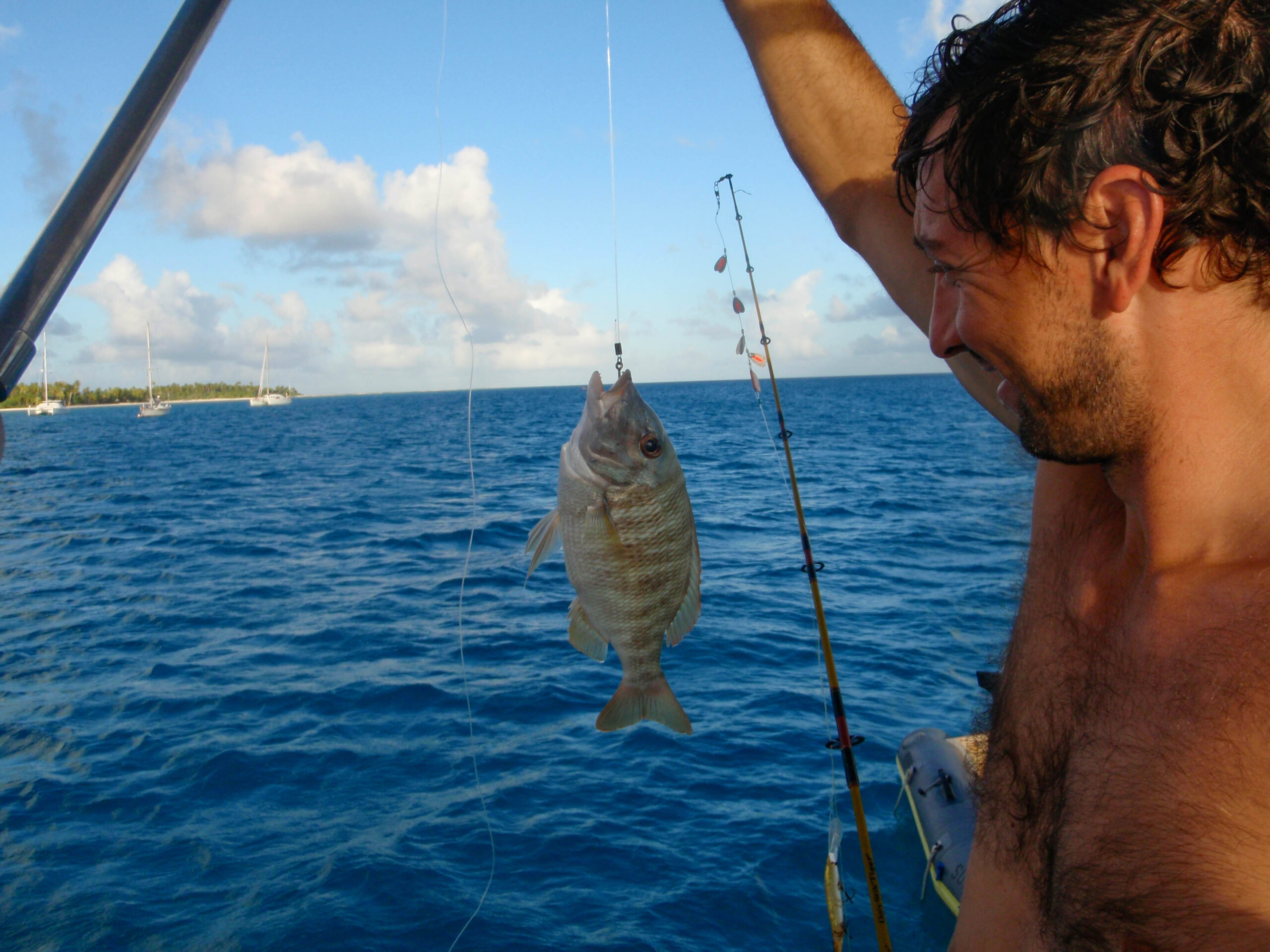
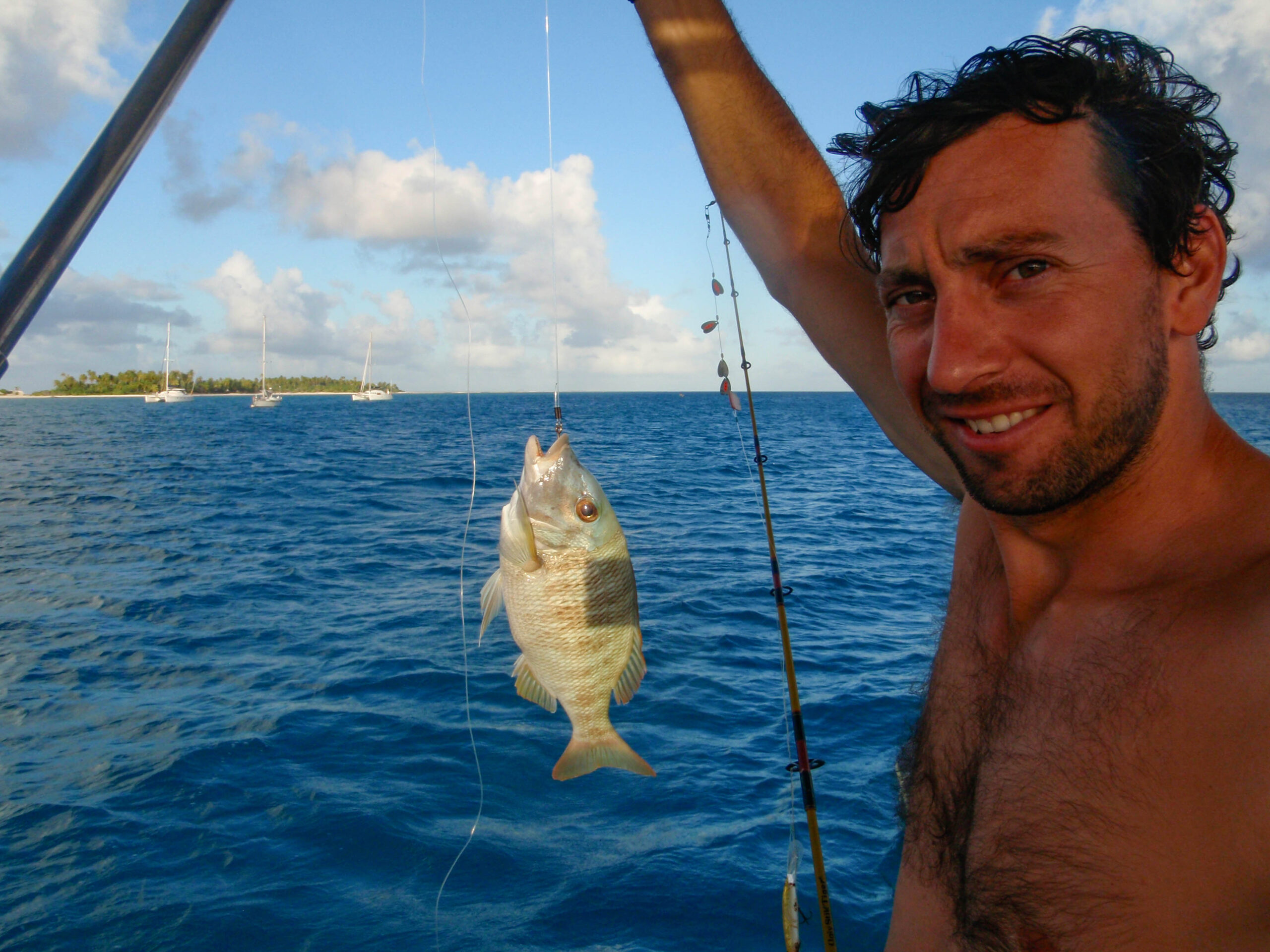
    Matt and Karen reported no luck fishing while sailing across the Pacific and while cruising the Marquesas and the Tuomotus.  This poor showing on the part of the fish to readily enjoy our lures, combined with Matt’s reticence at the idea of cutting up live things with guts in them has led to a decline in fishing attempts onboard s/v Syzygy.  Who can blame them?  They never caught anything.  With my arrival, I bring fresh hopes and renewed vigor to the idea of fishing.  And an indefatigable arrogance that it has to be possible to catch something.  Anything.

    And I have failed.  Failed as all other attempts at trailing lines has failed on s/v Syzygy.  Please other cruisers who are able to catch fish regularly,  tell us your exact set-up of trolling lines and how you catch fish, down to the minutest detail.  Because we are incompetent.  We have read a book and we have not learned.  Nearly all things done on this boat, all the sailing knowledge, all the boat projects completed are because we read a book and learned about it.  We read a book about fishing, but we cannot seem to learn how to fish.  Please tell us everything about your set-up.  Length of line out, type of knots, length of mono-filament.  Type of lure.  Color of lure.  Number of lures.  Depth of lure.  Time of day.  Depth to ocean floor.  Distance to land.  Boat speed.  Wind speed. Current. Hook size.  Hook placement within lure.  Allowable rust level on hook.  Bait used or not.  Leader weight used or not.  Chum used or not. Teasers used or not.  Pagan gods to whom you might give sacrifice in order to make the ocean share its bounty.  Please include video of ceremony, text of chants and incantations, list of all incense types used and step by step instructions for actual sacrifice.

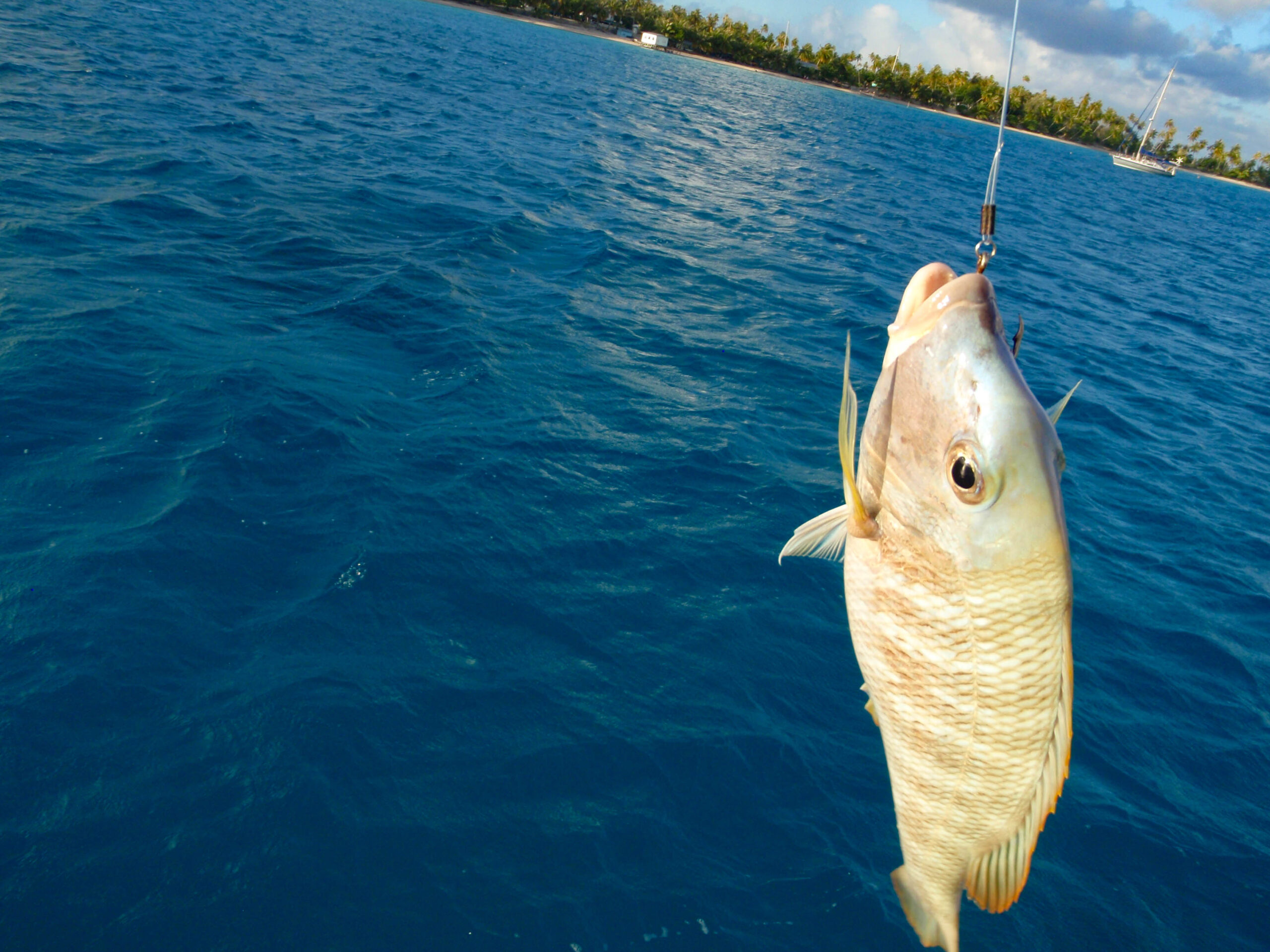
    I have, actually, caught some fish.  But I was only able to do that at anchor.  When we were in Apataki, and in having beer and an excellent lunch at the cargneage(boat haul-out center)/pension/restaurant/happy hour/pearl farm establishment, fishing was brought up with the family who owns all this enterprise, Alfred and his wife.  They said they had a surefire way for us to catch fish involving hermit crabs as bait and that next time we come to shore, they would show us.  The next day, we show up but Alfred is off fishing and his wife is gone.  Karen manages to relate to the very nice ancient lady that met us at the dock (Alfred’s mom??) our intentions.  So before we know it, this 80-ish year old woman has grabbed a hermit crab.  Matt and I are hustling around trying to watch every little step of what she does.  She then gets a hammer, one shot smashes the shell, grabs the hermit crab, one hand around all it’s legs and claws, the other around its guts and rips it in two pieces.  She threads it on the hook and done.  30 seconds have passed.  I am in awe.  In a couple of days, I will no longer be in awe of the process.  Instead, I will be a one-man professional hermit crab death squad.

    We collect a dozen hermit crabs and head back to the boat.  At dusk, apparently good fishing time, I retrieve a hammer, a cutting board, and a hook.  I ask Karen to retrieve a video camera.  The nice ancient lady completed the steps in about 30 seconds.  It takes me 30 minutes.  So despite that it is now dark, I try to fish anyway.  Nothing.  Nothing.  Nothing.  I take solace in the fact that it is pitch black out and vow to try again in the morning.

    In the morning at 6 am I begin setting up to try again. Success!  Within a half an hour I’ve hooked two fish.  Karen comes on deck.  I ask her what to do now that I have a fish flopping around in a large green bin.  She says I have to kill it.  I don’t know how to do that I reply.  She fetches the book.  We read it.  We learn.  The fish dies.  Knife shot to the brain, one inch behind the eye.

    After reading the book for each step in the process of gutting and cleaning we take the fish into shore to make sure that we can eat them.  Some fish you can’t eat because of a nasty little disease called ciguterra  I refer you to a blog post from our good friends Mike and Hyo aboard Io, Mike is a marine biologist and so can explain all the nastiness of ciguterra better than I.

    Matt gets the job of cooking the fish and that night we finally dined on fresh fish.  The next night we again dined on fresh fish.  It was wonderful, albeit a bit bony.  Then we moved anchorages, losing our source for local knowledge of ciguterra (Different fish on different atolls have it) and we have not had fish again.  Back to cans.

    So fellow cruisers, please help us become better fishermen and fisherwomen.  Please help us spare the cans.

  • San Diego

    We’ve been here four days already; we intend to depart on Tuesday. So far our San Diego m.o. is to wander around running errands and looking for parts. There’s a fair amount of logistical leftovers to deal with before we leave the country, mostly bills and taxes and online crap. Even though we’re in a slip, it’s still more convenient to take the dinghy across the harbor before we hoof it around town. The dinghy ride:

  • A view that makes you lose your dinner

    I’m afraid to imagine what Matt will do with other sail scraps when he runs out of underwear in the South Pacific….

  • Getting knocked-up and knocked-down

    Over the last five hundred years or so, if a sailor did something stupid like neglect his duties or disobey orders or insult his captain, or strike an officer, or desert the ship, or display rank incompetence or drunkenness or insubordination, or steal a dram of rum, or spit on the deck, or fail to stow his things properly or to clean his clothes adequately, there were any number of punishments that could be meted out: the sailor could be flogged, or whipped, or pickled, or cobbed, or made to run the gauntlet or to clean the head or to carry a 30-pound cannonball around the deck all day or to station himself at the top of the mast for a few hours or just to stand still until told otherwise. He could be lashed on board every ship in the fleet, or he could be tied to the mast for a week, or keel-hauled, or he could have had his feet bound and covered in salt and presented to goats for licking, which quickly went from ticklish to agonizing, because the goats don’t stop licking before the sailor’s feet have become bloody stumps. Or, if the sailor had mutinied or murdered, he could be hanged, shot, or have his head cut off, boiled, and then shoved onto a spike above decks, and left there for a week or so, to serve as an example to the remaining and hopefully far more loyal crew. Magellan preferred this latter technique. If the sailor had buggered (aka sodomized) another sailor, that, too could earn him the severest punishments. The sea was not San Francisco, man. But, if the sailor, while meeting the locals on some tropical island far away from home, knocked up a local woman, or a bunch of local women: nothing. Getting a girl knocked up was what sailors did when they weren’t sailing, like Genghis Khan, or Mulai Ismail, the last Sharifian emperor of Morocco, who had something like 1400 sons and daughters before he died. Most sailors probably never knew how many women they knocked up on their voyages.

    How far we’ve come since those days. I can neglect my duties all I want; I can make fun of Matt’s mom and call Jon a cabron and not get punched in the face; I can run off to Yosemite for a couple of weeks; I can trim the sails poorly and sail us home by some unimaginably indirect course; we can get so drunk that we decide to clean up our spilled wine with spilled beer; I can drink all of Matt’s beer and Jon’s expensive whiskey; I can spit on the deck or anywhere else on the boat I feel like it; and I’m not sure if I’ve ever stowed my things or washed my clothes properly. The boat is my oyster. If I were so inclined, I could invite over all the gay guys in the bay area with one simple Craiglist post; instead, I have tried my hand at luring girls here, all the while wondering what girl would really find this sailboat alluring. Remember: according to Google, Syzygy is a janky piece of shit, and based on the information in this paragraph (swearing, drinking, spitting, dirtying), I’m no example of fine manners, either. Finally, the biggest change of all: getting girls knocked up is decidedly not what sailors do. This is the 21st century, man, even if it is San Francisco.

    So I’m 31, and dating, and it’s always a mystery when and how to tell girls about the boat. They always have a ton of questions. Is it small? It’s like a New York City apartment, you know, a 400-square-foot studio. Is there a fridge, and a stove? Yup. Is there any headroom? I can’t jump up and down, but I don’t have to squat. Is there a bathroom? Yup, but I prefer to piss in the bay. Is it noisy? Seagulls squawk in the morning, and sometimes the wind howls in the afternoons, and sometimes the docklines creak as they stretch taut. I try to make it sound romantic. Does it rock back and forth? The boat moves a little bit when tied up, but nothing crazy. And get this: the boat is so burly that if it gets knocked over 90-degrees it still pops right back up. In fact, if it gets knocked over 120-degrees, it still pops right back up.  Do you get seasick? Not in the marina, but at sea, sure. Most sailors do occasionally. Is it cold? Not really, and I have a diesel heater. Sometimes I feel like a caveman, proving that I exist in modern times: yes, I have electricity and laundry and cell-phone service and an internet connection. Yes, a sailboat. Really, it’s not a big deal. It’s got a certain allure, I know it, but somehow I end up on the defensive.
    And here’s how I can tell my dating life isn’t going so well: I’m sleeping with Bob Seifert. Not “sleeping with” in the euphemistic sense, but literally, as in sleeping beside the book he wrote, called “Offshore  Sailing: 200 essential passagemaking tips.” I have a hardcover copy of it in my bed, and I cuddle up to it every night like it’s some titillating classic or a book of translated swooning poems. Page 27 describes one of my favorite projects: boom preventers. As if I need those. There’s no other way to put it: it’s my boat porn, full of seacocks and cockpits and blowers and interfacing electronics and deep-cycle batteries and coupling nuts and prop shafts and large tools and lubricants and docking equipment and proper bedding techniques. Talk about a change. I should be punished for my behavior.