Syzygy Sailing

Bought a boat, fixed a boat, sailed to Australia, sold the boat.

  • Learning to Weld

    When I was growing up on the farm my dad would weld out in the shop all the time. And so I placed that activity in the same realm as everything else shop-related: loud, dirty, greasy, uncomfortable, involving flying hot shards of metal, and as a result I wanted nothing to do with it.

    The boomerang of rebellious devil-may-care youth may fly far, but oh how often it eventually ends up right back where it started . . .

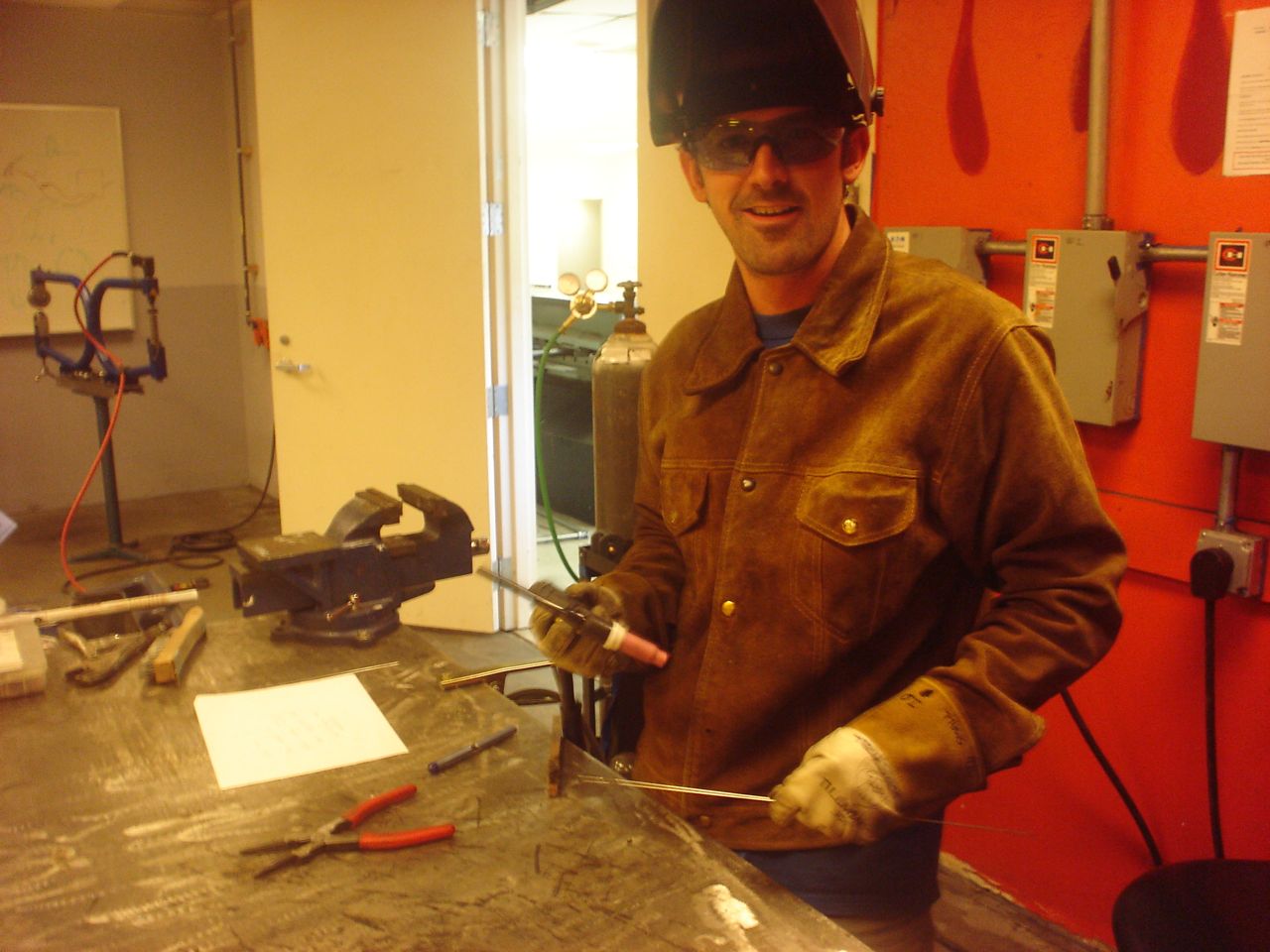
    Since buying a boat I have become more and more fascinated with welding. I decided we needed a new radar arch to accommodate our future wind generator, solar panels, and radar antenna, and that I needed to learn how to weld so I could make it myself (of course, right? how else? everything always all by ourselves). Like Jon with his sailmaking–like everything else we’ve done–I went big all at once. I got a membership to the Tech Shop for $70/month, paid $50 for the introductory TIG welding class, and bought $250 worth of 20′ long sections of 2″ diameter 304 stainless steel pipe that were a real hassle to cart around on top of the xterra down the highway.

    Maybe I used my learning to weld as an excuse to make a radar arch, or maybe I used the radar arch as an excuse to learn how to weld; either way at this point I’m in ‘ass deep to an elephant’, as jonny likes to say.

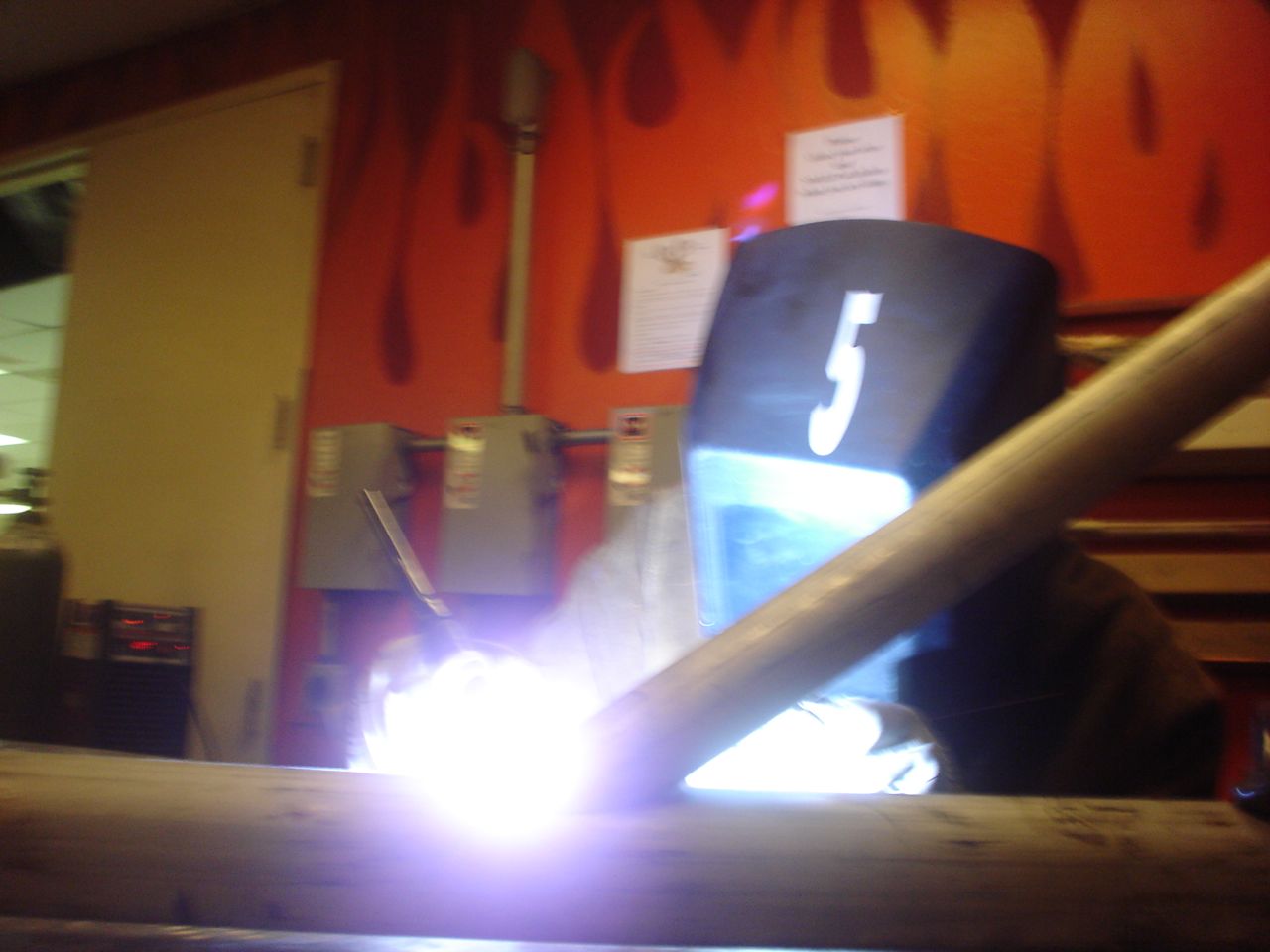
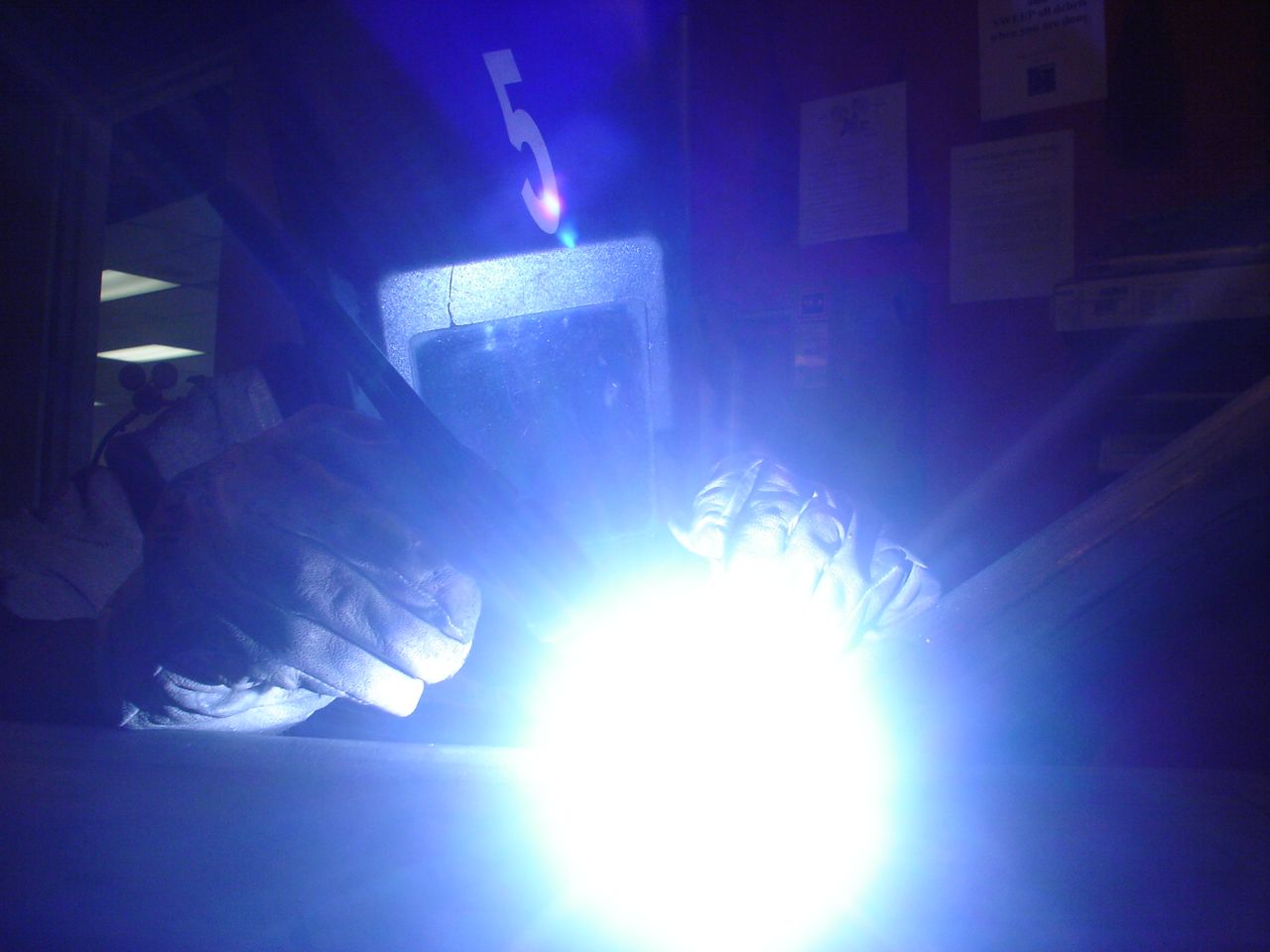
    Turns out welding is absolutely amazing. Totally space-age modern-marvel out of this world activity. Welding is proof of how far science and technology has taken us. The welding machine that I use at the Tech Shop is a box approximately 1′ x 1.5′ x 2′ in size–much smaller than a suitcase. It plugs into the wall, and it hooks up to a gas tank. Then you grab a stylus-shaped “torch”, bring it close to a piece of metal, and press your foot on a pedal on the floor–and then would you believe that little machine ignites a 1/4″ cone of light hotter than the surface of the sun. That’s right: instant 10,000 degrees in the palm of your hand, a little mini sun that melts metal. (Crazy!) You have to wear a face mask too dark to see through in full daylight; without it the 10,000 degree arc will blind you in seconds. (Scary!) You have to wear gloves and cover all exposed skin, because it creates so much UV that it will give you a sunburn in a minute. (Hot!) When you hold that torch, your hand is 6″ away from a tiny 10,000 degree cone of orange and green plasma that dances on the metal. Now why didn’t they tell me THAT when I was younger? Who wouldn’t want to hold the sun and fire it up and melt some metal with 10,000 degrees of blinding light?

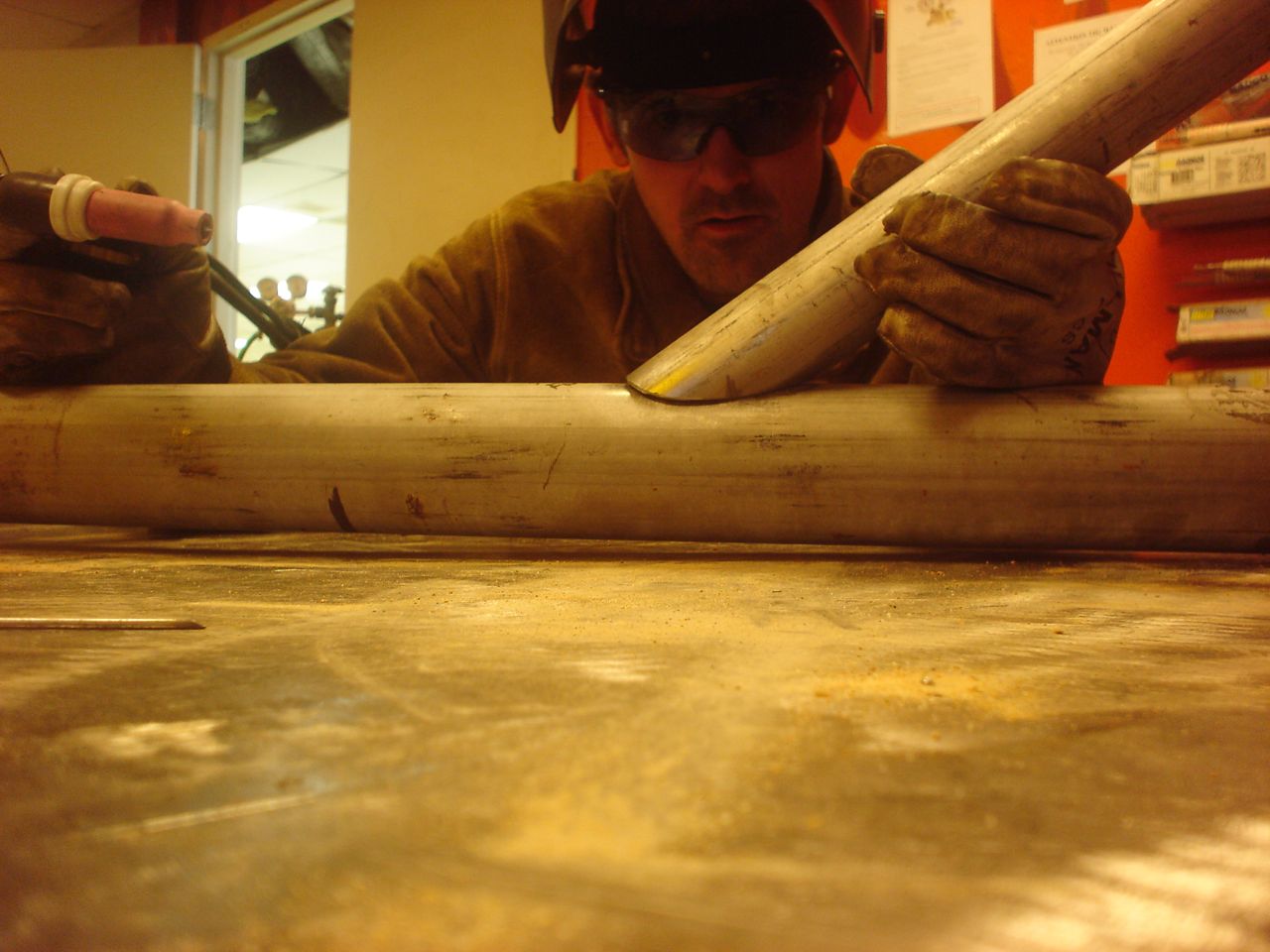
    The type of welding I’m learning how to do is commonly referred to as TIG welding, which stands for “tungsten inert gas”. It’s more accurately called GTAW welding: “gas tungsten arc welding”. It is the most precise and most versatile, yet also slowest, most difficult, and least used form of welding. In TIG welding (as in other forms of welding), the metal is melted by heat created by an electric arc, EXACTLY like the static electric spark that jumps from your hand to the doorknob after you walk across a carpet with rubber soles. Welding is a sustained form of that static electric spark–if you could keep that spark going and then make it 100,000 times more powerful, you could be welding. In TIG welding, you connect the electricity to a thin, sharpened stake of tungsten (called the “electrode”) and then you bring the electrode really close to (but not touching!) the metal. Really close–like an 1/8″. Then you press the pedal to give it juice. And you have to hold it that exact distance while you move the torch along a path which you can hardly see because you have some dark-as-hell facemask on. And you have to move kind of fast but not too fast. And I haven’t even mentioned yet that with your left hand (the torch is in your right hand) you have to precisely jab (dab) a rod of “filler” metal into the melted pool of metal, to add metal to make the weld.

    Get this: if the electrode touches the metal accidentally, or if you jab the filler rod into the electrode accidentally–both of which I do far too often–the event is punctuated by an even brighter spark and pop immediately followed by an accusatory green flame, which indicates that you have contaminated (i.e. fucked up) your weld with some of the metal from your electrode. At which point you have to CEASE AND DESIST, gingerly dismantle the torch (gingerly because it is still bloody hot, remember), and take your tungsten electrode over to the grinder to grind a fresh new uncontaminated tip onto it.

    The whole thing is really hard. It’s really, really damn hard. It’s not hard to make any old arc, it’s not hard to melt any old metal. But it’s hard to get a result that doesn’t look like cyclops went wild on your metal with his phaser eye–I’m talking all black and gobby and bubbly and smoking crappy. And in welding (like in climbing), if it looks bad, it probably is bad: weak and worthless. Why is it so hard? There are tons of different settings, and it’s hard to tell which setting is having what effect. That little suitcase of a welding box is a freaking computer with a gazillion different options and blinking lights and whatnot. And then you have to have super fine motor skills to be able to hold both the torch and the filler rod so steady, and move them so quickly yet precisely, so close to the metal, all while you play this foot pedal to control how many thousands of degrees of heat you’re pumping into a tiny spot on the metal. And all metal is different, and different thicknesses need different settings, and each different joint requires a different technique . . .

    All of which makes this radar-arch project daunting. I don’t want to add some ugly weak heavy janky piece of shit to the back of our boat now, do I? I agonized for months over what diameter and thickess and type of pipe to use, and how to join them, and where the support struts should go, and the moment of truth is coming in a day or so and I hope that it isn’t all shitty and stupid looking. I’ve spent a fair bit of time at the tech shop welding practice sections of tubing, and even at my best they are still black and ugly and melty. (You might well guess that at this point “ass deep to an elephant” may be too deep for me.) But I’m not getting much better and I don’t know what else to change and it’s time to move forward with this project and I think that my welds might be good enough. So tomorrow jonny and I go to the tech shop to make the first real welds on the actual radar arch. I KNOW they are going to be ugly. I’m hoping that they will at least be acceptably strong. I’ll post some pictures, regardless of how dissatisfied I am (especially now that I’ve laid the groundwork about how impossibly difficult it is :-). But damn! no matter what welding is a totally amazing thing that now I can (kind of) do!

    *addition note: Pictures are complements of Jonny; I still have to add some shots of the resulting welds
  • Bay Sail

  • Happy Mother’s Day

    “I just want my mom to approve!” I huffed to my dad as we chatted one evening on the phone, a year ago, about my plans for sailing around the world.

    There.  I said it.  After 31 years of doing my damndest to assert my independence from my parents, I realized I wanted desperately for my mom to approve of my future plans.

    Her reception, three years ago, of this cockamamy idea to go sailing around the world with my two best friends could be termed luke-warm at best.  She was officially Strongly Against the Idea, for the obvious reasons. “You’re abandoning a career,” she’d said.  “You should stop being so reckless.  Why don’t you settle down with one of those nice girls with whom you keep finding a way to go separate ways. Why do something so dangerous?”

    Her disapproval grew as our plan slowly manifested.  Shortly before we bought our boat, if I wanted to even talk about the sailing venture when i called home, I had to make sure only dad was on the line, otherwise I would face grim silence.  It only took a few times of sensing the steely look through the phone, and am pretty sure I sometimes heard teeth grinding together, before I realized to not bring up the topic.

    I vented sometimes to my sister, admitting to her how important it was for me to have my mom say something to the effect of ‘go have a great time son!’

    But why was it so important?  I suppose it’s obvious, she’s my mum.  I wanted them to be proud of my life, to think they had done a good job raising me, because I sure thought they had.  I wanted validation that my life is worth something, and if my mom didn’t approve, then it filled me with self-doubt.

    My sister’s advice was always the same: Talk to her about it.  Let her know how you feel.

    I couldn’t take it upon myself to face that conversation with my mom though.  So, cowardly, I avoided confrontation and discussion about it.

    But I sensed an olive branch at an unlikely location. My mom, dad, sister, and I were in a large children’s furniture store, surrounded by baby-cribs and pint-sized dressers, over a dozen example baby rooms perfectly laid-out with every required baby accessory, shopping for furniture for the niece on the way.  My mom pointed at a large map of the world and quietly asked where we might be going.  Where was our route?  I sketched out an idea for her, mentioned a couple of places that I was really excited about like Thailand and India.  Then I gave her a hug.  I hope that hug said what I didn’t:  Thanks for asking mom.” And, “I love you.” And,  “Thanks for playing the role of parent and making the first step towards reconciliation.”

    I felt better, but still uneasy.  And so a few months later I took the next step, and asked her if she and dad would come visit me in San Francisco over Thanksgiving, the winter holiday I usually spend with the fam.  She had adamantly declined previous invitations the summer prior, but this time she agreed they would come out.

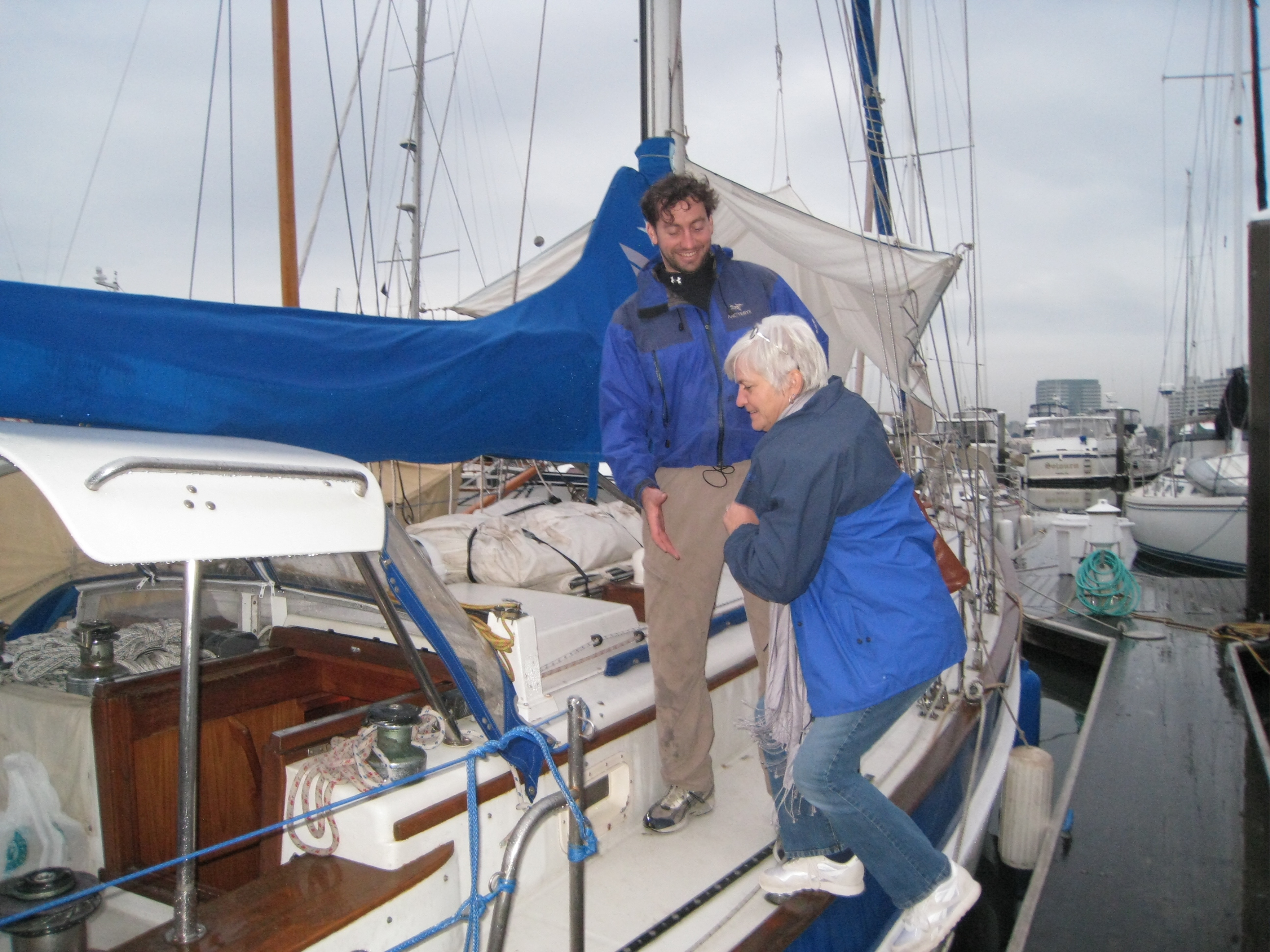
    Three months later, my mom stepped aboard Syzygy.  I showed her around the boat, pointing out work we had done, highlighting our safety improvements as well as some of the things I had learned along the way.

    “See these wires, Mom? They’re called stays and we put in brand new over-sized ones all around the boat so our boat would be super-strong.  The deck is a little slick right now, but we are going to put down a new rough surface so that it’s safer to walk around on.  See these?  They’re called fairleads and I helped install them.  Hey Mom, check out the engine room!  This is what I love learning about.  Let me show you.”  I watched her furtively but intently, assessing her eyes, her noises, her tone.  ‘What was going through her head?’ I wondered.

    I’m quiet by nature and often hold emotions inside; a trait I inherited from my mother.  So she was hard to read as she walked around the boat listening to me blather on anxiously.   But I think seeing the boat drove home that this concept I had been talking about for three years was real.  After seeing the boat, seeing the work and effort put into the boat, and hearing about the learning derived the experience, I think it came through that this wasn’t just a larger version of the carefree adventures we had taken so frequently in the past that, in the end, are individually trivial and superficial.  Jonny, Matt and I had worked hard at creating the opportunity for a life-changing experience involving enormous sacrifice and choices, and that we would emerge afterwards with an experience that would profoundly affect us; this will be a time of such greater import than the week-long climbing getaway. I think the enormity of our collective effort was made real when she saw the boat.  Or realized that I define those superficial carefree trips, but this trip, this trip will end up being part of what defines me, and by extension, a reflection of the values she raised me in me.  Values of which I am extremely proud.

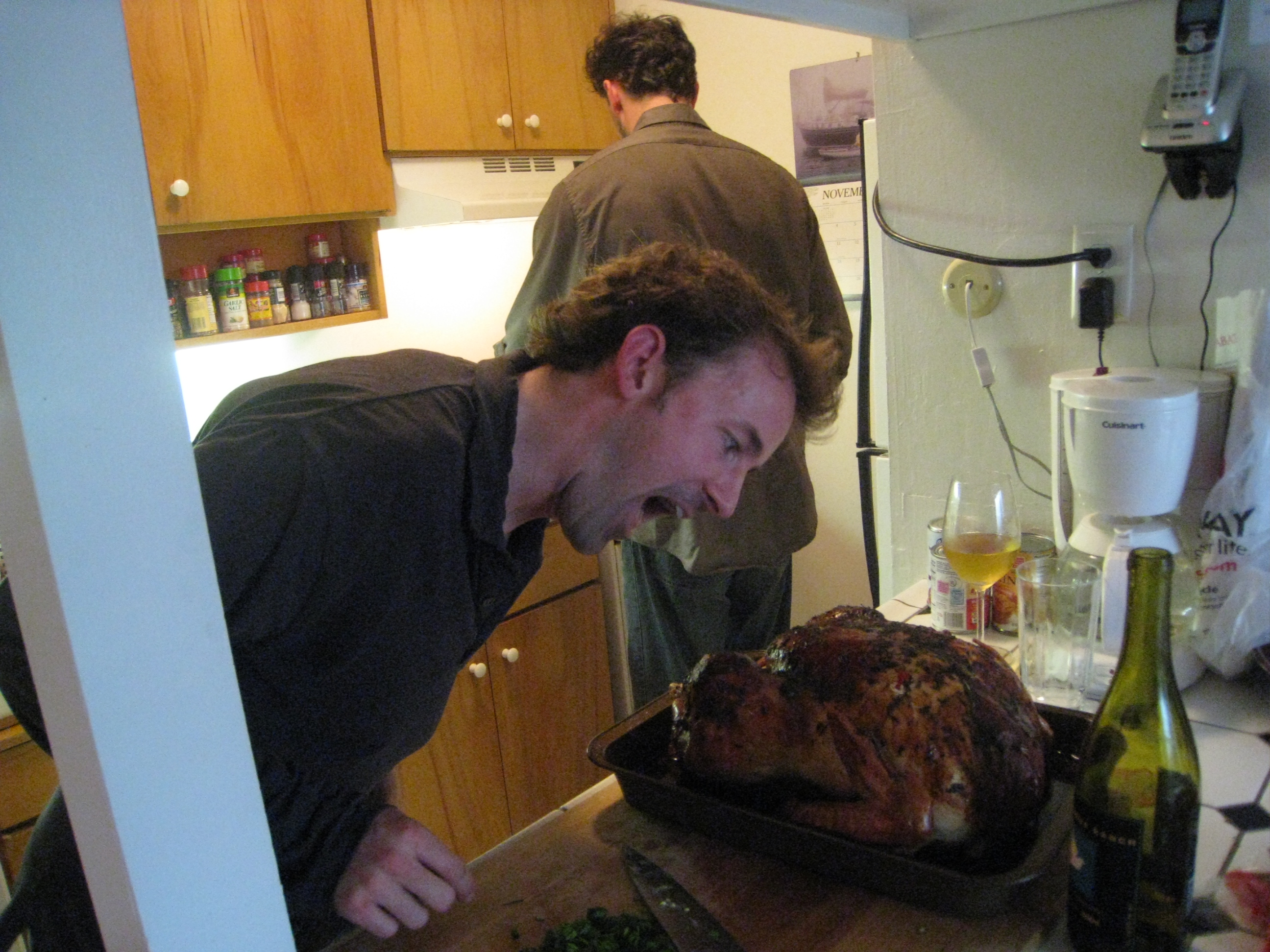
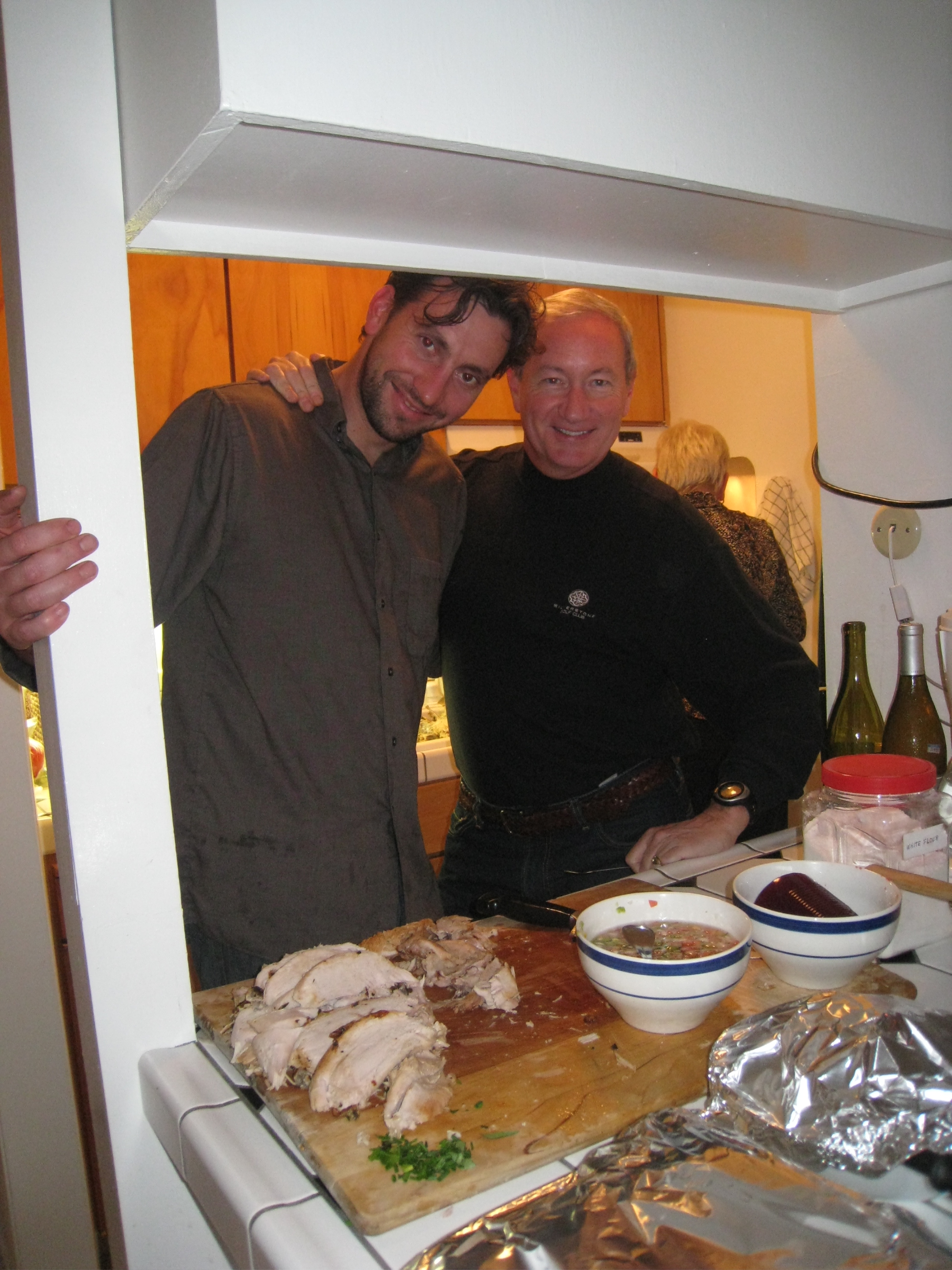
    The next  day, Matt and I treated my parents to a Thanksgiving dinner.  I’d never been in charge of a Thanksgiving meal before, though in the past I had taken on such important T-day duties as setting the table, making ice-tea, and heating up bread. Despite repeatedly being ordered to stay out of the kitchen under threat of being cut off from the wine, most of my pictures from Thanksgiving have somebody posing for a picture, and my mom in the background, in the tiny kitchen quietly trying to help.  In the end, Matt came through with a stellar turkey, my side dishes were generally a winner, and the meal was a success.

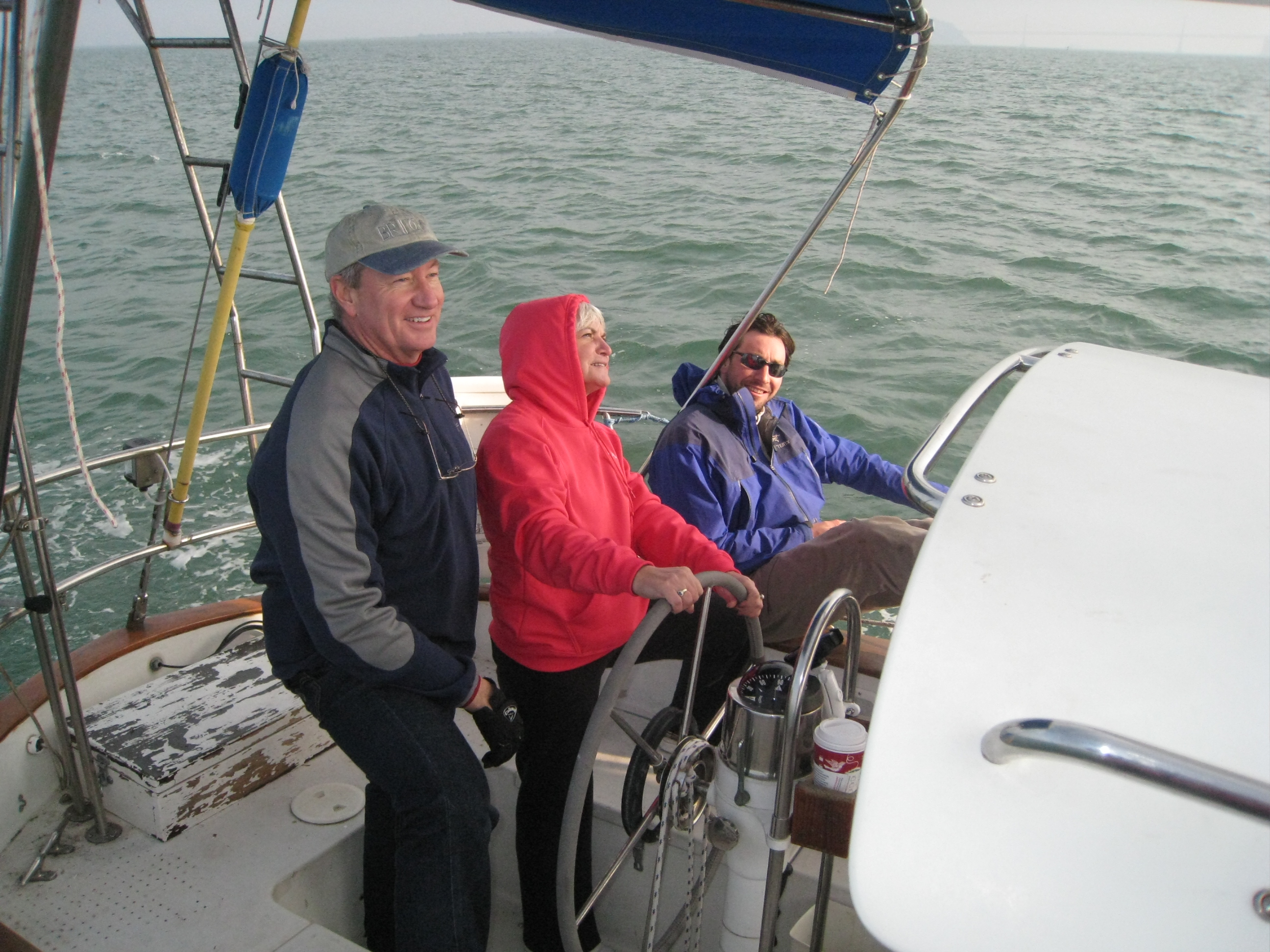
    The next day was another big day.  We were going sailing.  Matt played an excellent role of knowledgeable captain, correctly intuiting such a role would help put minds at ease.  Not that he was acting; he was just being clear in his captain-worthiness.  This was the first time that any of us had taken the parents sailing, and the wind was perfect for it.  Enough wind that we were able to move along at 5-6 knots, but not too strong.  We rarely heeled over much, allowing everyone onboard to walk around without having to hold on for fear of falling over.

    As we sailed out through the bay, I talked to my mom about the wind, the sails, work to be done and plans that we had.  We relaxed.  We drank some wine.  We laughed.  And finally came the moment that happens whenever we have someone new on the sailboat.

    “Would you like to take the helm for a while mom?  I’ll be right next to you.  It’s a great feeling.”

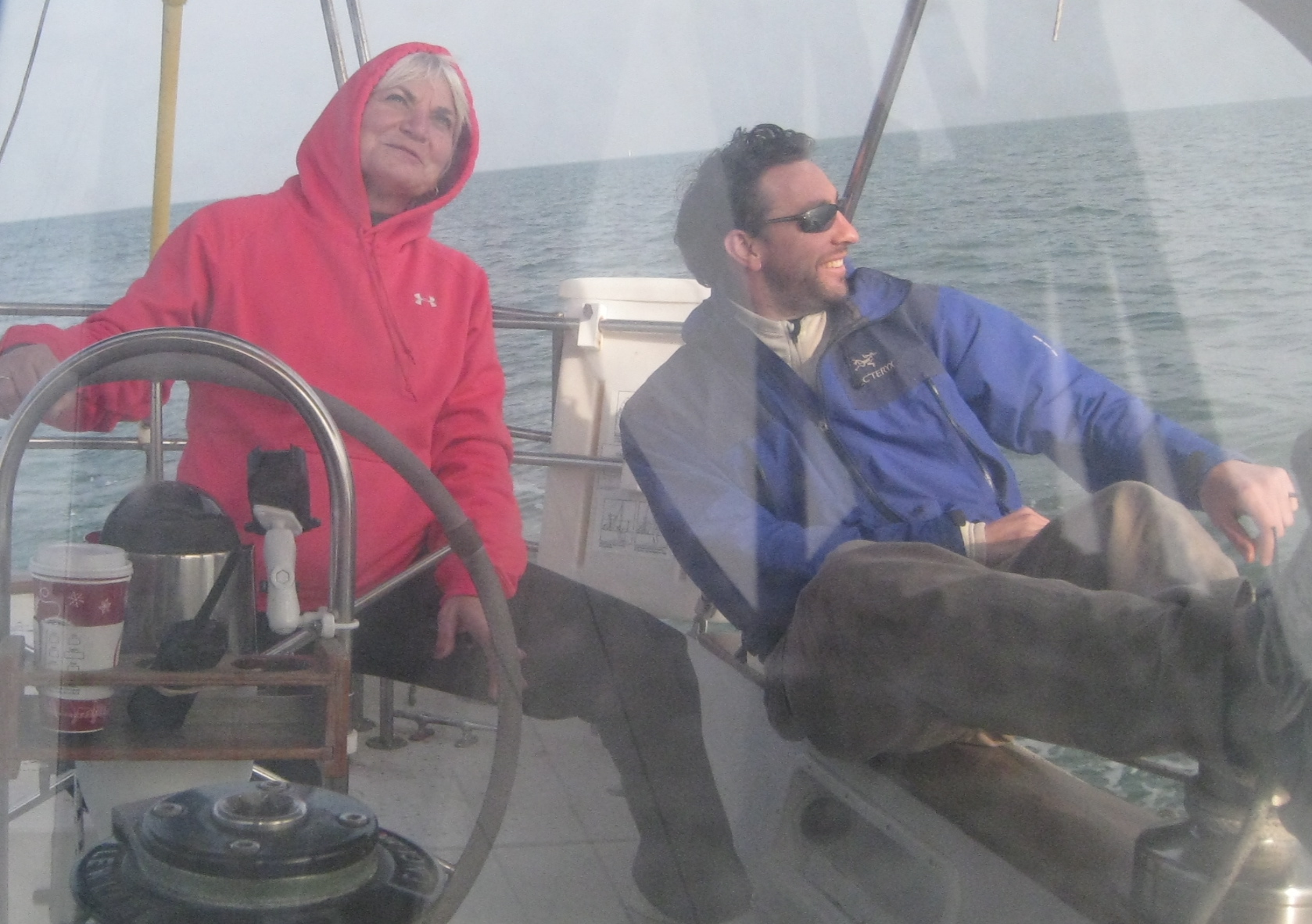
    She demurred initially, but with some more prodding from my dad and I, eventually wrapped her little hands around the wheel.  I could tell she enjoyed it.  Enjoyed the wind in her hair.  Enjoyed feeling the pressure on the wheel from water sliding over the rudder.  And at that moment, I felt like everything became O.K..  She was silently saying, “Go have a great time son.”

    Happy Mother’s Day mom.  I love you.


  • Me and my boat

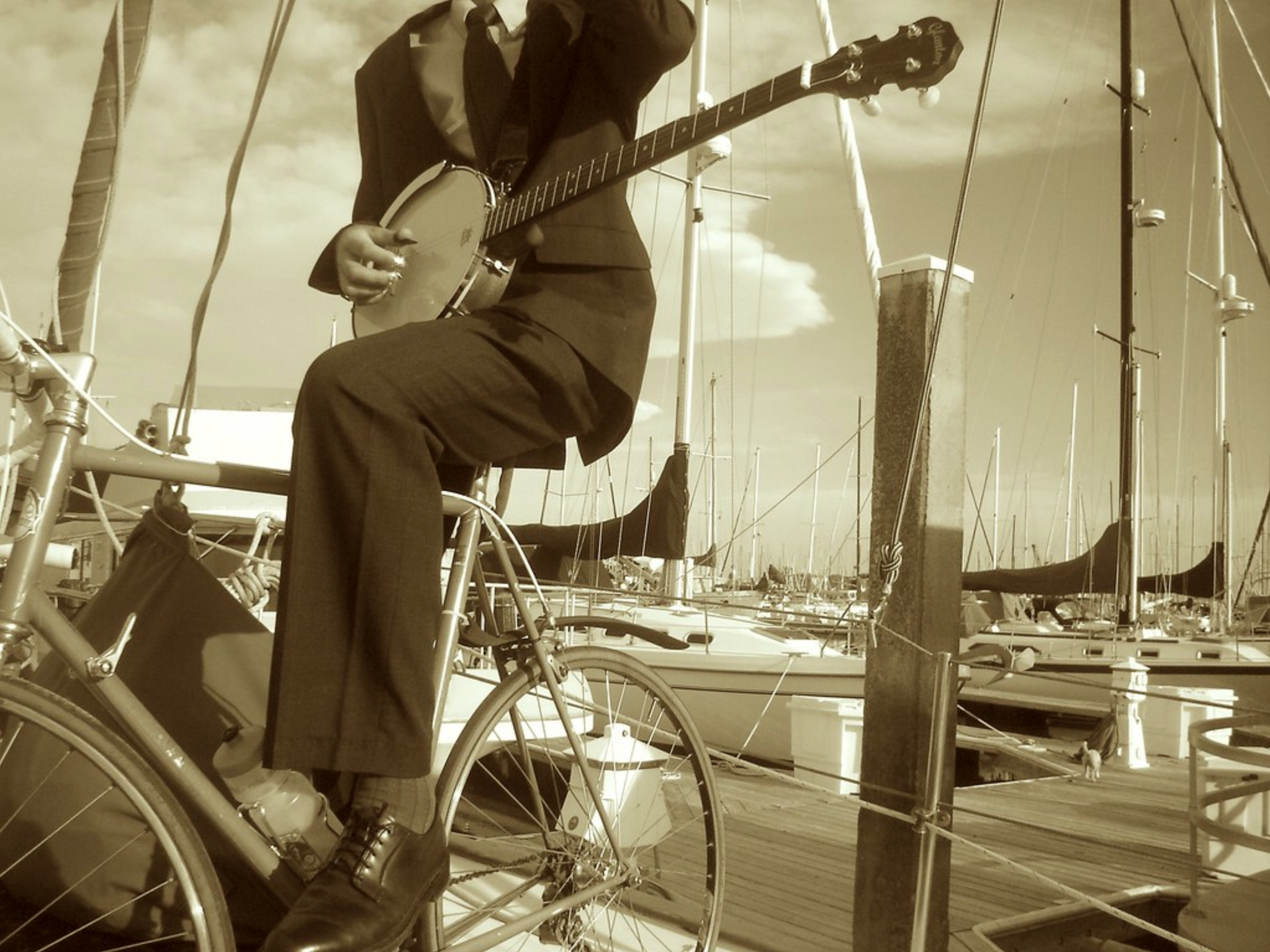
    If you couldn’t tell, things are coming along swimmingly aboard Syzygy. I’m immensely proud. (Yes, that’s me on my banjo on my bike on my boat, drinking a beer, in black and white — how’s that for vainglory?)

    I’m writing regularly about Syzygy — the work, the preparations, the doings in this new sailboat world — for Outside magazine’s blog — we have our own little Syzygy page, even.

    I’m proud of these ramblings, too, and should have re-posted them here, but I hope you’ll understand that I was busy. I was probably cutting another hole in the boat. I’ve written about the hundreds times I’ve done that (cut holes in the boat, and also written about San Francisco’s notorious wind, about removing janky parts, about the modern history of metals, about the love/hate nature of sailing, about waging a war on stainless steel, about the cult of the Valiant, about inspiration from a sailing legend, and more. The pipelines are full, too.

    Enjoy,
    -Jonny

  • Fortuitous Encounters

    In the midst of boat work we frequently acknowledge the “right tool for the job”; tonight it was all about the “right person at the right time”.

    I had a frustrating day trying–and failing–to drill a few holes in a piece of stainless steel. Drilling a few holes was my ONLY goal for the day–it has to be done before I can move forward with my current project–but after driving a hundred miles, stopping at various specialized establishments, spending an emotionally debilitating amount of money, and carrying multiple heavy metal objects back and forth multiple times, this task went unfulfilled. Along the way I did some other errands fine but Damn! I really just wanted to get those holes drilled!

    One would think that drilling holes is not that difficult. But sometimes Oh hell yes it is. In the past month I have learned how to TIG weld, use a mill and a lathe, how to adjust and replace blades on a serious band saw, how to properly cope a piece of tubing to mate to another piece of tubing, and designed and insulated an icebox. I assure you! drilling large holes in thick stainless steel remains the MOST IMPOSSIBLE TASK of everything we have done on the boat so far. Seriously, harder than everything else. Why? This amateur can offer only justifications (since I haven’t found the answer). Stainless is much harder than “mild” steel. If your drill bit doesn’t cut into it, dig into it properly, than all of the energy of spinning that bit goes into friction–thus heat–and when you heat stainless steel it only gets HARDER than it already is. I tell you truly: a quarter-inch thick slab of stainless steel is where drill bits go to die. You can drill all you want, you can press as hard as you can–with a drill press–you can pour cutting fluid on it, you can use exactly the right speed, you can buy expensive cobalt bits, but at the end of the day you’ll end up with a pile of dull drill bits and a piece of metal with a partial hole in it. And all of your efforts will have served only to harden the metal via that excess heat. It’s a downward spiral leading to frustration and despair and wasted money and broken drill bits, and yes I will shamefully admit that my failure to drill holes in stainless steel ruined my day today, has ruined many of our days in the past, and will probably ruin plenty more. What a silly thing to ruin a day! It’s only metal and a hole! But when there’s no one who can do it for you, and you can’t get it done, and you absolutely need to . . .

    After returning home with an attitude of failure inadequacy and disgust, I chose to pursue a proper drink at the Trappist in Oakland (best source of real beer–i.e. Belgian–in the entire east bay) with Karen. At the Trappist, we happened to sit next to a guy who happened to be wearing his California Blacksmithing Society t-shirt and happened to have work-blackened hands which I happened to notice and on which I chose to comment. His name is Brad Faris, and had I tried I could not have found a more ideal individual to answer all my metalworking questions and ease the specific frustrations of my day. Brad’s father was a pinball machine artist, and Brad was originally a pinball machine designer, who became a blacksmith after moving to germany to build pinball machines, and is now a custom smith with a studio in Oakland. Hell of a story, hell of a nice guy. Brad is a stellar individual with a wealth of knowledge, and it was a pleasure to talk to him.

    Brad and Karen and I talked technical stuff, like the reason why brass goes pink when it goes bad (the zinc in the alloy is oxidized, leaving on the copper, and porously weak) and what naval bronze does when welded (spitting zinc and producing salt-like deposits) versus silicon bronze (beautiful puttied welds), but we also talked about pinball machines and neat hot forges and old school metal suppliers in petaluma, which is to say that we weren’t dorking out at all–it was interesting and accessible and it was a conversation in a bar while buzzed that was filled with content and value and excitement to me and Karen both. He gave me the important names of the metal and tool supply places that I needed to know immediately, like KBC tools where tomorrow morning I’m going to get some new sharp drill bits and “TAP magic” cutting fluid for tomorrow’s second attack on the stainless. And US Metals which is a more standard supplier than ALCO metals which is like a metal flea market by analogy, and Metal Supermarket which is good for small pieces because they have smaller stock on hand and are more willing to cut and sell it in small quantities, and Van-Bebber in Petaluma which–even though it’s in a silly location for a place that gets all its raw materials from shipping yards in the bay–is apparently the type of customer-service rich operation that draws people from all over to make the inconvenient drive for a great product. Brad knows his shit! So incredibly fortuitous that we just happened to run into him at a bar on the day that I most needed his particular expertise.

    There is an oft repeated saying on the boat, about having the “right tool for the job”. For the water tanks, it was the cutoff blade (yeah the cutoff blade is frequently that “right tool”) on a 4″ grinder, for the icebox insulation it was Japanese pull saw, for rebedding it’s 4200 UV fast cure, the list goes on and on. Tonight I have to say that Brad Faris was the right person at the right time. His expertise is exactly what I needed to know to turn today’s frustrations into an optimism for a different tomorrow. I’m excited about tomorrow because I have new ideas about how to properly succeed with that piece of stainless–tomorrow I’m going to do everything right and at the end of the day I’m going to finally be able to give a detailed technical dissertation on how to kick 304 stainless ass. Hell of a frustrating day, hell of a rewarding night.

  • Sailboat not Required

    I’ll give you two really good reasons why I shouldn’t sew a sail: 1) I know nothing about sewing.  2) I know nothing about sails.

    All I know is that two months ago, while chatting about money and our sailboat, Matt said to me, “We definitely need a new sail.  Why don’t you sew it for us?  It will save us a lot of money and you could do it in Denver. It’s a boat project that doesn’t require a boat.”

    It seemed so logical, so rational. Even Sailrite, the company that sells sail-making kits, said it was easy. Zip, zip, zip — and voila — done. Check out the video and see.

    Still, intuition suggested that the task would be daunting. When I told my friends, “I’m thinking about sewing a sail,” I couldn’t even keep a straight face. Like so many other boat projects, sailmaking was unfamiliar and overwhelming.

    Now, ankle deep as I am in this sailmaking endeavor, I wonder if Matt asked the question in jest.  A completed sail is wider and almost as long as my condo (ehem..currently for rent). How the heck am I supposed to do this?

    I do know, however, the difference between a code zero, gennaker, asymetric spinaker, drifter, crusing spinaker, and genoa. I know how to thread a bobbin. I know what tension can be applied to different sail luff configurations and how that affects the ability of a sail to go to windward.   I also know what tension can be applied to a piece of thread and how that affects looping above and below the fabric.  I understand roach. I understand how to walk the dog.

    I know this because I did hours of personal research, had several discussions with Matt, read a book, and talked for 30 minutes on the phone with Jeff, the head sailmaster at Sailrite, hitting him with questions I barely have enough knowledge to even be asking, let alone understand the answers.  He was extremely helpful, though I’m pretty sure he realized I was a complete greenhorn.  We need a sail though, so I pressed on, e-mailed him even more questions the next day, and then called again a few days later.

    I know we want something that would work in light air.  You see, the breezes in the trade-winds (which blow from 20 degrees north to 20 degrees south of the equator minus about 5 degrees of doldrums right on the equator) are actually fairly wispy most of the time, only 5-15 knots.  All of our current sails are made of Dacron, the most common synthetic sail fabric, but which would be too heavy for those light trade winds.  Our new sail, called a drifter, will be made of super lightweight nylon, much like tent fabric.  We’ll mostly be flying it in what’s called a double-head sail set-up:  the jib and the drifter are attached at the forestay, one going to port and the other to starboard, each at about a 90 degree angle to the boat.  They create a big parachute the wind pushes against, moving the boat.  To use this set-up the wind needs to be coming from generally directly behind you, give or take 20 degrees.  Coincidentally, that’s what the wind will usually be like in the trades.

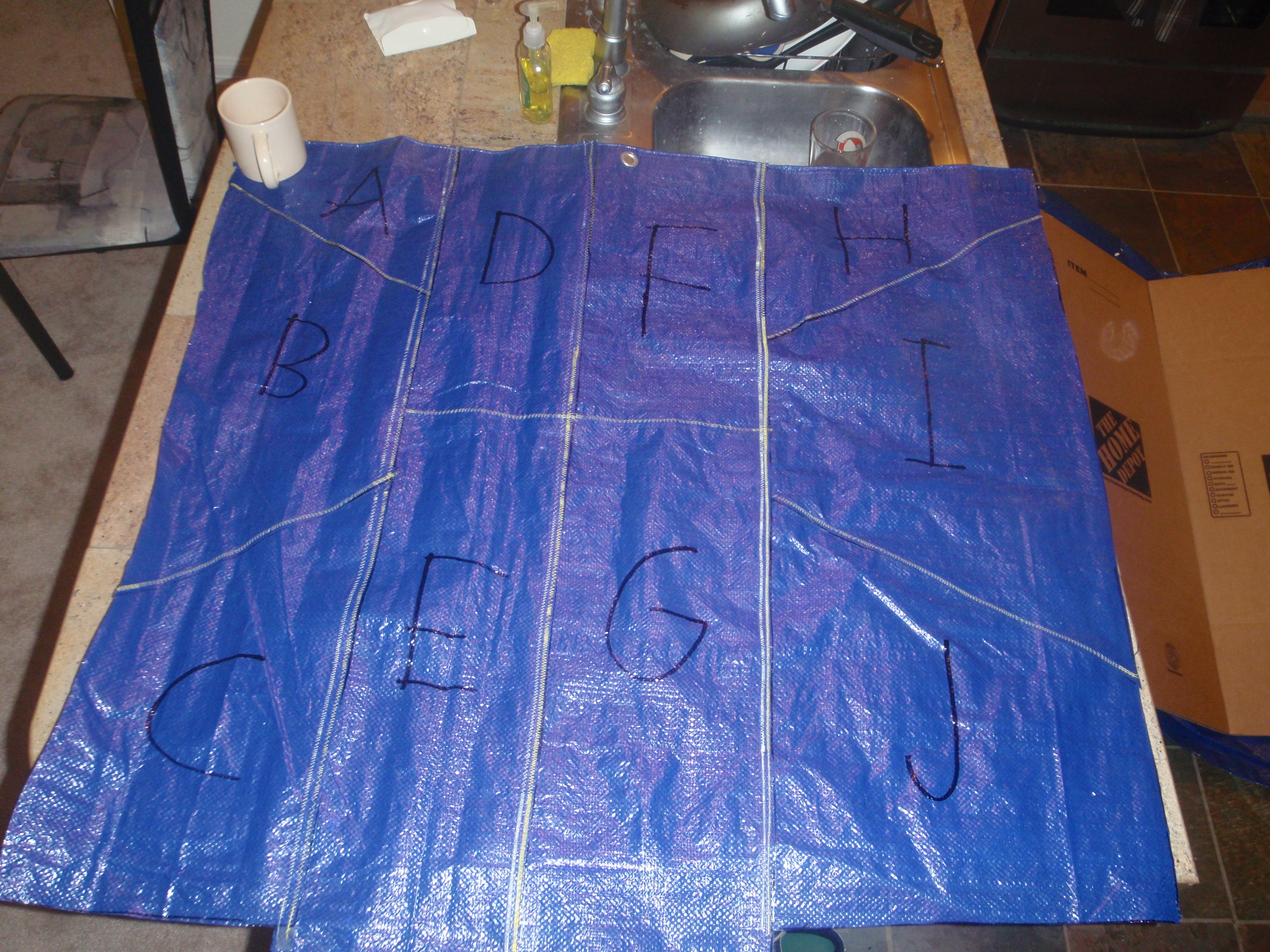
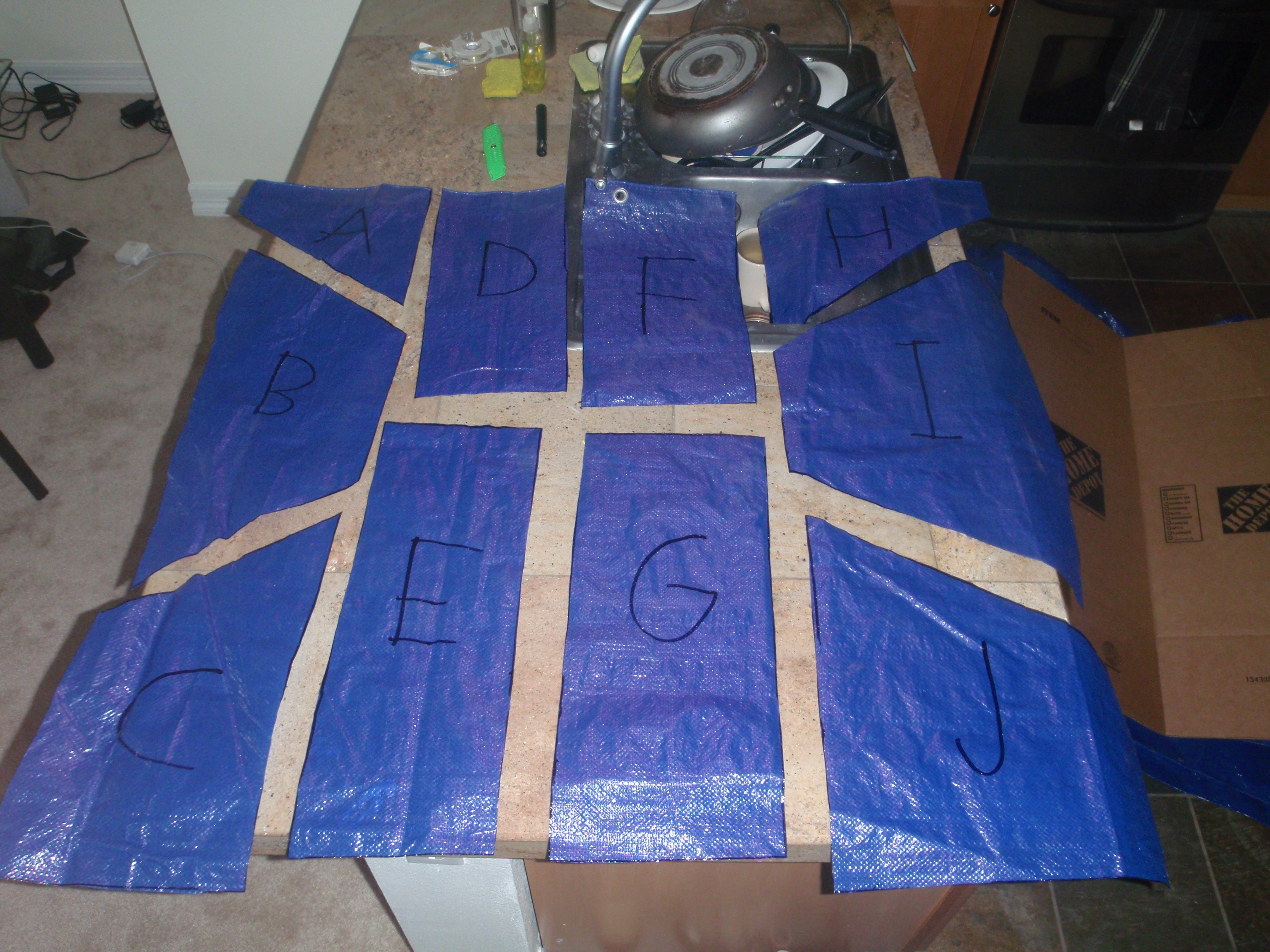
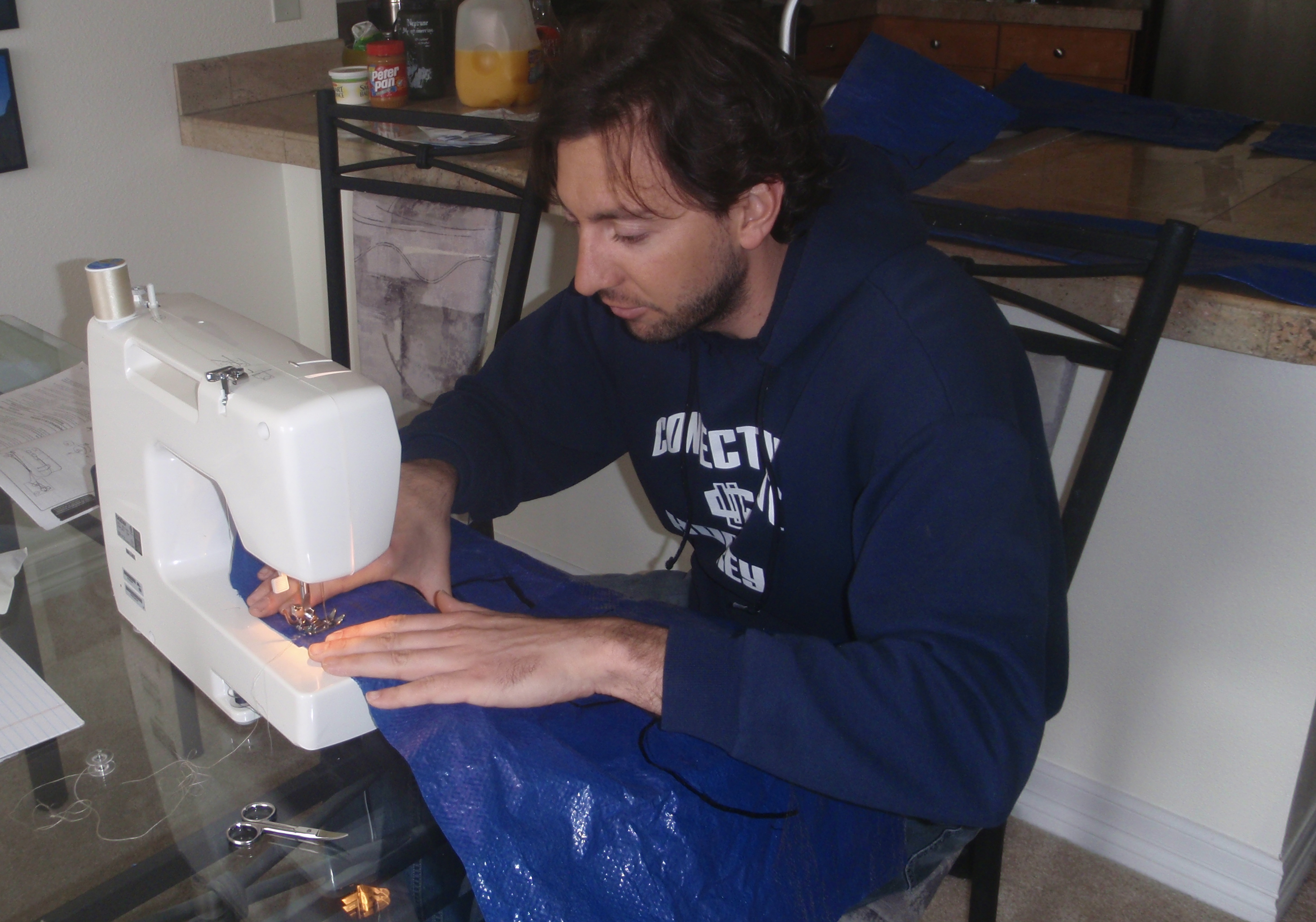
    I also know this because I borrowed my sister’s sewing machine, and had my newfound mentor, Lauren, gave me a brief tutorial on using it.  Like a good mentor, she stepped back and let me have fun. To start, I ripped off a 4’x4′ section from my 20 foot square blue ground tarp, hoping that it would mimic nylon, because I wasn’t willing to cut up my tent.  I then impatiently cut  the 4’x4′ square into 6 different pieces to sew back together.  Once in a while, when something stopped working and I couldn’t fathom why, I’d ask for help.  Otherwise, I showed her my stitching, asked for feedback, and generally felt proud of what I had done.
    The process reminded me of the internship programs that my students go through. Every week, they see new things, learn new skills, and push themselves beyond their normal boundaries — under the guidance of amazing mentors. Such opportunities — in school!— are awesome, and I smiled just thinking about it.

    Three significant lessons emerged from the reassembly of the first tarp:

    1) It would help if I cut up the tarp in straight lines.
    2) It would help if I mimicked the way the sail panels would be pre-attached with double-sided tape.
    3) It would help if I had more thread.

    So we drove over to Fancy Tiger, a local boutique thread-shop.  They have a surprising lack of thread, needles, and fabric, but an ungodly amount of yarn, and they also have sewing classes! You get to bring in your own projects and get help!  It’s like getting 10 mentors at once, for free! As far as I can tell, there’s no other shop like it for 500 miles.

    Back home, I cut out a second piece of tarp. This time with straight lines.  I tacked the pieces together with double-sided tape.  I used my new, bright yellow (Lauren raised her eyes at my choice, but I wanted bold) thread.  The second go was a significant improvement, and my confidence rose ten-fold.

    So, now, thanks to so much help, this project seems more manageable. I’ve got Lauren, and my sister, and Jeff, and the entire staff of the local thread-shop as support.  With all that scaffolding, it should be easy.  Right?

  • April Fools

    I’ve never been much of a prankster. The furthest I ever took an April Fools joke involved telling someone I didn’t like his shirt. Yes: lame. I know.

    As the day crept up this year my friend Amy regaled me with stories of epic April Fools jokes in her family. They sounded like so much fun. I felt so left out. To hear Amy tell it, April 1st was the only holiday worth celebrating.

    So I got to thinking about a prank. I started by searching for a victim. An obvious target was Amy, since she so enjoyed such shenanigans. She’s a professional April-Fooler, though, and I figured she’d see right through my meager attempts. What I needed was unsuspecting victims. Someone who trusted me totally. Someone who’s known me for years, and as such, never heard me pull an April Fools caper. Oh, Matt and Jonny: I would pity you if it wasn’t me doing the pranking.

    The three of us lately have been pushing our fingers into our temples, frowning in thought, throwing fake smiles every once in a while as our minds wandered toward the financial challenge before us. We have little money, a lot more boat parts yet to purchase, and (most importantly) a two year trip to save up for. We’ve tried prioritizing projects, but that only made the monstruous task before us more evident. What we needed was some levity.

    So I sent them this e-mail:

    —–

    From: Jon Haradon
    Subject: umm….news
    Date: April 1, 2009 5:52 PM
    To: Matt Holmes, Jonny Walman

    So the Superintendent of my district swung by our school today. Apparently she didn’t get the message about me leaving. She said the district was starting a STEM (science technology, engineering and mathematics) charter school in the district and she asked if I would be interested in running it. She basically implied that if I wanted the job it was mine. It would pay a bundle, and as director of the school, I would get to decide exactly how it looks. Couldn’t be be more perfect with where I want to go with my career. I have to admit, I’m strongly thinking about sticking around and taking the job…. I’ll give ya’ll a call to talk about it tonight.

    —–

    I let them sweat on it for four hours while I busied myself. I actually forgot about it. Matt and Jonny didn’t. I’m not sure what happened, and they seem unable to recall the events during the time in question, so traumatized were they. I heard hints, though, of emergency meetings, soul-searching conversations, and maybe — OK, definitely — some searing words for me.

    At 9PM, I called Matt.

    “Hey what’s up?”

    I feigned ignorance. After some pleasantries, Matt, slowly started, “So… uh… that was some bomb you dropped on us.”

    I couldn’t hold the facade any longer — I told you I’m no prankster — and offered “April Fools?” I felt like a little kid lighting a fire-cracker the size of a torpedo, and sprinting away while the fuse quickly burned down.

    Silence can reveal many emotions. In this long silence, I could hear disbelief and dumb-foundedness, and then relief mixed with incredulity.

    “You’re shittin’ me….”

    About all Matt could say after that was that I had better call Jonny. In the background, I heard Karen yell at me. She later flamed me on Facebook. I suppose I deserved it.

    I called Jonny. He asked if I had talked to Matt. I confirmed, which was about all I was able to do before spilling my beans.

    “Well I don’t know what he said, but I think I’m going to be a bit more harsh.”

    I cut him off. Yet again, I lit the fire-cracker and sprinted in the other direction. “April Fools,” I timidly let out.

    There was less silence this time. Jonny told me I ought to know how much he simultaneously hated me and was glad that we are the kind of people who are pranksters. He also said he’d need a week to get over the shock.

    I hadn’t thought about what the hoax might prompt as an aftermath; I was just hoping to fool them, and definitely succeeded. It’s strange, but swindling my friends made me feel really good. Not because I lied, but because my friends were truly moved and devastated by the possibility that I might not join them. Yes, love reveals itself in strange ways.

    In the next few days, Matt and Jonny mentioned that my firecracker actually prompted interesting thinking on their parts, something about soul-searching and opportunities in life and trusting your instincts and taking chances and friendship. For us to have conceived this adventure, have made it through over three years of planning, and be on the verge of leaving, there had to be some intense bonds of trust, respect, and compassion. Some serious man-love. And so while I might have severely severed that bond of trust, (and I currently don’t trust anything they say, because I know they are scheming up some way to way to exact revenge) I think I’ve nudged us all to think about what this journey means to us, together. We’ll need those bonds when confined for a months in a tiny, floating, 40-foot boat with no escape.

    Unless they prank me by throwing me overboard.

  • Sailing + Kite + Video Camera

    A while back we came across these superb videos made by Chris Humann (edited thanks to comment below) during his single-handed TRANSPAC race, in which he suspends a video camera from a kite and flies it from his boat while sailing. As soon as I saw the video I had to do it too. It’s so difficult to get good footage while sailing, since you’re usually limited to the deck of the boat–but Chris’s perspective and the footage he captures is just incredible.

    Extensive online research revealed that there is a whole hobby out there dedicated to “KAP” or “kite aerial photography”. My immediate question was: why doesn’t anyone talk about kite aerial video? Surely video is better than stills? Turns out that getting steady video is wicked hard!

    Most people make their own rigs and build it piece by piece a bit at a time, playing with different kites, etc, until they feel competent enough in their gear to hang an expensive camera off of it. This is probably smart, but I was in the mood for immediate gratification, so I put intelligence aside to make room for recklessness and in an impulsive moment I ordered a kite and a picavet suspension rig from Brooks Leffler’s web site, brooxes.com.

    Brooks is the man–he made it super easy to get started. He handled everything personally, and I had my gear in a day and a half. I highly recommend his excellent little company; he is a good guy with great products and great service, and he deserves our business.

    Everyone suggests first practicing with just the kite, getting to know how it functions in different conditions, etc, but I was just too impatient for that sort of thing. So the day after my new toys arrived we went out to the grass next to the marina on a pretty windy day and just did it. Put it all together, started the kite flying, then hung my $400 video camera from the picavet suspension and just let out the entire 500ft of line. It was funny to watch my little video camera become a little speck way up there, hanging directly over the sailboats in the marina.

    Here’s the basic setup: you launch the kite and let out a hundred feet of string, then you attach the picavet suspension rig to the string. The picavet is an elegant arrangement of lines that serve to keep the camera mounting bracket perfectly horizontal no matter what angle the kite is at. You mount your camera on the bracket at whatever angle you want it to be, and then it stays at that angle the whole time.

    About the video camera: I love my sanyo xacti VPC-E2BL videocamera, because 1) it’s WATERPROOF and 2) no tapes–it holds over an hour of top quality footage on a little 8gb memory card. Plug it into the computer and download all the footage in a minute. We have used this trusty little camera to film underwater in the bay–just put it under the faucet afterwards to rinse it off the saltwater. If only sanyo would make an waterproof version of their HD videocamera!

    That first trial run in the marina created very, very shaky footage. Check it out:

    Pretty much unusable stuff. I get the feeling that this is pretty common with kite aerial video, which in hindsight explains why the online traffic is all about kite aerial photography. I think you need the wind to be extremely steady without any gusts to get decent footage. Conditions the day we first tried were less than ideal:

    The most annoying aspect of the trial run was how long it took to wind up the line to bring the whole rig back in, so I built a new winder to which I could chuck our portable drill–this sped up the whole take-down process drastically.

    Emboldened by our trial run, the next weekend we took it sailing. It was a bit more challenging to deal with the setup from the deck of a boat, but all in all totally doable. We sent it out when the wind was about 10-15 knots, I let out the kite and all 500ft of line, and then the wind picked up to 20 and then 25 and I thought the line was going to break and I was going to lose the whole thing, so I hooked up the drill and wound that sucker back in. The footage was super shaky again, which is a bummer but I guess to be expected in those conditions. Also, the angle of the camera (easily adjustable, from the ground!) wasn’t quite high enough, so the top of our mast is never quite in the shot. This is unfortunate, but no so bad for our first try. I’m very happy with all the gear and the setup–thanks to Brooks for a simple and excellent product. Now we just need to send it up in better conditions, and hopefully sometime soon we can get great aerial footage of Syzygy in action.

  • Stellar Monday Sail

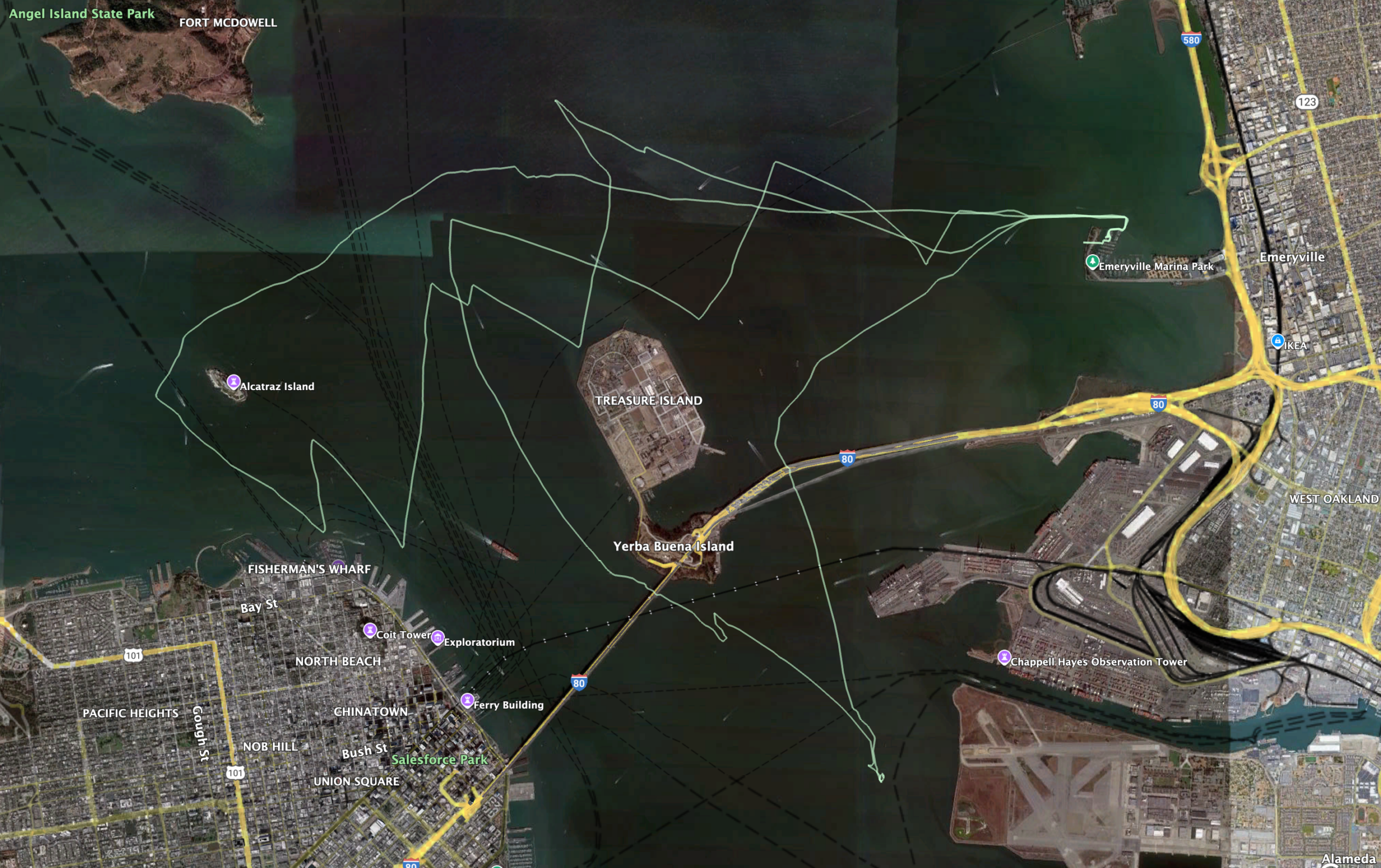
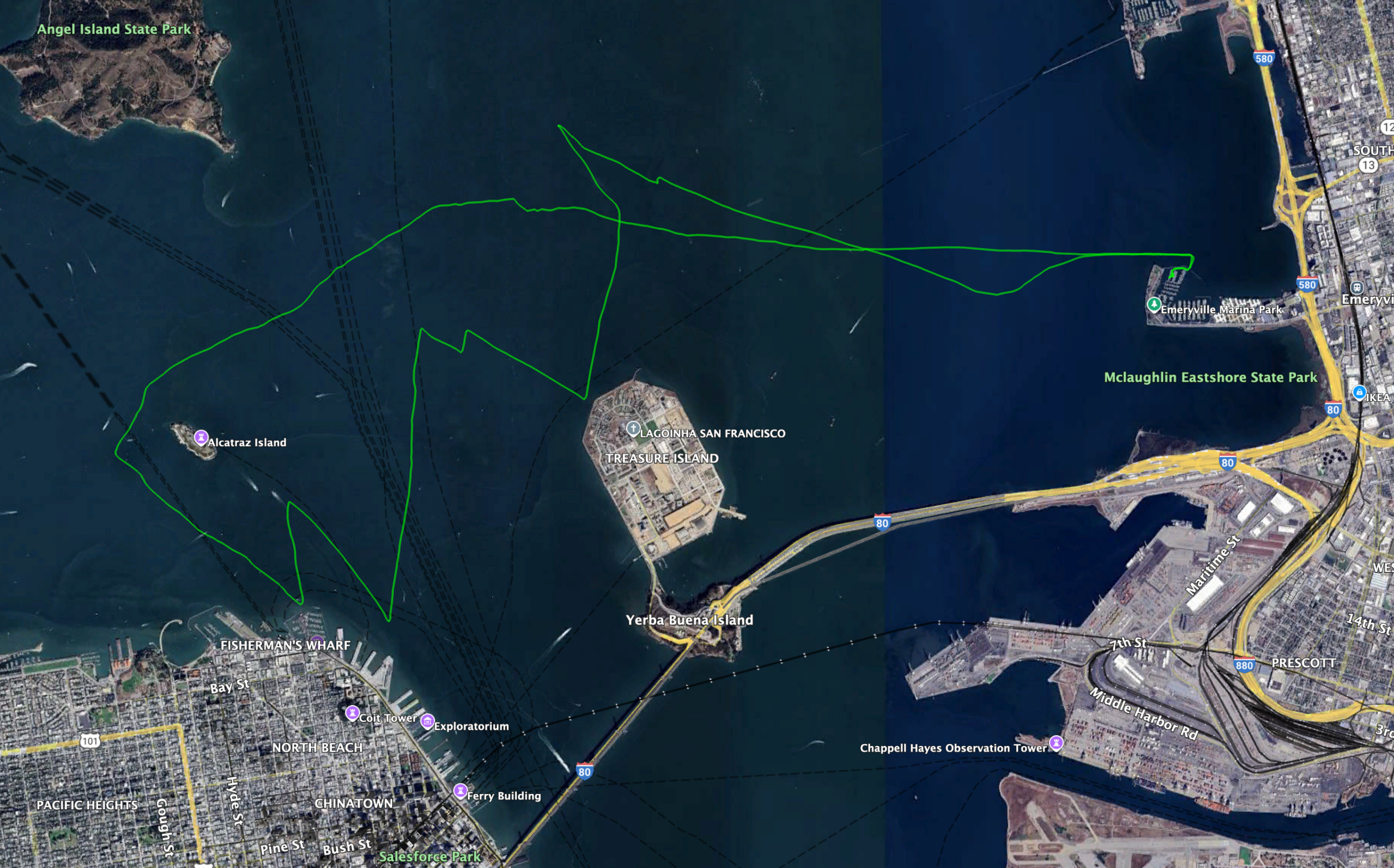
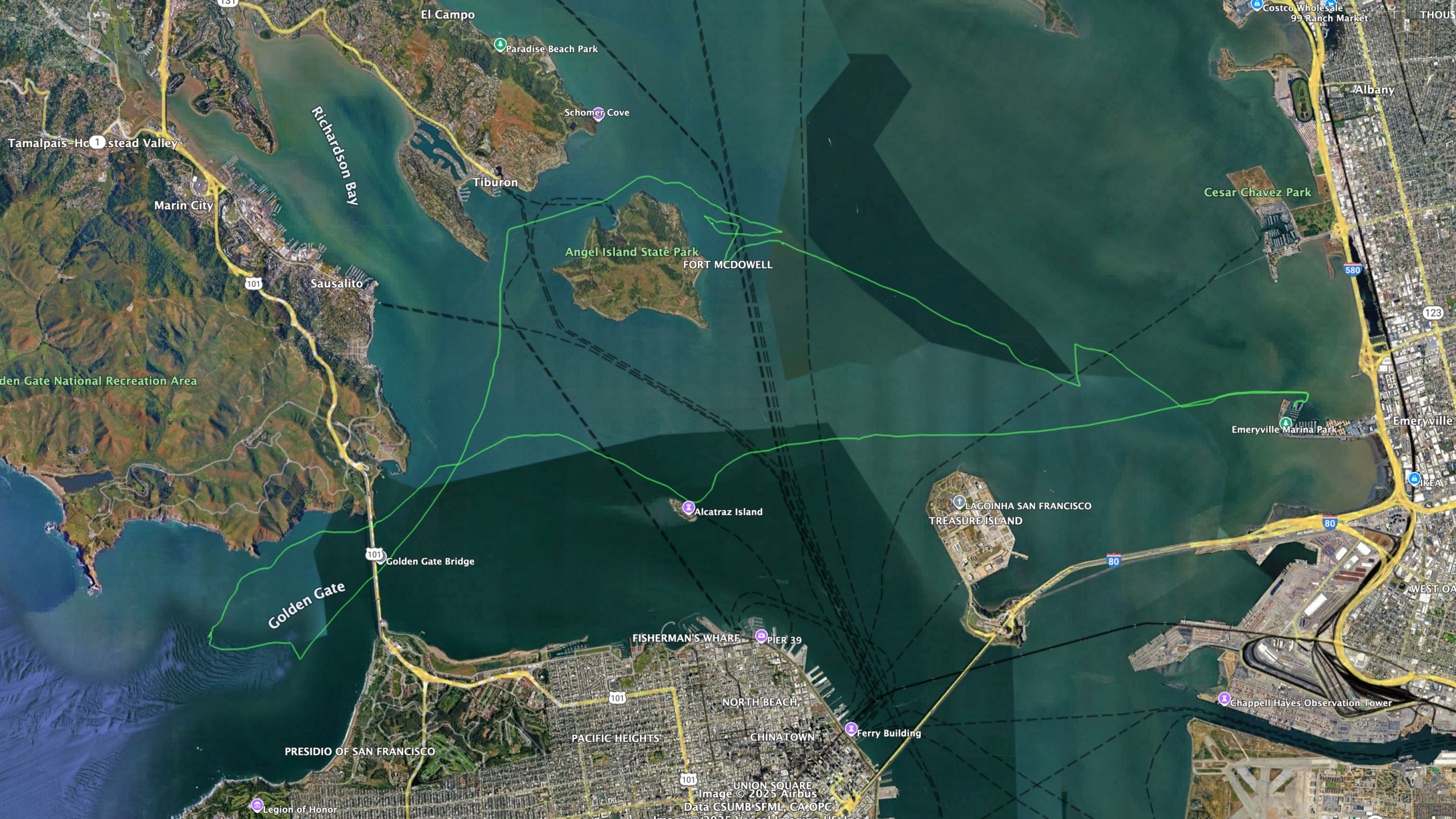
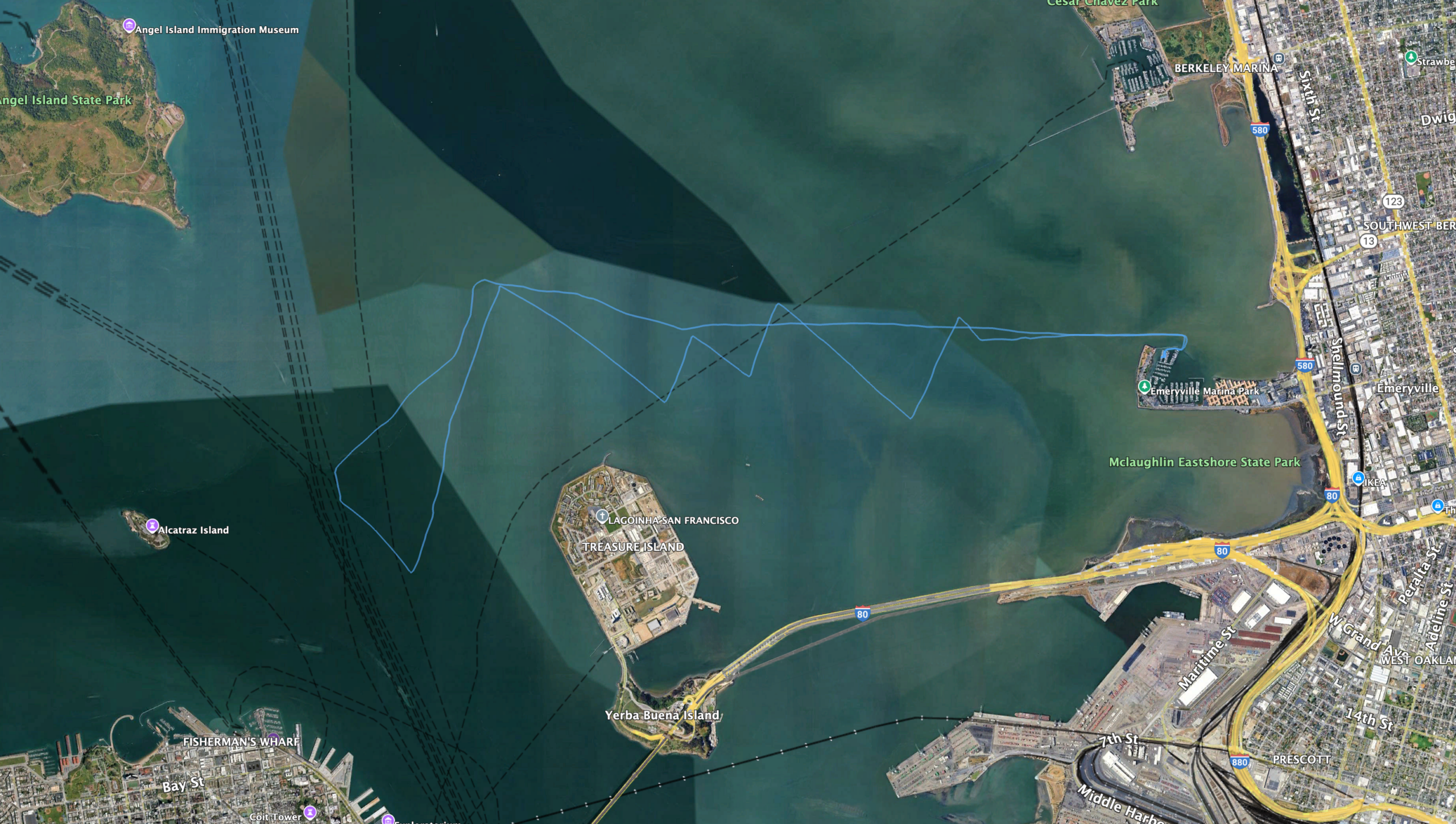
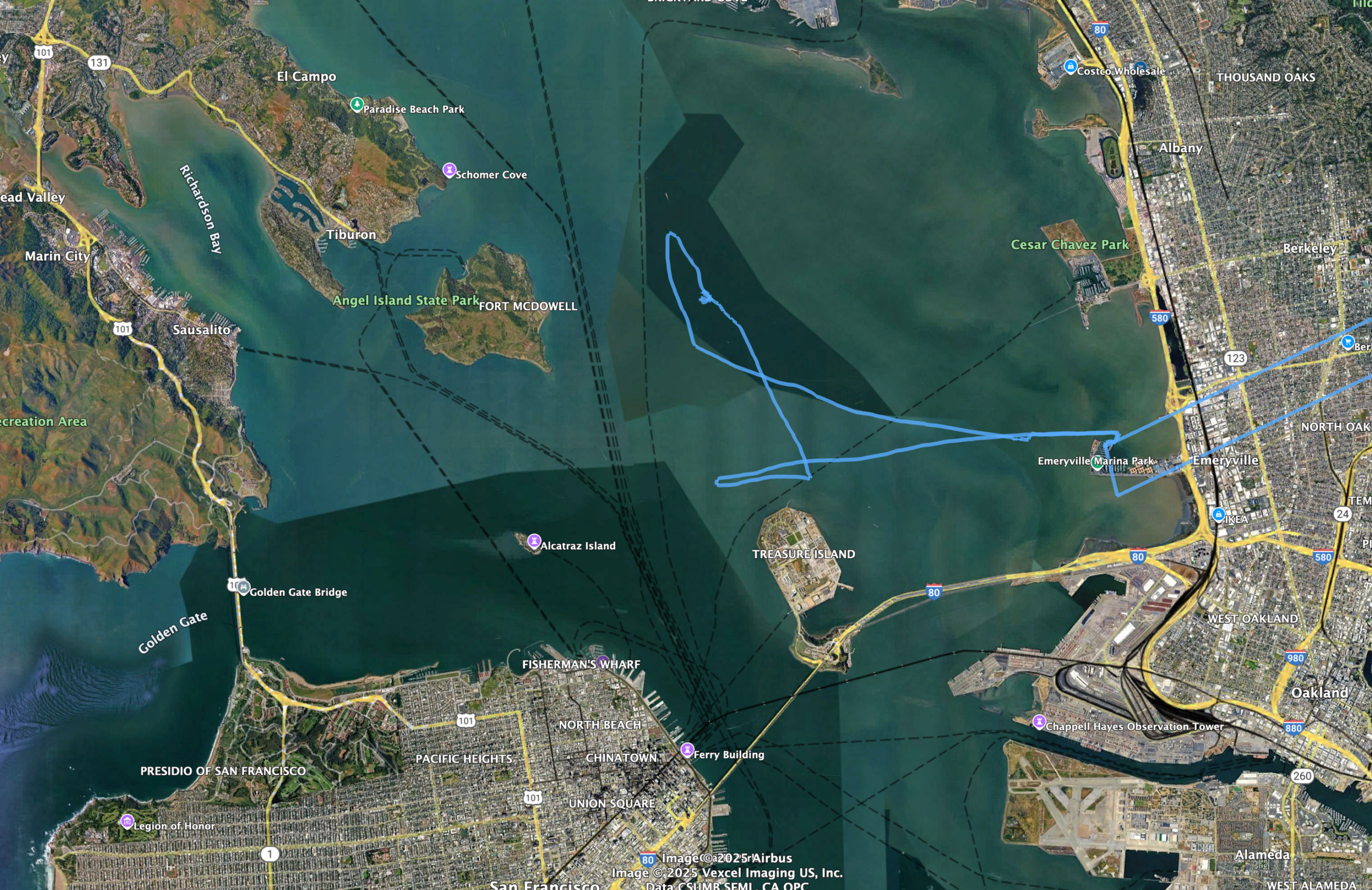
    This past Monday we sailed on the bay with friends Kevin Tompsett and Liz Roberts. This was the second week in a row that we had partially dismantled the engine and then put it back together in time for a sail (and we’re going to try for a third time this weekend). The conditions were varied, and interesting enough that I’ll give some details. First, here is our track:

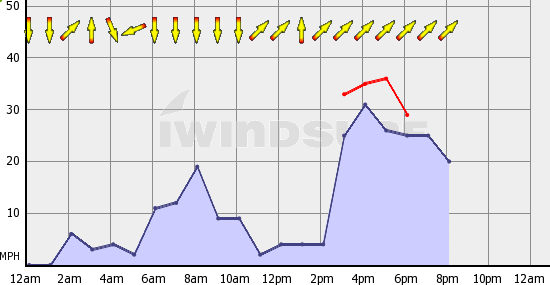
    We left the marina at 10am, a good 3 hours earlier than our usual average departure–which explains why we had no wind for the first 3 hours:

    Upon motoring out of the marina, we immediately discovered–via an unusual and alarming noise eminating from the engine room–that the drive belt of our engine was rubbing on the alternator belt, an unfortunate and potentially disastrous condition caused by my improper reassembly of the engine the previous day. We elected to motor very SLOWLY, thereby minimizing the bad sound, and in this hobbled and tenuous state we were able to make it out of the narrow channel and hoist the sails.

    Upon hoisting the sails, nothing happened. A situation caused by a total lack of wind (refer to wind archive graph above). So we sat around with the sails up for a half hour, floating for a bit. When the wind finally picked up enough for some proper sailing, we headed for angel island, and promptly sailed directly into the wind shadow of angel island. Disdaining engine usage–for reasons already mentioned–we floated around in a state of no wind for another hour or so. We sailed away from angel island a few times to reach some wind, and then elected to turn around and sail right back into the wind shadow. These maneuvers, confusing though they might seem, are well documented in our gps track above. In our defense: these things happen when you don’t particularly care where you’re going or how long it takes to get there.

    As we made our way up racoon strait (the section of water between angel island and tiburon on the mainland) the wind rapidly increased. By the time we hit the west end of racoon strait we were bowling along, way overpowered, under full jib and full main. Without fanfare, I took this opportunity to change into my foulies (there isn’t enough good raingear to go around, so I try not to flaunt my enviable ability to stay bone-dry). We started burying the leeward rail in the water, hefty splashes started coming over the bow. We partially furled the jib, which helped very little. Kevin had been playfully mouthing off about us not doing any “real” sailing earlier in the day, so I decided it was an ideal time to take him up to the bow to help me set up the staysail. Within half a minute seconds a big splash soaked him through. 🙂

    Thus outfitted with main and staysail, we sped under the bridge. When we made it a mile and a half past the bridge, the wind slacked off some, at which point we checked the time, Liz and I chose beers, and we decided it was time to head for home. The way back involved some fun sail changes–we went wing-on-wing for a while and scooted DDW (dead-down-wind) along the headlands, taking advantage of the flood current starting to pour back into the bay (it happens along the edges first). Back in the bay, we went off towards angel island a bit to get some room on the wind, so that when we jibed we would be ability to come up into the wind enough to use both foresails. Then we unfurled the jib again, and with both jib and staysail drawing well, we sailed just about as fast as our boat will go. The wind was still blowing and it’s a bit of a task to jibe with both headsails at once, so we sailed right into the lee of alcatraz for the maneuver. The jibe accomplished, we jammed along on the port tack until it was time to douse the staysail and main and crawl back down the channel at a lazier pace.

    Super light then quite heavy wind, and myriad sail combinations, all in one glorious day.

  • Another tool bites the dust

    At first, the returns lady at Home Depot didn’t wanna let me return the Dremel tool, since I didn’t have a receipt or the plastic box it came in. I pressed on.

    “It’s broken,” I said. “Try it. It turns on, but you can’t change the bits.”

    She examined the tool, turning it over mid-air. She held it gingerly, as if it were a sex toy, or a rotten vegetable.

    “What’s wrong with it?” she asked, bringing up the refund screen.

    “Broken collet,” I said, and she began typing. I spelled it out: C-O-L-L-E-T.

    A wave of joy swept through me. Success! I thought. Replacement Dremel, here we come!

    Alas, all was not right according to the returns lady. I had picked up a brand new Dremel tool, still in the box, for demonstration purposes, and now she looked at the image on the box — model 400XPR, with 70 bits and 3 attachments — and pointed to the attachments. She asked if I had those with me.

    “I don’t,” I said. “I brought everything I have.” This was definitely a lie. I had left all the good dremel bits on the boat, because we are down to a precious few of them.

    “You can’t return it without the box,” the returns lady said.

    “But it’s broken,” I said. “The tool is broken, and it’s guaranteed.”

    “I can’t return it like this,” she said. “There’s a code on the box that the manufacturer needs.” I begged. I pleaded.

    “What if you let me return the old tool, without the box, and then i give you the new box, since I won’t need it?” This calculus was beyond her. It didn’t work like that.

    The returns lady had me move over, to make way for another customer. Not a good sign. Not success. I felt like $100 was about to be pulled out of my pocket. My problem tool and I were handed off to Mike, apparently the fix-it guy at the service counter. I recognized him (I guess I’ve made too many trips to Home Depot) but tried to hide it. Mike grabbed a wrench,  depressed the collet button with his thumb, and tried to turn the collet with the wrench. It didn’t budge.

    “That’s what I spent the last half hour trying to do,” I said, trying to establish rapport. He tried again, this time with two wrenches: one on the collet, and the other on the bit.

    “I tried that too,” I said. I wanted to say: I’m not a dumbass, dude, but I restrained myself. Mike tried a few more times. By now the manager had walked over, to see if Mike had made any progress.

    “What were you grinding?” Mike said.

    “Balsa wood,” I said, which was true.

    “It’s rusted shut,” Mike said. “It won’t open.”

    “I told you,” I said. “It’s broken. I wasn’t even running it hot,” I added, which was also true.

    “I’ve never seen a broken Dremel,” Mike said, with an air of fascination. He looked up at the manager.

    “I’ve never seen a broken Dremel,” the manager said, with a sense of gravity. He seemed troubled, as if he’d just learned that the world was not round, but octagonal. I thought for a moment, and decided it was against my interest to point out that I had seen three broken Dremel tools before, in my own hands, by my own doing. I also restrained myself from blurting out: Are you guys serious? You work in a friggin’ hardware store! Instead, I lied again, and said I’d looked online and seen that a lot of people have this problem. It seemed innocent enough; how could people like me NOT have this problem

    Grudgingly, the manager said he’d take care of it. As the manager walked back to the returns counter, Mike made some joke about running a retail establishment, where the point is to sell things. Then, to me, he said a lot of people come in with “I.D. 10-T problems, saying it like that: I.D. ten dash tee. I tried not to laugh. I knew he wasn’t  comparing me to the people who can’t find the ON button, or who think their CD-drives are coffee cup holders, but I didn’t want to be mentioned in the same breath as them. I did not want to be cataloged anywhere near the Incompetents.

    The manager printed a refund slip and receipt, and I walked out into the world with a brand new Dremel, in a new case, in a new box, complete with 3 attachments and 70 bits. No money was sucked from my pocket. Success!

    Of course, halfway home, I realized I was missing one key bit: the coring bit that was stuck in the broken tool. The single best bit we owned! Curses!

    But I was too happy to turn around. Back at the boat, I swore I’d save the box, the case, and the receipt, because it’s only a matter of time before this one, too, bites the dust. Given how much work remains on the boat, it’s inevitable. I’d put money on it.

  • a frustrating work day

    For the next two months I’m unemployed. This condition is not by choice. Nevertheless I intend to avoid feelings of guilt or worry by constantly working on the boat. Today was the second day of this mandated vacation.

    Today I didn’t succeed in rewiring the nav lights (yesterday I didn’t succeed in fixing the diesel fuel leak). I spent all day doing it, and I finished maybe half of it. This is a job which I’ve already done twice and didn’t want to do even once. This third time it was because I accidentally cut through the wires while we were installing a portlight, in such a way that I couldn’t reuse the old wiring. Of course I only accepted this after taking apart half the ceiling which I enjoyed putting right back even less. Usually these things don’t faze me, they take their own time and I give it to them patiently. But today my coping system took a vacation and left me with the desire to hammer on everything in sight, to hammer the entire boat to nothingness. Nothingness wouldn’t need any maintenance.

    So I spent much of the morning stuck up in the anchor locker again, and I wasn’t wearing a smile and feeling goofy like the last time I shoved myself in that uncomfortable hole.

    This undertaking–i.e. planning to sail around the world–may be grand and romantic, but the reality of making it happen are thousands upon thousands of small victories and defeats. Each small task is necessary and requires total concentration; in such a state it becomes difficult to keep the big picture in mind. And sometimes I’d rather not think of that big picture, lest I become overwhelmed by the magnitude of the work that remains.

    Tomorrow is another day, I know. Take the bad with the good, I know.

  • A younger brother

    Matt, Jon and I went out on a rainy afternoon and caught up with Kanga, another Valiant 40 (built in 1989) owned by our new friends Jim and Jean. We’re sort of like family, our boats. Syzygy, of course, is the bolder, tougher big brother.

  • RIP, cactus. We’ll miss you.

    Oh cactus! One second you were there. And the next you were gone. We were out in the Bay, in the wind and waves. It must have been terrifying, from your planty perspective. Your spines must have been quivering, your little stumpy torso trembling in the soil.

    You were only two months old, and barely four inches tall. You hadn’t ever flowered, or heard many birdsongs. You were innocent. I know that you were a good, hearty, spiky plant. You never harmed anyone. You made our air richer, our lives warmer, and our boat a a little more homey. We’ll miss you.

    Maybe I pushed you a bit too hard. Maybe a landlubber like you didn’t like dangling from the stern of the boat. Maybe the humidity here didn’t suit your tough skin. Maybe you just missed Arizona. Maybe you got seasick and mistook up for down.. Maybe you jumped ship, hoping for the best. Or maybe you slipped into Davy Jones’ locker to put an end to it all. I don’t know. I’m just sorry it ended this way. What a tragedy, for both of us.

    RIP, cactus. You were a great plant, and we’ll miss you.

  • I’d like to thank my mom, my sister, my cousin, my cousin’s neighbor, my brother-in-law’s mechanic, my editor, my dog-walker’s friend’s doctor…

    It’s been almost a year since we started working on Syzygy, and sometimes, like when the engine wouldn’t start or when the lights didn’t work, or when the chaos of repair projects seemed to spread in every direction and leave no room to sit down (let alone think), standing up to face the pile of work head on has felt like a solitary endeavor indeed. Alas, lately I have been reminded how un-solitary, how befriended, I am — and how grateful I am for such help and friendship. So here’s a brief shout-out to all those who have lent a hand in some way. (If I’ve forgotten you, I apologize. I blame Craig, and the whiskey.)

    Liz – thanks for help on so many projects: the deck, jib car tracks, stanchions, cleats, and pushpit rails, among others. Sorry for getting epoxy in your hair and under your fingernails. It’ll come out eventually, I promise.

    Dave – thanks for letting me borrow/use the paint, throw cloths, and brushes again and again. And for the soup. And the beer. And the compliments.

    Barry and Donna – it’s so great to have such big fans. Thanks for finding the time and energy after running 20 miles to swing by. And thanks for the food/drink, also. You’re too kind. If we had more space we’d let you come with us.

    Pete and Ray, on board the Lady Margaret Rose – you’ve been our on-call boat support line. Thanks for helping out with the diesel engine, the compressor, and assorted mechanical issues… and for being friends.

    Jason and Laureen, onboard the Excellent Adventure — thanks for letting me use your table saw, and for the burrito.

    Jim and Jean, on board Kanga – thanks for such fine photography, steady praise, and for letting me copy the design of your table. Just because our boat’s older doesn’t mean it has to look it.

    Craig – thanks for the whiskey. It’s good, and almost gone.

    Jim (aka Maine Guy) – thanks for the steady stream of advice, and for letting me borrow some fine sailing literature.

    John – thanks for such fine metalwork and custom machining. We remain endlessly proud of our mast steps.

    Robert – for letting me borrow a carpenter’s square

    Scott – for donating so much electrical equipment. It’s going to good use.

    Heather, of Stitchcraft – thanks for playing banjo and singin’ up a storm on my birthday. If i hadn’t been so drunk, I’d say it was a birthday i’ll never forget.

    Lindsay Mac – for inviting me to a show, and playing a song in Syzygy’s honor. Without music I’d go bonkers. You (but not your cello, it won’t fit) are welcome on the boat anytime.

    Ryan – thanks for helping me paint the new shelves, and for assistance steering and soaking up the sun.

    Moe – thanks for the homegrown lemonade supplies. It was delicious, and helped us avoid scurvy a little longer.

    Chris and Lindsay – thanks for helping us sand and paint the rub rails, and for donating such awesome rope lights. It’s like a party on the boat, all the time!

    Matt’s dad – thanks for help troubleshooting the diesel engine, and for the oil transfer pump. There’s a seat with your name on it in the engine room.

    Jason, at Longacre Expeditions – for the swag and support and motivation.

    Zach, at Syzygy Wines – for the donation. What a kickass name! Can’t wait to raise a glass!

    Kati, at Rickshaw Bags – for the technical support with our new stowage system.

    Chris, onboard Vela – for letting us borrow your ingenious self-brushing brush. I hope Mexico is treating you well.

    Last but not least, thanks to the mystery mariner who’s left a variety of little goodies for us on the boat — a tub, zipties, some straps, a 1978 issue of Climbing magazine, a 1981 issue of Sports Illustrated, and an out-of-print guidebook to an obscure climbing area in Washington. You work in mysterious ways, amigo.

  • Bay Sail

  • WANTED: SEAWORTHY BOAT CAT

    Smart, responsible guy seeking cat to live onboard a small, clean, mouse-free sailboat. Cat must be trained to use litterbox and not get claustrophobic or seasick. Cat must not get scared near loud power tools or dig his/her claws into the sails or piss on the cushions or chew on electrical wires. Cat must not have allergies to epoxy or fiberglass. Cat must not mind swearing or heavy drinking or long, loud sea shanties. Ideally, cat would be a proficient swimmer. In a perfect world, cat would also be skilled at fishing and scaring away seagulls, and not mind drinking saltwater. International travel opportunities for the right cat. Ugly hairless cats need not apply. International applicants (with proper papers) are encouraged to apply.

    Applicants should submit a video demonstrating their abilities to Jonny.

    For reference purposes:

    *This cat does not meet requirements, and should be sent to aquatic school for further training. Pathetic.

    *This cat has sufficient swimming skills, and impressive navigational skills, but seems to lack the innate desire to attack ducks or go onto the boat. It would surely perish at sea.

    *This cat also has sufficient swimming skills, and a demonstrated ability to return to the boat, but it’s pretty slow and appears to need assistance. I’d consider this cat for an apprentice-level position.

    *This cat is perfect. Bold, assertive, strong, fearless, persistent. Note the cat’s skills with its claws: it doesn’t dig its claws into the inflatable dinghy, while it does use its claws to climb the rope. Impressive.

  • Energy Accountability: Sources

    To document our energy budget, let’s start with the sources of our power. 

    1. Sun: Solar Panels
    Planned installation: two kyocera KC 85 panels mounted on top of the dodger, currently available at Wholesale Solar for $410 each.  They are 85W panels, and can be expected to output an average of 20Ah each, so 40Ah each day from solar.  Naturally, these numbers vary wildly depending on how sunny it is, how high the sun is in the sky, and whether our mainsail is blocking the sun from hitting them. 
    daily contribution: 40Ah

    2. Wind: Wind Generator
    Planned installation: KISS wind generator, recommended by cruisers for its simplicity, quietness, and low startup speeds.  Cost: $995, not including the mounting of it.  Wind generators provide a decent amount of power in winds over 10 knots, and plenty of power when the wind is 15knots or above, but almost nothing below 10 knots.  So it is hard to estimate how much energy we’ll get from them on average.  The output curve of the KISS claims ~4A @ 5 knots (I’m skeptical) and 10A at 15 knots.  Let’s use a ballpark estimate of 4A for 10 hours a day average.
    daily contribution: 40Ah

    3. Water: Tow Generator
    We own a tow generator that came with the boat–I do not know what brand it is or anything about it (there are no markings of any kind).  It mounts to the port toe-rail, and a 100ft line is tied to a propeller on a weighty shaft that drags behind the boat.  The propeller rotates, twisting the line, which then turns the generator.  From the various things I’ve read all over the internet, I expect it will produce 6 A at 6 knots of sailing speed, and in doing so slow down the boat by half a knot.  It’s difficult to estimate how fast we will be sailing on average–we’ll probably average right around 6 knots when we are sailing, so on passage we would derive 144Ah a day, but we’ll only sail on average one of three days, so call it another 40Ah a day.
    daily contribution: 40Ah

    Total clean energy sources: 120Ah per day

    4. Diesel fuel: Engine Alternator
    We have a "Silver Bullet" 165A alternator mounted on the engine.  After breaking the mounting bracket twice, the previous owners turned it down to a maximum output of ~110A.  This is considered a "high-output" alternator (stock alternators are 65A) and will produce the remainder of whatever our daily deficit ends up being, thereby balancing our energy budget.

    Those of you out there who have more accurate estimates of daily production for the above sources, please share!

  • Motivations

    "What is it that motivates you to want to sail around the world?"

    I’m been considering this question in greater depth lately–more people have been asking, and I’ve been more closely examining my standard response.

    My standard response goes something like this: over the past decade I have experienced a substantial amount of adventuring around this country, largely through climbing and canyoneering, and the excitement and newness of those activities has faded.  Four years ago this culminated in looking for a next step, a new activity, a grander undertaking.  Learning to sail, then saving money to buy a boat, then buying a boat and fixing it up, then sailing the boat around the world–all of this combines into one very ambitious new adventure.

    I want to encounter new people and new places, I want to experience things that take me beyond my current boundaries, I want a larger universe.  The few times I have traveled abroad have been rare and precious gifts.  Each occasion has provided unequaled education and inspiration–I return home invigorated–and I constantly ask myself what is my major malfunction, that I don’t travel more frequently.

    I want to run away from it all.  Other cruisers commonly advise that escaping is a really bad reason to sail away.  Better to face your demons at home they say, deal with the root of the problem rather than running away, because the demons are really inside you and you’ll take them with you wherever you are.  They are surely right–but I also think that escape can be a good reason to go.  I want to escape those cancerous aspects of my current life that I have been trying, unsuccessfully, to excise for some time.  Sometimes one needs a dramatic departure from the current life–a discontinuity–in order to make a new start. 

    I’ve started sleepwalking through this bay area life, and I hate that more than anything.  I hate the sleepwalking!  I think it happens to everyone, it’s a natural consequence of human makeup.  It’s evolution, our minds are hardwired to turn things into habits–it’s the smart thing for the body to do.  When an activity is new it takes extra time and concentration and energy; when it becomes a habit it requires little effort or thought, and we can do other tasks at the same time.  Learning to drive a car requires concentration; you have to actually think about turning the wheel and pressing on the gas and when to do it and how much, etc.  After you’ve been driving for a few years is is completely habitual and requires no conscious thought, and because of this you can eat food and carry on a conversation while driving.  Making habits is efficient and natural.  It also robs us of the excitement and risk associated with activities.  You figure out a route to work, you learn how to complete your job the same way every day, you eat at the same few restaurants each night, you sleep on the same side of the bed with your head at the same end, every day.  Eventually the whole day, the whole month, a whole year just becomes a habit–then you’re sleepwalking.  And the insidious thing about it is that sleepwalkers don’t realize they’re sleepwalking.  The mind doesn’t give you feedback about how habitual an activity is becoming.  It just gets easier and easier until you consider it boring and you don’t think about it anymore–if you’re like me, your day job provides an example.

    Are these motivations sufficient?  A good enough justification for spending all of my money and time and putting everything on hold for five years in order to sail around the world?  Are the motivations strong enough to withstand the knowing look of a good friend (someone who can effortlessly identify and dissolve bullshit)?  Are they strong enough for my family–the watchdog reminding me to spend my life in a worthwhile way?  Am I bullshitting anybody?  Am I bullshitting myself? 

    I am engaged; Karen and I are getting married next fall.  Karen and I have talked a lot about our future after the boat, and we are optimistic and excited about that part of life too.  So the question of motivation gets harder to answer, as life on land looks pretty promising too.  The sailing trip isn’t the same no-brainer easy "yes" activity that choosing to do a hard climb, grueling canyon, or lengthy road trip once was.  People talk about how hard it is to go skydiving–when the moment comes how can you jump out of the plane–but that’s why it’s so easy–it’s only a moment.  You just have to get up your gumption, your "f-it, just do it" for only an instant and then you’re out of the plane you’re committed and reasserting your commitment is irrelevant.  It only took a second of effort.  If you had to maintain the same motivation–that level of fearlessness that it takes to push yourself out into the air during that moment–if you had to constantly sustain that day in and day out for years, it would be impossible.  Preparing for this trip has not required just one single huge sacrifice or commitment or leap; it has required years of plodding sacrifice and commitment which will continue until the moment we sell the boat.

    So you tell me: are my motivations sufficient?  Do my answers to the question justify all the time, effort, money, and sacrifice in order to take a sailing trip around the world?  My reasons for taking the trip haven’t changed, my motivations are intact.  So far I remain satisfied with my answers.  They don’t silence the internal questioning as easily as they once did–my life is more complicated than it was when we first embarked on this project–but they still quiet the doubts.  I examine my motivations much more frequently than before; my answers are correspondingly more polished, more carefully given.

  • Energy Accountability–The Currency

    The Amp-hour, Ah for short, is the currency of energy on the boat.  Every electrical device on the boat has an amperage rating; multiply the amperage rating by the number of hours it runs, and you get the Amp-hours that it consumed.  The stereo, for example, consumes 0.5 amps.  If I listen to music for 3 hours, I have used 1.5 Ah of energy.  Our battery capacity is currently about 130Ah (we will replace and upgrade the batteries before we depart).  So I could listen to music for 260 hours straight without recharging our batteries.

    The electrical panel on the boat has both an ammeter and an amp-hour counter.  We can use the ammeter to determine the precise amperage of any device on the boat, and the amp-hour counter tracks exactly how much energy we have stored in the batteries.  At any point in time we can immediately measure the effect of turning something off.  When we open the icebox to get a cold beer, half of the time it will cause the refrigeration compressor to kick on for cooling: the ammeter shows the spike in energy usage.  In this sense, the energy cost of even the simplest conveniences is noted on a digital readout.

    Everyone loves to talk about lights, to compare the energy efficiency of various lights.    We have three different types of overhead light on the boat: incandescent, compact fluorescent, and LED.  These are the same choices that we have for home use.  On the boat, we have measured exactly how much energy each uses.  The incandescent uses 1.5A, the fluorescent .75A (on the brightest setting), and the LED .05A.  The incandescent uses 30 times more energy than the LED.  In our world, that means we could use the LED for 30 times longer than the incandescent before we use up our batteries. 

    You can do some of these same calculations for your own home.  The currency of electricity in the domestic house is the kilowatt-hour (kWh), and every device has a wattage rating.  Our amp-hour is your kilowatt-hour.  To find the number of kWh consumed, multiply the wattage of the device by the hours it runs, and divide it by 1000.    A 100 watt lightbulb, left on for 5 hours, will consume 500 watt-hours; divide that by 1000 gives you 0.5 kWh.  The average cost of a kWh in california is 12 cents (US average is 11 cents), so it costs 6 cents to leave that lightbulb on for 5 hours.  Thus we come to the real reason why people aren’t doing more to save energy and to reduce carbon emissions: on land, POLLUTING IS CHEAP.  People can talk all they want, but realistically they aren’t going to change unless it directly affects them, and energy is just too cheap for people to notice the cost savings. 

    Let’s compare home to boat.  With a single conversion factor we can convert home energy measured in kWh to sailboat energy measured in Ah. You may be surprised: 1kWh = 83Ah.  The moral of that story is that it takes a whole lot of amp-hours to make a single kilowatt-hour.  Our new batteries will hold about 500Ah, and a kWh costs 12 cents, so with a little calculation you can figure out that the value of the energy stored in our fully charged batteries is $0.72.  Yeah. 72 cents.

    The purchase cost of those batteries is over $1100, but the value of the energy they store, fully charged, is less than a dollar–that’s the sailboat for you!  Remember those SAT analogies?  Here’s the sailing version:

    land life :: sailboat life
    73 cents :: 1,100 dollars

    So, energy is not cheap on the boat.  Energy is cheap on land and there’s no incentive to reduce consumption–hence the polluting nature of our modern society.  But on the boat, we will spend $1200 on batteries for storage, $1100 on a wind generator, $1200 on solar panels, and we already own a $1000 tow generator.  And even with all this money spent on energy creation, and carefully counting every amp-hour made and used, we will probably still have to run our engine occasionally to make up an energy deficit–and that will cost us in the price of diesel fuel.  As a result, on the sailboat we are motivated to monitor energy usage in a realistic, practical way, and we are directly rewarded for saving energy.  And this is only one of many reasons why sailboat life motivates us to live SIMPLY and to live CLEANLY.

  • Energy Accountability–Preface

     The front cover of the March National Geographic Magazine is titled "Saving Energy: It Starts at Home".  The article follows a few families trying to track and reduce their carbon emissions, by measuring and reducing their energy usage.  The article describes how these families have a hard time figuring out how much energy they are actually using, where it’s all going, and what techniques can legitimately alter their consumption. 

    On the sailboat, we can instantly measure the energy savings of any flip of any switch.  I got fired up reading the article, because I realized that we have so much more real information and feedback to offer.  The sailboat is a miniature model of a self-sufficient society, complete with energy creation, storage, and consumption, and it’s all on a scale that can be measured and monitored and understood.  We make our own electricity and we store it in batteries.  And we can track every bit of energy that we make and every bit that we consume. 

    Moreover, when we are out in the middle of an ocean, tracking our energy usage will not be some leisure exercise without consequence, as it was in the Nat Geo article.  If we don’t make enough energy with our few sources, or if we use too much energy with lights or the radio or any number of other devices, then the important systems on our boat will turn off.  Our lights will go out, our navigation instruments will go dead, we won’t even be able to start the engine.  Sure, we can always keep moving–provided there is wind–but we would be loathe to do so without such basic safety items requirements as nav lights at night, a radio for emergency communications, or a gps for navigation.  Keeping track of our energy usage will become a crucially important aspect of daily existence–not a mere exercise for the purpose of writing a magazine article.

    —Future installments of the Energy Accountability series will describe the details of our electrical system and our efforts to balance our energy budget—stay tuned