Syzygy Sailing

Bought a boat, fixed a boat, sailed to Australia, sold the boat.

  • Moving Forward

    It’s Halloween night, and I found myself sitting with Karen at a table in the common area of our building complex, making large To Do lists for the next few months and planning the details of how to dispose of our worldly belongings and cancel all our accounts and memberships and subscriptions and plans.  I was walking back to our apartment and it dawned on me that most other people were busy spending the night socially i.e. dressing up, drinking, partying, scaring people, trickortreating, whatever, while we were sitting in a large dark quiet room alone with big pieces of paper and magic markers and highlighters and lots of old partially completed to do lists, and then I had the thought: that would have been me a few years ago i.e. out partying and doing halloween stuff but now I’m the type that is planning a monstrous cruising trip without even remembering what day it is.  And also I thought: maybe that’s what people who really sail across oceans would be like when they planned their trip.

    Anyway, Karen and I started looking at where we will go in January.  Sure, we’re headed south, then across the pacific, that’s the general plan, but honestly up until this point I haven’t even looked at a map to decide what ports we might hit on our way down the coast. No clue.  So to buy a map and look at aerial photos on google maps and make a list of the spots we can duck into if the going gets rough–well that means we’re getting to a whole new stage of this adventure.  That’s a different kind of preparation than sanding the deck or mounting solar panels (both of which also happened today).  For one, it is a lot more fun to point at the map and say “let’s go there”.  For two, we’re at the point where I’m actively doing all those things that one needs to do in order to  depart from one’s former life start anew disembark cut ties and set out.

    And also it means that hey!, we really think it’s going to happen, just like that point in the matrix when mr anderson shows up and is about to put the smackdown on keanu reeves, who wants to run, but then starts to feel all badass and the computer guy back on the mothership says “what’s happening??” and lawrence fishburne says all matter-of-factly “He’s Starting To Believe” with incredible articulation of his words and then keanu reeves doesn’t run to the phone booth to escape but turns around and looks all cocky and then gets totally caught up in this wicked gunbattle with mr anderson but wasn’t truthfully ready to come into his own as “the One” and so gets his ass royally kicked and nearly dies via punching to the stomach followed by being hit by a train before barely escaping.  Moral I guess being that in the end (after the beat down) neo sails around the world!  Metaphorically.


  • The Things that Change

    I have been unable to write any posts on this blog for some time due to differences in opinion and vision between Jon, Jonny, and I, which to this point I could neither ignore nor discuss dispassionately. I feel the need to address some issues before I can move forward as an author of this blog.

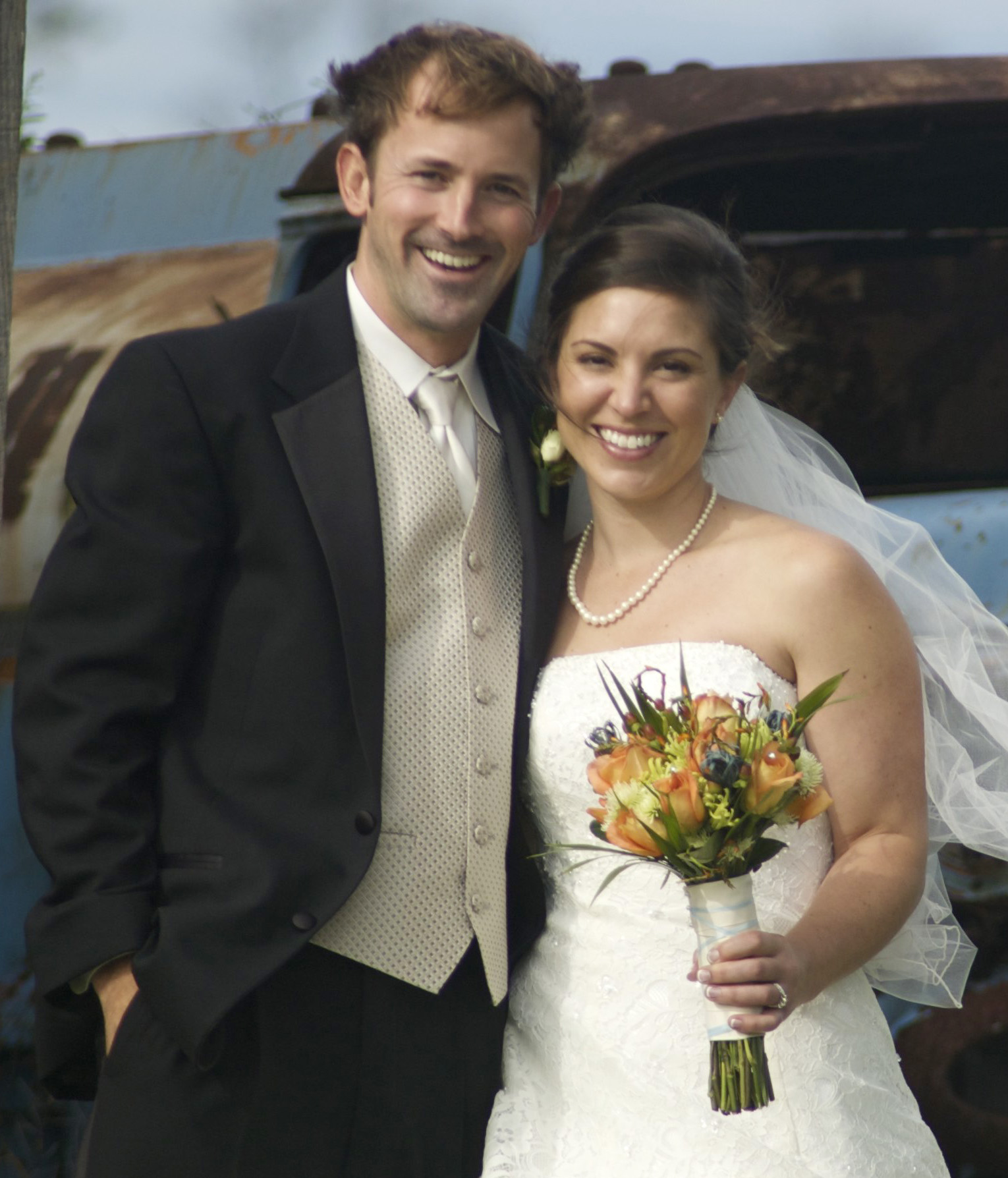
    To start with some excellent news: I got married. Karen and I have been together for a little over three years. After the first year, we started planning our future as a permanent team.  We made it official back on the family farm in NJ and it was beautiful.  Nothing has changed since we got married and I don’t expect it to: our relationship was healthy and wonderful before; our relationship remains healthy and wonderful. She is the best decision I have ever made in my life (and I told her that in my vows).


    When we first formulated this sailing plan, I had not yet met Karen (the plan was hatched about a year before I met Karen, and we bought the boat a year after I met Karen). Jon, Jonny, and I were bachelors when we decided that it would be a good idea to sail around the world–bachelors not by choice, but because none of us had found “the one”. The hitherto unsuccessful search for a woman had been the most popular topic of conversation among all three of us for a decade–far more popular and important a topic than climbing or sailing ever were. In retrospect, the only reason we ever entertained the notion of sailing around the world in the first place was because none of us were involved in relationships.

    Even though I became quickly involved with Karen, and despite differing levels of participation and commitment among Jon and Jonny, I never stopped or even slacked in my unwavering drive to fix up the boat and do this trip. The trip was never in question, for me.

    Karen loved me, and Karen knew that being with me involved a sailing trip, so Karen adopted the trip into her own plans for the future. Already interested in sailing, she took a sailing class and started imagining a two-year trip on a sailboat with three guys–only one of whom she was dating. It started out as my trip and my boat and my friends, but Karen bought into the trip in a way that has let me continue to pursue this dream.

    At some point, I crossed a threshold and Karen and I became a team, a package that comes together or not at all. Karen is more important to me than any boat or any trip. If it is a question of ______ or Karen, no matter what you put in that blank the answer is still Karen.

    My friends were happy for me because they agree with me that finding a mate is at the very top of the priority hierarchy above all else, without question. There was no need to explain why Karen comes before the boat; to say that I was in love with Karen was to say all.

    And yet I continued putting all my time and money and effort and determination into fixing up the boat and preparing for the trip–that did not change.

    Jon met a girl and fell in love, and I was happy for him. I didn’t know what that meant for Jon’s trip, but I knew that if she was the one for him then there was no telling what might come to pass.

    When Jon and his girlfriend got pregnant, he made the obvious choice for a good guy who is in love. None of his friends doubted or questioned. I back his play without reservation–the love life and the search for a mate and the relationship is more important than a boat or a sailing trip. Things change–Jon’s life has headed down a different path now than he ever expected and he is embracing the new path better than anyone else I know ever could have. He’s rolling with the changes and making the best of everything. He’s doing the right thing and I support that.

    Without a doubt, the changes in Jon’s life have had a direct effect on my own: all of a sudden he is out of the boat trip and not sailing around the world with us. And it all happened right as he was about to start putting in his time working on the boat, and take his turn paying for boat parts. But I haven’t felt even the slightest bit of anger or resentment towards Jon. The dramatic changes and responsibilities are in Jon’s life; the effects on my own life are mere ripples in comparison. More importantly, he is my best friend and I want what’s best for him and his life, regardless of the side effects it might have on mine.

    Jonny’s involvement and commitment to the trip has changed. He has decided to limit his financial contributions and the duration of his participation in the sailing. Following the successful sale of his business and recent changes in the group dynamics, he started planning for a future that does not have fixing up the boat and sailing around the world at the top of the list.

    In the initial stages of this endeavor, one of the most common questions I would answer is “how can you spend two years within 40ft of the same two guys?” and the related “how can you trust these guys with your life?”. My answer was invariably the same: although I had many other worries on my mind, I had complete confidence that the three of us guys would always get along–that was the one thing that was locked down tight. After all, I have known these guys for over a decade, and have had some close calls in extreme situations with each of them, and have counted on them with my life at times in the past where that statement was actually tested.

    The dynamic broke down, and I have been humbled. If I can be wrong about the one thing about which I was most certain, I can be wrong about anything. Anything can happen. Anything could change tomorrow–in fact, these days I expect it to.

    Some things haven’t changed (not yet at least). I continue to spend all of my time and money preparing to take a big sailing trip. I continue to get up at 6:30AM every day in order to go work on the boat (those days that I don’t work for money that is). I continue to read and research and figure out how to fix the boat and make a plan and make it happen. I continue to make lists of what we need and how to get it. I continue to drive to svendsens and lay down my credit card.

    I don’t know how long the trip will last. Now that I’m bankrolling the boat repairs by myself, Karen and I have less money for living expenses for the actual trip. I don’t know if the boat will be ready to leave in January since the rest of the repairs are all on my shoulders. Karen and I are planning on sailing for as long as the money and the fun last–when one of those runs out, our trip will come to an end.

    The plans have changed, the trip has changed, the crew has changed. The changes haven’t been of my choosing, but I can live with them. Things are rough at the moment; recently I have not enjoyed the time I spend on the boat. I feel like I am pushing through to the start, sacrificing my current happiness for a few more months before we are able to depart. I remain optimistic that the trip will happen and that all of the setbacks will have been worth the reward (or else I wouldn’t be keeping on keeping on). It’s a dangerous gamble, sacrificing current happiness for the promise of future reward: what if the promise doesn’t come through? Still I feel like it’s worth the gamble, worth the effort.  So I stick it out.

  • On to a New Adventure

    What a change.  For the past four years I’ve been part of planning a two year sailing adventure.  Now, I’ve been spending time planning a new life-long adventure.  I’m expecting a baby! And with a girl that I love!.  Wow.  You sure can get some unseen huge curves on that road-of-life thing.

    My relationship is not analogous to some random islander hook-up.  We are very much in love and very much together for the long haul.  Rather than run off to the next port-o’-call like they might have done in previous centuries, a couple of months ago I left Syzygy.  Upon arriving from Colorado, I was at Syzygy only briefly before I learned the news and headed back to Colorado to be with my girl-friend.  Contrary to being punished, I feel rewarded. My life has traded one option for the equally incredible one of raising a child.  Of course, this was definitely unexpected. I mean, I was planning on sailing around the world for Christ’s sake!  So it was a heady choice, though definitely the right one for me, and I am very much excited.  A baby!  I’ve always looked forward to the idea of kids.  Soon after I found out, a friend relayed a story that struck a cord.  He talked about how he had always thought about having kids but probably would have never gotten around to doing it.  But it happened unexpectedly to him and now he just couldn’t be happier.  I think, in the first half of that thought, there’s some truth to that for me and I fully expect that the second half will ring spot on.

    It was extremely hard telling Matt that I was having a baby, moving back to Colorado and not going sailing.  I was still a mess of emotions at that point.  My fear of the unknown was high;  I didn’t know how he would respond and so I feared the worst: his reproach, his disappointment, and the weight and the burden such a response would have on my already frazzled emotional state.  His opinion carries so much weight with me and his opinion of me is incredibly important.  It would have been crushing to me if his reaction was intensely negative.  When I broke the news though, my fears did not come to pass.  Instead congratulations came and the reassurance, “I’m not mad at you.”  It speaks to his character that despite his disappointment, which I knew was there, despite his sadness at how our lofty goal would not be shared, he chose, perhaps because he knew I needed it, to stand in support of my decision and where my choices are taking my life.

    With that fear overcome, I felt enormous relief.  I knew telling Jonny would be, while difficult and emotional, immensely easier.  A couple of hours later, as I put away a few beers, Jonny and I talked well into the night on it.

    I know I’ve chosen to miss out on an incredible adventure: attempting to sail around the world.  But I also know that this is clearly the right choice.  And there will be plenty of adventures for me in the future.  They might not be the sailing-around-the-world type, but adventures will be had.  I’m going climbing this week-end.  I’m planning a trip to France in December.  So adventures will still be had.  I feel some guilt though that I will not contribute to finishing work needing to be done on the boat.  We were on a tight timeline even before this event.  Now, minus my labor, the to-do list looms larger.  And as is usually the case, while some items get checked off, new ones get added.  It has been tough to listen to Matt and Karen describe working on the boat.  Karen told me of her excitement at refinishing the deck:  laborious work, but extremely fulfilling to see it look so nice.  I had pangs of envy wanting to be there to pitch in and enjoy.  Matt vented and despaired at new work to be done, and I despaired because I can’t say, ‘well let’s you and me double down on our efforts.  Let’s make a big push.  We can do it.’  I can’t say that because I’m not there.

    However, I certainly was not the critical component to this trip like our captain Matt, and my departure from the plan will not doom the trip.  My sailing skills are still, unfortunately, much to my chagrin and to put it nicely:  limited.  Living in Colorado has not allowed for nearly as many opportunities as I would have liked to get to know my boat: sailing her, the systems, and the work put into the boat.  I have to admit that I have never taken the boat out sailing without our captain on board, Matt and I agreeing that my skills simply were not quite up to par.  Depressing perhaps, but I willingly admit it to be true.  So my bailing certainly isn’t an impediment to Matt, Karen and Jonny going forth on an amazing adventure and doing what we began planning four years ago.  Sailing the world is still a consummate adventure filled with endless potential.  People beg off trips all the time, including many trips that Matt, Jonny and I have been on or led, and those that stay on still get to experience everything the adventure has to offer.

    We’ve all had six weeks to sit and chew on this.  Matt and Jonny, at my request, refrained, for the most part, from writing about this this until I was ready, a fact I very much appreciate, allowing me to announce this very personal news first.  We aren’t the Washington Post, here at our little corner of the blog-osphere, breaking news of Watergate to the world, and so I want to acknowledge the courtesy of allowing me to tell our little audience about this first.  I’m sure they both have many thoughts on it, some of which I hope and expect they will share here.  We have all used this blog as a window into our excitement, frustrations, and feelings for the last two years.  I will probably not have much more to blog (though a sail still awaits completion), this adventure ending for me as a new one begins.  Jonny, Matt and Karen, however, have the opportunity for an incredible adventure ahead.  My absence from it certainly doesn’t stand in the way of that.  Good luck to you!

  • Getting knocked-up and knocked-down

    Over the last five hundred years or so, if a sailor did something stupid like neglect his duties or disobey orders or insult his captain, or strike an officer, or desert the ship, or display rank incompetence or drunkenness or insubordination, or steal a dram of rum, or spit on the deck, or fail to stow his things properly or to clean his clothes adequately, there were any number of punishments that could be meted out: the sailor could be flogged, or whipped, or pickled, or cobbed, or made to run the gauntlet or to clean the head or to carry a 30-pound cannonball around the deck all day or to station himself at the top of the mast for a few hours or just to stand still until told otherwise. He could be lashed on board every ship in the fleet, or he could be tied to the mast for a week, or keel-hauled, or he could have had his feet bound and covered in salt and presented to goats for licking, which quickly went from ticklish to agonizing, because the goats don’t stop licking before the sailor’s feet have become bloody stumps. Or, if the sailor had mutinied or murdered, he could be hanged, shot, or have his head cut off, boiled, and then shoved onto a spike above decks, and left there for a week or so, to serve as an example to the remaining and hopefully far more loyal crew. Magellan preferred this latter technique. If the sailor had buggered (aka sodomized) another sailor, that, too could earn him the severest punishments. The sea was not San Francisco, man. But, if the sailor, while meeting the locals on some tropical island far away from home, knocked up a local woman, or a bunch of local women: nothing. Getting a girl knocked up was what sailors did when they weren’t sailing, like Genghis Khan, or Mulai Ismail, the last Sharifian emperor of Morocco, who had something like 1400 sons and daughters before he died. Most sailors probably never knew how many women they knocked up on their voyages.

    How far we’ve come since those days. I can neglect my duties all I want; I can make fun of Matt’s mom and call Jon a cabron and not get punched in the face; I can run off to Yosemite for a couple of weeks; I can trim the sails poorly and sail us home by some unimaginably indirect course; we can get so drunk that we decide to clean up our spilled wine with spilled beer; I can drink all of Matt’s beer and Jon’s expensive whiskey; I can spit on the deck or anywhere else on the boat I feel like it; and I’m not sure if I’ve ever stowed my things or washed my clothes properly. The boat is my oyster. If I were so inclined, I could invite over all the gay guys in the bay area with one simple Craiglist post; instead, I have tried my hand at luring girls here, all the while wondering what girl would really find this sailboat alluring. Remember: according to Google, Syzygy is a janky piece of shit, and based on the information in this paragraph (swearing, drinking, spitting, dirtying), I’m no example of fine manners, either. Finally, the biggest change of all: getting girls knocked up is decidedly not what sailors do. This is the 21st century, man, even if it is San Francisco.

    So I’m 31, and dating, and it’s always a mystery when and how to tell girls about the boat. They always have a ton of questions. Is it small? It’s like a New York City apartment, you know, a 400-square-foot studio. Is there a fridge, and a stove? Yup. Is there any headroom? I can’t jump up and down, but I don’t have to squat. Is there a bathroom? Yup, but I prefer to piss in the bay. Is it noisy? Seagulls squawk in the morning, and sometimes the wind howls in the afternoons, and sometimes the docklines creak as they stretch taut. I try to make it sound romantic. Does it rock back and forth? The boat moves a little bit when tied up, but nothing crazy. And get this: the boat is so burly that if it gets knocked over 90-degrees it still pops right back up. In fact, if it gets knocked over 120-degrees, it still pops right back up.  Do you get seasick? Not in the marina, but at sea, sure. Most sailors do occasionally. Is it cold? Not really, and I have a diesel heater. Sometimes I feel like a caveman, proving that I exist in modern times: yes, I have electricity and laundry and cell-phone service and an internet connection. Yes, a sailboat. Really, it’s not a big deal. It’s got a certain allure, I know it, but somehow I end up on the defensive.

    And here’s how I can tell my dating life isn’t going so well: I’m sleeping with Bob Seifert. Not “sleeping with” in the euphemistic sense, but literally, as in sleeping beside the book he wrote, called “Offshore  Sailing: 200 essential passagemaking tips.” I have a hardcover copy of it in my bed, and I cuddle up to it every night like it’s some titillating classic or a book of translated swooning poems. Page 27 describes one of my favorite projects: boom preventers. As if I need those. There’s no other way to put it: it’s my boat porn, full of seacocks and cockpits and blowers and interfacing electronics and deep-cycle batteries and coupling nuts and prop shafts and large tools and lubricants and docking equipment and proper bedding techniques. Talk about a change. I should be punished for my behavior.

  • Friends in the cockpit at the marina

  • Bring on another thousand

    [Reposted from my Outside blog]

    There’s a cliche about boat-owning: they say that the best two days of a boat-owner’s life are the day you buy your boat and the day you sell it. Anecdotal evidence already suggests the opposite.

    First, buying Syzygy was no fun. Buying the boat — literally paying for it — entailed electronically wiring the largest check I’d ever written to some obscure bank in Seattle, while at the same time second-guessing myself and wondering if I’d made a grave mistake. Was I buying the right sailboat? Had I taken a big hasty jump too soon? Did I just screw myself for the next three years? Five years? Life? My concerns ranged from tiny to huge, such that the actual boat-buying was fraught with anxiety and concern and distress. Which is to say that the day I bought the boat was not one of the best days of my life — 99% of the other days in my life, in fact, were better. A bad day at the dentist was better, because at least there was progress. With the boat, I wasn’t sure if I was going forward or backward. I can’t fathom how the first part of this myth was born.

    Second, I saw Syzygy’s previous owners a year and a half ago, when we met them in Mexico to take the boat for a sea trial, and I would testify in court that they assuredly did not enjoy selling their boat. I think owning it made them feel young, spirited, engaged, and adventurous, and that selling it only reminded to them that life’s circumstances — increasing age and flagging ability and mobility — had finally caught up with them and forced their hand. It took them three years to sell their boat, and it’s difficult to imagine that, at the end of the ordeal, there remained, as far as Pavlov could be concerned, any joy still associated with their boat. Relief: sure. Annoyance: yup. Finality: fine. But exultation? No way. That’s not what I saw.

    There is another cliche about boats and money that does hold true: they say a boat is a hole in the water that you pour money into. Some say BOAT stands for Bring On Another Thousand. Absolutely. Here’s how you quantify it: You think a project will cost $500? Triple it. Even if you’ve already beefed up your estimate, added some wiggle room — triple it. It’ll cost $1500, I guarantee it. It is absurd how much stainless steel, copper, and “marine-grade” parts cost. The only way to spin it positively: at least this isn’t aeronautics.

    On top of projects and maintenance, there’s the cost of keeping a boat at a marina or, if you’re really feeling flush, at a yacht club. To most sailors, this is an extra cost, in addition to rent/mortgage for a dwelling on land. When the economy sours (as California’s has), boat owners promptly stop paying their slip fees. Marinas, in turn, chain up boats belonging to such delinquents, so that the owner can’t just sneak in one day and sail away. There are a few such boats here. Apparently, you can put freedom in shackles.

    I suspect that John Tierney, in last month’s NYT science column, called “When Money Buys Happiness,” was right. He examined the relationship between money and happiness, and reported that houses, higher education, travel, electronics, and fancy cars, though expensive, tend to provide happiness. On the other hand, there’s children, marriage ceremonies, divorces, and boats. These things are also expensive, but don’t provide happiness. Tierney sums it up: “Boats: very costly, very disappointing. Never buy a boat.” I wish he’d told me that a year and a half ago.

    There’s a corollary rule about time that’s related to money and happiness. If you think a project will take 5 minutes, that means 10 hours. If you predict 3 hours, that means 6 days. The rule: double the number, and step up the unit – from seconds to minutes, from minutes to hours, from hours to days, from days to weeks, and from weeks to months. Accordingly, as projects abide by this rule, and drag on and on, it’s easy to see where the happiness goes. It swims for shore, headed to Colorado. Boat owners chase after it, and before they know it, a few years have gone by and the bank account is near empty. So it goes.

    Perhaps the best rules of all, though, I learned last summer from Tim, a friend who also owns a sailboat. We were at a bar, yabbering on about the ongoing nature of boat projects, when someone interrupted and asked if there were any general principles to sailing. He answered immediately. “Keep water out of the boat, keep people out of the water, keep the girls warm, and keep the beer cold.”

    There’s only one last important rule, lest you are prepared to lose all of that happiness, time, and money: Keep the boat off land.

  • A Little Faith…

    [Reposted from my Outside blog]

    A mile out of the channel, John lost control of his rudder. One of the shivs holding the steering cable taut between the wheel and the sector had ripped out of a piece of oak one-and-a-half inches thick. These things happen.

    John is the captain of Faith, a 40-foot wooden ketch built in 1946, that sits across from Syzygy.  John’s also the pilot of an IAR 823, a 1979 Romanian four-seater that he keeps up in Napa, and he tends to keep his cool under duress. His steering had failed. It’s not like he was a mile high and leaking fuel or something.

    He rigged up the emergency tiller. It was made of old wood, and it snapped in two like a baseball bat. John has since fabricated a new one out of a steel bar.

    With the engine still on, John raised the mizzen. The sail steadied the boat, kept her elegant bowsprit nosed into the wind. Everyone, including his eight-year old daughter Elizabeth, was fine. It was a Sunday in July. Everyone had a PFD, and dry clothes. It was windy, gusting to 30, but sunny and clear, at least on this side of the bay. Classic fogger weather.

    John radioed the Coast Guard, and asked for assistance. The Coast Guard, by then, was busy; so busy that Jim and Jeannie, who were out that same afternoon aboard Kanga, picked up a sailor in the water before the Coast Guard was able to get to him. He’d been in the water for half an hour, and was blue. He was shivering uncontrollably. His 15-foot dinghy had capsized, and he’d been unable to right it. To the Coast Guard, this was typical: vessels without steering, vessels upside down. (A couple days later, I heard someone declare “Mayday,” and heard the Coast Guard respond casually to the call.) Over the radio, they instructed John to drop an anchor, so that he’d stay put. He did.

    A little while later his engine died. He’d run out of fuel. This is when John started to get irritated, at least in recounting the story. “There are so many things Ian” — the previous owner — “didn’t tell me,” he said.  Welcome to the complexities of a new (technically old) boat. “These things” included the locations of the manifolds to the reserve fuel tanks. John is now much more familiar with the fuel system onboard Faith.

    The Coast Guard arrived, saw that Faith’s engine was dead, and instructed John to pull the anchor. I can’t, he said. He couldn’t sail up over it without steering, and he couldn’t motor up over it without his engine. A conundrum. Faith alone wouldn’t suffice. Cut it, the Coast Guard said. So he did. John’s anchor, and 200 feet of 5/16-inch galvanized chain, ended up in shallow water about a mile west of the marina. He marked the spot on his GPS.

    At last, the Coast Guard agreed to tow Faith — but with the steering all funny, the rudder shoved to starboard, they wouldn’t risk bring him through the tight turns at the entrance to the marina. Instead, they brought him to the nearest safe harbor, on the east side of Treasure Island. The next morning, John paid Vessel Assist $250 for a tow back into the marina.

    I bumped into John a couple of hours after he returned. I told him I’d seen him go out on Sunday afternoon, and had wondered if he had intended to spend the night elsewhere. He laughed. The height of his spirits seemed unwarranted, but I’m not complaining. Cheerful sailors are welcome around here.

    He recounted the details of the story, then zoomed out and assessed the big picture. “Stuff broke, but nobody got hurt,” John said. “It was a grand adventure, and a steep learning curve.” He paused, and smiled, and allowed a smidgeon of resentment to invade his sunny demeanor. “OK, it was brutal.”

    A week later, John and I tried to retrieve his tackle from the bottom of the bay. We took his inflatable dinghy, five-horsepower Nissan and all, as well as a grappling hook and 50 feet of line. We headed out before noon, before the tide and chop picked up. We both had on PFDs, and I brought a handheld VHF radio, inspired mostly by the leak John had just discovered in his dinghy. We brought a bailer, too, and a pair of oars. Perhaps we lacked faith.

    While John tended the throttle, I watched the GPS, and called out our coordinates. As we neared the spot on John’s map (which was more of a doodle), I tossed the grappling hook over, and waited for the line to draw taut. I pulled it in, dribbling water all over my legs. Nothing. John threw it out with more vigor, and I pulled it back in. Nothing. We spent the next hour motoring around, bobbing up and down in the building chop, tossing the grappling hook into the deep, and dragging it back and forth over the the silty bay floor. Nothing. All we got was water. But it was a faithful effort. I’m pretty sure John’s gonna call his insurance company, and see if they’ll spring for a new anchor.

  • Two years on a boat

    [From my Outside blog]

    In 1834, Richard Henry Dana, a classmate of Henry David Thoreau, dropped out of Harvard because his eyesight was failing. He couldn’t study — couldn’t read — like he used to. So he joined merchant marine, to sail from Boston to California and collect hides. The voyage, which began with 14 other men on the 86-foot Pilgrim and took him around Cape Horn twice, lasted more than two years. When he returned, he went back to school, got a law degree, and got married. Then he wrote a book about it, called “Two years before the mast.” It, like he, made waves.

    Edward Tyrell Channing, a professor of oratory and rhetoric at Harvard, reviewed the book in the North American Review. He wrote that it was “a successful attempt to describe a class of men, and a course of life, which, though familiarly spoken of by most people, and considered as within the limits of civilization, will appear to them now almost as just discovered.”

    Indeed, it still reads that way. There are discoveries on every page.

    The New York Review agreed, and published a review that said the book “will serve to dissipate all the illusions about the sea, which most young men are wont to cherish; they will learn from it, that the forecastle of a ship is the most undesirable of asylums, to any one who has had even a moderate share of comforts at home; and be convinced, that no reasonable man will choose it for his dwelling place.”

    Richard Henry Dana destroyed illusions alright, but he also wrote about boredom, fortitude, discipline, and perspective. He wrote adventure and tragedy, history and legend. The book, which is on most current lists of best-adventure books, still floats.

    He showed up with a chest of stuff, and spent his first three days at sea puking. Recalling that first night, he wrote: “I had often read of the nautical experiences of others, but I felt as though there could be none worse than mine; for in addition to every other evil, I could not but remember that this was only the first night of a two years’ voyage.” He goes on: “There is not so helpless and pitiless an object in the world as a landsman beginning a sailor’s life.” Weeks later, a different kind of misery: “However much I was affected by the beauty of the sea, the bright stars, and the clouds driven swiftly over them, I could not but remember that I was separating myself from all the social and intellectual enjoyments of life.”

    But he was getting the hang of it, learning about the boat and how to sail it. He wrote of “the routine of sea-life which is only broken by a storm, a sail, or the sight of land.”

    “The discipline of the ship,” he wrote, “requires every man to be at work upon something when he is on deck… You will never see a man, on board a well-ordered vessel, standing idle on deck, sitting down, or leaning over the side. It is the officers’ duty to to keep every one at work, even if there is nothing to be done but to scrape the rust from the chain cables. In no state prison are the convicts more regularly set to work, and more closely watched.”

    He spent two hours each morning washing down the decks, then filling up the fresh water bucket, then coiling up the rigging. There was no end to the work. “When I first left port,” he wrote, “and found that we were kept regularly employed for a week or two, I supposed that we were getting the vessel into sea trim, and that it would soon be over, and we should have nothing to do but to sail the ship; but I found that it continued for two years, and at the end of the two years there was as much to be done as ever.”

    The work then wasn’t so different from what is required today: “If we add to this all the tarring, greasing, oiling, varnishing, painting, scraping, and scrubbing which is required in the course of a long voyage, and also remember this is all to be done in addition to watching at night, steering, reefing, furling, bracing, making and setting sail, and pulling, hauling, and climbing in every direction, one will hardly ask, ‘what can a sailor find to do at sea?’”

    Sailing south soon became monotonous. He wrote of the “unvarying repetition of these duties,” and spelled out the predicament: “No one who has not been [on] a long, dull voyage, shut up in one ship, can conceive of the effect of monotony upon one’s thoughts and wishes. the prospect of change is like a green spot in a desert, and the remotest probability of great events and exciting scenes gives a feeling of delight, and sets life in motion, so as to give a pleasure, which any one not in the same state would be entirely unable to account for.”

    He thought of home: “Everyone away from home thinks that some great thing must have happened, while to those at home there seems to be a continued monotony and lack of incident.”

    The monotony worsened on the return trip: “The sole object was to make the time pass on. Any chance was sought for, which would break the monotony of the time; and even the two hours’ trick at the wheel, which came round to each of us, in turn, once in every other watch, was looked upon as a relief. Even the never-failing resource of long yarns, which eke out many a watch, seemed to have failed us now; for we had been so long together that we had heard each other’s stories told over and over again, till we had them by heart; each one knew the whole history of each of the others, and we were fairly and literally talked out. Singing and joking, we were in no humor for, and, in fact, any sound of mirth or laughter would have struck strangely upon our ears, and would not have been tolerated, any more than whistling, or a wind instrument. The last resort, that of speculating upon the future, seemed now to fail us, for our discouraging situation, and the danger we were really in, (as we expected every day to find ourselves drifted back among the ice) “clapped a stopper” upon all that. From saying—“when we get home”—we began insensibly to alter it to—“if we get home”—and at last the subject was dropped by a tacit consent.”

    “I commenced a deliberate system of time-killing, which united some profit with a cheering up of the heavy hours. As soon as I came on deck, and took my place and regular walk, I began with repeating over to myself a string of matters which I had in my memory, in regular order. First, the multiplication table and the tables of weights and measures; then the states of the union, with their capitals; the counties of England, with their shire towns; the kings of England in their order; and a large part of the peerage, which I committed from an almanac that we had on board; and then the Kanaka numerals. This carried me through my facts, and, being repeated deliberately, with long intervals, often eked out the two first bells. Then came the ten commandments; the thirty-ninth chapter of Job, and a few other passages from Scripture. The next in the order, that I never varied from, came Cowper’s Castaway, which was a great favorite with me; the solemn measure and gloomy character of which, as well as the incident that it was founded upon, made it well suited to a lonely watch at sea. Then his lines to Mary, his address to the jackdaw, and a short extract from Table Talk; (I abounded in Cowper, for I happened to have a volume of his poems in my chest;) “Ille et nefasto” from Horace, and Gœthe’s Erl King. After I had got through these, I allowed myself a more general range among everything that I could remember, both in prose and verse. In this way, with an occasional break by relieving the wheel, heaving the log, and going to the scuttle-butt for a drink of water, the longest watch was passed away; and I was so regular in my silent recitations, that if there was no interruption by ship’s duty, I could tell very nearly the number of bells by my progress.”

    Thank god we’ll have books, and plenty of ’em, with us, on board Syzygy. Richard Henry Dana was so overjoyed to discover six-month-old newspapers that he pored over them, again and again, for a week, “until I was sure there cold be nothing in them that had escaped my attention, and was ashamed to keep them any longer.” I’m bringing the complete works of Shakespeare.

    At sea, he saw pirates. He learned some new sea shanties. He saw “”one of those singular things called catamarans.” He sailed across the equator. He experienced a gale, and learned how to reef quickly, without “sogering.” He experienced man-killing weather for 20 days straight — weather that ripped apart sails, weather that blew “like scissors and thumb-screws.” He experienced the glory of sailing 1300 miles in seven days, and the glory of sealing a wooden boat so well that even smoke couldn’t find a way out.

    He wrote a thrilling chapter on rounding Cape Horn; it features snow, hail, fog, and sleet; violent wind; seas breaking over the bow, burying half the ship up to their chins. “We hardly knew whether we were on or off,” he wrote. He spent ten consecutive days reefed, and a few hove to. “Our clothes were all wet through, and the only change was from wet to more wet.” On the misery the wet entailed: “snow is blinding, and very bad when coming upon a coast, but for genuine discomfort, give me rain with freezing weather.”

    By and by, his experiences turned to hardened wisdom: “No time is allowed on board ship for sentiment.” And:
    “Whatever your feelings may be, you must make a joke of everything at sea; and if you were to fall from aloft and be caught in the belly of a sail, and thus saved from instant death, it would not do to look at all disturbed, or to make serious matter of it.”

    When he arrived in San Francisco, there was no bridge, no city;  just the Spanish mission (still here), and one other boat in the whole bay. There was also constant rain, cold, fog, and strong currents. But he recognized the splendor of this area. “If california ever becomes a prosperous country,” he wrote, “this bay will be the centre of its prosperity.” He called the bay “fit for a place of great importance.”

    Later, he was amazed that a letter made it from California to Boston, via an overland route from Mazatlan to Veracruz, in 75 days — “the shortest communication ever yet made across the country.” Now there’s history.

    After far too much time sailing up and down the California coast, he packed up, and headed home, loaded down with 40,000 hides, 30,000 horns, several barrels of otter and beaver skins, spare spars, a dozen pigs,  a dozen sheep, 40 chickens, as well as stores — food and water — for five month of sailing.

    One of the crew was lost, and Richard Henry Dana captured the devastation. “Death is at all times solemn, but never so much so as at sea. A man dies on shore; his body remains with his friends, and “the mourners go about the streets;” but when a man falls overboard at sea and is lost, there is a suddenness in the event, and a difficulty in realizing it, which give to it an air of awful mystery. A man dies on shore—you follow his body to the grave, and a stone marks the spot. You are often prepared for the event. There is always something which helps you to realize it when it happens, and to recall it when it has passed. A man is shot down by your side in battle, and the mangled body remains an object, and a real evidence; but at sea, the man is near you—at your side—you hear his voice, and in an instant he is gone, and nothing but a vacancy shows his loss. Then, too, at sea—to use a homely but expressive phrase—you miss a man so much. A dozen men are shut up together in a little bark, upon the wide, wide sea, and for months and months see no forms and hear no voices but their own and one is taken suddenly from among them, and they miss him at every turn. It is like losing a limb. There are no new faces or new scenes to fill up the gap. There is always an empty berth in the forecastle, and one man wanting when the small night watch is mustered. There is one less to take the wheel and one less to lay out with you upon the yard. You miss his form, and the sound of his voice, for habit had made them almost necessary to you, and each of your senses feels the loss.”

    “All these things make such a death peculiarly solemn, and the effect of it remains upon the crew for some time. There is more kindness shown by the officers to the crew, and by the crew to one another. There is more quietness and seriousness. The oath and the loud laugh are gone. The officers are more watchful, and the crew go more carefully aloft. The lost man is seldom mentioned, or is dismissed with a sailor’s rude eulogy—“Well, poor George is gone! His cruise is up soon! He knew his work, and did his duty, and was a good shipmate.” Then usually follows some allusion to another world, for sailors are almost all believers; but their notions and opinions are unfixed and at loose ends. They says—“God won’t be hard upon the poor fellow,” and seldom get beyond the common phrase which seems to imply that their sufferings and hard treatment here will excuse them hereafter,—’To work hard, live hard, die hard, and go to hell after all, would be hard indeed!’ …Yet a sailor’s life is at best but a mixture of a little good with much evil, and a little pleasure with much pain. The beautiful is linked with the revolting, the sublime with the commonplace, and the solemn with the ludicrous.”

    Take that, Shakespeare.

    He gets used to the sailor’s life. He learns that “an overstrained sense of manliness is the characteristic of seafaring men, or, rather, of life on board ship. This often gives an appearance of want of feeling, and even of cruelty. From this, if a man comes within an ace of breaking his neck and escapes, it is made a joke of; and no notice must be taken of a bruise or cut; and any expression of pity, or any show of attention, would look sisterly, and unbecoming a man who has to face the rough and tumble of such a life. From this, too, the sick are neglected at sea, and whatever sailors may be ashore, a sick man finds little sympathy or attention, forward or aft. A man, too, can have nothing peculiar or sacred on board ship; for all the nicer feelings they take pride in disregarding, both in themselves and others. A thin-skinned man could not live an hour on ship-board. One would be torn raw unless he had the hide of an ox. A moment of natural feeling for home and friends, and then the frigid routine of sea-life returned.”

    Even though life before the mast, life in the forecastle, is at times miserable, he knows it well.  “To be sick in a forecastle is miserable indeed. It is the worst part of a dog’s life; especially in bad weather. The forecastle, shut up tight to keep out the water and cold air;—the watch either on deck, or asleep in their berths;—no one to speak to;—the pale light of the single lamp, swinging to and fro from the beam, so dim that one can scarcely see, much less read by it;—the water dropping from the beams and carlines, and running down the sides; and the forecastle so wet, and dark, and cheerless, and so lumbered up with chests and wet clothes, that sitting up is worse than lying in the berth! … A sailor is always presumed to be well, and if he’s sick, he’s a poor dog. One has to stand his wheel, and another his lookout, and the sooner he gets on deck again, the better.” Nevertheless, he starts to prefer it. It offers him a better perspective on life.

    “We must come down from our heights, and leave our straight paths, for the byways and low places of life, if we would learn truths by strong contrasts; and in hovels, in forecastles, and among our own outcasts in foreign lands, see what has been wrought upon our fellow creatures by accident, hardship, or vice.”

    He discovers, approaching Cape Horn, that “a ship, unlike people on shore, puts on her best suit in bad weather.” He discovers that “no one knows what he can do until he is called upon.” He discovers a penchant for good, solid, practical boats: “There was no foolish gilding and gingerbread work, to take the eye of landsmen and passengers, but everything was ‘ship shape and Bristol fashion.’ There was no rust, no dirt, no rigging hanging slack, no fag ends of ropes, and ‘Irish pendants’ aloft, and the yards were squared to a ‘t’ by lifts and braces.” He discovers that he’s become a sailor: “Give me a big ship. There is more room, more hands, better outfit, better regulation, more life, and more company.”

    Yeah, and more money.

     

  • A glorious holiday

    In honor of Independence Day, and brave adventurers like Thomas Jefferson and John Adams, I dug up an American flag from the wet locker and hung the stars and bars from backstay. I hate to get all jingoistic, but there’s something fantastic about a boat, a flag, and the water, something almost timeless, something that people 233 years ago and long before that must also have recognized. I’d call the combination a triumvirate of awesomeness, were not that label already taken.

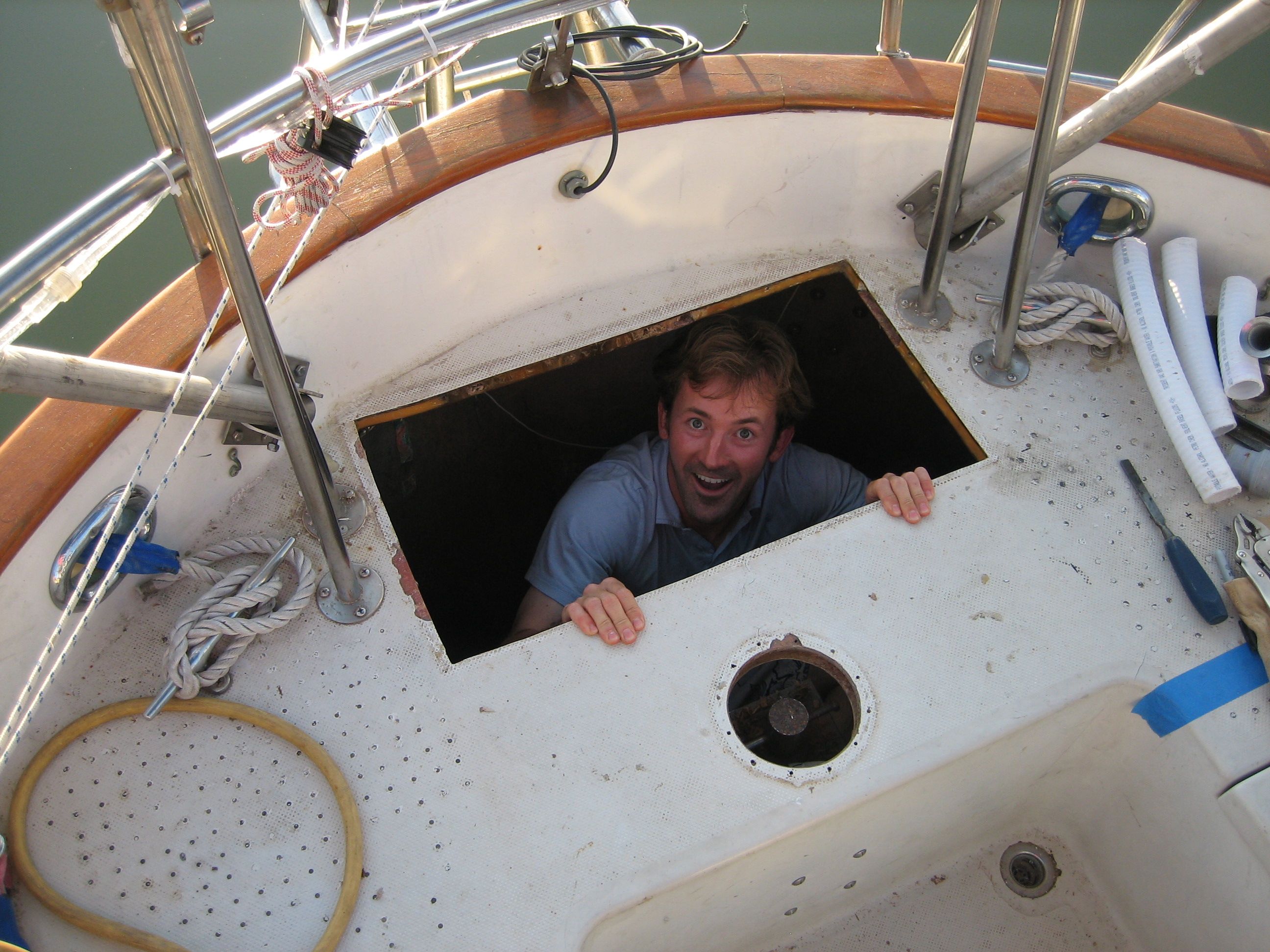
    The flag, five feet off the deck, bestowed upon Syzygy some glory. That afternoon, the wind picked up from the west, and the flag began flapping loudly, wrapping around itself, fluttering and flicking about. I was working on the lazarette — aka stern locker — and kept ducking to keep from getting smacked in the face by the flag. There’s a metaphor for a boat: sacrificing practicality for beauty, functionality for symbolism. These are sacrifices worth making, sometimes.

    So I kept my head low, determined to crank some productivity out of the holiday. Unfortunately, I kept my nose so close to the deck that the wisdom in the air almost blew by unnoticed. Almost, but not quite.

    Jim, from Kanga, stopped by, and we chatted about ideal gasket-making techniques, the better to keep the ocean out of the new stern locker. “Water’s gonna come in the hatch,” Jim said. “You can’t force it, just direct it.” He paused. “Actually, you can’t direct it, just coax it.” He recognized the poetry he’d spoken, and laughed. It applied to so many hurdles before us. I told him I wouldn’t forget it.

    An hour later, two of Jim’s friends stopped by. I was upside down and backwards in the new propane locker, fiberglassing away, and when they — a couple — yelled hello, I waved with my foot before extracting myself. They laughed because they’d spent three years fixing up (“nerding out” they called it) a 1988 Passport 42 before sailing it to New Zealand, and recognized what I was up to. Their work had paid off; their voyage wasn’t compromised by mechanical failures or catastrophes, and that bolstered my spirits. They recalled having to explain to friends that, contrary to popular opinion, sailing wasn’t all fancy drinks and white shoes; that nautical-themed pashmina afghans never entered into the equation. “You’ve probably heard this before,” he said, “but remember: It’s a lifestyle, not a vacation.” Here’s to the eloquence therei

    Two days later, still nose-down, Matt and I stopped by Svendsen’s, to empty out our bank accounts and acquire some information and goods in the process. I’d been having a bitch of a time polishing the metal of our new radar arch, so I stopped by Svendsen’s metal shop, and asked Chris for advice. He led me around the workshop, revealing industrial-grade tools I could only fantasize about. No, I could not borrow them, and no, I could not afford to pay $80/hour to have them polish the metal for me. Chris told me where to pick up jeweler’s rouge (aka grinding paste) and then, all Yoda-like, sans-pronouns, offered the best advice I’ve heard all year: “When faced with daunting task, lower expectations.” I may take him up on that.

  • Getting Over the Hump

    [ reposted from my Outside blog ]

    A month ago, on a flight to DC, I started up a conversation with my neighbor because he was flipping through a catalog of farm equipment — $150,000 tractors and combines and such. I asked what he was up to. He said he was a South Dakotan, and had picked up the catalog for fun, since his dad used to be involved in farming. We talked for a bit about machinery and engines, maintenance and reliability, lifespans and longevity. Such was our common ground. Was he still involved in farming? No, he worked for the South Dakota Department of Education, and was en route to DC for meetings with South Dakota’s elected representatives. In particular, he was eager to talk to Senator Thune about getting funding for a program to deter bullying. I asked what he meant by deter, since it seemed bullying would always be around. He said I was right, and that the program would help teachers to better deal with bullying. This reminded me of John Guzzwell’s definition of sailing: “prepare and deal.”

    I’ve been thinking of Guzzwell’s definition of sailing a lot lately. At first, it suggests a 50-50 cut: half preparing, and half dealing. That’s not the split on Syzygy these days. Lately, it seems like 99% preparing, and 1% dealing. It’s frustrating, because the adventure is in the dealing, and here the preparing part is languishing interminably. We tear stuff out. We fix stuff. We make a mess. We clean it up. We buy things. We install them. We imagine that we are improving our boat — that we are making it more suitable for long passages and burly weather and rugged conditions — and we are. It just all seems so theoretical, so abstract. We want some hard evidence, damn it.

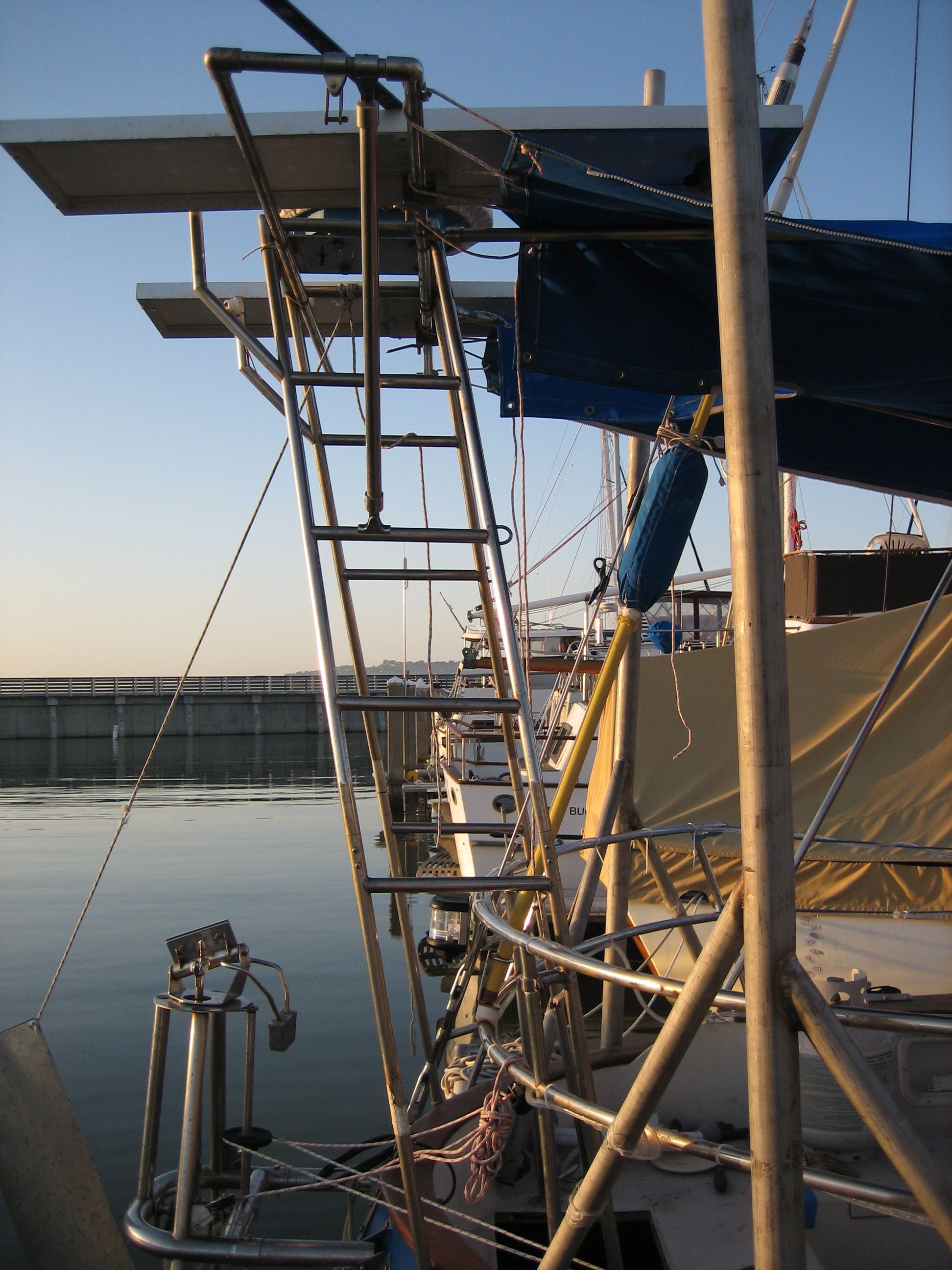
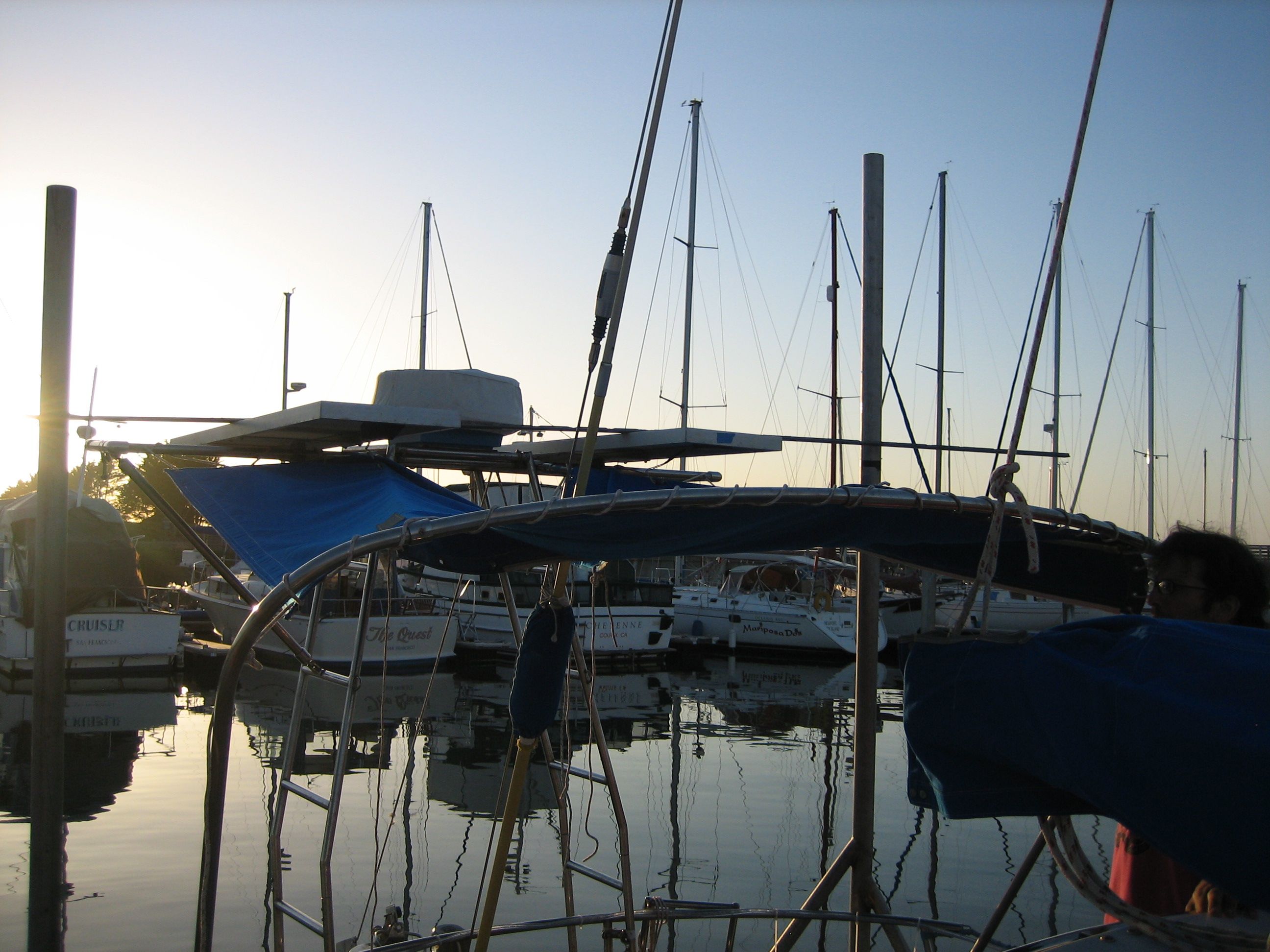
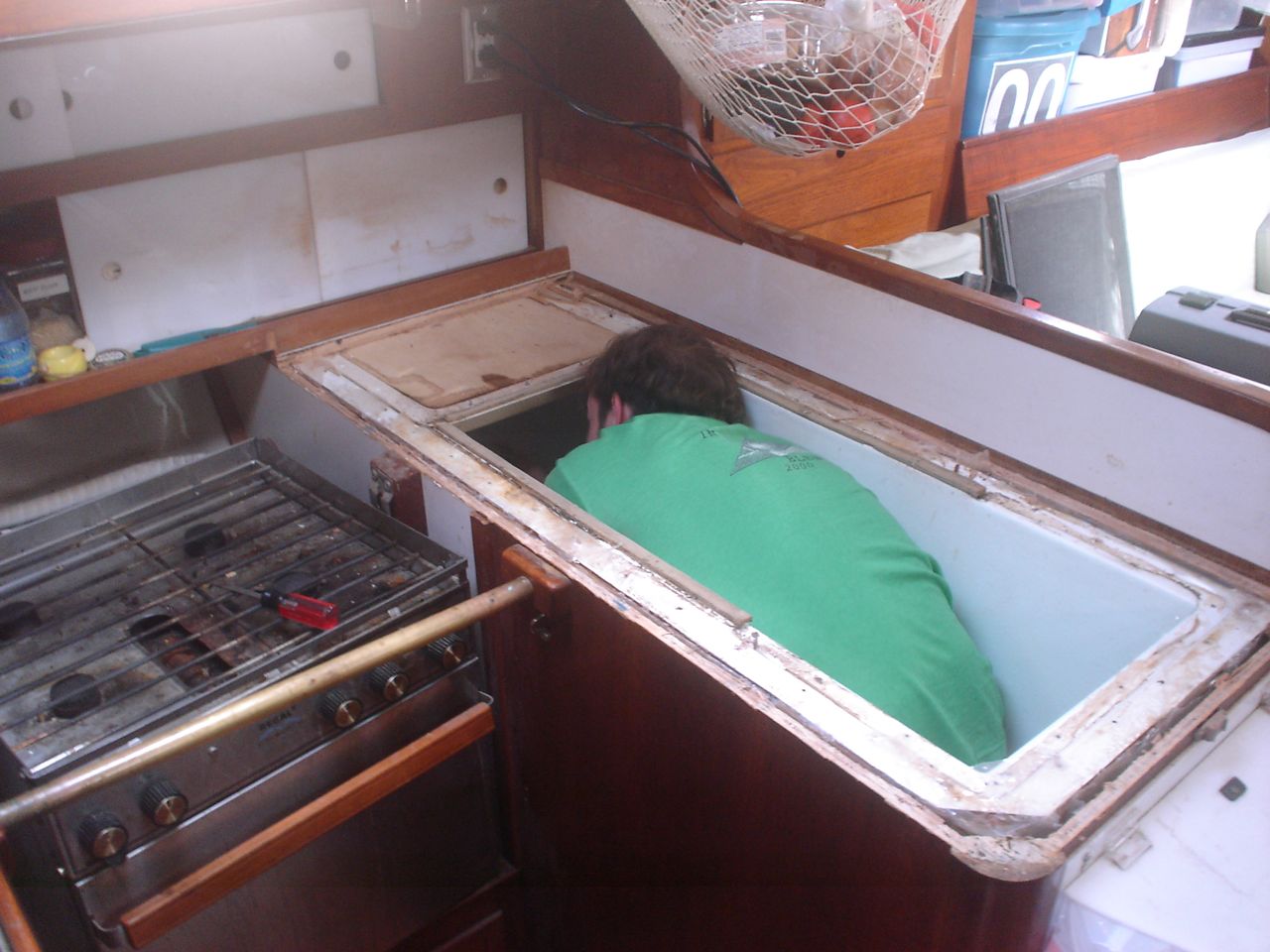
    Our current preparations —  a new (way more efficient) fridge, a new (better located) propane locker, and a new (far stronger and more adaptable) radar/solar/wind-generator arch — are, of course, bigger and badder than those behind us, and for some ridiculous reason we’ve chosen to tackle them simultaneously. Matt and I have convinced ourselves that, as such, they comprise “the hump.” Getting over the hump is what we dream about. Getting over it will mean we’re about 75% through our refit agenda, an achievement so staggering I’m somewhat scared to mention it. We imagine that the pressure, the frustration, and the difficulty will wane once we get over the hump. But John Guzzwell didn’t mention anything about a hump. He just said prepare and deal. Believe me, we are preparing. If anything, we’re preparing so much that we have to deal with it.

    Mid-hump, there’s only one consolation, and it’s not pretty. Schadenfreude bolsters our spirits, gives us perspective. Things don’t seem so bad when I think about Robert, whose boom snapped in two while sailing on a not-particularly-windy day. Things seem OK on Syzygy when I think about Jim’s mainsail ripping clear across. The pace at which we’re proceeding seems more tolerable when I think of Marcus, who spent almost $4,000, and six months, building a new fridge.

    And then there’s Stuart, who returned two weeks ago, with a new engine and $17,000 less in his bank account. Not knowing quite how to ask if he was satisfied with the result, I asked him, “Does it sound good?” “It sounds like an opera,” he said. “Wanna see?” I was glad he asked. It was beautiful, bright red and shiny as a fire truck.

    A few days later, Stuart invited me over for a beer. We sat in the cockpit, listening to seagulls squawk over fish guts on a nearby trawler.  The sun was low, the wind calm. Without prefacing it, he said, “Wanna hear it?” I said yeah. Stuart turned a switch, the oil-pressure alarm rang briefly, and then the engine started up. It purred, smooth and confident. Stuart said he might not even install sound-proof insulation in his engine compartment, given how quiet it ran. I was impressed.

    The schadenfreude faded to envy. I can’t wait to feel that way about my boat.

  • Take it from a sailor: It’s All Lumber; Throw it Overboard!

    [Reposted from my Outside blog]

    A couple of days ago, I helped my friend Liz move out of her fancy apartment. She’s lived in San Francisco for five years, and, as landlubbers tend to do, acquired nice furniture, a bunch of art, and a few acres of books, as well as all those little gewgaws that sit atop shelves and coffee tables. I was enlisted to help move the “heavy things” and “very heavy things” down three flights of stairs, so that she could transport them and store them elsewhere, until further notice. My help, unsolicited as it was, began immediately, over the phone. “Sell it all!” I said. “Put it on Craigslist. Put it on the street. Just get rid of it!” I tend to treat unwanted objects like jank.

    Liz, who fancies her possessions, likes her lot of things, was not amused. And her initial experience with Craigslist — some scam artist claiming he was hearing-impaired, hence the unusual shipping and payment arrangement — was not encouraging. She rationalized her situation. If she couldn’t sell her unwanted furniture right away, she’d put it in storage, and sell it in a few weeks. This was even worse: this was like being a slave to your possessions. “Just get rid of it!” I said again. “It’s not worth the trouble!” Liz’s uncle, a sailor, who was also there to help, agreed with me. While Liz crammed things into cardboard boxes, I offered to throw some stuff out her 3rd floor window. He said he’s already suggested that. We laughed: a laugh, perhaps, that only sailors can share. Liz didn’t laugh. She ran around packaging things up, making her life difficult, chained, apparently, to her stuff.

    I’ve always been a minimalist, but living on a boat makes you an austere minimalist. You don’t fret over things, or lament their loss. When deciding whether or not jettison possessions, the default becomes Get Rid of It. I’m sure the habit will come back to bite me in the ass later in life, but for now, I’m proud of it. I am the Jank Remover, and when the question is “To take or not to take,” I have my answer in 3 milliseconds. Beat that processing speed, Google.

    So after I carried Liz’s sofa bed, bookshelf, carpet, coffee table, and huge TV down the stairs, and had a couple of beers, I recalled a certain relevant literary anecdote. It’s a tongue-in-cheek story of three overworked, partied-out, permanently-hungover English lads — George, Harris, and Jerome (and their dog) —  who decide to rejuvenate themselves by taking a week-long boat trip up the Thames River. It’s called, fittingly enough, “Three Men in a Boat,” and it’s hilarious. The story is classic — it’s #33 on the Guardian‘s list of “The 100 Greatest Novels of All Time” and #2 on Esquire‘s list of “50 Funniest Books Ever.” It was written in 1889, and has never been out of print, and is freely available online, courtesy of the Gutenburg Project.

    The part that I thought of, and later sent to Liz, is from the planning stage of their voyage. Here’s an extended excerpt:

    George said: “You know we are on a wrong track altogether.  We must not think of the things we could do with, but only of the things that we can’t do without.”

    George comes out really quite sensible at times.  You’d be surprised.  I call that downright wisdom, not merely as regards the present case, but with reference to our trip up the river of life, generally.  How many people, on that voyage, load up the boat till it is ever in danger of swamping with a store of foolish things which they think essential to the pleasure and comfort of the trip, but which are really only useless lumber.

    How they pile the poor little craft mast-high with fine clothes and big houses; with useless servants, and a host of swell friends that do not care twopence for them, and that they do not care three ha’pence for; with expensive entertainments that nobody enjoys, with formalities and fashions, with pretence and ostentation, and with – oh, heaviest, maddest lumber of all! – the dread of what will my neighbour think, with luxuries that only cloy, with pleasures that bore, with empty show that, like the criminal’s iron crown of yore, makes to bleed and swoon the aching head that wears it!

    It is lumber, man – all lumber!  Throw it overboard. It makes the boat so heavy to pull, you nearly faint at the oars. It makes it so cumbersome and dangerous to manage, you never know a moment’s freedom from anxiety and care, never gain a moment’s rest for dreamy laziness – no time to watch the windy shadows skimming lightly o’er the shallows, or the glittering sunbeams flitting in and out among the ripples, or the great trees by the margin looking down at their own image, or the woods all green and golden, or the lilies white and yellow, or the sombre-waving rushes, or the sedges, or the orchis, or the blue forget-me-nots.

    Throw the lumber over, man!  Let your boat of life be light, packed with only what you need – a homely home and simple pleasures, one or two friends, worth the name, someone to love and someone to love you, a cat, a dog, and a pipe or two, enough to eat and enough to wear, and a little more than enough to drink; for thirst is a dangerous thing.

    You will find the boat easier to pull then, and it will not be so liable to upset, and it will not matter so much if it does upset; good, plain merchandise will stand water.  You will have time to think as well as to work. Time to drink in life’s sunshine – time to listen to the Aeolian music that the wind of God draws from the human heart-strings around us – time to… Well, we left the list to George, and he began it.

  • Sewing. Exciting!

    The sail-making kit arrived from Sailrite two months ago.  I immediately opened the box and had, on a mini-scale, the same feeling upon seeing our boat for the first time.  “What the hell am I getting myself into?”  I slowly plodded through the instructions and all of the components.  Like poking around the boat for the first time, this induced more feelings of dread.

    34 yards each of light blue and dark blue ripstop Nylon Sailcloth
    79 feet of leech line
    81 feet of 5-ply Waxed Bobbin Twine (I still don’t know what this is for)
    1 square foot of 2-3 oz Pearl Gray Cowhide Leather
    240 yards of Seamstick Basting Tape (both 1/2” and 1/4”)
    a variety of other stuff

    One last item caught my eye.  2400 yards of 1 oz V-46 White Polyester UV Thread.  Over 1.36 miles of thread.  It would take me 9 minutes to sprint a distance the length of the thread included in the Sailrite kit.  It would take our boat over 7 minutes, at top speed in heavy winds to cover the distance.  I tried not to think about how much sewing this implied.

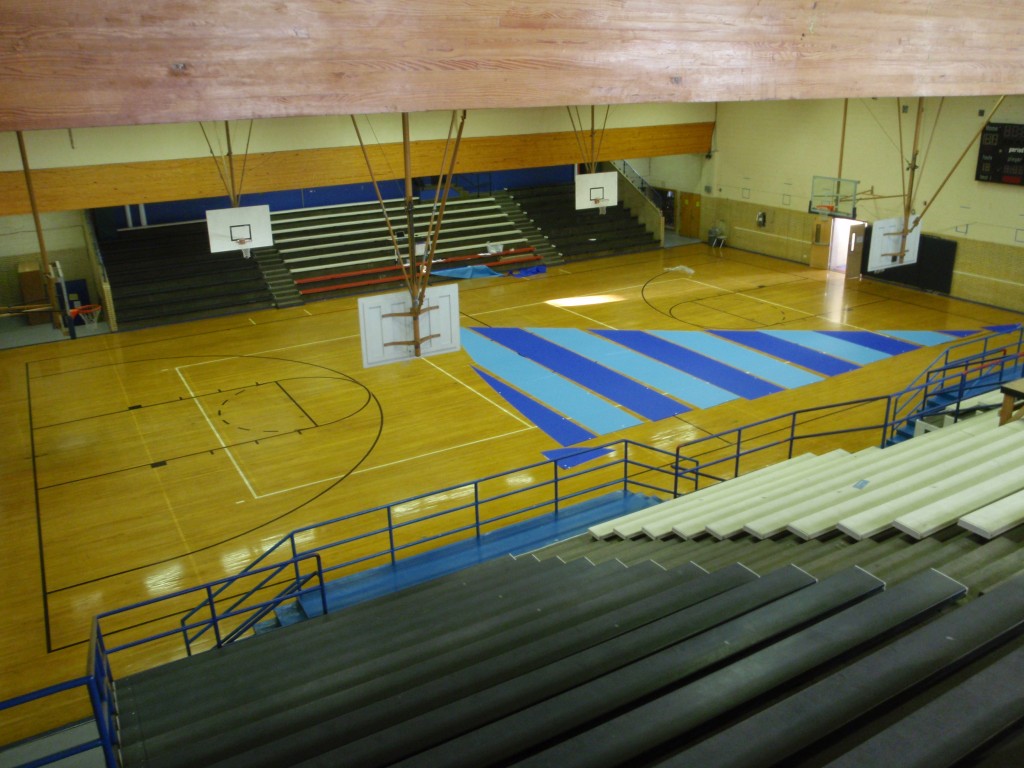
    I did know the first step, though, of this project:  securing a location to do the sewing.  My condo would not do.  The total square footage of my condo is 1126  feet, not including the balcony.  The largest room is a mere 220 square feet.  The square footage of our sail: 706.37 square feet.  My condo would not do.

    I had been to another sail-making shop though, when we needed a patch put on our jib.  They had an enormous wood floor that immediately made me harken back to my high school basketball days.  The perfect location was so obvious.  I even work at a school… easy access!  A week later I sheepishly asked my principal at my school if I could use the gymnasium after school the next week.

    “For what?” she inquired.

    “I’m sewing a sail for our sailboat.”

    “Wow.  Do you know how to make a sail?”

    “No.”

    “Do you know how to sew?”

    “No.”

    She laughed and wished me luck.

    A week later I carted into the gym a box of supplies, including my sewing machine, some scissors, pens, black clips and scotch tape that I borrowed from school, and the Sailrite kit.

    I then left and fetched a 48-inch wide dust mop.  Because I knew the floor was gross.  No way was I laying our brand new thousand dollar sail down on that floor.

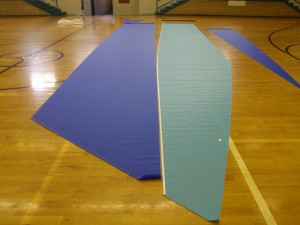
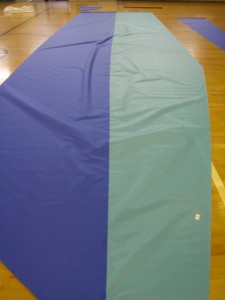
    Sail laid out on gym floor
    Sail laid out on gym floor

    I pulled out the scraps they include for patches and making sure the settings on your sewing machine are correct; they would be my practice test runs and only the fourth time I had ever operated the sewing machine.  I hemmed and hawed, but finally set up a work station in the middle of the gym floor and went at it.

    And it was surprisingly easy!

    Step 1: Take a roll of Seamstick basting tape and methodically roll it on to the edge of one of the sail panels.  
    Note: Be careful to keep the sail taught but not stretched while applying.  There can be no bunching or buckling of the sail or of the basting tape.

    Step 2: Line up two panels.  Remove backing to basting tape.
    Note: a little at a time is best.

    Step 3:  Apply one sail panel on top of another, lining it up on the marks drawn on the sail by Sailrite.

    Note: This time both sails must be taught, but not stretched, as they are joined together.  
    This results in awkward positioning wherein one knee is on the union of the sail panels where they have already been basted so as to provide the main anchor point for proper sail cloth tensioning for the next basting. The other leg, so as not to be on the sail cloth, thus providing another anchor point on the sail, resulting in improper tensioning, and consequently buckling or bunching of the sail cloth, must wrap on top of and behind the other leg.  Now while balanced here, one hand pulls taught one sail, the other hand pulls taught and applies the other sail to the basting tape.  Yoga helps.  The position I would get into, incidentally, looks a little like a kneeling eagle pose.

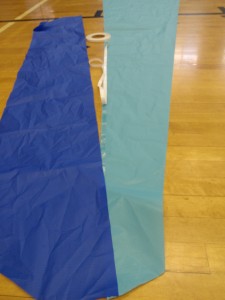
    Sail with basting tape applied.
    P5060244
    Basting the panels together.
    Panels basted together.
    Panels basted together.

    Step 4:  You should only do the joining of sail panels in small increments so as to ensure a proper sail union.  “Basting is a  critical step in sail-making.”  So says Sailrite.  Therefore, repeat step 3, 8 inches at a time, and just to join two sail panels you might be at this for 40 feet.

    Step 5:  Roll up both panels from each end so that only the seam is showing.  
    Note: Rolling the 4 foot wide panels at the head (top) of the sail by yourself is easy.  Rolling 40 foot wide panels at the foot (bottom) of the sail by yourself is not.

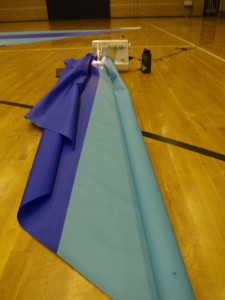
    Panels lined up to sewing machine.
    Panels lined up to sewing machine.

    Step 6:  Finally some sewing!  Drag entire ensemblage over to sewing station and begin to sew.  
    Note: A 45 degree zigzag stitch is proper, 3 mm wide.  No backing of the thread is required at the edges because luff tape will cover and anchor the strands of thread.  Be sure to sew as close to the edge of the seam as possible.
    picture

    Step 7:  Repeat Step 6.  Two rows of zigzag stitching are required at each seam.
    Note: Three rows if using a straight stitch.
    Note: On 40 foot sail panel seams, two rows of zigzag stitching will require you to change the bobbin on a standard consumer sewing machine a minimum of three times.  This will be annoying.
    Note: On 40 foot sail panel seams, two rows of zigzag stitching will take beginning sewers 2 hours.
    Note:  Your back will hurt from leaning over.
    Note:  Your eyes will get fuzzy from staring at one spot for hours.
    Note:  Your left leg will cramp from being awkwardly positioned to the side while controlling the speed with your foot on the footpad.
    Note:  Your right knee will hurt from being on the ground for hours.  Even if wearing a knee pad.

    There you have it.  Sewing the sail panels together in 7 easy steps.  All it takes is time.  Lots of time.  Next comes the reinforcement patches on the corners and the edges.  Both do not seem as straight forward as stitching in a straight line for 40 feet.

  • For janky pieces of shit, Syzygy is #1!

    [reposted from my outside blog ]

    A year ago, back when Syzygy was named Sunshine, and her port of call was listed as Portland, OR, I set to scraping off the old name and cleaning up the paint in preparation for applying the new vinyl letters.

    The boat was up on stilts, then, at a workyard in Berkeley, so I had to climb a ladder to get aboard. I dragged the ladder back a few feet, closer to the stern, and climbed up five or six steps and from there began scraping off the letters. The letters were white vinyl, about eight inches tall, on blue paint, and it was just luck that I started on the left side, and not the right, so that after a little bit of work SUNSHINE became UNSHINE. I giggled at first, then thought about the irony, or the truth, as it were, in the new name. I sorta wished we hadn’t sent off our paperwork to the US Coast Guard with the name Syzygy, because UNSHINE was so perfect. It was our style. It was unique. And it was so easy — I’d barely started, and the job was already done. Voila, name removal and reapplication complete! If only other boat projects could be like that.

    But Syzygy (which was my grandfather’s favorite word) it was, so on with the work I  went. Maybe it was an omen, this little taste of completion well before it was deserved. Or maybe it was an omen that before things would be completed, they would lack a certain luster. Or maybe it was an omen that painting (or preparing to paint) is a bitch. Or maybe the omen was this: there will be jank. Lots and lots of jank.

    Now, it has recently come to my attention that my sailboat is the 5th thing that pops up if you Google the phrase “janky piece of shit.” If you don’t use the quotes in your query, my sailboat pops up 8th on the list. Given how much there is to be proud of onboard Syzygy, the amount of satisfaction I gain from this little internet phenomenon is perhaps disproportionate to its actual value. I’m not concerned though; you take from life what joys it provides, and if those joys come wrapped in a package with a return address from Janky and Co., in Gary, Indiana, you don’t return the package to its sender and ask for a refund. You open it up, and enjoy the contents, even if the contents are pieces of crap, as janky as janky gets. So that’s how it is, an that’s why I now officially want my boat be at the top of the online janky list. When people around the world look up “janky piece of shit,” I want THE answer to be Syzygy.

    This is no unsubstantiated desire, as Matt, Jon, and I derive great (dare I say intense?) pleasure from removing janky parts from the boat. Lately, I’ve discovered a new twist on the jank removal: if I’m good, I can double the fun by selling the janky stuff that we don’t want. This being America, eBay and Craigslist being only a few clicks away, perhaps this should have occurred to me earlier. I would never claim to have overlooked this option because I’m such a nice guy. No, I overlooked this option because the sheer removal of janky pieces of shit overwhelmed my senses to such a degree that rational thought was unavailable to me for the next half hour, and by then it was too late, because by then the janky piece of shit was in the middle of the dumpster. 

    So I’m not sure how this realization came to me; I blame poverty. And for the poverty, I blame the boat. Take warning, would-be-boat-owners! A sailboat will do that to you. It will eat your money, and force you to sell your trash, and trick you into thinking you are some kind of entrepreneurial genius for having thought of (aka resorted to) it. Take it from me!

    Nevertheless, I sold the old metal radar arch for $300. I sold the old fiberglass propane locker for $150. I sold the old 15-gallon water heater for $100. To think: people want to pay me for the crap I don’t want! Amazing! What a world! Gooooooo capitalism!

    Some jank, though, is so janky it’s hard to get rid of. I tried to sell a few cans of freon refrigerant from 1989, but my listing was removed from Ebay, because I’m not licensed by the EPA to sell that stuff. So what am I supposed to do with it? It’s janky, it’s toxic, and it eats holes in the Ozone layer — and some poor sailor out there is still using a refrigeration compressor older than I am, and probably could use it to keep his lemonade nice and chilly. I’m sure it’s illegal to ship the stuff, too. A conundrum, no? All I want to do is get rid of this jank, but the law won’t let me. Curses! I sure would like to barter it for something… ehem ehem.

    So here’s one more effect of boat ownership: me and janky pieces of shit are now best buddies. In fact, I’m thinking of pointing jankypieceofshit.com to syzygysailing.com. Not bad, huh? That’s probably because I don’t own any more, because I’ve weeded them all out. It’s also probably because my last name isn’t Janky.

  • The solstice.

    Just cooked a great meal with karen on the boat on an uncharacteristically balmy calm day and watched the sunset go down over the water while sitting on the soft green grass splitting a bottle of cold white wine and eating chocolate mousse out of a plastic container from the corner store to mark the longest day of the year.  Glorious!

  • Gaining Perspective

    [Reposted from my Outside blog]

    In late November I flew to the East Coast to visit my family for Thanksgiving. It was the first time I’d spent 10 days away from the boat in six months. They gave me an earful, my family.

    On a walk in the woods with my mom, she asked if I was “prepared to weather a downturn in the economy.” I hemmed and hawed, and admitted all my savings were sunk into the sailboat. Then I tried to explain that cruising is really cheap — you load up on rice and beans, and just take off and go, like a climbing road trip. She seemed unconvinced, and rightly so.

    My cousin Myles asked if I was done fixing up the boat; I told him it was complicated, that the boat was sorta like his house — a huge, ornate 1880’s Victorian, perpetually mid-repair, in a historic town. He grasped the situation immediately, and said, “So you’ll never be finished.” I smiled. “Exactly.”

    My cousin Joel told me to read “Adrift” — Steve Callahan’s terrifying story of shipwreck and survival — and I told him I had, and that if he thought that story was good, he should read “Survive the savage sea,” by Dougal Robertson.

    This got them — my whole extended family, now — riled up, and the comments began to pour forth. Myles, reasoning that piracy was more of a threat than sinking, suggested that I acquire cannons. My dad chimed in: torpedos! Myles: machine guns! My cousin Jim: Missiles!

    I opened another beer, and tried not to get defensive. Maybe I should bring their phone numbers, so that I could have the would-be-pirates call them directly to negotiate the ransom?

    While home, I also added a few more names to the list of People Who Wish They Could Come Sailing With Us:

    -My mother’s boss
    -At least one of my folks’ neighbors
    -Half of my friends, including one who’s just finishing grad school and afraid to look for a job
    -At least one former coworker

    Heckling and eager stowaways aside, it felt good to get away from the boat and gain some some perspective. Onboard Syzygy, it’s easy to get so involved, so focused, so lost within a project that it’s impossible to decompress or relax. At the same time, being away from the boat was also disorienting. Soon enough, withdrawn from the boat, I found myself getting antsy. I chalked it up as an urge to tinker. The urge to repair and build was so physical — like I needed to hold tools in my hands lest they curl up and wither — that I had to wonder if the sailboat thing hadn’t changed me.

    I climbed up onto the roof of my folks’ house and did some caulking. I put down some new roof with my dad. I cleaned the gutters. I tried to go with the urge, but this was just regular maintenance. I still yearned to build something, and the opportunity that presented itself came, courtesy of my mother, in the shape of… a squirrel-proof bird feeder. It was no sailboat, but it was a challenge: could I use a little ingenuity to outwit mother nature? (The answer, sadly, was no. Squirrels are tenacious little things.) As I dug through the garage looking for parts, I wondered: do I enjoy asking for trouble? Do I tend to invite problems my way? In another sense, I was looking for an opportunity to solve a problem. Such opportunities are often compelling. Can I get up that rock? Can I get up that mountain? Can I get down that canyon? Can I run those 26 miles? Or how about: Can I fix up an old sailboat and sail it around the world?

    I spent last week away from the Syzygy, too, visiting my family again. The urge to tinker was still there — I climbed up the Chestnut tree in the backyard and hacked off some dead branches, and sanded and painted the rusting wrought iron railings on the front steps — but even more evident was the urge to nestle in, stay put, have some coffee and just relax. After all this fixing-up-a-sailboat work, I needed a break. I needed to, as they say in the South, “set a spell.” So I sat. And that’s when I noticed the coolest thing: I’ve changed. I’m way more patient than I used to be (though still no saint). I’m way more eager to immerse myself fully in a task. And I’m more comfortable without distractions, just me and my thoughts.

    This last realization occurred near the end of a six-hour, coast-to-coast flight, when I noticed the passengers near me getting fidgety, almost childishly so. I sat, knees bent, safety belt buckled, neck squished against one of those godawful airplane headrests that comes standard on those godawful airplane seats, and thought: this is nothing. This aint no sailboat, and this aint no ocean.

  • Refrigeration

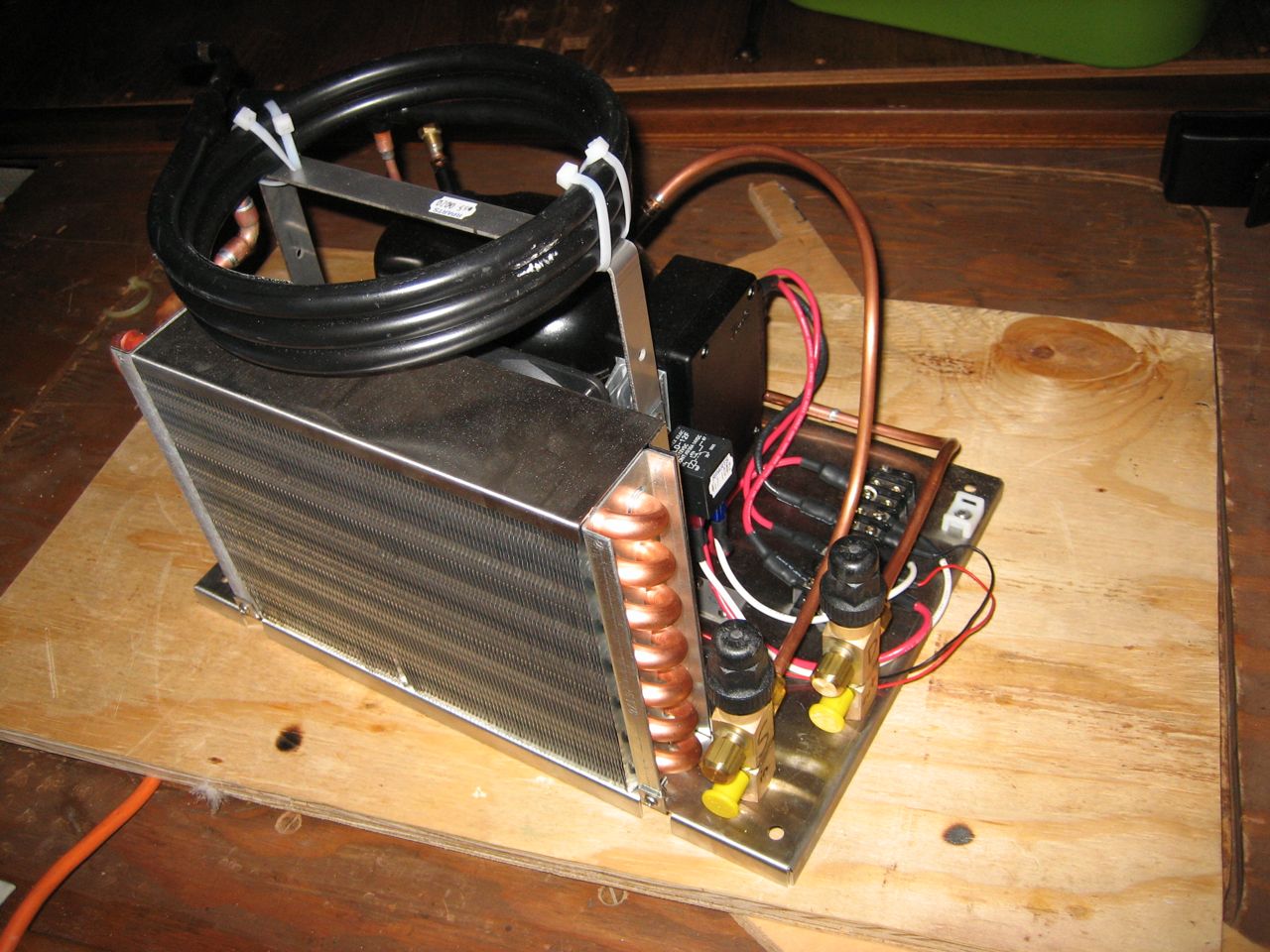
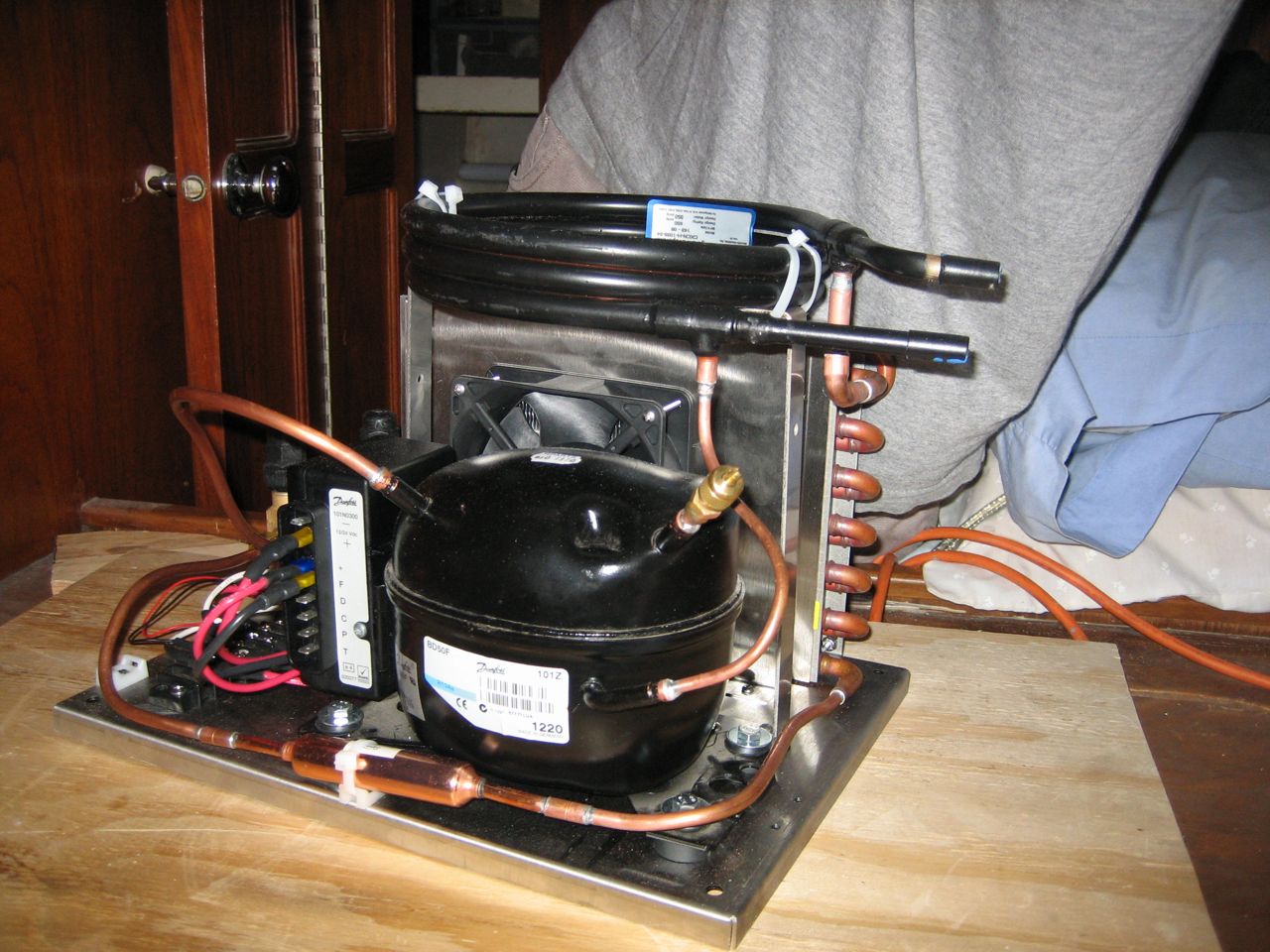
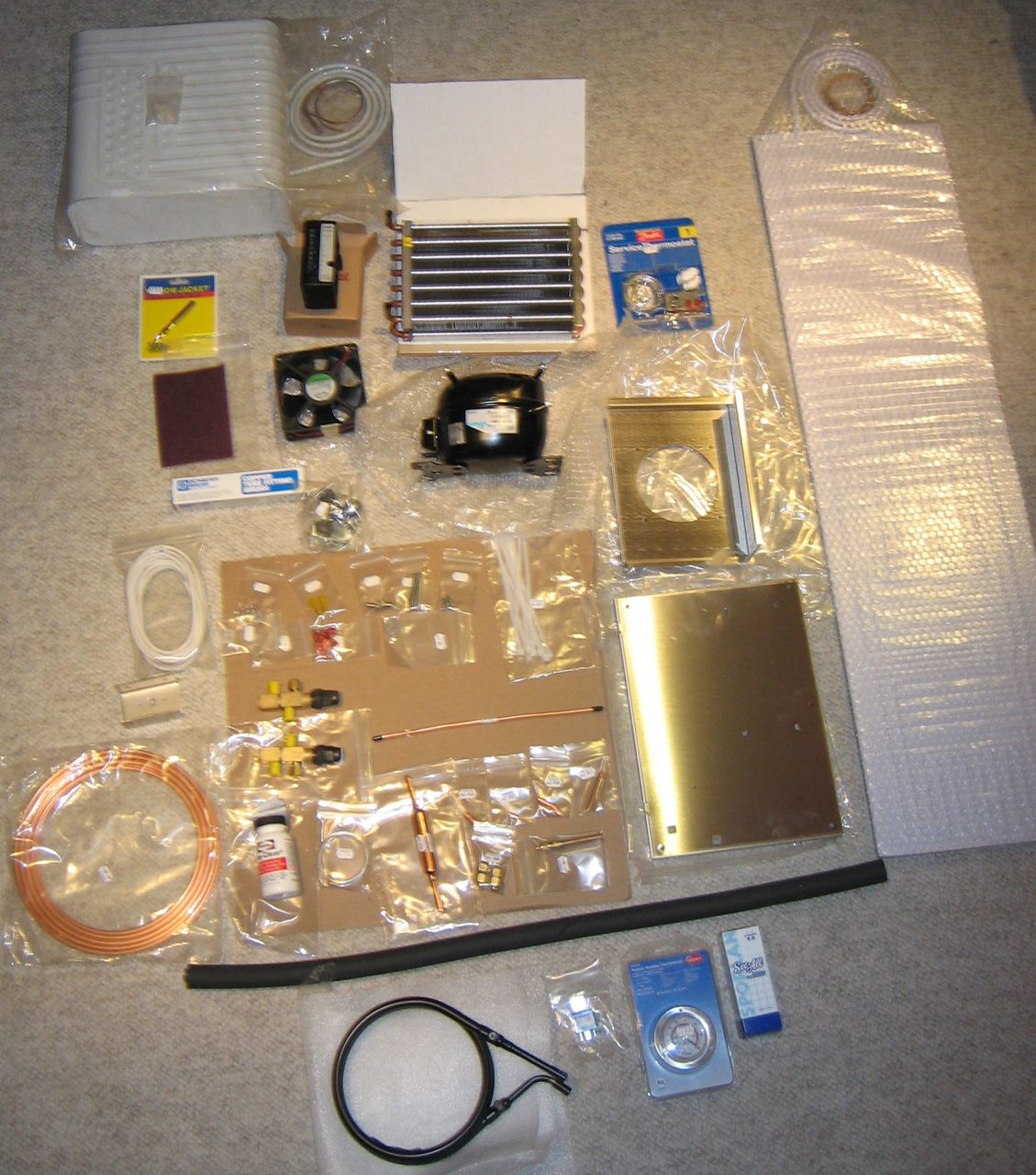
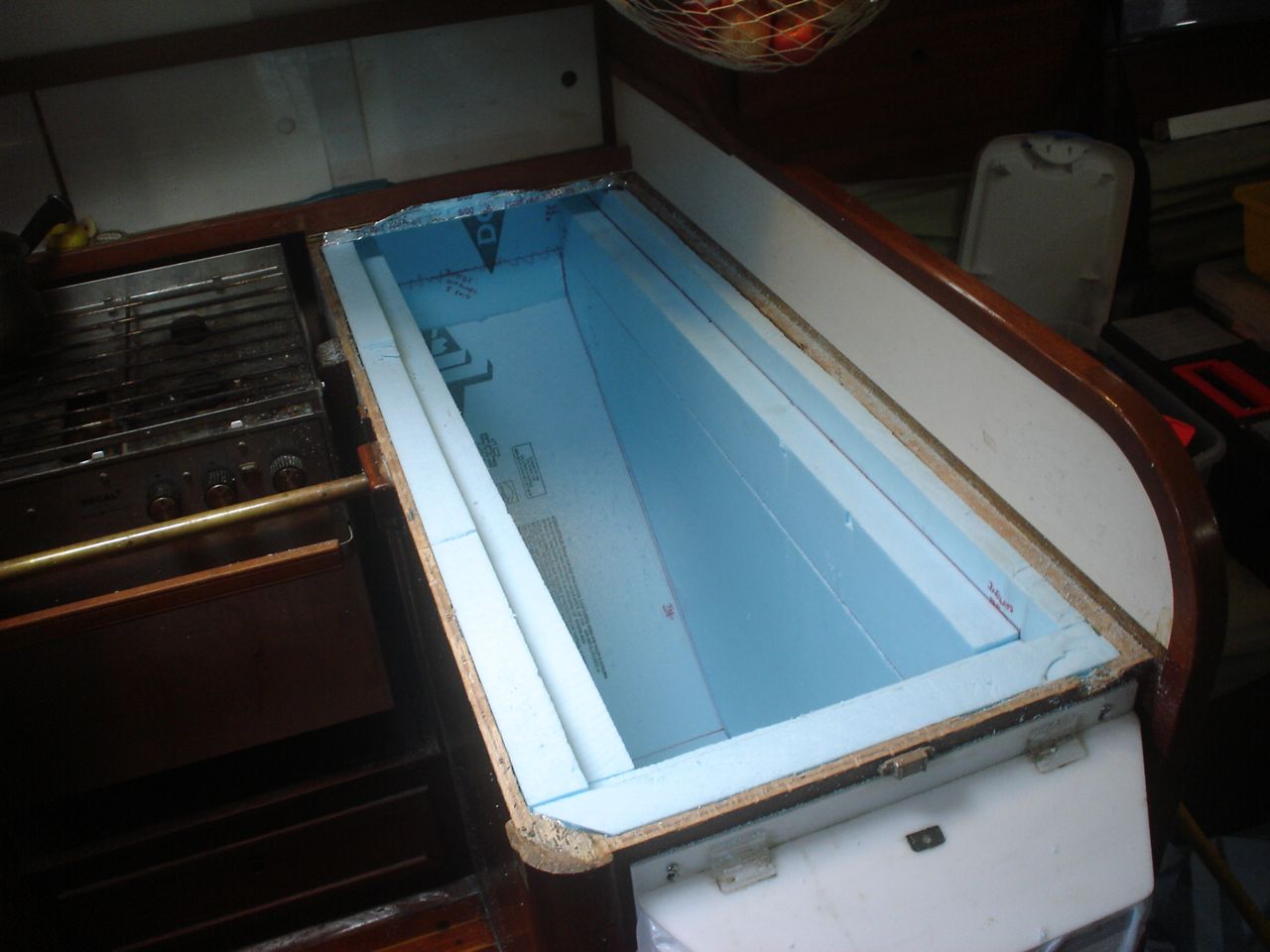
    I built this:

     Out of this:

    I read Nigel Calder’s “Refrigeration for Pleasureboats” three times, I read Richard Kollman’s forum on marine refrigeration, and I spoke with Marcus a few times (a fellow cruiser-friend in the marina).  Marcus is lending me his top-quality, indispensable refrigeration tools (much thanks to Marcus!), and also turned me on to RParts, where I ordered all my stuff.  I learned how to “sweat” copper tubing (i.e. silver soldering copper), how to form flare fittings, how to use a refrigeration gauge set, the detailed principles behind refrigeration, and I built my own refrigeration system.  I’m pretty proud of this 1.5′ x 1.5′ x 1′ cube of refrigeration goodness–it’s hard to believe that a month ago I didn’t understand how this thing worked, and now I’ve built my own out of parts.  It’s not making anything cold yet, but I pressure tested it yesterday and to my immense satisfaction and relief I have no leaks!  (that’s huge–to find and fix a leak would have been a nightmare)

    Refrigeration is a lot more interesting once you understand how it works.  You don’t want to hear the details, but I have admin access on this blog so I’m going to tell you all about it.


    A refrigerator works by moving heat from one place to another.  It does not “create” cold.  Heat is removed from the icebox and deposited at the “hotbox” (that’s my own term, it will be helpful for the discussion).  On our boat, the hotbox happens to be the storage space under the quarterberth; for your fridge at home, the hotbox is just the space behind the fridge.

    On each side of the circuit there is a heat exchanger.  The heat exchanger transfers heat from the air to the refrigerant in the icebox, and from the refrigerant back to the air in the hotbox.  The heat exchanger in the icebox is called the evaporator; the heat exchanger in the hotbox is called the condenser.

    The refrigerant is the medium that moves the heat around the circuit.  If the refrigerant was simply pushed around in a circle, it would not be inclined to transfer heat out of the cool icebox into the warm hotbox–that would be trying to push the heat uphill, so to speak.  The key is to pressurize the refrigerant, using a compressor.  When the refrigerant is compressed, it warms up; when it de-compresses (expands) it gets cold.  The refrigerant comes out of the icebox medium-warm.  The compressor pressurizes the refrigerant, which heats it up.  Then the pressurized refrigerant passes through the condenser–which looks like a mini car radiator–and as the refrigerant passes through the condenser its heat is transferred to the air (just like your car radiator, in fact).  The refrigerant returns to the icebox at a mediumish temperature, but this time it’s pressurized.  At the icebox, the refrigerant is allowed to expand–which causes it to get cold.  The cold refrigerant sucks up heat as it passes through the evaporator.  Then the process is repeated.  Good diagram.

    There’s one more principle at work: phase changes.  If you just pumped a liquid around in circles, from the evaporator to the condenser to the evaporator to the condenser, etc, then you might be able to remove a small amount of heat from the icebox and dump it at the condenser.  However, you can’t suck up much heat just by warming up a liquid and then cooling it off.  The real way to suck up heat and drop it off elsewhere is to use a PHASE CHANGE to your advantage.  The phase change is the key to the whole process.

    Consider heating a quart of water in a pot on the stove.  It takes 320 BTU of energy to heat that water from 33 degrees F to 211 degrees–320 BTU to change the temperature of the water by 178 degrees.  Then, to heat that water only 2 more degrees, from just 211 degrees to 213 degrees, it takes 1934 BTU!  Because at 212 degrees, the H2O changes from water to steam; this is the phase change.  During the entire process of converting water to steam, you keep dumping in large quantities of energy and the temperature stays the same–all the energy goes into the conversion from liquid to gas.  The message is that the energy required to do a phase change from water to steam is WAY GREATER than the energy required to change the temperature of the water itself.

    In refrigeration, we store our heat as a phase change of the refrigerant in order to efficiently transfer it from the icebox to the hotbox.  We don’t use water though, because we want the phase change to take place around the 20 degrees F in our refrigerator (not very helpful to us for it to take place at 212 degrees).  We use refrigerant specially formulated to undergo the phase change near freezing (in our case, R134a).

    We pump a liquid to the evaporator, and then let it expand into a gas; that expansion to a gas sucks huge amounts of heat out of the box.  Then back at the compressor we compress the gas, which heats it up (essentially exchanging “pressure energy” for heat).  Then we send it through the condenser, where the the hot gas dumps off all its heat and turns back into a liquid (condenses!) in the process.  Then we sent the liquid back to the evaporator, where it turns into a gas again . . . and so on.  The refrigerant goes to the icebox as a liquid, but it returns as a gas; the phase changes that happens in the icebox and the hotbox are the primary means of temporarily storing the heat in the refrigerant for transfer from one location to another.

    Refrigeration is by far the single largest energy sink on a cruising sailboat.  In the average residential home, refrigeration is 5% of the energy bill–not an insignificant amount. One site says that the average fridge uses ~$8 of electricity per month, depending on how big, what kind, and where you live.  The efficiency of the refrigeration system depends very strongly on the refrigerant dumping off heat as it passes through the condenser.  Most systems use air-cooled condensers (I put in both air-cooled and water-cooled condensers–the air-cooled is the radiator-looking thing in the picture above; the water-cooled is the black circle of tubing on the top of the apparatus).  If the air-cooled condenser is located in a cool spot with good air-flow, this heat dump can happen very effectively; if the condenser is located in a hot spot with stagnant air, or even worse in the hot engine room, then the refrigeration cycle’s efficiency plummets.  Meaning that the fridge runs much longer, and consumes much more power.  Moral: the quickest improvement you can make to reduce your energy needs on a sailboat is to improve the air circulation around the refrigeration condenser.

    You can do the same for your fridge at home: just pull the fridge away from the wall an extra inch, and you’ll greatly increase the air-circulation around the condenser, improving the efficiency.  Avoid shoving plastic or paper bags between the wall and the fridge for storage–that’s not helping out your fridge, or your electrical bill.  Even better, use a vacuum to clean off the condenser tubing on the back of the fridge–that gunk kills the condenser’s ability to dump heat.


  • Free Advice

     There’s no shortage of advice at the marina. One guy in particular, Steel Boat Jim, who I refer to as Maine Guy on account of his Downeast accent, is a treasure trove. You’d be hard-pressed to carry on a conversation with him and manage to sneak away without having received a point in some direction.

    The first time I met Maine Guy, back in November, he was wearing a gray t-shirt from which his stomach protruded, and he had a beer in hand. It was maybe noon. I liked him already.

    “So when ahh you leaving?” he asked. I was up on deck, the grinder in my hands, and earplugs in my ears. I pulled them out, and said, “Huh?”

    “When ahh you leaving?”

    “Not for more than a year,” I said.

    “Well, remember, after yooah all stocked up on food, then buy yooah electronics.”

    “Sounds like good advice,” I said.

    “Yeah, well, I’ve wrecked all my fuckin’ electronics.”

    He went on, providing more detail — but the pattern had been established: 1) question; 2) answer; 3) unsolicited advice. Technically, the advice also goes unheeded, but he doesn’t know that.

    I stopped by Maine Guy’s steel boat, the Arctic Tern, a couple of weeks ago, and after checking out his new solar panels, got to talking about wind generators.

    “Yooah totally fuhcked if yooah relying on a wind genertah!” He said. “That thing’s a piece of fuckin’ gahbage! You gotta undastand, theah’s no wind from twenty degrees to twenty degrees. In the tropics, that generatah’s gonna be worthless.”

    Maine Guy says that a lot: “you gotta undastand,” as if he’s the purveyor of ancient wisdom. That’s the prelude to his free advice. It’s not patronizing so much as amusing. Of course, he had a point. Wind generators produce no power in winds below about 10 knots, and much of the ocean is festooned with such light air.

    “If you buy a wind generatah, theah goes a yeah of cruising,” he said. I’m not sure if I could survive for a year on $2,000, but I got the gist of it. He continued. “If you buy a radar, theah goes a yeah of cruising. If you buy a life raft, theah goes a yeah of cruising.”

    I knew better than to steer the conversation toward money or the economy, as he had earlier e-mailed me a long rant about converting my savings from dollars to gold, so I played defense. I said, “Yeah, if you know what you’re doing, you may be OK without those backups.”

    Maine Guy had an answer for that, too. “Hey, isn’t that what adventure’s about?”

    Score another point for Maine Guy, but remember that there’s a line between adventure and recklessness, a line that we’ve gotten to know in the mountains. That and we already have a radar and a life raft, and we’re not about to sell them.

    In the spirit of passing on more advice — this time literally — Maine Guy dug through his bookshelf and handed me a copy of “Blue Water,” by Bob Griffith, one of the circumnavigators on that list I found later. “If you read this book,” he said, “you’ll find out that the most important things on your boat are the anchor, the anchor, and the anchor. And that in two thousand years of sailing, not much has changed.”

    “What’s the second most important thing,” I asked.

    “A bottle opener,” he said.

  • working with your hands

    Matt, Jon and I couldn’t help noticing the recent NYT  Magazine article, “The Case for Working With Your Hands, about the value of the trades – how they are real, knowledge-based, tactile, lose-yourself-in-the-work, challenging, valuable, and fun; how they bring moments of elation and failure; how they’re high-stakes, with an always present possibility of catastrophe, and how they demand and produce plenty of integrity and responsibility. As one commenter noted, working with your hands brings to mind a certain Danish proverb: “You can do the work of the mind without the hand, but not that of the hand without the mind.”

    Of working on old motorcycles, the author writes:

    “Imagine you’re trying to figure out why a bike won’t start. The fasteners holding the engine covers on 1970s-era Hondas are Phillips head, and they are almost always rounded out and corroded. Do you really want to check the condition of the starter clutch if each of eight screws will need to be drilled out and extracted, risking damage to the engine case? Such impediments have to be taken into account. The attractiveness of any hypothesis is determined in part by physical circumstances that have no logical connection to the diagnostic problem at hand. The mechanic’s proper response to the situation cannot be anticipated by a set of rules or algorithms.”

    It’s the same on boats and bikes! He continues:

    “Some diagnostic situations contain a lot of variables. Any given symptom may have several possible causes, and further, these causes may interact with one another and therefore be difficult to isolate. In deciding how to proceed, there often comes a point where you have to step back and get a larger gestalt. Have a cigarette and walk around the lift. The gap between theory and practice stretches out in front of you, and this is where it gets interesting. What you need now is the kind of judgment that arises only from experience; hunches rather than rules. For me, at least, there is more real thinking going on in the bike shop than there was in the think tank.”

    I particularly liked the author’s disenchantment behind a desk, pushing paper, representing an organization and its purported mission. I also liked his loathing of a style that demands an image of rationality but not indulging too much in actual reasoning, and his confoundedness of an inner-office ruled by provisional morality and logic, and his recognition of the divide between reality and official ideology.

    Get reading!

  • Seeking volunteers for…


    …Boat work!

    It’s slow! It’s frustrating! It’s messy! And expensive!

    There’s tons to do!

    You won’t finish half of what you started, and you won’t start half of what you wanted to!

    Small project? It’ll probably grow bigger than you ever feared possible!

    Big project? Just be glad you don’t have to deal with it for the next month!

    • Unemployed? Come on by!
    • Energy to burn? Come on by!
    • Unskilled? That’s OK! On-the-job training provided
    • Like drinking on the job? So do we!

    Why not? Who cares? NOBODY!

    For more information, contact Jonny, on Syzygy, at the Emeryville Marina.

  • quick update

    just to let you know what we’re up to . . . Jonny and I are taking the boat apart, starting too many huge projects all at once, and getting way in over our heads. Good times! We are simultaneously rebuilding the fridge, moving the propane locker to build a lazarette hatch, and rebuilding the entire radar arch/bimini/solar panel setup. A few pics: