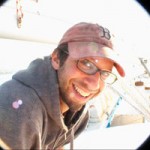
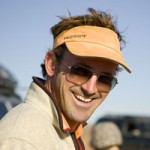
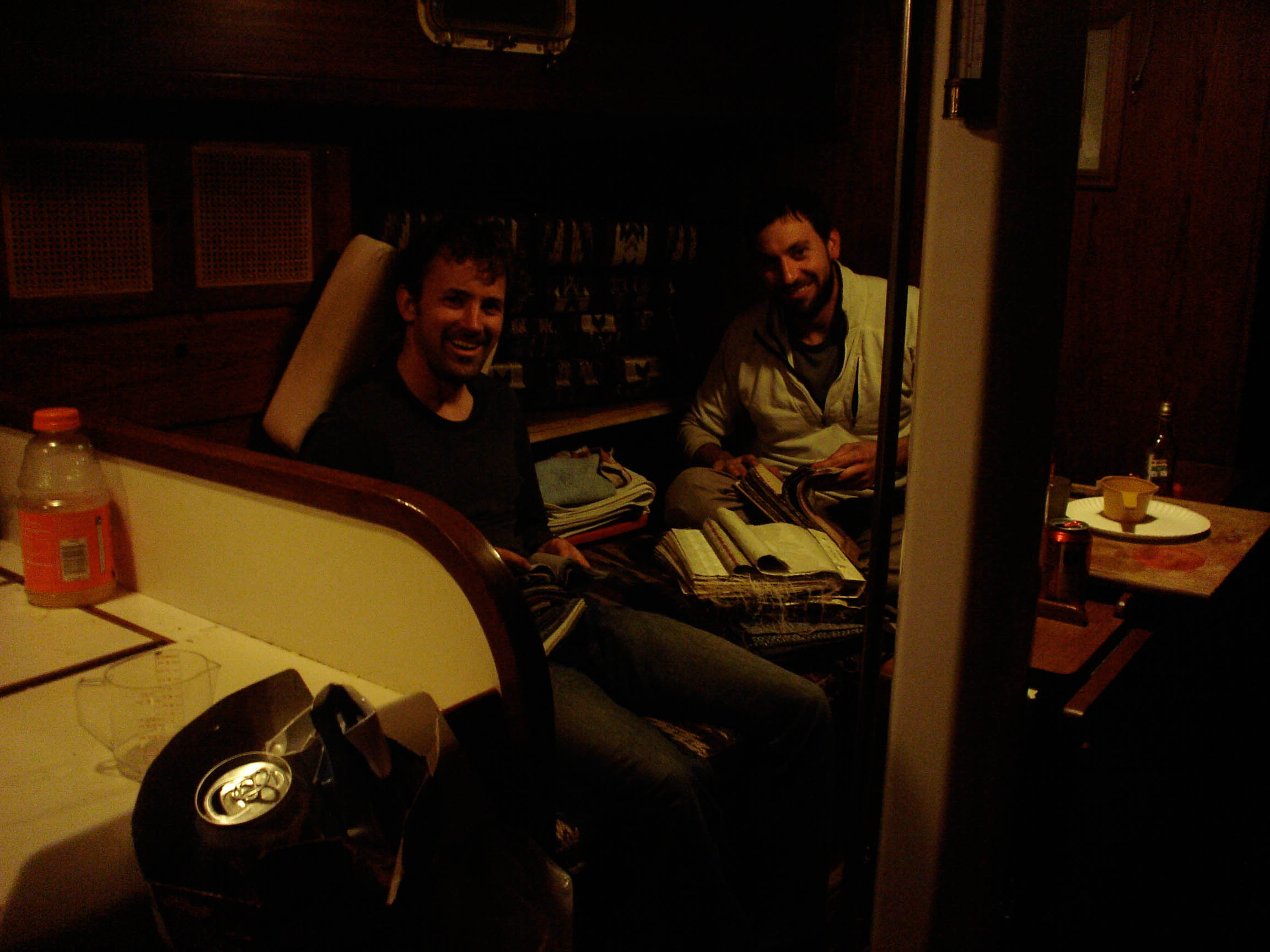
Happy Birthday to me. I turned 31 on January 1st, and spent the double holiday with Matt and Jonny, on our new boat. I haven’t spent a birthday with good friends in a long time. Everyone it seems, travels for the Christmas-New Years holidays, including me, and so I just haven’t seen any close friends, which is too bad, because I don’t celebrate any holidays really. You could say that I yearned for when I was with friends partying it up for my birthday, not for new years, but me.
So being in Mexico with Matt and Jonny over my birthday was, deep down, pretty exciting and important to me, though I didn’t want to let it on too much. They came through though in a great way.
After a hard day’s work, we headed to the Captains Club, the new sailors’ bar run by Mike in San Carlos. We ate approximately 1 gallon of salsa and 82 fish tacos, and slugged back a couple of celebratory drinks, but headed back to the boat too early — before the the bar-top dancing began. As midnight approached, and I was ready to pass out from exhaustion, Jonny and Matt brought out a cake (referred to by Matt in supposed-Spanish as “caca”), a couple of presents, and a tasty bottle of tequila claro, as is only available in Mexico. We toasted to our boat, to our trip, and to ourselves. Then I proceeded as planned, and passed out around 10:30pm.
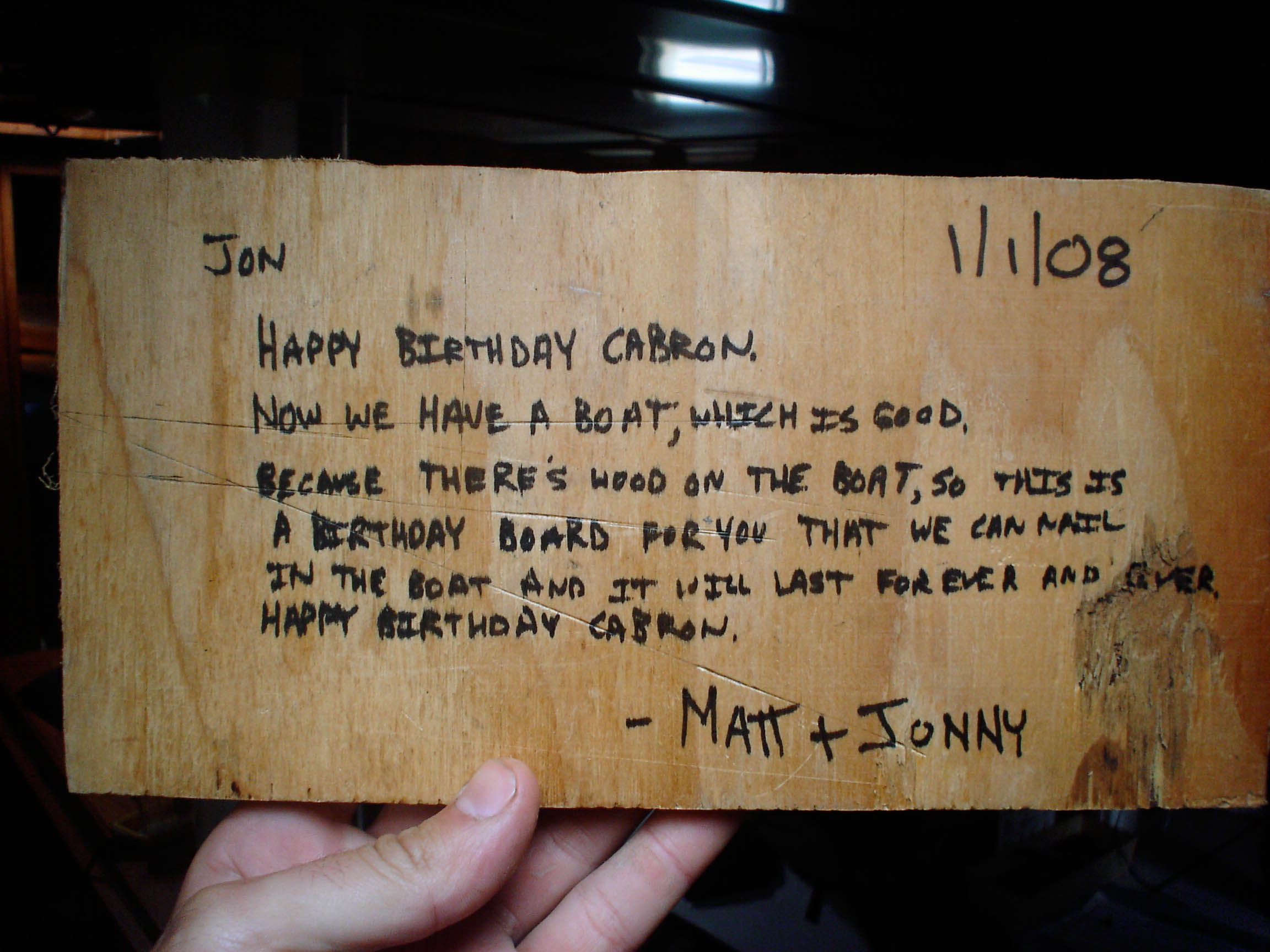
I couldn’t have asked for a better birthday. I was with my two best friends, hanging out on the boat that we will soon spend two years together on. A plaque they wrote for me know sits in our boat, a constant reminder of this day, our friendship, and good times to come. Thanks guys.
A couple of friends have emailed me, asking about our progress. Have we sailed Syzygy yet? Is the engine running? Have we practiced motoring around the marina, in and out of our slip? Have we fixed our leaky water tanks?
Until last night, my answer was a sad litany of qualified justifications and hedged excuses.
Here’s what i mean:
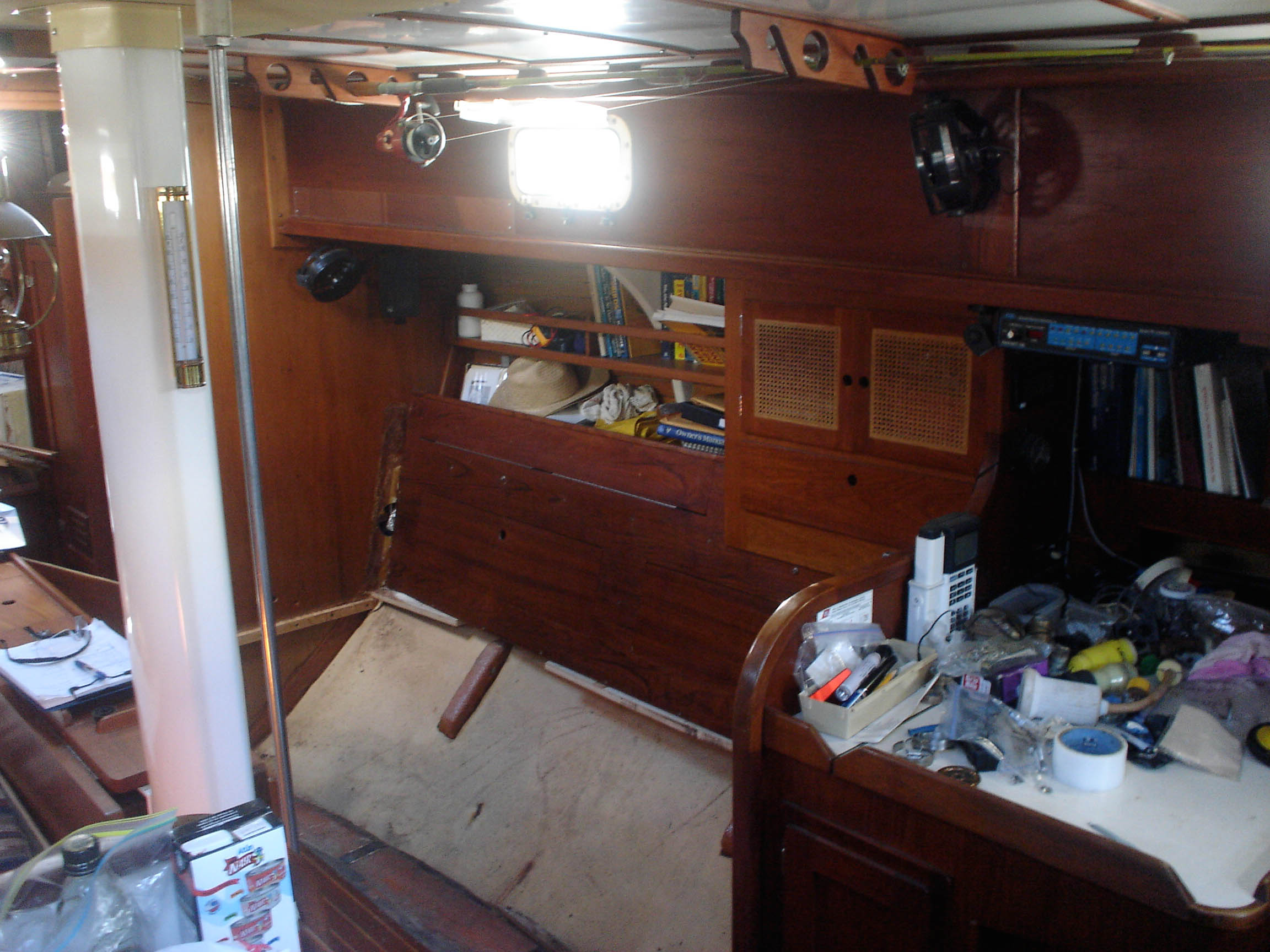
Q: Have we sailed yet? A: Nope… but we were GONNA sail yesterday, and were all set to do so. Sails up, stuff stowed, everything set. We were especially eager to sail for the most ridiculous reason, though. We wanted to cut up the port water tank while out at sea. Why? Because it wouldn’t fit out the companionway, and was just sitting there, a big hulk of stainless steel, in our cabin salon. Why couldn’t we just cut it up at the marina? Because the jig saw is really loud, and the marina master specifically told us not to use power tools on our boat, since we’re docked so close to a bunch of fancy beach-front houses. Given that we’re so new to most everything we’re doing, we didn’t wanna get kicked out of the marina for making a racket.
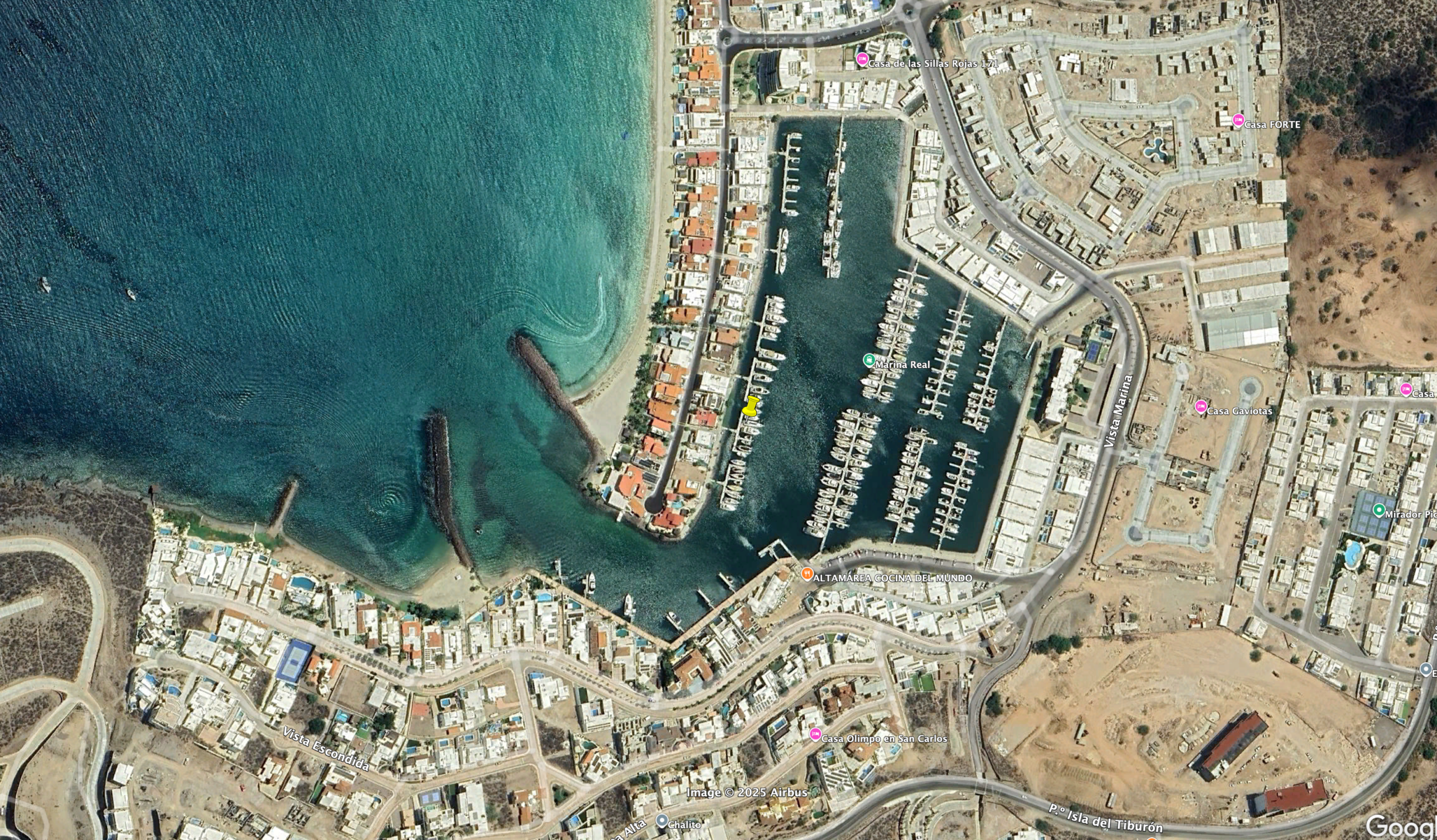
So anyway, we really really really wanted to go sailing. Thing is, the tides totally screwed us. Actually, the marina sorta screwed us, too. The canal entrance to Marina Real is shallow — about 5’6″ shallow. Syzygy has a draft of 6’6″. So she can only get out of the marina when the tide is at least 1′ above the mean. And yesterday, high tide was at 4:30am. Here’s the chart for Jan 3rd:
3:10 AM MST Moonrise 4:26 AM MST High tide 0.62 Meters 7:15 AM MST Sunrise 1:49 PM MST Moonset 2:13 PM MST Low tide -0.20 Meters 5:40 PM MST Sunset
We didn’t find this out until 8am, though, and by then it was too late. It all the begs the question, though: how does anyone go sailing around here? Are all the sailboats trapped in the marina until the stars align?
At any rate, that’s why we didn’t go sailing.
Q: Is the engine running? A: Yes, finally. This is a shameful story too. We put Syzygy in the water a week ago, and it felt glorious for about 10 minutes, until Matt tried to start the engine, and it just wouldn’t catch. Some small puffs of gray smoke came out of the exhaust pipe, but that’s it. So — and I hate to admit it — we got towed to our slip. Yep. We got towed, by a dinky little dinghy, with a tiny outboard motor, about 100 feet, over to our slip. And we almost crashed into the dock. It was pathetic.
Anyway, we were gonna have a mechanic look at our engine, but Matt persevered. On the advice of another sailor, he bled the fuel line, letting pockets of air out so that diesel fuel could proceed straight to the engine. It worked. So the engine now runs. And we know now how to start it.
Q: Have we practiced motoring around the marina, docking and such? A: Well, we had planned to spend days doing this, but got caught up a) dealing with the damn water tanks, b) not being able to start our engine (see above), and c) running around San Calors and Guaymas buying tools and supplies we needed.
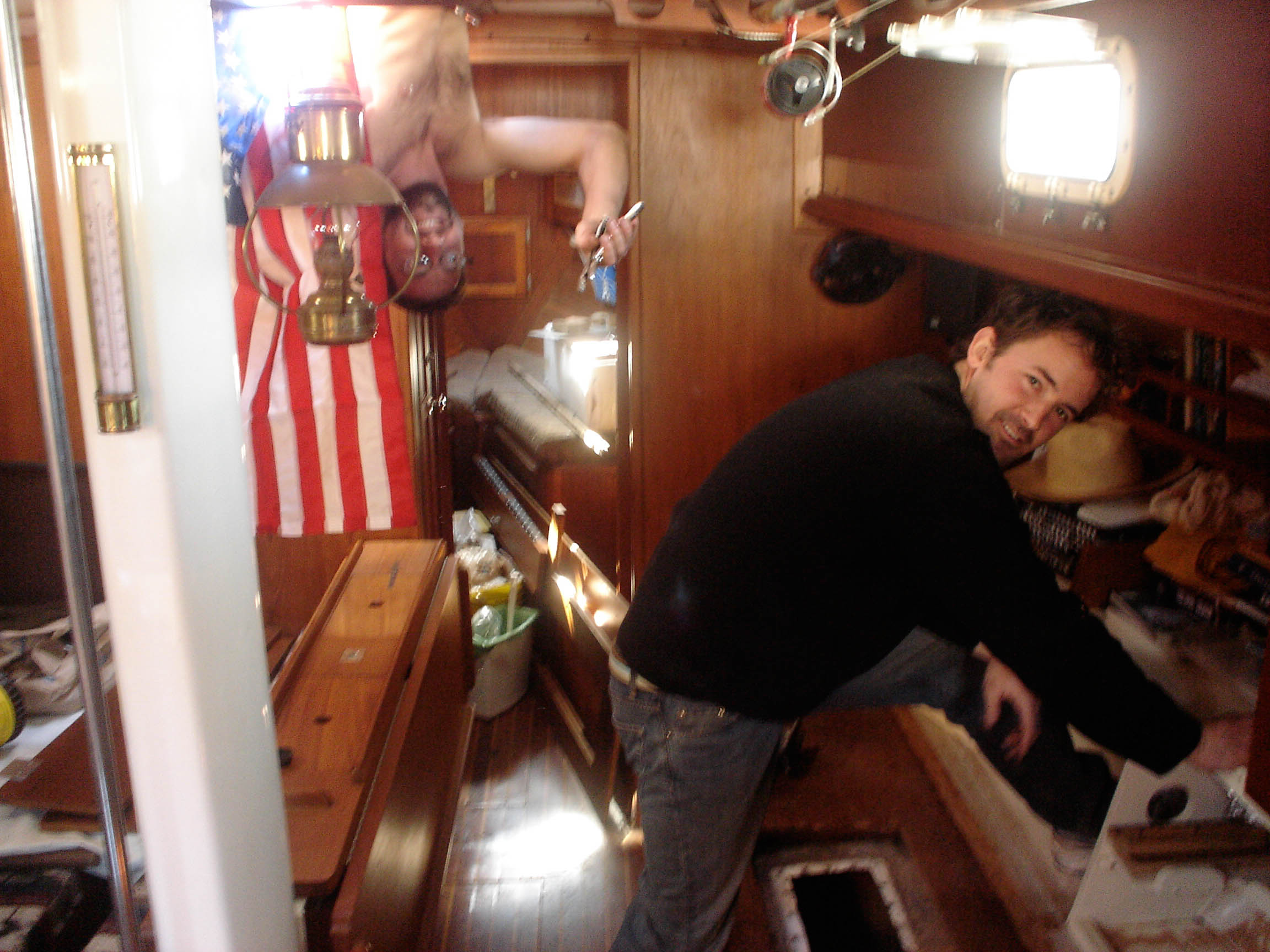
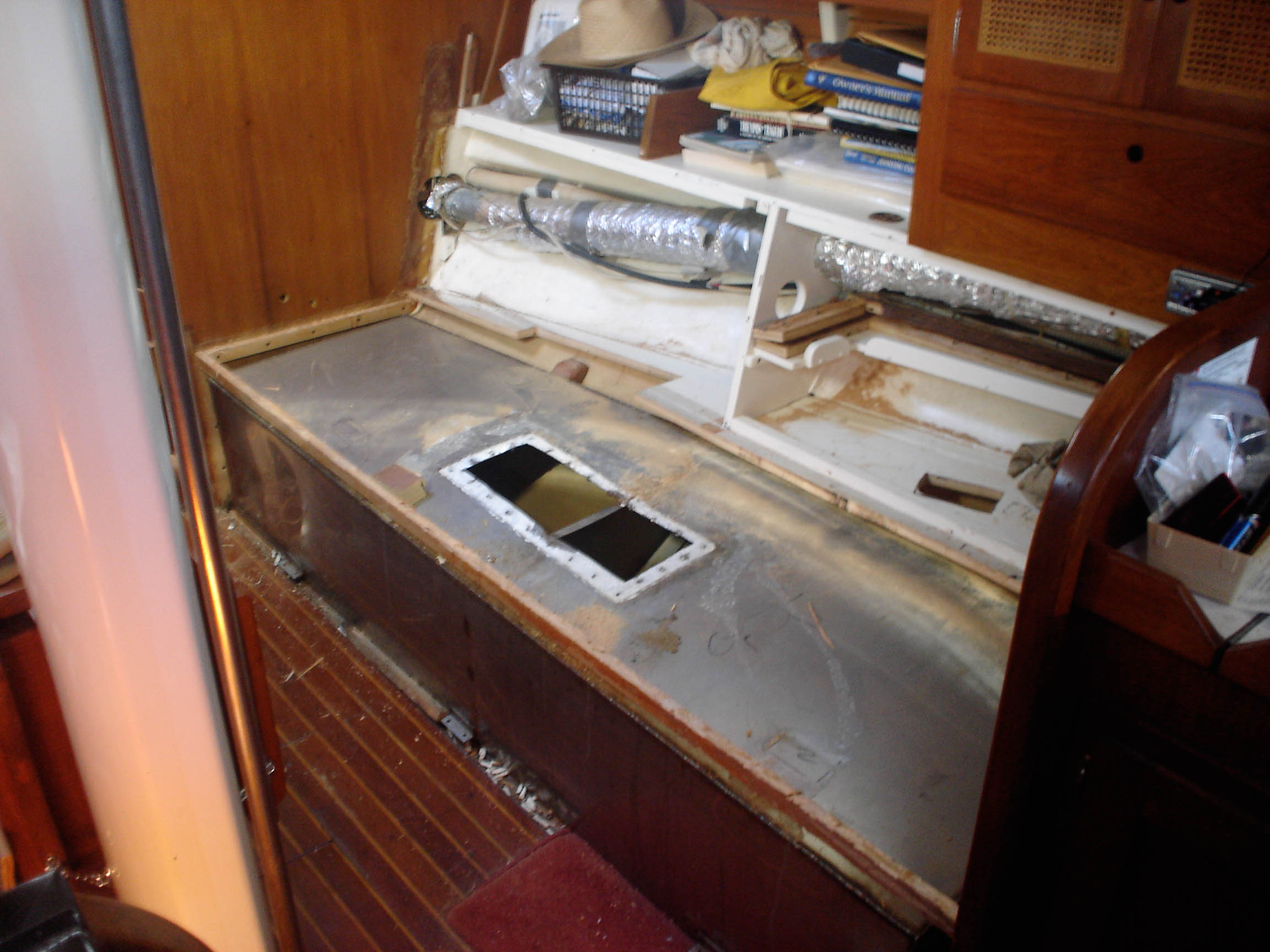
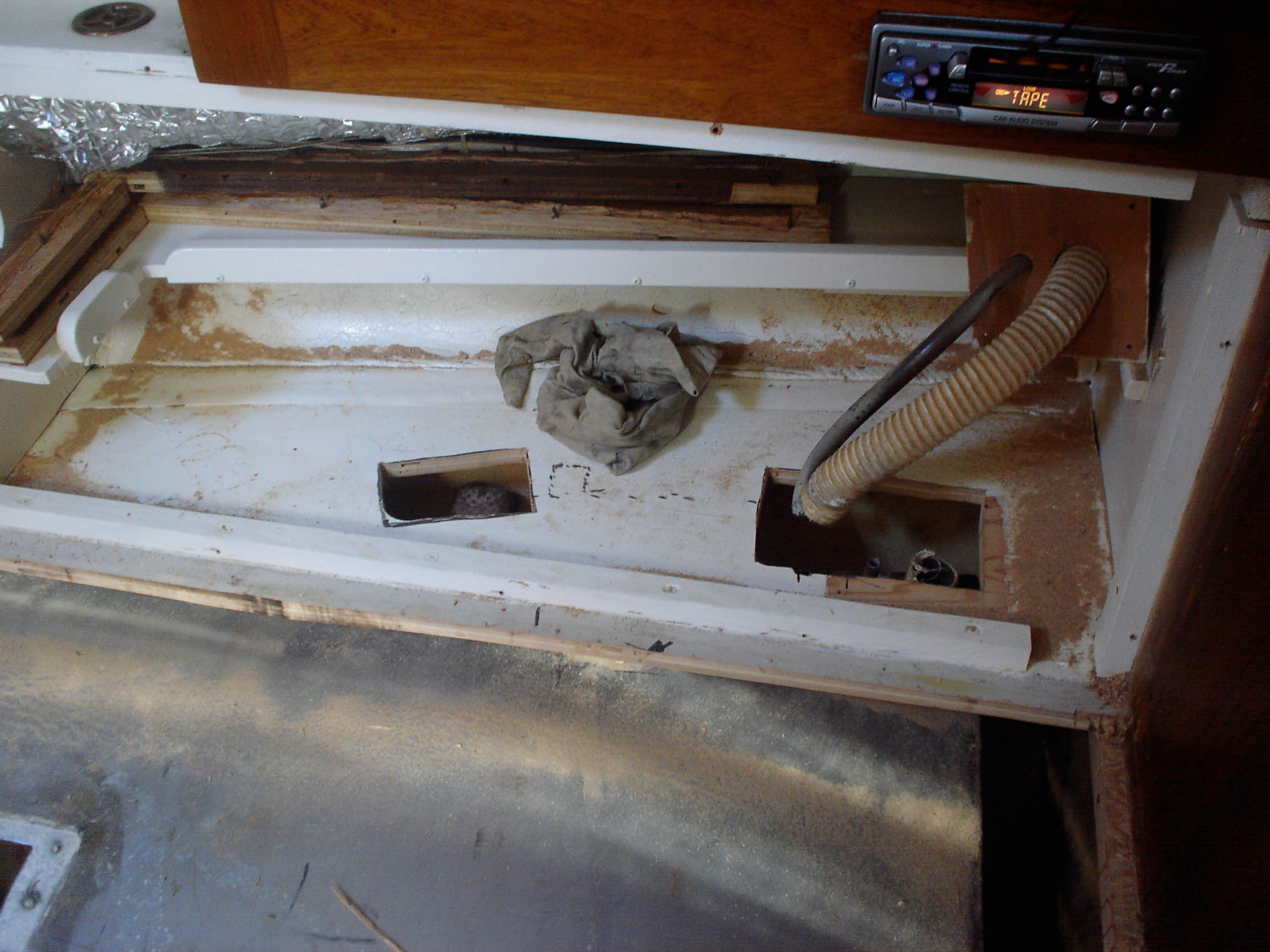
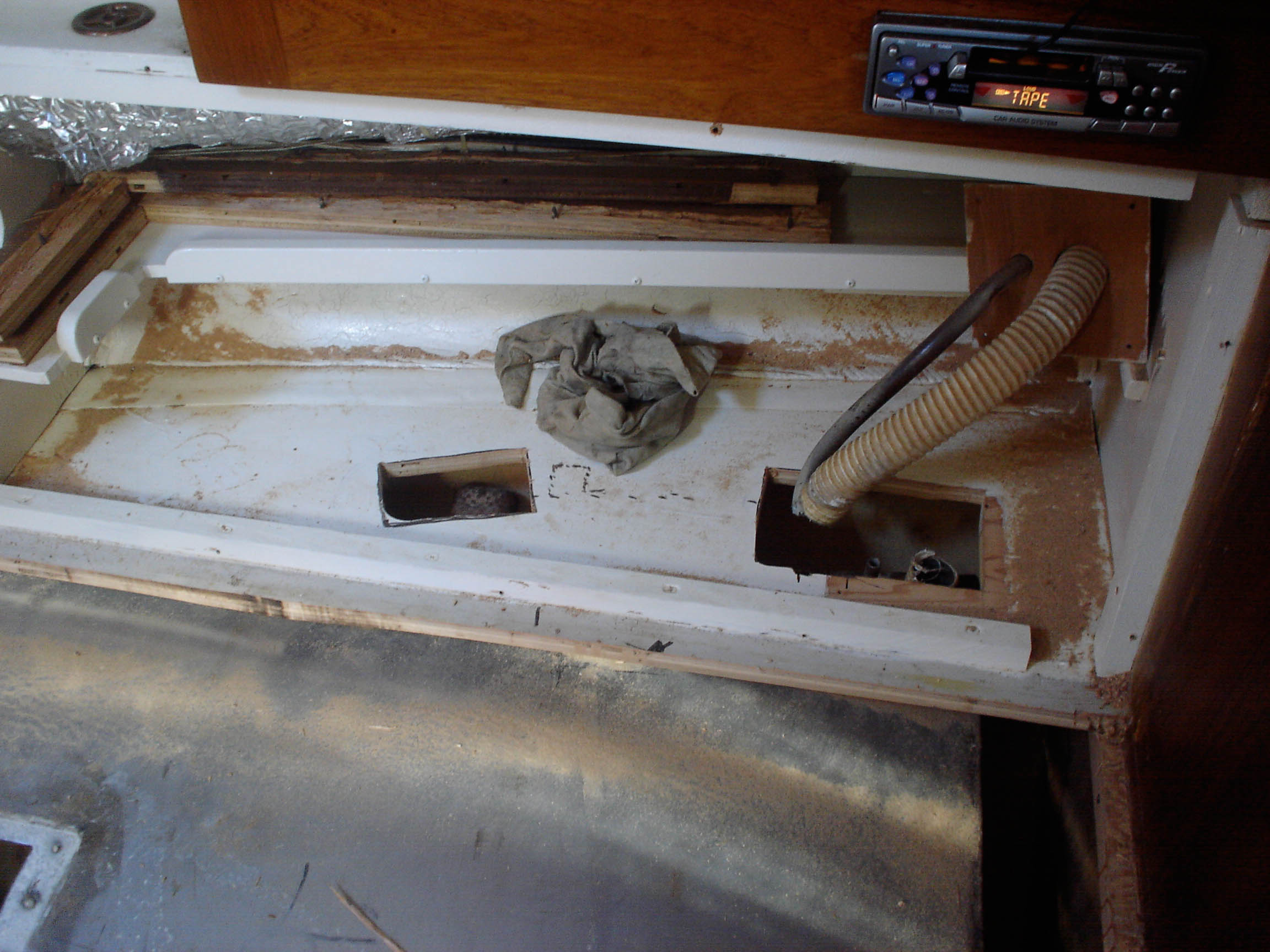
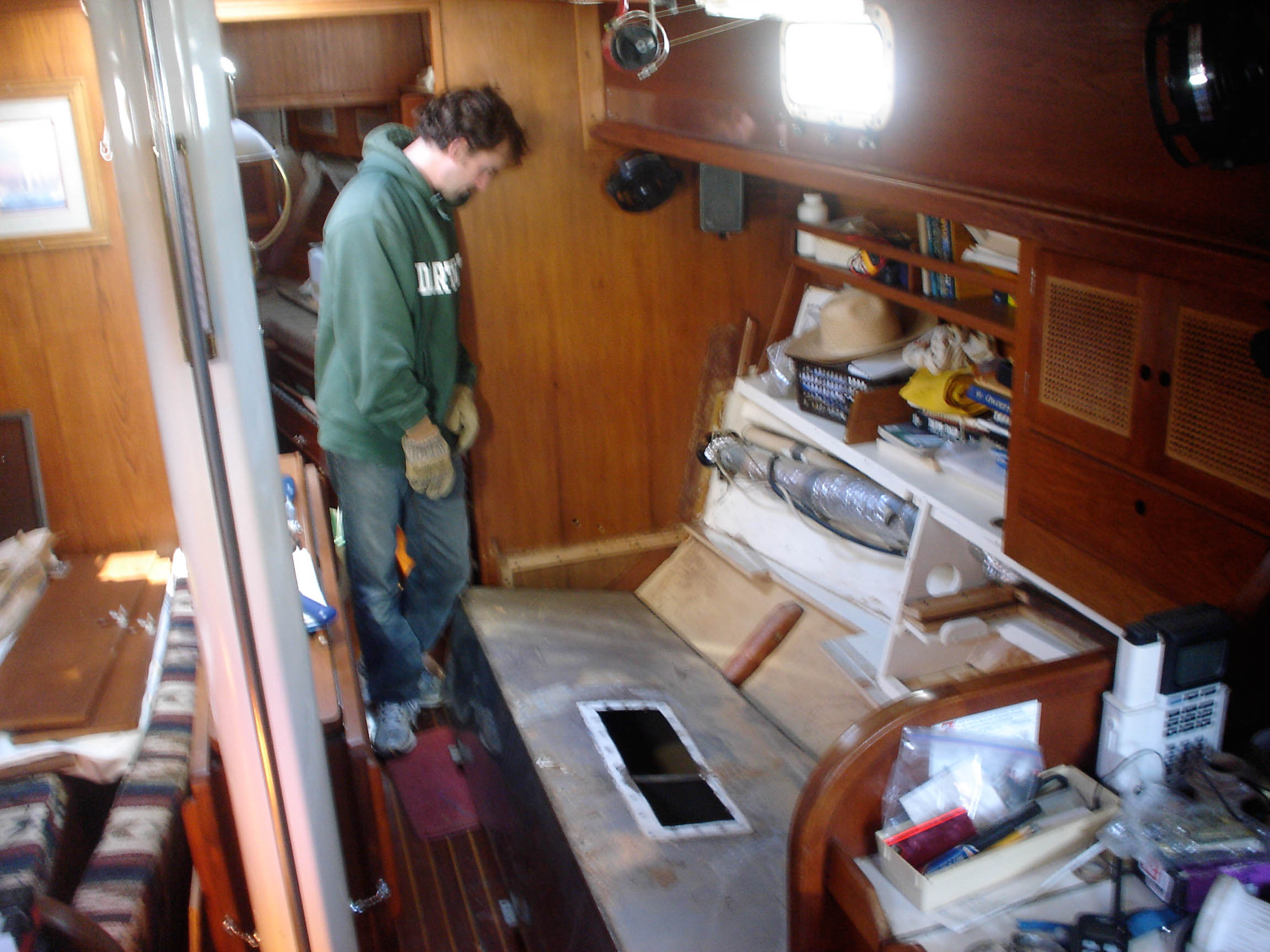
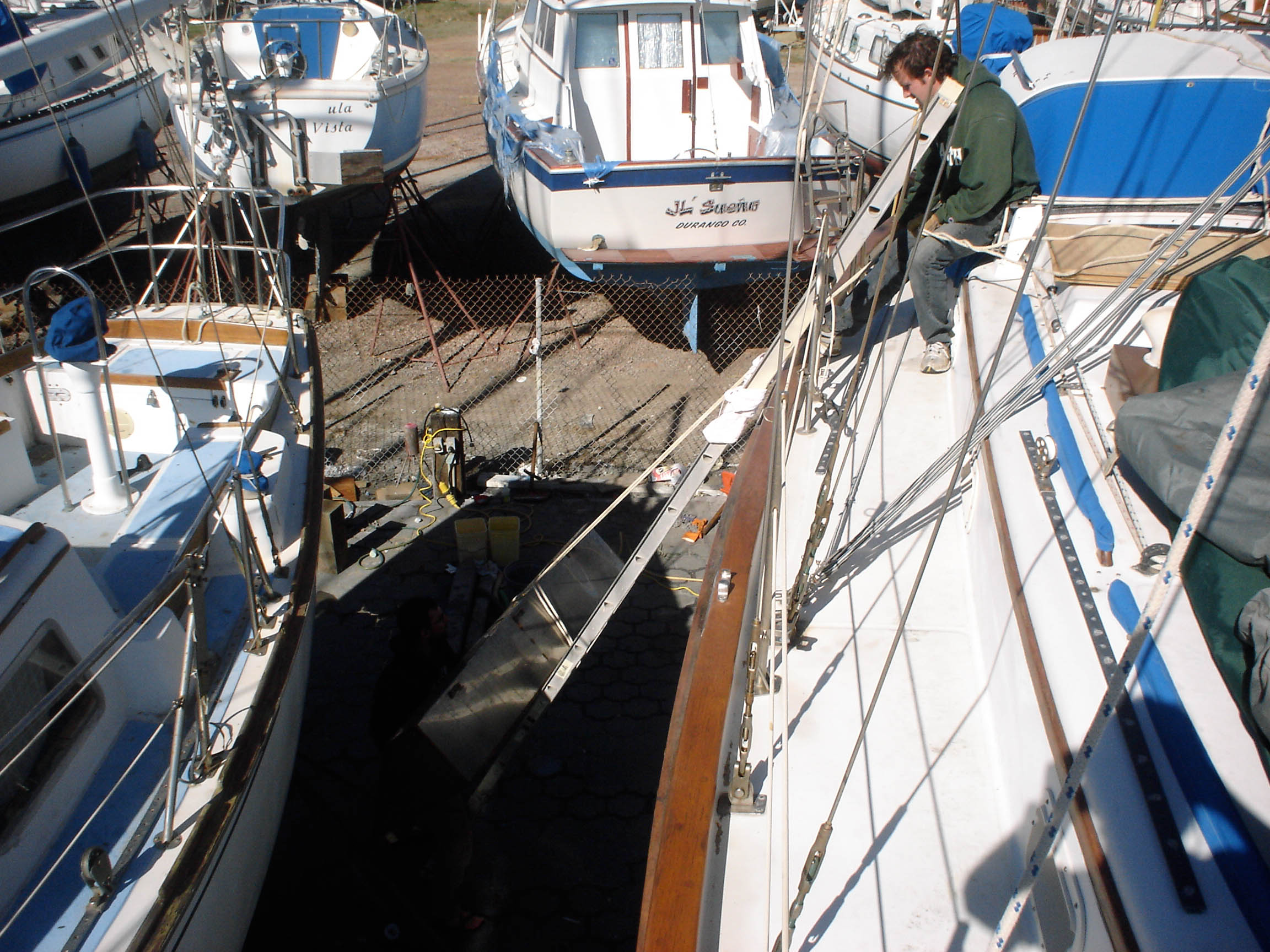
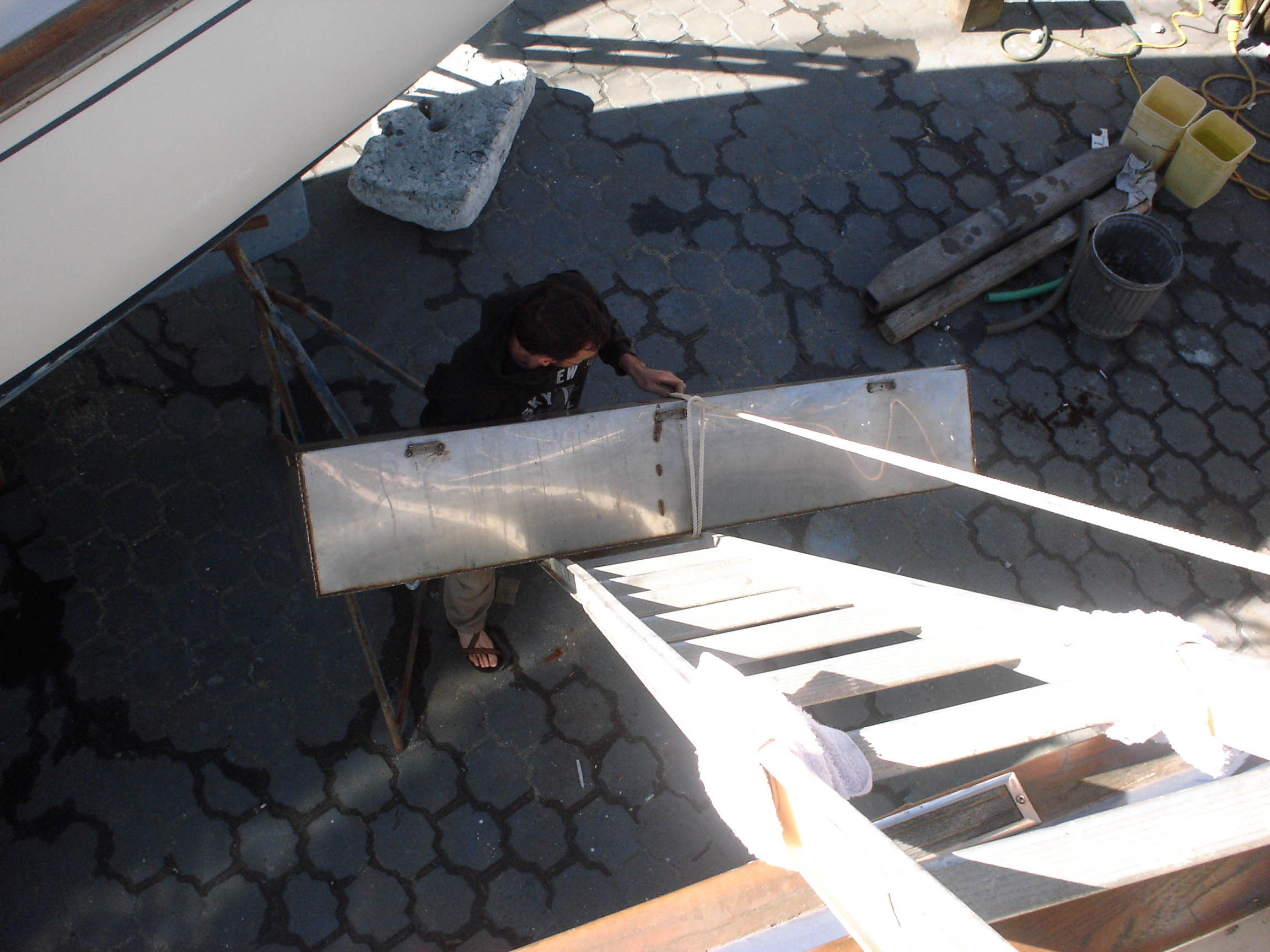
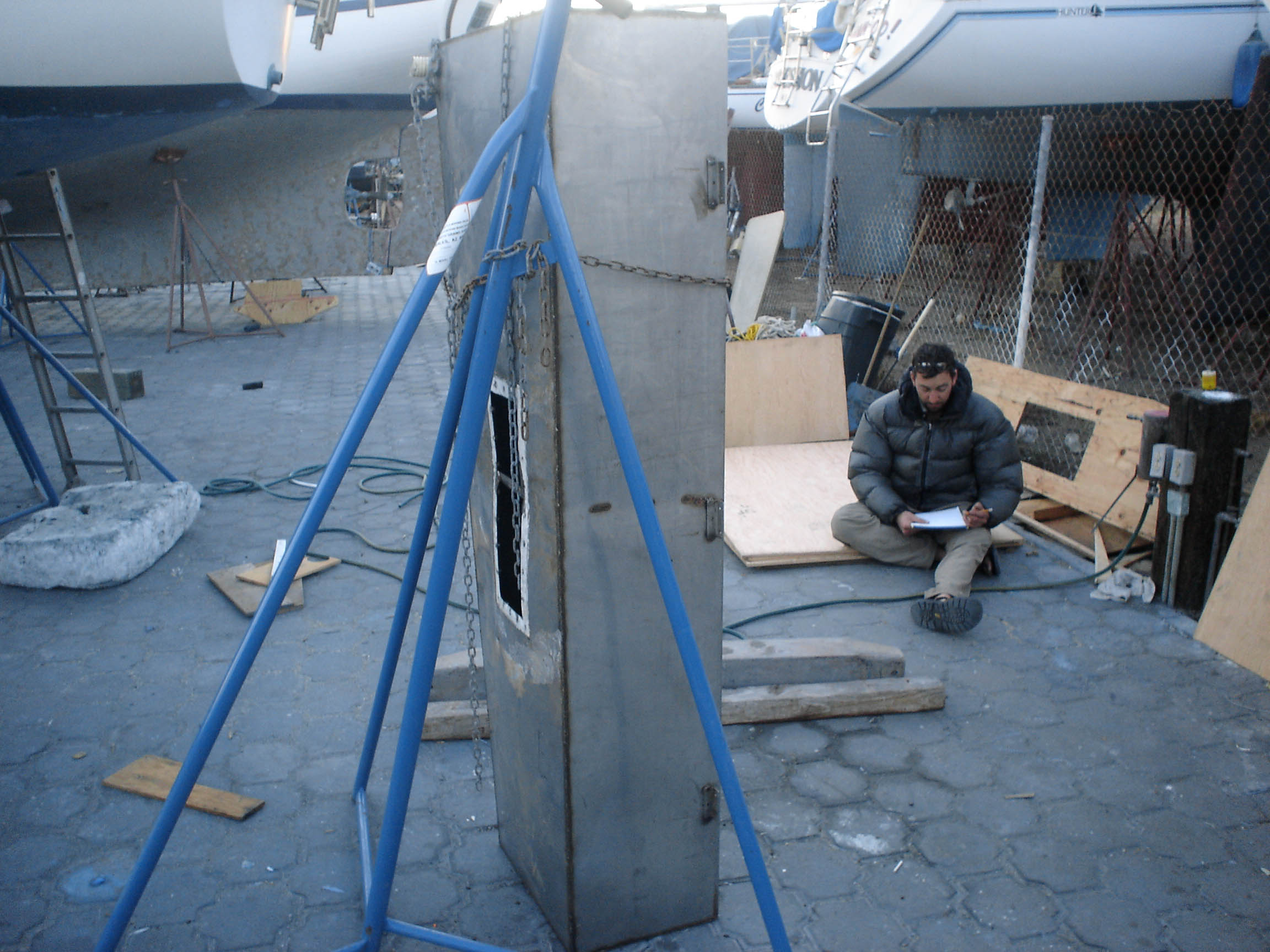
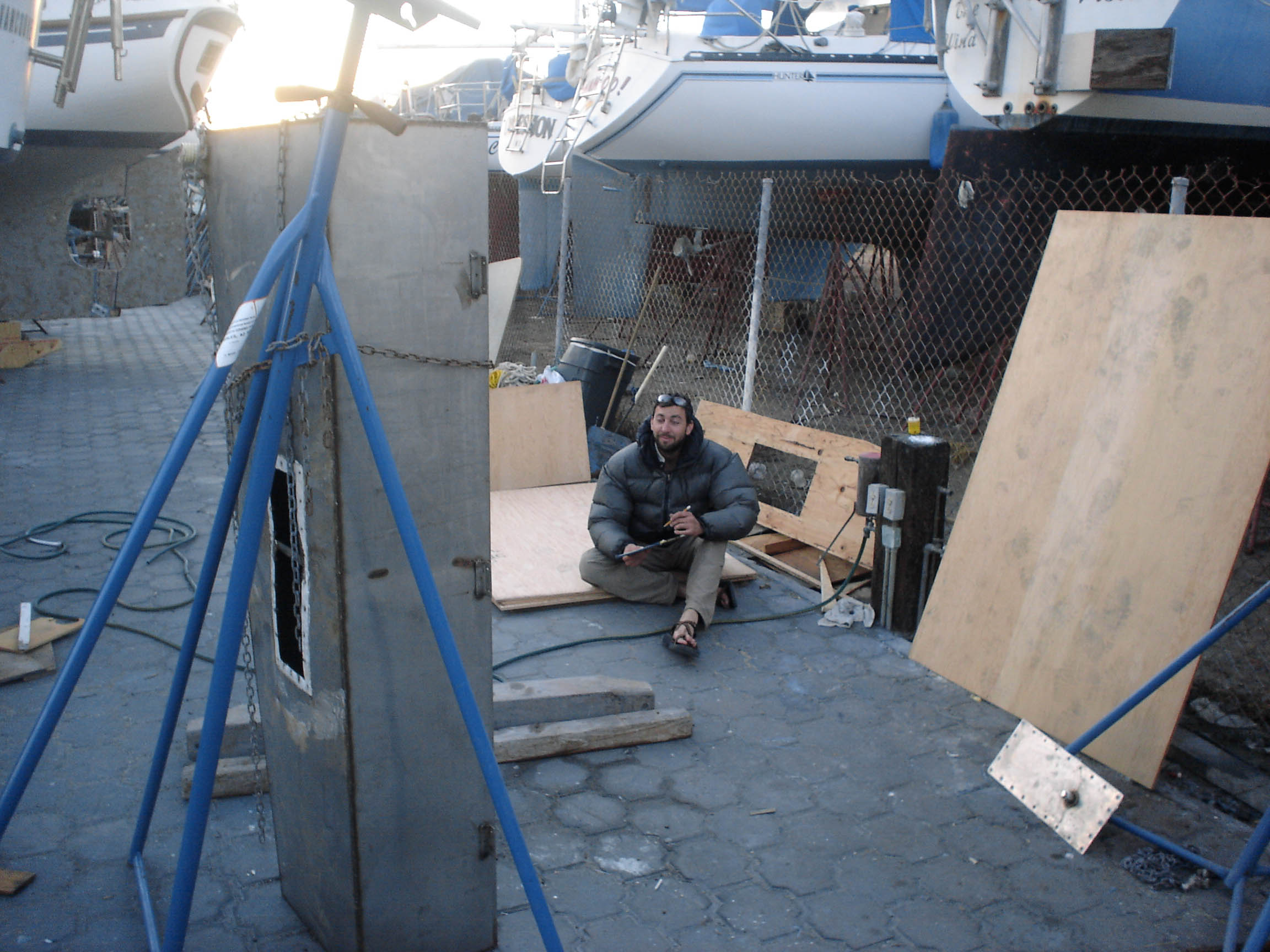
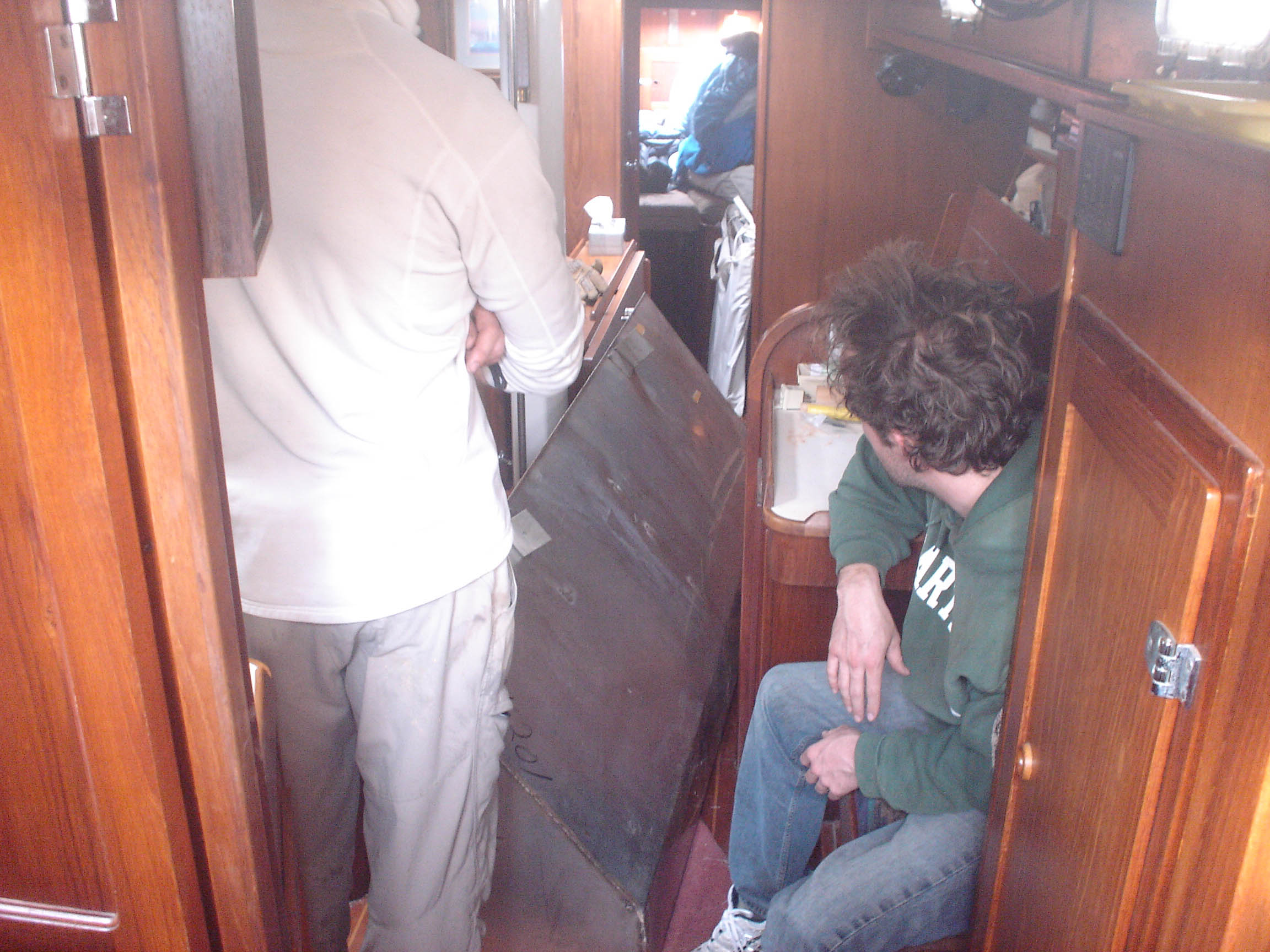
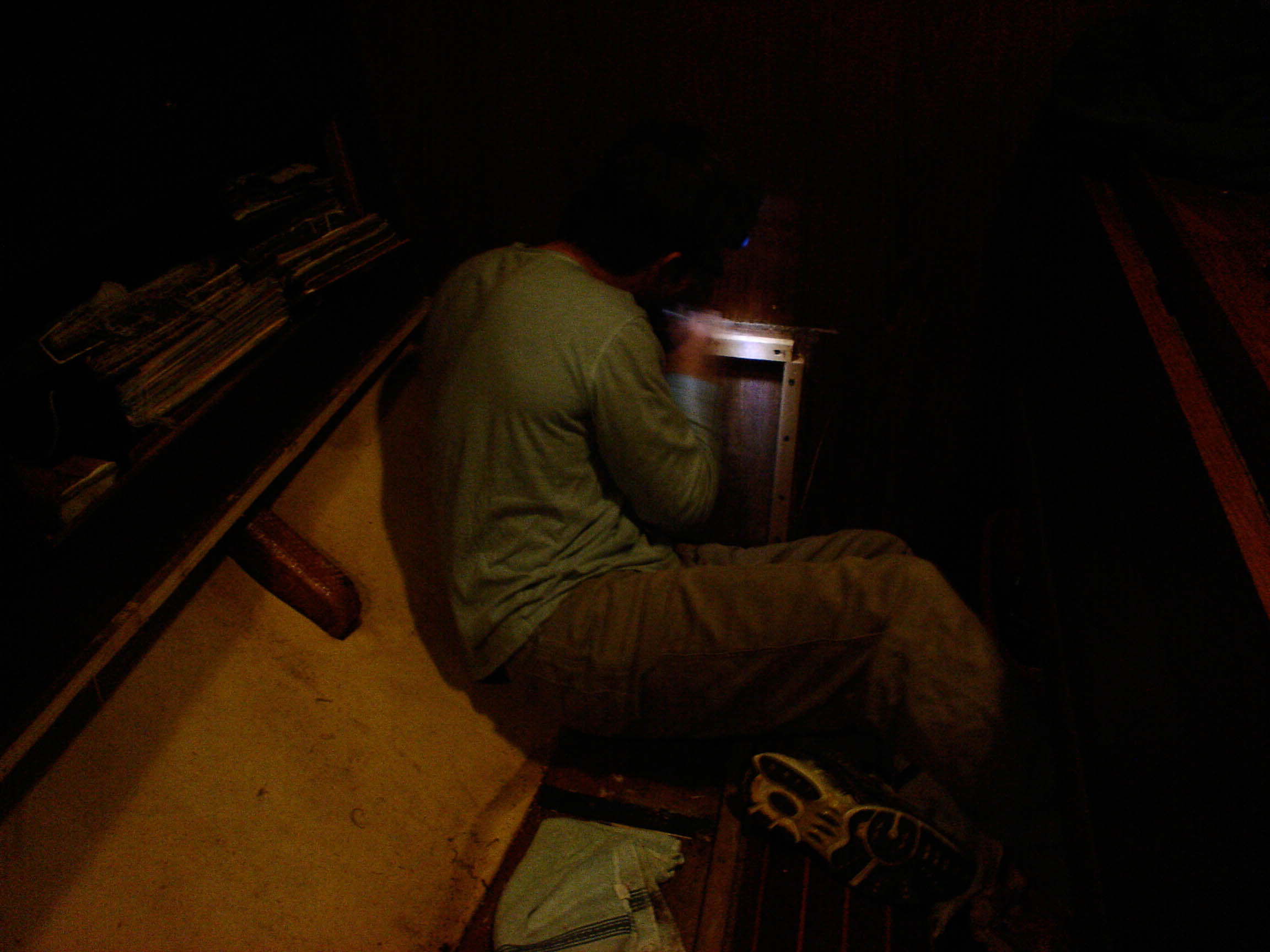
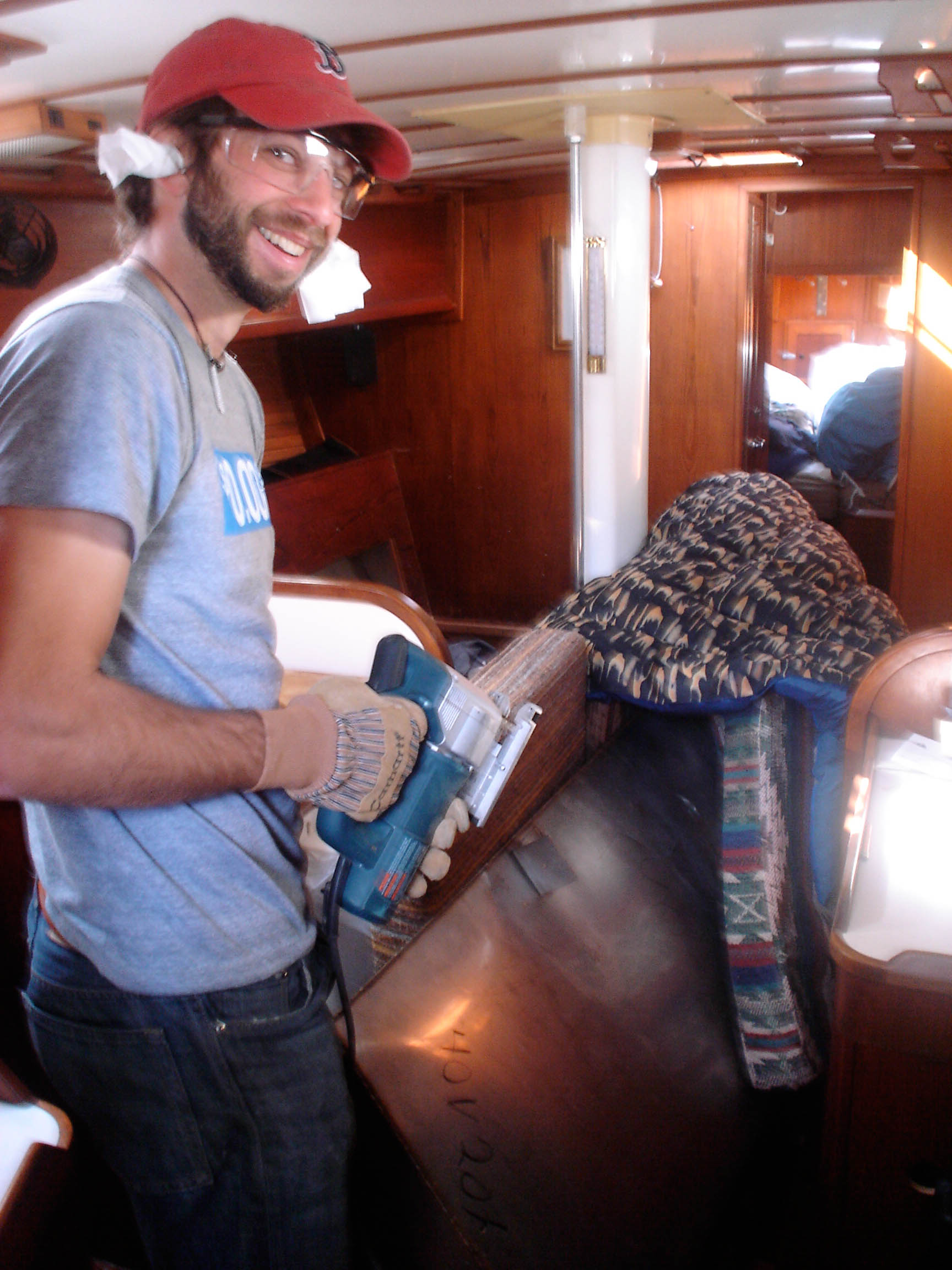
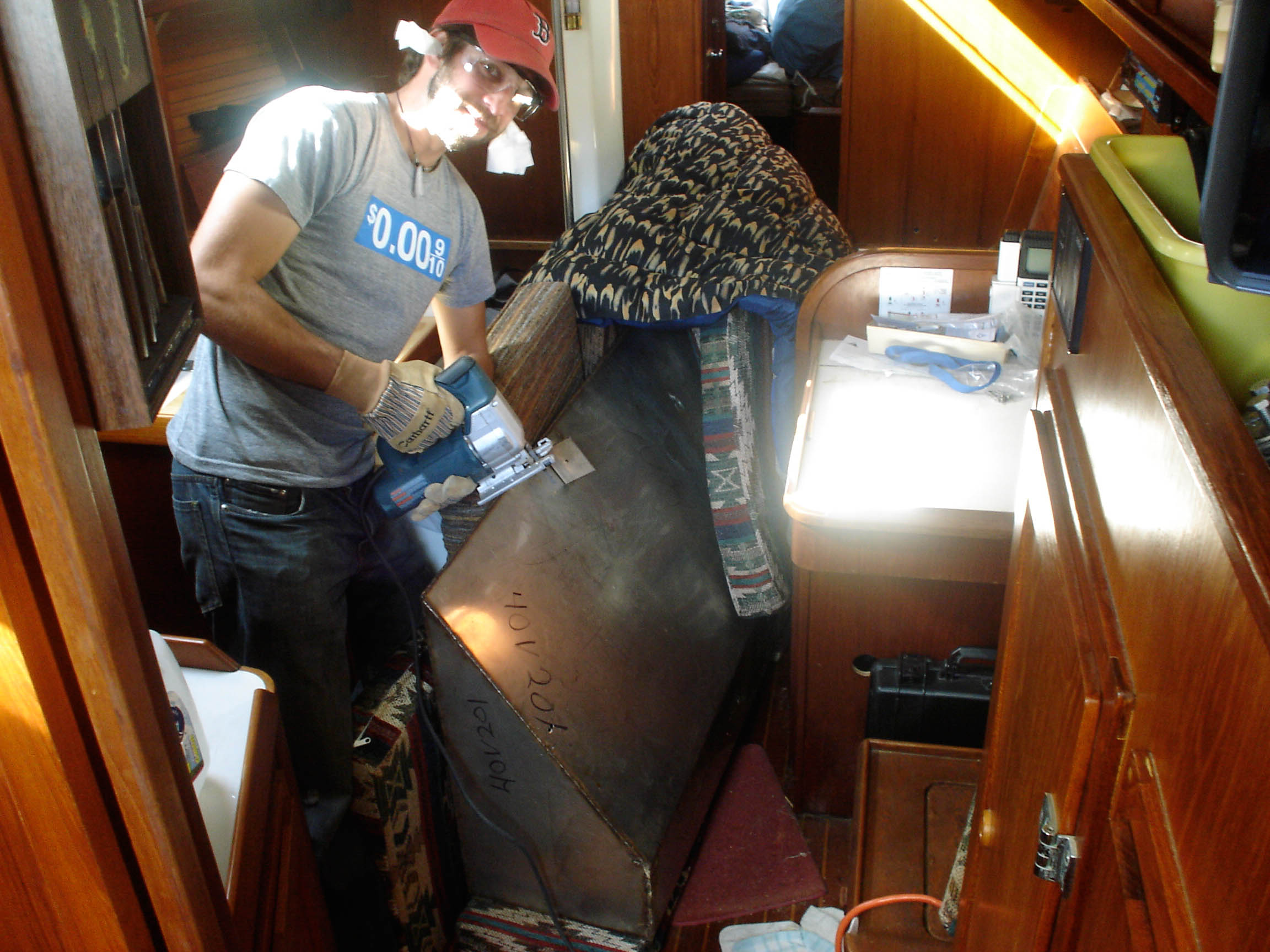
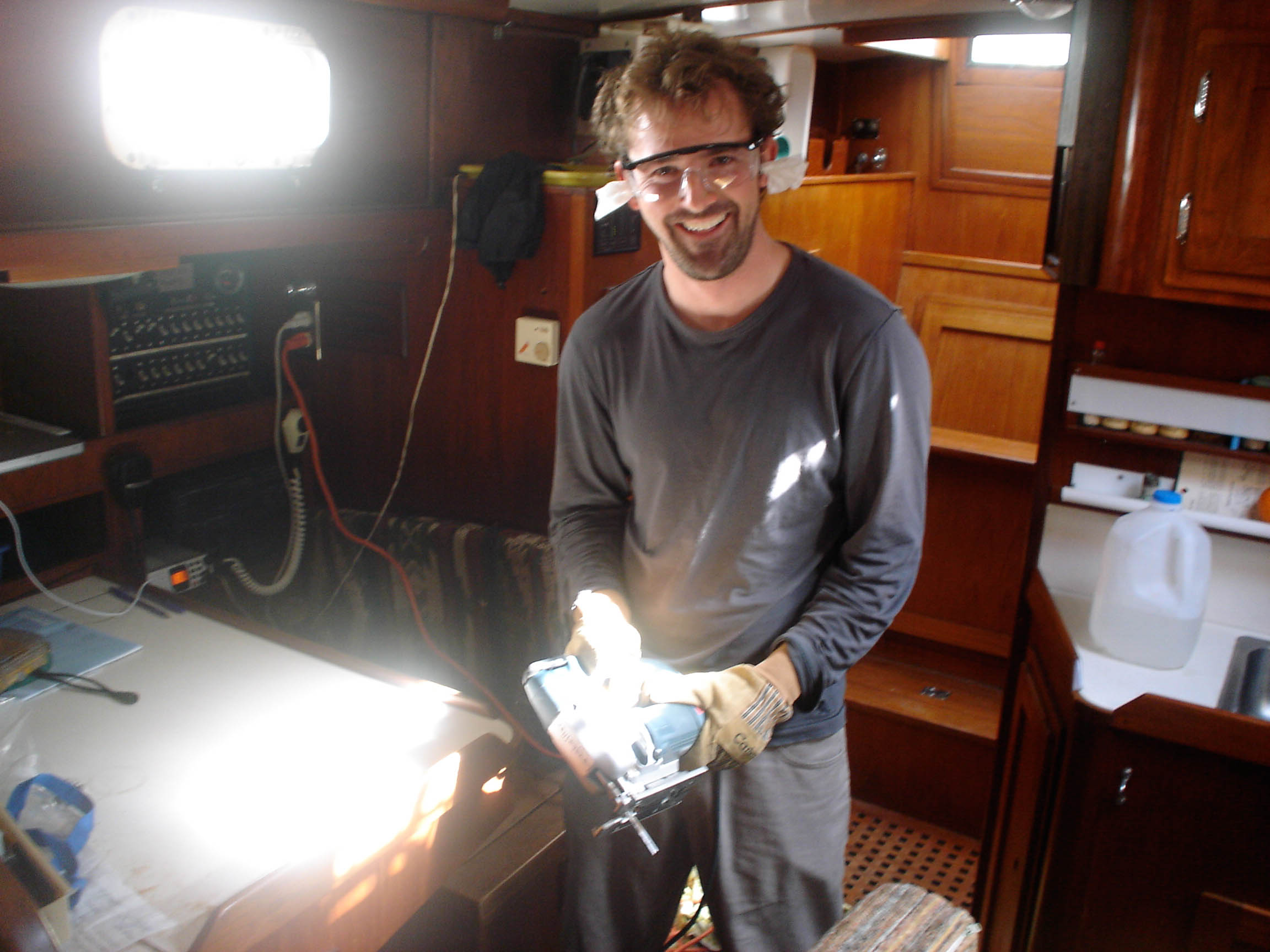
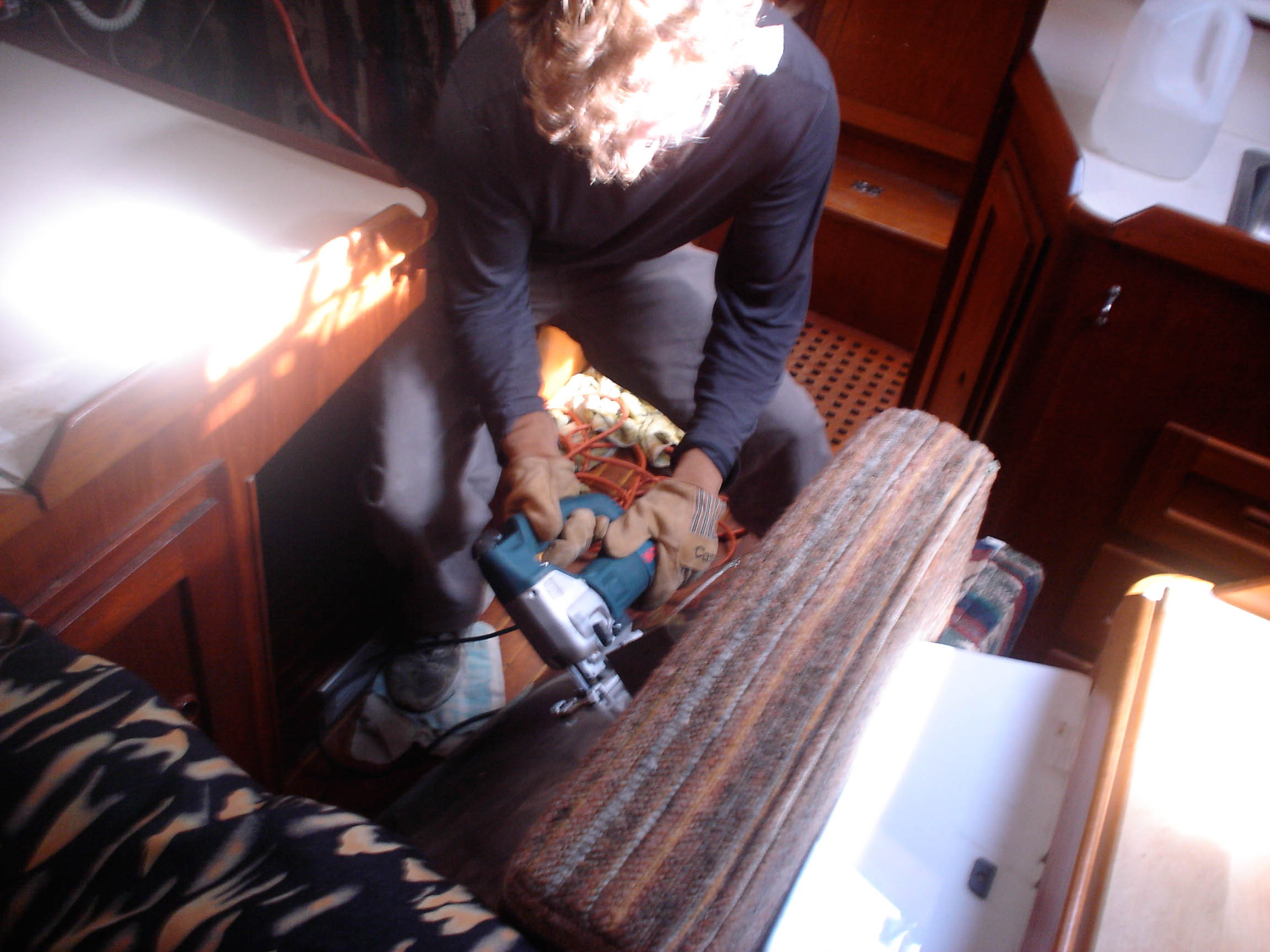
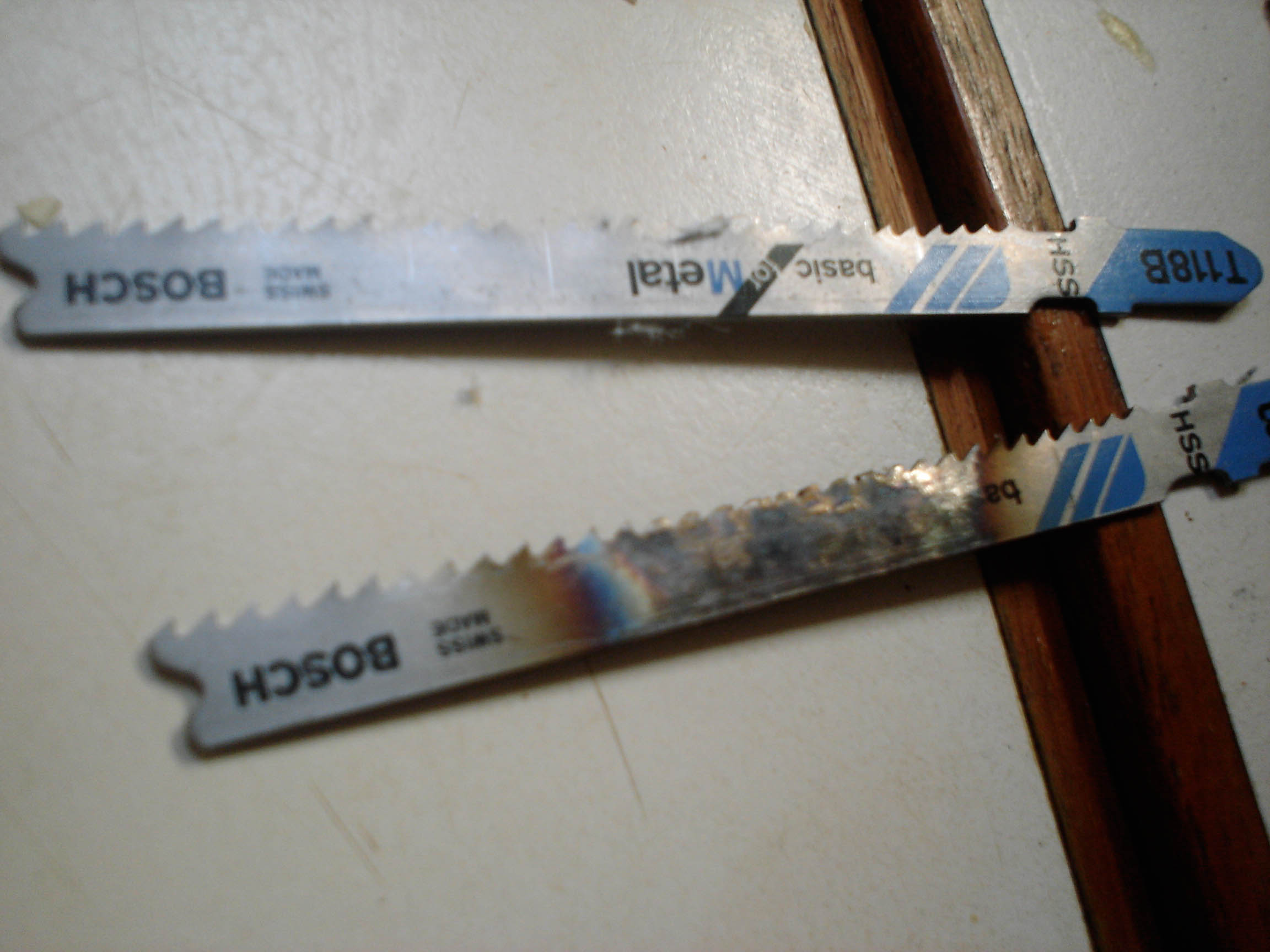
Q: Have we fixed our leaky water tanks? A: Not yet, but we’ve made good progress. We got the starboard watertank out of the boat, but the port watertank is a couple of inches bigger, and wouldn’t fit out the door. After finding the hand-saw worthless at cutting through 1/8″ stainless steel, and after having melted through six metal-cutting jig saw blades, and after having tried-but-finally-decided-against removing the companionway trim (to widen the door), we found a cutting disc for our grinder. After a brief test, we also decided to screw the marina rules and go for it. So late last night, we closed the hatches, padded the tank in pillows and cushions and blankets (to muffle the sound), and hacked away at the thing. Actually, Matt and Jon hacked away at the tank while I stealthily patrolled the dock, VHF radio in hand, so that we wouldn’t get busted. We used a code to disguise our operation:
Shark to Whale – Are we clear to begin feeding? Whale to Shark – The waters are all clear to begin feeding. Proceed.
-15 minutes later-
Shark to Whale – Papa shark is, uh, getting bitten by electric eels. Mama shark is taking over, because she has thicker skin. Whale to Shark – Copy that, Shark. How’s feeding going? Shark to Whale – Uh, feeding is slowing down because, uh, the shark’s teeth are getting dull, and we don’t have any dentures. Also, there’s an oil spill. Whale to Shark – Um, copy that. Waddya mean, an oil spill? Shark to Whale – The waters are cloudy. It’s hard to breathe or feed, Whale. Whale to Shark — Ah, copy that.
Shortly before midnight, the feeding was over, and for the first time in weeks, things seemed to go our way. Nobody haggled us for making noise. The grinder didn’t break (though Matt ground the cutting disc down to a tiny nubbin.) The power didn’t go out. Nothing caught fire (though Matt did burn a hole through a cushion, and ripped two blankets, and filled the cabin with smoke, and covered every surface in metal dust). NEVERTHELESS, we got that friggin’ water tank cut into 3 chunks, and got it out of the boat. Mission accomplished.
Actually, that’s only the first half of the mission. The old, leaky watertanks are out of the boat, and now we’ve gotta build new tanks, which we’re gonna make out of epoxy-coated marine-grade plywood. We’ve cut the pieces, but run out of time on this trip to continue…so it’ll have to wait.
All of which brings up a good point: the whole “fix up the sailboat thing” has forced us to readjust our perhaps overly-ambitious, landlubber-style, deadline-driven agendas. It’s put us in some tough spots, and brought out anger, frustration, exhaustion, and unwarranted criticism. It’s forced us to discuss out approaches to solving problems together, and forced us to admit to each other that we’ve got to be more patient and easy on each other. And we’ve only just started. It’s a challenge already.
I’ll admit it, I don’t normally buy used. I bought a new car. I bought a new condo. Consequently, I rarely have to fix things. In fact, when I tried to make a very minor fix to something in my condo a month ago — my refrigerator — I ended up breaking it. Snapped a coolant tube. Oops. So I had to replace the fridge. You may have guessed it, I didn’t buy a used model; I bought a new one. I think I inherited this behavior from my parents, who also almost always do they same thing. I also never really had experiences hanging around with my dad on Sundays, head under the hood of the car, tinkering and fixing. I’m OK with that. I get to spend my time on other things. Hey, we all make choices on where our time goes. So this whole fixing-old-stuff thing, like a 30-year-old boat, is relatively new to me.
So I spent a couple of days trying to fix our boat’s packing gland, which is the fixture around the hole through the hull where the propeller shaft enters the boat. Clearly, if this leaks, there is a problem. Ours leaks: clearly a problem. At least it only leaks sometimes…
The packing gland is right next to the engine, so it’s kinda dirty. I wanted to clean it and asked Matt and Jonny how. “Use acetone,” they said. So I grab the acetone and pour it into a bowl in the kitchen. I dab the cloth rag I’m using into it, go back to the engine room (two feet away) and wipe along the propeller shaft. All good so far; it looks cleaner. I go back to the kitchen, dab, back to the engine room, wipe. Cleaner. This process gets repeated a few times until I’m finished cleaning and decide to tidy up my materials.
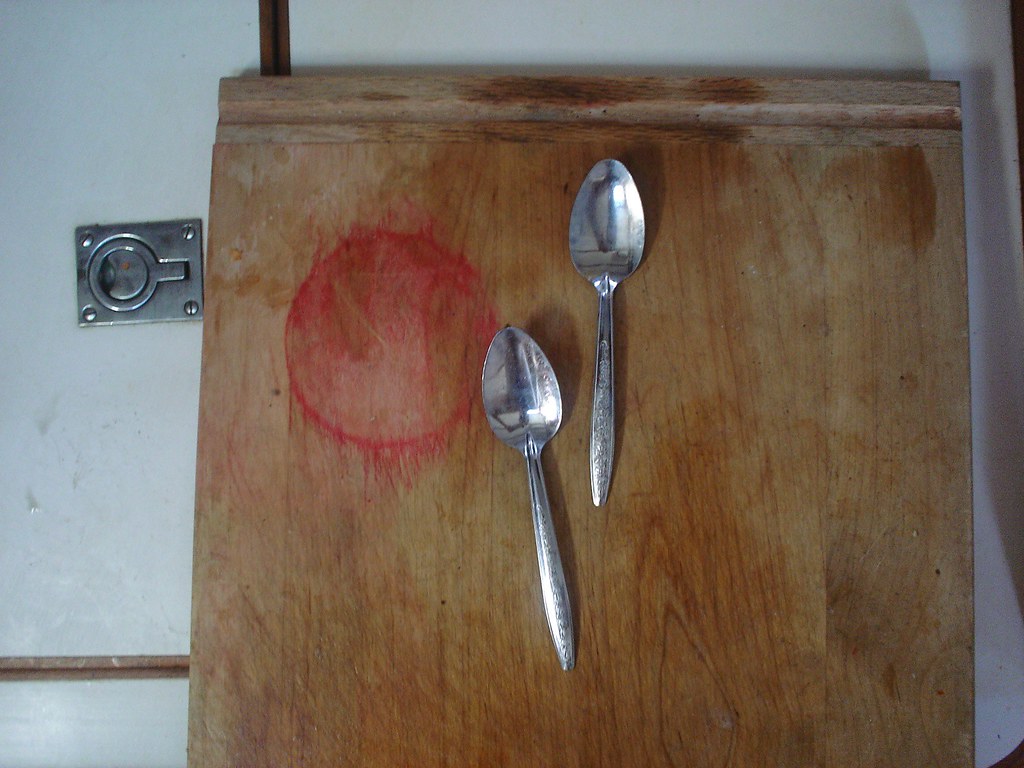
Back in the kitchen, however, acetone has shown why it’s such a good cleaner, and has begun to eat through the cheapo plastic bowl that I put the acetone in. Oops. The bottom of the bowl is a gooey mess, and when I pick up the bowl the bottom separates from the rest of it, and acetone spills out of the now-bottomless bowl, and gooey plastic strings dangle in the air. Good stuff. Matt laughs hysterically at me.
The plastic bowl happened to be located on our wooden cutting board in our kitchen and now we have a permanent red strain on our cutting board — a memento, if you will.
I’m tired. We’ve worked for nearly two weeks and have yet to accomplish most of our major objectives for this trip. I feel a combination of a sense of accomplishment at working hard for two weeks, mixed with frustration at little visible progress. ‘How come you have done seemingly so little?’ some of you might ask. Other more direct people might simply say, ‘are ye incompetent?’
Maybe. But I think my tussle with the baby stay (the inner of two wires at the front of the boat holding up the mast) is illuminating. Since we are planning on replacing the babystay, we need to know the size of the pin that connects the wire to the fitting, so that the fitting we buy to replace the old one will fit. So all I need to do is remove one small pin. The pin is my objective.
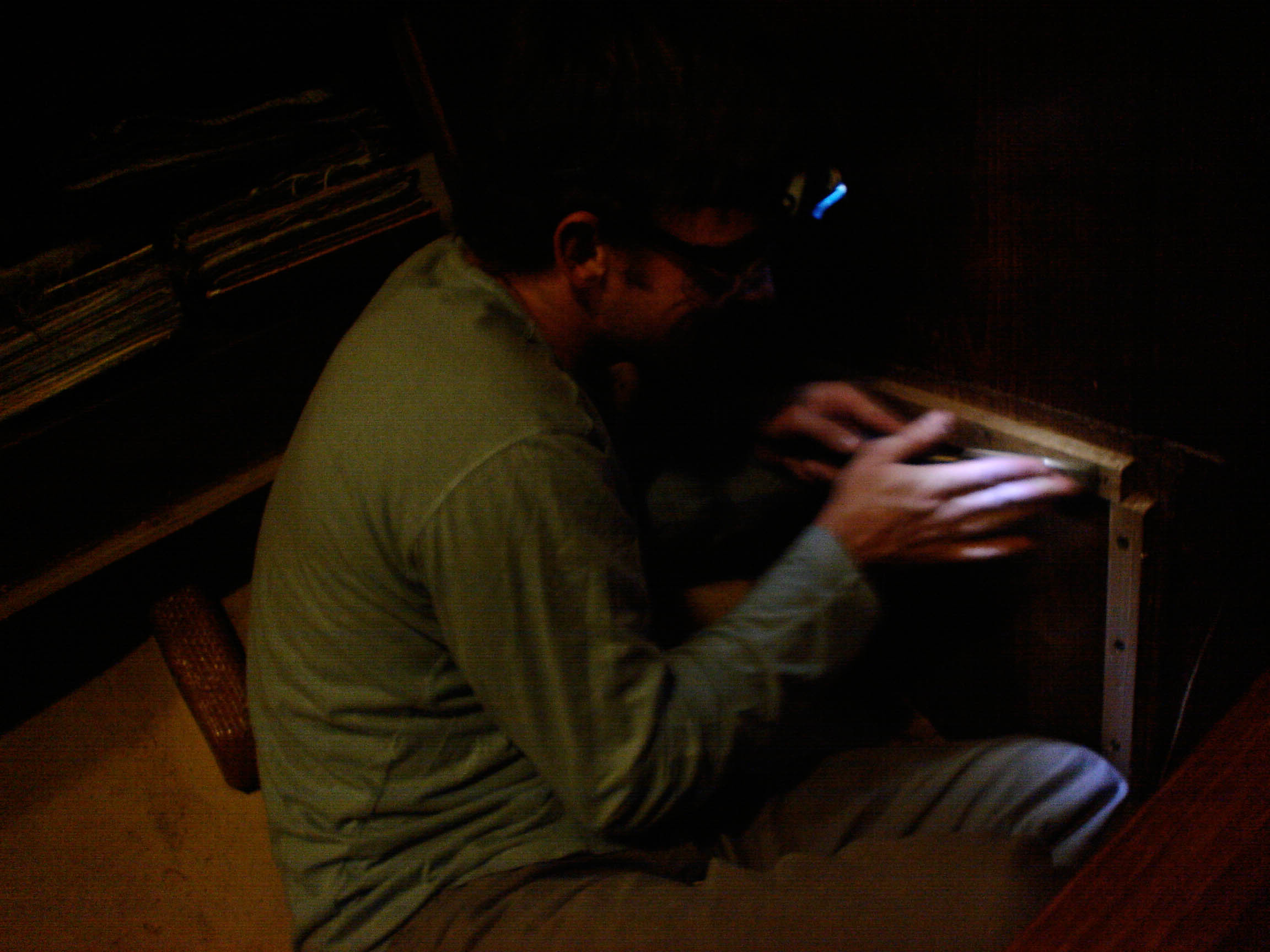
At Matt’s advice, I take our largest screwdriver up on deck to unscrew the pin. The pin, however, having probably only been put in or taken out a few times in the last 30 years, and certainly none at all in the last five years (while the boat was in storage), has other ideas, and refuses to budge. I spend 15 minutes attempting to unscrew the pin with that screwdriver, which is admittedly too small for the job. I had hoped muscle power would overcome the screwdriver’s inadequecies, but apparently my muscles are inadequate also. Returning to the boat interior, I ask Matt and Jonny for ideas. Go ask Miguel, our new-found friend and yard manager, for a larger screwdriver, they say. Off I go to find Miguel, who isn’t around. I ask Arturo, another local mechanic, if he has a large screwdriver. Nope. He refers me to another local, and again I come away empty-handed. Goodbye to another fruitless 20 minutes, perhaps longer, given my poor Spanish skills [see ealier posts for more on those skills]. Back to the boat, where I sit and ponder. Five minutes. I think. Earlier in the week, we used a random piece of metal to unscrew hose clamps; perhaps I could find a larger piece of random metal to fit this much larger screw. I go and measure the size of slot on the pin. 18 mm x 4 mm. Ok, commence searching. Five minutes. 10. 15. Alright, I think I have the perfect piece! but it’s 17mm x5mm. Maybe I measured wrong and this one will fit. Silly me. Of course when I try to fit it in, it doesn’t go. Aargh!
At this point I am faced with a dilemma. Continue searching, or, since it is so close, try and modify this piece. Well, since searching more would be boring, and modifying it involves using power tools, the choice is obvious.. I get the drill, screw in the piece of metal to a block of wood. Next, I get the grinder and begin grinding away at the metal. I’ve never used a grinder before, and this is kinda fun. Fifteen minutes of getting tools, tool use, and cleaning up yields what I hope is a usable piece of metal. I test it and it fits! Mini-victory! Now, I get the vice grips, chomp them down with all my might and insert my homemade screwdriver-apparatus into the head of the pin. Ten minutes later, and the pin is finally removed. At last. 80 minutes after starting, I’ve removed one pin. Victory, albeit over one pin. There are many more parts to deal with on this trip and I think they each will individually take 80 minutes of attention. And this is how we’ve worked non-stop yet accomplished seemingly nothing.
Our first day in the work yard, we met a fellow gringo-boat-owner named Richard. He’d just recently bought his 10th boat, a trawler, and was busy painting it. She’s not nearly as elegant as Syzygy, but she’s definitely cleaner and shinier.
Richard asked us if Syzygy was our first boat. We told him it was. His reply: “Wow, you guys went big.”
You could say that made us proud.
Throughout the day, whenever we bumped into Richard, we chatted about repairs and maintenance. We told him our plan: 1) remove and service the seacocks, 2) fix the leaky packing-gland (the waterproof seal around the propeller shaft), 3)remove the leaky water tanks and rebuild new ones, and 4)remove the old, crappy toilet.
Richard, obviously familiar with over-eager-boat-repairmen who-just-bought-a-ton- of-new-tools -and-have-big-dreams, took the opportunity to share a wise Italian aphorism with us: “Better is the enemy of good.”
We heard him, but not really, and continued with our plans. We were intent on achieving perfection, and spent five days tearing up Syzygy, disassembling and eventually throwing away half a dozen trash bags full of old, unwanted/corroded/cracked hoses and parts.
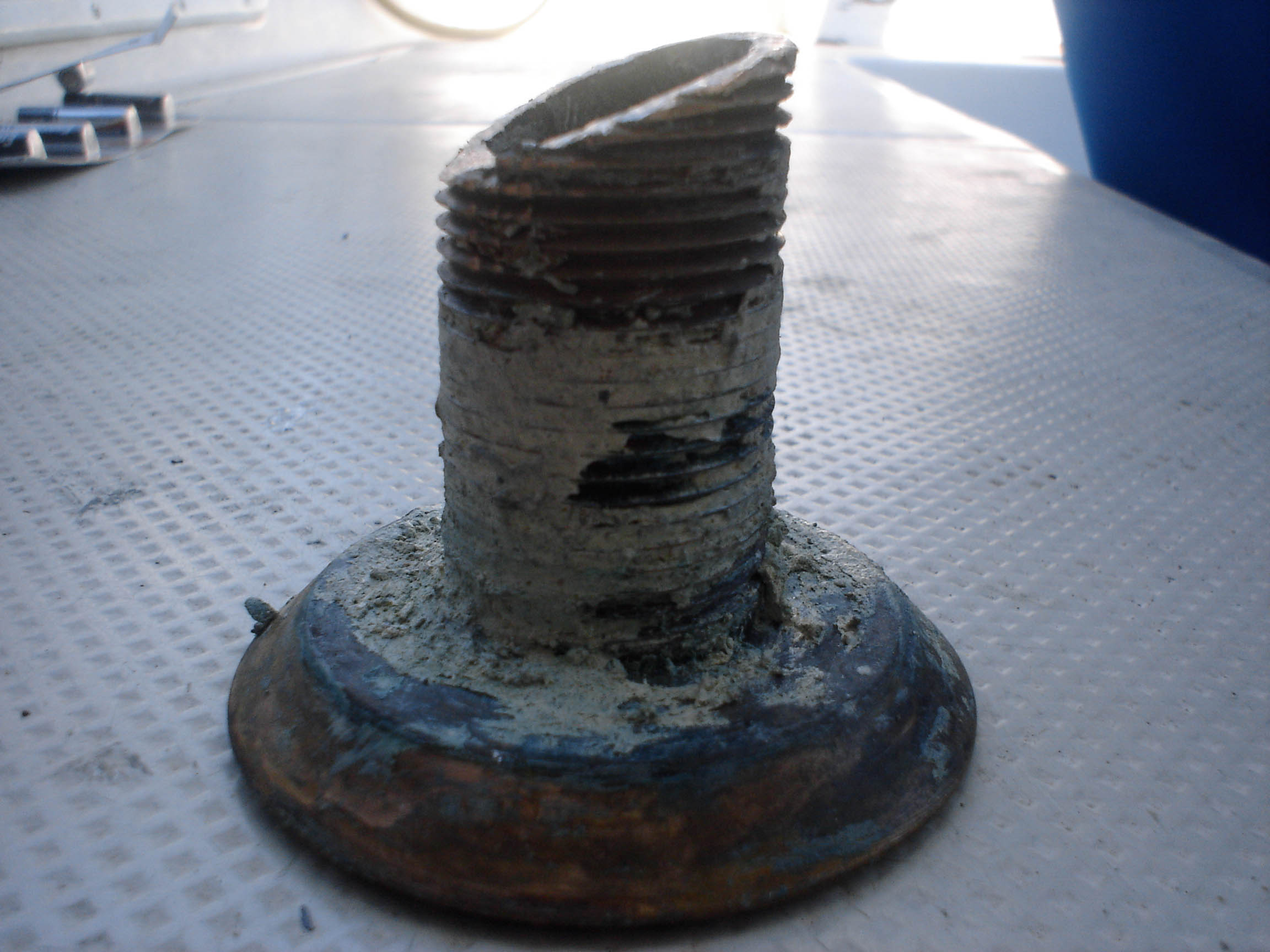
Then Jon got his hands on the jig saw, and decided to have a go at repairing one of the through-hulls. Through-hulls are bronze cylinders that the seacocks screw onto, and you could say that their bomproofness is essential to any sailor’s peace of mind. Seacocks are supposed to be screwed down until flush with the hull, and this through-hull was too long, preventing the flush junction from occurring. Technically, it had been installed incorrectly. It was good, but not perfect. So Jon was just gonna shave off an inch or so.
Jon’s attempt didn’t go so well. He was cutting under a tiny cupboard, in the bathroom, and was holding the saw at a crazy angle while all scrunched up, so that he could reach his arms in there. He ended up cutting the through-hull off at a 45-degree angle, leaving it too short to use.
The result: yet more work for us. We’d need to 1) remove the now-damanged through-hull, 2) buy a new one and 3) re-bed it in the hull. Also, there’s the bonus result of a bruised ego for having just essentially cut a hole in your $60,000 sailboat.
So Matt and I spent 3 hours driving around San Carlos and Guaymas today, seeking out the elusive new through-hull and the appropriate glues and epoxies and tools for setting it in place. Not surprisingly, such materials and parts are hard to find around here. We were left vexed and tired at the end of the day, and empty-handed on some counts. So you could say we’re starting to understand Richard’s advice.
Let’s start with some basics: Like most sailboats, Syzygy has a whole bunch of holes in her hull below the waterline. Syzygy has 8 of ’em. Two of em hold instruments that measure depth and speed. One of ’em lets exhaust out of the engine. The remaining five have seacocks (aka valves) on them, so that we can let water in or out of certain pipes and go about our lives like normal civilized people. One lets water into the galley sink. One lets water out of the galley sink. One lets water (as coolant) into the engine. One lets water into the toilet (so we can flush it). And then there’s the last one, the most glorious seacock. It lets shit out of the holding tank.
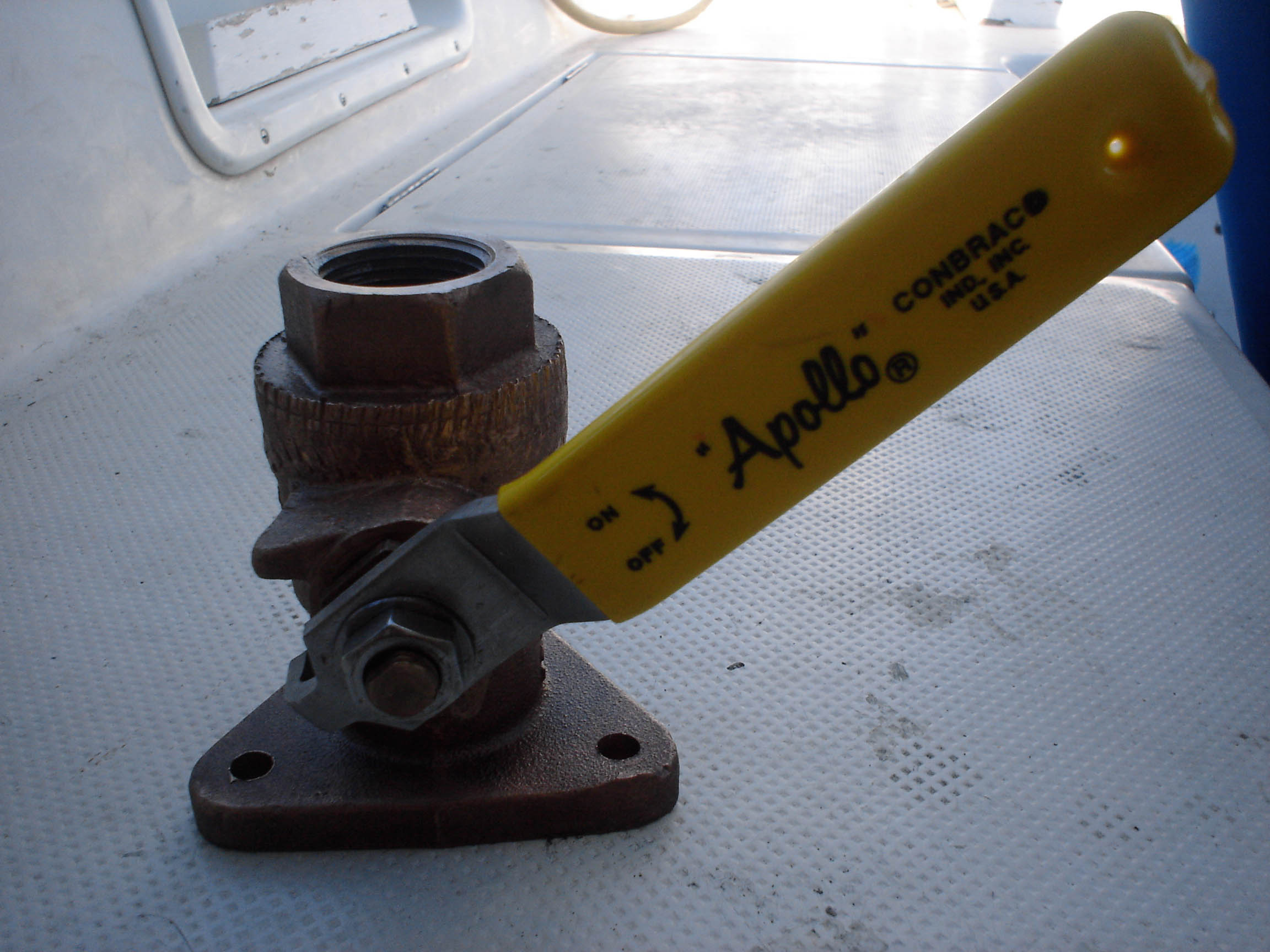
So our first task, here in San Carlos, was cleaning and, for lack of a better term, “servicing” the seacocks. It’s a task you can only do when the boats on land, and it’s a task we wanted to do before putting Syzygy in real water, since you’re essentially screwed if the seacocks leak or don’t properly close. It’s also a chore. The seacocks are big old bronze things, with short stubby arms that rotate 90 degrees. Let me be more precise: if they’re in good shape the arms smoothly rotate 90 degrees. If they’re old and corroded and full of caked-on, calcified shit, they rotate most of the way there, with a lot of force.
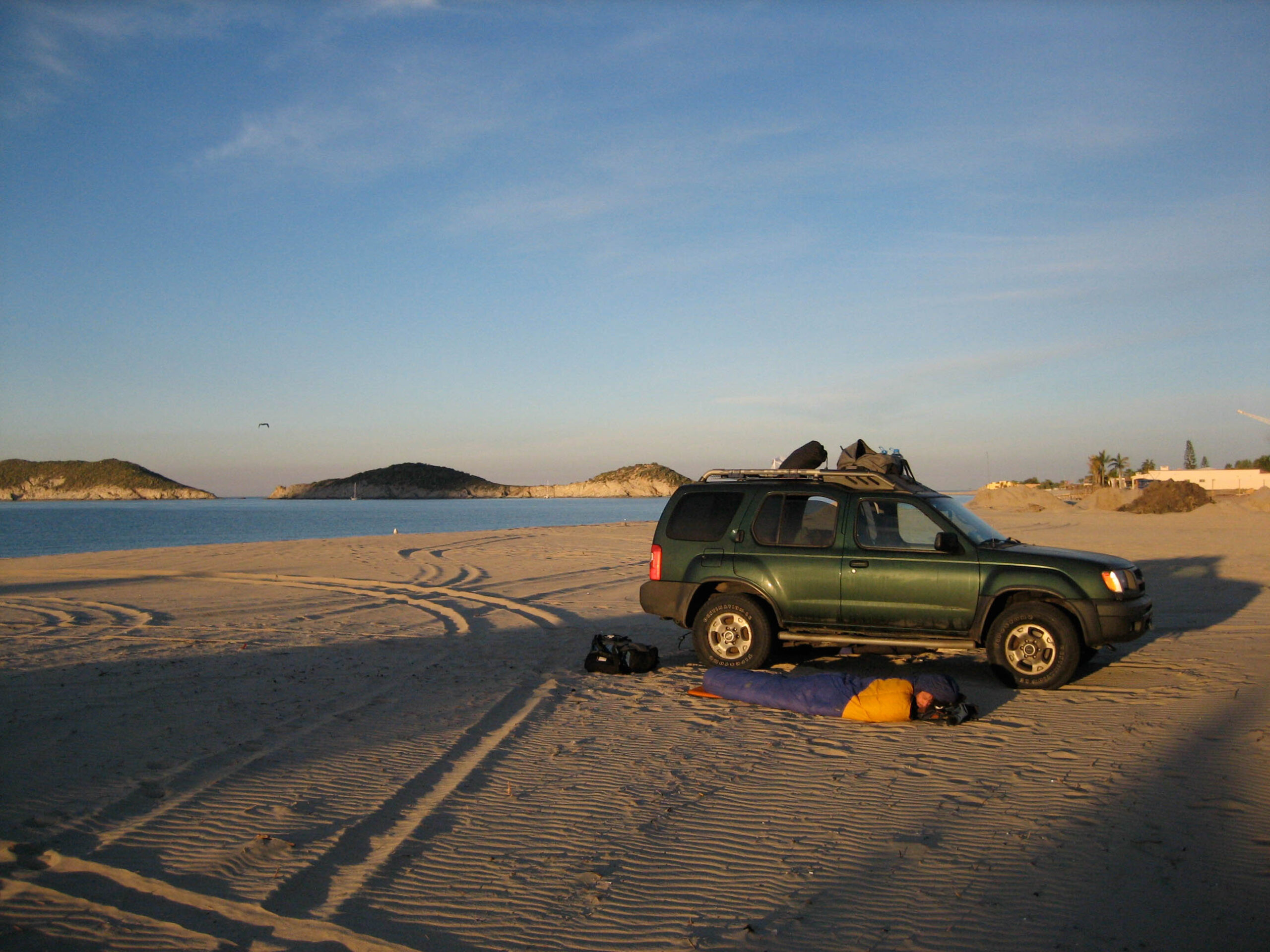
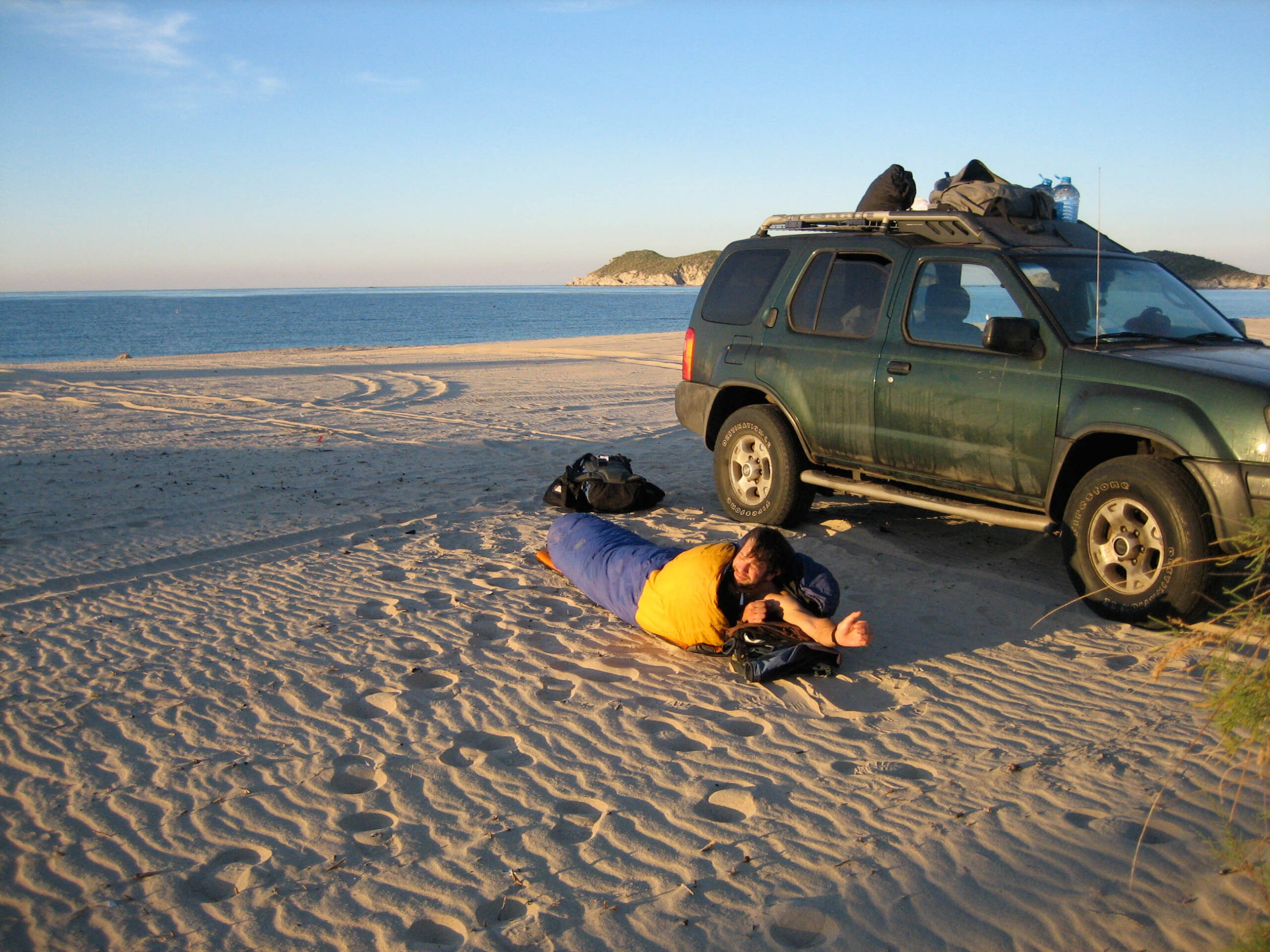
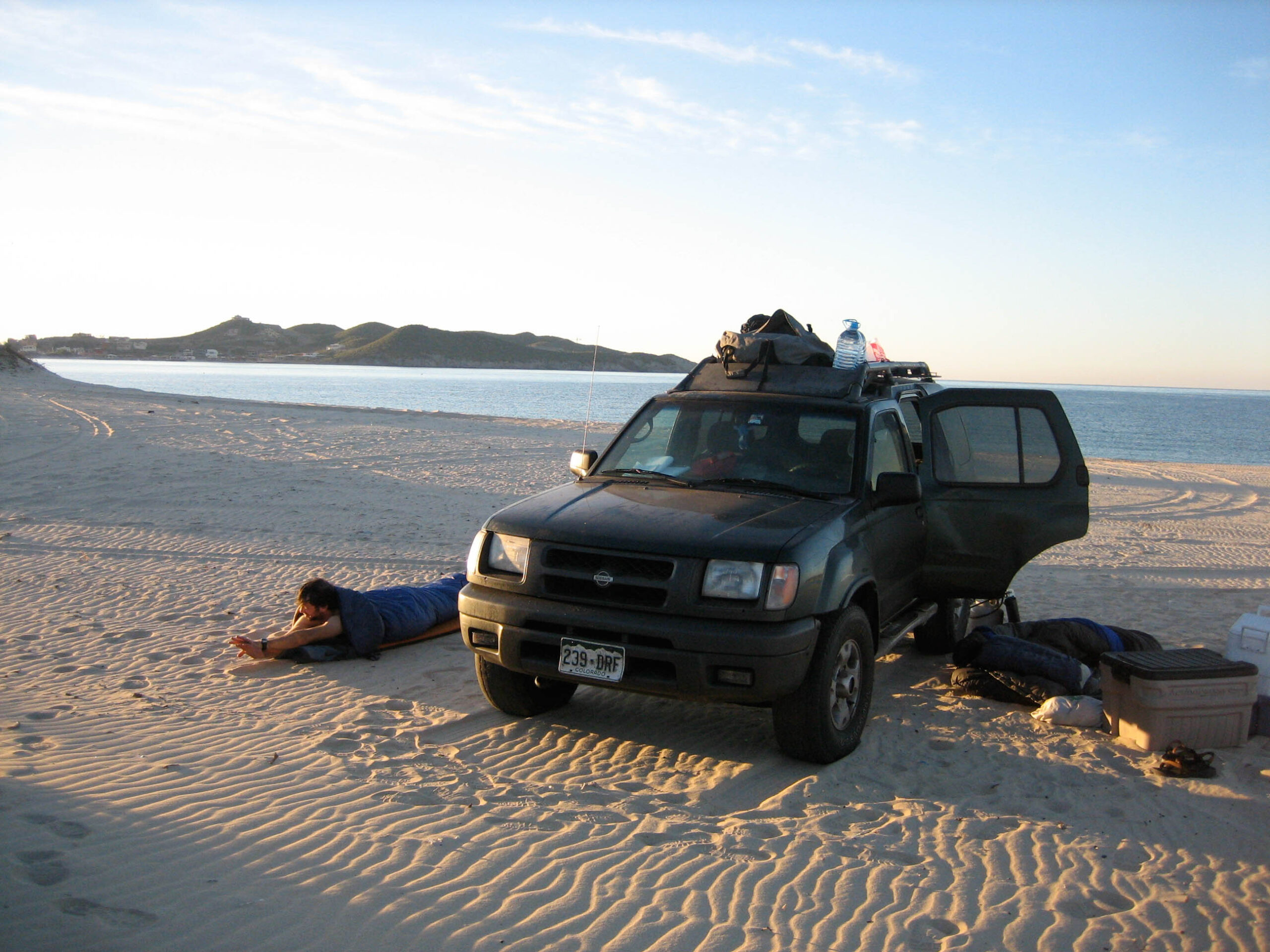
So Jon and I rolled in to San Carlos after midnight Sunday night (Matt’s flying/bussing in tomorrow), and slept on the beach, which turned out to be much frostier than we expected. We slept well after 15 hours of driving, and woke at first light, eager to finally start getting our hands dirty with all kinds of satisfying repair jobs. After quick breakfast burritos, we headed over to the marina office, arranged to have Syzygy moved to the work yard, and immediately set to removing the seacocks. Three hours later, at 2pm, the marina closed, since it was Christmas eve. Jon and I had only removed 3 of them.
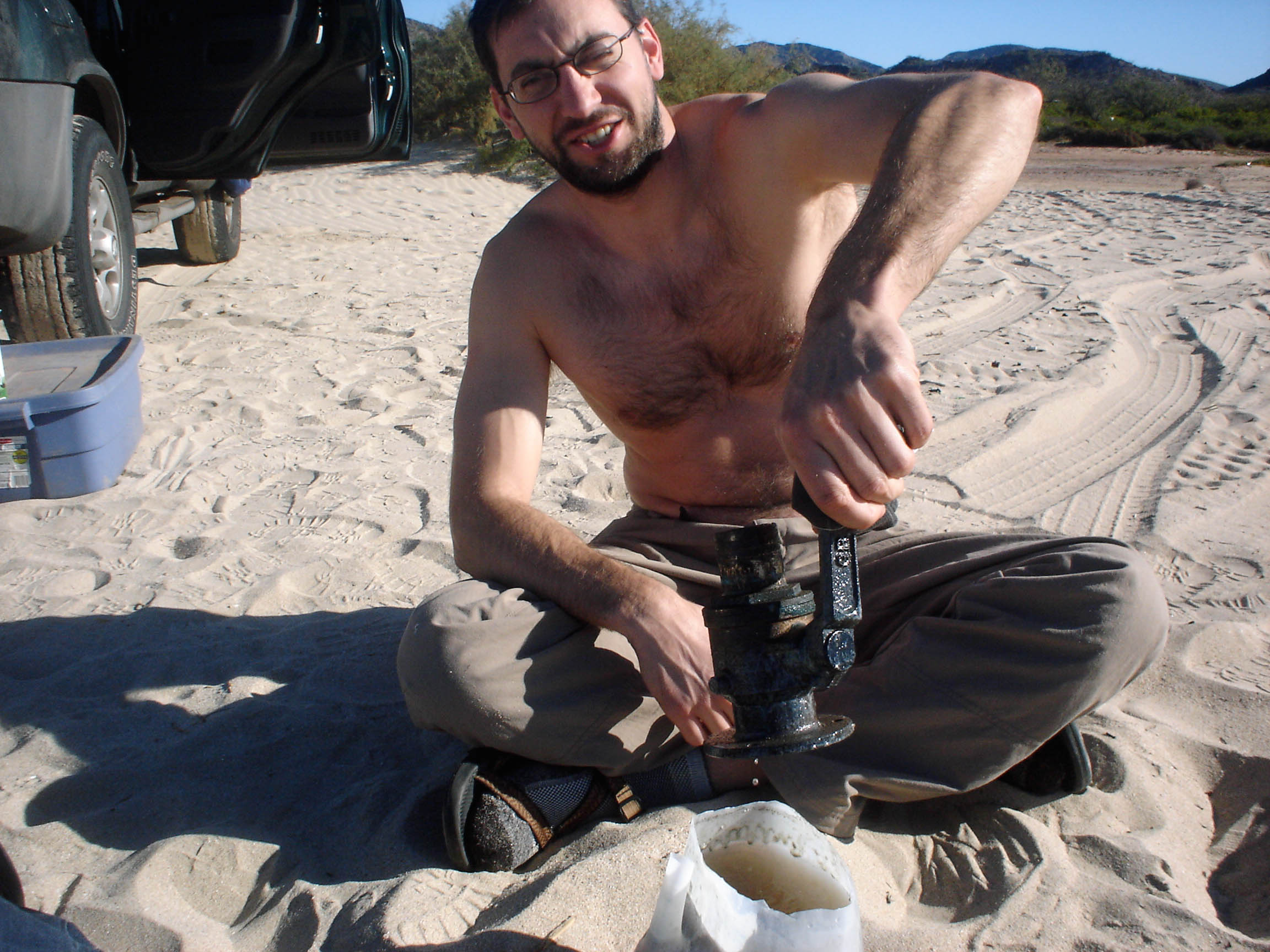
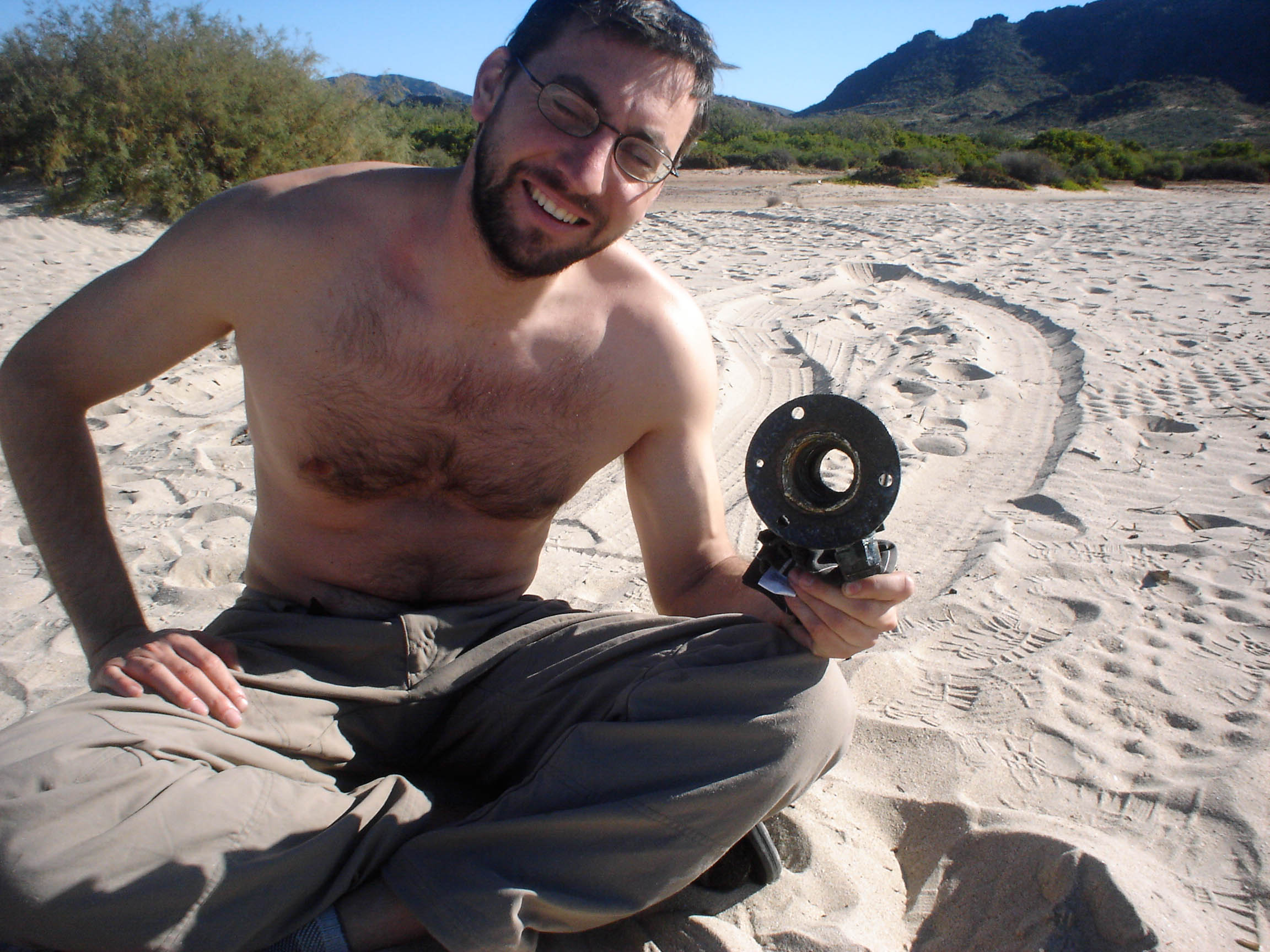
The next morning — marina still closed on account of Christmas — Jon and I got to work cleaning the seacocks on the beach. We discovered that sand + rags + muscle = kinda-like-sandpaper, and polished up two of the seacocks pretty good, greasing up the open/close mechanisms until they were smooth.
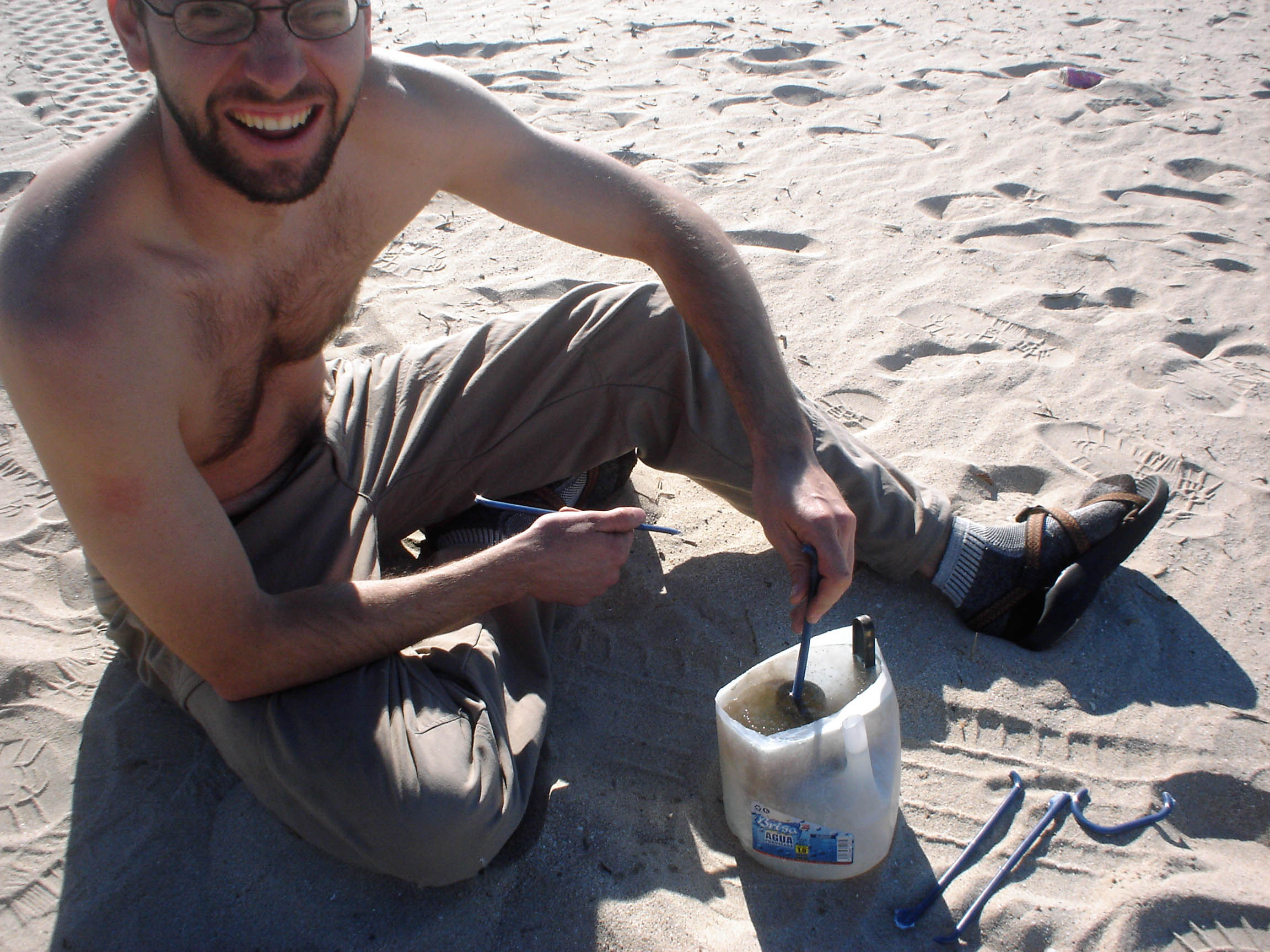
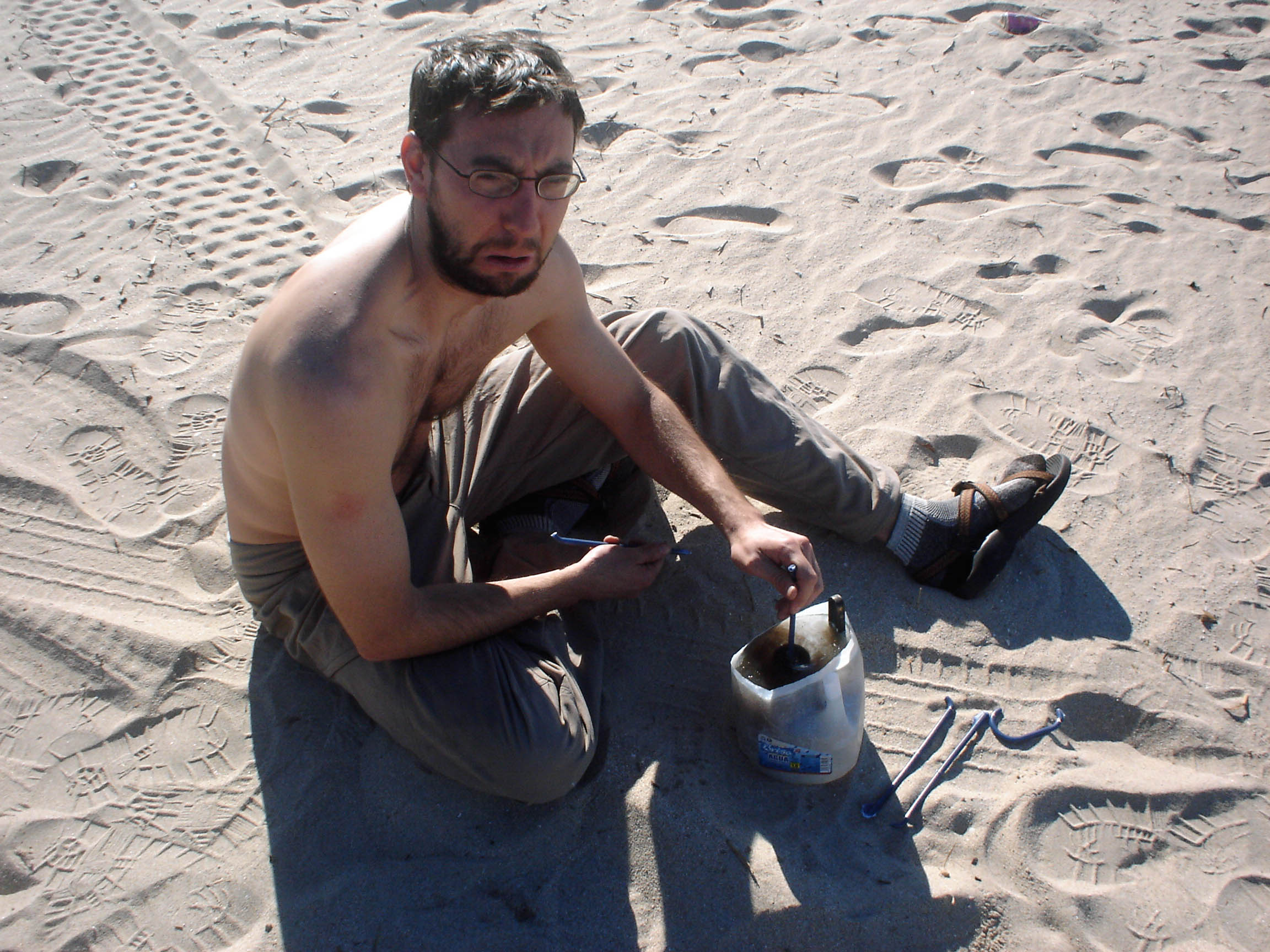
The shit-laden seacock was another matter. Its inside looked like a giant clogged artery, and it took an arm and a leg to close it all the way. We scrubbed and scrubbed with bronze wool and a couple of bronze brushes, but to little avail. Then we improvised. We poured hot water into a cut-open milk jug (Jon brought a propane camping stove), dropped the seacock in, and scrubbed the inside with pieces of coat-hangers. Voila: if you’re looking for a gallon of piping hot shit broth with a full-bodied shitty aroma, there’s no better way to go. And, lucky for us, if you’re looking to take 10 years off the life of a seacock, our method’s not so bad either.
So here it is: the priceless shot of Jon, getting his hands dirty, making memories that dreams are made of.
We bought the boat, and I am pleased to be in the happy excited phase of ownership. It feels really good to be able to tell people that we bought a boat. It gives legitimacy to our plan. I don’t get those infuriatingly skeptical looks anymore, and people actually pay attention when I tell them we’re going to sail around the world.
The boat is a 1978 Valiant 40, hull number 201. The Valiant 40 is one of the most solid blue water production boats ever designed. Valiant 40’s are heavy and solidly built and can survive anything, yet they are respected for their sailing ability as well (a rare combination).
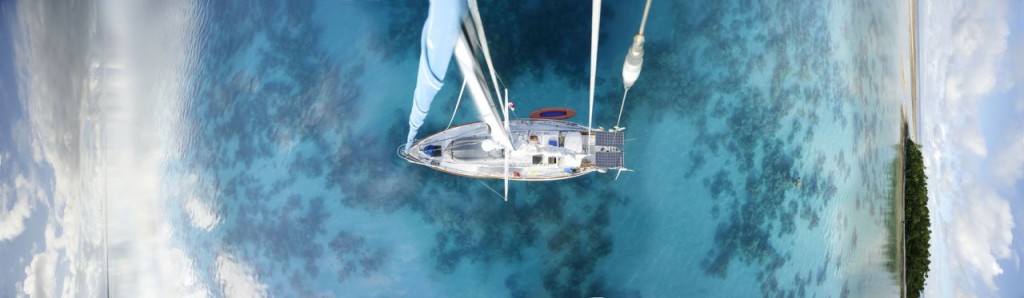
We are naming the boat Syzygy (she was Sunshine before we bought her). Syzygy is an astronomy term referring to the alignment of three or more celestial bodies. There are three of us, aligning our plans and aspirations to make this happen, and our circumnavigation will be a once-in-a-lifetime event, so the name seems to fit.
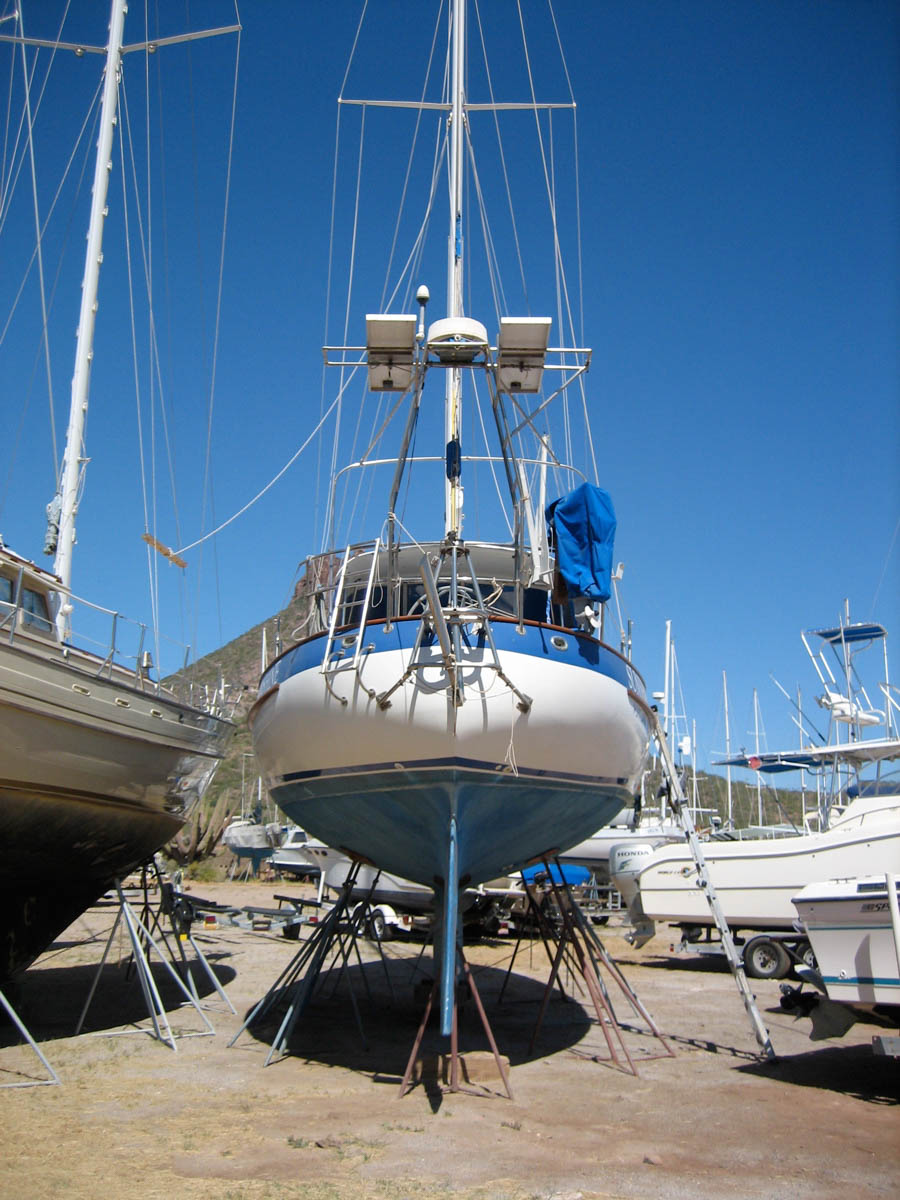
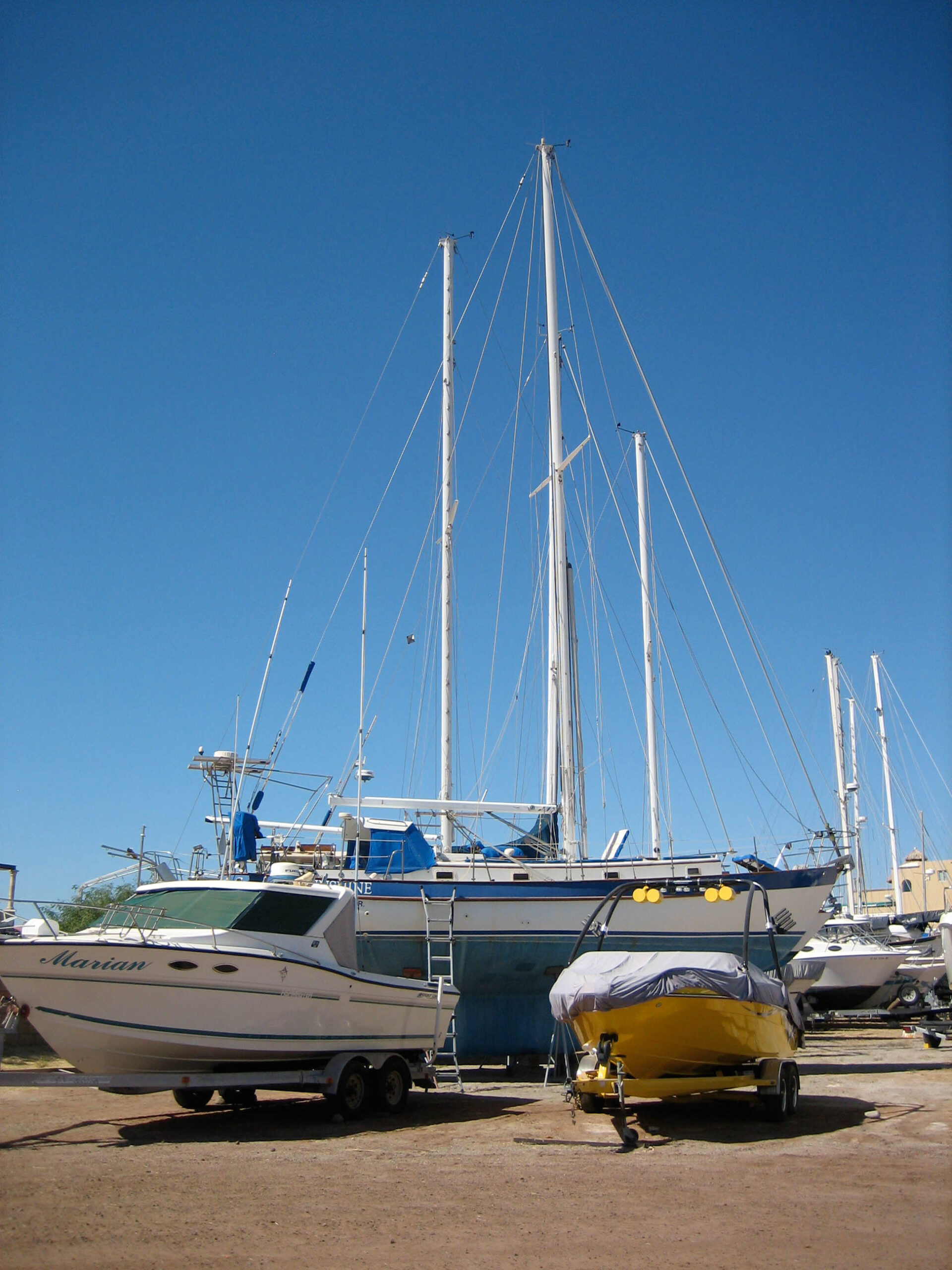
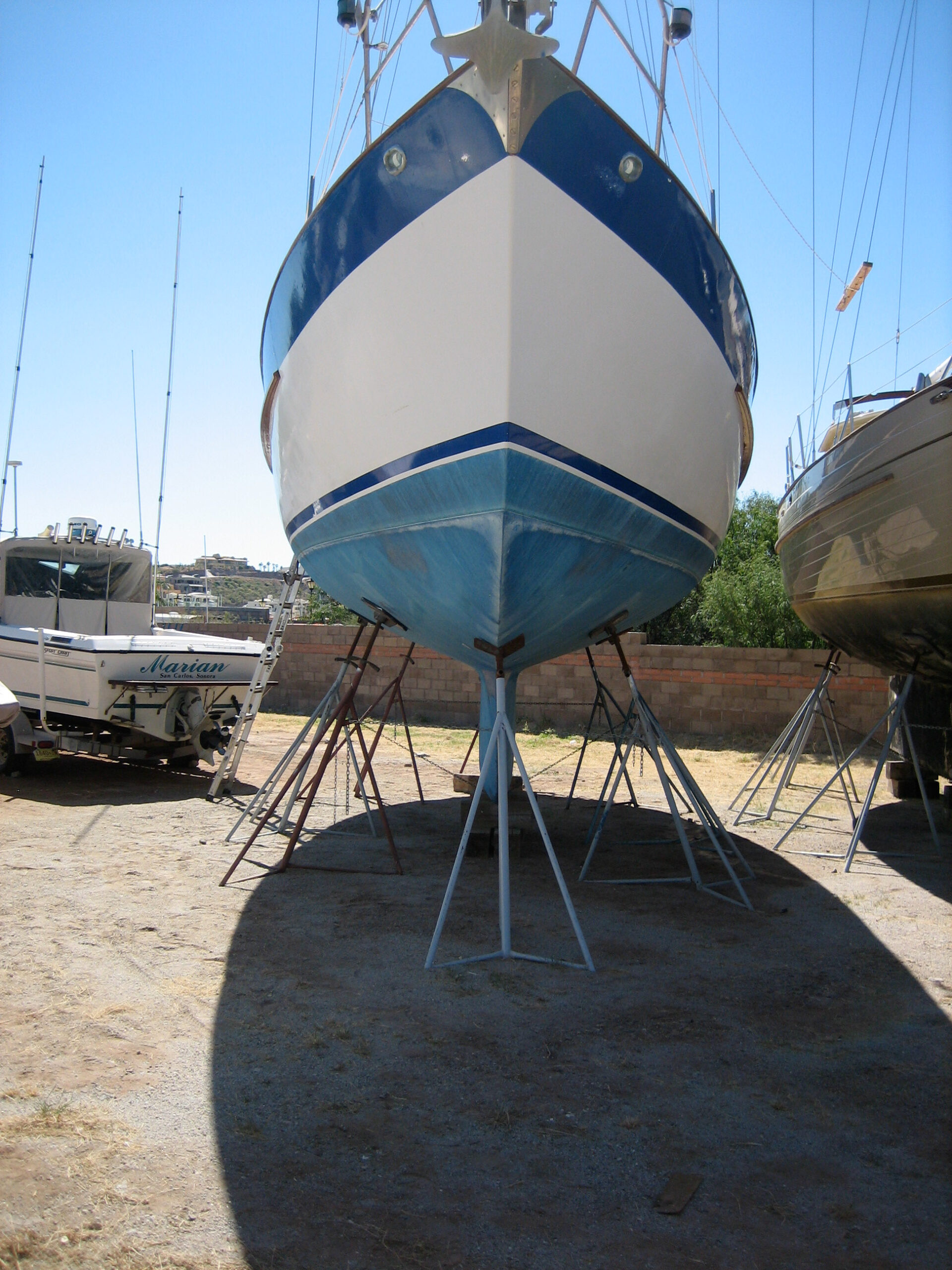
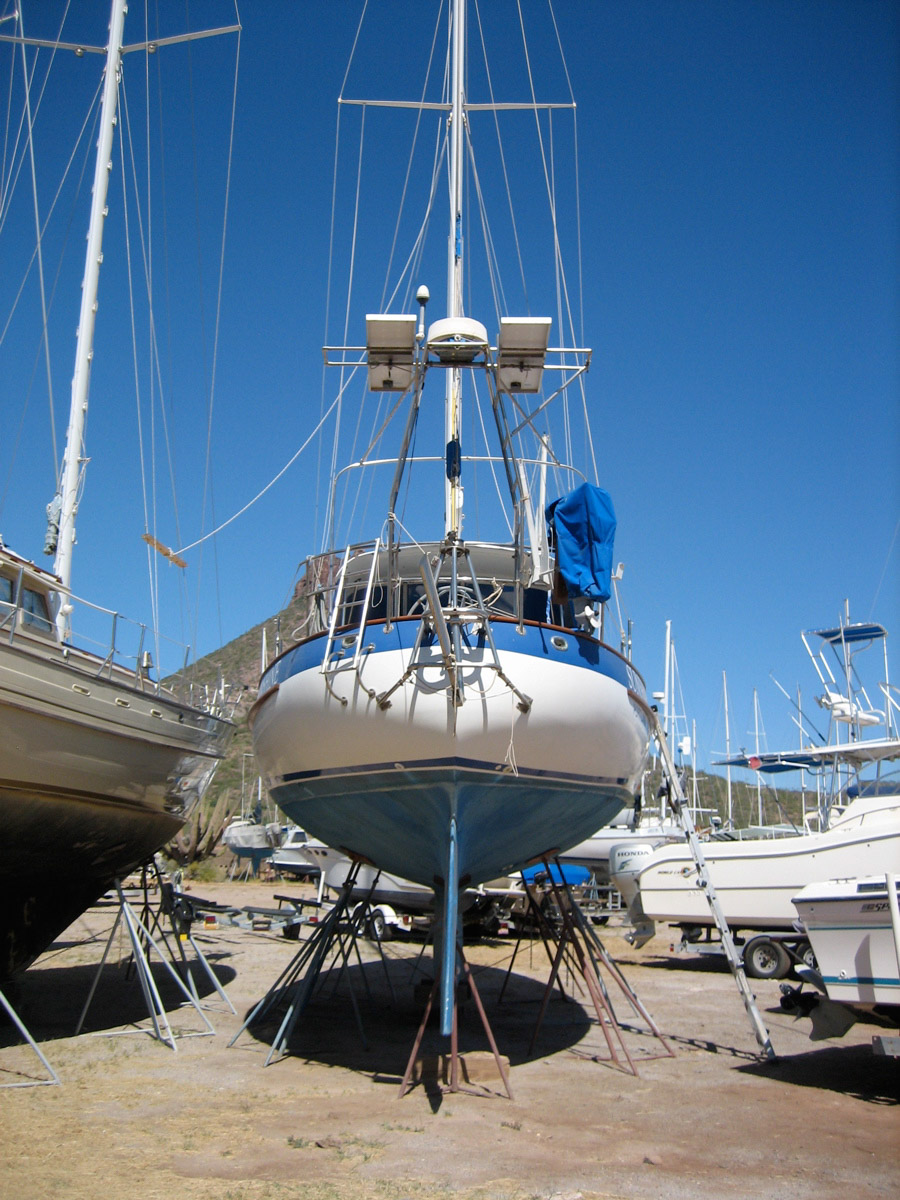
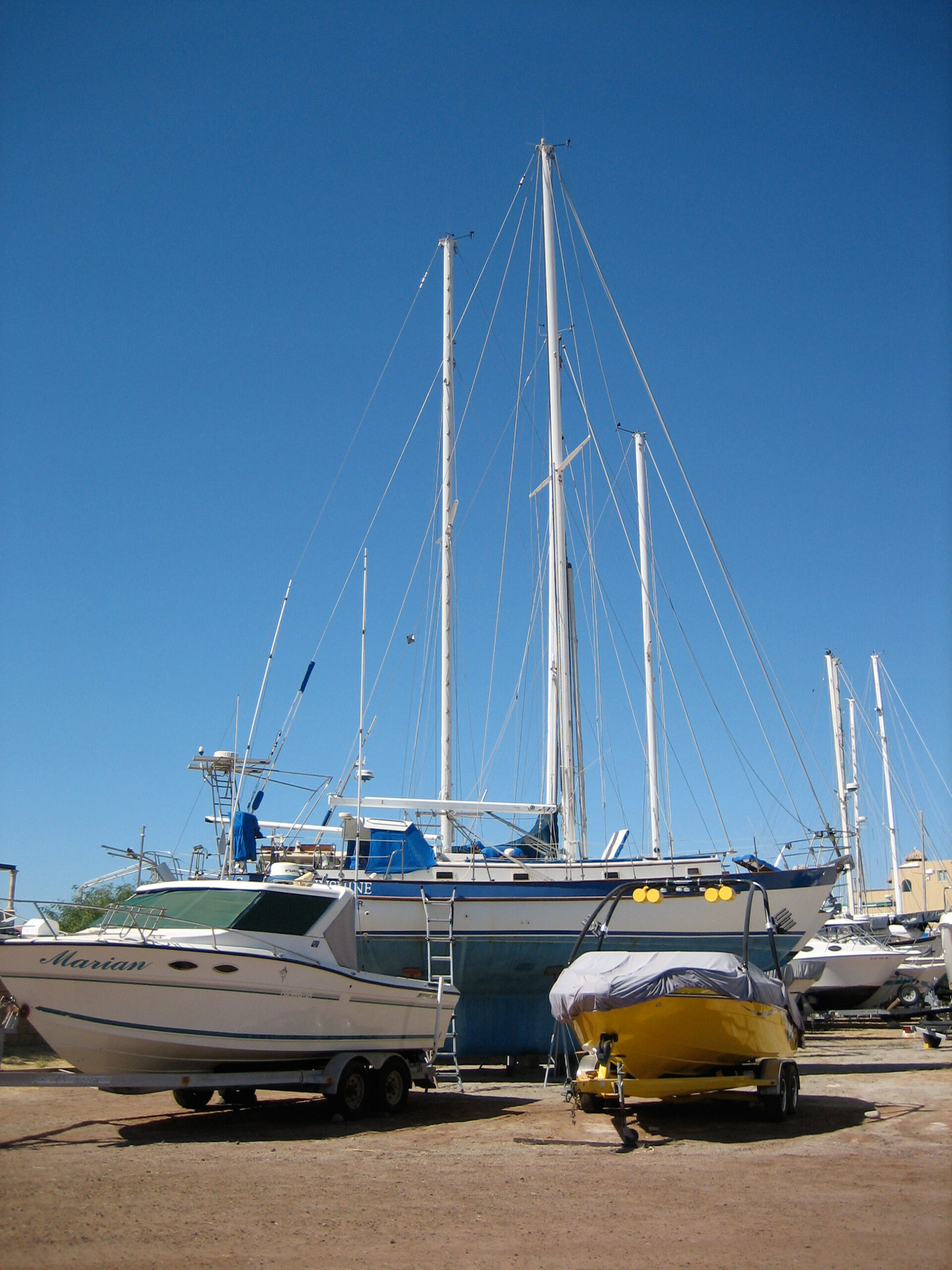
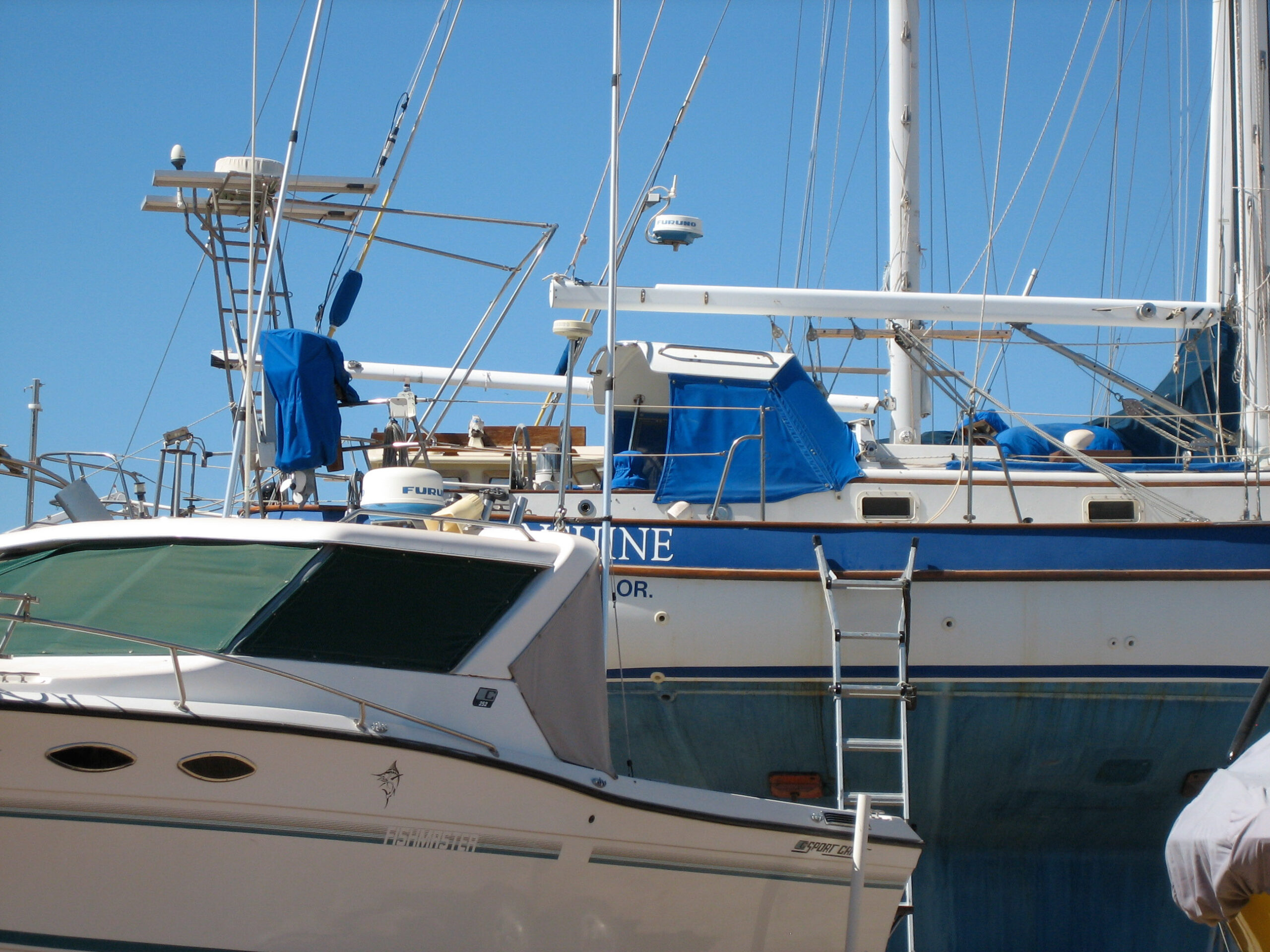
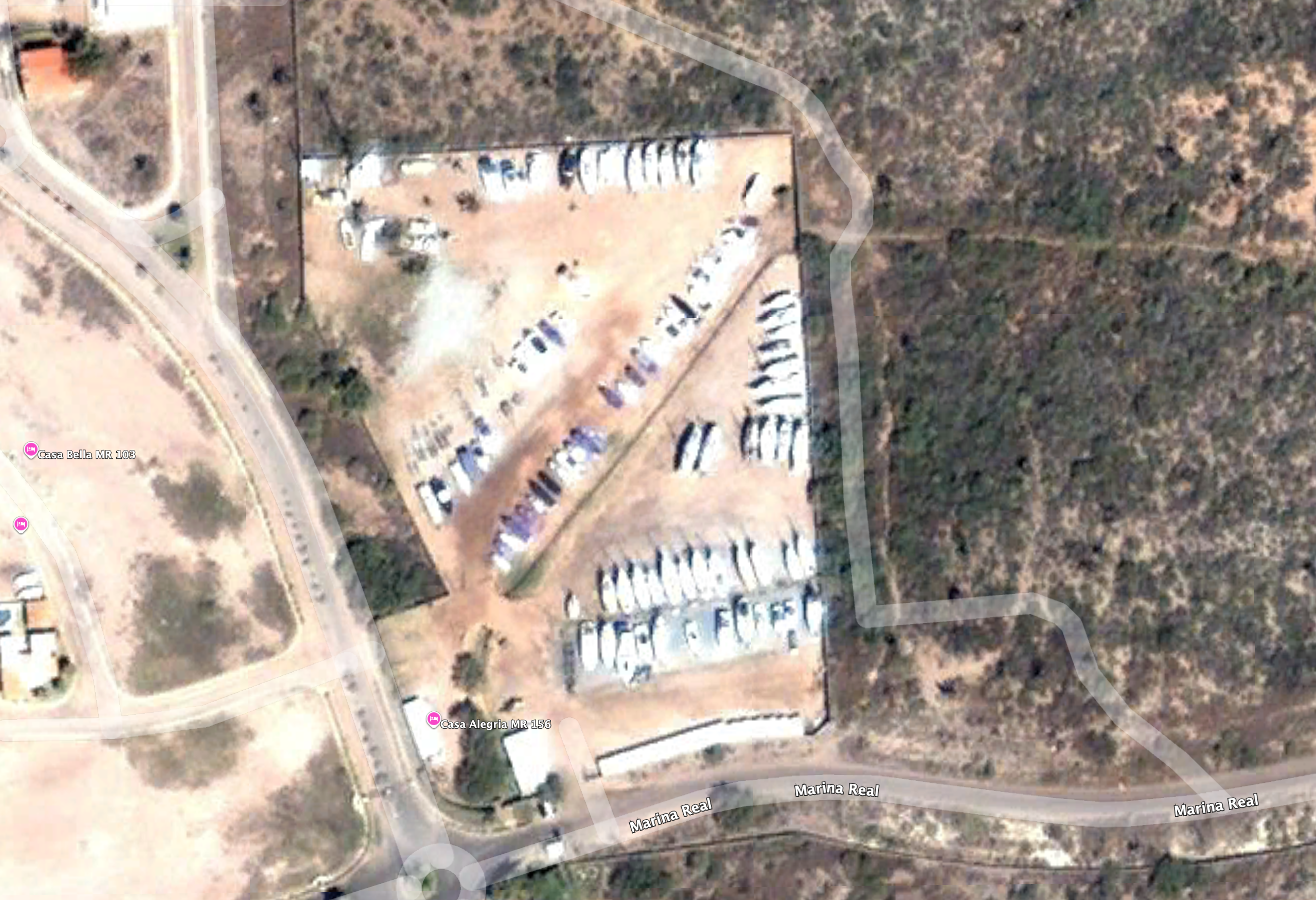
Syzygy is currently on the hard in San Carlos, Mexico, waiting for us to return this christmas and start fixing her up. We’re going to replace the standing rigging and much of the bilge/scupper hoses so that we will feel confident about sailing her up to San Francisco sometime this spring. We’re damn excited to work on the boat. Let’s just hope we get our first order of supplies before we have to leave!
So two weeks ago, when we were down in San Carlos, taking Syzygy for a little spin, we got ourselves into a funny little situation.
We’d just returned from the sea trial, and had put Syzygy in a slip at the marina. The then-owners and broker had gone about their day, leaving us to poke around the boat more, measuring and tinkering and such. With the sun out, Matt, Jon and I put our feet up, congratulated each other, and had a few nibbles of lunch: some prepackaged Mexican cookies and swigs of bottled water (you can tell that I did the shopping that morning.) Then, as typically happens after lunch, the urge to piss arose.
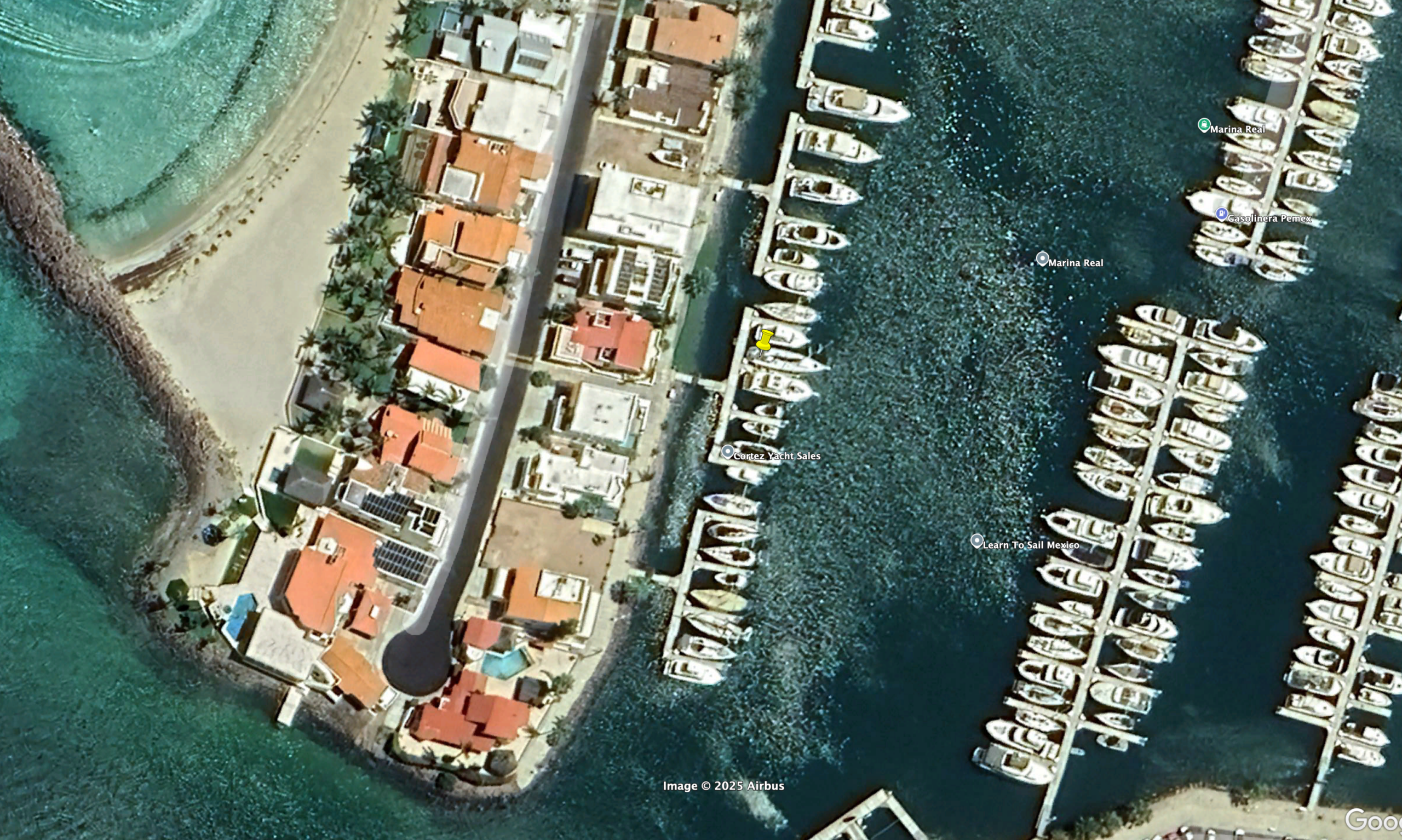
Thing is, the toilet on the boat was out of commission, on account of broken/leaky hoses. And we couldn’t just pee in the bushes, because there were none, or into the water, because it was a really nice, fancy marina. So Jon went up on deck and asked our neighbor if the marina had a bathroom. The guy explained that the bathroom was just 50 yards behind us, but then traced a wide arc with his hand, and further explained that getting there would require walking about a mile around the peninsula, unless we were willing to swim.
So Jon did what any climber-turned-sailor would do: he went back below deck, grabbed one of those plastic water bottles, and pissed into it. Matt did the same thing. So did I.
Hours later, the broker returned. Matt and Jon packed up their stuff, grabbed a bag of trash, and jumped in the broker’s car. 10 minutes later, back at the office, we were signing important papers, to the tune of I-hereby-agree-to-pay-$60,000-for-that-there-sailboat type of papers. So we sorta forgot about the contents of that trash bag. Actually, Jon remembered, but thought it inappropriate to deposit our piss-bottles in our broker’s trash can. He’s got class, Jon does.
So we signed the papers. We rejoiced over a can of cheap beer. Then we left, trash bag in tow, and walked around the corner, to a coffee shop, to let the feeling sink in some more. It should be noted here that Jon speaks terrible Spanish. Or rather, he mumbles some stuff in Spanglish and then looks at me, knowing that I will correctly translate what has just been not-actually-said. So I heard Jon say the word “basura,” in an interrogative kind-of-way, as in, “do you have a trash can?” The barrista nodded, then extended her hand. Jon passed her our bag of trash. She took it, and disappeared into the kitchen. That seemed to be that.
We had some coffee, then went upstairs, to get online. An hour later, after writing some excited emails, we were eager to get some tacos. Matt and I were packing up our stuff when we heard Jon say, “Shit. I can’t find my Nalgene.” We poked around under the table, in case the bottle had fallen or rolled away. It wasn’t there. So Jon did what any normal person would do: he asked the bartender if he’d seen a yellow water bottle. (His nalgene is made of yellow plastic.) Of course, Jon didn’t get all of that syntax in there, given his Spanish skills. What he actually said is, “water? yellow?? where???”
Now I wasn’t there to actually witness the culmination of this piss-in-a-bottle-in-the-trash story (I had run off to call a taxi for later that night), but here’s what happened, according to Matt. The bartender ran downstairs to search. 3 minutes later, he ran back upstairs, shouting something like, “we found it!” (lo hemos encontrado!) Jon smiled. He ran downstairs. He approached the counter. Halfway there, he probably realized that there had been a grave misunderstanding. The barrista handed him our piss bottles, and did not smile as she did so. Not having any other recourse, Jon accepted the piss bottles. Not knowing how to say, “I am sorry, for this is not actually the yellow Nalgene I was seeking, nor is this a situation that I intended to create, and now I am embarrassed, and you are most likely angry, and for good reason,” he just hung his head low. No translation was needed. He made a beeline for the door.
I caught up with Jon and Matt 5 minutes later, at the taco place. By the time the first round of beers arrived, I think Jon had pretty much given up on the search for his lost Nalgene. Jon looked relieved, having just deposited the piss bottles in a bigger, better trash can.
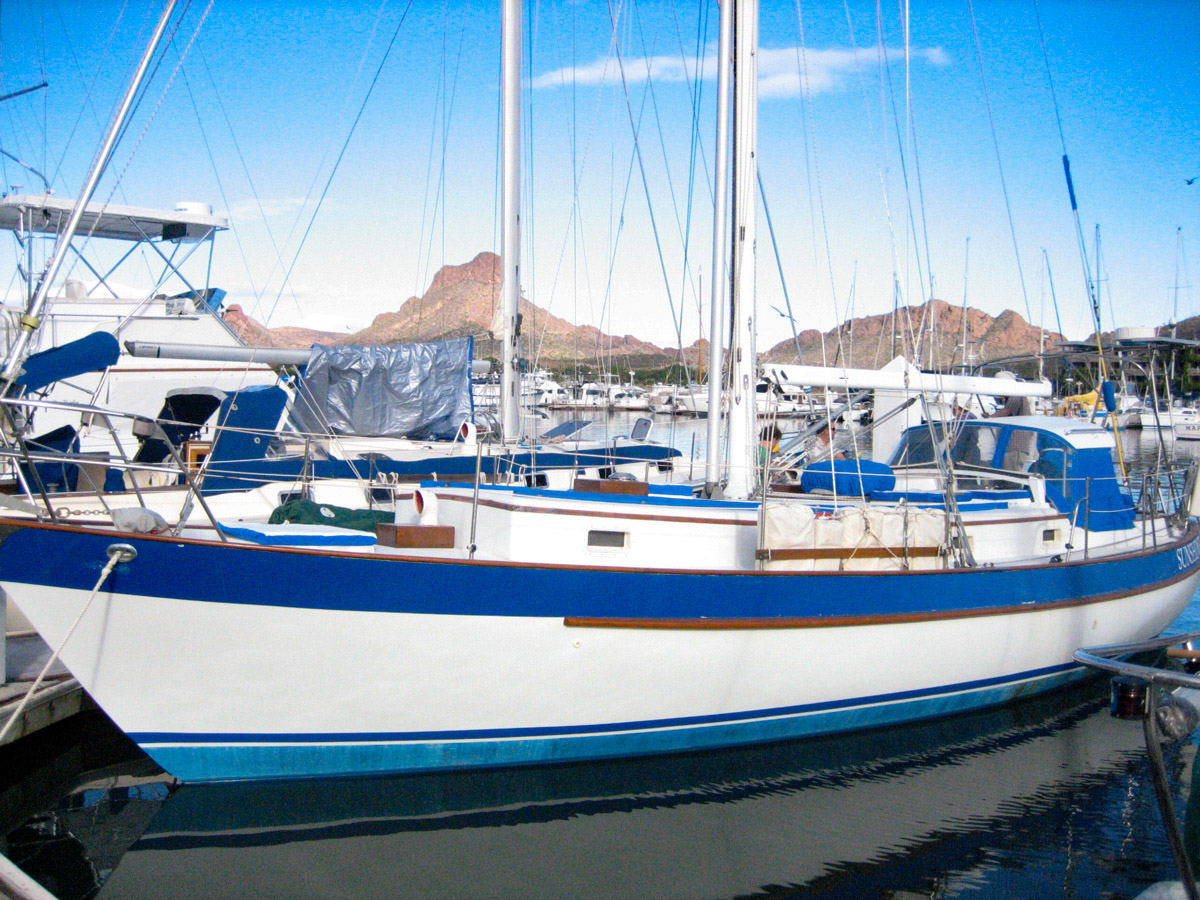
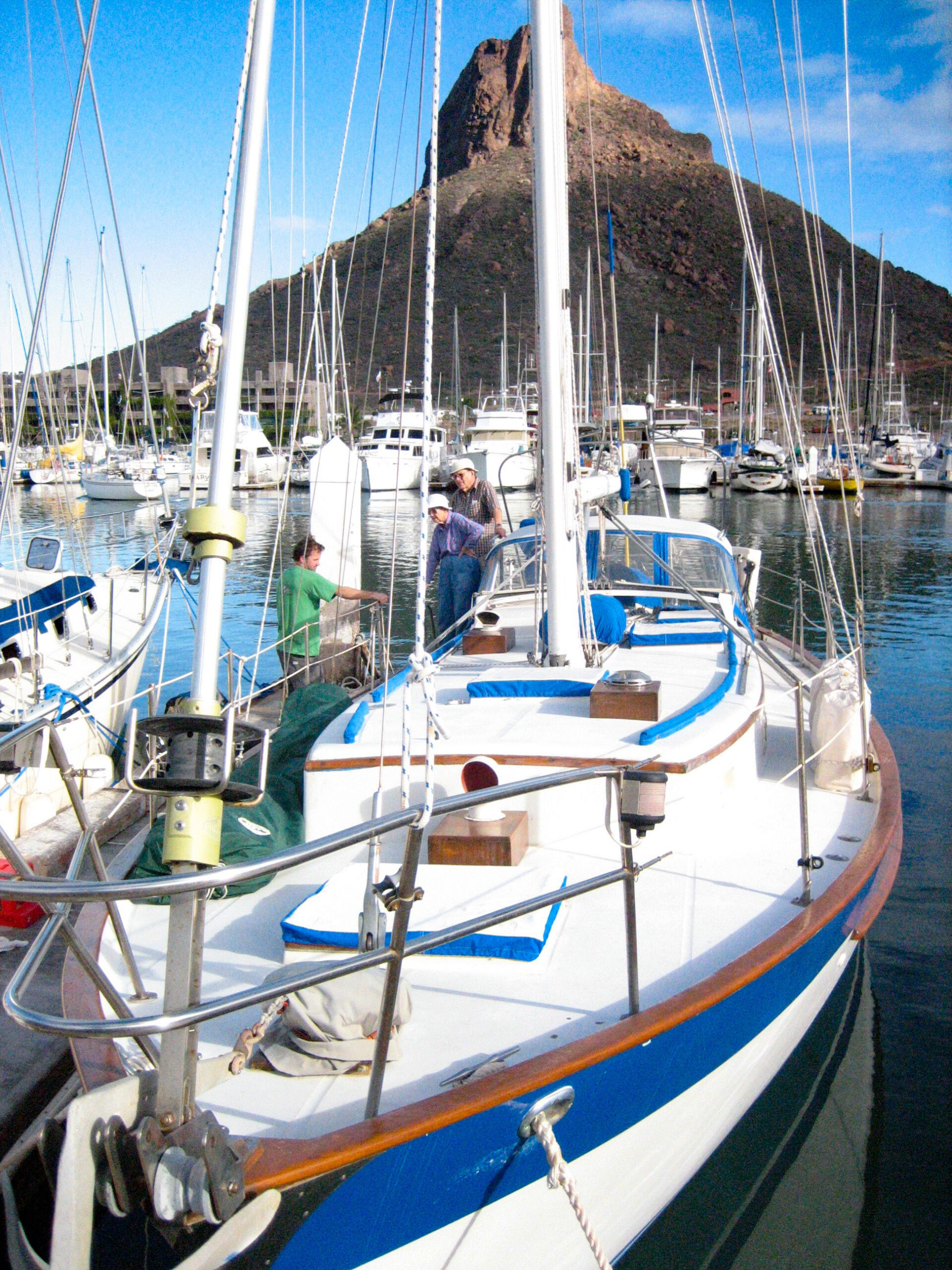
She was parked in this slip after we finished the sea trial, waiting to be hauled back out of the water the next day. Even though she was only sitting there for a night, I still worried and had momentary nightmares of her sinking right there in the marina (there are some old hoses!), and even asked our neighbors if they would watch over her. Our neighbors had been living on their boat for years, and I think they had a laugh at my expense when I explained in detail where the manual bilge pump was.
Another photo of her in the slip. Jon took this photo just as I was saying goodbye to the old owners, telling them that we have grand plans to show their old boat a great new time.
Here it is, the big moment. She’s been on the hard for a few years, and finally, at long last, she gets a little splash in the Sea of Cortez, in San Carlos, Sonora, Mexico.
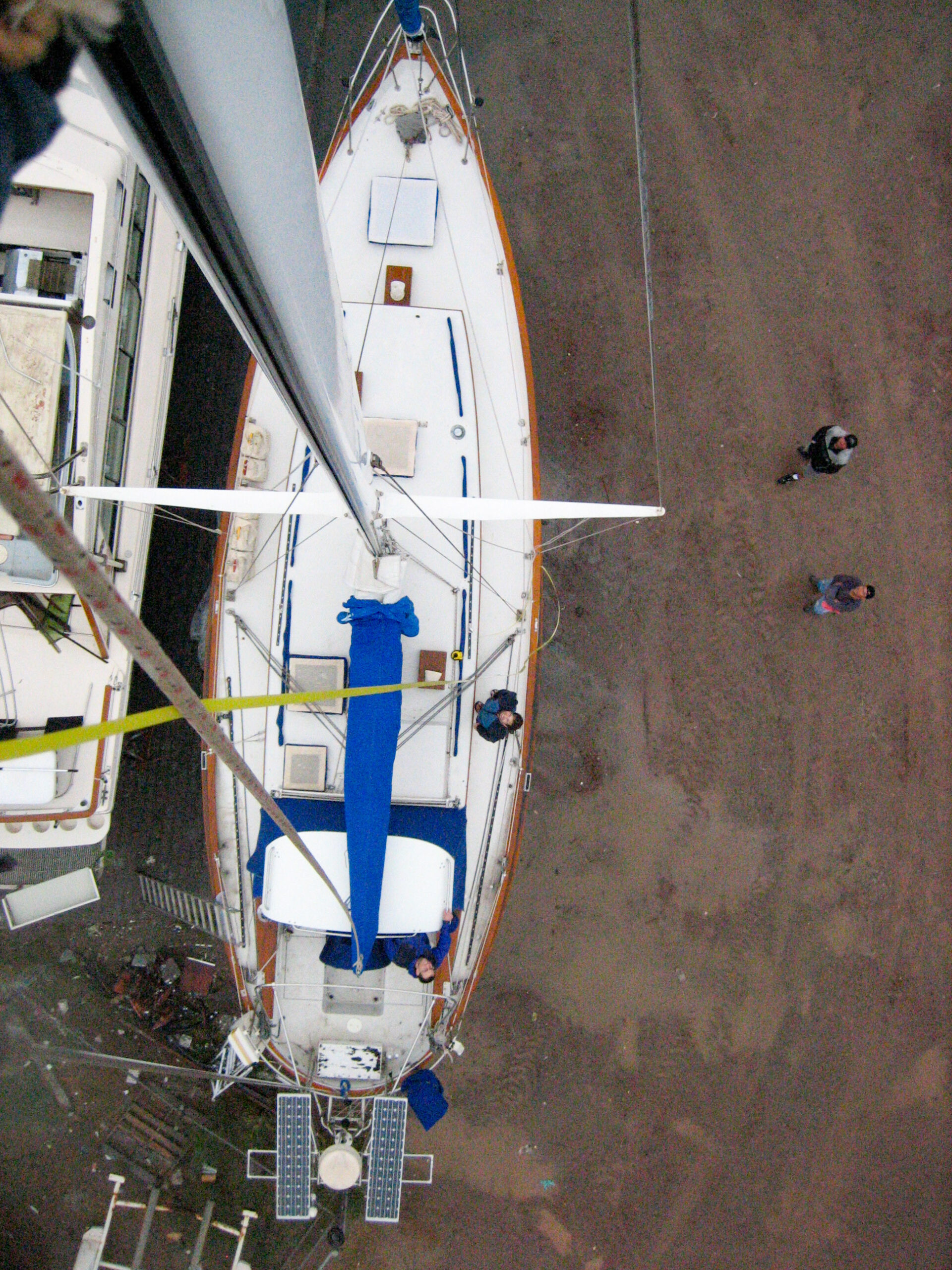
I took this photo while measuring the rigging for replacement purposes. The yellow thing is my tape measure. It rarely rains in San Carlos, but it was raining hard this day–hardest just when I decided to go up the mast.
Matt, Jon and I returned to Mexico to take Sunshine for a sea trial (aka test drive) before buying her last week. While there, it rained like gangbusters in Sonora, so the whole experience felt tinged with a sort of foreboding element. In those two dreary days we had to fix ‘er up and get ‘er seaworthy (since she hadn’t been in the water for 7 months), we had a small part of her keel re-fiberglassed and her engine taken apart, while we scuttled to figure out why there was water sloshing around in her bilge and why the bilge pumps wouldn’t pump it overboard. (We found a very leaky hose and a disconnected Y-valve, and also found out that we’d need to replace those bilge pumps.) Welcome to boat-ownership, right?
Once things were sufficiently fixed (albeit temporarily), we started measuring parts we planned on replacing. Jon and I hauled Matt up the mast (in a downpour) so that we could measure the standing rigging. After that, we got intimate with the boat’s plumbing (aka toilet), and figured out how we’re gonna rebuild it. We measured the lifelines, the diameters of the holes in the stanchions, deck fittings, and anything else we could approach with the caliper. We flipped through manuals, turned on electronics, crawled through lockers, and poked around the galley.
In the evenings, we met up with Capn’ Bob, a vibrant 72-year-old Valiant-40 owner and spinner of fine sea tales, and Mark Schneider, a similarly spirited owner of another spiffed-up Valiant-40. After somewhat hectic days, these two confirmed that we were making the right decision. (The beers might have helped, too.)
Of course, on the day of the sea trial, the sun came out, but the winds vanished, so we sorta bobbed around in the sloshy water until sufficiently queasy, then motored back in to the marina. While we technically raised her sails, they never filled with wind, so I can’t really report that she sails like a beauty, or that she slices through the water, or make any other even mildly poetic statement about her agility/speed/grace/elegance. But I can say this: she floats.
So now it’s on. The money has changed hands, and our dream is becoming reality. Here’s the easiest way to tell: for a few nights there I’d wake up terrified of expensive boat parts that I’d probably have to pay for, aware that my bank account alone couldn’t do it. Somehow, though, we will.
We’re two weeks away from owning a boat! So now seems like a good time for the back story . . .
There are three of us: Jon Waldman (Jonny or J5), Jon Haradon (Jon), and me (Matt Holmes). We’ve been friends for at least a decade, mostly getting together for outdoor adventures. None of us had seriously sailed before ’05. (Jonny went to sailing camp when he was like 12.)
The sailing idea sorta formed in the summer of ’05, when I started crewing on race boats in the bay. In the spring of ’06 we committed to ourselves and to each other to sail around the world starting in the summer of ’09 (when Jon becomes free of his teaching obligations). It seemed like the most natural departure date.
We knew hardly anything about sailing. I kept racing boats on the bay and reading books.
Jon and I took two OCSC courses to learn how to sail, fall ’05 and spring ’06. I continued racing on the bay and reading books.
In January of ’07 we sorta formally agreed to save $10k every six months. We figured we’d need $100k for the boat, plus more for refit/repair costs, as well as $15k each year for living expenses. So we figured $130k, or $44k each, should take us around the world. I continued to read books.
In the summer of ’07 we started looking for boats; in July we got serious about it. I created a spreadsheet that included all the features and gear we’d need on the boat and what it would cost to add each thing, including the hidden expenses of transporting the boat and paying sales tax. Each time I looked at a boat listed on yachtworld.com, I went through the spreadsheet and calculated how much money we would have to spend for the refit. Subtracting that refit cost from our 100k ceiling, and we had a rough idea of how much we could offer.
The first boat we looked at was a Tayana 37. Jonny and I went together to Sausalito to see it, and we didn’t have a damn clue what we were looking for. I felt ridiculous, like I was kicking the tires of a car trying to assess its worth. I went back and did more reading. A month later I looked at a Valiant in Alameda–again I felt like I was clueless. I did some more reading. I met three Seattle guys who had just circumnavigated on a boat called SohCahToa –super great guys who not only gave me good advice, but offered to come look at a boat with me. I went back with the Seattle guys and looked at the Valiant in Alameda again–six months after the first time I had looked at it–and this time it all made sense. We spent three hours taking the boat apart, peering into every dark hole, under every floorboard and examining every piece of equipment. I felt confident that I understood how much work it would need, and how much it was worth to us. According to my spreadsheet, we could offer $50k for it. It was originally listed at $80k, was lowered to $60k, and then someone else snatched it up. I drove down to Ventura to look at another Valiant, and decided that it needed far too much work to justify an offer. We made an offer on a repossessed Valiant in Florida, sight unseen, but we were outbid by some Scottish dude. I inquired about two other Valiants, a centerboard model in Florida and one in Virginia.
I have an admission: I had already decided that I wanted a Valiant before I ever looked at the first boat. I had read about what makes a good blue-water (read: ocean-worthy) boat. I knew all the features we wanted. The Valiant has them. The Valiant’s reputation is badass. It is a proven hardcore bluewater boat, and it isn’t slow as hell like lots of heavy ocean boats. I knew that they were plagued by blisters; and I had decided that blisters were ok with me. Blisters (little air bubbles in the paint) wouldn’t sink the boat, and they would lower the price so we could afford it.
In the beginning of September ’07 we found Sunshine, a Valiant in San Carlos, Mexico, originally listed at 80k. When I put it in our spreadsheet, I was surprised to discover that we could potentially offer $70k (on account of all the additional gear on the boat, the condition of the sails, etc.) We had originally discussed Jan 1 as the earliest that we were willing to purchase a boat–that was our $20k each deadline, allowing us to offer $60k. But it’s hard to maintain willpower when you think you’ve found a deal on the perfect boat. There’s an amount of irrational emotion that comes into play, which is OK, because that’s the only way you end up loving your boat. Just as long as you don’t make a financial mistake. We decided to offer $60k and no more. Writing that email was scary, and exciting. The sellers came back a week later with an offer of $65k. It was close. We were close. But we decided we just couldn’t quite afford it. We declined it. Two weeks later, the broker called me back to say that the sellers would take $60k. We accepted the offer.
It took three weeks or so to iron out an offer agreement that we were satisfied with–the sellers wanted us to buy the boat without a survey and without a sea trial, and we were having none of that. In the end, we got the survey and sea trial by agreeing to a $3k non-refundable deposit.
Jonny drove to Mexico with Jeff Purton to look at the boat, and make sure it didn’t have any deal-breaker-type problems. He brought back many pictures, and a green-light report. The boat was a go.
Jon and I flew down to Mexico two weeks later to look at the boat for the first time and get the survey. The survey was acceptable; there are a few issues with minor delamination that we are trying to resolve before signing, but it is not yet a reason to walk away.
The sea trial is scheduled to happen on December 1st. All three of us are going down a few days early to help the sellers recommission the boat, since it’s currently up on stilts in a dry-dock. So it looks like it’s really going to happen this time.
And how do I feel? Excitement tinged with trepidation and flavored with a bit of anxiety. I’m excited to find the boat that we’ve wanted all along, in good condition at a good price. The anxiety comes from knowing all too well what we’re getting ourselves into. I shouldn’t know already, because I’ve never owned or even worked on a boat and none of us has any experience. But I do know. I already have a list of all the things that we will need to do to the boat, and have checked on all the parts to complete those jobs, and have read how to do those jobs. And before we even start the work, we have to get it out of Mexico up to San Francisco. And I know that the sail up the coast in March may be the hardest passage we make during our entire circumnavigation–right out of the gate, with little experience and no knowledge of the boat. We don’t know how to use the systems in the boat, we don’t have much time to do any work, and the boat is not safely sail-able in its current condition (at the very least we need to re-rig it). I will feel much, much better after the boat is sitting in a slip in the bay–until then my excitement will be tempered.
A sailboat’s transportation is clean by design: we move by harnessing the wind. But modern life – even sailboat life – demands energy for lights, computers, fans, a refrigerator, and a stereo, as well as a watermaker, which turns saltwater into drinkable fresh water. And the sailboat requires still additional energy to run a GPS, RADAR, and radio, among a dozen other instruments. Typical of modern life, the list of convenience items that consume energy is distressingly, shamefully long.
Our daily challenge — beyond figuring out life at sea — will be to collect more energy from nature than we consume. We’ll be using solar panels and a wind generator, which epitomize renewable energy. If, on the balance sheet of natural energy, we come out in the black, we will live clean, quiet, inexpensive lives. If we use too much energy and our balance sheet comes out red, then we will be forced to run our diesel engine to recharge our batteries and make up the deficit.
The cost of running the engine is manifold: we pay in the form of excessive noise and heat, we pay in dollars to buy diesel, and we pay indirectly by polluting our immediate world — we do, after all, live right above and beside the engine, and on top of the sea. It is the power source of last resort – and, in a sense, an alarm indicating our failure to live within our energy means.
To succeed on our journey, we will need to change the way we live. We’ll need to maximize energy capture and minimize energy consumption, and our journey around the world aboard Syzygy is as much about documenting this effort as it is about adventure and travel and sailing. In that way, our tiny energy challenge is no different than modern society’s enormous energy challenge.
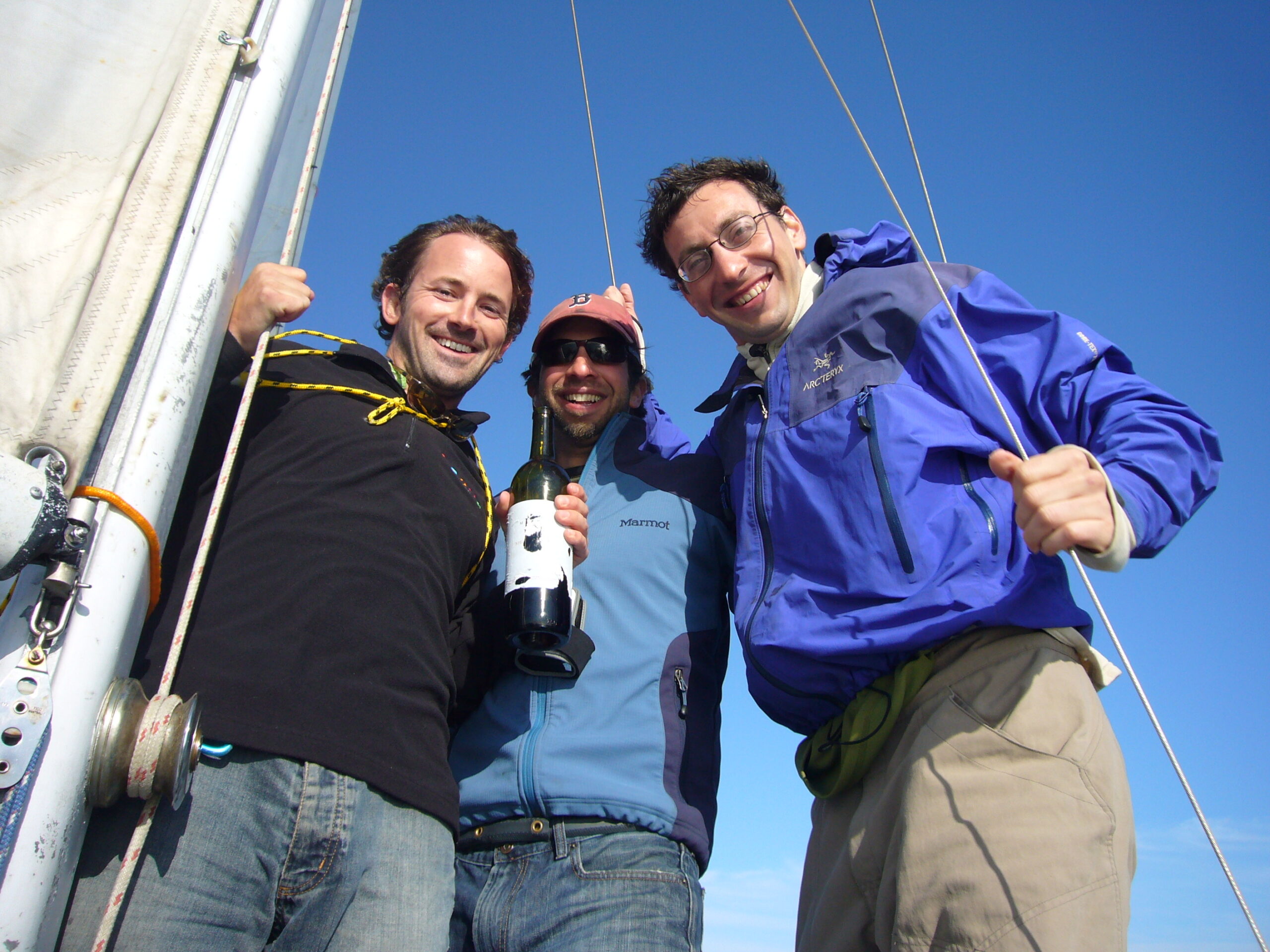
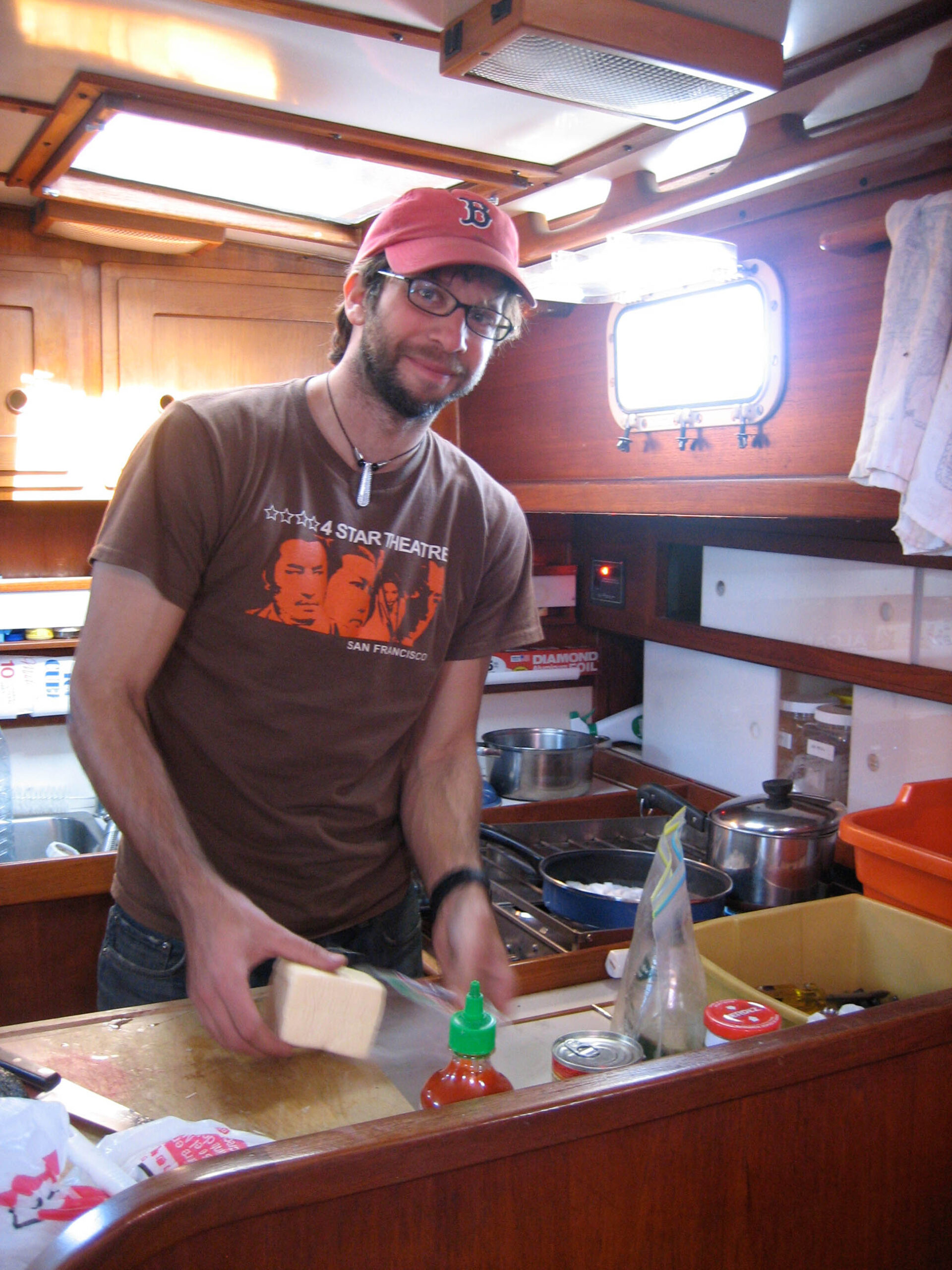
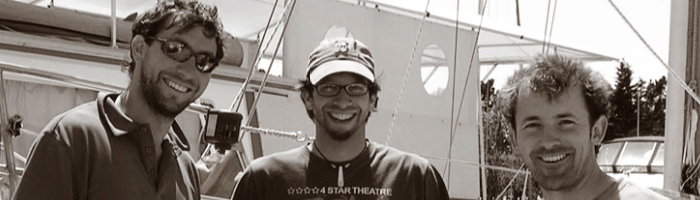
There are three of us (from left to right): Jonathon Haradon, Waldman, and Matt Holmes — a teacher, a writer, and a photographer, respectively.
We’ve been friends for at least a decade — Matt and Jonny were roommates at Dartmouth; Jonathon and Matt were roommates in Los Alamos, NM — and have tons of leadership and outdoor and adventure experience. Together, we have done a lot of climbing, mountaineering, canyoneering, and biking. Together, we’ve survived a tornado, two flash floods, an avalanche, getting wedged stuck in a slot canyon, and falling in a crevasse.
Sometime during 2005 the three of us started looking at sailing as our next frontier. Our other activities had lost some of their appeal, and we yearned for the next adventure. Visiting/living in San Francisco provided ample opportunity to observe sailboats heeled way over out in windy weather. To be on a sailboat on a windy day looked wet, cold, challenging, exhilarating. Each of us allowed our romantic imagination to ruminate on the adventurous and exciting aspects of long-distance sailing (romantic notions that do indeed become the reality for some). Our desire to tap into that world evolved over the course of a year into a plan to learn how to sail, buy a boat, and sail around the world.
In a conversation that occurred during the spring of 2006, we tentatively settled on 2010 as the year to depart. In December, 2007 we purchased Syzygy, a Valiant 40 sailboat that we found on yachtworld.com. She was located in San Carlos, Mexico at the time, and after a brief stint attempting to work on the boat where it rested in Mexico, we elected to have her trucked up to the San Francisco Bay area, where she currently rests in her slip at Emeryville Marina.
We may be accomplished outdoorsmen, but we settled on this plan with astonishingly little sailing experience. Most strangers (and many friends) regard our undertaking as overly ambitious. Considering that only one of us has ever spent a night in the open ocean, those opinions are fully justified. Before 2005, neither Matt nor Jon had ever sailed before, at all. Jonny sailed on a lake when he was 12, Jon took an OCSC sailing course, and Matt raced on the San Francisco Bay for a few years–that was the extent of our sailing resume prior to purchasing Syzygy.
Choosing to believe in this plan represented a new form of risk-taking. Each of us has found exhilaration in various forms of more commonly discussed “risk-taking,” e.g. climbing a big rock, cliff-jumping into a remote river, or hitch-hiking around a third-world country. However, devoting years of your life–every bit of your time, money, and energy–to fixing up and preparing for a pursuit with extremely questionable success is also extremely risky. We have now spent two years putting every free minute and every last bit of money into the boat–will it be worth it? Will the trip, if it ever starts, be the opportunity-of-a-lifetime that we imagine? It is not assured either that the trip will happen, or that it will be everything we hope for. Sailing suits some and not others. So, while there is no daily opportunity to defy death, there is a very real chance that we have mismanaged a few years of our life–we all agree there is already too little life to waste.
Jon, a former high-jumper turned climber, is something like a kangaroo crossed with a monkey. In the last 8 years, he’s spent 300,000 miles on the road, and cooked almost 700 meals in the back of his truck. Along the way, he’s summitted half of Colorado’s fourteeners, descended more than two dozen of Utah’s most difficult technical slot canyons, and climbed some of the wildest big walls and desert towers in the West.
In Colorado, he has climbed technical routes on Crestone Needle (Ellingwood Arete; IV 5.7), Longs Peak (the Casual Route; IV 5.10b), and Kit Carson (the Prow; III 5.7), as well as some of the state’s most exciting technical traverses (North Maroon to South Maroon Peak; Crestone Needle to Crestone Peak; Little Bear to Blanca Peak). In Utah, he has climbed Prodigal Son, Moonlight Buttress, and Spaceshot (in a day) at Zion; as well as the Stolen Chimney on Ancient Art (5.8, A0), the Cobra (5.11b R), the Colorado NE Ridge of King Fisher Tower (5.8, A2+), and the Kor Ingalls and North Chimney routes on Castelton Tower (both III 5.9).
He’s climbed long routes in the Bugaboos, Tetons, and Yosemite; been up Ixtacehuatl (17,800 feet), in Mexico; and attempted 17,913-foot Yanapaccha and 20,846-foot Chopicalqui in Peru’s Cordillera Blanca. He’s descended Kolob Creek Canyon (solo), Englestead Canyon (solo), and Imlay canyon (in a day). He’s also gone 27 days in a row without showering.
Jon grew up in Pennsylvania, and, after briefly pursuing a career in chemical engineering, now works as a high-school math-and-science-and-everything-else teacher. He first stepped foot on a sailboat in 2003.
Jonny is more or less an energizer bunny with undiagnosed ADHD. Over the last 12 years, he’s climbed in at least 20 states, and biked up, through, or over the rest of ‘em.
He has been up every peak in the Tetons, all of Oregon’s Cascade volcanos, and all 46 of the 4,000-foot peaks in New Hampshire’s White Mountains. He’s led 5.10 trad climbs at Squamish, Joshua Tree, Index, and the Gunks; flashed V7s in Bishop; and onsighted 5.12 sport climbs in at Rumney, Red Rocks, and the Red River Gorge. He’s also climbed a dozen grade IV routes from Wyoming to California, and been up Citlaltepetl (18,700 feet) and Ixtacehuatl (17,800 feet) in Mexico.
He has biked across New England (from Amherst, MA to Yarmouth, Nova Scotia), and biked solo across the country (from Washington, DC to Colorado). He raced in the 2007 North American Cycle Courier Championships, and has finished in the top-5 in many alleycat races in San Francisco, Washington, DC, Baltimore, and NYC. He’s biked up all of Colorado’s big passes, ridden to the top of Mt. Evans, and linked up Vermont’s four gaps in a day. He’s also run three marathons, even though he hates running.
Jonny grew up in the suburbs of Washington, DC, the son of two writers. Big surprise: he’s a writer, too. He learned how to sail — on a 14-foot Sunfish — when he was 12 years old, and hasn’t been on many boats since.
Matt, the captain of Syzygy, learned to sail by crewing for races in San Francisco Bay, primarily working the foredeck aboard Cirque (a Beneteau 43 skippered by Louis Kruk), the winner of the Offshore Yacht Racing Association’s 2007 race series.
A landlubber like Jon and Jonny, Matt has driven across the country 25 times, and climbed innumerable crags and mountain ranges along the way. He’s climbed 5.13s at Whiterock, Rumney, and Red Rocks; placed in the top-3 at climbing competitions in New England; and climbed long routes in the Tetons, Yosemite, and Zion. He’s also been up a dozen of Colorado’s fourteeners, and down more than two dozen of Utah’s technical slot canyons.
He spent three winters snowboarding (and working) in Crested Butte and Vail; and two summers leading teenagers on three-week backcountry trips in Colorado and British Columbia. He’s taught climbing classes in New Hampshire and New York; led hut-to-hut ski trips in Colorado’s Elk Mountains; and organized a mad float trip down the Colorado River through Utah’s Caynyonlands.
Matt grew up on a farm in New Jersey, and, having briefly pursued a career in theoretical astrophysics research, now works for photographers as a digital tech. Note: he’s a truly terrible swimmer.
 JONATHON HARADON