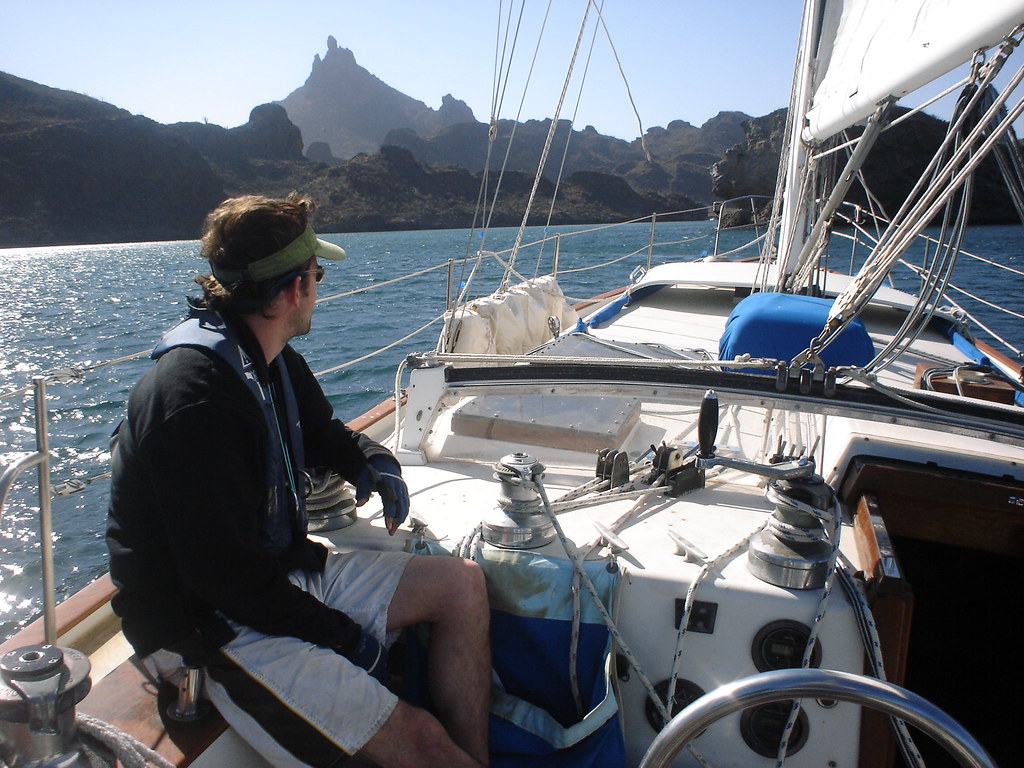
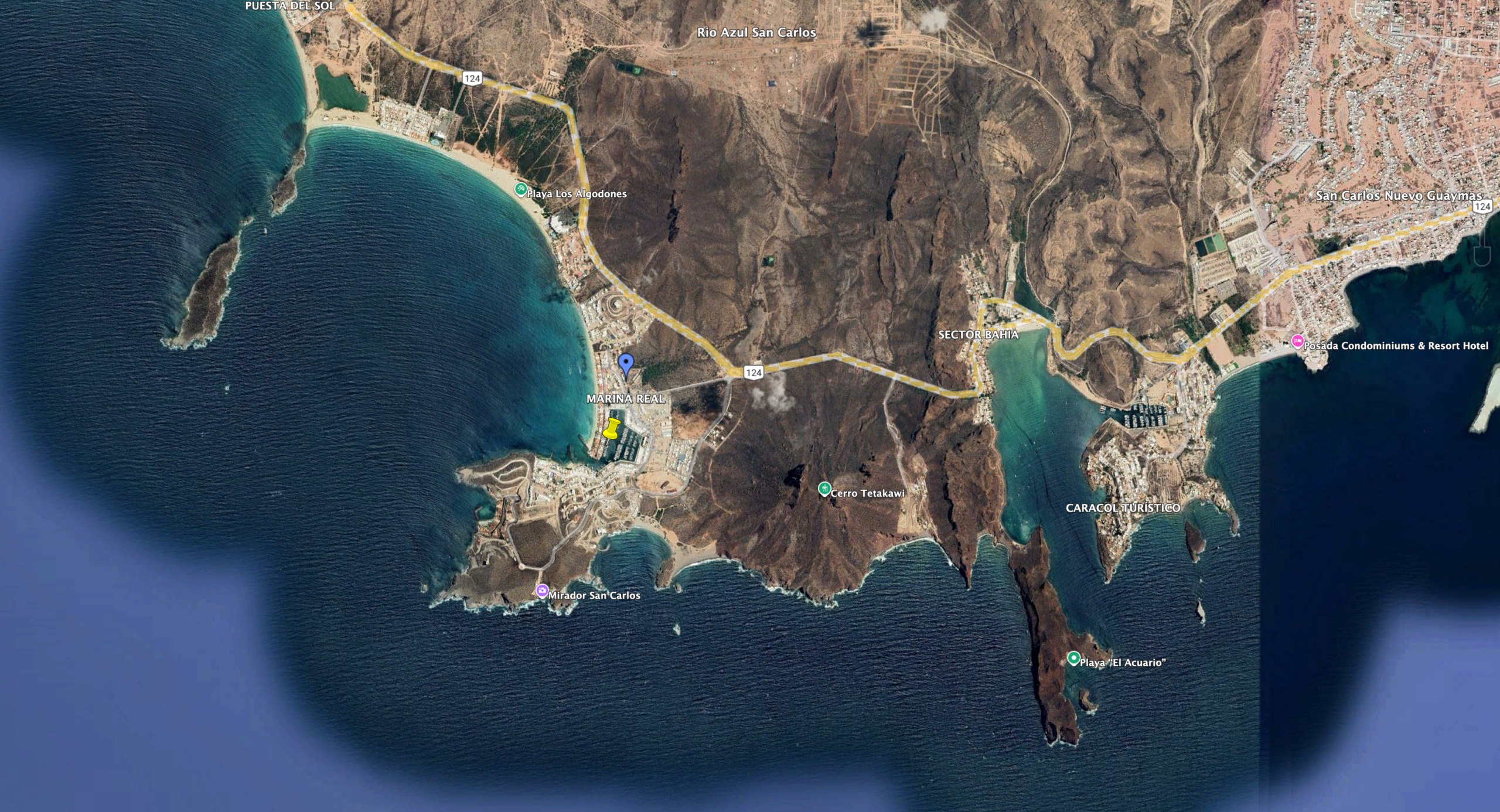
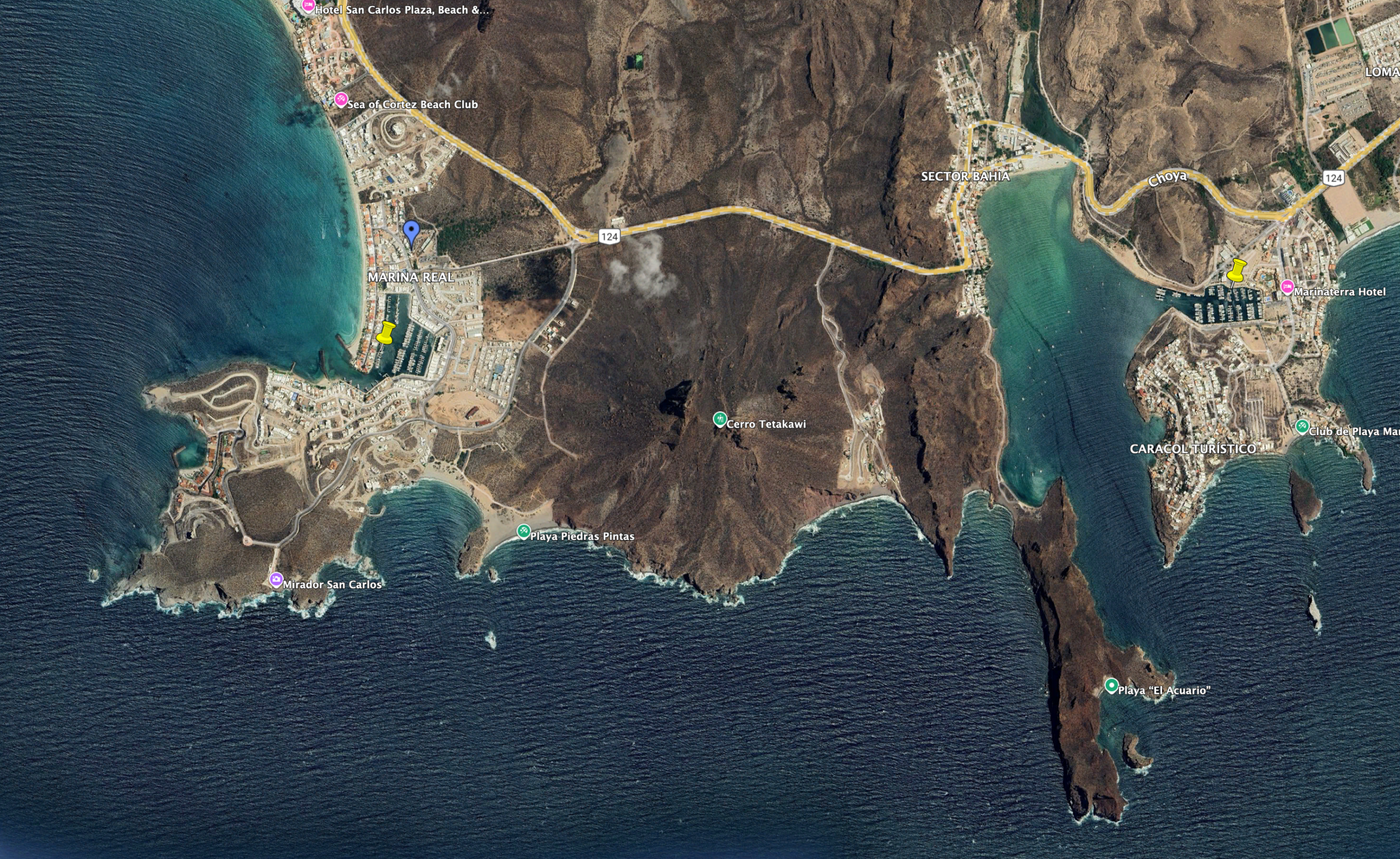
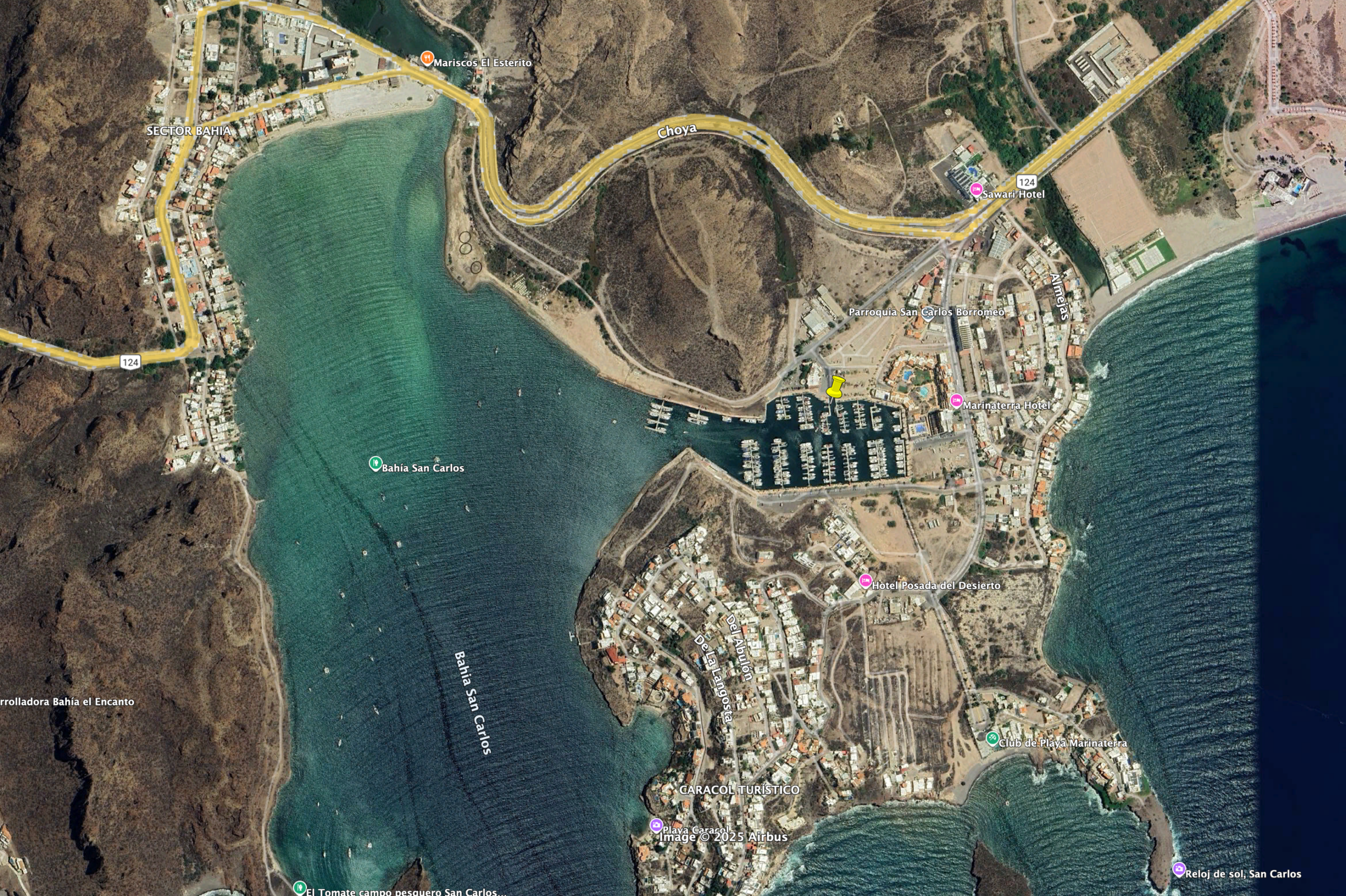
I’m here! After months and months of anticipation, I’m at the boat, eager and excited, a teenager at prom. It’s especially exciting, because for months I’d been listening to Matt and Jonny talk about everything they were doing with the boat, and I felt so left out, missing great adventures and stories, and wanting so desperately to be there. It was agony; but no more. The first night in Emeryville, Matt filled me in on some projects that I could get started on. We needed to create lifelines, he said, by lashing skinny lines around thicker lines. We needed to remove the ineffective and messy sound insulation in the engine room, probably by using a putty knife. Also, the old resin in the bottom of the bilge needed to be chipped smooth; for this Matt recommended a wood chisel. Easy enough, I thought: lashing, putty knife, wood chisel. No problem.
The next morning, I sprung awake at 7:30, earlier than I get up when working during the school year. I went looking through the tool bin for the various equipment Matt mentioned. Lashing: check. Putty knife: check. Wood chisel… huh. I found about 5 chisels but none of them was a wood chisel. So I put that off, and busied myself taking off the sound insulation. I finished that by 11:00, had lunch, and then wrapped up my last little bit of schoolwork, and submitted my stundents’ final grades. I met Matt back at the boat that evening and he asked what I had managed to accomplish. “I took off all the sound insulation, and started looking at the lashings, but I couldn’t find any wood chisels.” Matt seemed confused, and glanced down at our array of tools. “What are you talking about,” he said, while picking up a chisel and showing it to me, “there’s four of them right here.” I grabbed the tool from his hand and inspected the chisel more closely. “This is made of metal!” I sputtered. “You said a wood chisel!” Matt just laughed and laughed, and I’ve laughed at myself quite frequently since. Oh well, I suppose someone has to do stupid goofs like this.
Three months ago, when we were contemplating having our boat trucked up from Mexico to San Francisco, we picked the last week of March, because it was my spring break, to go down and get the boat ready to truck up. Unfortunately, that week didn’t work for the haul-out company; tides were too low. So Matt and Jonny got to go down to the boat two weeks later, work their butt’s off, get to know our boat, and have fun. Me? I got to sit around and do a whole lot of nothing, and a little bit of school work.
So, to make up for this, I decided to take a week off from work to be in San Fran when the boat arrived so I could work MY butt off, get to know our boat, and have fun. Alas, this effort was also thwarted, as our boat arrived three weeks late in S.F., exactly one day after I departed. It was left to Jonny and Matt again to have all the fun, do all the work, and get to know our boat better.
I feel a smidge guilty about all of this, like somehow, my not contributing to all the effort is somehow my fault. And I definitely feel behind in learning about various ins and outs of our boat, nuances, and feel pretty clueless, while it seems like Jonny and Matt know everything or are at least learning everything.
When I think of working on a sailboat, I think of tight squeezes and awkward contortions to reach a bolt here or a fitting there. So In the spirit of working on the sailboat, I decided to find the tightest and most awkward area in my condo and do some cleaning.
I’ve also been doing some other preparing for sailing, namely getting eye surgery. This way when the the weather is miserable, I don’t have to worry about water in my face washing out my contacts. Or when Jonny calls us on deck at 3:30 am because we’re about to crash into a rocky shoal, I’m not fumbling for my glasses. Here’s me all toked up on Vicodin right after my surgery, with clear plastic shields taped over my eyes and big sunglasses to boot. The picture is blurry to mimic what my eyes are still seeing…
At 6pm wednesday afternoon, as we were sailing out of the Berkeley Marina, there was substantial reason to be proud of ourselves.
We had replaced all of our standing rigging–the very important wires that hold up the mast–by ourselves. We had replaced the bearings in our supposedly unmaintainable furler (“Profurl bearings are sealed and can’t be replaced,” said the rigger at Svendsen’s) by ourselves. We had sanded and painted the bottom by ourselves. We had replaced the through-hulls and added backing plates ourselves. We had repaired our delaminated rudder by injecting epoxy, ourselves. We had glassed over damaged areas of the keel, ourselves.
None of us had ever done any of these things before, never even seen them done. Without tooting our own horn too much, some of these jobs are a hell of an achievement for inexperienced guys like us. Things like getting the rigging to fit perfectly the first time, and creating beautiful through-hull seacock installations, and replacing sealed bearings are almost always jobs left to the professionals. We did it though, and we are FAR from professionals.
But above all else we felt proud because at 6:30pm on Wednesday evening we were heeled over and hauling ass on a close-reach, pointed directly at the Golden Gate Bridge, just before sunset, in 20 glorious knots of wind with waves splashing over the bow and down the deck. We felt proud because we had done all of our yard work all ourselves, in just two weeks and were already in the water, headed for our slip ready for us in Emeryville.
Now for the slapdown part. Right when you’re feeling on top of the world, like you pulled off some sort of sailing coup d’etat and maybe this whole thing isn’t all that hard after all . . . that very moment is the perfect time for a dose of humility.
I did not succeed in parking the boat in our slip. As we pulled into the Emeryville Marina a low was moving in, and it was gusting to maybe 15 knots in the marina, which are somewhat challenging docking conditions especially since our slip was downwind but honestly not particularly abnormal. However, I am completely inexperienced motoring our boat around. With her long keel and skeg rudder, she turns like an elephant and backs even worse. As we approached our slip my anxiety skyrocketed–rightfully so, because I was realizing far too late that I had almost no chance of getting us into the slip without damaging a boat. Our boat weighs 22,500 lbs–you can’t hold that off with brute strength–and the wind, not me, was in control.
I barely got the nose in the slip before the wind rotated the rest of the boat right past the slip. To avoid hitting the neighbors boat I threw it in reverse, sending us backward across the narrow fairway and leaving Jonny and Karen on the dock. I proceeded to carve a full circle as I was blown down the fairway, able only to motor forward and backward enough not to hit other boats. Syzygy came to rest, mercifully lightly, on the stretch of dock at the end of the fairway. I didn’t hit any boats, but I also didn’t get in our slip and we were in a tough spot blown up against the dock. Compassionate bystanders came to our aid (I give thanks) and helped with docklines while we formulated a plan. We ended up powering off the dock (a delicate task, with no room to maneuver) and parked in a massive, uninhabited, upwind slip that even I couldn’t mess up. We would move in the morning when the wind had abated.
After the pride I have rightfully taken in our successes, it was important to receive this slapdown–this reminder of how much we still have to learn, and how this isn’t a game in which our failures have no consequences. Skippers all over the marina park their boats without mishap every day–it is no particularly impressive skill. Yet it is a skill that I lack and that I must acquire.
The next morning the wind had not abated at all, but we needed to move out of the slip that wasn’t ours. I cannot tell you the anxiety this caused me. Jonny and I spent over an hour motoring in the empty space of the marina, practicing parking around a downwind buoy, pretending it was our slip. It was horrifying how infrequently I was able to accomplish the job, even around the buoy, and when we finally turned towards our slip to do it for real, I felt more fear of the consequences of my imminent failure than I have in years. I had very little reason to expect that I would accomplish the task any more successfully this time than I had the night before. In truth, I had more understanding of how likely it was that I would fail, given the failure rate while practicing with the buoy. It was as if I was readying myself to go out on the stage for some recital, knowing full well that I couldn’t perform the piece.
Well this time I got us into the slip without damaging anything. I felt immediate and overwhelming relief–of the sort that makes you want to hug everyone in sight and makes you feel like you could exhale for a whole minute from all the pent-up air you were holding. Not pride though–I’m not proud of it because I have no right to be proud of a success that resulted from luck more than skill–and even if any of it had been skill, it is a basic skill that a dozen other skippers a day perform all over the marina.
So Syzygy is finally resting safe in her home, her slip. For now. I have as much curiosity as the next person about what will happen the next time we take her out and try to bring her back!
You can tell it’s been a good week by looking at the contents of the big rubber trash can next to the boat: beer bottles and coffee cups and cans of beans, rubber gloves and dirty rags, rusty screws, burnt-out light bulbs, old bearings, bits of corroded wire, paper bowls lined with epoxy residue, stiffened paint brushes, three empty paint cans, three dremel bits worn down to the nub, two broken drill bits, and one broken dremel tool.
The broken dremel was our first tool casualty — I burnt out the motor while sanding the old paint off of the propellor. It popped, then stopped spinning, and then a few wisps of smoke snaked out of it. It was bound to happen, and I’d been kind of expecting it since meeting a guy in Mexico who broke half a dozen grinders in the process of refurbishing his Norwegian steel-hulled boat. So Matt went out and bought a new dremel, which we immediately put to use by grinding down a couple of our new backing plates. So far so good.
We’ve gotten very good at buying tools and parts; in fact, my mental map of this new place I call home consists mostly of places to get them. I used to know intuitively how to get to bike shops, bars, restaurants, friends, and parks. Now I know how to get to five local hardware stores, a screw manufacturer, a bearing distributor, a plastics place, a sailmaker, and three chandleries. It’s worth noting that at Svendsen’s, the best chandlery around (particularly since, as new boat owners, we get 40% off everything), I can name most of the staff.
They say that a boat is a hole in the water that you throw money into, and they’re 100% right. During the last two weeks, I’ve spent $1000 (2/3 or it at Svendsen’s) on two sanding bits, two hole saws, a depth gauge, a medium punch, die grinder, a tap, and scissors; 125 paper bowls, 200 rubber gloves, 12 plastic syringes, 12 small brushes, eight mixing sticks, two rolls of painter’s tape; three 3x3x1″ pieces of plastic, two rubber spreader tip covers, 15 feet of 1″ rubber tape, one spool of seiizing wire; two industrial bearings and four oil seals; four nav lights, four gold-plated coax connectors, two waterproof cable clams, a heat gun; four bronze through hulls, two bronze rods, one bronze seacock, one 4×6 hull zinc, two 1″ round prop zincs; 1 quart of epoxy primer, 1 quart of bilge paint, 16 ounces of marine-grade lubricant, 14 ounces of molybdenum grease, 12 ounces of epoxy resin, 8 ounces of anti-sieze lubricant, 1 can of penetrant, and a caulk gun; 30 6mm set crews, 15 5/16 lag screws, 12 2″ machine screws, nine 2″ cotter pins, eight 1/4″ phillips screws, eight 1/4″ socket screws, eight lock washers, six 1/4″ lag screws, four 1″ cotter pins, and four locknuts — all A-4 grade stainless steel, with less than .02% carbon and at least 2% molybdenum.
The worst part? Those stainless-steel screws aren’t cheap, but they’re nothing compared to bronze. Last week, at Svendsen’s, Matt was searching for 1″ lag bolts made of silicone-bronze, the most corrosion-resistnant marine-grade metal available. Instead of buying 18 bolts, he figured a bag of 25 would be cheaper. So we put ’em in our pile of stuff. As Pat was ringing us up, I asked her how much the screws were.
-“Oh, you don’t want those,” she said. -“Waddya mean? How much are they?” I asked. -“Seriously. You don’t want those. They’re $144.”
Yep, Pat was right. We didn’t want those. $6 per screw was too much. (And that was with the 40% discount.) So we got stainless steel lag bolts, for about 50 cents each.
This week, we had no choice. We rebuilt the zinc on the hull, and the 4″ screws that hold it there had to be conductive. Bronze it would be. No two ways about it. The price: $12 per screw. We bought ’em.
And that right there is one of the best analogies for owning a boat: spending an exorbitant amount of money only to get screwed.
But… then again, the hull zinc is mounted perfectly. Our seacocks and through-hulls are now bombproof. Our engine exhaust now spits out above the waterline. The four coats of bottom paint I just applied should last years. Our rigging — knock on wood — is burly. Our mast is wired elegantly. Our bow pulpit will be mounted solidly. Everything we’ve done, we’ve done by the book, as it should be done. We’ve cut no corners. After just two weeks, I think our boat is at least 20% less janky than it was before.
I sanded so much today that my fingers were still tingling 20 minutes after I put the sander down. My shoulders ache, my hands are sore, and if you were to ask me to pick something up off the ground, the manner in which I’d bend over to do so wouldn’t be very graceful. It reached 90 degrees here today — probably a record — and I spent most of the day in a full-body Tyvek suit, with rubber gloves and a face mask on, while holding a 10-lb sander above my head. My hair is matted with sweat, and my shirt (the same shirt I’ve worn all week) is a little bit stickier. My fingers are covered in blue dust. So are my feet. And my hat. And my cheeks. I’m about to go take a shower at Matt and Karen’s place, and am contemplating taking a bath in Gojo instead.
How much work was it? I’ll put it this way. After two hours of sanding, and little to show for it, I asked Nick, a yardworker more or less my age, how long it takes him to sand a 40′ sailboat, to see if I was on track.
-Nick: “Oh, I’m lucky. I hurt my shoulder, so I never have to sand any boats, because I can’t lift my arm above my shoulder. I can’t even do a pushup.”
-Me: “How’d you hurt your shoulder?”
-Nick: “Surfing. But I can still surf.”
So the guys who work here, the guys who get paid to do work: they dislike sanding to the extent that a personal injury seems like a blessing.
At any rate, Matt and I finished sanding the bottom of our boat (he sanded the port side, and I the starboard) and it looks really good. Actually, it looks bad, because the bottom is all scratched up and patchy, but it’s a good sanding job. In fact, Carl, our much-revered yard manager, walked by and said of our sanding work, “Wow, it doesn’t get much better than that. I like to see professional work.” That made us proud.
So the bottom is almost ready to be painted. Of course, almost is a weighted term as far as sailboat repairs go. Almost means it feels like we’re done, even though many tasks remain. We’ve still got to prime on the bare metal parts. And we’ve got to lightly sand the parts that we fiberglassed and smoothed with fairing compound (aka marine-grade spackle). And we’ve got to put the through-hulls back in…It’s worth noting that putting the through-hulls back in isn’t the quickest task, either. We’ve got to level the backing plates (aka grind away the high spots), and measure the depth of each through-hull, and cut off the extra threads. Then we’ve got to mark the spot where the seacock rests on the backing plate, and drill holes for the lag bolts that hold the flange of the seacock in place. Then we have to fill in those holes with epoxy, so that the backing plates don’t rot. Then we have to let the epoxy cure. Then, at long last, we have to squeeze in a big glob of marine-grade caulk, and screw the seacock onto the through-hull, and insert the lag bolts.
There’s a good analogy for this: Xeno’s paradox. After hours of grueling work, we’re half way done. Hours later, we’re half way through the remaining work. Hours after that, we’re halfway through the little bit that remains. Ad infinitum… and we never get there. We never finish. But like I’ve said before, it’s fun, and it sure beats an office job.
Some friends stopped by this week. Dave and Ben, both engineers, spent an hour poking around the boat. Kevin did too.
-Dave: “It’s so cool how everything fits together.” -My thoughts: Cool, maybe, when stuff works. Not cool when it needs to be repaired.
-Ben: “This is totally comfier than a tent, and bigger than the back of my truck.” My thoughts: More expensive, too.
Kevin: “You don’t get anxious? I’d be anxious.” My thoughts: I think the anxiety has been replaced by excitement.
Phil wins the best-visitor award, though. He stopped by with a cooler full of sandwiches, cold drinks, chips, salsa, and brownies, and then lent a hand cleaning the bottom of the boat. Those beers at the end of the day were delicious – thank you, Phil.
The week has flown by in a blur. One second it’s 10:20, and I’m kinda hungry, and the next it’s 12:47, and I’m so hungry I can’t think straight. Meanwhile, I’m neck deep in a project, so eating will have to wait. One second Carl walks by and, seeing me neck deep in said project, asks, “Are you winning?” My answer: “No, but it’s a good game.” A few hours later, I bump into Carl, and proudly report: “I won the game!” Carl: “Attaboy! Attaboy!”
I’ve learned so much, and kept learning so many new things, that it’s been impossible to revel in the glory of each new thing learned. That I will have to successfully figure something out and then move on to another thing is no longer a surprise. Only when I stop to think about it do I realize that this week I learned how to tap threads, how to disassemble industrial bearings, how to splice coax cable, and how to fiberlgass, such that I can drill a hole in my boat and patch it and still sleep soundly onboard that boat. That beats an office job, too.
We damn-near finished working on the mast: we rewired and re-sealed the deck/steaming light, and rewired and remounted the new ultra-efficient LED nav light, too. Matt installed new gold-plated VHF connectors for the antenna, after chopping off a foot of corroded wire on each end. I rigged up a new mount for the wind vane (the old one snapped off in a storm), and Matt cleaned the butyl rubber goop off of the anemometer connection. All that remains is the furler… and the much needed parts are coming tomorrow in the mail…
On account of all this, I’m feeling kind of giddy… like, well, like it’s almost time to paint the bottom, and almost time to put the mast back in, and almost time to put the boat back in the water, where she belongs.
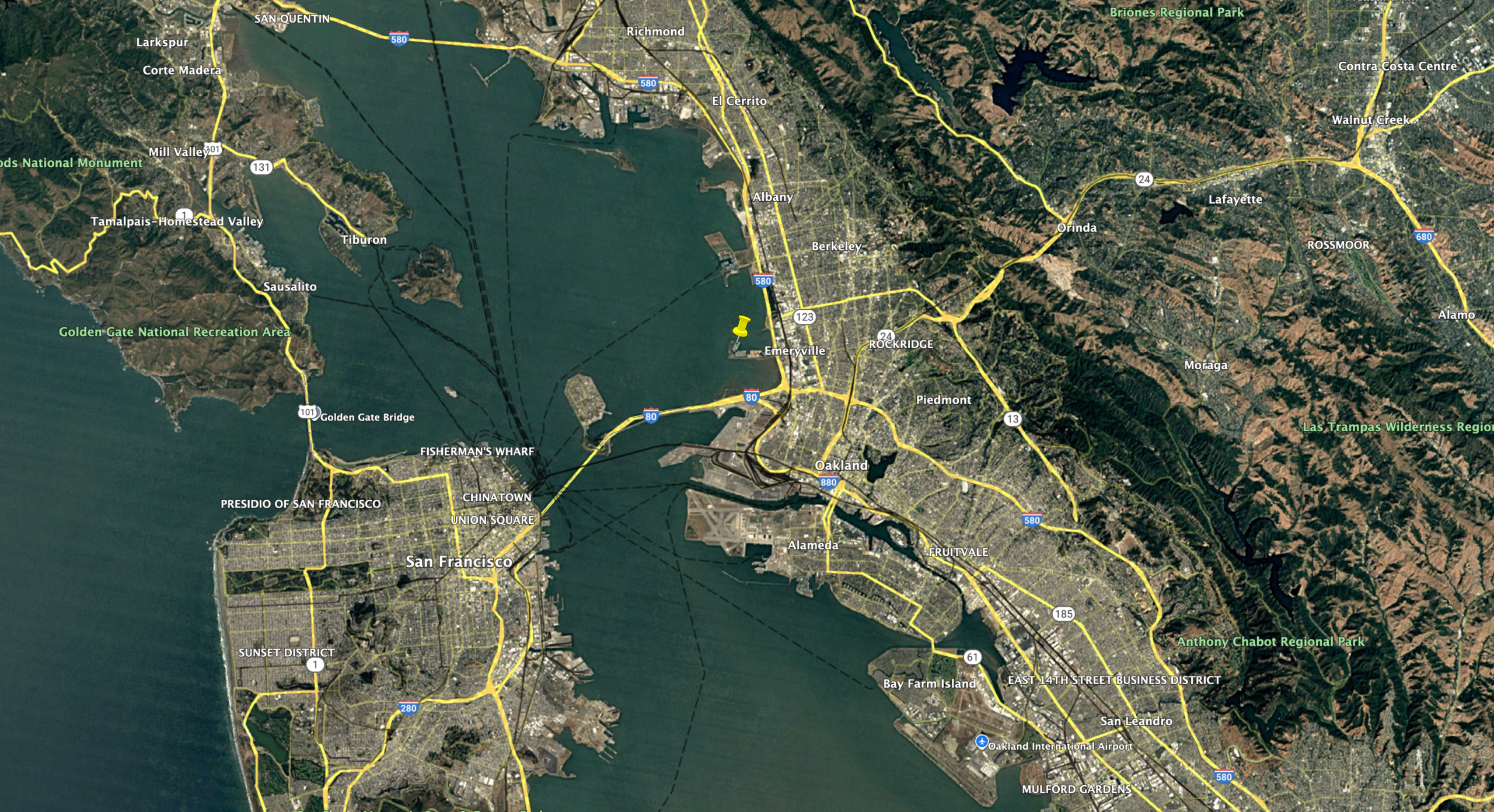
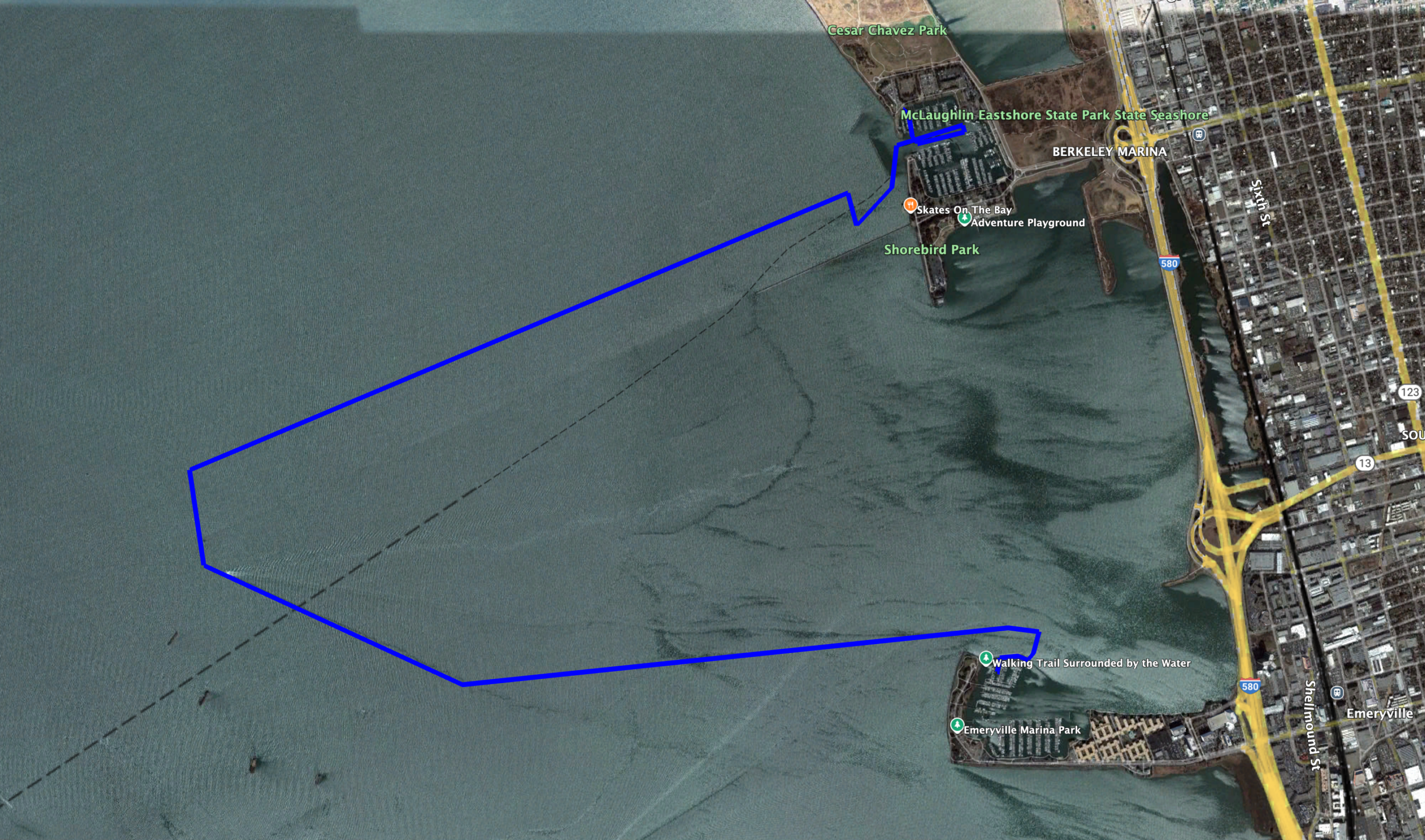
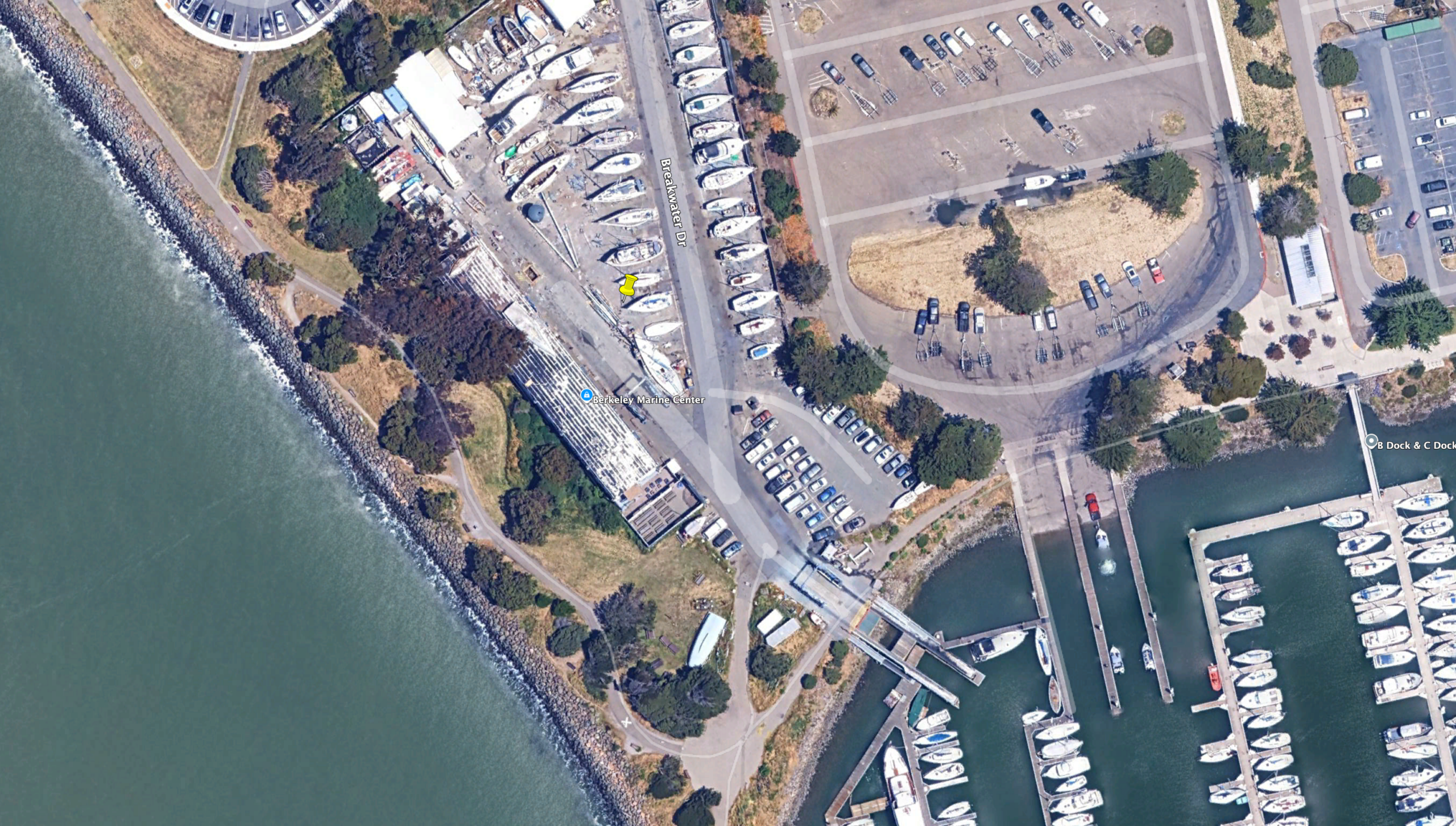
We’re in the workyard for hopefully less than 2 weeks as we do all the work necessary before putting her in the water. She was trucked up from mexico 5/5/08, and will go to the Emeryville marina when we’re done in the workyard.
I’ve worn the same pants for a week now; they tell the story of the last seven days — my first week living on the boat — better than I. Embedded in them are bits of caulk, epoxy, and grease; stains of sweat, salt, snot, and blood; smudges of pasta sauce, wine, and melted chocolate; metal filings, fiberglass strands, resin shards, and saw dust.
It’s been a week. I haven’t shaved. I haven’t washed my hair. I’ve been washing dishes with my fingers, pissing in a bucket, drinking wine out of the bottle, and sleeping sound as a baby.
If tools are like pets, and they enjoy being petted, or maybe just held, ours are very very happy. I’ve kept vice grips in my back pocket most of the time, and relied heavily on a screwdriver, crescent wrench, hammer, tape measure, and awl. I’ve alternated between the drill, dremel, grinder, and jig saw as if they were pens and pencils, occasionally using a drill press and a die grinder hooked up to our compressor.
This week, Matt and I put the new rigging on the mast, which entailed disassembling and servicing the furler, which is an ordeal in itself — more on that next week. We poured resin into the rudder, patched up holes we’d drilled in the hull, and fiberglassed over a crack in the keel. We re-bedded the through-hulls, added backing plates, raised the exhaust through-hull 6 inches, and fiberglassed over the old hole. We cleaned the mast step. We drilled a bigger drain hole in the bottom of the mast, rewired the mast lights, and cleaned the propeller and shaft. And we’ve begun 10 other tasks, if not more.
In between all that, I moved in, taking up residence in the V-berth – the little V-shaped room in the bow. I shoved all my clothes into one locker, and dumped a few extra things — my checkbook, toothbrush, and a few books, on the shelf above it. During a couple of other moments, I rode over to the grocery store, and bought some food; somehow the addition of food in the galley makes the boat seem more like a home, even if the counters are covered in stacks of toolboxes and bags of screws and pieces of hose and piles of brushes and cleaners and fixtures and instruments and other various boat parts.
I mention these projects and tools and parts a) so I don’t forget, and b) because for a certain type of person, satisfaction is more meaningful than pleasure, and these projects have been intensely satisfying. I’ve rejoiced so many times over infinitesimal mechanical achievements — extracting rusted/welded screws, for example — that I’m beginning to feel like the master of the universe, or maybe just the master of the 40-foot universe that is my sailboat.
Along the same lines, for a certain type of person there’s also a direct relationship between the length of time since the last shower, and happiness, such that if you’re that type of person, you’ll say oh yeah, and if you’re not that kind of person, you’ll have no idea what I mean. This only occurred to me recently, when I realized that I felt something like I felt when I rode my bicycle across the country seven years ago. I was so out-there, so busy doing my thing, so engaged, that there was no time or place to worry about comfort and cleanliness and appearance. That’s how I feel when I’m climbing, and that’s the feeling I’ve enjoyed most of this week.
There’s a cliche about boat-owning: they say that the best two days of a boat-owner’s life are the day you buy your boat and the day you sell it. Empirical evidence already suggest the opposite.
First, buying the boat was no fun. Buying the boat — literally paying for it — entailed electronically wiring the largest check of my life to some obscure bank in Seattle, while at the same time second-guessing myself and wondering if I’d made a grave mistake. Did I get the right boat? Did I take a big hasty jump too soon? Did I just screw myself for the next three years? Five years? Life? My concerns ranged from tiny to huge, such that the actual boat-buying was fraught with anxiety and concern and distress. Which is to say that the day I bought the boat was not one of the best days of my life — 99% of the other days in my life, in fact, were better. So I don’t know what’s up with most boat-owners. Maybe they lead very boring lives? Maybe psychologically, they think that they can buy their happiness, rather than create it? Who knows. Point is, every day since the day I bought the boat has been more satisfying. That much is clear after one week.
Second, I saw the previous owners of this boat five months ago, when we took her for a sea trial, and I would testify in court that they assuredly did not enjoy selling this boat. I think having it made them feel young, spirited, engaged, and adventurous, and that selling it only reminded to them that life’s circumstances — age, ability, mobility — had finally caught up with them and forced their hand.
I bring up the cliche because recognizing it as false is somewhat vindicating, given that I’ve only lived on the boat for a week. It makes me feel like my experiences thus far are propelling me into the life of a true sailor (or at least boat owner), and if taking this step only takes one week, then shit, maybe I will sail around the world next year.
Speaking of time, I was concerned, to say the least, that moving onto the boat would eat up all my time. I wondered how I’d have time fix up the boat while still having time to cook, write emails, deal with work, and answer my cell phone, let alone read the news, keep up with the New Yorker, and keep playing Scrabble online. Thus far, things have worked out well. I’ve found that I can bounce from fix-it mode to domestic mode rapidly, and probably because fix-it mode is so satisfying, I look at my computer less. At the same time, I rejoice a little more when I get a good email. Unfortunately, I fall asleep reading, but I wake up rearing to go.
Jonny and I have worked moderately hard for the past two days and I am astonished at how much we have accomplished in just 20 hours.
This is what we did. We repaired the rudder delamination by injected epoxy and filling all the holes. We did all the keel glasswork also–sanded the crack, scrubbed epoxy into the lead, glassed over the crack with knytex (thick and sweet fiberglass), and filled all the holes I drilled to drain it. We repaired the “smile” at the leading edge of the keel the same way. We removed the 5 seacocks and through hulls that will require various glasswork and/or backing plates. We drilled a new hole in the mast to reroute the wiring in the bilge, and a new drain slot. We removed old wiring up the mast, pulled off the steaming light fixture, and rerouted a wire out the mast at the steaming light. We entirely dismantled the furler (jonny already had done most of this already). We located the wiring failure in the bilge that was plaguing the steaming light. Jonny pulled off the bow pulpit backing plates.
As Jon previously explained, every single job, no matter how infinitesimally small, turns out to require a hundred unforeseen steps. Doesn’t matter how small. Drilling a hole. You think it’s easy? You’re wrong. Because the bit isn’t right for the metal, or there is a wire behind the object that might be punctured . . . or . . . . or . . . or. I don’t even want to go into it anymore.
But it’s fun. It’s really fun. You see a problem, you figure out how to solve it, you solve it, it feels good. Repeat. Feel good again. That’s why it’s fun.
The video shows jonny fiberglassing the “smile” at the leading edge of the keel, drilling a new hole to reroute the wiring exit from the mast, and removing the engine exhaust through hull which was for some undecipherable reason located below the waterline.
It came on Monday, at long last. What an immense relief. I drove over to the marina and watched them pull it off the trailer. Travel-lifts are sweet–made our boat look like a toy. Since Monday I’ve had to earn money so I haven’t been able to work on it, which was proven very frustrating. Jonny started laboring away. Tomorrow is my first day off, so for me it all begins tomorrow.
Jon flew home to Denver this morning, after spending a week in town with us. Here’s what he did with his week:
-Climbed at the gym 3 times
-Went sailing (on other peoples’ boats – a stunning Beneteau 32, a barely-afloat Catalina 27, and a 14-foot JY) 3 times
-Went for an hour long run one day
-Went on a date
-Saw 2 bands play at local venues
-Spent an afternoon helping me make a couple hundred Zero Per Gallon belts
-Spent an afternoon slack-lining in Golden Gate park
-Got drunk a couple of times, during which he drew this sketch of his round-the-world ambitions:
(*clarification via notes on flickr)
Actually, Jon did a couple more boat-related things while here that I mustn’t omit. He re-spliced the frayed main sheet on Loren’s Catalina 27, and he attached one Norseman fitting to one of our upper stays.
Jon was *supposed* to help us do a lot more boat-related work on Syzygy, but, since she hasn’t arrived, ended up with a week of vacation. So here’s to a productive week, Jon.
As our luck would have it, Syzygy is scheduled to arrive tomorrow. Fingers are crossed.
My membership at cal sailing club comes in handy when friends come to town. A prompt dunk in cold water is the perfect “welcome to the bay area” greeting. Here is some footage of Jon on a JY15–a fast and tippy little dinghy–wetsuit required.
Let me tell you how I have been dealing with the situation. Since the boat has been two-thousand miles away, all I have been able to do is prepare. I have prepared until I have nothing left to prepare.
I have made lists. I have made a list of all the tasks that need to be done while the boat is out of the water in the work area. I have made a list of all the tasks that need to be done when the boat gets back in the water but before it reaches the marina. I have made a list of tasks to be done when the boat reaches the Emeryville marina. I have made a list of EVERY SINGLE THING we want to do to the boat for the next YEAR. I have made a list of the tools that we need to obtain, organized by task. I have made a list of the tools and materials to gather together before starting each task. I have made a list of each step to do to complete each task.
Most of these lists I have rewritten and recopied over at least twice.
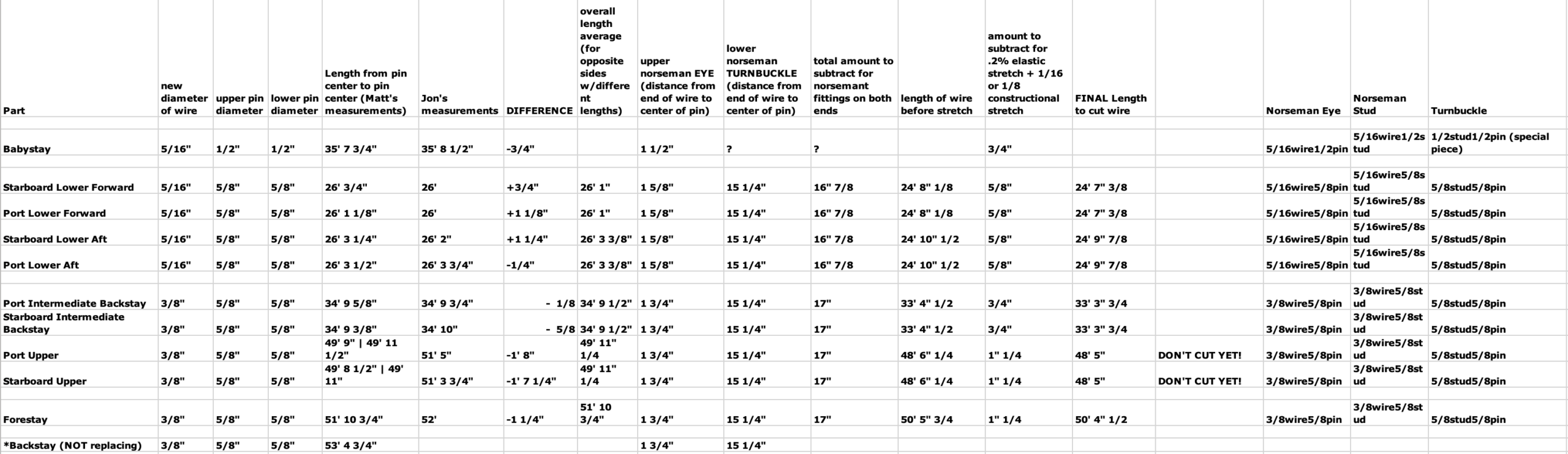
I made a spreadsheet with the precise measurements of all our rigging, a diagram of the location of all our through hulls, another diagram locating just the underwater through hulls, a diagram of how to rebuild the plumbing for the new head, two diagrams with brainstorms of how to rearrange the electrical system, a diagram of the mast steps I want to build.
I have been to two tool supply places today, five yesterday, and three the day before that. I have been to Svendsen’s Marine Center three times in the past week, without buying a single item.
Clearly, making lists and over-preparing is my thing. Clearly, I like this. But now I’m ready to be done with lists. Now I’m ready to check things off of lists. I’m ready to be too busy to make any more lists.
First it was the cushions. Now it’s getting the boat across the border.
We’d planned, months ago, to have Syzygy trucked up to San Francisco in mid March, during Jon’s spring break. Before Jon bought plane tickets to Mexico, I talked to Jazmin, at Marina San Carlos. She told me that the wacky spring tides were too low, preventing us from getting Syzygy out of the water until April 9th. (We later heard stories of other boats scraping against the bottom and getting stuck, right at the launch ramp.) So we rescheduled our trucking for April 14th, and pushed back Jon’s visit to April 25th. Since trucking Syzygy from San Carlos to San Francisco takes a week, we expected Syzygy to be here, well, now.
Then Jazmin quit (or got fired), and things got shuffled around.
Melissa, our new contact, assured me our plans were still on track.
Then Melissa sent me this email: — I am writing you regarding a situation we are having from the past couple of weeks. For the moment we are not able to cross a boat thru the border because, we need a number to import your boat back to the US. Customs told us it would take 10 days, to get this number, and the time has passed for about 1 month. They deny to give us the number and we are trying to figure it out what are we going to do regarding this situation. I had not sent you any e-mail, because I supposed this would be a matter of at least 15 days, but now it is out of my hands. For the moment I have 5 boats waiting to be ship to US, and I believe this would affect your date to be truck to Tucson. I already talked to your US Carrier and he told me it won’t be a problem at all. Believe we are trying to do the best we can to put everything on its place. I hope to hear very soon from you. —
That’s why people don’t buy sailboats in Mexico…
As I began pulling my hair out, we discussed a) complaining to our congressmen/senators; b) calling Customs ourselves; and c) whether or not Syzygy would be here by April 25th, when Jon was scheduled to arrive.
Then I talked to Melissa, and she told me she could ship the boat on Friday, April 18th. Two weeks, ago, in Mexico, she told me (in person), that things were looking good, and that it would happen on April 17th. Hair-pulling slowed down.
Then, according to Melissa, another boat got delayed at the border, and there were problems getting their oversize truck permit, so we got pushed back to Monday the 21st (since customs is closed on the weekend.) The only benefit: $400 off our trucking bill. Hair-pulling picked up.
Melissa called me on Monday morning with news of another delay. Apparently truck drivers in Nogales are protesting lengthy customs inspections (which take a few hours) thereby lengthening customs inspections for everyone, and delaying the delivery of Syzygy at least another day, if not more. Hair-pulling continued.
By today (Tuesday) at noon, Melissa hadn’t called, so I knew things weren’t looking good. She called at 1pm, and told me that Syzygy wouldn’t head north until Thursday (and that she’d deduct another $200 from the tab). That’s not good news for us; Jon’ll be lucky if he even sees the boat, and, at any rate, I’ll be bald by then.
Matt and I spent a day last week cutting the new rigging for Syzygy, after we spent a day going over the numbers that we collected in Mexico. Why a whole day looking at 10 numbers? Because there were, uh, discrepancies between Jon’s measurements and Matt’s measurements. Sometimes those discrepancies were only 1/8 inch; sometimes those discrepancies were 1 1/4 inch. Fortunately, that’s why we have turnbuckles — so that we can tune the rig to the proper tautness, even if the shrouds are a bit long or short.
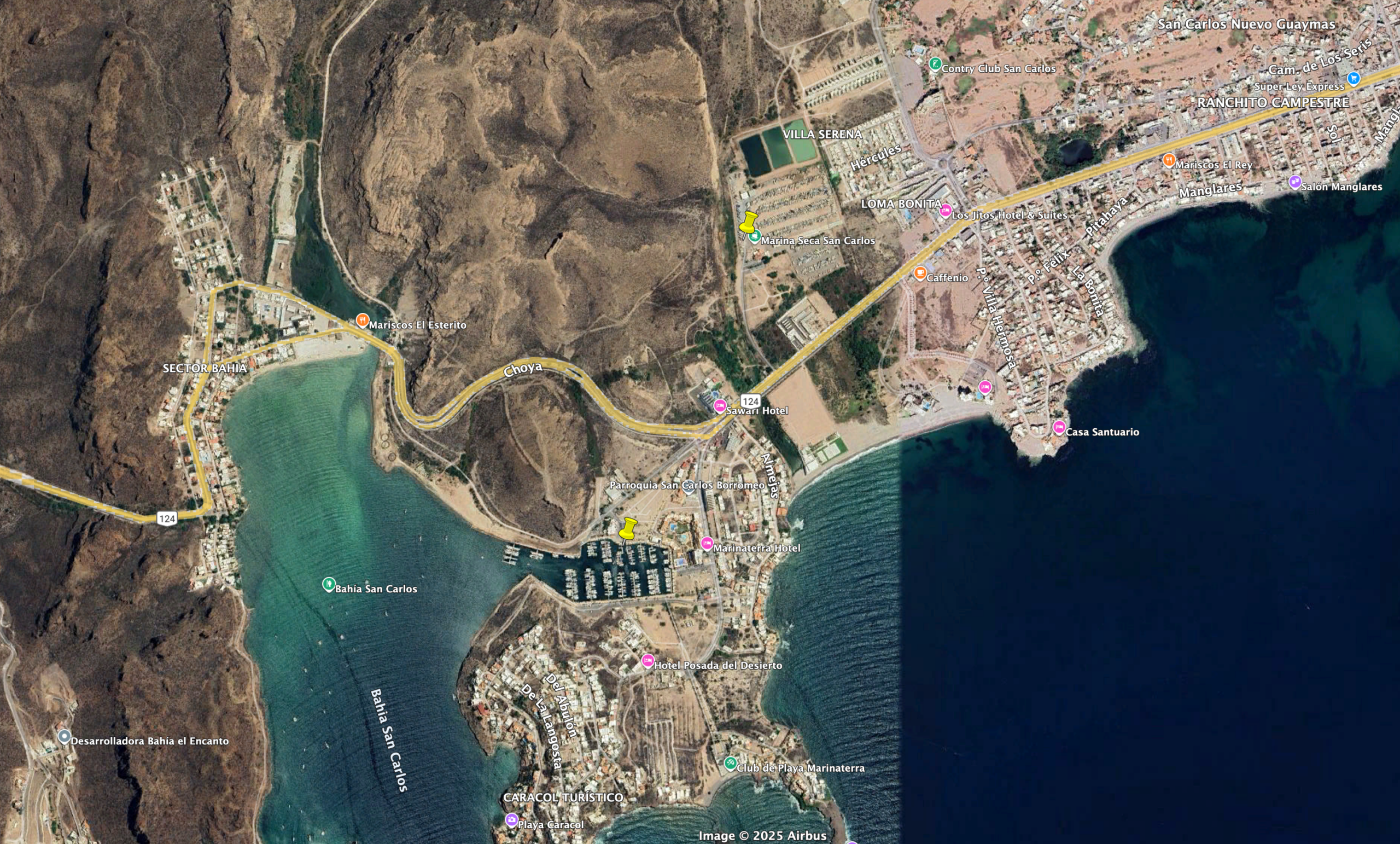
Matt and I spent last week in San Carlos, Mexico, readying Syzygy for shipment. It was a week full of victories and discoveries and very satisfying moments, in which our labors appeared to have paid off.
We flew to Phoenix on Friday night, and then hussled over to the Tufesa bus station, to catch an overnight bus down to San Carlos. At midnight I gave Matt a pack of Mentos, and wished him a happy 30th birthday – what better place to celebrate than on an uncomfortable plastic chair beneath fluorescent lights in a shady part of Phoenix? We rolled into Nogales at 6am, and I laughed as yet again, after all these trips to Mexico, we got green lights at the border. All these trips, and never searched; while in the States, airport security takes my toothpaste because the tube exceeds 3 ounces.
Our first day began with minor victories: – Syzygy was present and floating, with only 2lbs of caked bird shit on her solar panels. Even her hull was clean. -The engine’s oil was oily, as it should be, which was good news, since we thought maybe the oil cooler was leaking. It also started right up, purring along. Phew!
There was only one small defeat: Rafael, the cushion guy, hadn’t left our cushions on the boat for us. I called him, and he agreed to meet us the next day.
We went to bed excited about being back on the boat, optimistic about the week ahead. Since we lacked cushions, we slept on wood, with a pile of towels/clothes beneath us. Also, since we didn’t close the hatches, a small army of mosquitos (who knew they lived in the Sonoran desert?) invaded our quarters, and vexed us all night. I woke up in the V berth with bug bites all over my knuckles; Matt woke up in the quarter berth with bug bites all over his face, like some pimple-faced teenager.
The next day, with the tides in our favor, we were able to escape from the marina, and take Syzygy sailing in light winds, in beautiful green water. She sailed great.
Another victory: the packing gland (the seal around the propeller shaft) didn’t leak one drop. Here’s to Jon for fixing it well last time.
Then began the fixing… Matt and I replaced the cruddy/clogged drain hose in the the propane locker, and rebuilt both of our manual bilge pumps.Screens in the hatches kept our quarters bug free, but since Rafael never showed up, we slept on wood yet again.
The next morning, I climbed up the mast with a measuring tape and calipers, and we spent an hour measuring our rigging (here’s hoping we measured correctly) and inspecting parts like the tangs and spreader tips.
Another victory: we successfully assembled, inflated, and rowed the dinghy (which we’ve named Cabron) across the marina, giddy as 10 year olds.
I disassembled and serviced the bearings in a couple of blocks (pulleys), such that they run very smoothly. Two down, 40 to go.I also called Rafael and left a message; I told him I was contemplating kidnapping his firstborn son in return for our cushions.
We started the next day with business, filling out the paperwork required for trucking Syzygy up to San Francisco while at the same time trying to keep my eyes from popping out of my head on account of the very big bill I’d be footing. Note: if there’s any problem with Customs, I’m blaming Jon, because his passport is expired.
I called Rafael again; he said he’d meet us at 3pm. I crossed my fingers, and we returned to the boat.
We spent the rest of the day removing the dodger and bimini frame, and lashing them to the deck; removing the solar panels and stowing them below deck; and spraying WD-40 on all of our old turnbuckles, hoping to loosen them just enough so that we could remove our old rigging when the time came.
3pm came and went, and Rafael never showed up, so we slept on wood, yet again.
We started the next day early and worked until midnight. First, Matt labeled all of the blocks and lines, so that when we disassembled everything we’d know what was what. We disconnected the wiring at the bottom of the mast, pulled off the mast boot (the waterproof rubber seal around the base of the mast on deck), and detached the table in the salon, which is bolted to the mast.
And then, just before leaving the marina, Rafael showed up and forked over… half of our cushions. (Jon: you’re right, I love the color you picked.)
Then, gear stowed, we went sailing around the peninsula, to the marina where Syzygy would be pulled out and put on a truck. With more wind, and some swells, we were getting some spray across the bow; perhaps we’d jumped the gun and removed the real mast boot a bit early. I quickly made an improv mast boot out of my towel, which worked pretty well.
We sailed into the San Carlos marina in perfect conditions, with a stiff breeze off our port.
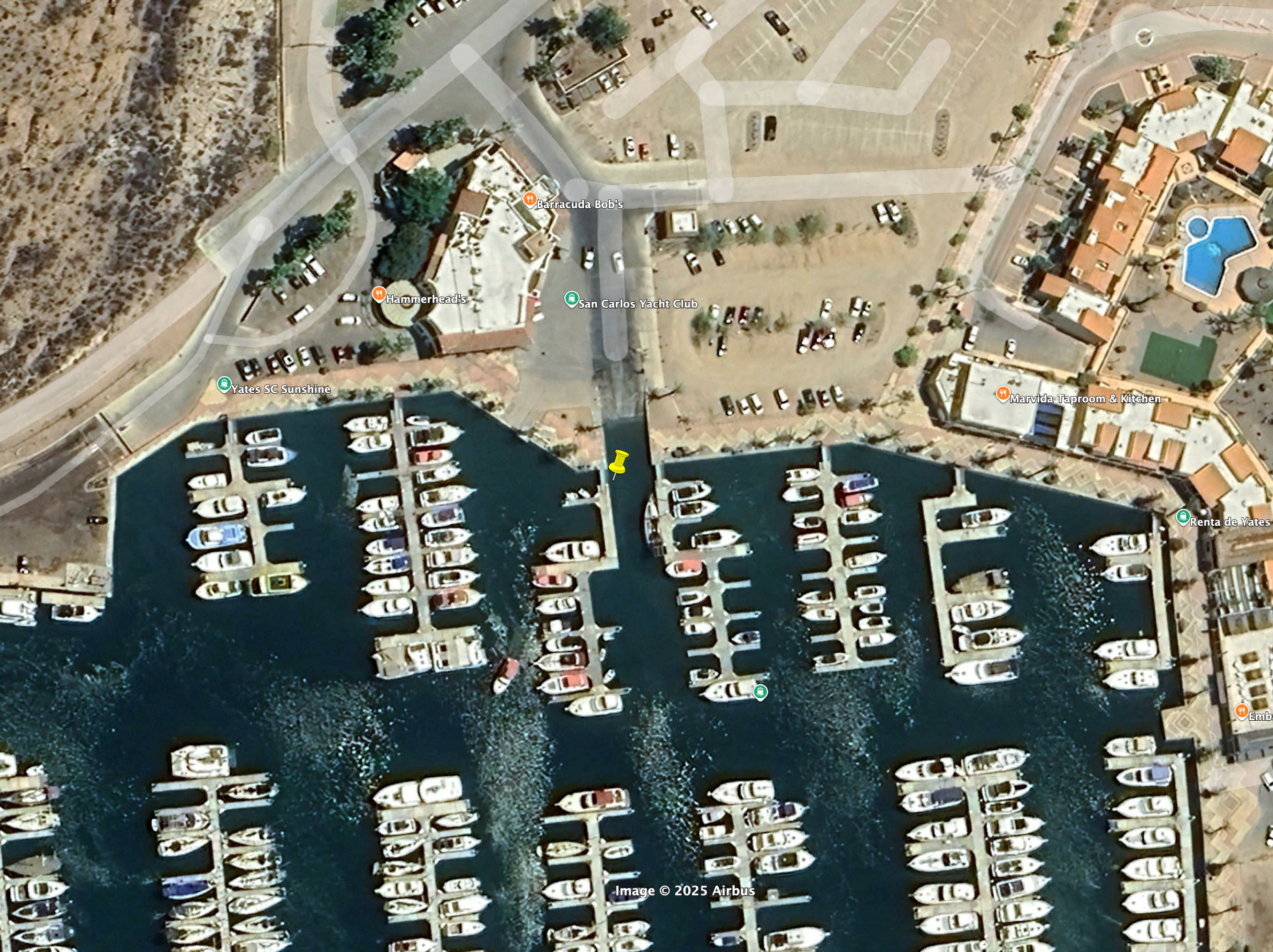
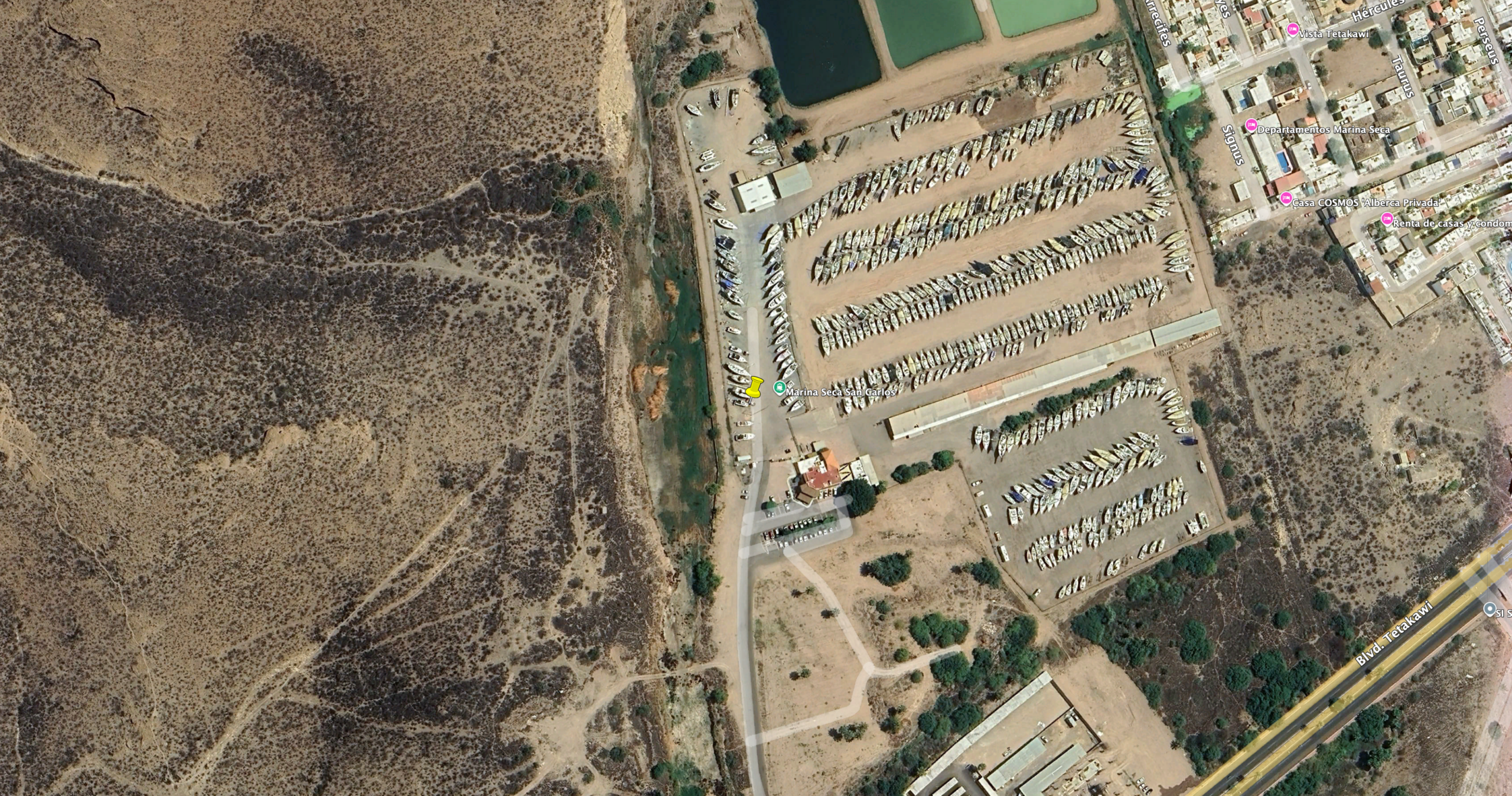
We tied up at the dock for half an hour, then got hauled out and moved over to the workyard, beneath a tall crane and beside another boat on a truck, all wrapped up in plastic, ready for shipping. In a few more days, that’s what Syzygy would look like…
At the workyard that evening, we set to work in a fury.
We removed the boom and vang, and stowed the jib and mainsail. We unreeved all of the lines (pulled them through various pulleys), and tied them to the mast, and went to bed when we lacked the energy to do anything else.
Early the next morning, we worked like madmen to prepare the mast for removal, so that we wouldn’t have to pay for many hours of labor at $150/hr — the fee for mast removal. (I’d heard a horror story of sorts, of a mast that became welded to the hull, such that it took 2 days to remove it… at, yes, $150/hour. Ouch.) We spent an hour fiddling with needlenose pliers and vice grips, wrestling with the rusty old cotter pins in the turnbuckles, and finally disconnected the 4 lower shrouds, the 2 intermediate shrouds, and the baby stay, leaving only the forestay, backstay, and uppers holding the mast up. Then we unwired the antenna from the backstay, unbolted the furler from the forestay (a task and a half), and struggled to get the spinnaker pole off of the mast, since the quick release mechanism had locked up.
Just as we finished, five guys from the workyard climbed aboard, looped a thick rope around the mast, and turned on the crane’s winch. Slowly, the line rose up to the spreaders, and held the mast firmly. They removed the upper stays, while one of the guys went to the bow (to removed and then hold the forestay, and prevent the furler from bending), and another went to the stern (to remove and then hold the backstay, and prevent the antenna insulators from bending), and another guy went below deck to guide the mast up and out of the cabin. And then, just like that, the mast was up in the air, dangling from the crane, no longer part of Syzygy. Slowly, they lowered the mast to the ground, and propped it up, horizontally, on two stands beside the boat, and walked away. Total time: 25 minutes, close to record time.
We spent the rest of the day removing the rigging from the mast (four of the clevis pins were rusted/welded to the tangs, requiring the assistance of others and the use of a grinder), drilling holes in the keel and rudder (to drain water which had gotten in there — we’ll repair the holes in San Francisco), removing the spreaders, and grinding away the crack in the keel from which the water entered. Of course, I also called Rafael, and pleaded, in my best Spanish, for him to bring us our friggin’ cushions.The next day, we removed the bow pulpit, which required unwiring the nav lights that feed through the poles, as well as removing the backing plates that hold the bow pulpit in place. This, in turn, required crawling in the chain locker to access the backing plates (which had rusted almost all the way through), and grinding away the heads of the bolts on the 2 rear poles, because we didn’t have the time or energy to dismantle the cabinets in the V berth so that we could access the backing plates. (Alas, there’s a job waiting for us when the boat gets up to San Francisco.) We cut off the old crappy lifelines with a grinder (which was very satisfying), and then loosened the radar arch, dealt with the wires that run through it, and lowered it to the cockpit. We took all the instruments off the top of the mast, then wrapped it up (w/backstay and forestay still on) with lines and rags and plastic, like a big, long, $30,000 Christmas present.
That night, our work almost done, we gobbled up some fish tacos and tossed back a few beers at the Captain’s Club, and talked shop with captain Bob, an American expat/badass-sailor/amazing-old-fella who lives on a similar Valiant 40. We told him we felt like we’d learned so much about our boat just by taking it apart, and that everything — except for getting our cushions from Rafael — was pretty much working out for us.
We spent our last day in San Carlos lashing/stowing/packing/cleaning everything else up, and realized that exhaustion was creeping up on us. We’d been in San Carlos exactly one week, and been working so constantly that it was hard to recall what jobs we completed only a few hours before, let alone a few days before. I was amazed at how much we’d gotten done; how desperately we needed an off-day; and how we just barely pulled this whole thing off. I was looking forward to returning home, and even to the bus ride back to Phoenix, and the comfort of soft, reclining seats.
Speaking of which, on that last day in Mexico, just as were were headed to town to get some tacos, Rafael showed up. He delivered a few more of — but not all of — our cushions. What a cabron.
Boat news has been a roller coaster lately: up, down, up, down, up, down.
It started when I stopped by the Emeryville Marina two weeks ago, and found a slip for us. I’m not much of a believer in omens, but I took it as a sign when the skies cleared and a double rainbow came out just as I rolled in on my bike. I was drenched, and my glasses were all foggy/drippy, but I was smiling. I could imagine Syzygy, sitting there in the rippling water, with a view of the whole of San Francisco bay — From Mt. Tamalpais to the Golden Gate Bridge to the city to Treasure Island to the Bay Bridge. It would be perfect.
Don, the harbormaster, and I chatted for a bit about details — he told me I’d have to get a $300,000 insurance policy to keep our boat there, and gave me a phone number of an insurance agent to call.
So I called. The conversation didn’t go so well. Wait; calling it a conversation isn’t quite fair. It was more of an insurance agent’s interrogation:
-Have you ever owned a boat before? No, hmmm. And how long have you been sailing? OK. Where’s the sailboat? It’s in Mexico? I see.. And how many people own the boat? Hmmm… that makes it difficult…
The result: the agent told me he wouldn’t be able to insure us. I hung up, exasperated. If we couldn’t get insurance, we wouldn’t be able to put the boat in the marina. If we couldn’t put the boat in the marina, we wouldn’t be able to go sailing. If we couldn’t go sailing, what’d we buy a sailboat for??
Before my head began to spin too much, I tried calling another insurance agent. This conversation went better:
Q: have you ever been denied coverage? A: no Q: have you been in any motor vehicle accidents, or made any claims, in the last 3 years? A: no Q: is your driver’s license in California? A: yes. Q: how many years of sailing experience do you have? A: well, um, i went to sailing camp when i was like 12, and, um, sailed a bit off the coast of maine, and in Boston, here and there… so, uh, i guess 10 years. Q: what’s the largest boat you’ve ever operated? A: um… 43 feet. Q: has matt ever been denied coverage? A: no Q: has matt been in any motor vehicle accidents, or made any claims, in the last 3 years? A: no Q: is matt’s driver’s license in California? A: yes. Q: how many years of sailing experience does matt have? A: i’d say, uh, 3 years. Q: has jon ever been denied coverage? A: no Q: has jon been in any motor vehicle accidents, or made any claims, in the last 3 years? A: no Q: is jon’s driver’s license in California? A: no, it’s in Colorado Q: how many years of sailing experience does jon have? A: i’d say, uh, 3 years. Q: OK. sounds good. A: Really? Really! Great! Q: Looks like… we can underwrite your boat for $265/year A: Wow! We’ll take it!
So, the agent said, since the boat is in Mexico, they couldn’t insure it yet. Once we get it here, then they’d be able sell me an insurance plan. Fear not, the agent assured me — the rate would still be available two months hence.
Greatly relieved, I emailed Jon and Matt the good news. Everything was coming together — I found a company that could truck the boat up to San Francisco, a slip in one of the best marinas around, and an agent who could insure us as soon as we got here.
Of course, I still hadn’t figured out the pattern, and didn’t realize what would follow Up, Down, Up…
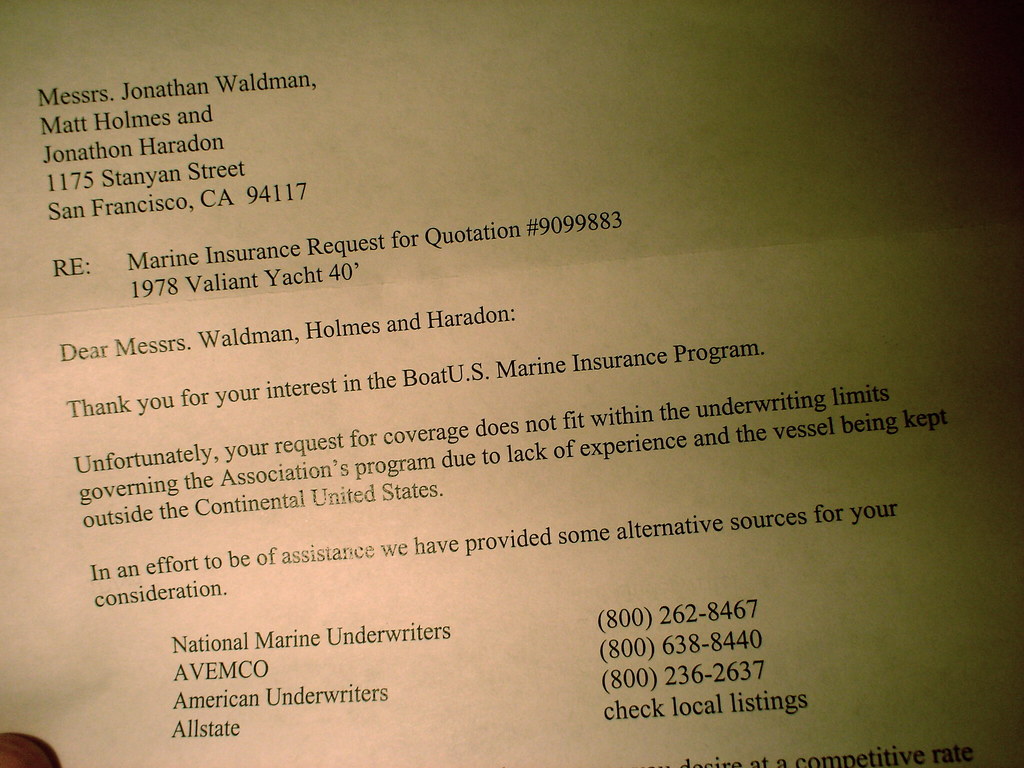
Three days later, a letter arrived, from the insurance company. “Thank you for your interest,” it began — an auspicious start for a form letter. “Unfortunately, your request for coverage does not not fit within the underwriting limits… due to lack of experience and the vessel being kept outside the continental United States.”
Let me be plain: I freaked out. I called back, and explained that while our boat is currently in Mexico, it wouldn’t be for long, and besides, we only wanted to insure it while it’s in the states, anyway.
OK, the agent said. It looks like that’ll cost $550/year. I tried calling, and haggling them back down to $265, but have had little luck so far. I’m not even sure if it’s worth complaining about.
Meanwhile, I’d been emailing Jazmin, at the trucking company, trying to schedule our boat delivery. (*We’d originally wanted to sail Syzygy up to San Francisco, but the logistics are a nightmare: time, currents, winds, the North Pacific swell, money, and boat repairs are all working against us.) Jon has only a week off from teaching at the end of March, so we’d been planning to spend that time in San Carlos, one last time, preparing the boat for its expensive overland journey.
So I emailed Jazmin, and told her we’d like to haul Syzygy out of the water on March 26th.
Her response:
“I was checking the tide and we won’t have enough water to haul out until April 9th at 7 pm. If we haul out that day, we can transport on April 14th.”
This was very bad news. I forwarded the email to Jon, and he left me a voicemail later that day:
“I am officially demoralized… and completely fucking hate our sailboat right now. Goddamnit. Why did we buy a boat down in Mexico. Fucking shit!”
So now it’s just Matt and I, headed down to Mexico in early April, to prep the boat for a very expensive (another bit of bad news) journey to San Francisco.
At any rate, a few days later, Jon called with better news: the last of our parts had arrived. Actually, this was sort of bad news, because we’d ordered $4,000 dollars of assorted boat parts (wire rigging, running rigging, a toilet, hoses, turnbuckles, etc.) almost two months ago, and had hoped to have it within a couple of weeks. We should have known that shipping a pallet would be complicated, or at least slow. But, Jon called, and he was proud to report, at long last, that every little thing we’d paid for was accounted for. He told Matt that he only had one more box to open up.
So he opened up the box to find… fluorescent pink lashing line. (It was supposed to be grey.) Jon laughed, while Matt expressed his fervent position on the matter, which is: there will be no pink lines on any boat Matt’s sailing.
Well, they must have sent us the wrong color line, Matt said. Well, um, no, Jon countered. It looks like we gave them the wrong part number.
My own feeling: when all is said and done, if we successfully a) truck the boat to San Francisco; b) put the boat in a slip; c) find someone willing to insure it; d) re-rig it without killing ourselves; and e) have a few laughs along the way, it’ll be the least of my concerns what color the friggin’ lifelines are.
Almost every day, I tell my students, “Trust me, you’ll need to use this math someday.” When they’re learning about arcs of a circle, and how two rays of an exterior angle cut through the circle can be subtracted and that the result equals half the exterior angle, their eyes glaze over and I wonder how better to convince them. “Well, I know it’s slightly boring, and maybe you don’t see the relevance now,” I say, “but trust me!”
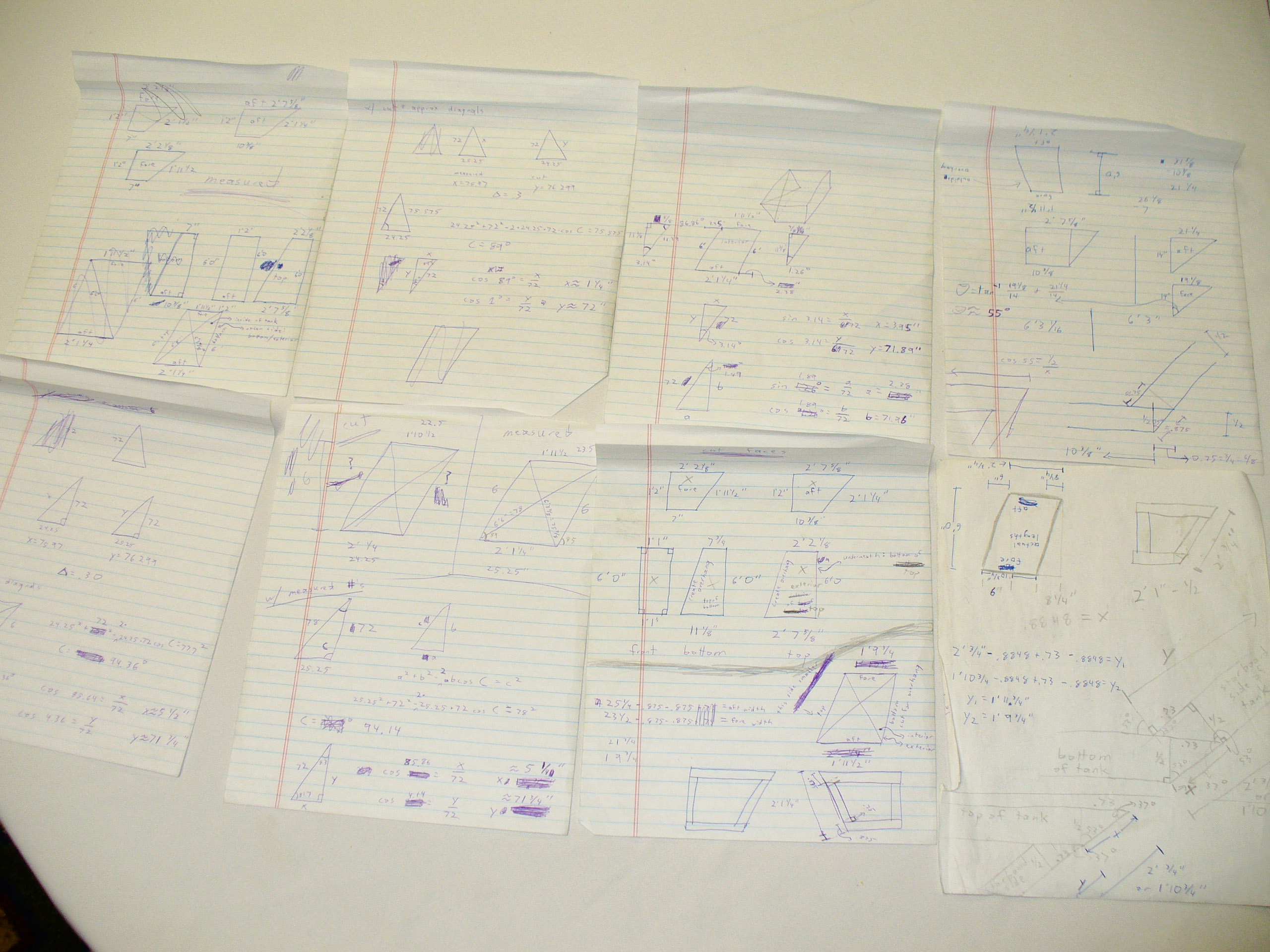
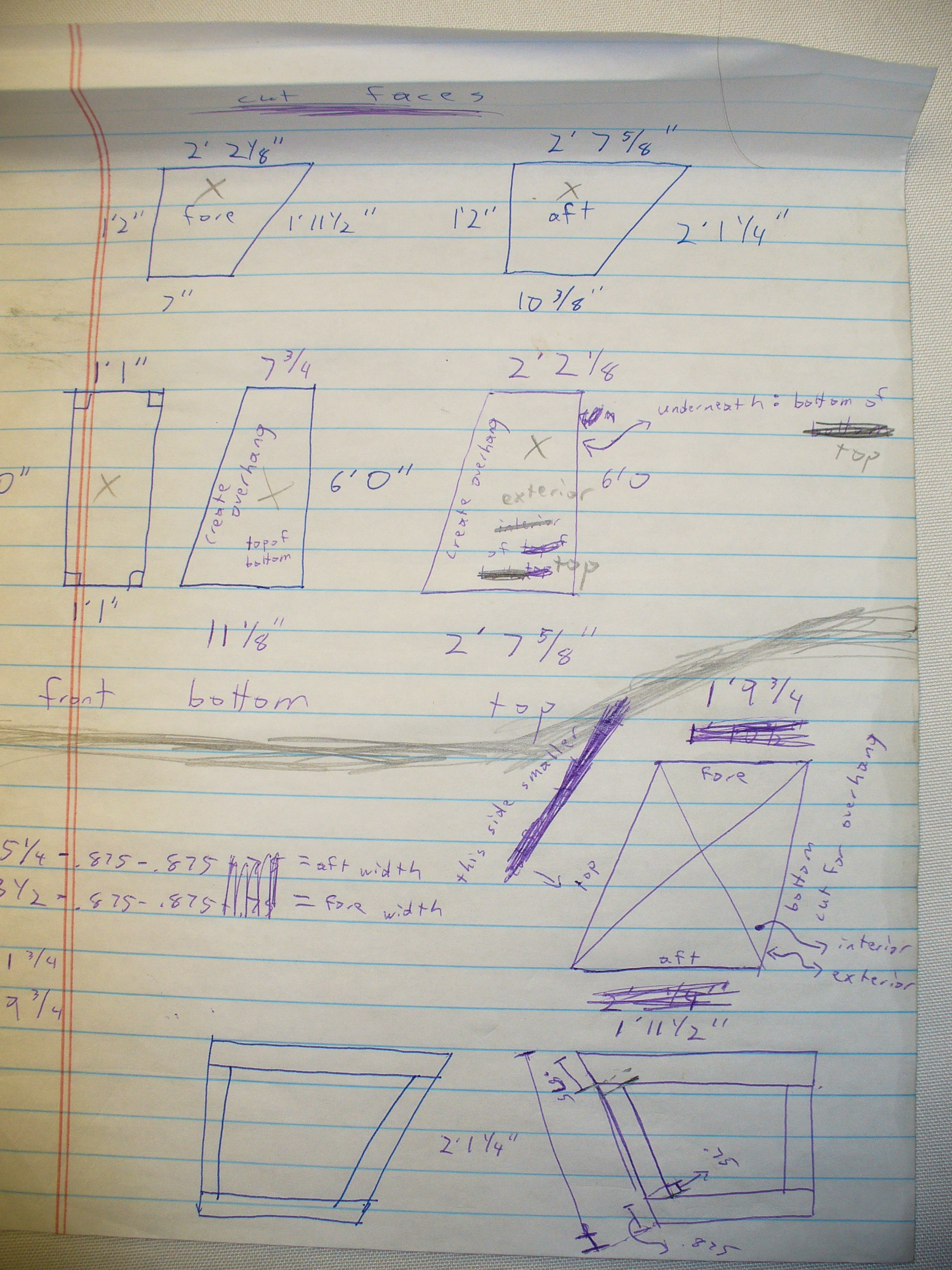
Well, kids, take a look at this: Eight pages of mathematics, all done for the practical, real-world purpose of making new water tanks.
Jonny mentioned that before we hacked up that port watertank, Matt and I measured it, because our plan all along has been to build new similarly-shaped tanks out of epoxy-coated plywood. But he failed to mention some complications. (It’s a sailboat; of course there were complications, right?) The complications: the tank was shaped funny. It wasn’t a nice boxy shape, like a coffin, but rather one side was more like a torqued trapezoid. The first problem was that trapezoids are kinda looked down on in the shapes world as a named-yet-odd shape. More importantly, the torqued trapezoid was like a piece of paper with the top edge twisted one way and the bottom edge the other, ie. not a flat plane.
This nefarious, twisting face of the tank was a dilemma, because 1/2″ marine-grade plywood cannot be curved in the same way that stainless-steel can. What really vexed us, though, was the way that the face was just barely curved — not enough to measure easily, but enough to make it very difficult to reproduce in wood. In a way, it’s like it was just daring us to try.
Matt, the ex-physicist and I, the ex-math teacher, attacked the problem of determining the shape with a vengeance, each with our own methods, furiously battling to see who could come up with an answer that would best satisfy the other and thus win the king for the day. Diagonals were measured, plumb-lines were drawn, angles were estimated, cosines were determined, arc-tangents were employed, lengths were re-measured, and spreadsheets created. Around and around we went. Jonny, the ex-english-writer-something-or-other-that-required-little-to-no-mathematics person, behooved us to consider his idea for determining the shape. “Just trace it,” he said. “Nonsense!” Matt and I exclaimed. “Your assumptions are invalid!” And off again to our calculations we went. I found errors in Matt’s work; he found errors in my work. Jonny’s suggestion was ignored.
A new day arose, and with it, the need to begin cutting the plywood. Before making those first cuts, we invoked that old saying, “measure twice, cut once,” and double-checked our measurements. What should have been a simple operation became a 20-minute math discussion, with errors discovered left and right. Once again, Jonny once implored us to consider his suggestion, but he was overruled by us math crazies. More measurements were made, more calculations completed, and then, finally, all three of us settled on a solution.
In the workyard, I picked up the jig-saw for the second time, determined to cut perfectly. (You’ll recall that the first time I used the jig saw, I essentially cut a hole in the hull of our boat.) Matt and Jonny were impressed as I cut away, but we still weren’t 100% sure if I was cutting the right shapes.
After I’d cut the six pieces, we assembled the wooden tank with screws, to make sure it’d fit. Voila! Fit it did! It was 1/4″ off on one end, but that was easily remedied. After days of work, our tank-to-be sat there in the workyard, a thing of beauty. Granted, we still had hours of fiberglassing and epoxying ahead of us, but we felt we’d taken a great leap forward. So we sat around and drank canned beers with the yard manager, Miguel, satisfied at having accomplished something, even if we weren’t done yet.
Oh yes, whose method did we use? Not the ex-physicist’s, nor the ex-math teacher’s. We used Jonny’s method. King’s to you, Jonny.
I’ve heard married friends say they nearly got divorced over curtain, rug, and paint color choices, and — maybe because I’m a 31-year-old bachelor — always laughed at such stories. Those stories, incidentally, normally ended with the wife making a decision and saying to her husband: Trust me. You’ll love it.
Then I bought a boat, and, apparently, without my noticing, I got married to Matt and Jonny. Thus began remarkably similar dramatic domestic disputes.
Back up a few weeks to the end of a frustrating trip in which we a) didn’t fix the engine b) didn’t go sailing c) spent lots of money and d) ended up frazzled, we ran into Rafael. Rafael makes custom cushions, mattresses, and seats for sailboats. He showed us his work on other sailboats in the marina, and we were impressed.
Nevertheless, we weren’t in the mood to spend more money. Somehow, though, Matt convinced us — he must have waved a pendulum in front of my eyes — that it would behoove us to redo our 30-year-old cushions/mattresses/seats with new foam and covers less, uh, overtly heinous. The way Matt saw it, Rafael’s Mexico prices were a mere fraction of what we’d pay back in the states, and besides, he couldn’t stomach looking at our yellowing faux-Navajo patterns any longer. He had a point there.
So we told Rafael to bring us a few books of fabric swatches, with a wide variety of choices. This he did.
I liked modern, pattern-less designs. Abstract. Random. Colorful.
Jonny and Matt didn’t like my choices. They called them tacky, kitschy, and straight-out-of-the-1950’s.
Jonny liked blues. Matt liked reds. Or maybe it was vice versa. Whatever it was, none of us agreed.
So we rejected the first one thousand samples that Rafael had brought, and told him to bring more. He returned with another thousand, and after quickly rejecting 95% of them, we asked to keep them overnight, apparently out of stubbornness. Such is the nature of marriage.
After dinner, we discussed:
Q: “What about this yellow?” A: “Are you on drugs?”
…The night wore on…
Q: “I kinda like this one. Waddya think?” A: “It looks like a 50’s rug. We’re buying cushions. Not rugs.”
…And on…
Q: “This one?” A: “Too thin, easy to rip, and goddamn it, Jon, stop picking patterns you know we’ll hate.”
Eventually, someone said, ‘If we end up with that color on the boat, I’m dropping out of the trip.” You think I’m exaggerating.
By the wee hours of the morning, Matt and I reluctantly agreed to agree on a color that Jonny had previously brought to our attention. Then Jonny flipped a 180, said he had visualized it, and hated it, and that we were making a grave mistake.
In the end it came down to a bluish beige called something like periwinkle cream (or something equally silly) that Matt favored, and a green-ish beige that I favored. In true womanly fashion, part of my objection was because I simply didn’t like the name. Jonny didn’t really like either of them, I think, but was tired of the impasse. He came down on the side of the blue, leaving me as the lone hold-out.
Matt left for home early the next morning, before we’d made a decision. Before leaving, he made one small concession: He said if it came to it, he’d settle for the green, but that he strongly preferred the blue. The he advised Jonny to persuade me.
By that point, though, Jonny favored a sleazy leopard-skin print, and I’m still not sure if he was joking.
So with Matt, the husband, gone, I did when any good wife would do. When Rafael dropped by, I told him we’d take the green. Sorry Matt. Sorry Jonny. But trust me – You’ll love it.