Syzygy Sailing

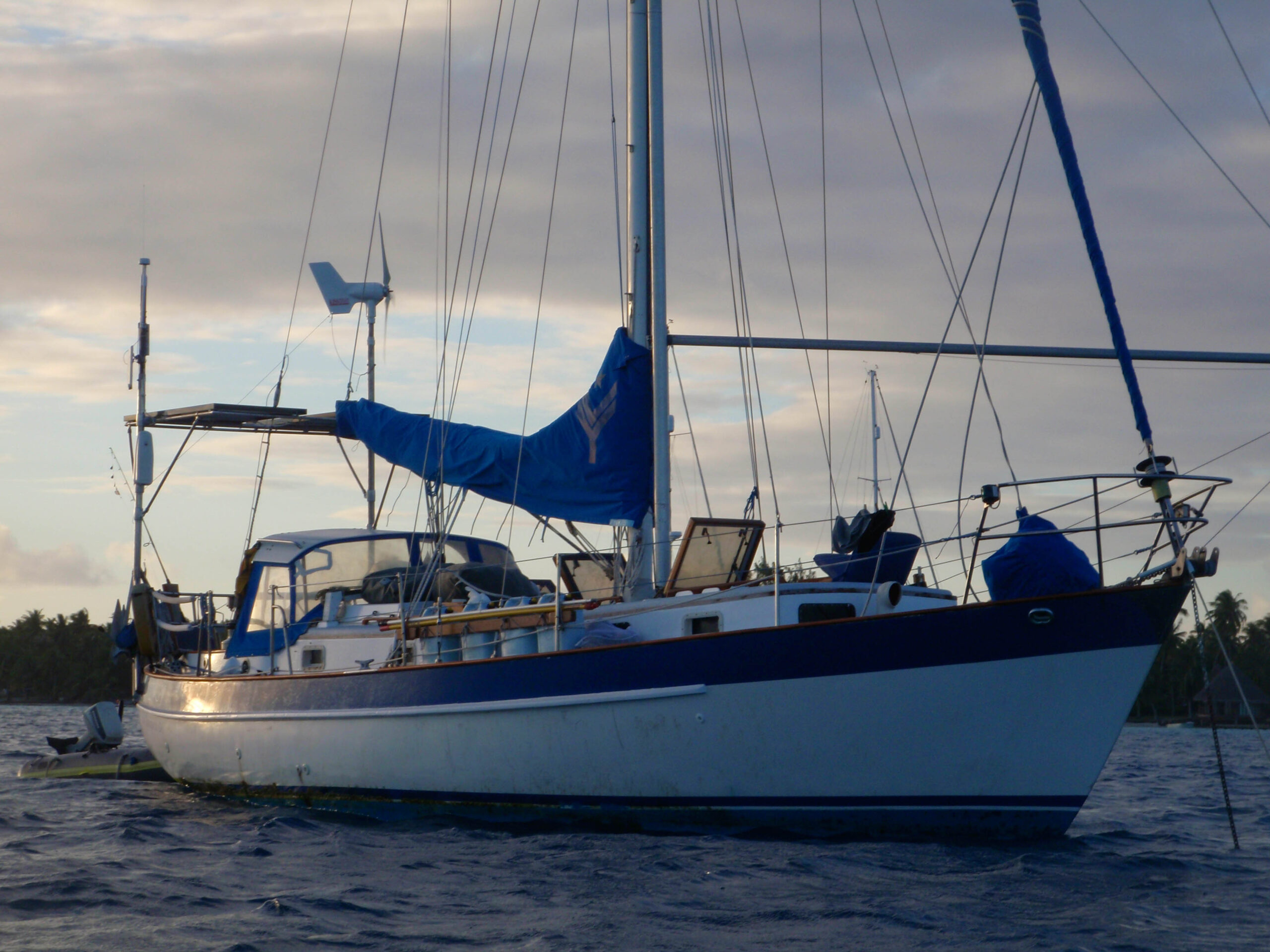
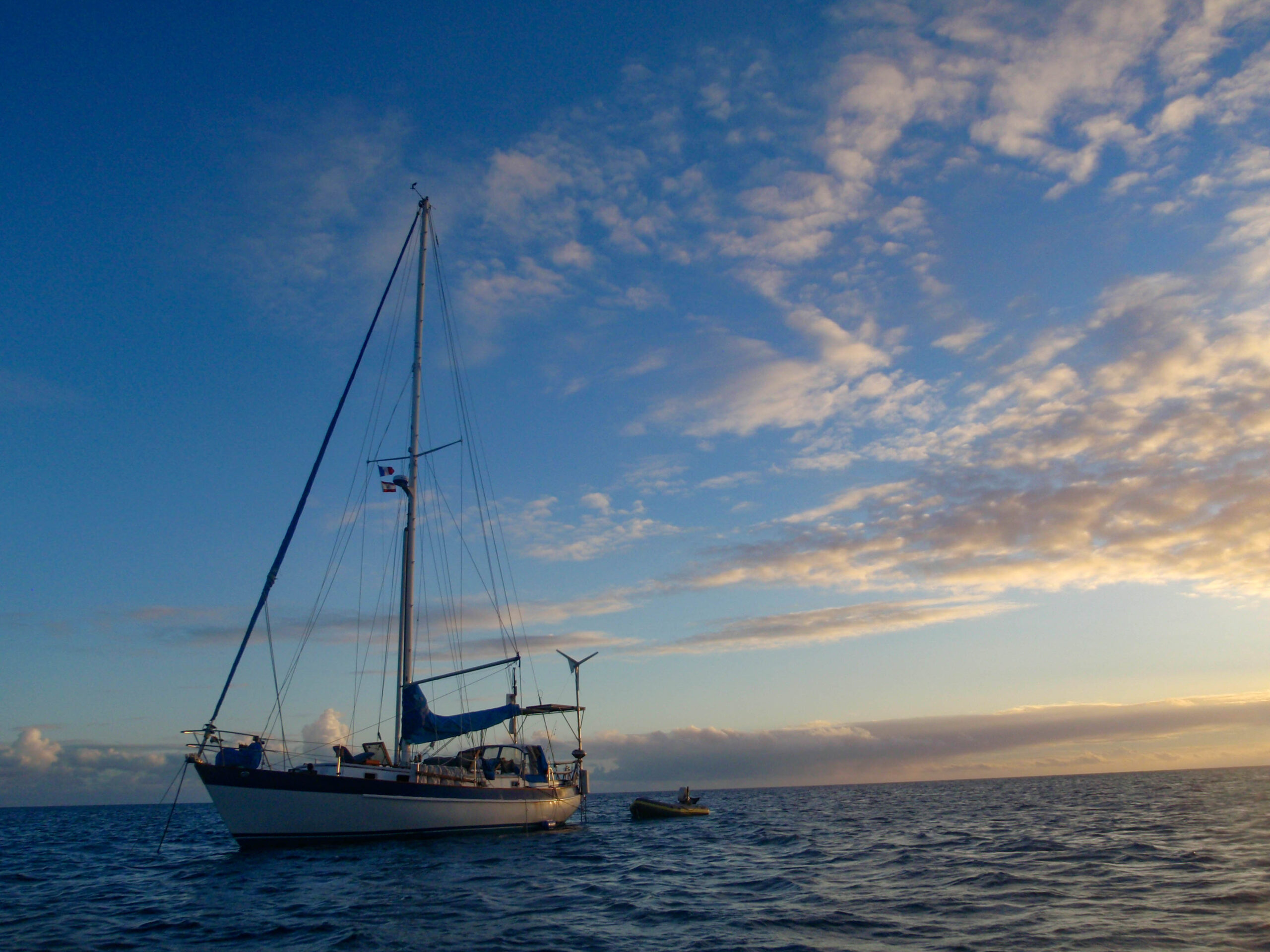
Bought a boat, fixed a boat, sailed to Australia, sold the boat.

  • Tattoo

    (refers to events that happened most importantly on July 20th)

    I have toyed with the idea of getting a tattoo for about eight years now, starting right at the peak of my young adult ‘I’m-trying-to-find-and-define-myself’ phase.  We all have one right? Back then, my ideas for a tattoo ran the stereotypical Chinese or Japanese character, or a Greek or Latin word.  How cliche right?  Thankfully that phase passed before I acted on it.

    Matt rekindled my interest three years ago when he suggested Jonny, Matt and I all get similar tattoos to mark our journey, something with a sailing theme.  I toyed with a number of drawings.  Again nothing inspired a decision.  When it was clear the trip would not happen as planned with the three of us, our inaction seemed prescient.

    When, however, I was going to join the trip again, I knew the last last five years of effort towards a sailing trip and this past tumultuous year in particular deserved a special remembrance.  So I began researching traditional Polynesian designs and locations on the body.

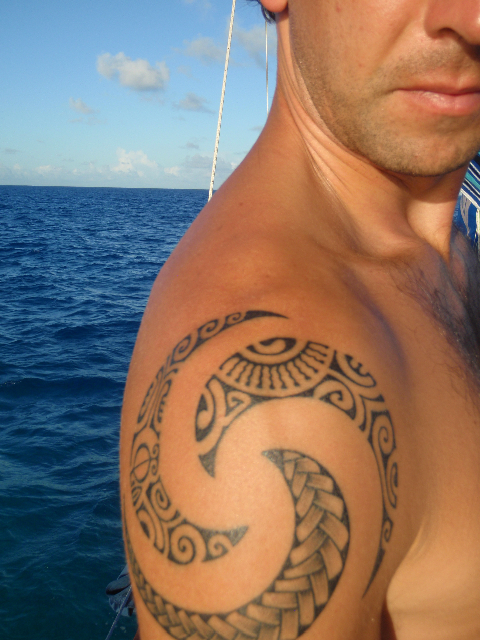
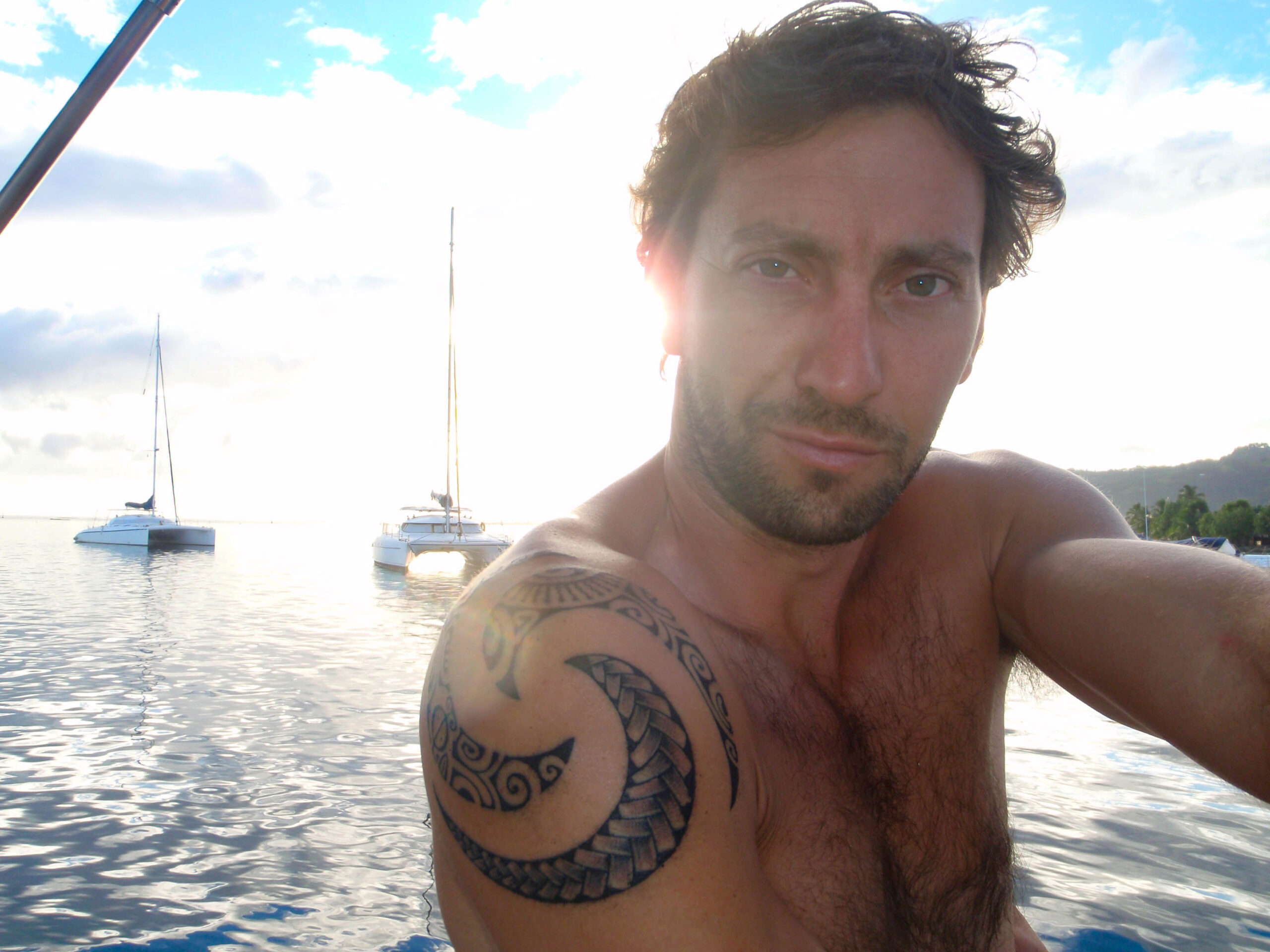
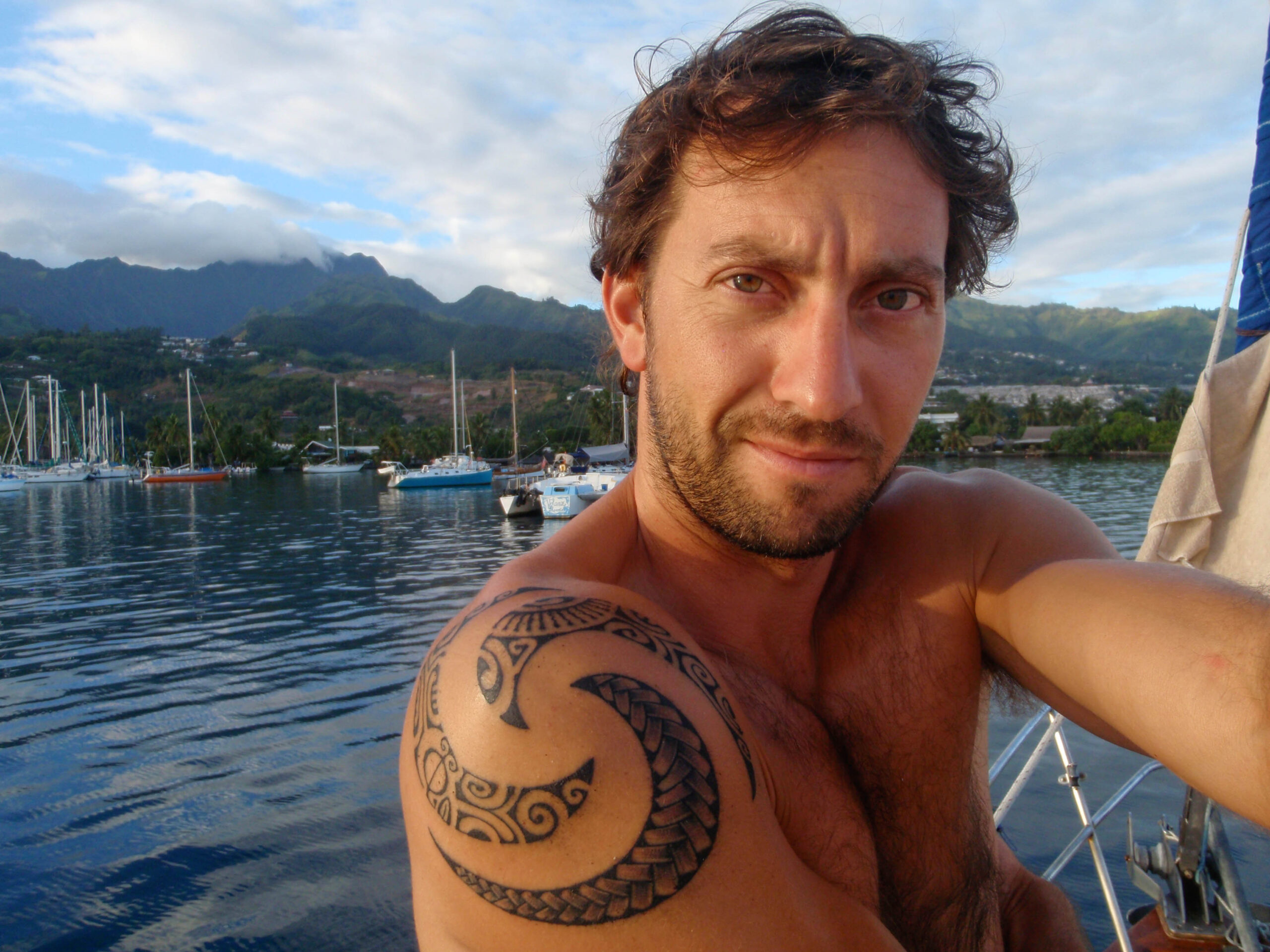
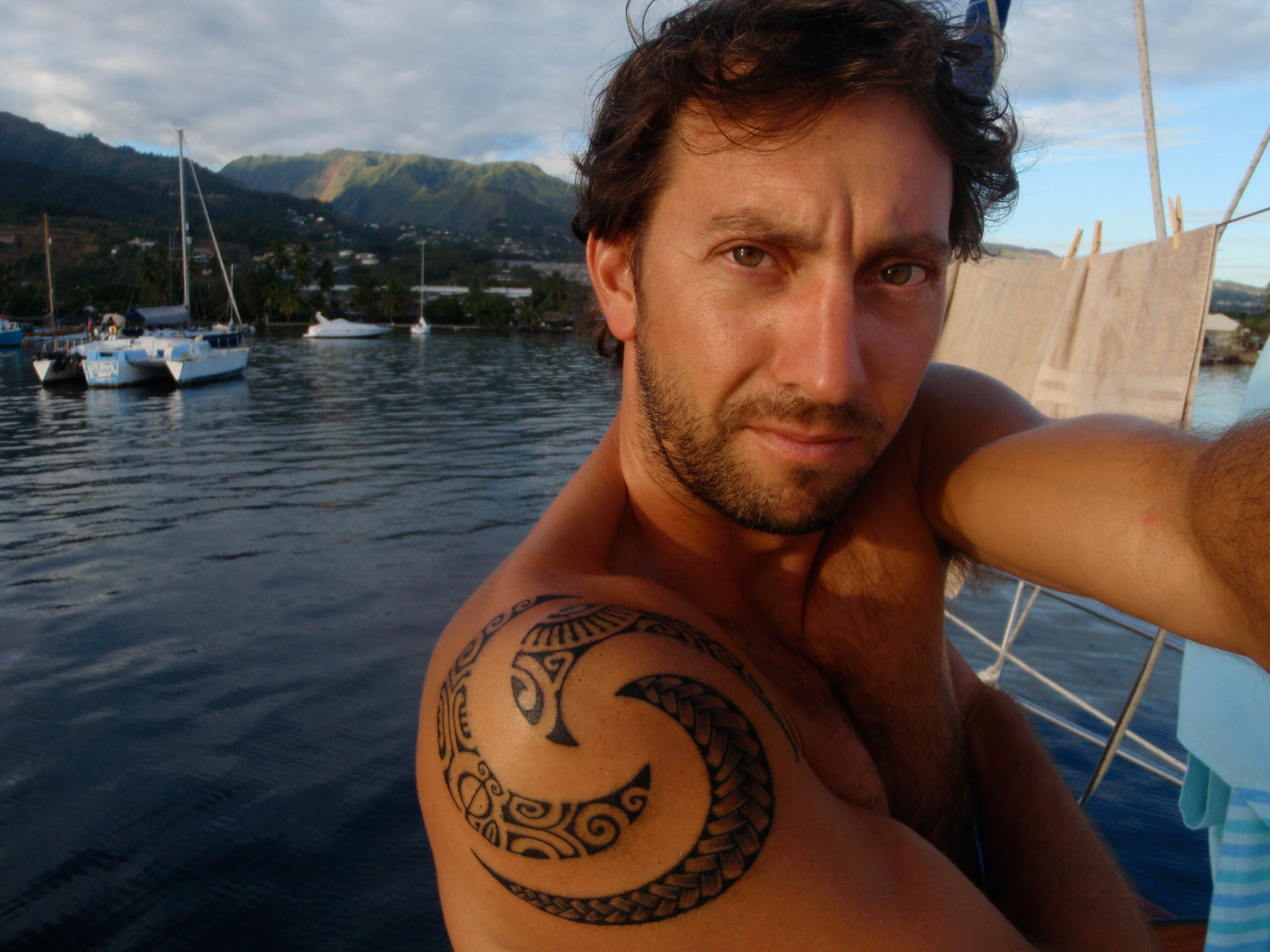
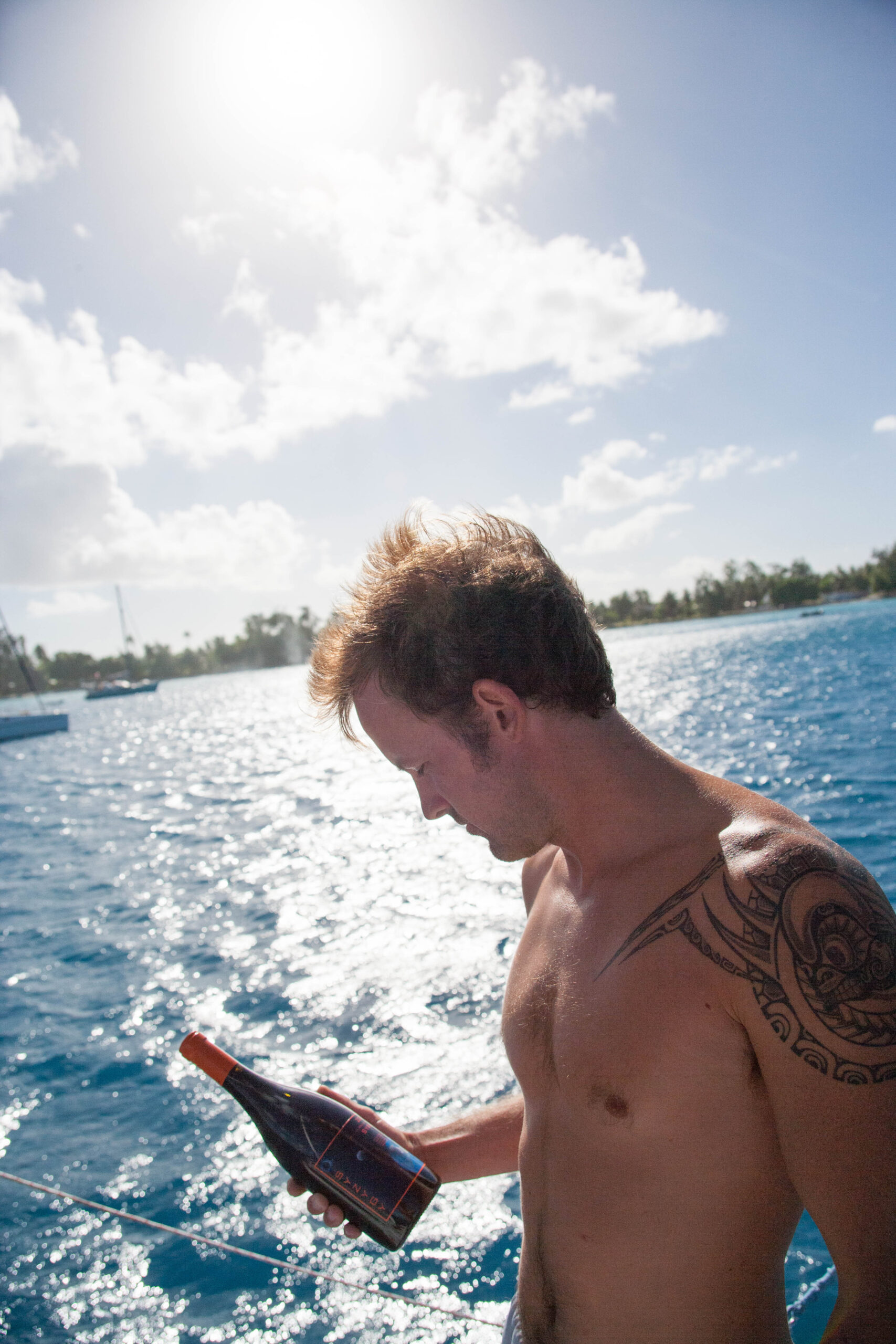
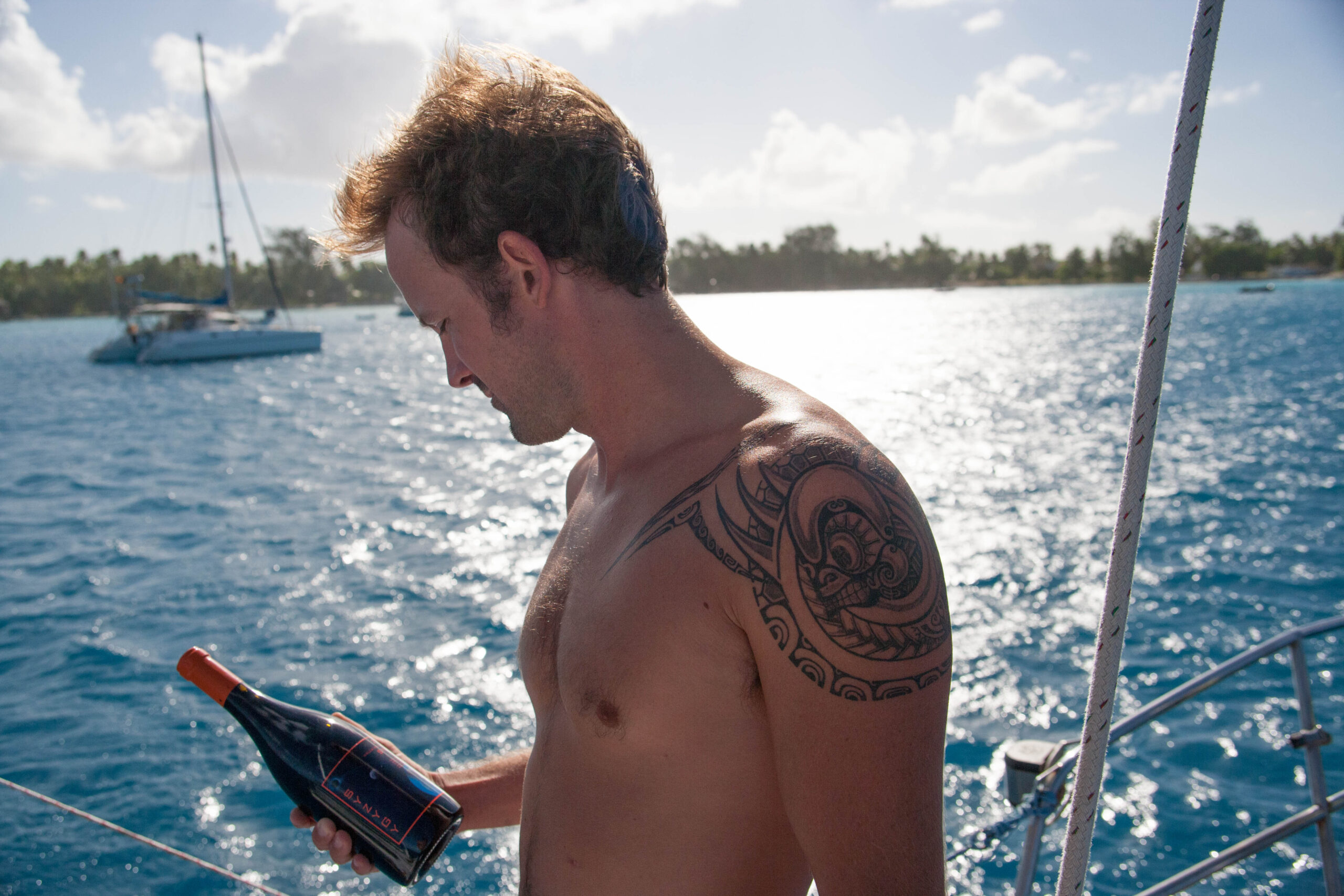
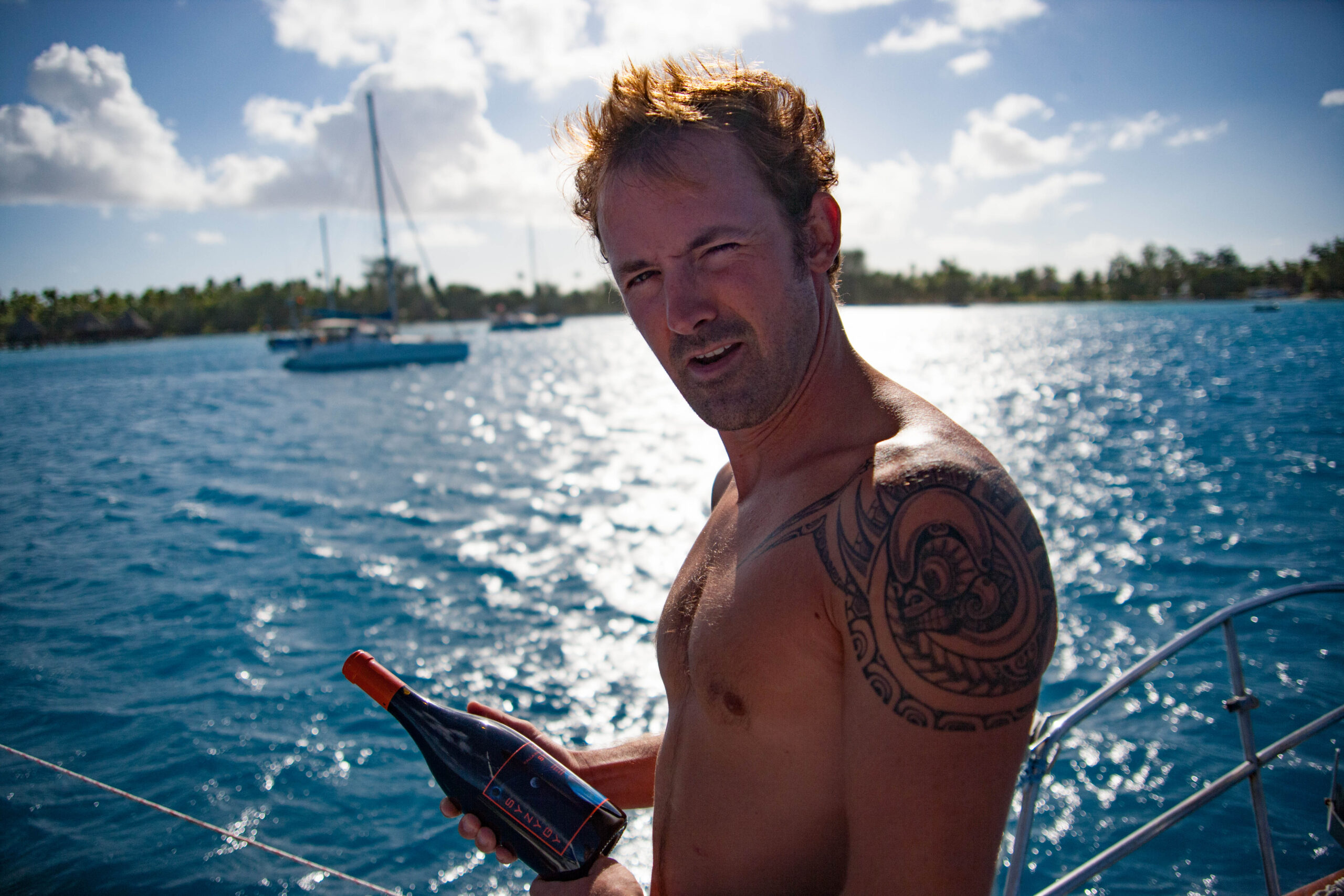
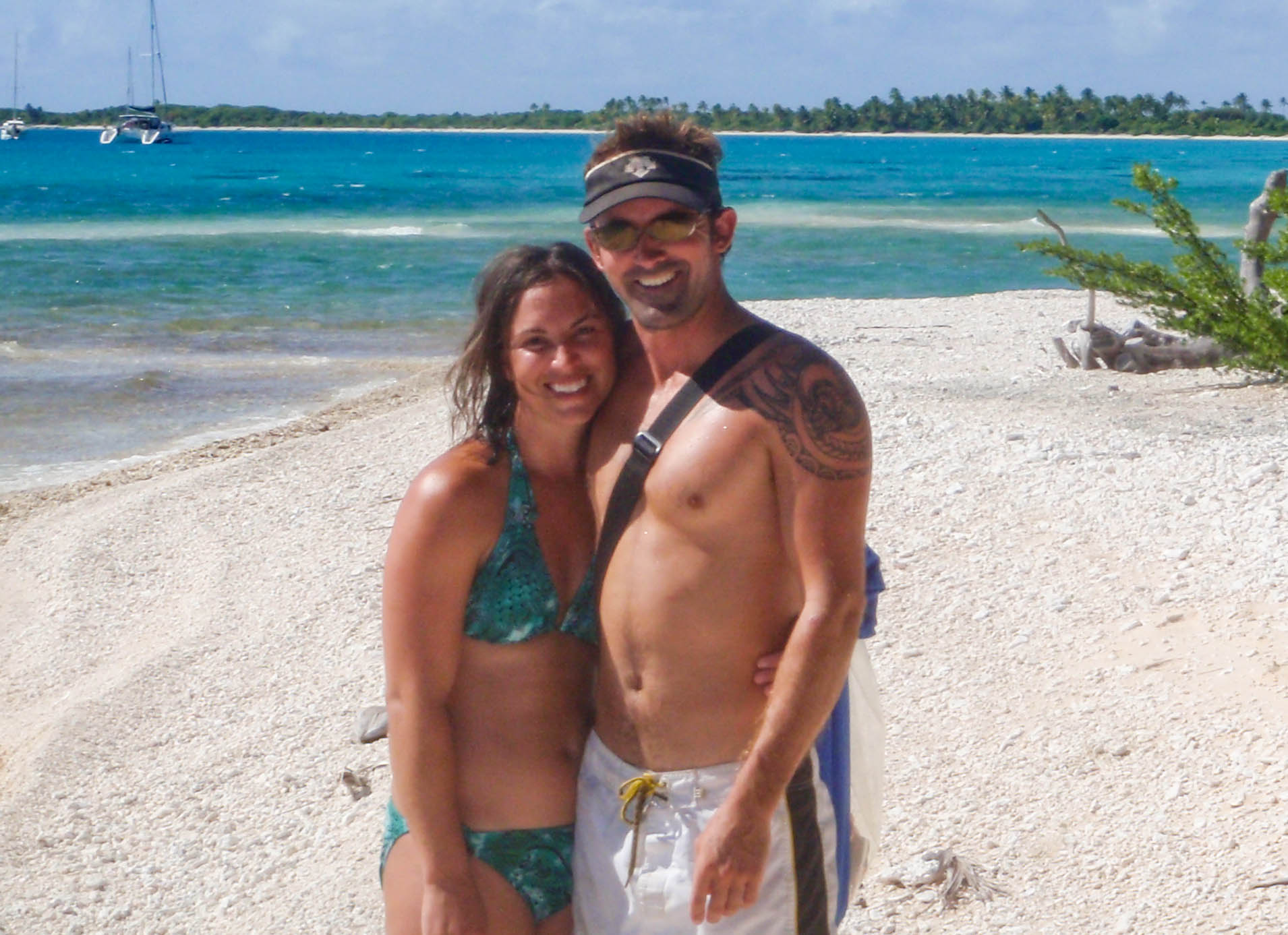
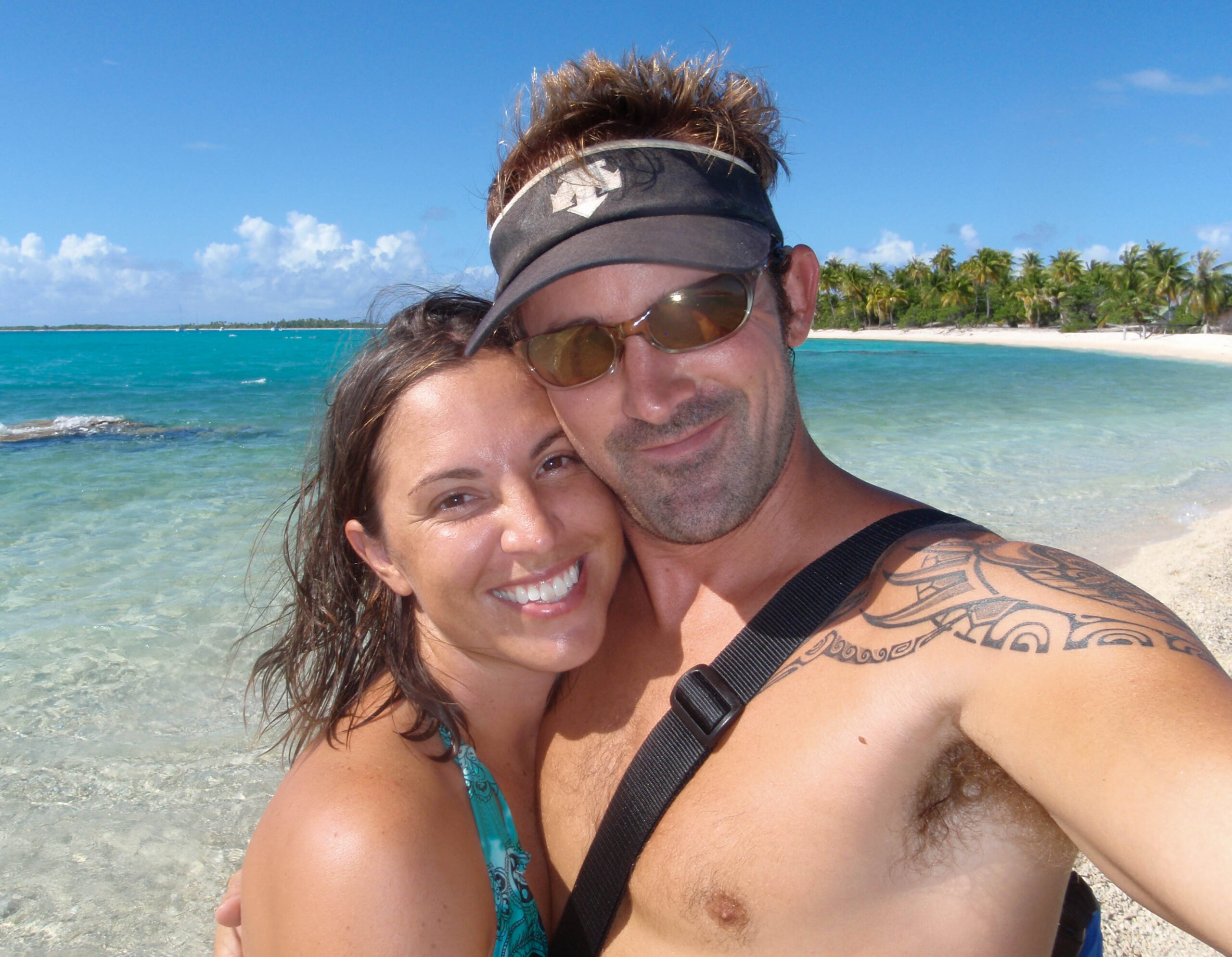
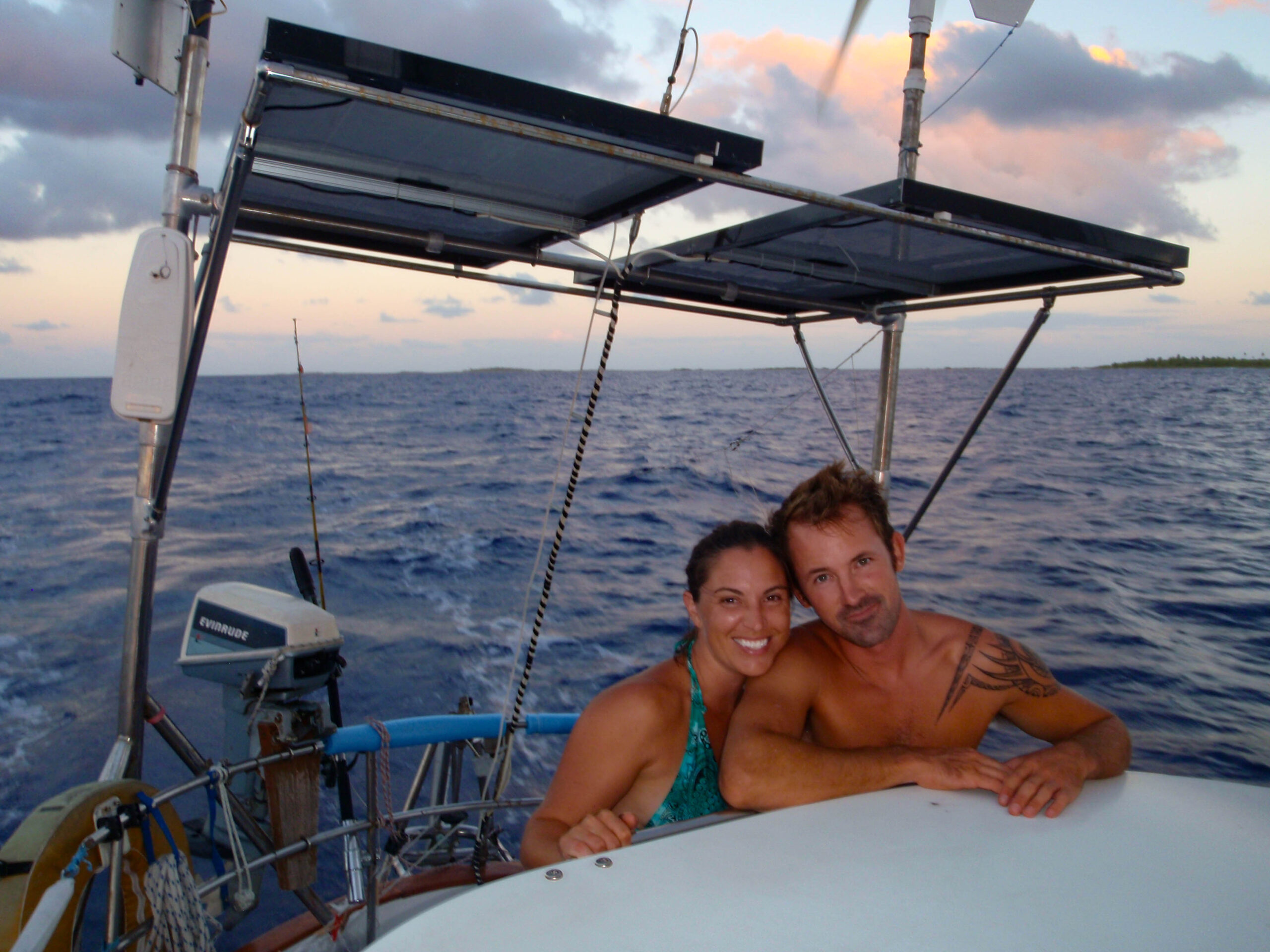
    For a location, I settled on my right shoulder; my right because for some reason it feels more natural to look down at my right shoulder.  As for the design, Polynesians frequently make use of a spiral.  Most often, one path spirals around itself; Karen’s tattoo is an example of this.  Part of Matt’s tattoo has two paths that spiral around each other.  In all the pictures I looked through, I never saw a tattoo with three, so I painstakingly made a sketch that had three symmetrical paths that spiraled each other.  I then re-worked it on a computer.

    As for a design, I wanted a tattoo I could attach my own personal symbolism to, and my idea had three distinct parts representing three phases of life over the last five years.  As for location, I wanted to be able to see it.  This ruled out the popular Polynesian location of the entire ass-cheek.  It also needed to be somewhere I could live with should I rejoin the proper business world.  This ruled out the less popular but very traditional facial designs.  Recalling all the styling I had seen of Polynesian tattoos, I made a terrible sketch, I am a terrible artist, of what could be within each spiraled path.  My sketch was by no means what I actually wanted, just a visual to attach my very visual brain around.  One was a basic geometric design; simplicity and un-complex. Another, a dark swirling, heavily inked pattern; change, turmoil, confusion, loss, sadness.  The third, many Polynesian symbols and a smiling tiki face; looking forward, happiness and a trip realized.

    I took the outlines of the spirals (but not my styling sketch, I didn’t dare show a true artist my awful renderings!) to Simeone.  His shop is upstairs in the main market of Papeete, tucked away behind one of the myriad of jewelry and cloth booths.  Friends of Jerome, whom I stayed with in Papeete for a week, highly recommended him.  The many awards on his walls of contests won spoke to why.  I flipped through five books of pictures of tattoos he had done, pointing at styling that was similar to what I envisioned.  I then tried to indicate that he was free to do what he wanted within the spirals, let him do his artistry.  As usual, I was reduced to pantomiming and basic phrases; Simeon was not talkative and did not seem to speak much English.

    It took two and a half hours to draw and ink.  Normally, there wasn’t much pain, but a few times it was more painful that I anticipated, but not unbearable.  I am extremely happy with the result; Simeon did an excellent job reproducing the spirals and his artistry within them is definitely to my liking.  All in all, I know I’ll be happy 30 or 40 years down the road looking down at my shoulder.

  • Misadventures with the dinghy: Part 4

    (refers to events that happened July 12th -July 20th)

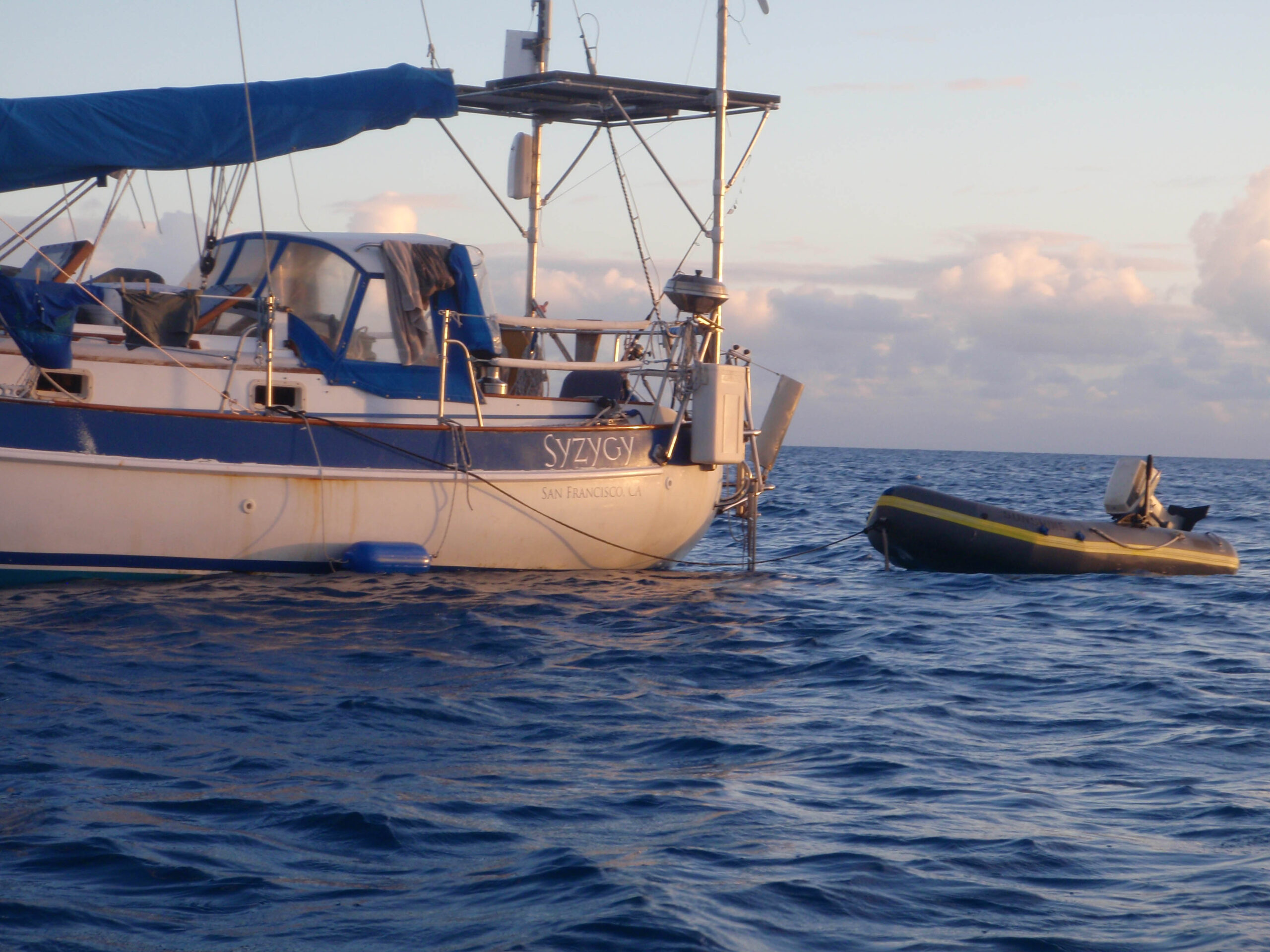
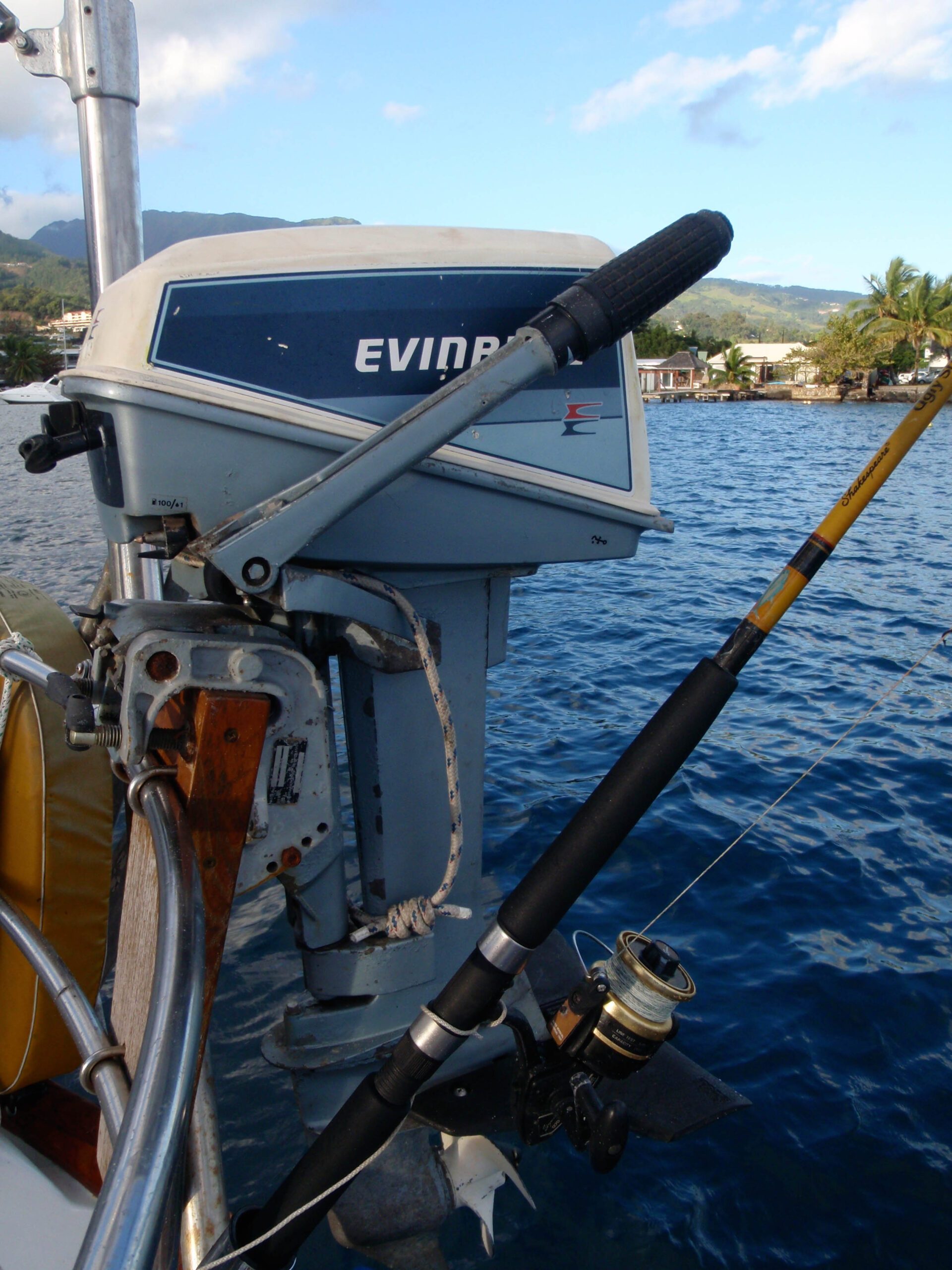
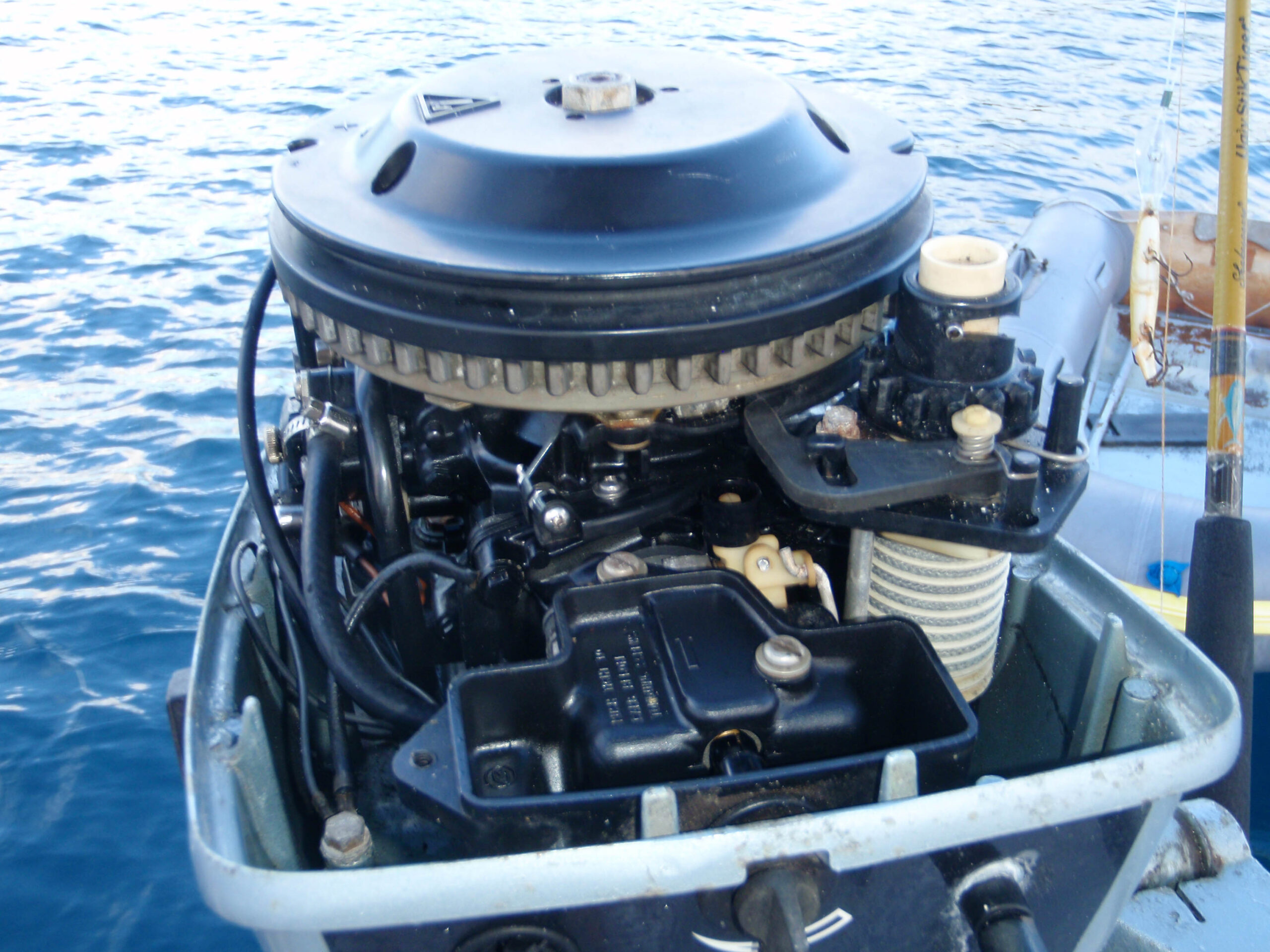
    We have never been happy with our outboard engine for our dinghy.  It sat on the rail of Syzygy for over a year before anyone bothered to start to tinker with it.  And what they found was not particularly encouraging.  It didn’t run particularly well.  We rarely used it.

    Fast forward three years and once Matt and Karen left San Francisco, the dinghy actually started getting used.  And yet again, the outboard was not particularly reliable.

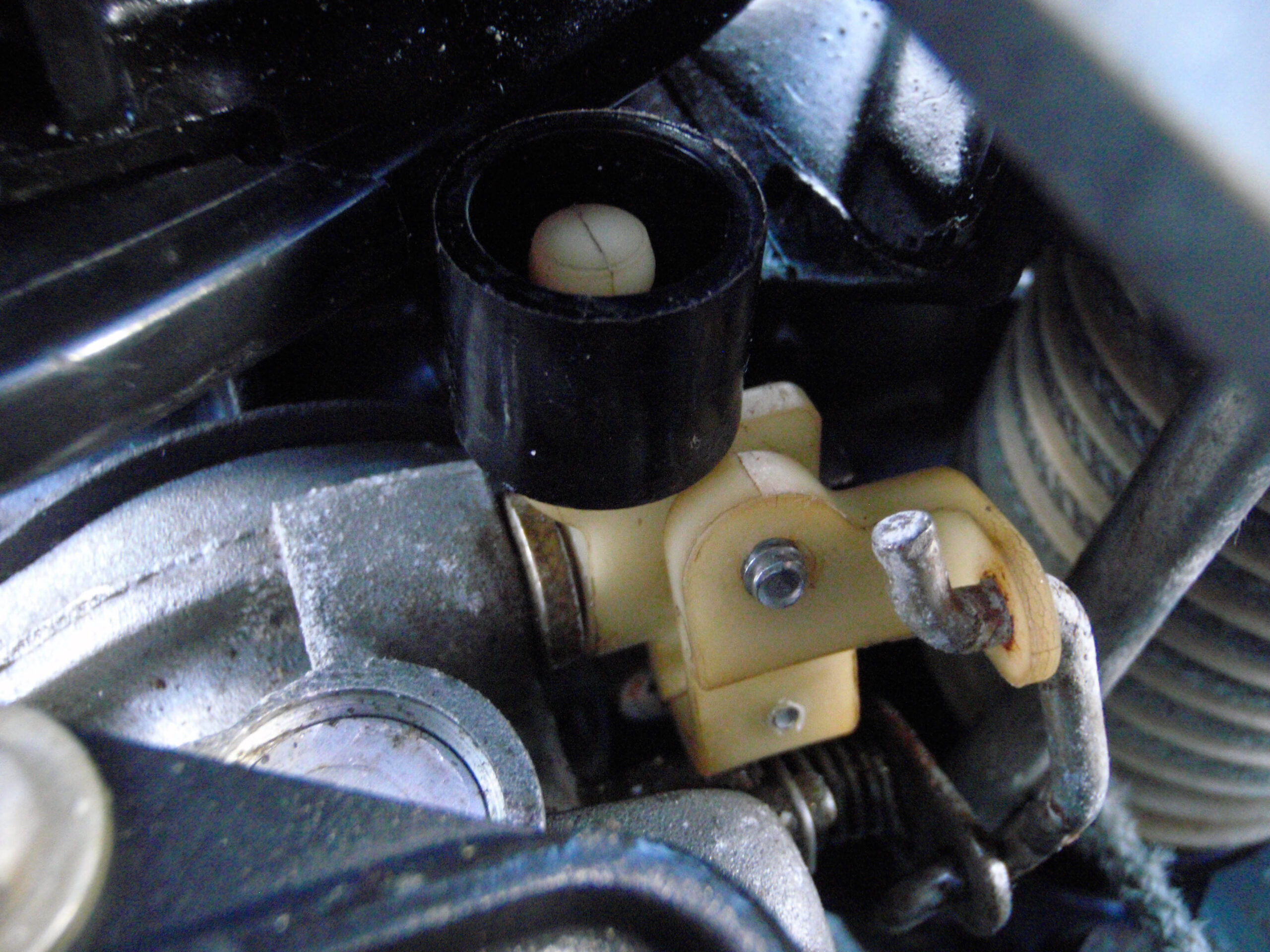
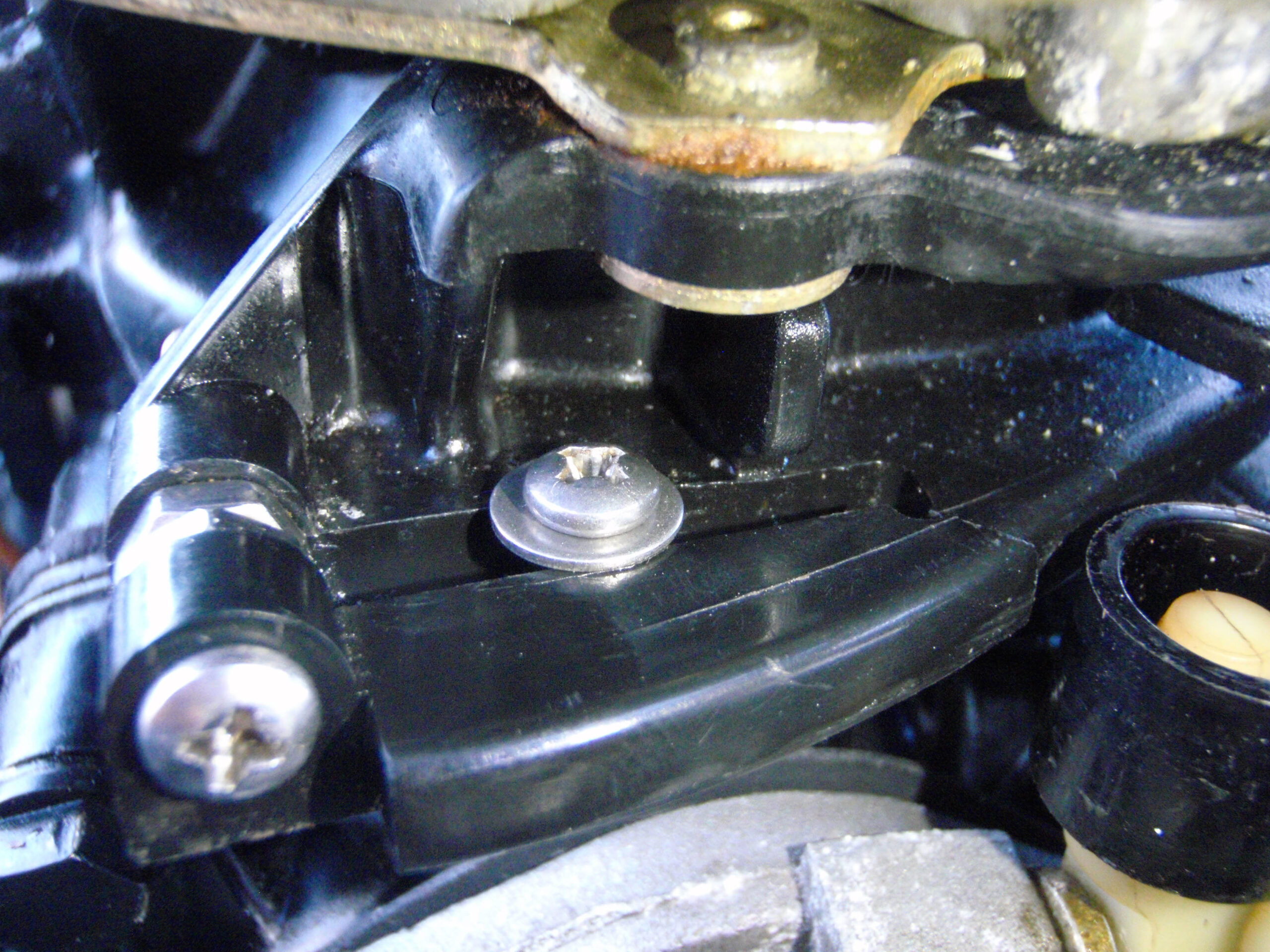
    It puttered at higher RPM’s.  It was difficult to start.  It cut out randomly.  It seemed to be overheating.  Old supposedly adjustable plastic parts would break upon adjustment.  It looked old and ugly.

    Then, once I arrived, shortly thereafter we did not tie up the dinghy well enough.  It came loose, and on its drift away, flipped over, submerging the engine in salt water.  When I say ‘we’ did not tie up the dinghy well enough, I mean ‘I’, but choose to use the royal ‘we’ in an attempt to lesson my embarrassment.  Submerging an outboard engine in salt water is not good for it.  In fact, it effectively dooms it.  Salt gets onto the piston walls, immediately begins to corrode them, which causes all sorts of bad things.

    But really, my action only hastened what Matt has wanted to do for the last six months.  He even joked about purposely wanting to lose the dinghy not two days before it drifted away.  So after tinkering around and cleaning some of the salt off, I came around to Matt and Karen’s point of view.  It was time to spend serious money on our outboard, either a large overhaul on ours, buying a used one, or buying a new one.

    A few days later, we arrived into Papette, Tahiti from Rangiroa after one long overnight sail.  First thing the next morning, I was up and motivated.  If we wanted to do something about our outboard, we needed to get started right away because it would take a few days and none of us wanted to be in Papette very long.  Matt supported, but did not share, my enthusiasm and so I struck off alone early Saturday morning around 8 am.  That it was Saturday was unlucky, as I knew many places would close at noon and some would not be open at all.  This is how they do business in paradise, ‘island time’.

    Since I had wandered around Papette for a week before flying to meet Matt and Karen, I knew of at least one outboard engine store and so started there.  At each place I went, I had three questions.  Do you fix outboards?  Do you sell used outboards? What are your prices for new outboards?

    The first place, Evinrude/Suzuki Outboards, said: “No.  No.  $1800.”

    This was not particularly promising.

    The salesman was extremely courteous however, and did direct me to the authorized Evinrude repair shop and other outboard engine retailers.  I spent the rest of Saturday wandering around, asking questions, saying “I am sorry I don’t speak French, do you speak English?” and trying to determine what to do about our engine situation.

    Repeatedly I heard, ‘there are no used outboards for sale anywhere.  Tahitians run them until they disintegrate.’

    On Monday, Matt and I went to the repair shop and on Tuesday returned with our engine.  I visited them again on Wednesday to hear their prognosis.

    The owner gave me the gist:  “Pas possible,” he said.  Not Possible.  He then began telling me what might be wrong, but they weren’t exactly sure.  And to fix what might be wrong would take over a month to get the part and cost $500 just for that part.  With no insurance that would fix all our problems.  He was right.  Pas Possible.

    Resigned to the fact that we would have to by a new engine, I asked him if he was interested in buying ours for the parts.  He crossed his arms, rubbed his chin and appeared in thought.  The head mechanic walked over and the owner asked him if he thought they should buy it for the parts.  The head mechanic was not so diplomatic and simply scoffed! Laughing out loud.  This was embarrassing.  I left saying we would be back to pick up the engine in a couple of days.  We never did return.

    One of the shops I had contacted, Mercury, had quoted me a price of 130,000 Pacific Francs, about $1,300.  Matt had talked to them separately at a different location and they offered him a price of $1200.  I called back to confirm Matt’s price, he gave me a slightly higher price, I sort of paused on the phone, hedging, and then he gave me a final price of $1125.  Done.

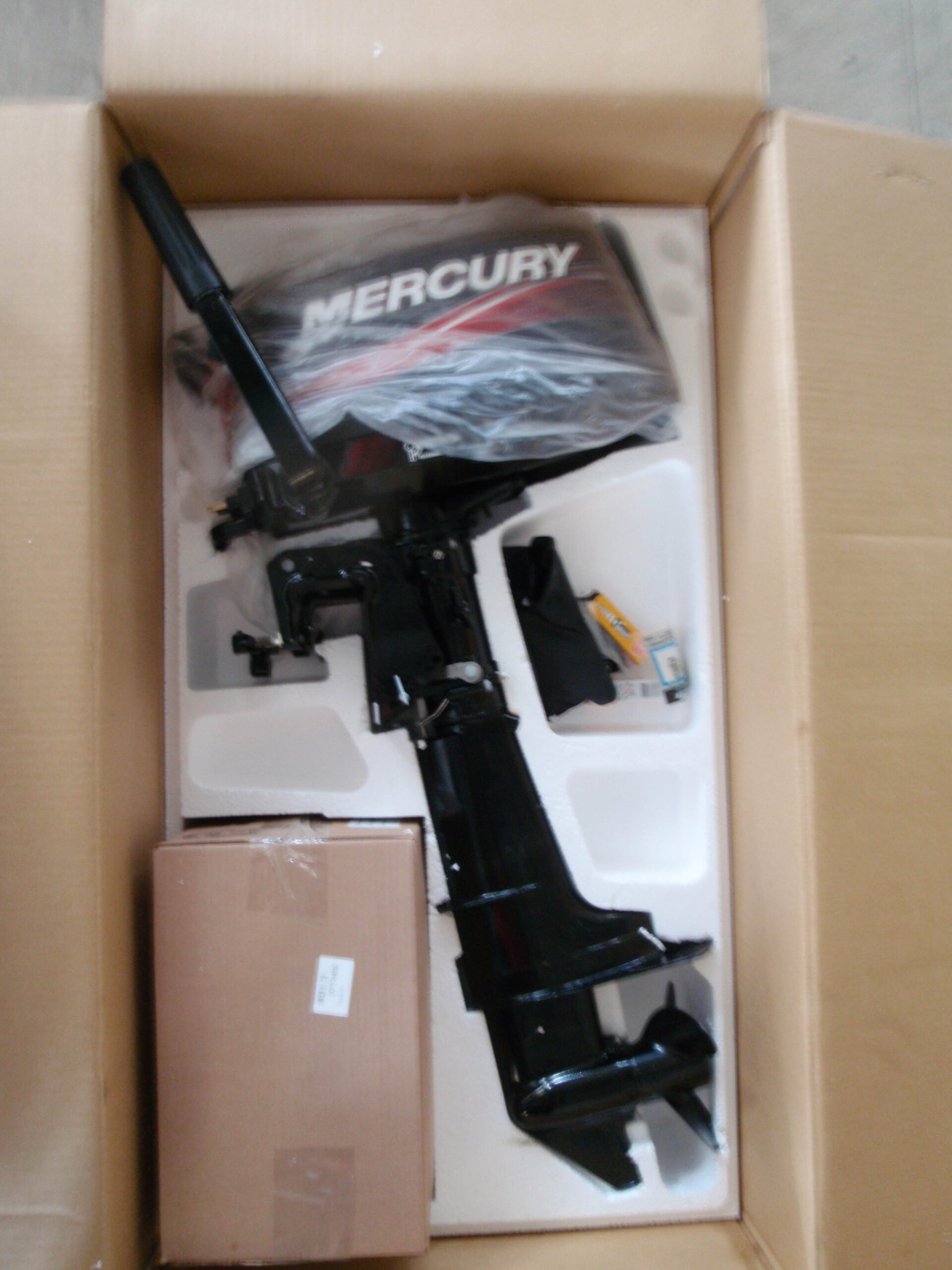
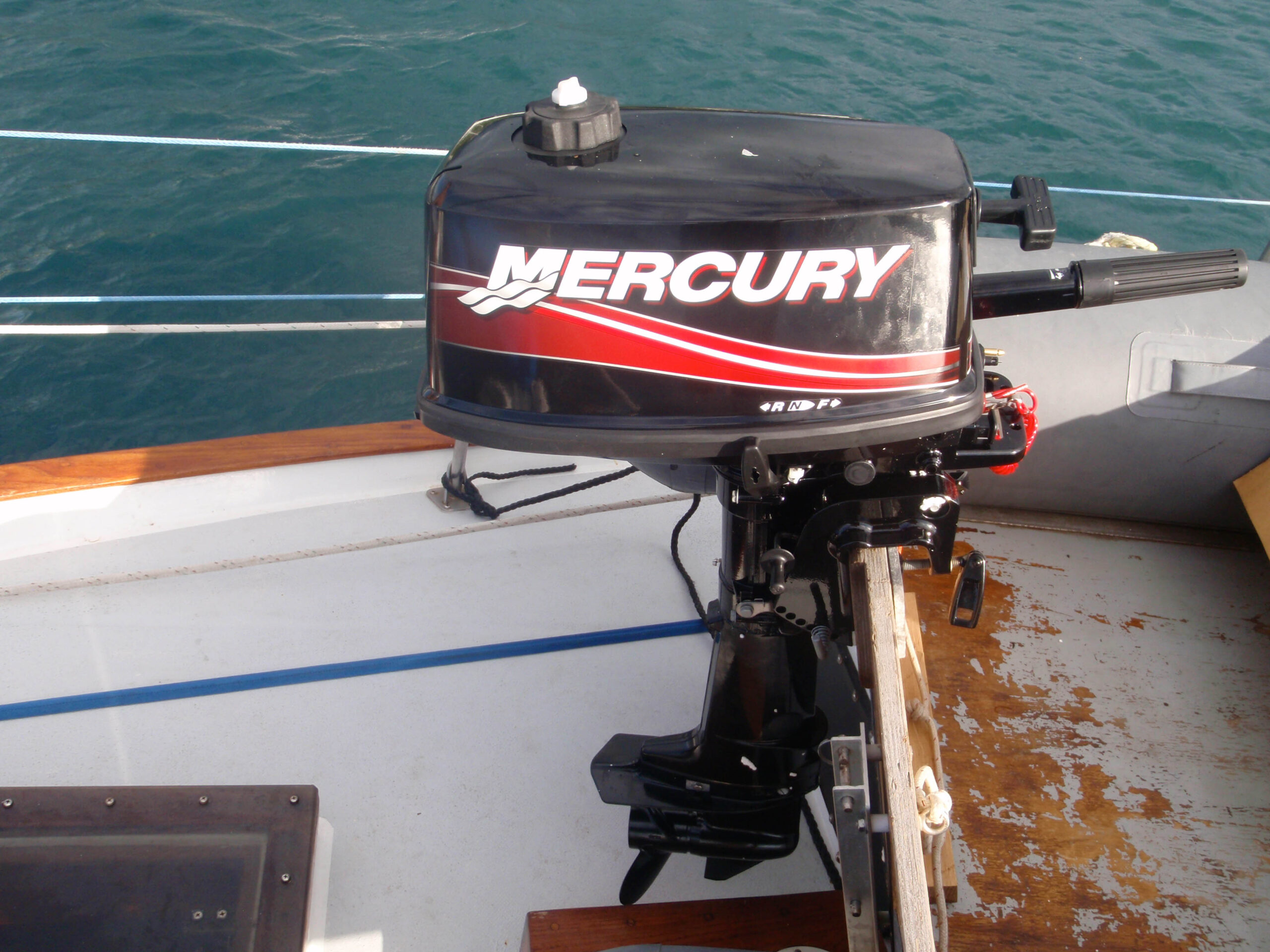
    We now have a brand new, shiny, 5 hp, 2-stroke Mercury outboard  It purrs.  It starts with one pull.  It easily goes up to its maximum RPM.  It planes over the water with ease.  Did I mention it purrs?

    We are very happy.  We had to spend some money, but we are very happy.  Who says money can’t buy happiness? Misadventures part 4: success!

  • Tahiti

    (post-dated: we arrived in Tahiti July 16)

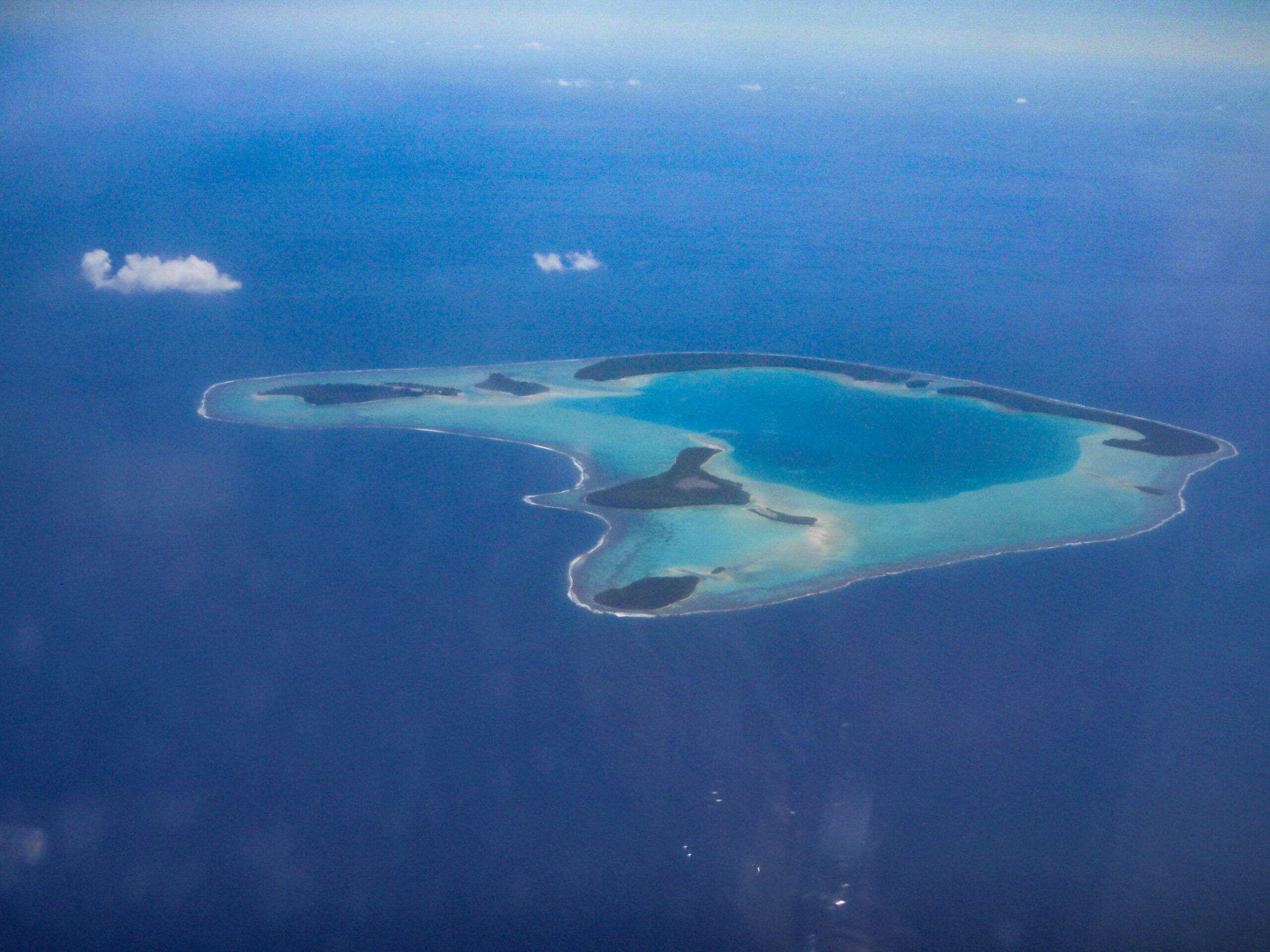
    Rangiroa was our last atoll in the Tuamotus; the passage from Rangiroa to Tahiti took a day and a half.  Tahiti is the administrative center for all of French Polynesia, which includes the Marquesas, the Tuamotus, and the Society Islands (Tahiti is in the Societies, along with Bora Bora).

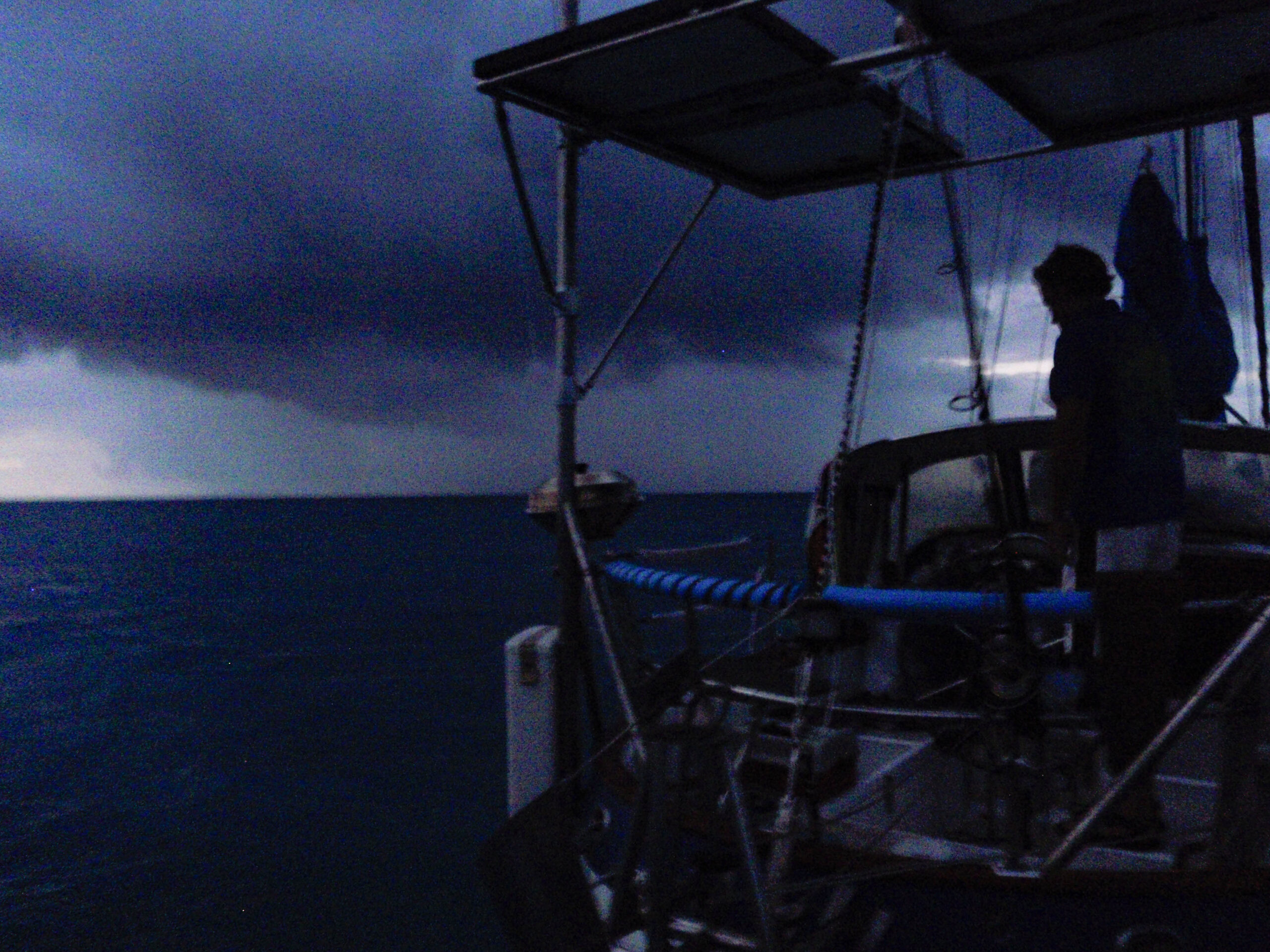
    The passage from Rangiroa to Tahiti was tedious.  We were very fortunate to be sailing a beam reach, because the wind conditions were highly variable, from 20-30 knots the whole time.  Usually a squall is temporary–from a minute to an hour–but eventually it goes away and leaves better conditions.  This passage was like being in and out of squalls, back to back, all night long.  Wet, cold, and lots of work.  I was on-call all of the night to trouble-shoot various situations; twice the main got backwinded against the boom-preventer in big shift of heavy wind.  Jon stayed on watch most of the night, and I woke up whenever I was needed, thus we handled the division of work.  The waves were short and steep–every 10 minutes a wave would give the boat a good smack and spray the top of the wave all across the deck and cockpit.  We had a close call where one wave came in through a portlight across the cabin and managed to cover the computer station in spray–I was concerned that my laptop had been ruined, fortunately not.

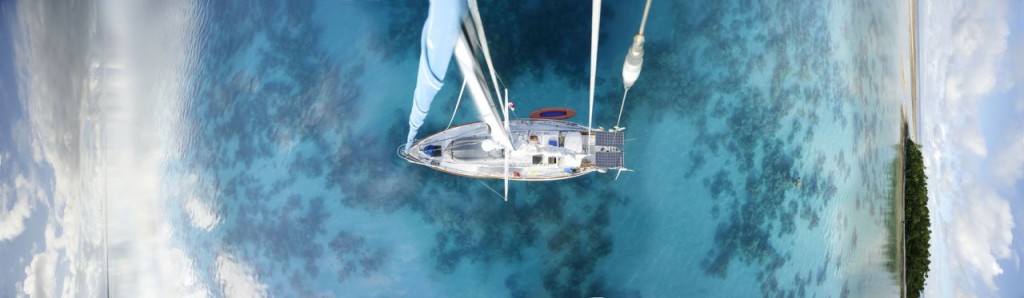
    In Tahiti, we tied up to a mooring just off of the “Tahiti Yacht Club”, north of Papaeete.  For $13/night we got the mooring and hot showers.  The water was opaque, dirty and frequently stinky.  No swimming here!

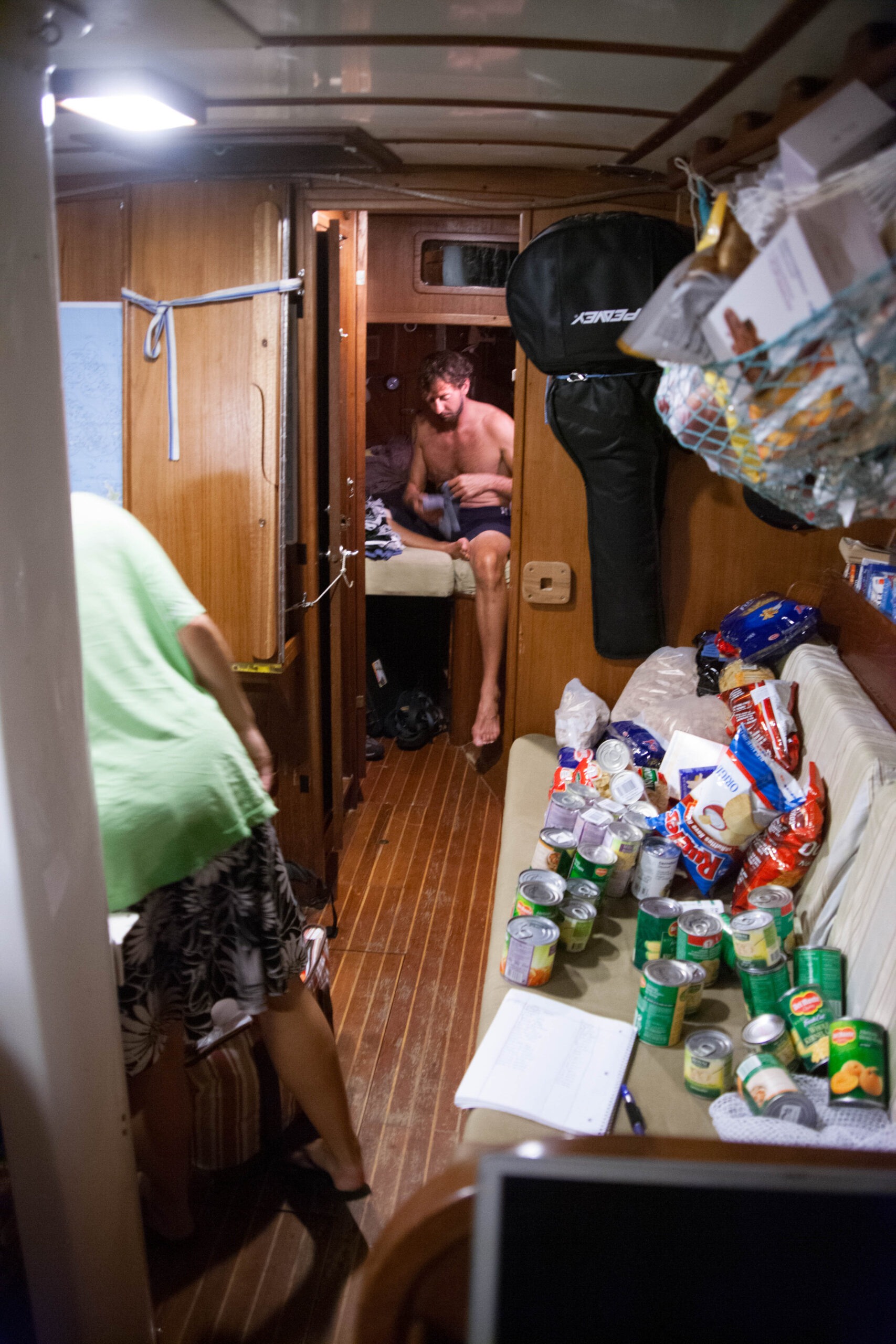
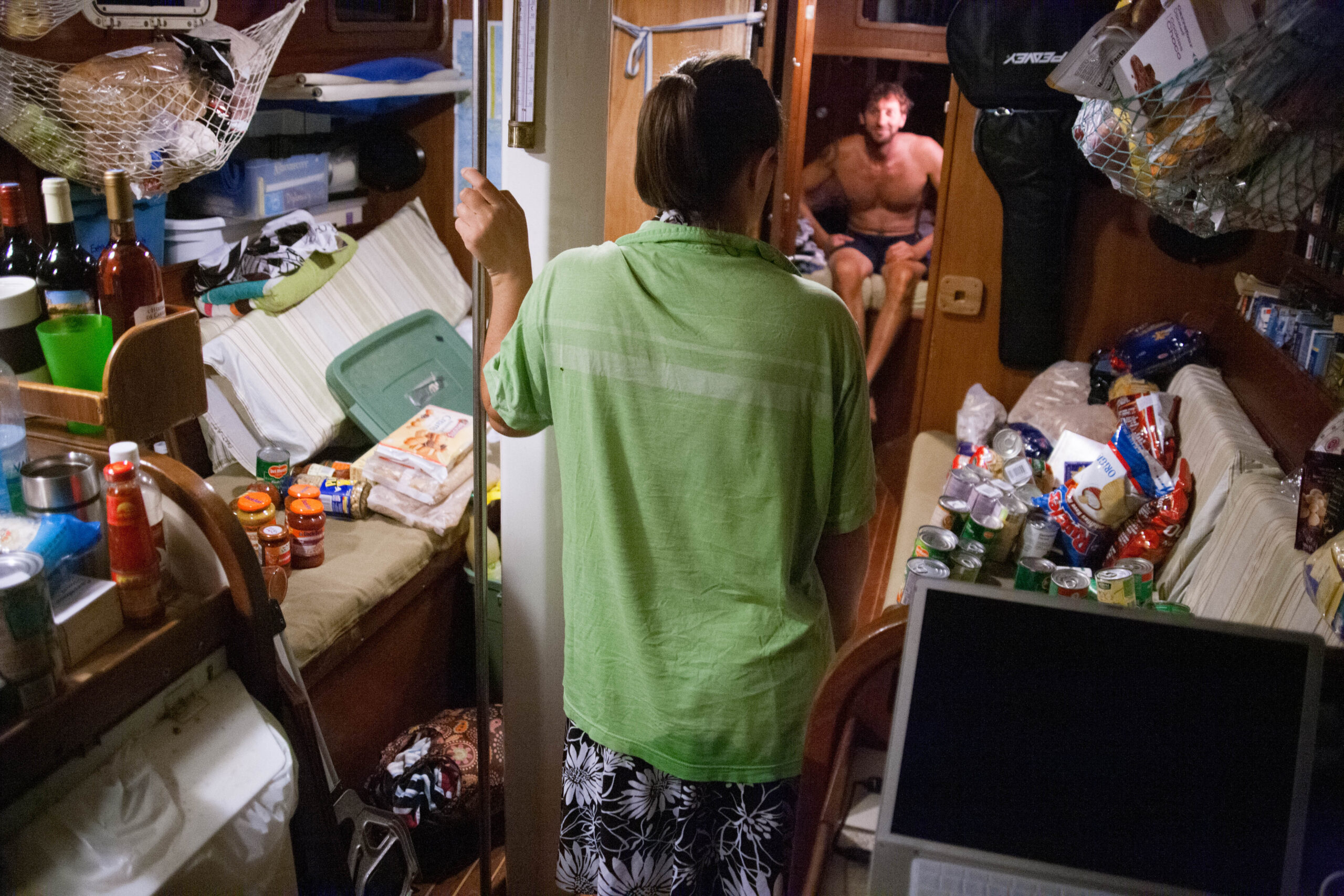
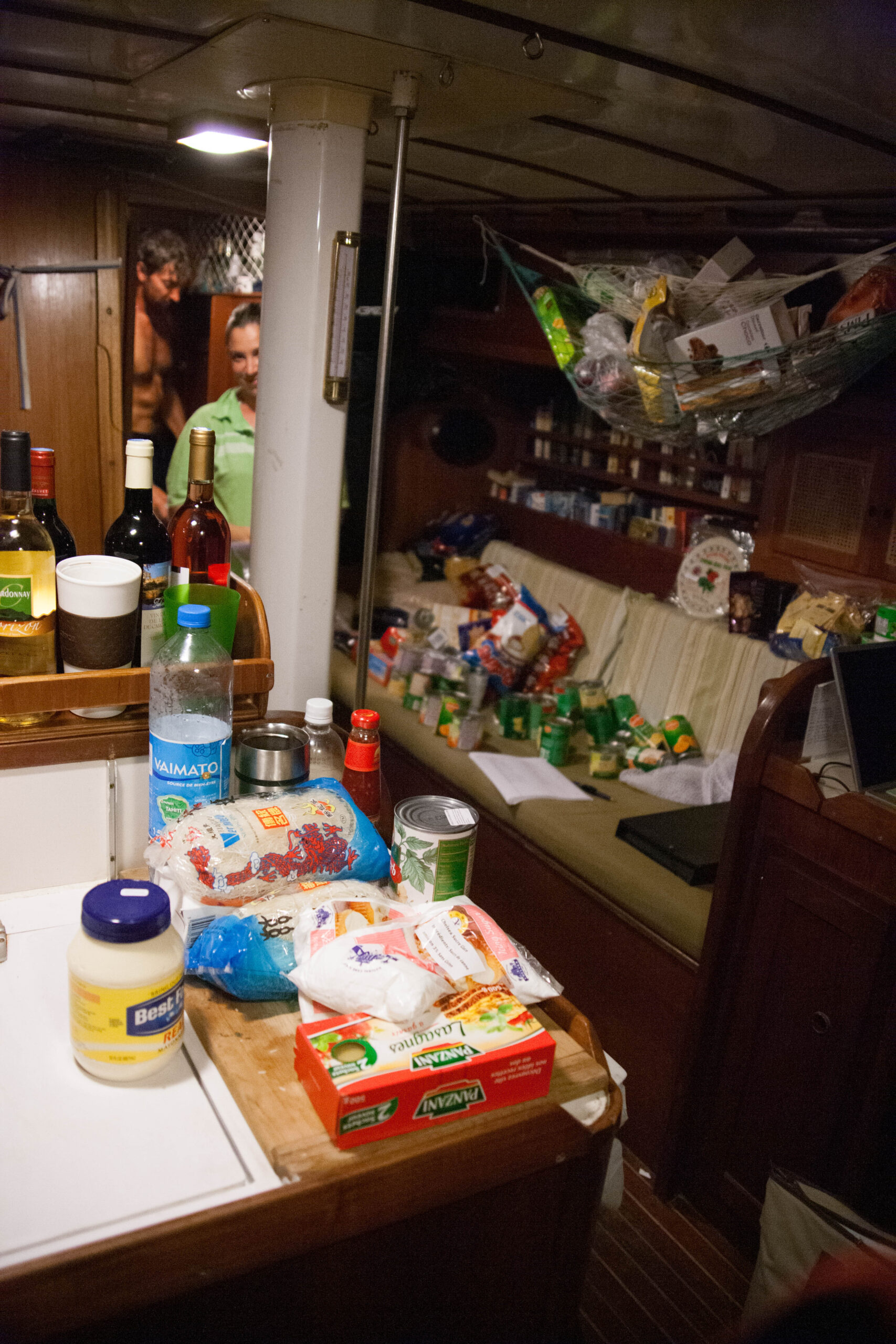
    We used our time in Tahiti to take care of business, the first two priorities to find a new outboard motor and get lots of food at the grocery store.  Additionally we had to take care of the official check-in/out from French Polynesia.  Even though downtown Papaeete is a standard busy trafficky dirty and especially expensive city, it was still fantastic to have the resources available to us (here I’m thinking mainly of restaurants and bars and cafes).  We bought parts, new masks and snorkels, machetes, you know, the usual.  Naturally, we ended up staying longer than anticipated.

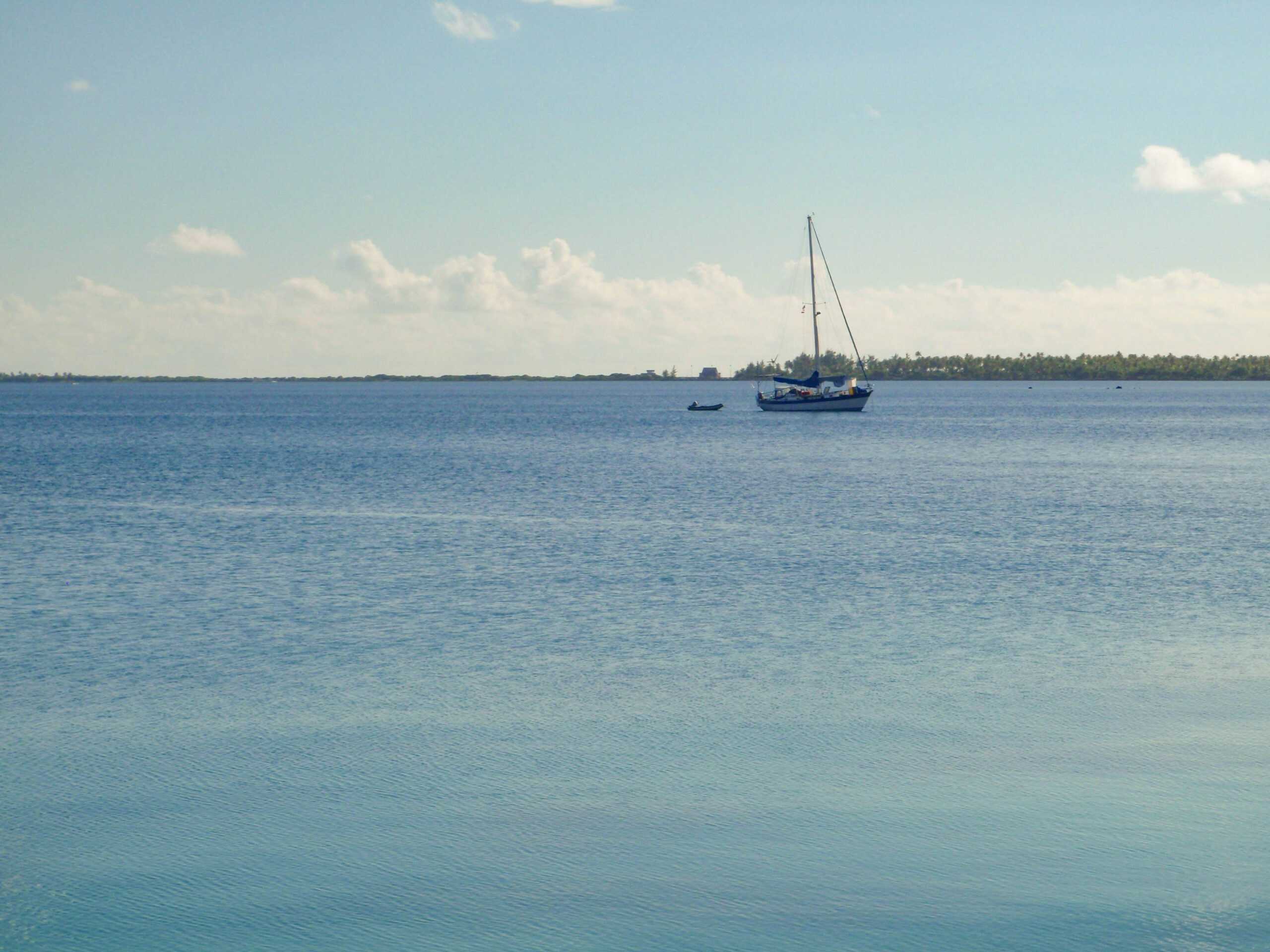
  • Rangiroa Anchorage

  • Dolphins in Rangiroa

    (refers to events that happened July 12th)

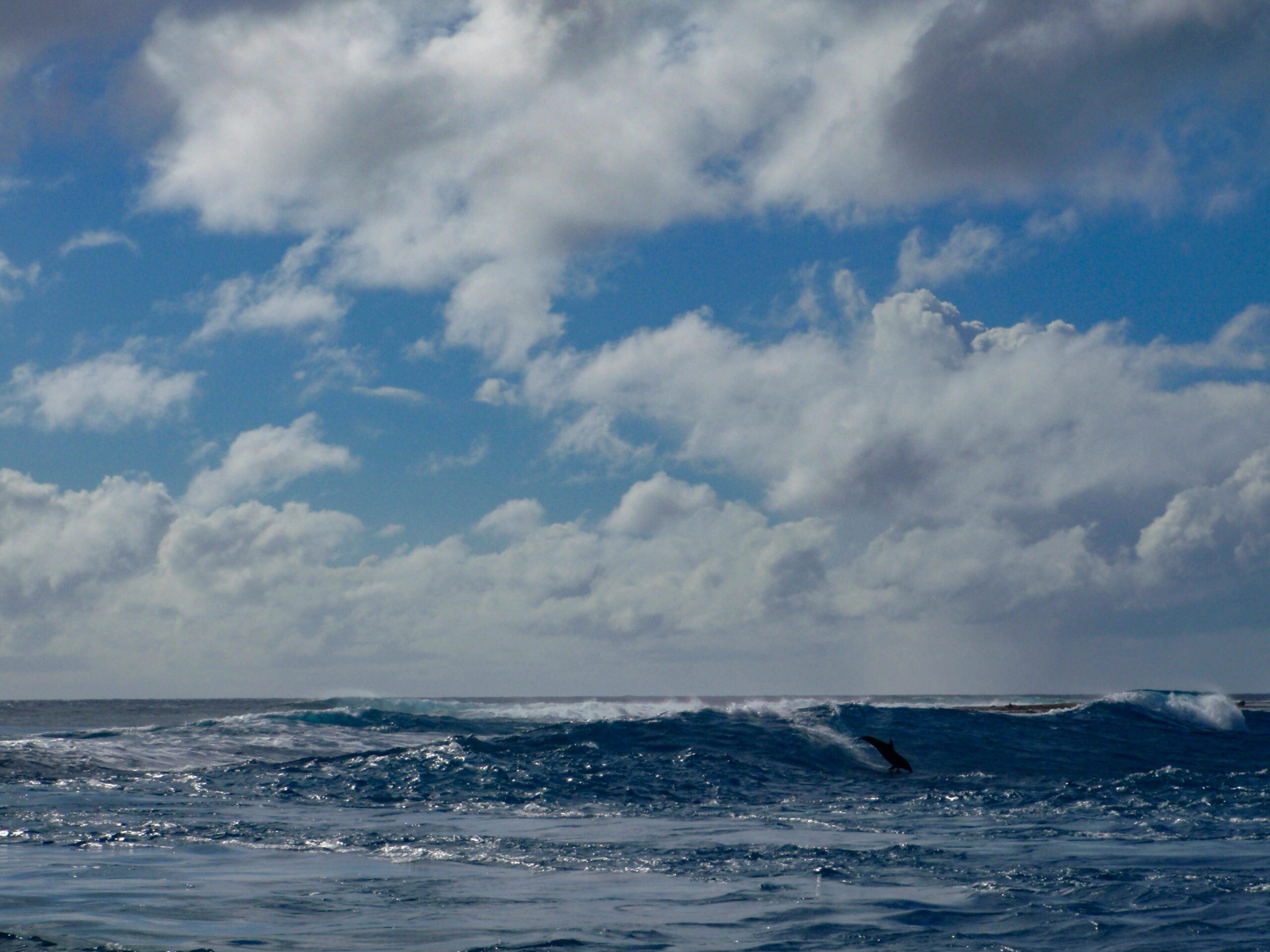
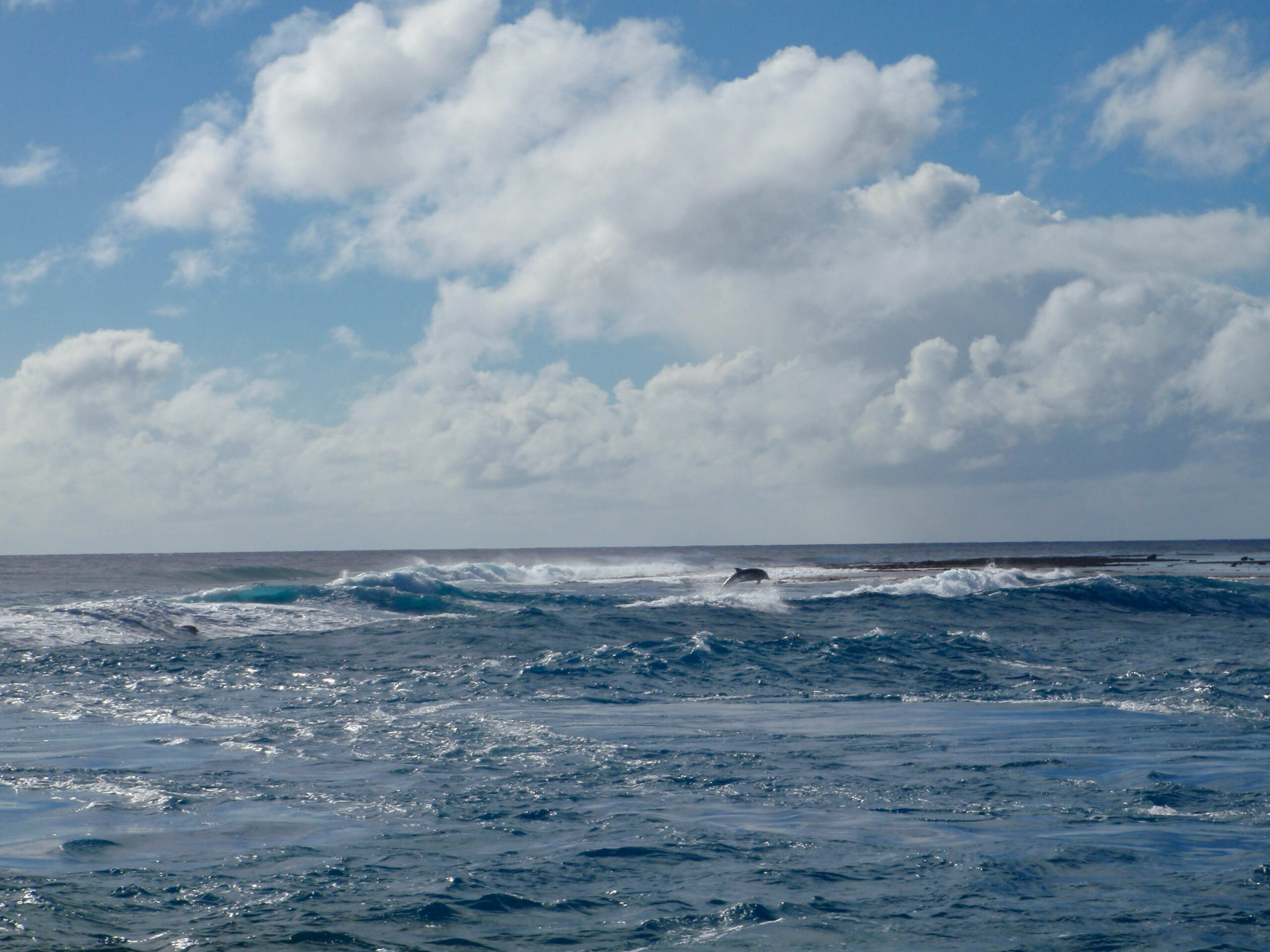
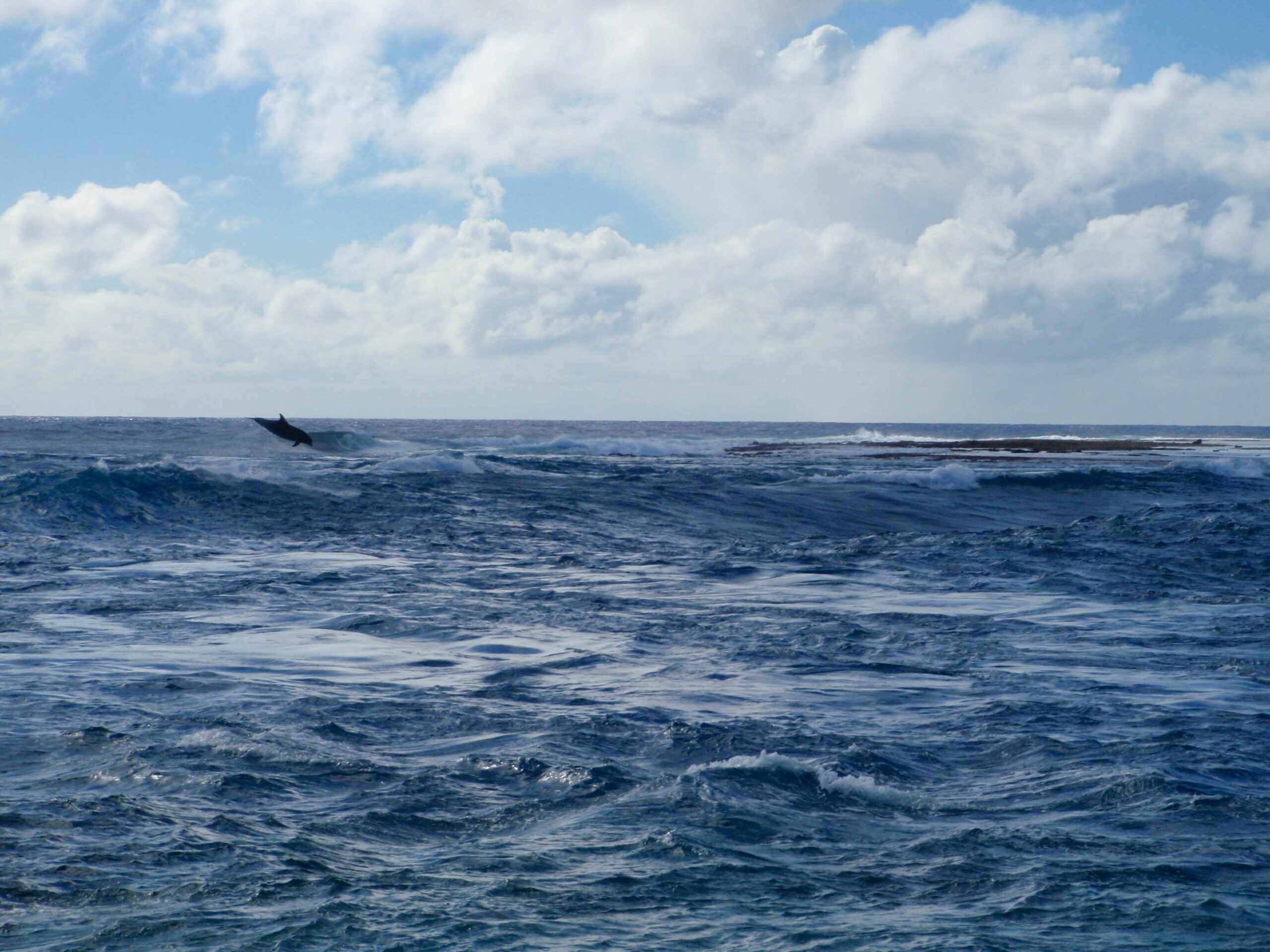
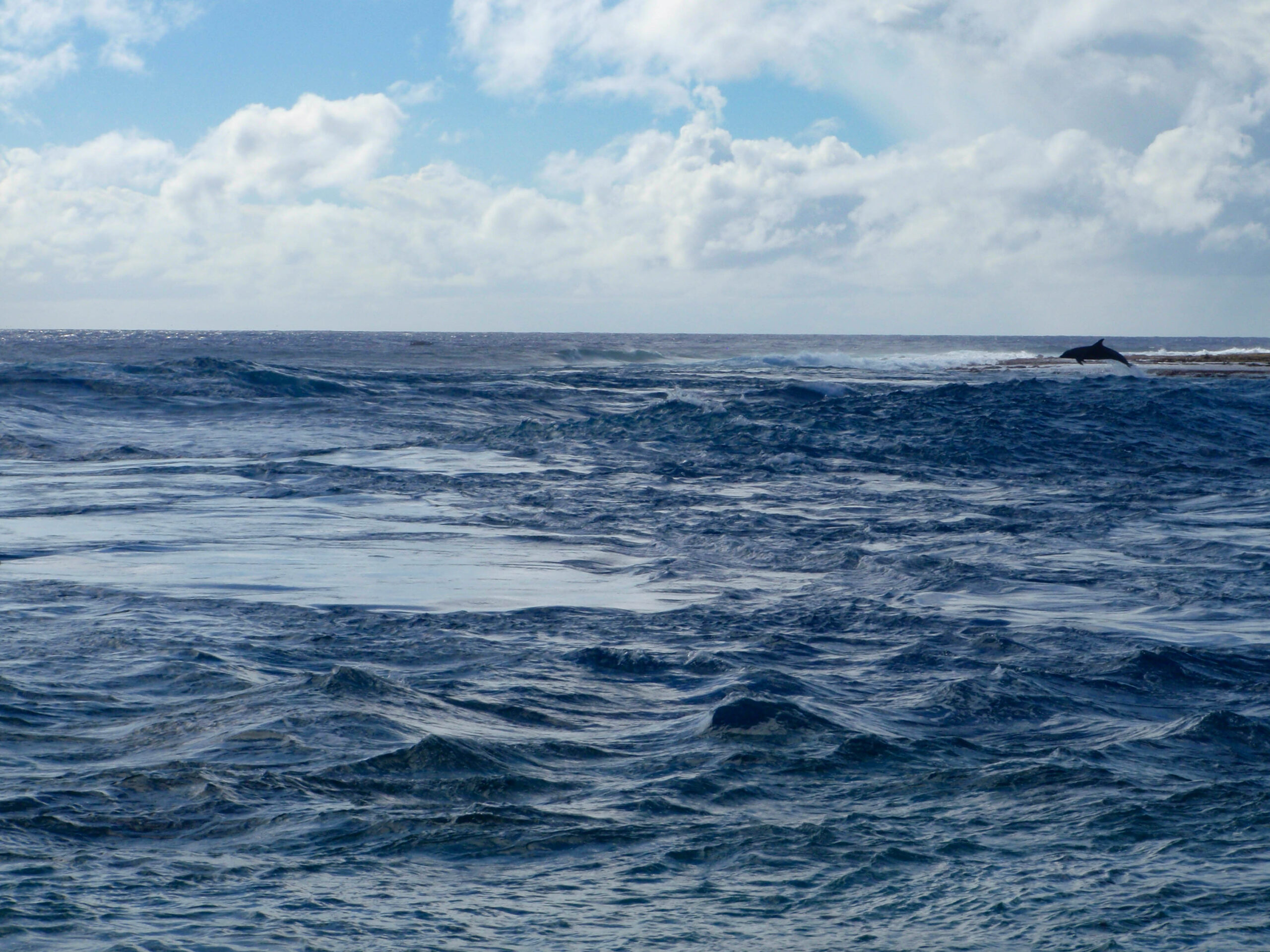
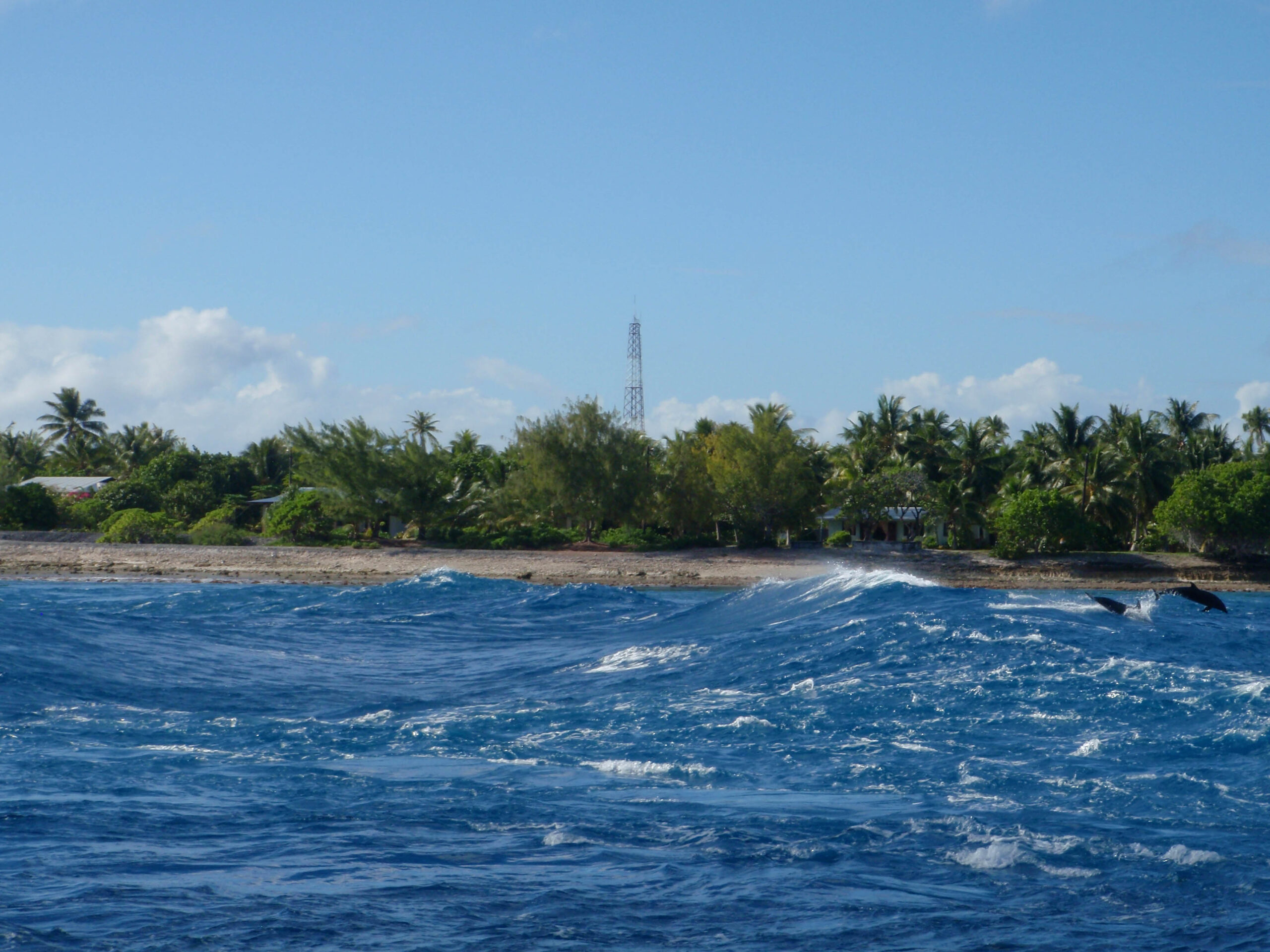
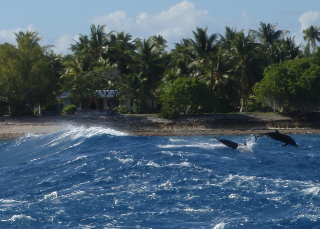
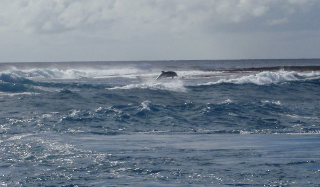
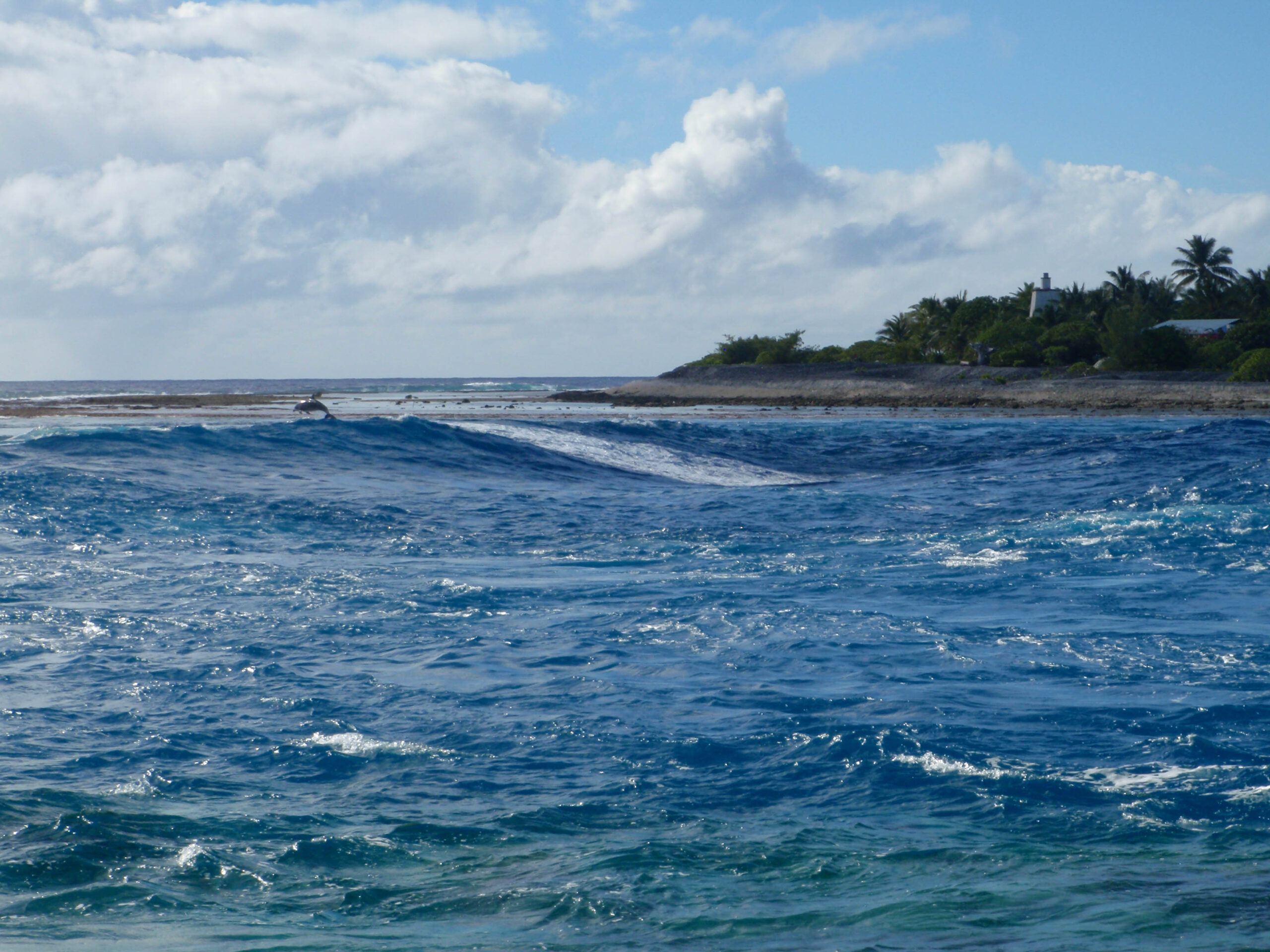
    In Rangiroa one morning, I had headed over to the post-office bright and early to mail a couple of letters.  Our boat was anchored on the north west side of Pass Tiputa.  The post office is on the south east side of the pass.  So I headed into land, caught a twelve passenger motor boat for $2, and rode with a bunch of locals on their way to work that morning.  On both times across the pass, I could see dolphins in the pass.  They were swimming and jumping in the waves the current creates as it rushes out of the pass, marking the transition between high and low tide.

    It was an incredible sight, a dozen or so dolphins surfing down the face of standing waves.  Jumping sometimes ten feet into the air.  I had only my meager point and shoot camera.  Though waterproof, it certainly has the drawback of not being the greatest picture taker.

    Below are some pictures from the pass that morning.


  • Misadventures with Slurpy Part 3

    Part 3

    (refers to events on July 11th)

    “Syzygy, Syzygy, this the Gendarmarie.”  cracked the VHF in a heavy and thick French accent.  So thick, it was almost impossible to tell they were calling us.  My heart quickened as I glanced at Karen while answering.

    “Gendarmarie.  this is Syzygy.  Want to go up one?”  I said, asking if they wanted to go to another channel.  They didn’t understand.

    There was only one reason I thought they could be calling however.  They must have our dinghy!

    “Syzygy.  We haz yur zodiac.”  Sweet!!!!!

    The gendarmarie wanted us to report to them immediately.  Apparently, we were supposed to check in with them four days ago when we arrived in Rangiroa.  Technically we were outlaws.  Outlaws in the land of Rangiroa.  But they were pretty laid back about it.  They were, however, now effectively holding our dinghy hostage until we officially checked in.

    We went ashore at 1 pm, the gendarmarie meeting us at the docks.  We were 30 minutes earlier than our scheduled arrival time.  They were a little too in a hurry for me.  We piled into the back of the car, and I couldn’t help but think we must look like fugitives to those whom we passed on the drive.  But they were pleasant enough and once we had officially checked in, the police chief himself took us to the restaurant/pension where our dinghy was.

    And there it was!  Looking perfectly fine.  The engine was still there, though the fuel tank had mysteriously gone missing.  The oars were still there, as was snorkeling gear.  But no fuel tank.  Odd we thought, but if that’s the price, we easily acquiesce to that finder’s cost.

    After a round of drinks, we began to contemplate our return.   There was the matter, however, of how to get the dingy back to our boat.  With no fuel, we couldn’t run the engine, and well, our outboard is a piece of shit anyway and probably couldn’t handle that.  Matt however, thought we could easily row back on our own.  Karen came down on the side of deflating the dinghy and getting a taxi.  I sided with Matt encouraged by appeal that it would be a fun team building exercise.  He seemed jazzed about the idea and so I was for it simply because he was jazzed about something.  So we pushed the dinghy into the water and began to row.

    We rowed and rowed and rowed.  It quickly became apparent this was not going to be an exercise in team-building, but an exercise in futility.  We were taking on more water than we used to; there must be a leak somewhere.  There was no seat through the middle so the rower couldn’t sit properly.  We have miserable oarlocks and soft bottomed dinghy, both of which reduce the ability to row effectively.  We were fighting the current.  We were going against the prevailing wind.  This was a terrible idea.

    After thirty minutes, we had made maybe 100 yards of progress.  I think that is generous. Karen was the first to get out of the dinghy and try to swim along and push the dinghy.  This didn’t work so well.  I took a turn at rowing.  It was miserable.  So then I hopped out, tied the painter line around me and began swimming in front of the boat pulling it along.  With Matt rowing and Karen bailing, this was our best method and we managed to increase our speed to about 300 yards per 30 minutes.  At this rate, it would take us over eight hours to get back to our boat.  Clearly, we were bumfuzzling idiots.  Well, maybe just Matt and me who originally thought this would be fun.  Karen, smartly, had never thought this was a good idea.

    Luckily for us, another couple was motoring nearby in their dinghy looking for someplace to eat.  They took pity on us, and told us they would tow us back to our boat.  THANK YOU!

    It still took us nearly an hour to get back.  Matt insisted we row to help us along.  I’m not sure how much it helped, though it made me feel more in control and helpful.  It also made me feel ridiculous.

    Back at our boat, we begged them to let us thank them with some gift and ended up promising to deliver some movies and books to them in thanks sometime in the next couple of days.  We plopped down in various places on our boat, exhausted both mentally and physically from the ordeal.  The dinghy had yet again gotten the better of us.  So despite that we got the dinghy back to our boat, and could be happy at not having to buy a new dinghy, (the P.O.S. engine might be another thing) it still didn’t feel much like a victory.

    Misadventures part 3: monetary success.  emotional failure.

  • Solar Eclipse on Rangiroa (syzygy on Syzygy)

    post-dated:  this refers to events on July 11

    (for background, see this previous post)

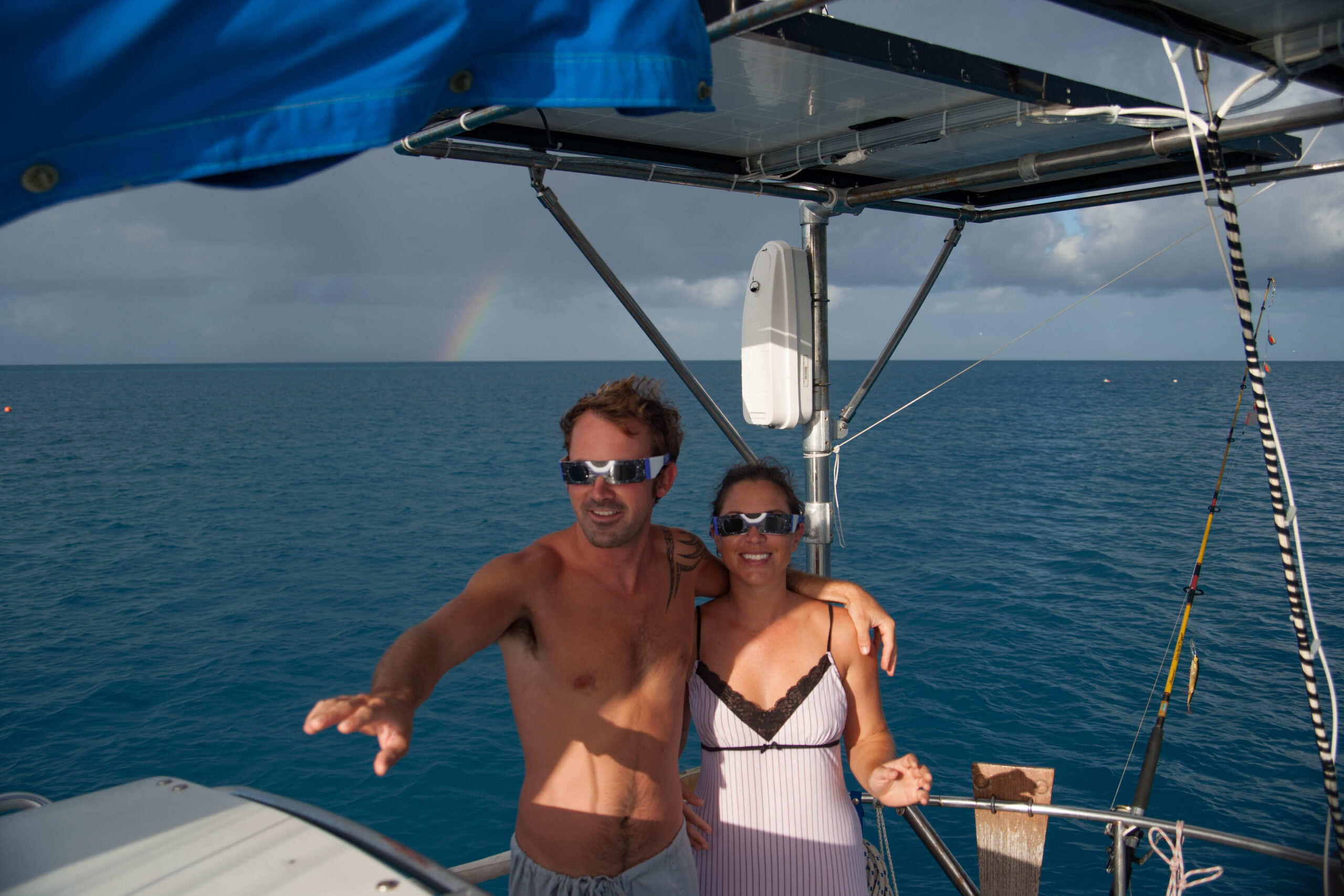
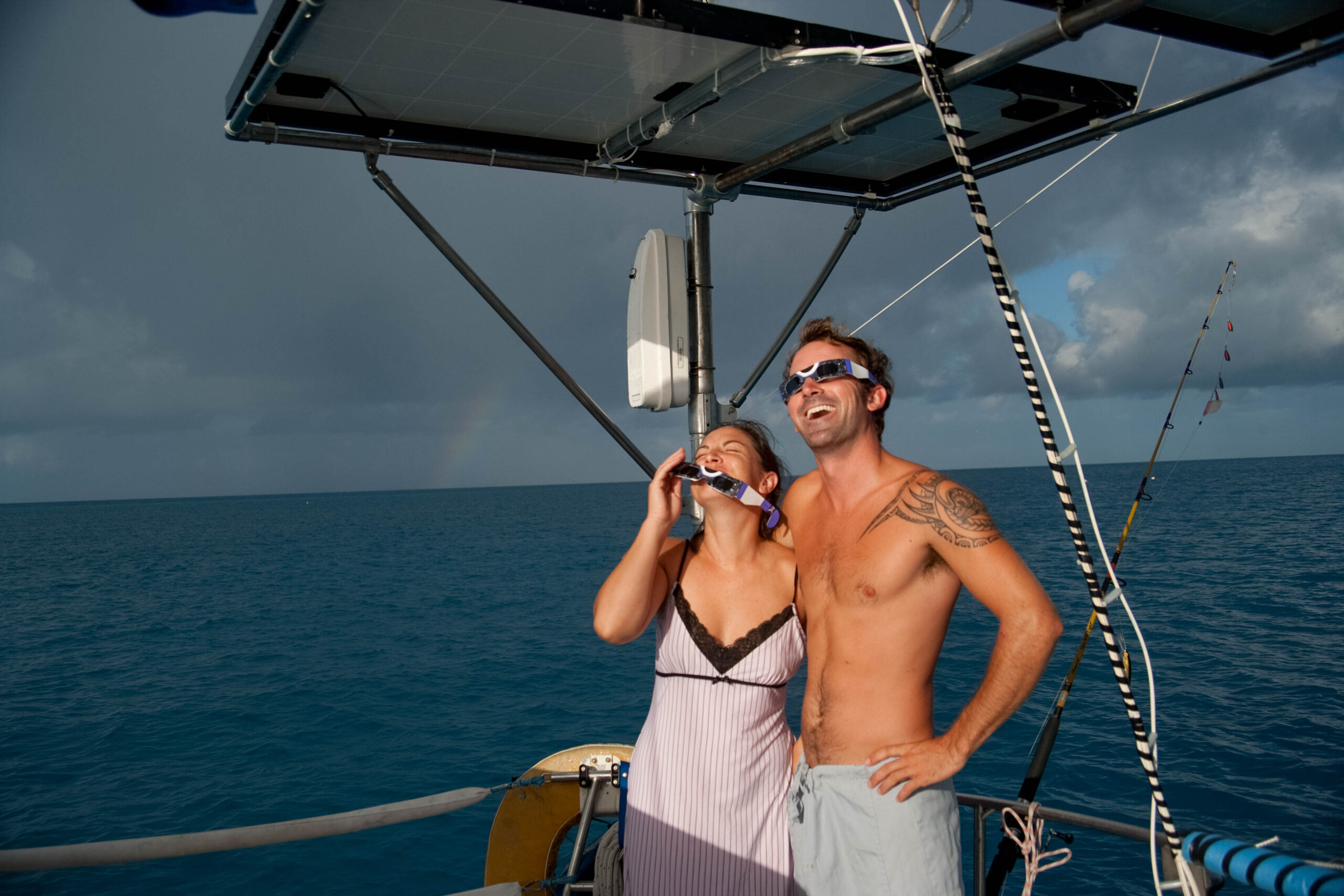
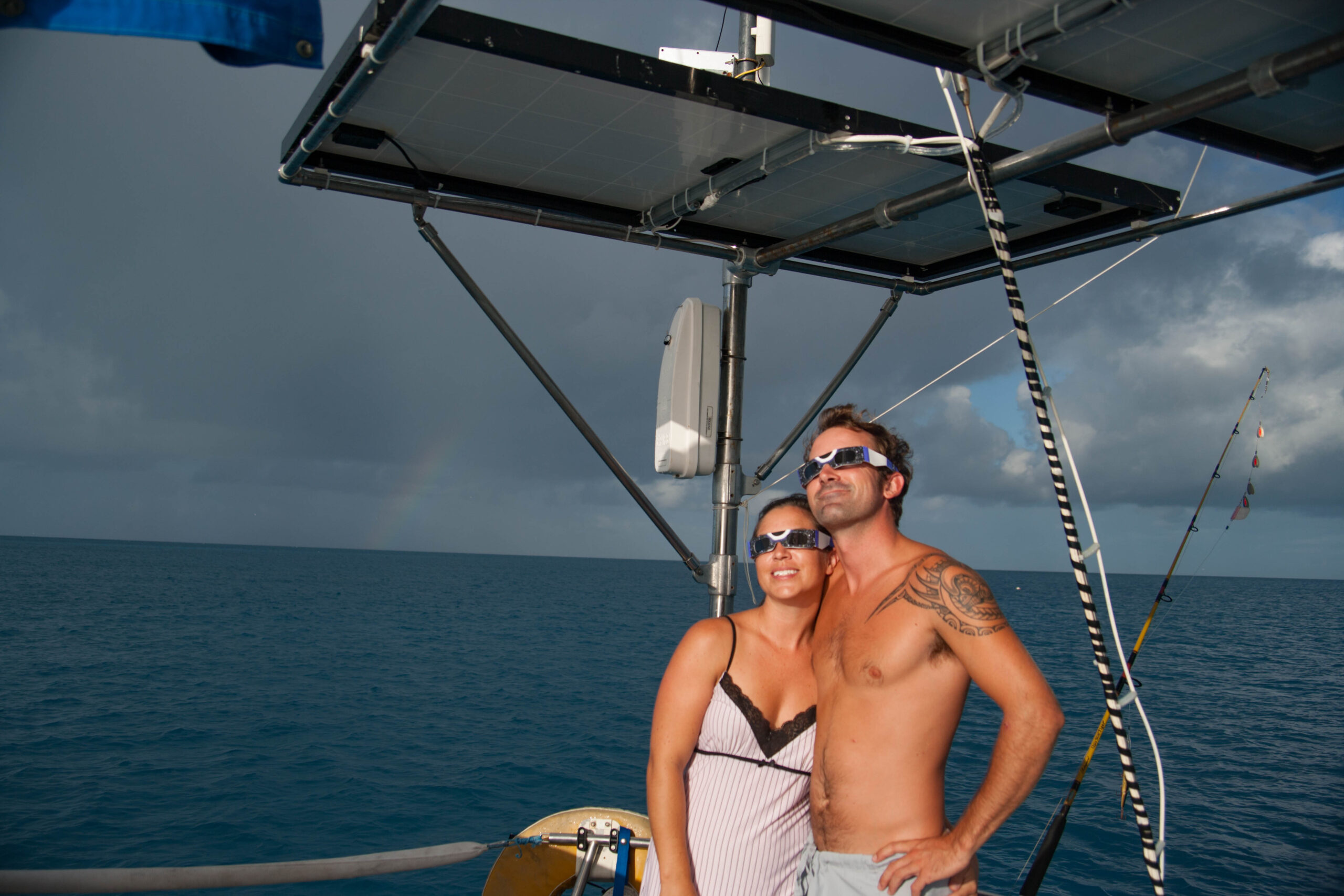
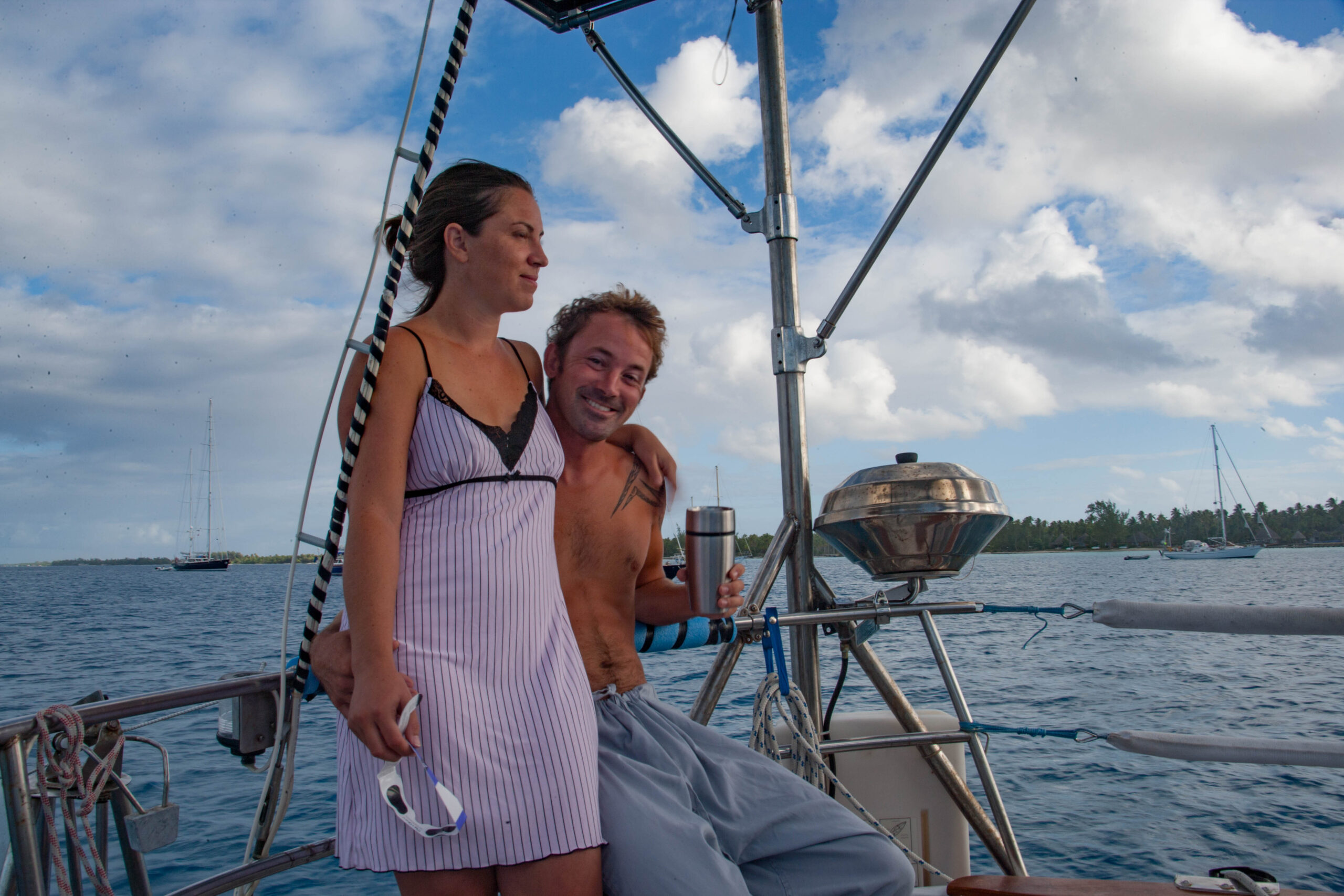
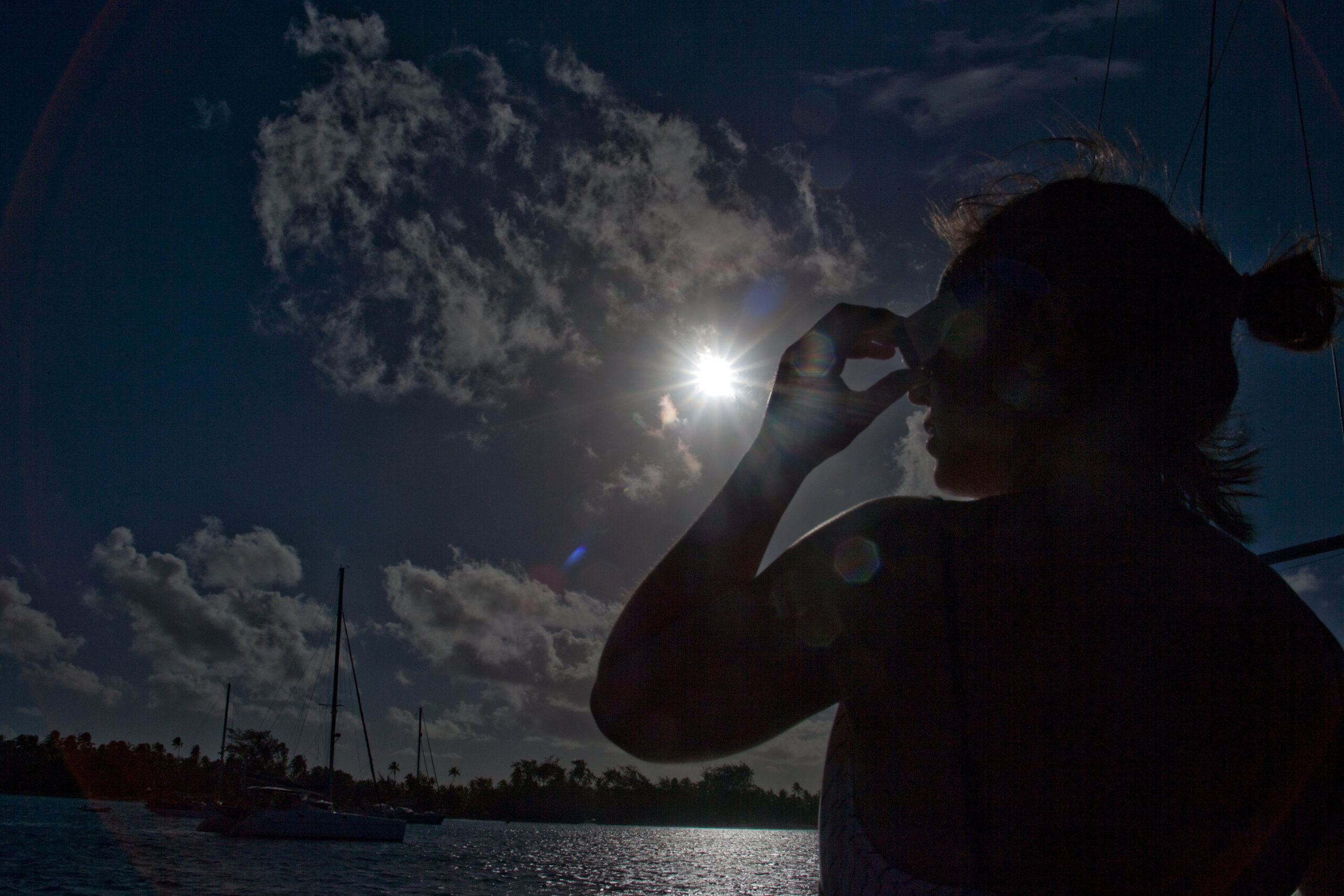
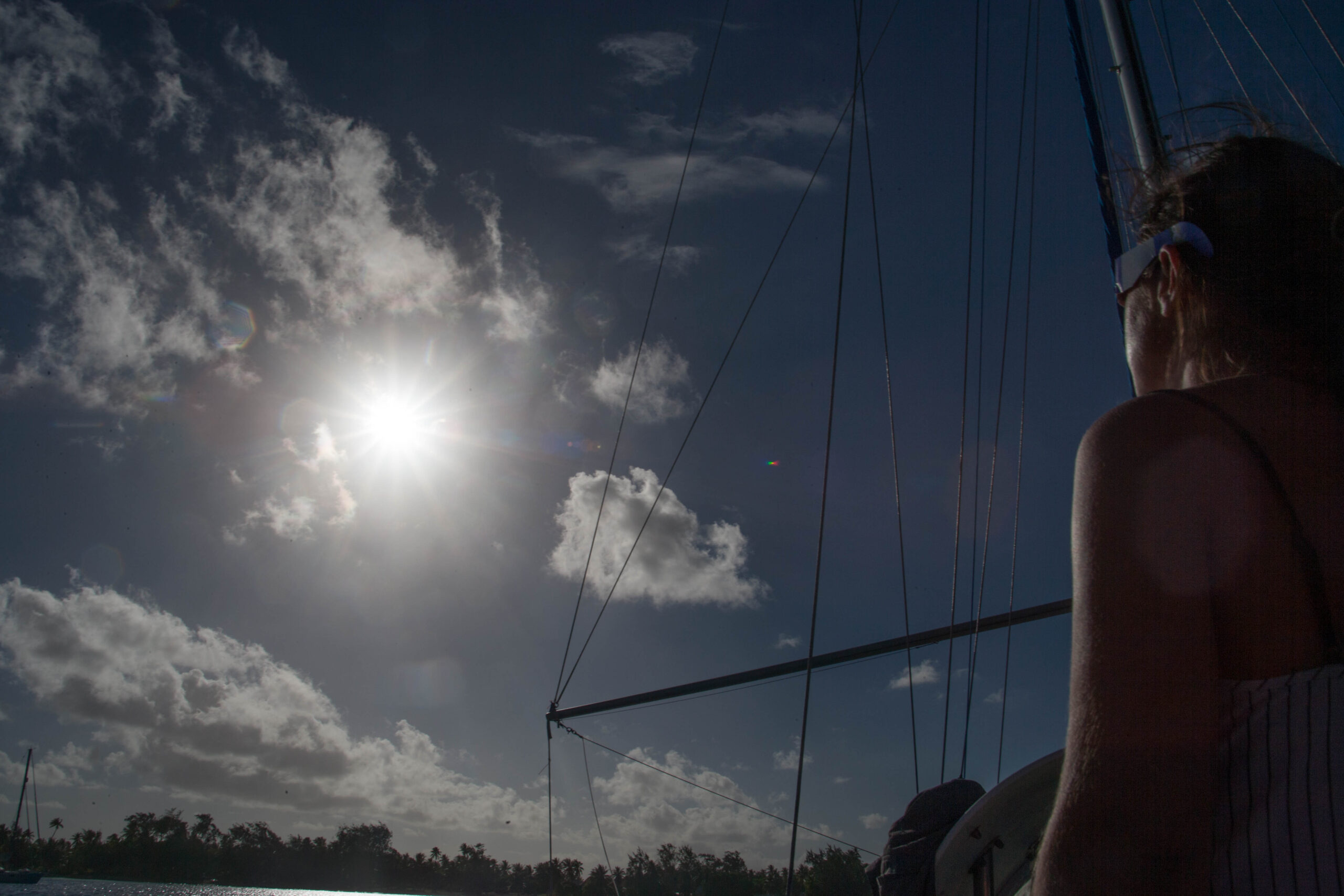
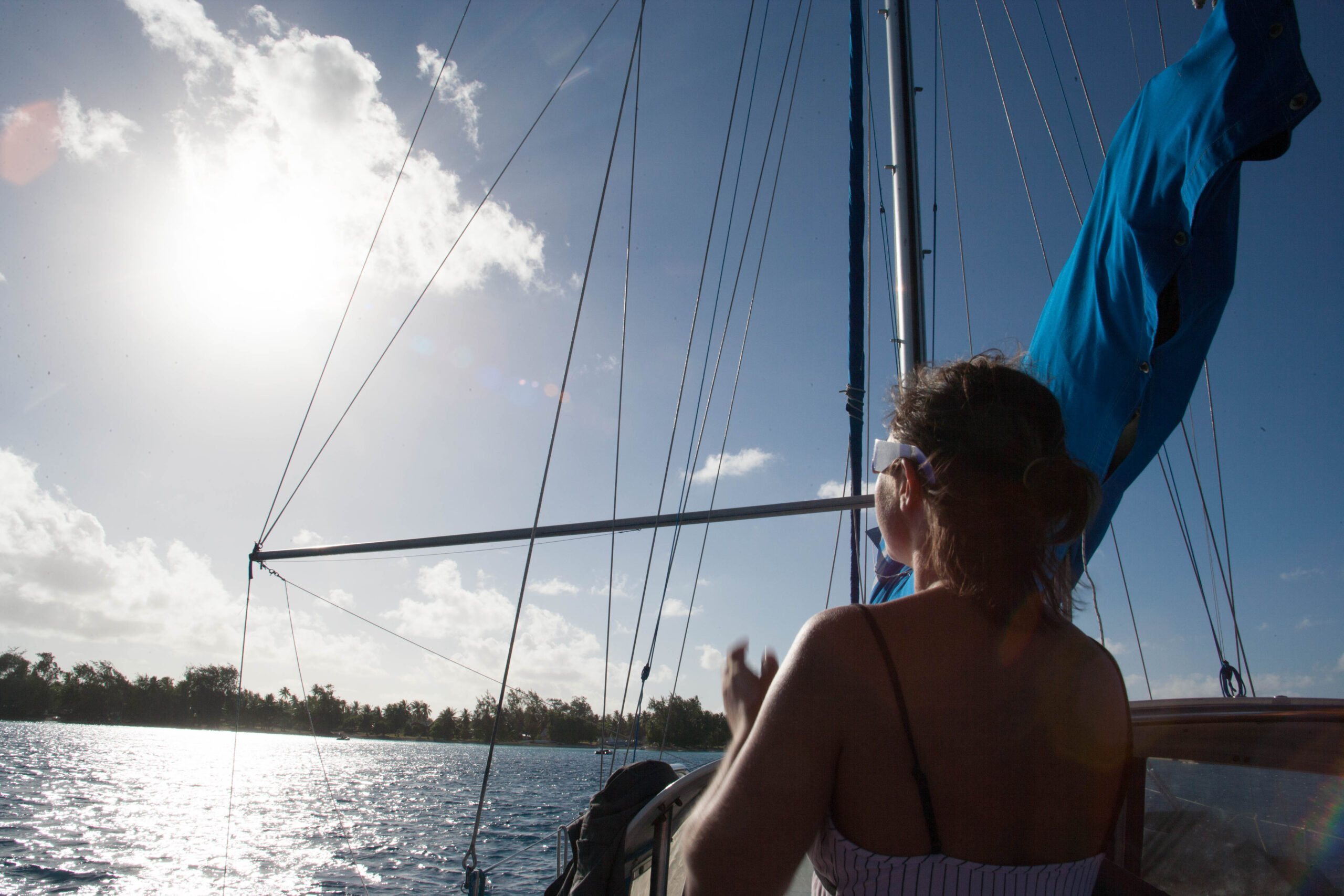
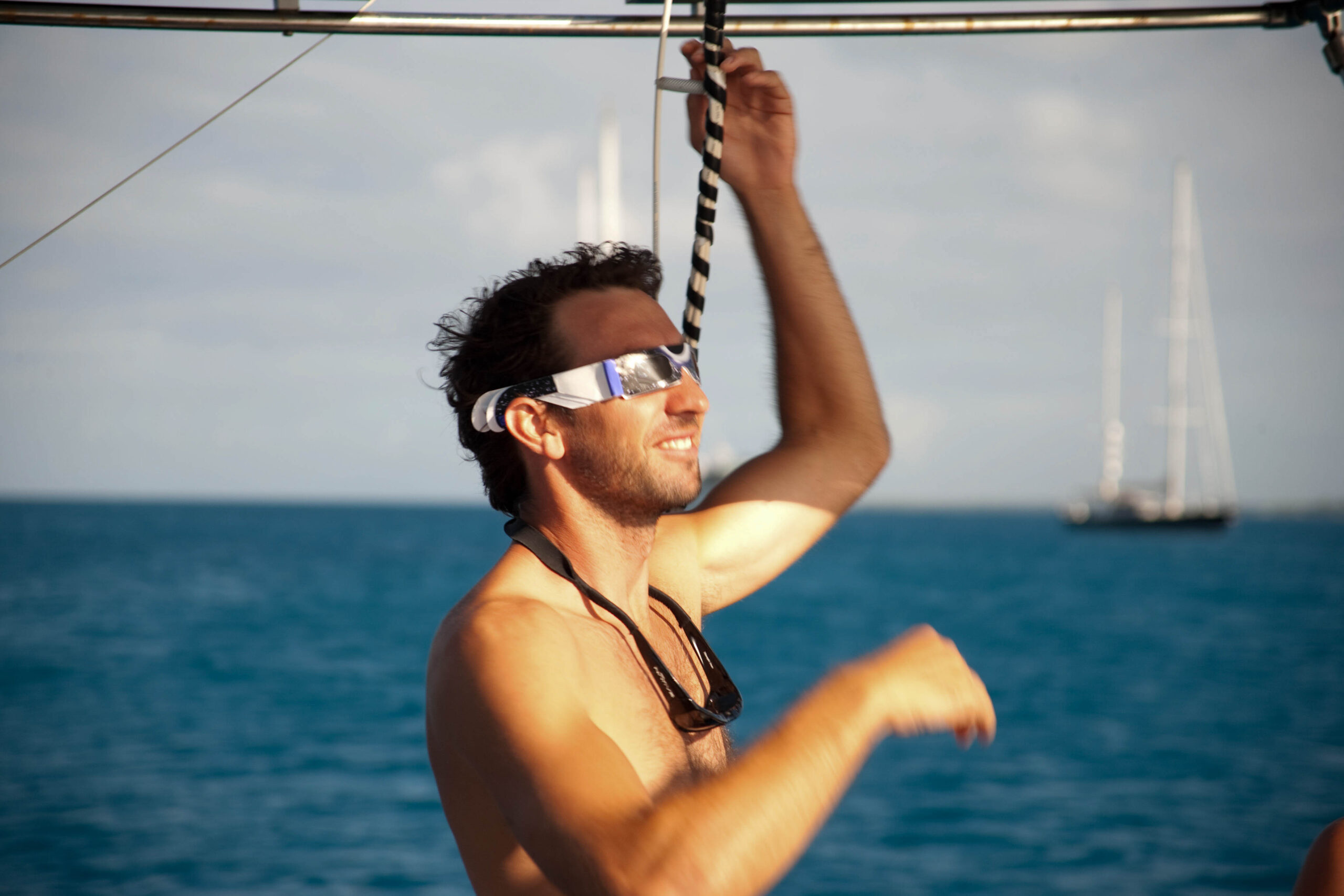
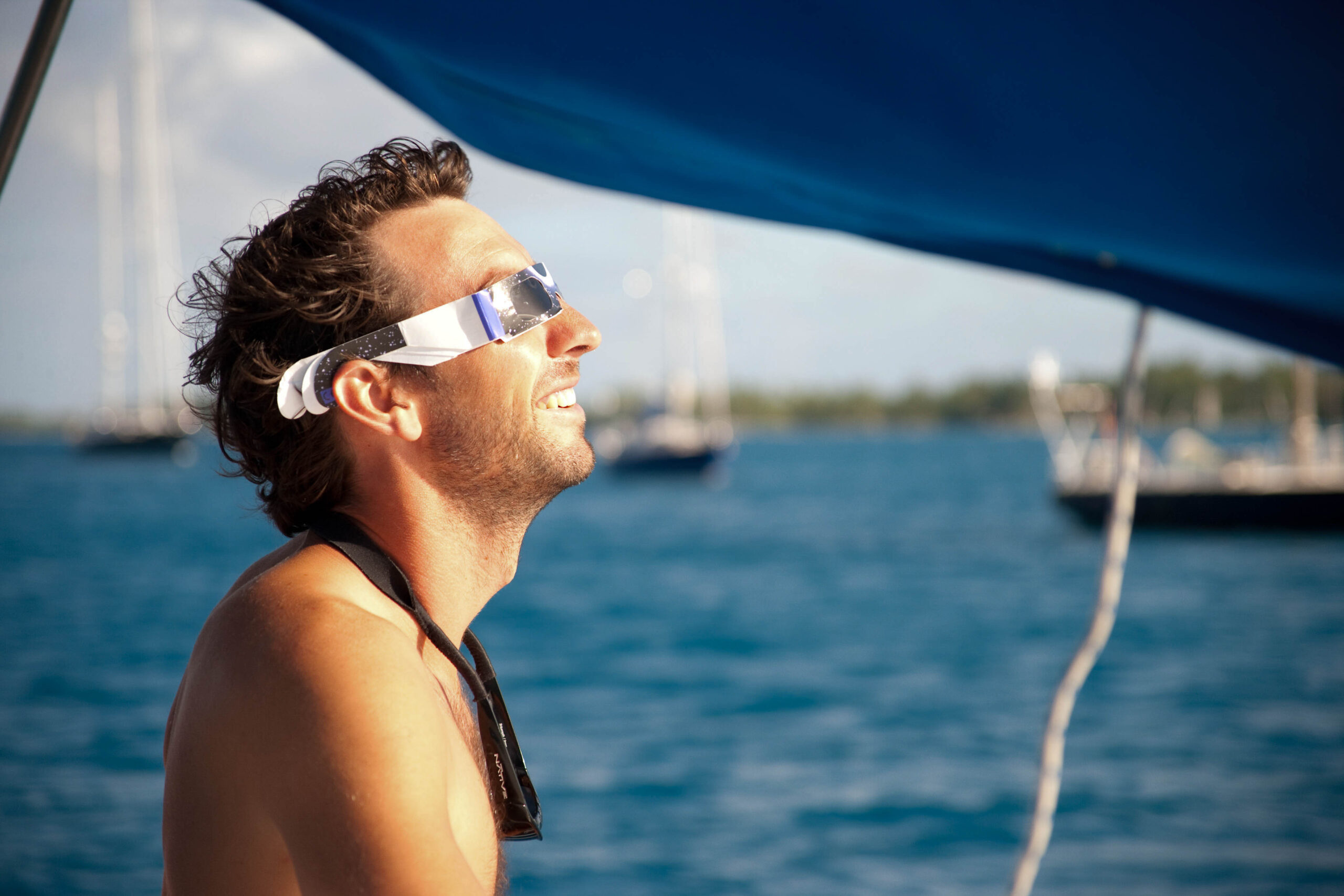
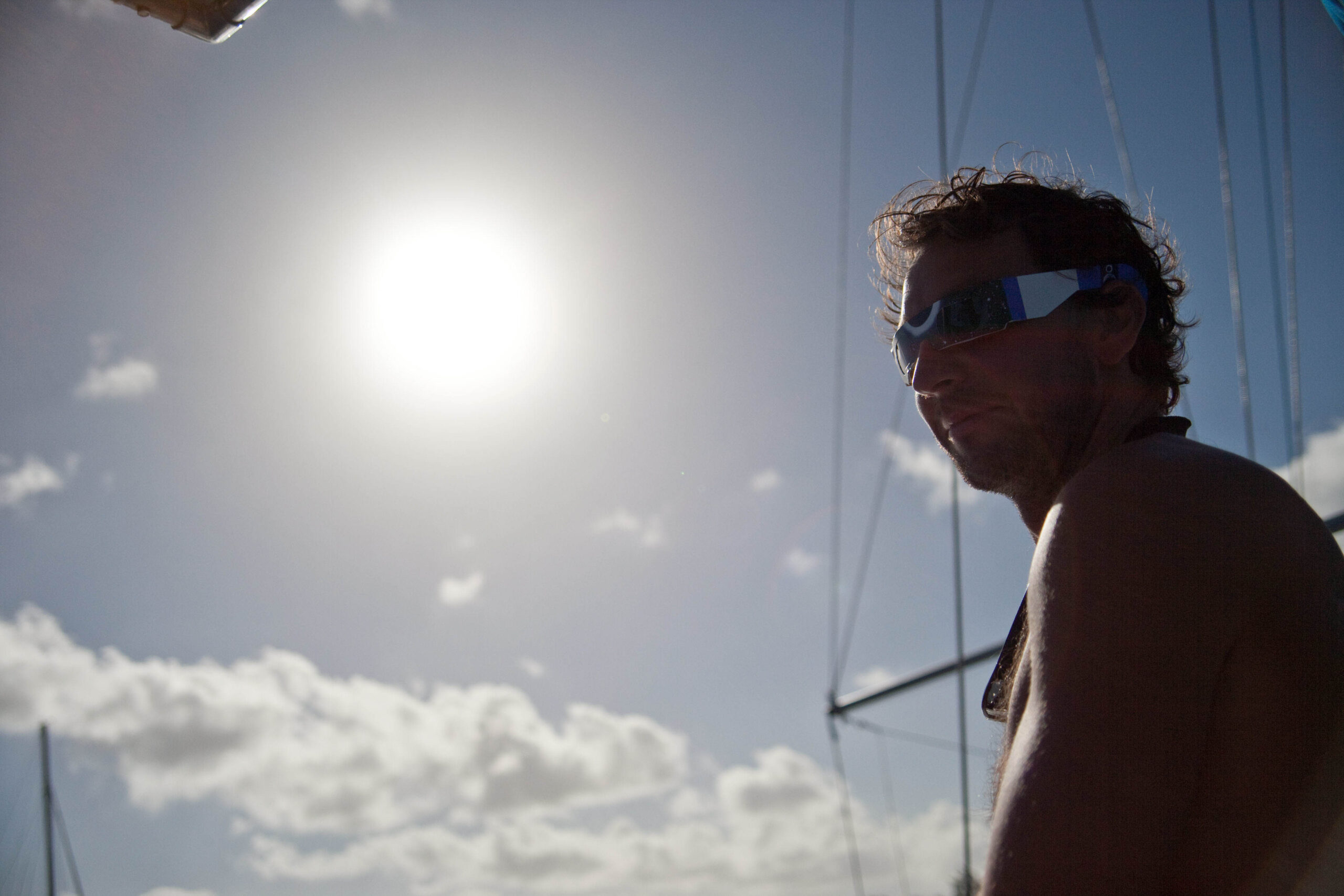
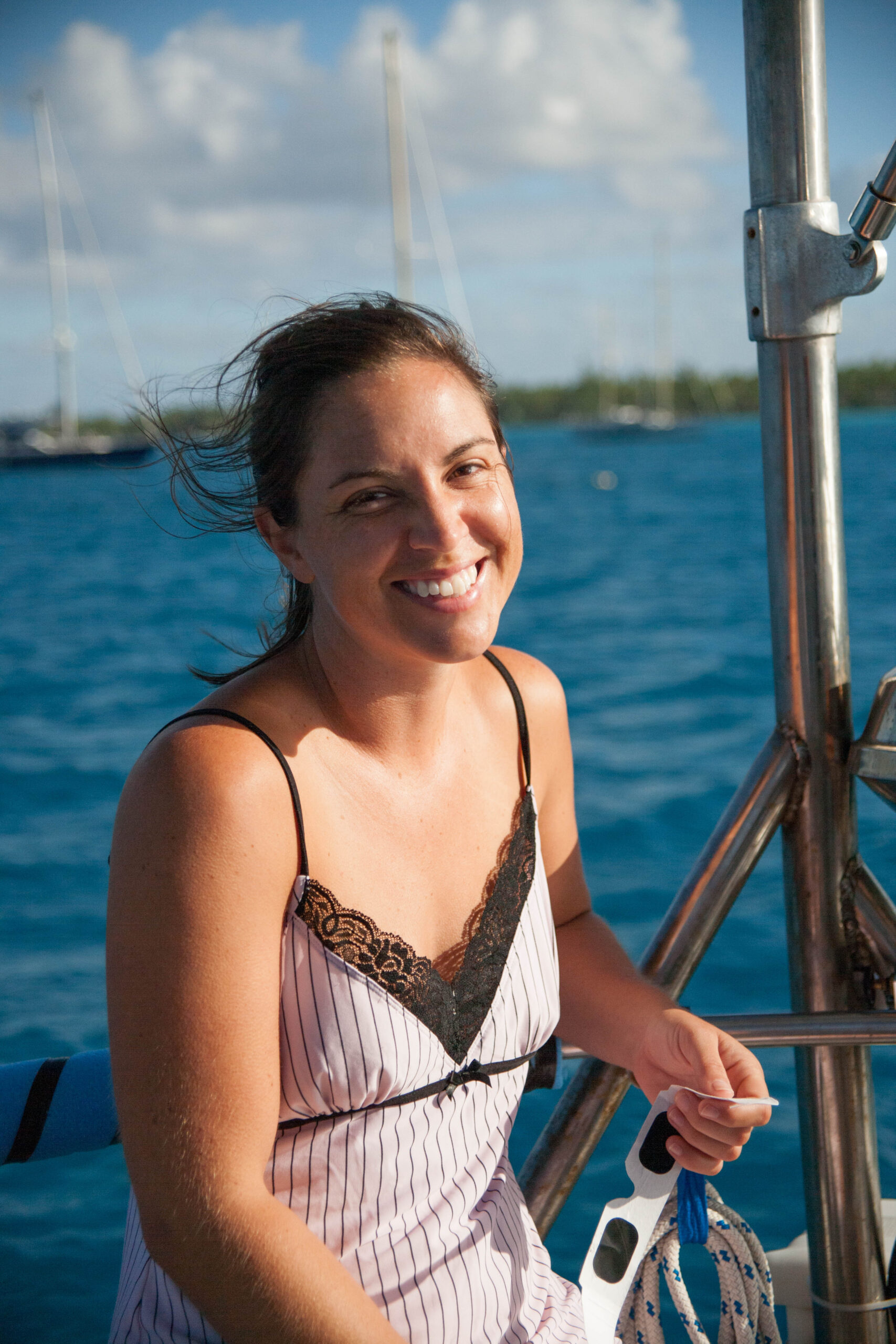
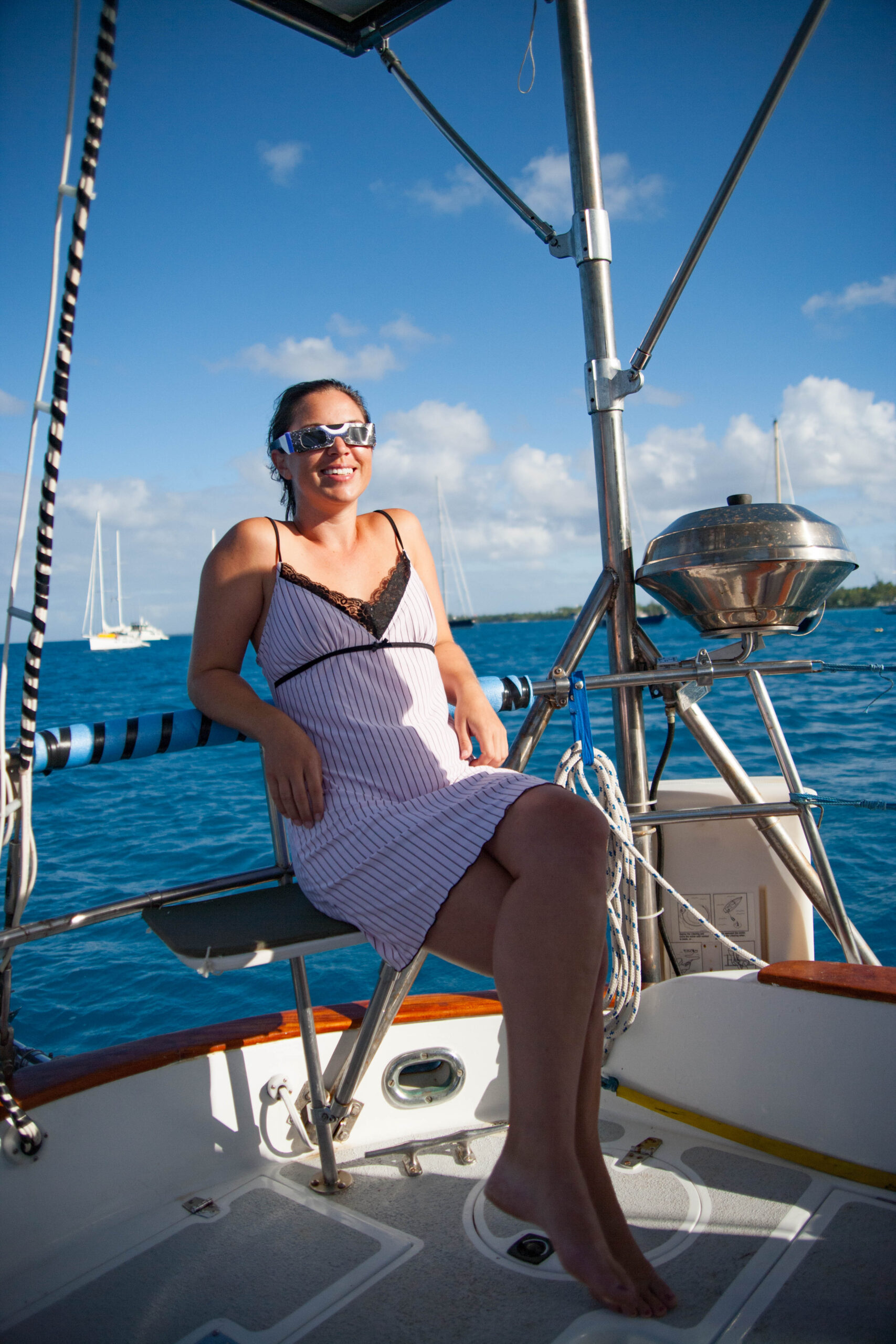
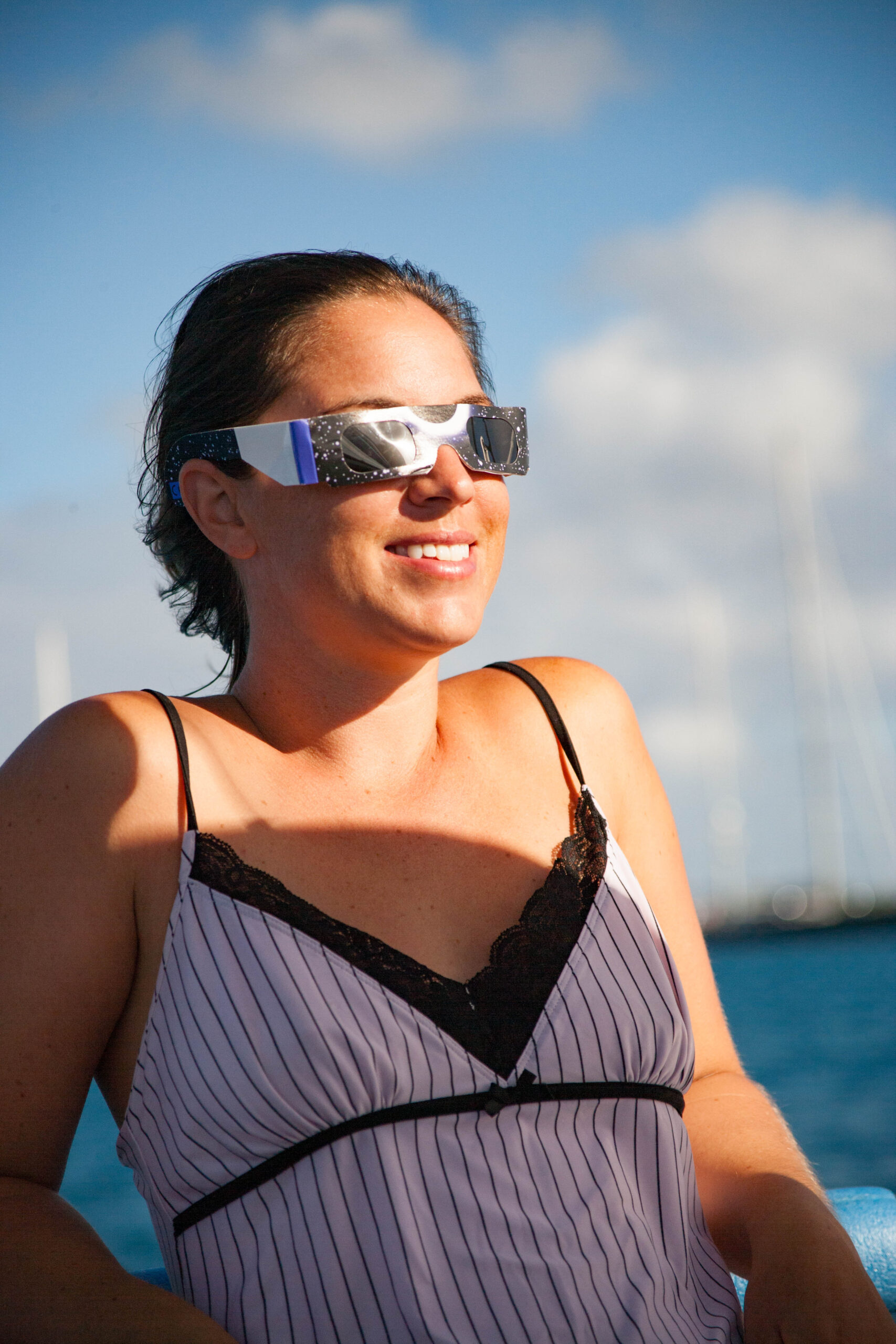
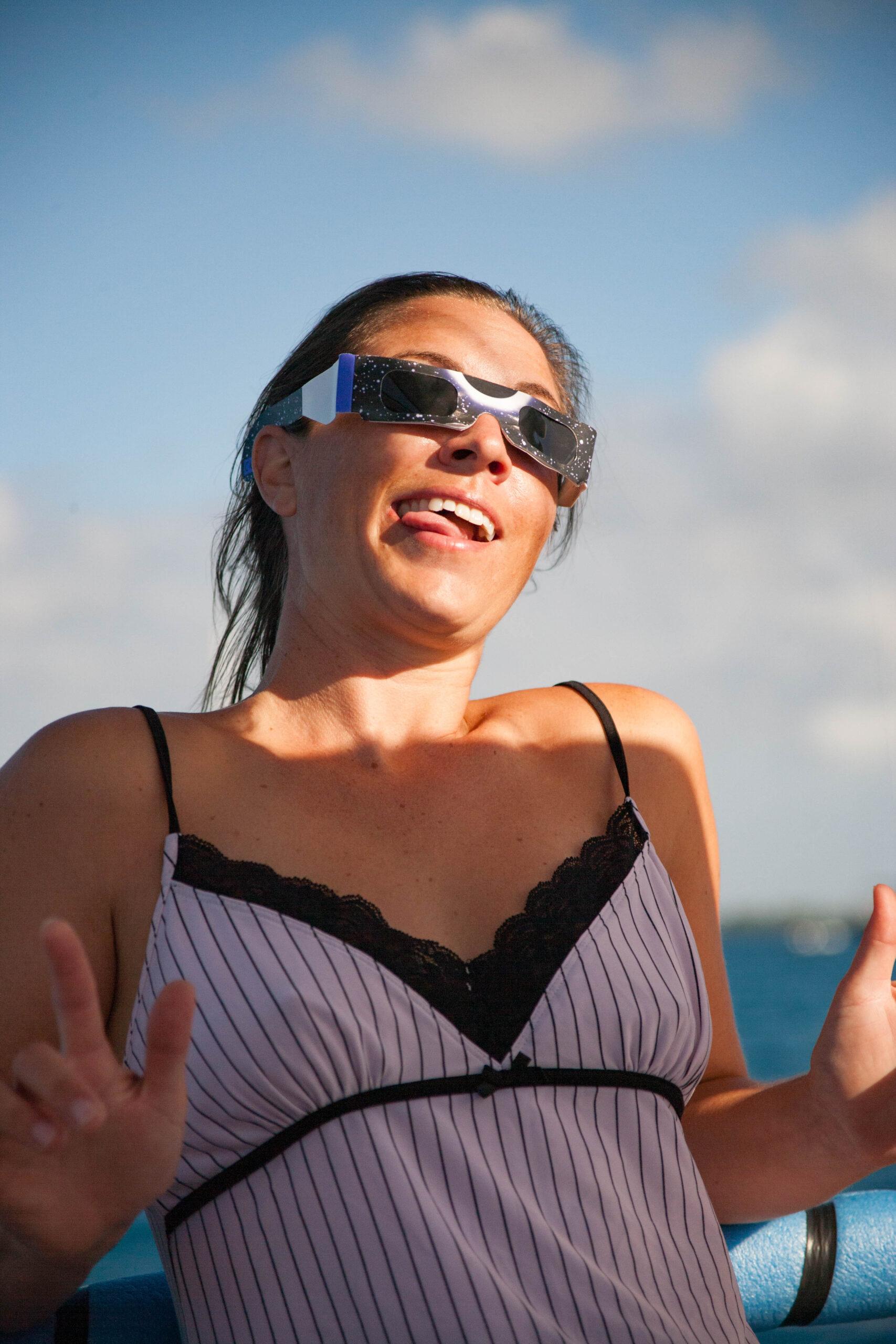
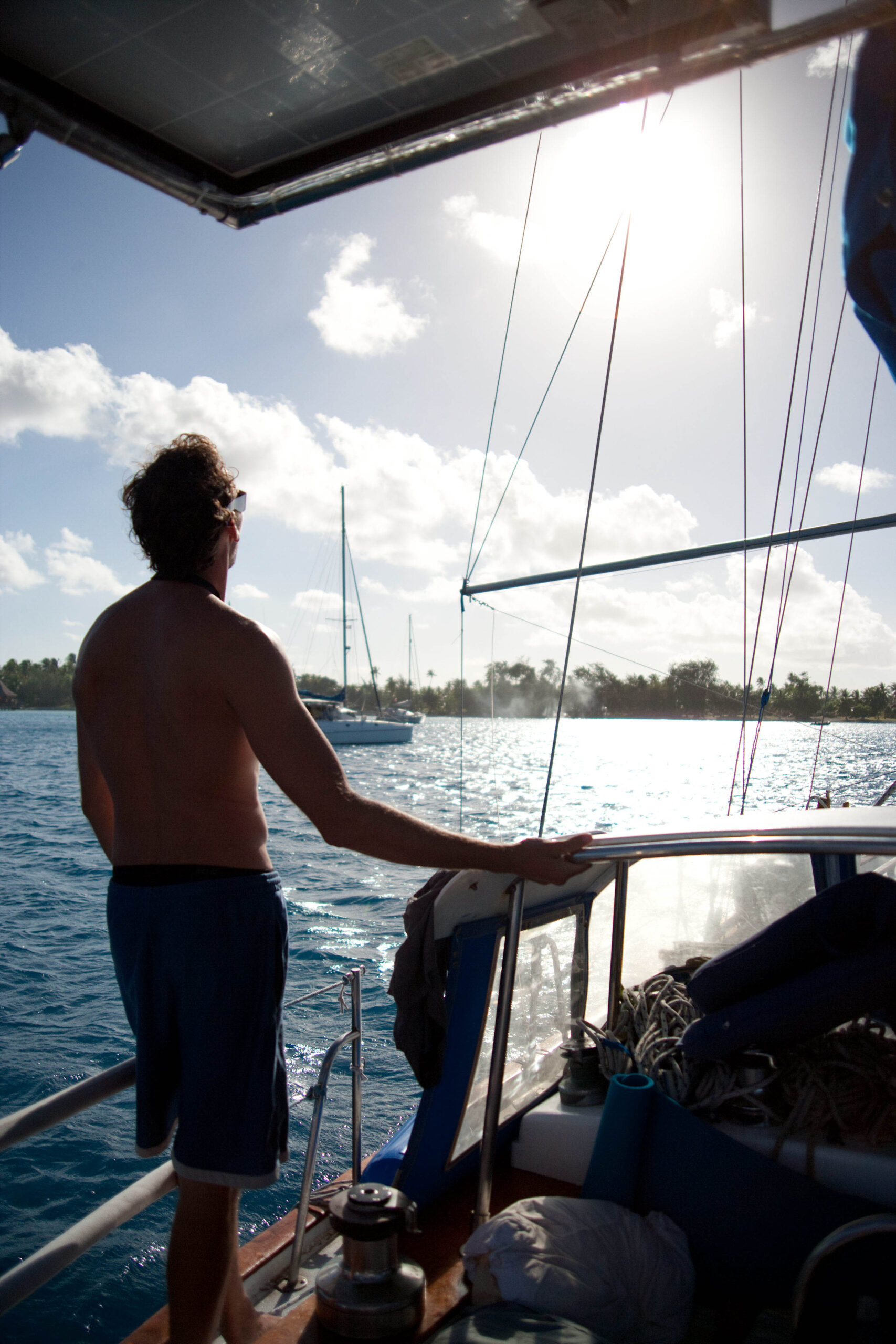
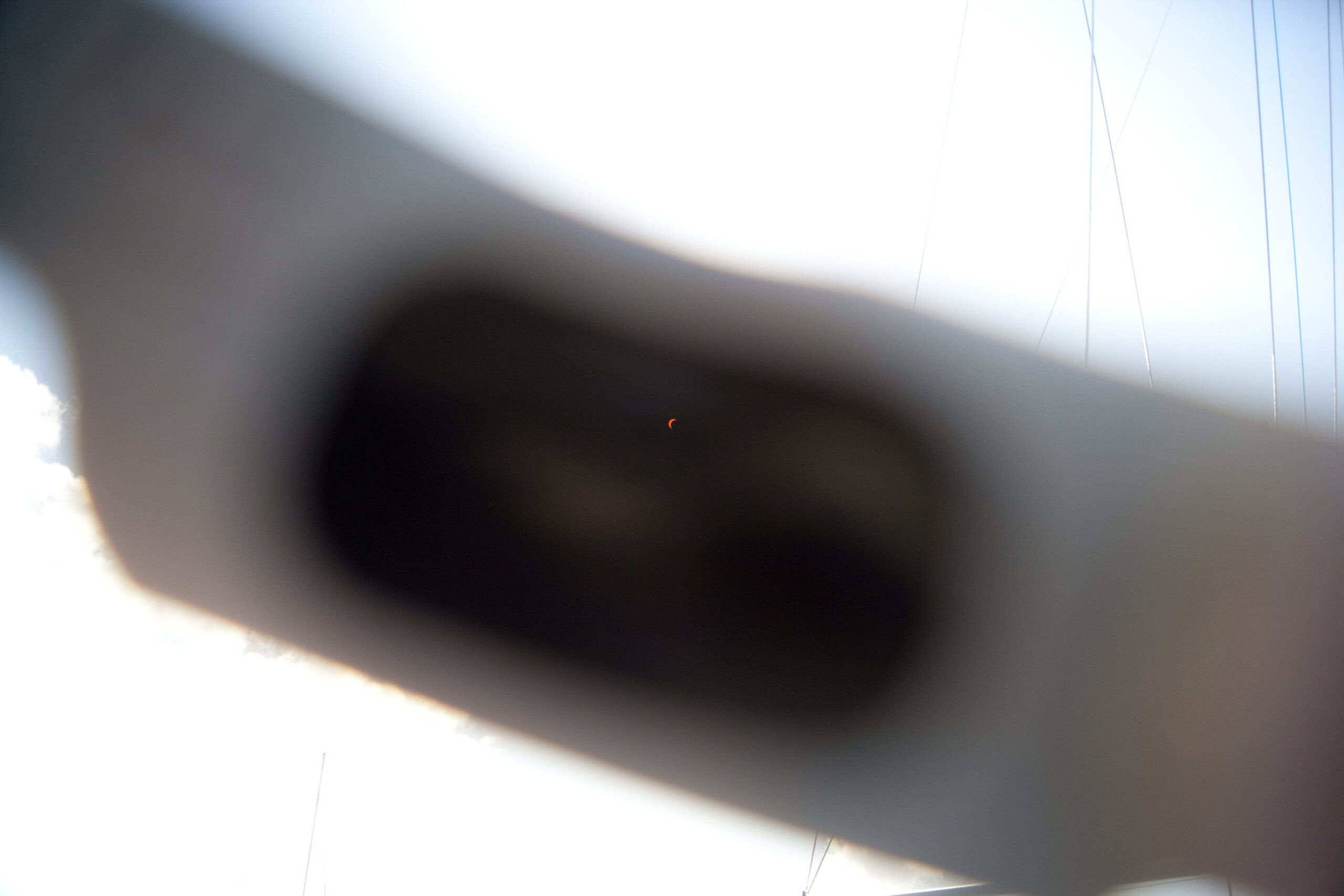
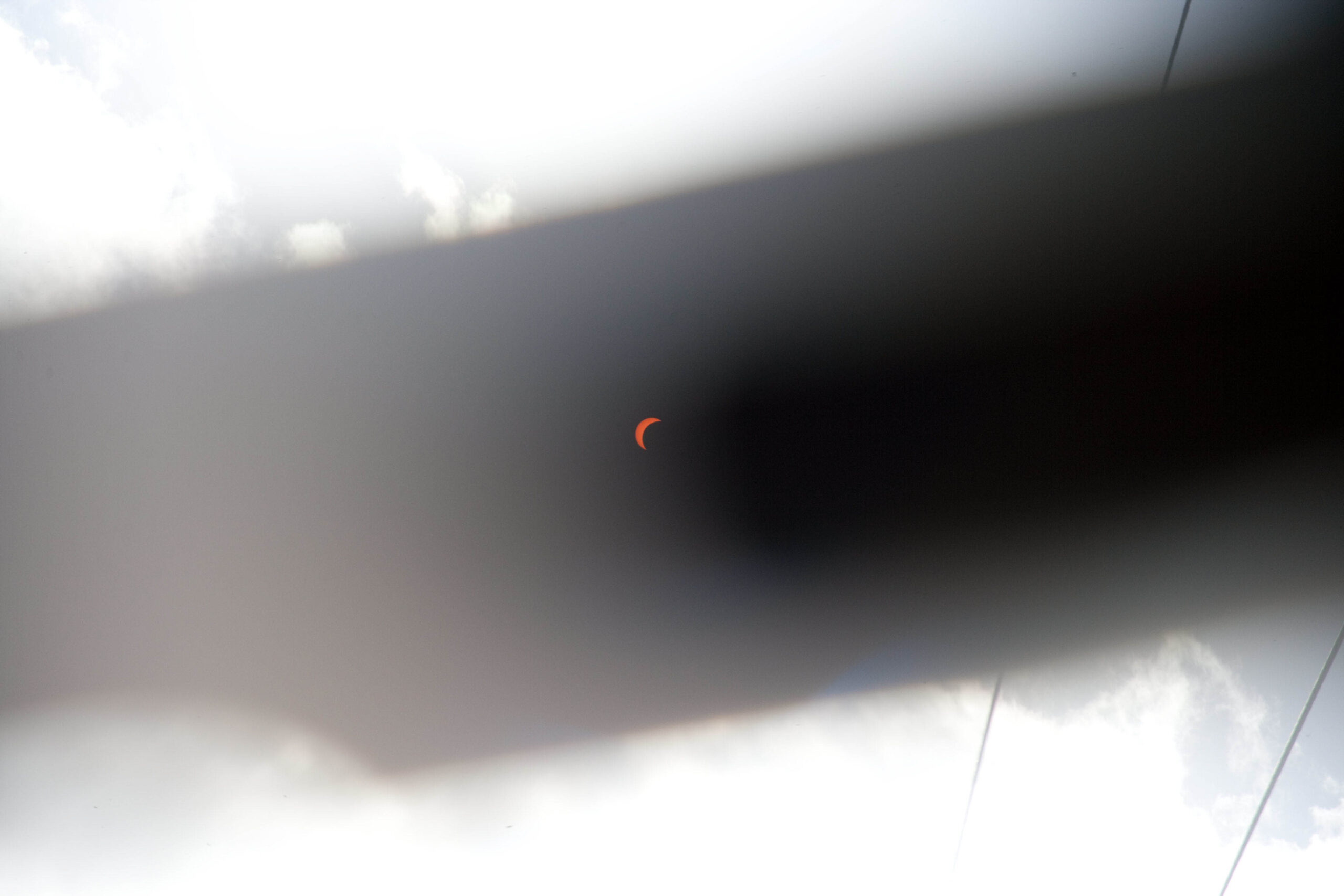
    We observed the solar eclipse from the atoll Rangiroa in the Tuamotus. It occurred around 10 in the morning, which is why in the pictures below Karen and I both look like we just got out of bed (jon was up at dawn). Jon found these cheap dark glasses for safely looking at the sun, which is why we all look like we’re watching a cheesy 3D movie.

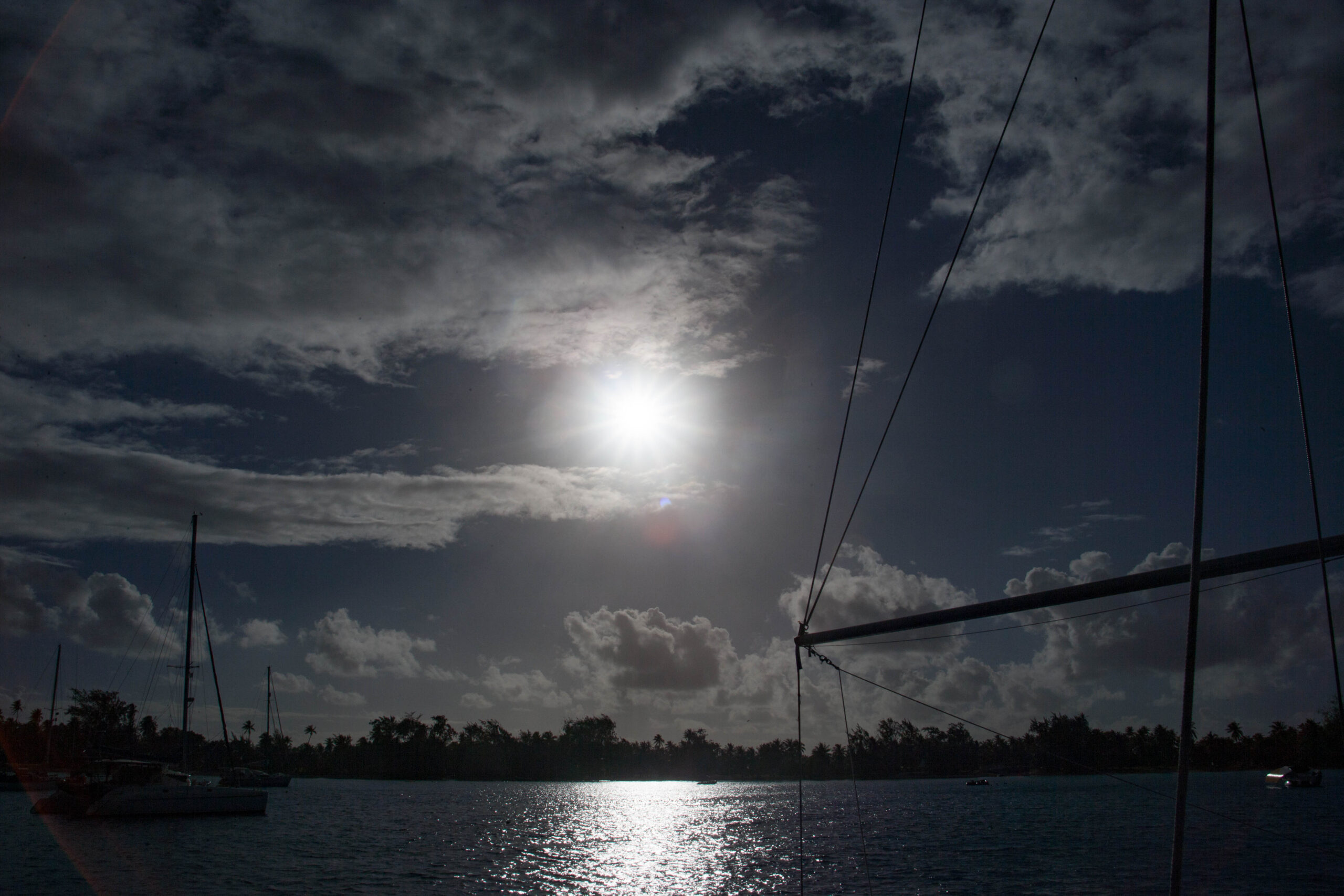
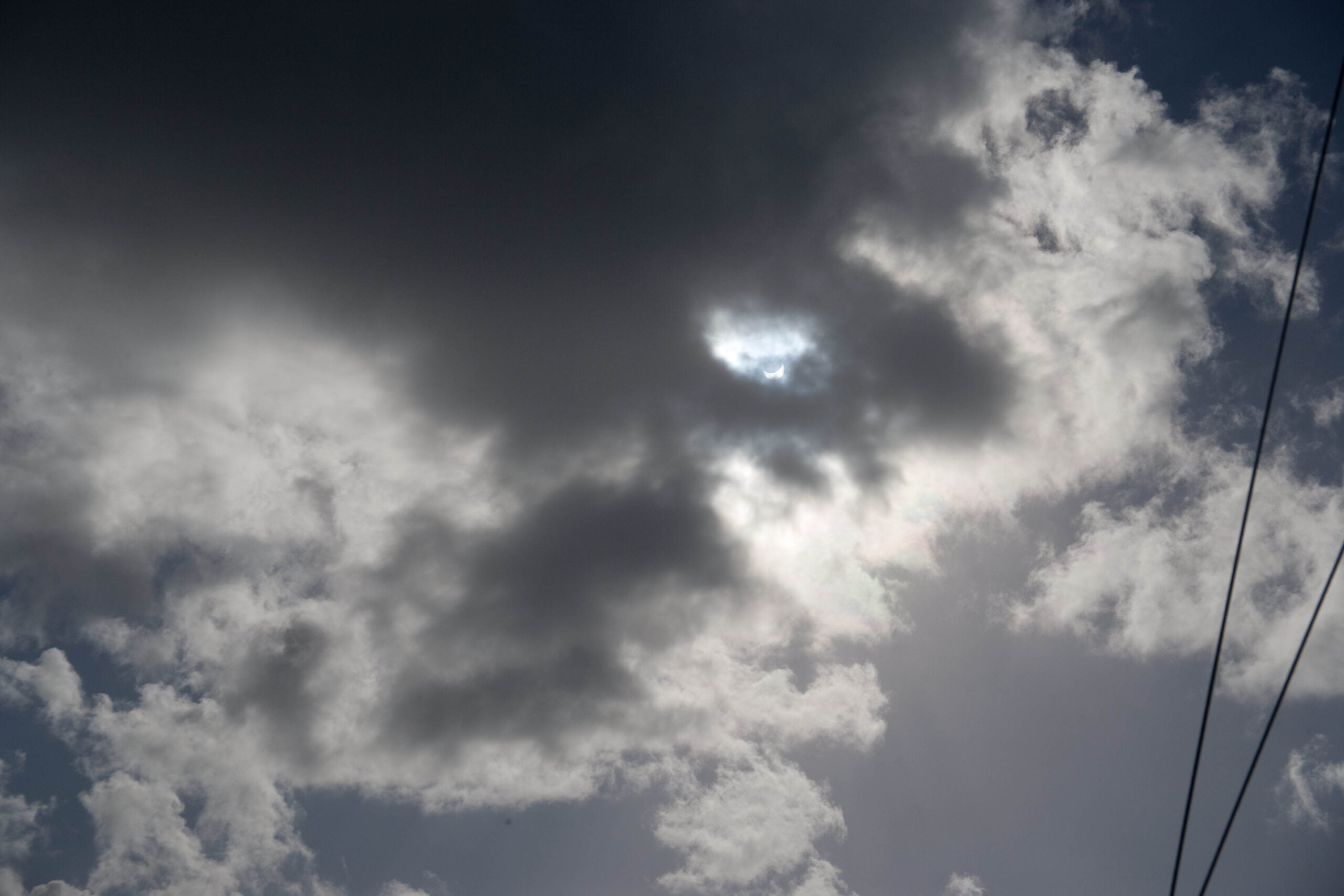
    It was great to observe a solar eclipse, though it was admittedly less dramatic than I had hoped for. The viewing party lasted about 30 minutes, so it wasn’t as rapid as I had expected, either, which gave me some time to drink my coffee, wake up a bit more, and appreciate it.  We were just outside the area of the total solar eclipse; on Rangiroa we had something like a 93% totality, and it turns out that 7% of the sun is a hell of a lot brighter than you would expect.  At its darkest, it had a magnitude of illumination equivalent to the sunset.

    Originally we had planned on being farther south, in the path of the total eclipse, but it turned out to be incompatible with all our other route-planning considerations.  I do not regret our choice.

    As a photographer, I was most fascinated by the color temperature of the light.  At sunrise and sunset we describe the light as very “warm”: when the sun is very low in the sky, its light passes through much more of the atmosphere before it illuminates our surroundings; as a result more of the blue wavelengths are filtered out, leaving a more orange, or “warm”, illumination.

    –ignorable aside:
    The expression “color temperature” comes directly from physics: as an object is heated, it gives off radiation (this is called “blackbody radiation” fyi).  The temperature of the object determines the wavelength of radiation.  At room temperature, objects give off long wavelength radiation, in the infrared spectrum (which we cannot see, except with the help of special goggles anyway).  When the object gets hotter, say a couple thousand degrees, the wavelength of radiation becomes shorter, and it gives of visible light that we can see (think of a piece of metal glowing orange in a forge).  The hotter it gets, the shorter the wavelength. Orange light is longer wavelength, bluer light is shorter wavelength.  As a piece of metal heats up in the forge, it goes from orange towards blue in color.  So, strictly speaking, blue is hotter, orange is cooler.  However, photographers got it backwards and refer to orange light as warmer and bluer light as cooler; admittedly this seems more intuitive.  Since it is rare to find a photographer who pays any attention to physics, we’ll have to forgive them the mistake.
    –end of ignorable aside.

    During the eclipse the sun was high in the sky, and so even though the amount of light felt like a sunset, the illumination it provided had the color temperature of the mid-day sun–far “bluer” than we observe at sunset.   In fact, it felt exactly like moonlight–this makes sense because moonlight itself is only reflected sunlight.

    So if you want to understand what it was like, imagine a sunset with moonlight.

  • Misadventures with Slurpy: part 2

    (refers to events on July 10th)

    I felt like a champ after having found the VHF.  Back at the boat, cold but ecstatic, we hurriedly tied up the dinghy and enjoyed a sweatshirt and beer in celebration.

    I wish we had not hurried.  In the middle of the night, our dinghy decided to float away.  The knot somehow slipped.  Matt told me in the morning that he woke up at 3 am to pee and the dinghy was gone.  He then went back to sleep.  What else could he do?

    I found out at 6 am when I woke up.  The prospect of a new dinghy was not pleasant.  A minimum of $1000 for an engine.  Another $2000 for the dinghy itself.  This was an expensive problem.  Getting to shore was now a major challenge, involving swimming, paddling the two-person kayak, or hitching a ride.

    It slowly dawned on my through the morning that it was I who had tied up the dinghy.  In my rush and because I was cold, I apparently did a poor job.  Perhaps it wasn’t as tight as it needed to be on the cleat.  It is doubtful that I went back over the knot, and I clearly did not tie up the dinghy with the second painter line that has now become mandatory but at the time was rarely used.

    Matt was always magnanimous as we talked to various people about the incident.  Careful to never blame me or express anger towards me.  I had in fact, watched a knot of his nearly come undone just two days before.  You would think this might have made me more wary and it did in the moment.  I did not remember to be wary when I was cold and wet and exhausted from searching for over an hour for the VHF.

    We discussed what to do.  It was clear this was a blow to Matt and had effectively resigned to buying a new dinghy and engine.  He didn’t really like either anyway.  I thought we should go looking for it, for which I received a ‘Yep, you should do that.’  I radioed the anchorage intent on getting a ride to shore, and relayed my embarrassing sob story over the VHF.  “Good morning Rangiroa.  You know its a good day when you wake up and discover your dinghy has floated away in the middle of the night,” I began.  A couple of our yachty friends replied and two hours later I had a ride into shore.

    There, my miserable French tried to describe to people on the dock what happened and ask them if there was any hope.  This was not easy and I certainly wished for Matt and Karen to help with the language.  My vocabulary is limited to “Des sole, je ne parle pas francais. Parlez-vous englais?”  However, with the help of a local dive operator, I managed to talk to one person who was insistent that our dinghy would be on sure somewhere.  Just walk the shore he said.  It will be there.  I am positive it will be there.  This was encouraging!  Others however were not so enthusiastic.  But I had to try.

    So walk the shoreline I did.  It was six miles between Passe Tiputa and Passe Avatoru.  at which point I would have to stop.  Walking along the shore was not like some stroll along a beautiful white sandy beach.  Or even a kinda crappy beach.  There was no beach. It is all bits of coral, usually only 3 feet wide before land starts.  At the land were peoples’ houses, schools, restaurants, a police station: the gendarmarie, other businesses and dogs.  Lots of dogs.  I am not a dog lover in the United States, though I lived with one for 8 months and quite enjoyed it.  In French Polynesia, I strongly dislike dogs.  They’re mangy, dirty, underfed, bark randomly and bark protectively when coming near a home.

    I filed a police report.  I a couple dozen people.  Walking through peoples backyards will do that, and they frequently eyed me suspiciously.  Particularly the couple I came across whose wife was sunbathing nude in her backyard.  The husband was quite nice about it, despite my intrusion.  Each time I would tell swallow my pride and relate my story, often in short keywords with much pantomiming, as the person I was talking to did spoke only a little English.  Yet again, having Matt or Karen along would have been nice to try and communicate.  Frequently, the people would exclaim something, walk closer to the shore, look either way and say something to the effect of, ‘i do not see it!’ Yes, I know.  I wouldn’t ask be asking or talking to you if I could see it.  My patience was growing thin.

    One person would say it probably went out the western pass.  Another would say it might be at the school where the land bends south.  Another reiterated some of the people on the dock by saying it might be at the blue lagoon.  Each time I said merci, asked them to tell the gendarmarie, the police, if they heard of anyone finding it, and continue trudging on my way.

    At about 5 pm, I had made it to the other pass.  Resignation beset me, Our dinghy was lost.  Misadventure part 2: failure.

  • Passage Apataki to Rangiroa

  • Misadventures with Slurpy Part 1

    (refers to events on July 9th)

    The dinghy has provided a constant source of amusement for us.  Matt and Karen probably would chose a different word from ‘amusement’.  Like ‘hatred’.  This has only increased since I arrived.

    Since we have an inflatable dinghy, it does not deal with rough water well.  A hard bottom dinghy would do better. In rougher water with larger waves, larger being over 6 inches,  a blast of water will spray up over the boat.  The spray only increases with speed and wave height.  Luckily our dinghy, handicapped as it is by a poor engine, never goes very fast.

    I’ve noticed up until this point that to combat this spray, Matt or Karen will stand at the bow and pull up on a line connected to the bow.  The idea is that you pull the bow up so that a: waves more easily pass underneath the dinghy and b: even if they don’t a higher bow will block some of the waves.

    Now, I generally thought this dubious at best.  The bow, in my opinion, seems to get pulled up about one inch.  Better to just grin and enjoy the spray, a reminder that we are not cooped up in an office, working our 40 hour weeks, dressed in slacks and a button down, and paying lots of bills.  However, on one fine day in Rangiroa, I decided to give my hand at trying this, if for no other reason than everyone else on our boat was doing it, so I wanted to be cool too.

    As we pulled away from the dock, I grabbed the line and stood up.  Another boat passes by.  I note the wake (the waves eminating from behind the boat) they create, and think: not a problem.  Their wake reaches us and rocks us side to side.  I then think: this is a problem.  I stumble from side to side, and as there is not much room side to side on our dinghy, I proceed to be clipped in the calf by the sides of the dinghy and tumble backwards overboard.

    Man Overboard!

    I am perfectly O.K. save a bruised ego, and once Matt has ascertained this he immediately starts laughing.  I am not laughing.  Not yet.  I am frantically trying to get things out of my pockets that I don’t want to get wet.  Money.  My journal with months of entries I don’t want ruined.  Two long letters to Allison.  If those get wet, oh I would be so upset.  Hence my franticness.  However, the journal and letters are in a waterproof bag that I had remembered to seal, and the money was in a ziplock.  After fishing those out of my pockets and realizing they were fine, I too laughed at myself, treading water and just laughing.  Two cheapo glasses I had bought so you could look directly at the sun during the solar eclipse are within reach and I grab at them.  The third has already started to float under.  I pull myself back into the dinghy, sopping wet and laughing.

    I take inventory and as Matt is starting to pull away, I realize I’m missing something.  The handheld VHF radio.  The extremely-nice-christmas-present-from-Matt’s-parents handheld VHF.  Matt is displeased.  Both of us without even telling the other simultaneously start trying to take a bearing on land.  If you line up two points, say a pylon and a tree, then you return to this spot you can again line up the pylon and tree and know that you have returned to somewhere along that line.  Do that with another 2 objects, preferably two which form a line perpendicular to the first two, and you have two lines which can only intersect in once point.  Theoretically you can return to the same spot.  As long as you don’t use a mooring ball which might move with a shift in wind and current.  And you don’t forget what you used.  Both of which happened to me.

    After going to the boat to pick up snorkeling gear, we return to where we think I might have fallen in.  I flop out of the dinghy, and swim around, frequently diving down to the bottom, it’s only about 15 feet, looking around.  Matt moves around in the dinghy to scan a larger area, dunking his head in the water periodically.  Ten minutes of searching.  Twenty.  Thirty.  It seems inconceivable to me that we can’t find anything.  I know other things fell out of my pockets.

    And then I see the pair of glasses that had had been out of reach and sank to the bottom.  Here’s the right spot!!  Ten more minutes of searching.  Search time no longer feels fruitless.  The VHF must be here.  I find a coin, 100 francs, about 1 US dollar, bright and shiny.  This must have also fallen out of my pocket.  And there is a AA battery I bought for the GPS.  it must be here.

    And finally there it was.  A swell of relief first then a swell of apprehension.  Would it work?  I pop up out of the water.  The smart thing would have been to take it back to the boat, rinse it with fresh water, let it dry out thoroughly, open it up and continue to ensure proper drying.  I didn’t do that.  It was still on, and so as soon as I popped up on the service and waved to Matt and pushed the boat to call Karen back at our boat.  “Syzygy, Syzygy, this is Jon.”  Karen replied.  It worked.  Thank you to Matt parents for buying such a nice VHF that it withstood being in 15 feet of water for over an hour!  Misadventure part 1: a success!

  • Life in 15 minute intervals

    (concerning events: July 8th)

    When on a passage, the people on board take turns being ‘on watch’.  While on watch, that person is called the helmsman.  They are in charge of sailing the boat, making sail changes if necessary, ensuring the proper course of the boat.  The helmsman can ask other people for help in doing a task.  Other people can take it upon themselves to tinker with sails, look at and adjust the course, etc. etc. if they are so inclined.  The captain (Matt), if he feels like it since he’s the captain gets to do whatever he damn well pleases and tell the helmsman to piss off if wants.  We, thankfully, have a benevolent captain (so far) who makes his requests much more politely.   In the end, particularly through the night, it is the helmsman’s job to make sure the boat doesn’t hit anything.

    My first overnight watch was not particularly exemplary.  I was determined to improve upon this in my next one.  Our passage from Apataki to Rangiroa would provide me with the first opportunity.  I volunteered to take the midnight to 6 am shift .

    Every 15 minutes the person on watch is supposed to at a minimum scan the horizon looking for anything we might run into.  15 minutes is the chosen interval aboard Syzygy as we believe it balances differing factors such as: how far you can see at night, how generally busy with other vessel traffic the area is, human comfort.  We have a wristwatch aboard Syzygy that has an alarm set to ring every 15 minutes.  I would wear it around the band of my headlamp so that it was always extremely close to my ear.  Just in case I was sleeping or simply had my eyes deeply closed.  I would even wear the watch during the day so that if I got busy doing something, when the alarm rang I would be reminded to, at a minimum, look around for other boats, land, check our course, etc.

    Through the night, I noticed my life quickly become wholly defined by that alarm.  I would wait for the alarm before I would do almost anything, so that I would be less likely to be in the middle of something when the alarm rang.  I would plan to do different jobs by the alarm.  “After two alarms I will _____________.”

    Here is my night watch, my life, as defined by those 15 minute intervals.

    11:45 pm – 1200 am
    Look for coffee maker.   Become frustrated at not being able to find it.  Attempt to light stove for coffee.  Continue frustrations at stove for not staying lit at a low flame, optimal for coffee making.  Not processing what Matt is saying to me about his and Karen’s watch because I feel like a zombie and nauseous.  I drink a large glass of juice because I know I need calories but can’t think of anything easy enough to make.  Stomach feels queasy from the rocking motion of the boat as it pitches and rolls 10 degrees to each side.

    12:00 am – 12:15 am
    Coffee finishes boiling.  up on deck listening to Matt.  During the first part of my watch I need to take down the whisker pole, and bring in the fishing lines.  At some point, we will need to heave to as we will have arrived at the entrance to the atoll but don’t want to go through the pass in the dark.  Stomach feels queasy; I think the rolling of the boat has increased to 15 degrees to each side, though I’m probably imagining it.   Eat granola bar for more calories and because a more full stomach usually helps me with seasickness.  Alarm sounds.

    12:15 am – 12: 30 am
    Look around the horizon.  Check course on computer.  Pour coffee into cup. stomach feels awful, it’s not looking good.  Boat is definitely, in my imagination, pitching 20 degrees to each side.  Alarm sounds.

    12:30 am – 12:45 am
    Look around the horizon.  Back down below to add milk and sugar to coffee.   I imagine 30 degree rolling pitches to each side, a roller coaster fun house of nasea.  Realize my stomach is done.  Stomach is rising. Need to get outside immediately.  Get halfway out the companionway, remember that I’m about to drape myself 1/2 off the boat and I’d better clip in. stomach in throat.   Fumble with the tether trying to get clipped in.  It takes ages. Stomach in mouth.  Finally can step on deck knowing I’m tethered.  Stomach in mouth, mouth forcibly closed to prevent a god awful mess in the cockpit.  Fall into the jack lines, stomach exiting.  Sit down on the boat, stick my head between the jack lines into a nice comfortable position and continue to throw up into a dark sea.  I have to time my events with the rolling of the boat so as not to coat the sides of the hull.  I’m not very good at this.  Alarm sounds.

    12:45 am
    I give the alarm the bird, heave one more time and then drag myself up to look around.  Nothing like taking a break from throwing up to look around for boat traffic.  Fuck me.  I then go back to the rail to hang out and watch water flow by the boat.  It’s quite a sight.  Mysteriously dark, the swell rising and falling.  I listen to all the unique sounds that happen.  Waves hitting up against the hull.  The rush of water as we accelerate down the face of the wave.  The ripples it makes as our boat cuts through at 6 knots.  Light glistens off the surface particularly from the moon.  Parts are eerily smooth, like an oil slick.  Others are little whirlpools, particularly as it eddies off the back of our boat.   Sea sickness seems to have gone away and I actually feel much better.  Alarm sounds.

    1:00 am
    Look around.  Get some water swish it around my mouth.  Back to the rail to watch some more water.  Able to sit up comfortably and look up at the stars.  The stars are a treat.  There are thousands, millions of them.  On a cloudless, moonless night, the faintest stars are visible barely there to the straining eye.  The brightest gleam dominantly.  A milky way band stretches prominently across the sky.  All new southern hemisphere stars to gaze at and wonder about.  I know none of the constellations like I do in the Northern hemispere.  A week later, safely at anchor and feeling much better, I’ll start making up names for constellations.  A particular group of three forming a triangle gets called Allison.   Tonight though, I just stare at them, looking at different ones as they glisten differently, sparkle with this color or that.  A shooting star darts by, long enough so that I only see it in my peripheral vision, have time to move my head and eyes to focus on it and it is still goes for another second.  Very cool.  Alarm sounds.

    1:15 am
    Look around. Check course on computer.  Get my coffee and bring it on deck.  Take my first sip.  It’s cold.  Begin contemplating the tasks I have to do.  Clean up the side of the boat,  some off the lifelines and a little off the side deck.  Alarm sounds.

    1:30 am
    Look around. Start bringing in the first fishing line.  I am able to do this sitting down.  This is good because I feel exhausted from my earlier bout of nasea.  Realize that our tackle box is still quite a mess, despite some effort and time Matt put into organizing it.  Once I finish pulling in the first line, I relax and wait.  I don’t want to start on the second line and have to stop if the alarm goes off.  I could look at the watch and see if I have enough time, but I prefer to just sit there and wait it out.  One minute. Two, three, four, five.  I probably could have pulled in the line by now.  Alarm sounds.

    1:45 am
    Look around.  Check course on computer.  Bring in the second line.  I endeavor to bring some semblance of order to tackle box while stowing the fishing lines.  Alarm sounds.

    2:00 am
    Look around.  Check course on computer.  Make a plan for the next two alarm cycles.  I plan to spend an extensive amount of time dealing with our course, checking our course on the computer, looking at how far we have to go, when we should heave-to, etc.  Tasks such as these can take up nearly an entire cycle as the computer program we use, Mac-Enc is woefully slow.  Embarrassingly slow for a program running on a Mac.  After the time-consuming check, I’ll spend the remainder of that cycle and the next cycle resting.  Then, I’ll begin taking down the whisker pole.  Alarm sounds.

    2:15 am
    I look around for longer then necessary, using the binoculars to stare off at the lights from shore, eyeing each intensely to make sure it is not, in fact, a boat that might head for us.  After doing the multiple tasks on a mind-numbingly slow Mac-Enc, I come back on deck and look around again.  There is not much time left in this cycle, but I lie down and watch the stars.  I close my eyes.  Consider eating and become nauseous at the thought.  I try to slow my breathing, trying to bring as much relaxation and rest as possible to a still awake but dehydrated and tired body.  Alarm sounds.

    2:30 am
    Look around extremely quickly, as it was just three minutes or so that I last looked.  Back to lying down.  I close my eyes and let my thoughts drift.  Idly thinking of people back home, what they might be doing, what changes are happening in their lives.  Has Allison found a job yet?  Has she gotten my letter?  Is not communicating for three weeks hard?  Did Dave’s school get approved? Has Maddi my niece gotten even more adorably cute?  I try and drift as close to sleep as possible.  Alarm sounds.

    2:45 am
    Still lying down in the cockpit with my eyes closed, giving myself 30 more seconds.  As I’m opening up my eyes, I almost sense it before I even see it. A bright light, 20 degrees up the horizon and behind us, a boat would have to be close, TOO CLOSE for a light that bright.  Close and large.  “How could I have not seen a boat like that before!?!?”  rushes through my head as I sit up with a quick start, brain fast into action as to what I’m going to have to do.  I then heave a sigh and collapse back down onto the cushions in the cockpit, done staring at the moon for now.  Thanks moon, thanks for that.  Look around.  I note an actual new light on the horizon.  Could be more shore lights, but I’m inclined to think it’s a boat.  Check course on computer.  Back up on deck, I begin going through the steps to take down the whisker pole.  On foredeck, unclip the pole.  Slowly bring twenty foot pole to rest on deck.  The boat has seen fit to make this task difficult by rolling 15 degrees to each side of vertical.  Standing is generally out of the question, and so I lean/sit on the dinghy which is tied upside down on our foredeck.  Pole down, a dozen more steps to go.  Alarm sounds.

    3:00 am
    Of course the alarm sounds right now.  I curse silently, then try and pin the pole down while I scan the horizon.  The new light has definitely moved closer.  Back to the whisker pole, I get the bridle off, loosen the topping lift so I can move the pole to it’s stowed position, Get the jib sheet off the pole, and begin moving the pole to the other side of the boat for stowage.  Alarm sounds.  Really? Already?

    3:15 am
    Look around. The light is now the shadow of a boat as it is slips by our port side.  I finish stowing the pole.  I then have to retrieve the whisker pole bridle and re-lead the jib sheet.  Alarm sounds.

    3:30 am
    Look around.  Check course on computer.  I wake Matt up so we can heave to.  He immediately notes the light, but I assure him it is moving away.  We then heave-to, which simply means that we tack the boat without allowing the jib to move to the other side.  This pins the jib sail up against the shrouds and stalls the boat.  The jib tries to take the boat down-wind, while the main and the rudder act to counter by trying to drive the boat up into the wind.  The idea is to completely stall.  Alarm sounds.

    3:45 am
    Look around.  A proper heave-to takes a bit of finesse.  Our boat is also not particularly inclined to completely stop in it’s heave-to.  We have slowed to a 1 knot however, from about 5 or 6.  Matt and I look at the sail, banter about how to get us to completely stop.  Matt starts to clean up lines and I say “Dude, go back to bed.”  “Oh yea,” he replies, “See you at 6.”  and disappears down the companionway.  Alarm sounds.

    4:00 am
    Look around.  Relax and aimlessly watch the stars and the water.  Alarm sounds.

    4:15 am
    Look around.  Check course on computer.  Relax and aimlessly watch the stars and the water.  Alarm sounds.

    4:30 am
    Look around.  Relax and aimlessly watch the stars and the water.  Alarm sounds.

    4:45 am
    Look around.  Think that describing life in 15 minute segments might be an interesting blog post.  Open up Matt’s computer to start writing. Alarm sounds.

    5:00 am
    Look around.  Check course on computer.  Continue writing.  Then I think to myself, “Really?”  and head back up on deck and calmly this time, tether in, sit down on the coamings of the cockpit, move my head between the life lines and throw-up.  Alarm sounds.

    5:15 am
    Look around.  Gurgle some water and feel exceedingly good except for my pride.  What kind of a sailor am I that I can’t even look at a computer screen for a little while to type?  So what the boat is rolling.  How am I going to manage on a 5 day passage or 10?  At least I’m not doubled over and incapacitated.  Oddly, I’m actually in excellent spirits.  I just would like to be able to do something on watch other than relax and aimlessly watch the stars and the water.  Alarm sounds.

    5:30 am
    Look around.  Relax and aimlessly watch the stars and the water.  Alarm sounds.

    5:45 am
    Look around.  Check course on computer. Relax and aimlessly watch the stars and the water.  Alarm sounds.

    6:00 am
    Look around.  Relax and aimlessly watch the stars and the water.  Alarm sounds.

    Matt gets up.  While my watch is technically over, there is stuff to do like getting out of the heave-to and then motor sailing back to the pass which we have drifted to the west of and then a pass to enter.  All things good for me to practice So I stay up and go through all of these.  The pass into Rangiroa is exciting, with tall standing waves from a mix of currents and wind.  The waves seem to tower over us as they roll in behind and then sweep under us.  We get to anchorage, and Matt lets me suss out our options for anchoring and then pilot us into place.  I’m not quite up to the task yet though, and so in the last bit Matt modestly gives out some directions on what to be doing.  Once anchored, Matt go about the various little tasks that all have to been done after anchoring.  We do these in silence.  I am reminded of when after a long rock-climb, or a hike out from a canyon, when you have to do those last miserable details.  We both know what needs to be done, and we go about it silently. After 45 minutes of slowly moving through these tasks, it is about 9 am.  I crawl into bed and pass out.
  • Food and Fish

    (concerning events: July 3rd -July 6th)

    People have lived in French Polynesia for around 2000 years and ever since have been eating fish.  Lots and lots of fresh fish.  We have not been eating lots and lots of fresh fish.  We have been eating little to no fresh fish.  This vexes me to no end.  We had fresh fish once in the two weeks I have been here.  Native Tuomotians Ken and Martin caught it for us.

    Karen is a fantastic cook.  She probably cooks the most dinners, though I cook my fair share.  Matt and Karen seem to have tired of their repertoire of recipes.  I certainly haven’t though and everything that Karen makes I think is delicious.  Everything that Matt makes I think is delicious.  Everything that I make…. well Matt and Karen eat it, so it must be edible.

    But we all acknowledge that our meals are with drawbacks.  Nearly every meal is ‘x’ number of cans + [either] pasta or rice + alcoholic beverage of choice = meal.  Sometimes this is canned spaghetti sauce plus canned chicken plus pasta equals a meal.  Sometimes this is canned roast beef + canned corn + canned mushrooms + canned yams + canned gravy + boxed potatoes = meal.  I think they are delicious every time.  But something fresh would be wonderful.

    When Karen makes various fresh bread, it’s a little slice of heaven.  Sometimes sourdough english muffin.  Sometimes tortillas.  Or sourdough french bread.  Or puffy donut holes with cinnamon and sugar, oh sinfully delicious.  So bread, bread we can do fresh.  Otherwise, cans.

    I feel like we should be eating fish.  For one, it’s free.  For two, it’s not cans.

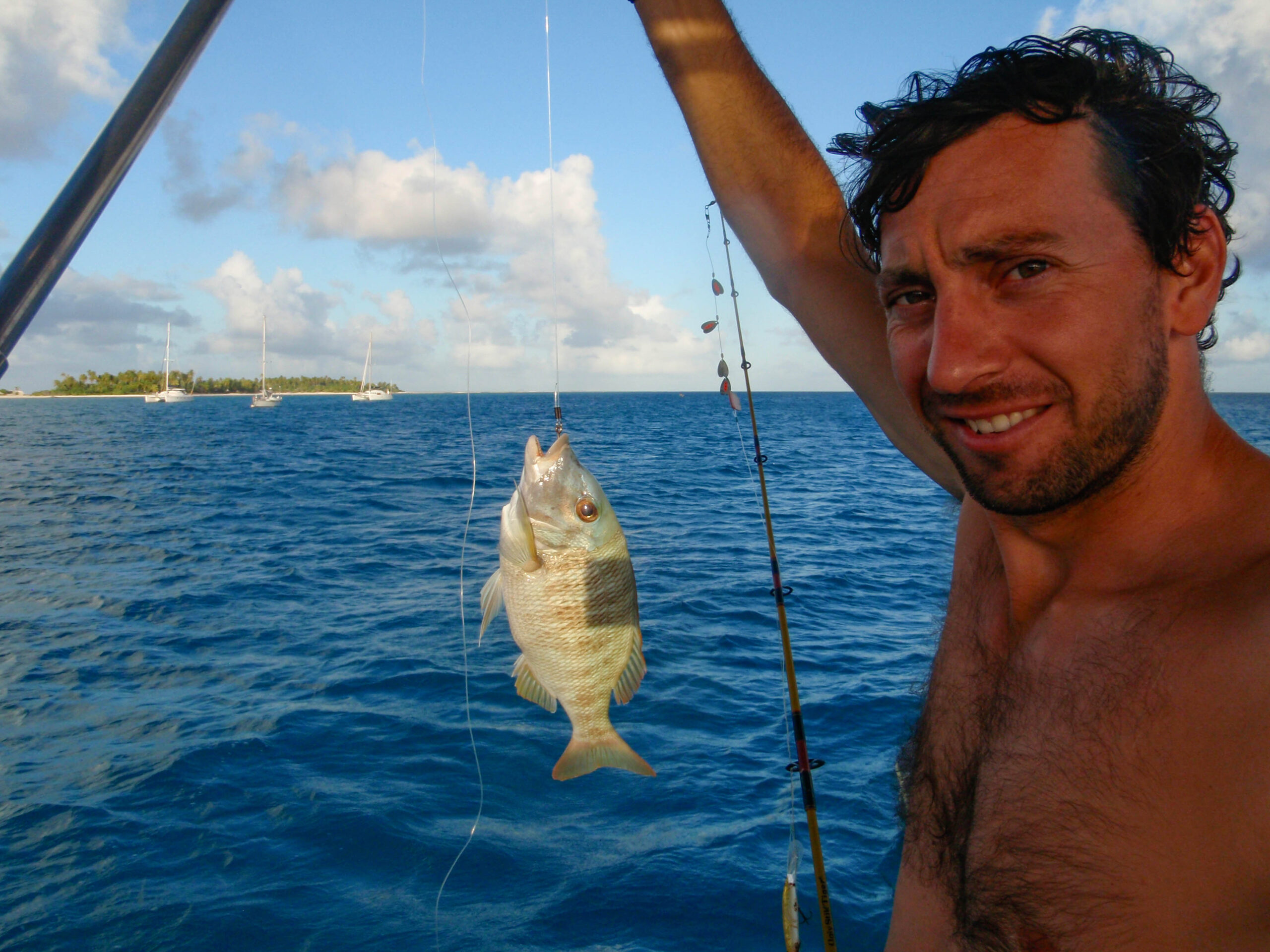
    Matt and Karen reported no luck fishing while sailing across the Pacific and while cruising the Marquesas and the Tuomotus.  This poor showing on the part of the fish to readily enjoy our lures, combined with Matt’s reticence at the idea of cutting up live things with guts in them has led to a decline in fishing attempts onboard s/v Syzygy.  Who can blame them?  They never caught anything.  With my arrival, I bring fresh hopes and renewed vigor to the idea of fishing.  And an indefatigable arrogance that it has to be possible to catch something.  Anything.

    And I have failed.  Failed as all other attempts at trailing lines has failed on s/v Syzygy.  Please other cruisers who are able to catch fish regularly,  tell us your exact set-up of trolling lines and how you catch fish, down to the minutest detail.  Because we are incompetent.  We have read a book and we have not learned.  Nearly all things done on this boat, all the sailing knowledge, all the boat projects completed are because we read a book and learned about it.  We read a book about fishing, but we cannot seem to learn how to fish.  Please tell us everything about your set-up.  Length of line out, type of knots, length of mono-filament.  Type of lure.  Color of lure.  Number of lures.  Depth of lure.  Time of day.  Depth to ocean floor.  Distance to land.  Boat speed.  Wind speed. Current. Hook size.  Hook placement within lure.  Allowable rust level on hook.  Bait used or not.  Leader weight used or not.  Chum used or not. Teasers used or not.  Pagan gods to whom you might give sacrifice in order to make the ocean share its bounty.  Please include video of ceremony, text of chants and incantations, list of all incense types used and step by step instructions for actual sacrifice.

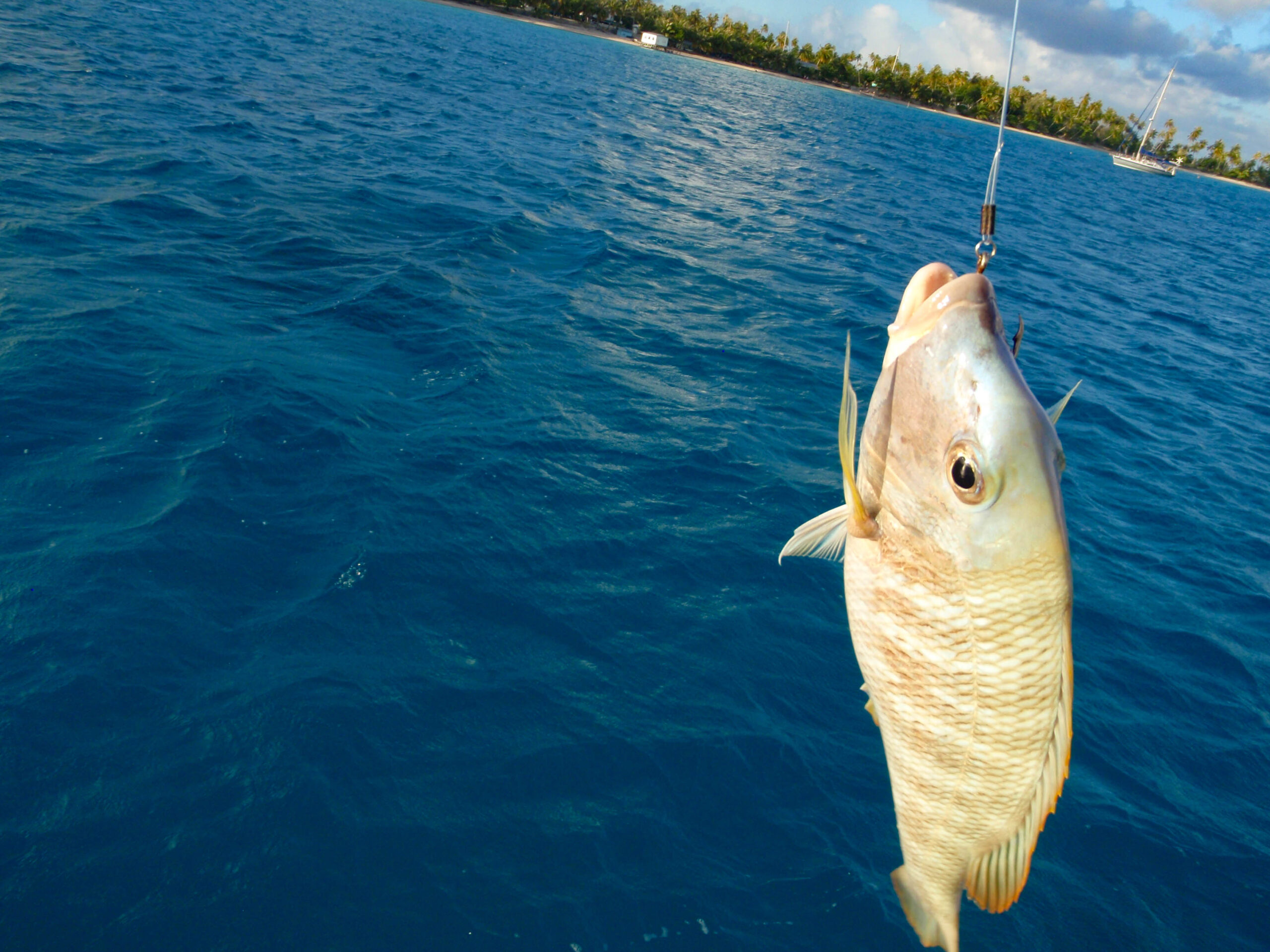
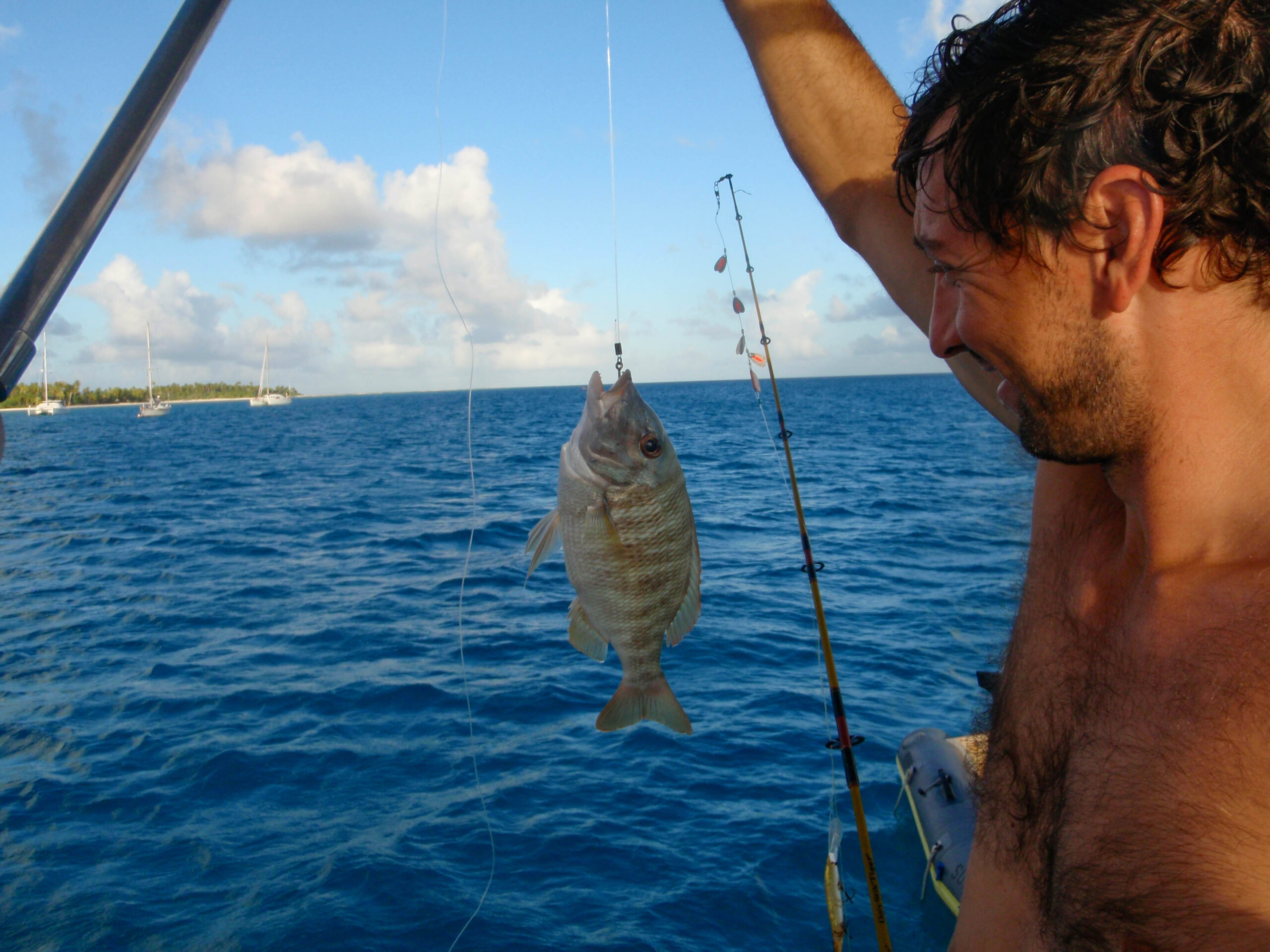
    I have, actually, caught some fish.  But I was only able to do that at anchor.  When we were in Apataki, and in having beer and an excellent lunch at the cargneage(boat haul-out center)/pension/restaurant/happy hour/pearl farm establishment, fishing was brought up with the family who owns all this enterprise, Alfred and his wife.  They said they had a surefire way for us to catch fish involving hermit crabs as bait and that next time we come to shore, they would show us.  The next day, we show up but Alfred is off fishing and his wife is gone.  Karen manages to relate to the very nice ancient lady that met us at the dock (Alfred’s mom??) our intentions.  So before we know it, this 80-ish year old woman has grabbed a hermit crab.  Matt and I are hustling around trying to watch every little step of what she does.  She then gets a hammer, one shot smashes the shell, grabs the hermit crab, one hand around all it’s legs and claws, the other around its guts and rips it in two pieces.  She threads it on the hook and done.  30 seconds have passed.  I am in awe.  In a couple of days, I will no longer be in awe of the process.  Instead, I will be a one-man professional hermit crab death squad.

    We collect a dozen hermit crabs and head back to the boat.  At dusk, apparently good fishing time, I retrieve a hammer, a cutting board, and a hook.  I ask Karen to retrieve a video camera.  The nice ancient lady completed the steps in about 30 seconds.  It takes me 30 minutes.  So despite that it is now dark, I try to fish anyway.  Nothing.  Nothing.  Nothing.  I take solace in the fact that it is pitch black out and vow to try again in the morning.

    In the morning at 6 am I begin setting up to try again. Success!  Within a half an hour I’ve hooked two fish.  Karen comes on deck.  I ask her what to do now that I have a fish flopping around in a large green bin.  She says I have to kill it.  I don’t know how to do that I reply.  She fetches the book.  We read it.  We learn.  The fish dies.  Knife shot to the brain, one inch behind the eye.

    After reading the book for each step in the process of gutting and cleaning we take the fish into shore to make sure that we can eat them.  Some fish you can’t eat because of a nasty little disease called ciguterra  I refer you to a blog post from our good friends Mike and Hyo aboard Io, Mike is a marine biologist and so can explain all the nastiness of ciguterra better than I.

    Matt gets the job of cooking the fish and that night we finally dined on fresh fish.  The next night we again dined on fresh fish.  It was wonderful, albeit a bit bony.  Then we moved anchorages, losing our source for local knowledge of ciguterra (Different fish on different atolls have it) and we have not had fish again.  Back to cans.

    So fellow cruisers, please help us become better fishermen and fisherwomen.  Please help us spare the cans.

  • Apataki

  • Toau North

    karen wrote a good post. I will copy it here in case the links break.

    The moon shone round and bright in the evening sky and the water sparkled under the stars.
    We pulled our dinghy up to the short wooden dock, noting that we were the first crew to arrive for dinner.  “Are those lobsters?!?!”  I asked hopefully, pointing at a table on the porch stacked with spider-like objects.  Seconds later, we were greeted warmly by our hosts, locals Valentine & Gaston, whom we had met briefly a few nights before.  They invited us to lounge on the porch enjoying our wine and fresh baked foccacia de poisson while we waited for the others.

    The porch was a sturdy structure, housing some chairs, a table, an open bbq and, interestingly, three furry frigate chicks that Gaston & Valentine were raising.  The birds’ beady eyes watched us suspiciously and if we got too close, they opened their long beaks and made hissing noises, and flared their fluffy white wings, already looking rather menacing though they were only a month old.  At our feet, a dozen hermit crabs roamed the floor, their prickly red legs clutching awkwardly at broken pieces of coral.  We made ourselves comfortable in the chairs and Matt uncorked the bottle of red wine we had brought from the boat.  We had barely poured our glasses when Gary & Tara of Pursuit IV showed up.  We all introduced ourselves and opened with the usual yachtie chit-chat, but I knew almost instantly that they were a fun couple….  Because one of the fastest ways to judge someone’s sense of humor is to see how they react when there are humping dogs less than five feet away.  In this case, a large rottweiler-pit bull mix was attempting, rather unsuccessfully, to get it on with a little shitzue.

    “Doesn’t look like he’s having a whole lotta luck,”  Matt said.

    “Oh, I don’t know – I thought he had the right idea with that ramp over there,” added Gary.

    “Yeah, but she doesn’t really seem all that interested,” said Tara, as we watched the shitzue nuzzle a hermit crab, seemingly oblivious to the rottweiler’s advances.

    That we could discuss the merits and methods of humping dogs just minutes after meeting Gary and Tara convinced me that they were our kind of people.

    Gaston chased off the horny rottie just as Oscar and Graciella from Zenitude joined us.  Oscar was quite the character.  He reminded me of Sal Mineo (?) of the movies, with a tanned rugged, round face, exuding warmth and humor, and had such a thick spanish accent that every word he said made me want to laugh.  He was full of useful anecdotes, though, especially when it came to sealife.

    “De moray eels, you know-ah dem? They got de big teeth and look-ah like-ah snake? Did you know that you can charm-ah dem like-ah snake too?  Yesss, when you dive, you see dem, and don’t get too close because dey are territorial, but you see dem and dey poke-ah the head out of-ah de hole and you go-ah like dis…”  He then undulated his hands slowly in front of him as though he was wafting a fragrance towards his nose.  “You do it like-ah dis and you will see de head come out and de body of the moray eel will come out and he will follow you!  Just like-ah dat…”  he did the waving motion again.

    He then goes on to tell us that we should be careful when searching for lobsters because of the “dramatic triangle.”

    ” See, de dramateek tree-angle is de lobster, de octopus and de moray eel.  De octopus love-ah to eat de lobsters.  Dey tear off the shell and suck-ah out de insides.  De moray eel, he love-ah to eat the octopus. So, frequently, you-ah find-ah the lobster and de moray eel together.  The lobster, he like-ah da eel for protection from the octopus, and de moray eel, he-ah use-ah the lobster like-ah de bait!  So, when you grab-ah for the lobster, maybe you put-ah your hand near the moray eel hole and he will bite you, or maybe he will be bite you because he is pissed off that you are stealing his lobster!”

    Eventually, our conversation made its way back to the usual cruising topics:

    “Everyone always asks how we can afford to do this,” says Tara.  “It drives me crazy! I mean, it’s like asking how much money I make in a year, you just don’t do it!”  She shakes her head.  She’s 30 and Gary is 40.

    Oscar leans forward, “Well, it’s-ah because you are young! Everyone knows that us old people are retired!  You’re young, you’re not supposed to be able to afford it!”  He pauses and looks around at all of us younger cruisers. “But, is good.  Is good that you do it now. My son, he want-ah to go cruising and he take-ah his girlfriend and they have a boat, and they sail for a while.  But then, she turn thirty.  And you know…”  He looks pointedly at Matt and Gary. “You know, when a woman turn thirty, she-ah start-ah getting funny in de head.”  The guys laugh and Tara and I look at each other with understanding.  “So she turn-ah thirty and want to get married.  So dey stop-ah de cruising and dey get married right away and then she get pregnant right away!  So,” he sighs heavily, “Now we have a granddaughter.”  Tara and I smile at Graciella.  “But!” Oscar continues with renewed enthusiasm, “Now I have-ah two problems!”  He thrusts out two fingers.  “One, now-ah I have to go back-ah to Australia because I have to see my granddaughter, and two…”  He pauses theatrically, ” I’m married to a grandma!”

    Our conversation easily wound its way from topic to topic as good, enjoyable conversations tend to do, and somehow we ended up talking about other types of traveling and Oscar once again pipes up.

    “Right-ah after nine-eleven, I was-ah moving to the U.S. and I had to pick-ah up my large moving boxes from-ah Kennedy airport.  So, I-ah rented de van from … u-haul! and put de boxes in de van and den I had to go through de mid-town tunnel.  Can you imagine what-ah happened to me?!  Dey were stopping all of de vans and so dey stopp-ah me and here-uh I am – an Argentinian with an Australian passport and a New Jersey driver’s license!  Haha!  Dey didn’t know what-ah to do with me!”

    We all laughed, more so at the expression on his face than at the story itself, and then Valentine called us in for dinner.

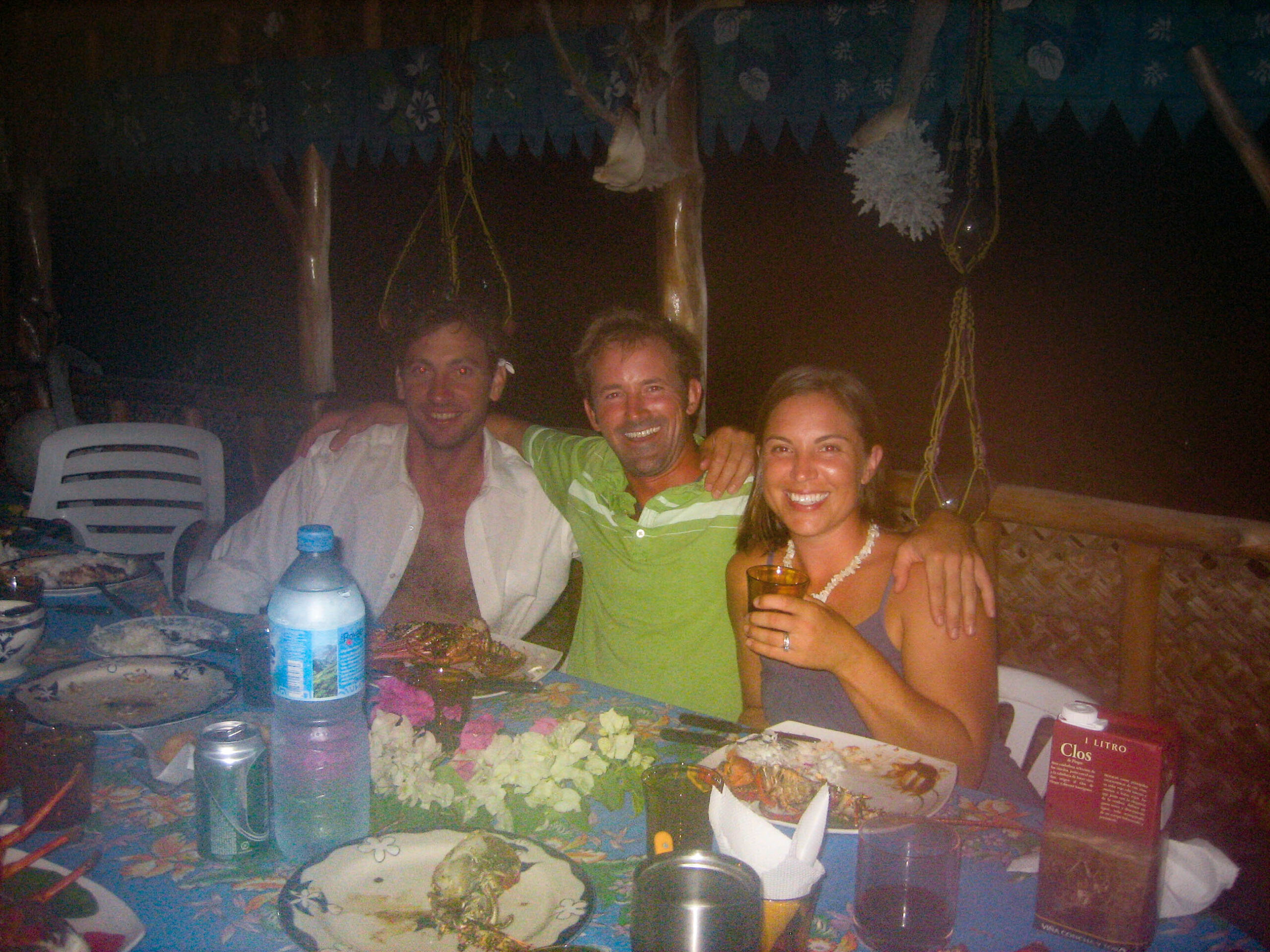
    The table was in the center of the room, covered with a blue table cloth and decorated with long branches of pink, purple and white flowers.  Evenly spaced down the center there were bowls of rice and sauces, and trays stacked with halved spiny lobsters. Valentine served slices of breaded tuna first, slightly cooked, with warm raw centers.  We dipped these in a spicy red cocktail sauce (although Matt swears it was just A-1 mixed with ketchup).  Next, we passed around pieces of lightly breaded chicken accompanied by white rice and fresh-baked coconut bread.  Finally, we got to the lobster – sweet, buttery and delicious!  All this was followed by a large slice of fluffy white cake with a sugary, carameley topping drizzled over it.

    Gary, Tara, Oscar, Graciella, Matt, Jon and I shared loud boisterous tales at one end of the table.  We were discussing couple-living in small places – like a boat – when Gary said, “Arguing is the worst.  You can’t get away.  It’s like, ‘um, can you just go hang out at the bow for a while??’”   Tara added, “Yeah, it’s hard when you fight.”

    “What do you mean?”  I said incredulously, with a touch of sarcasm.  “I cry,  Matt feels bad, and the problem is resolved!”   Laughter erupted around us and Oscar pointed at Matt.

    “You!” he started, between laughs.  “You are in trouble!! She has a dirty mind! She is already tricking you! She has a dirty mind! You are in trouble my friend!”

    Thankfully, Gary took over after that, relating his more hair-raising adventure of breaking free of a mooring buoy and getting washed up on coral the night before we arrived here.

    Although I was yawning, the night still felt too young when Valentine kicked us out with an unceremonious, “Ok, dinner is over” as she stood up and started clearing plates.  Apparently, the Argentinians and the Brazilians were coming over at 4:00 AM to watch the World Cup game with Gaston, and Valentine would have to be up early, too.

    Our fantastic homemade dinner felt a bit expensive at $30 per person, but the experience was priceless.  And, at the end of the night, we all unhitched our dinghies, made a few jokes about each other’s outboard engines, and putt-putted away with smiles on our faces.

  • Toau North

  • Meeting Ken. Pronounced …. I still don’t know

    (concerning events: June 20th)

    After a couple of days in Fakarava, Matt and Karen wanted to beat a hasty leave to Toau, another atoll a short day sail away.  Another couple, Mike and Hyo aboard Io, were anchored there.  Mike and Hyo are awesome fun people from Canada.  They have done a fair bit of rock-climbing, are adventurous and generally see the world similarly.  Mike’s insistence that you cannot buy a new, quality, made-to-last toaster for any amount of money anywhere in the world notwithstanding.  He says the same thing about chain-saws, a subject upon which, given his Canadian background, he can more convincingly provide expert opinion.  They are also young, young 30’s, a rarity in the cruising world.  Matt and Karen, after having been predominantly on their own for the last two months exploring nearly or completely deserted locales, were, despite my arrival, still desperate for more interaction with more people.  So while I might have wanted to stick around Fakarava for a while, it was my very first place after all, I easily deferred and we were off to Toau, I content in the thought that more adventures would be waiting.  Mike apparently had a spear gun.  And a machete.  More adventures would definitely be waiting.

    The first morning in Toau I was again up at 6 am.  Despite having played a game of Carcassone (a fun tile-based make cities and roads and farms and score points thing) until midnight or so with Matt, Karen, Mike and Hyo.  I swam to shore, and starting walking along the water’s edge, lagoon side.  It was not evident that anyone lived here, though we knew Mike had hung with a couple of locals, Martin and Wallace, that lived 3 miles south.  Martin and Wallis lived on different motu’s, the little islands that make up the atoll ring, and so rarely got together.  They communicated with each other every night via a smoke signal, to let one another know they were doing OK.  So didn’t think that I would be running into anyone, but about 20 minutes into my slow stroll along the lagoon, a voice calls out in Hello.  “Bonjour!”  I reply hesitantly, not wanting to insinuate that I spoke any other words in French, but also wanting not to be an ugly American and presume English capabilities.

    Ken and I thus met.  I was the only person from any of the sailboats he had met and was eager to interact.  You pronounce his name like it appears, however the ‘n’ is very soft to the point where if you just say the ‘K’ and the ‘e’ like you were about to say ‘Ken’ but then left off the ‘n’, you would probably be most correct.  Retrospectively, I don’t think this was his given name, but rather the name he gave to foreigners.  Ken spoke some English and I was rapidly becoming excellent in Pantomime, so we hit it off well.  He asked if I wanted some breakfast, some coconut, and so found one of his specialized tools for copra farming he uses to cut down coconuts.  It was essentially a 10 foot long pole, bamboo I think, with a small curved scythe like blade on the end.  Reach up and hook it around a coconut, then cut and run.  So you don’t get hit by falling coconuts of course.  Out comes the machete.  Top priority in Tahiti is to buy me a machete.  With a few quick hacks the husk is off, and a small hole the interior nut is chipped.  I am now drinking coconut water straight from a coconut, while sitting on the beach, talking with a Tuomotian.  At 7 am in the morning.  This day is starting off well.

    Ken and I continue talking.  I desperately wish in this moment that I could speak fluent French.  The interaction would have been so much deeper.  This feeling has happened few other times so far during my three weeks here, and we only have another three weeks or so in French speaking territory.  But in this moment, I definitely wish I could speak French.  We talk about what he does for a living, which is harvesting copra.  Copra is the meat of older coconuts which is then dried.  It is then sent to Tahiti to make coconut oil.  Or something like that.  Once I’ve finished the coconut water, he takes it from me and breaks it in half with the blunt of the machete.  A flick of the wrist, the machete slices through the air, and he has carved from the outer edge of the interior nut a spoon like utensil which he hands to me and motions that I should dig out the jelly like material inside of the coconut.  More delicious yummy goodness for breakfast.

    Ken then asks if I fish, and I unfortunately have to reply that, no, I don’t fish, but I very much want to learn.  So he motions that we should go over to the ocean side of the atoll.  It’s a quick 5 minute walk away and along the way he picks up one piece of fishing gear.  An eight foot long perfectly straight wooden pole with three metal pieces of sharpened rebar on the end.  This is a traditional Polynesian spear.  We are going spear fishing.  Polynesian style.

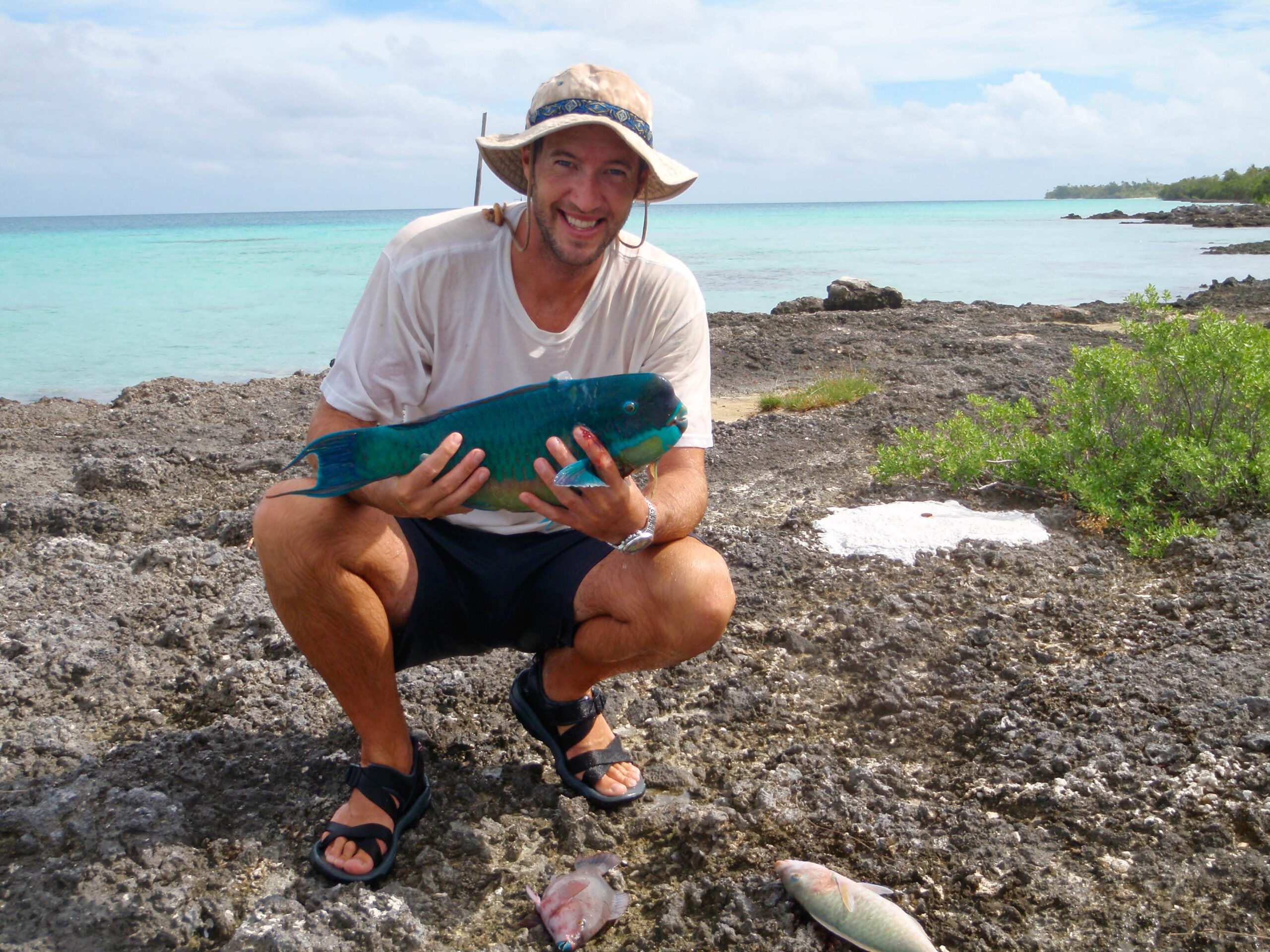
    Ken walks up to the edge of the water looking for fish.  On the ocean side of every atoll I have been on, there is a small reef between 20 and 60 feet away from shore where the waves break.  the reef is submerged during hide time and exposed during low tide.  It’s about midway right now, the tide rising, and here, (not everywhere as I will find out a week later when walking along a similar reef I am knocked over by a wave and sustain small cuts from the coral reef on my fingers, ankle, thumb, calf and a deeper, larger abrasion on my back) we can safely walk along the reef as well.  As Ken walks up to the water’s edge, he motions that he is looking for fish and sometimes points a few out.  We are looking mainly for parrot fish who with their bright blue-green skin are extremely easy to spot in the two foot deep shallows between the reef and shore.  Moments later he spots one close.  He creeps  slowly at first, then a quick burst of speed and the spear is then flying into the water.  Splashing the six feet over to the spear he pulls it up.  First throw: one fish.  He then hands the spear to me.
    ‘That didn’t look to hard,’ I think, knowing full well that a lifetime of practice went into that throw.  He helps me stalk some fish.  I try the slow stalking method, but he encourages me to get upon them faster and so I run up and then give the spear a toss.  Laughable.  LAUGHABLE!  the spear didn’t even make it to the water cleanly, deflecting through the air and hitting the water nearly broadside.  I laughed.  Ken laughed.  I went to try again.  I spotted more fish, and this time the spear at least entered the water cleanly.  I picked it up, but no fish came with it.  Half a dozen more tries, kept me hilariously occupied, Ken encouraging me on.  I could have gone for another two hours I was enjoying myself so, but I think that Ken was tiring of my ineptitude and was ready to head back.  I don’t blame him.

    As we were walking back, we again talked about coconuts, him pointing out which ones were good for eating and what stages the coconuts were in.  As we arrived at the atoll shore, he said I should return at 10 am to do some more fishing with him and his cousin.  I asked (pantomime combined with embarrassingly short phrases) if the other people from Syzygy and Io can join.  I’m thinking Mike from Io and Matt would love to meet Ken.  Mike had met Ken’s cousin, Martin, who would also be fishing with us, but not Ken.

    At ten Matt, Mike and I head back into shore in Mike’s dinghy.  Ours is not reliable.  O.K., it’s a janky piece of shit and we have tried our best to inadvertently lose it or ruin it.  (see Karen’s blog, and… just kidding.  Kind of.)

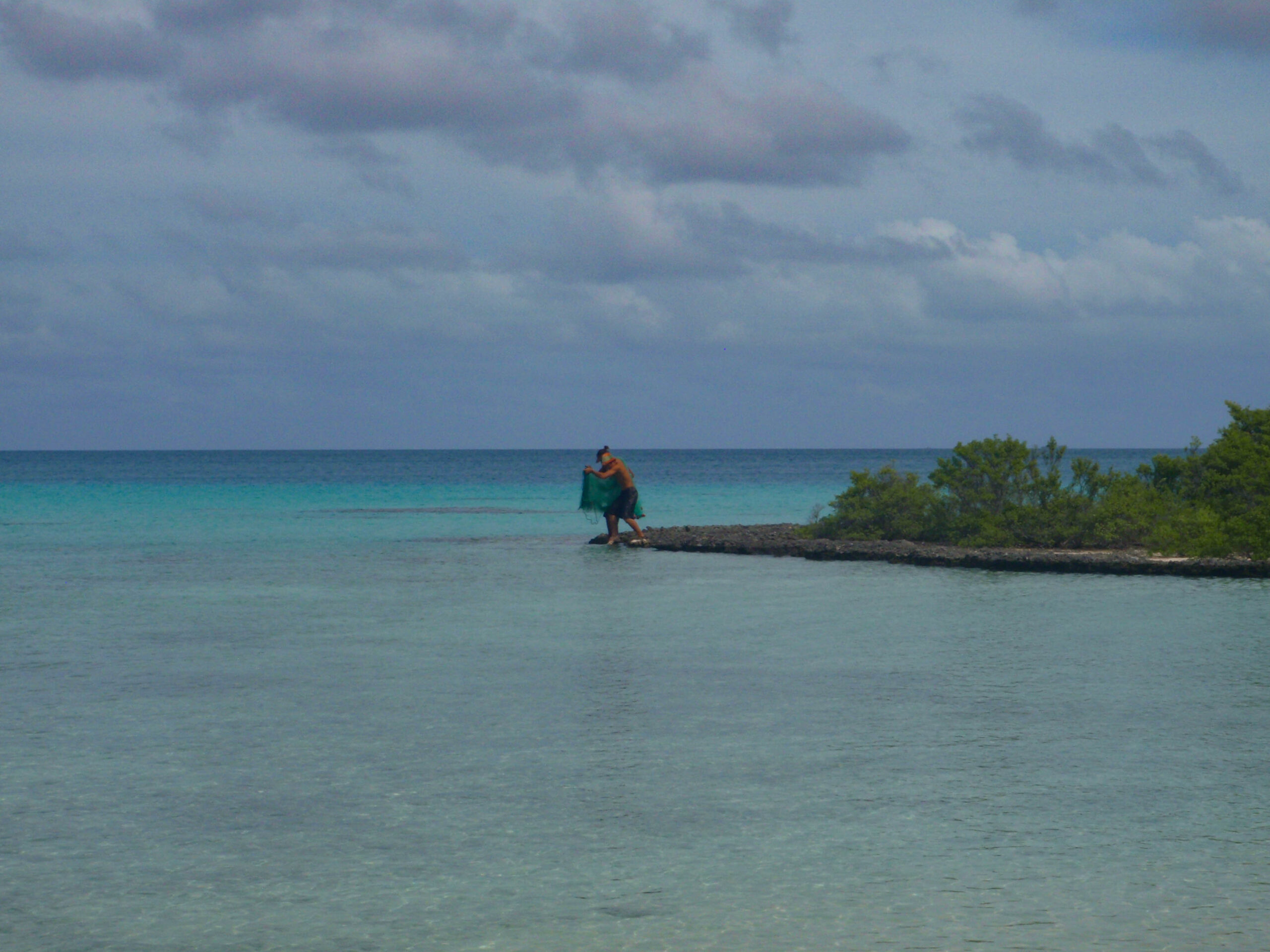
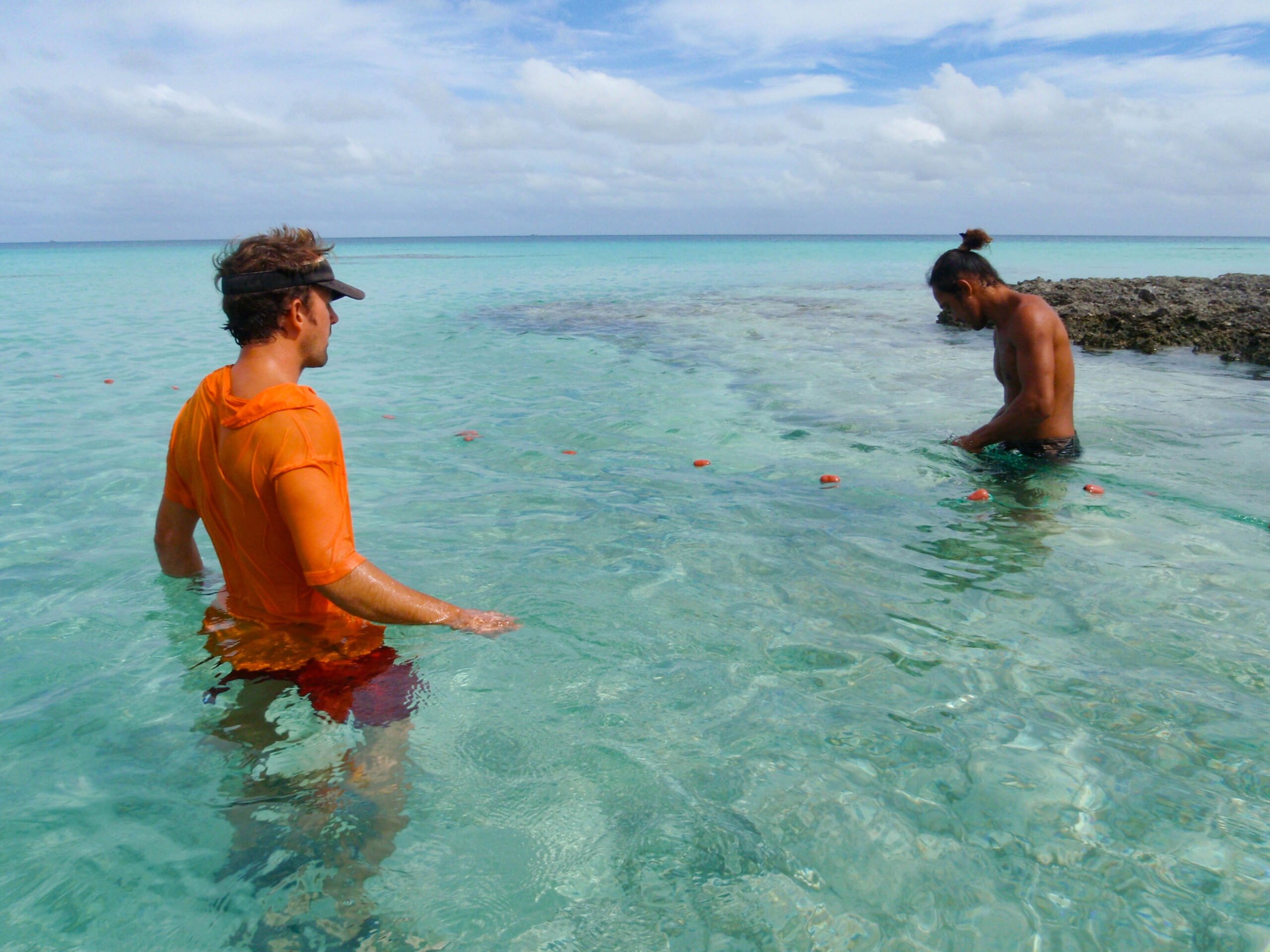
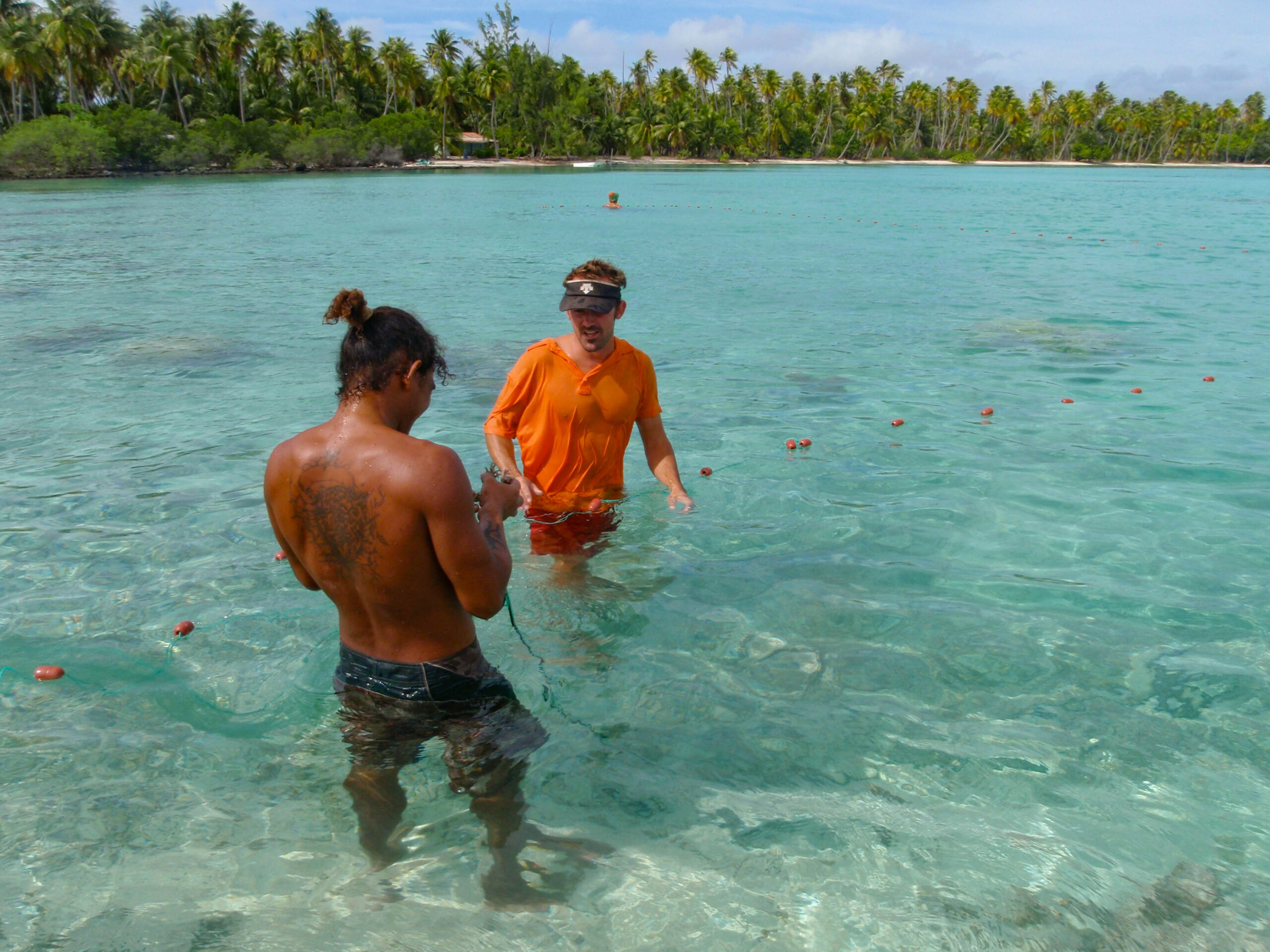
    Ken and Martin take us down the shore a bit to a small little cove.  We wait on shore while they take what looks to be an incomprehensibly jumbled net 200 feet away to the other side of the cove.  To my amazement, they are able to  stretch the net out with little to no tangles; it was perfectly laid out to unfold nicely.  The net is a mesh of super thin mono filament or nylon, extremely hard for fish to see.  A fish hits it and will quickly become tangled.It also has floats along one edge and weights on another to form a wall of net.  It ends up being about 80 feet long and once it is stretched out, they motion for us to begin walking towards it.  Mike has said that he has seen this and that we should grab sticks and bang the water.  So Matt and I go looking for something to hit the water with.  We then proceed to wade through the water towards the net slapping the water with sticks in an apparent effort to scare the fish and corral them towards the net.  Three white guys walking through the water banging on the surface with tiny sticks.  It must have looked side-splittingly funny.  I felt ridiculous.  Matt later said the same.

    Once we have arrived at the net, Martin and Ken start checking the net for fish and throwing ones that were caught onto the bank next to us.  Matt spots one in the net.  We’ve caught four fish!  One large parrot fish is the big prize.  Back to shore, we begin to scale them.  Ken and Martin tell us that all of the fish are ours; we can’t thank them enough.  More people in a seemingly unending string of wonderfully nice local people.  Willing to share their generosity, kindness, and skills with foreigners.  You just have to reach out a little and show you are open to it.

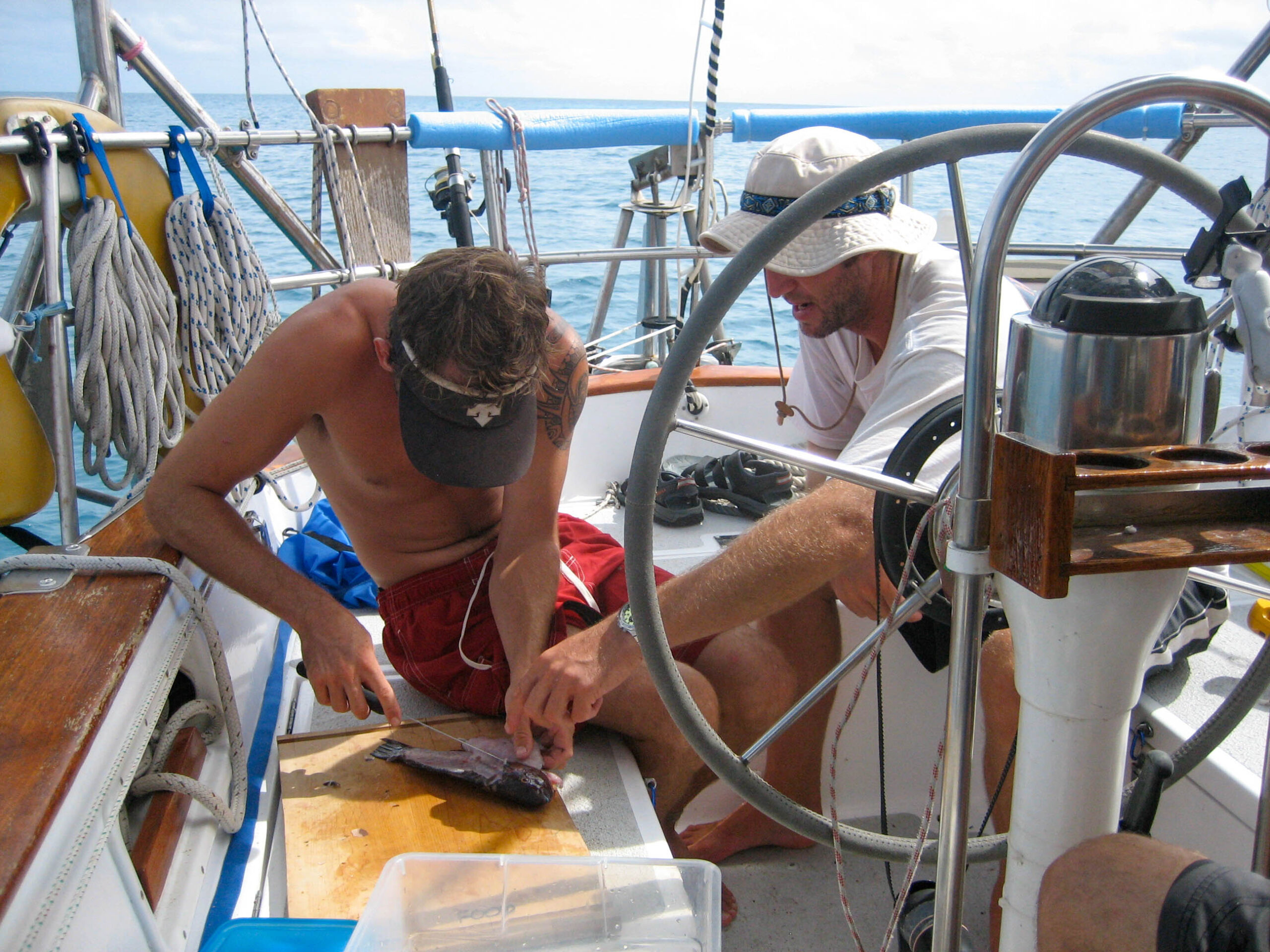
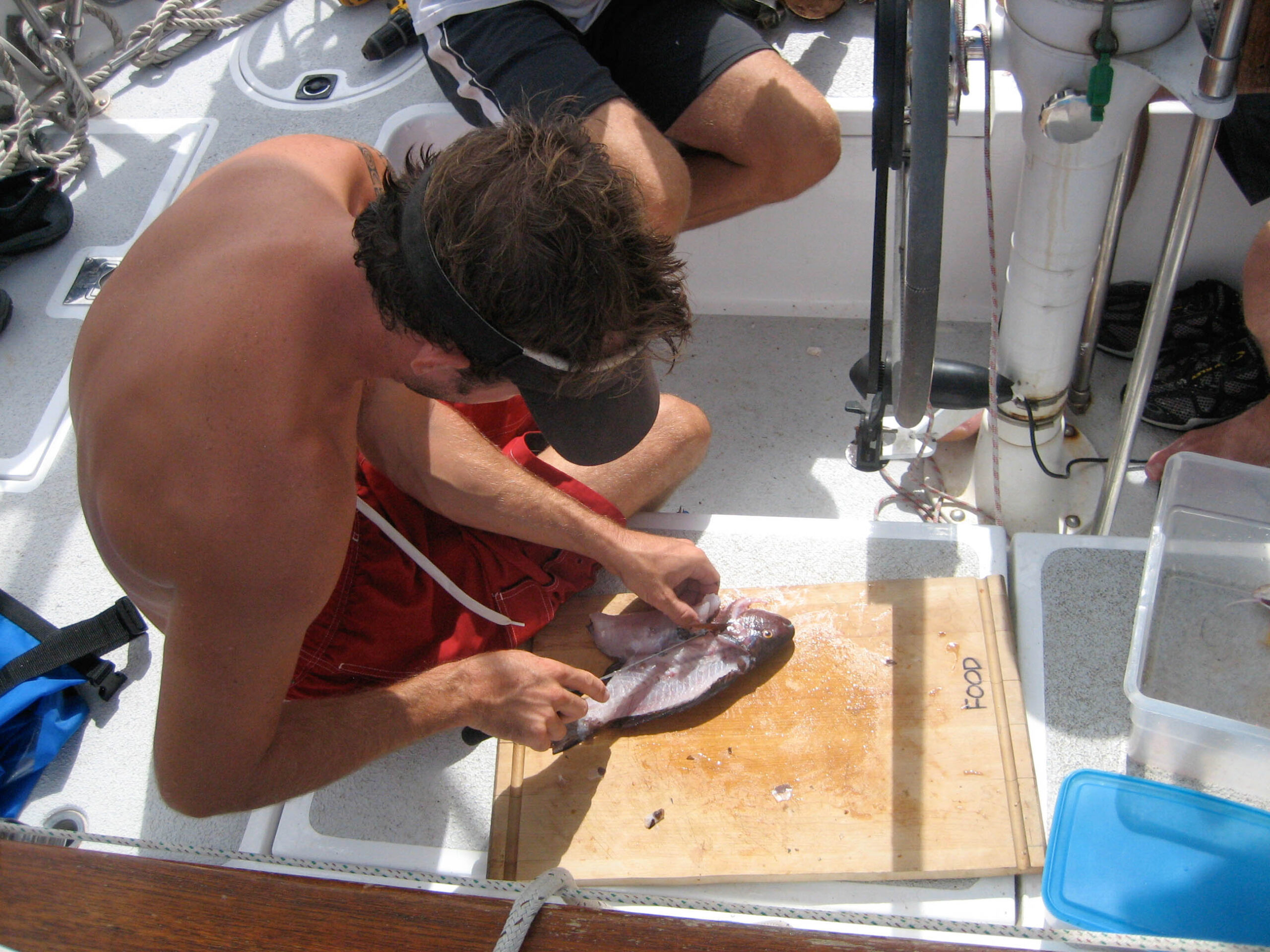
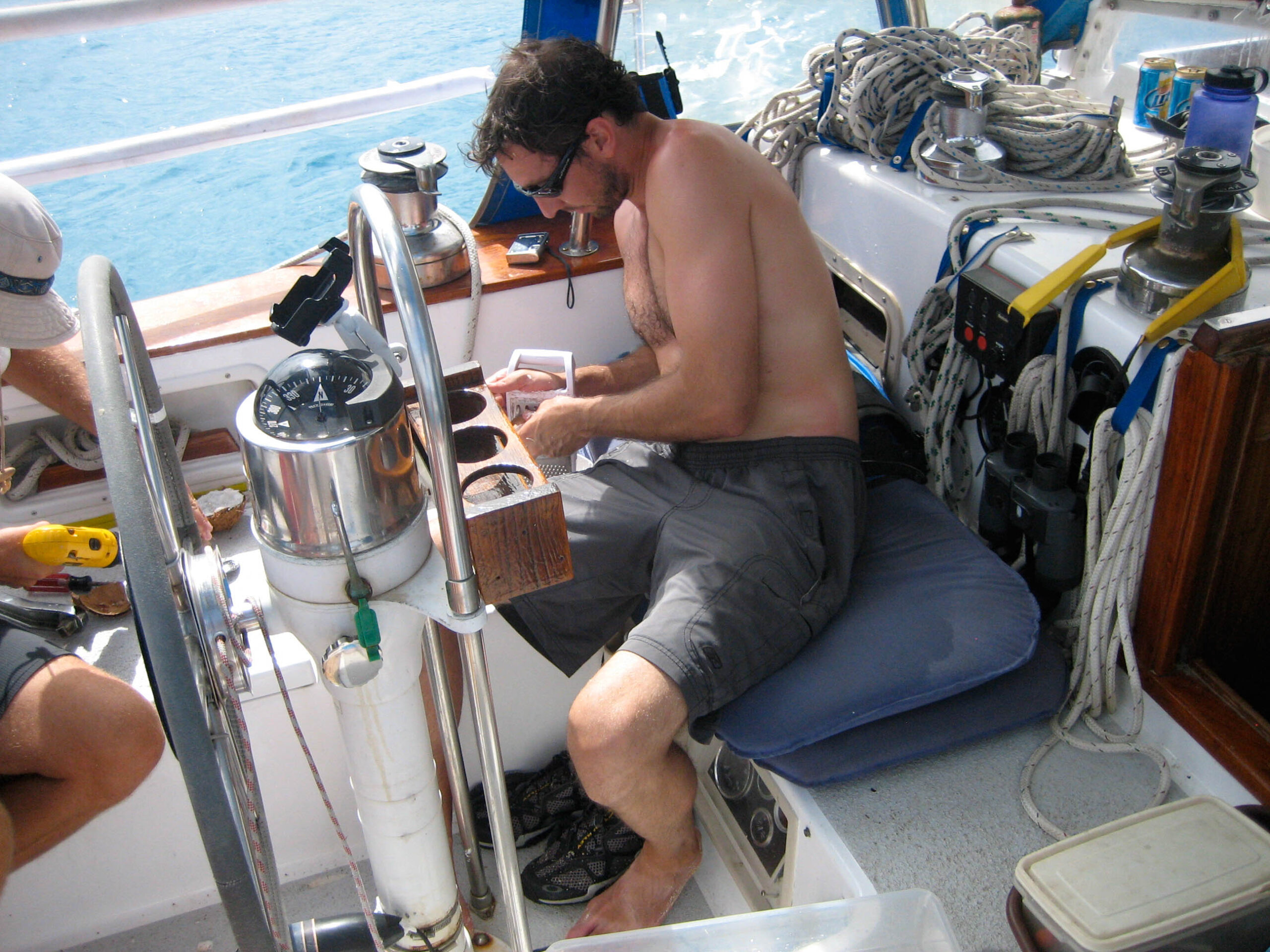
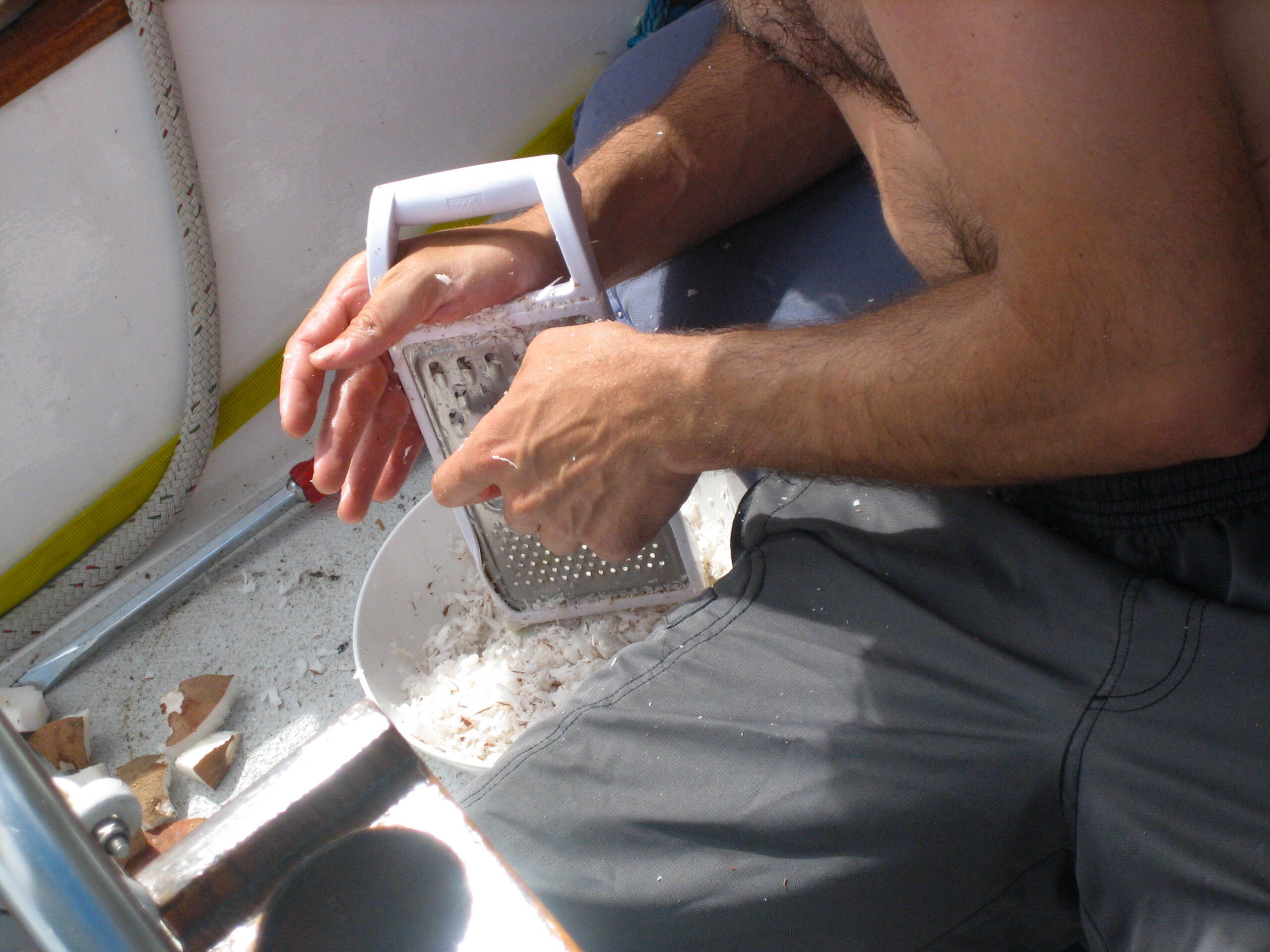
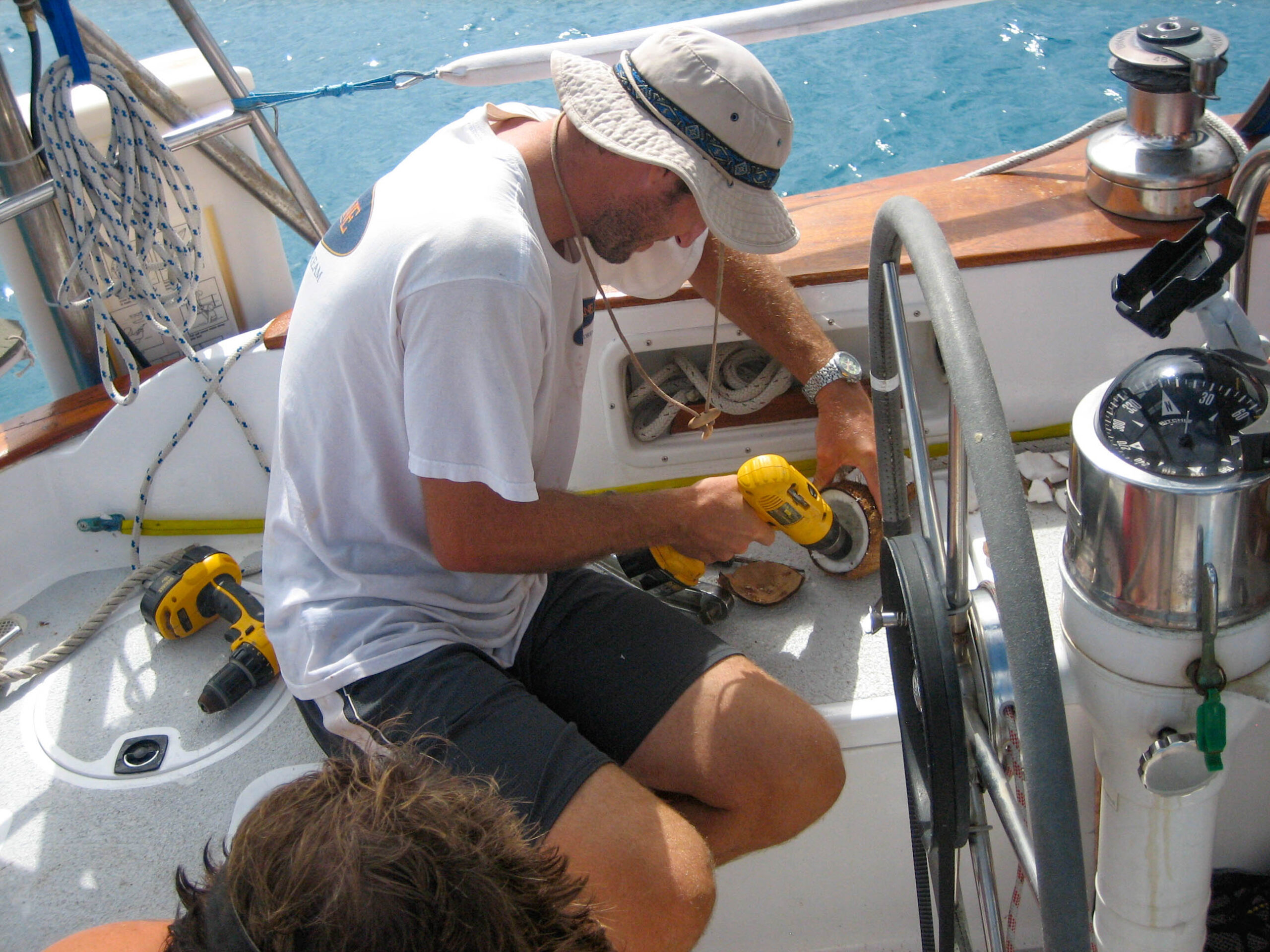
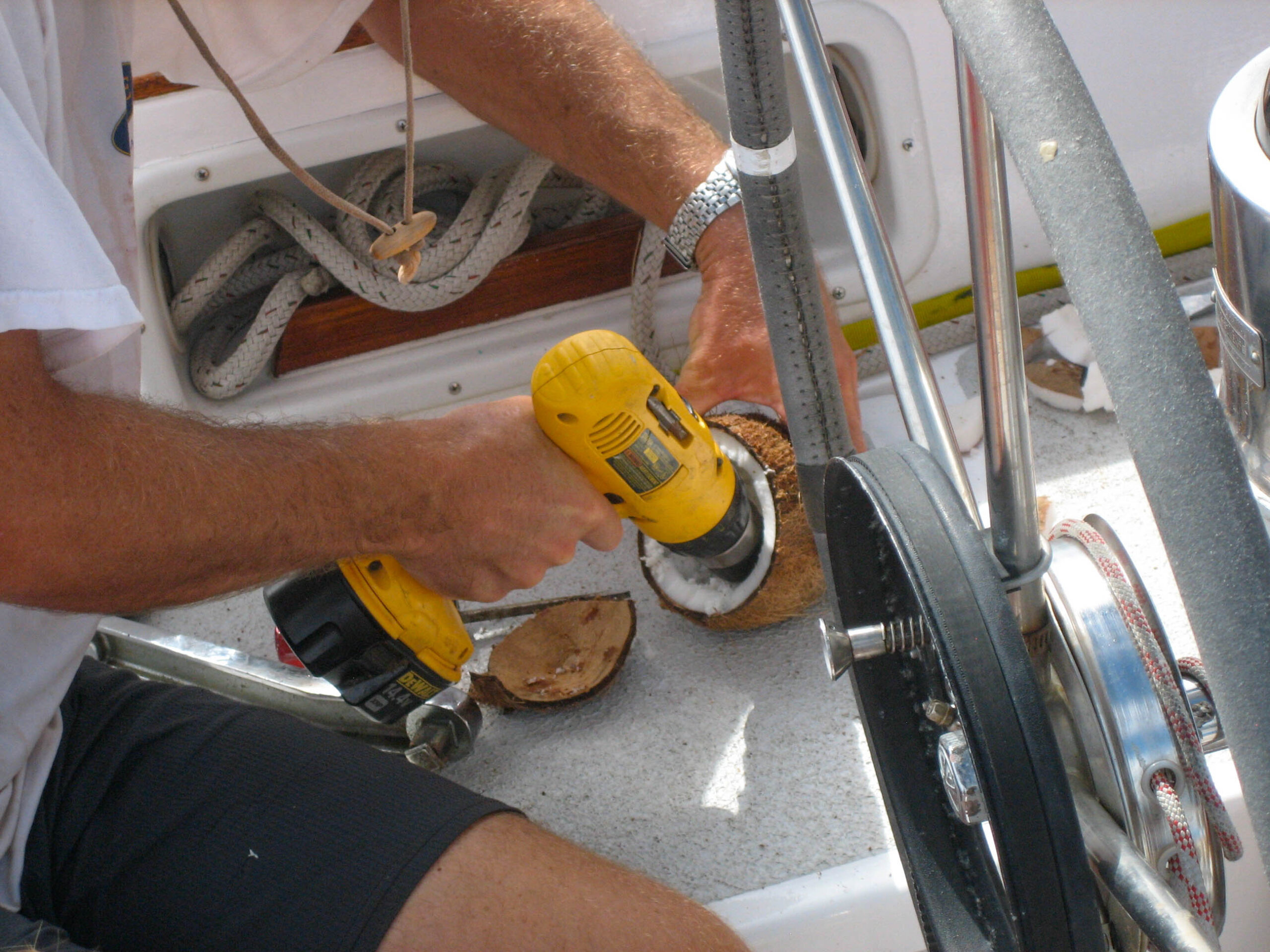
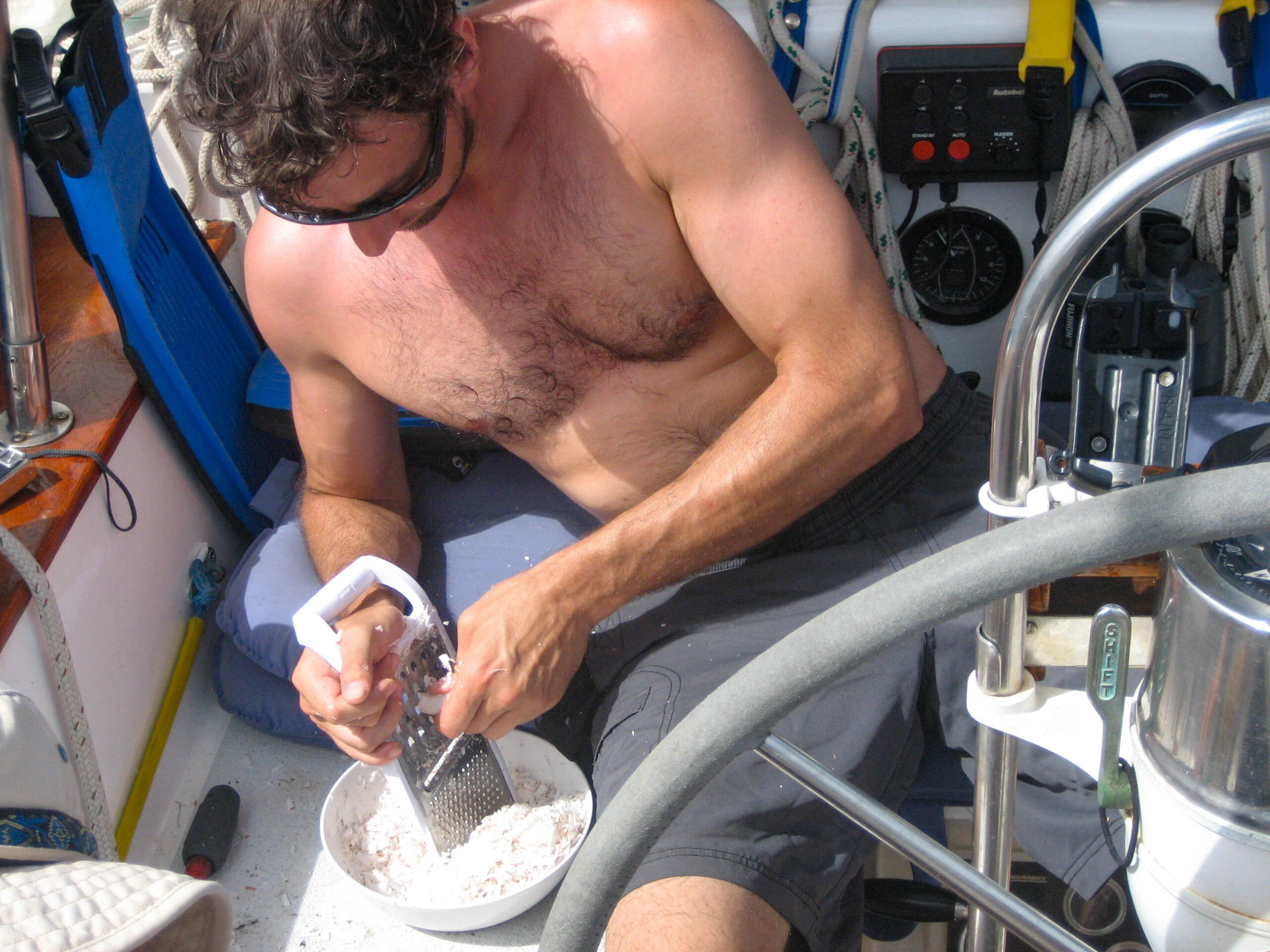
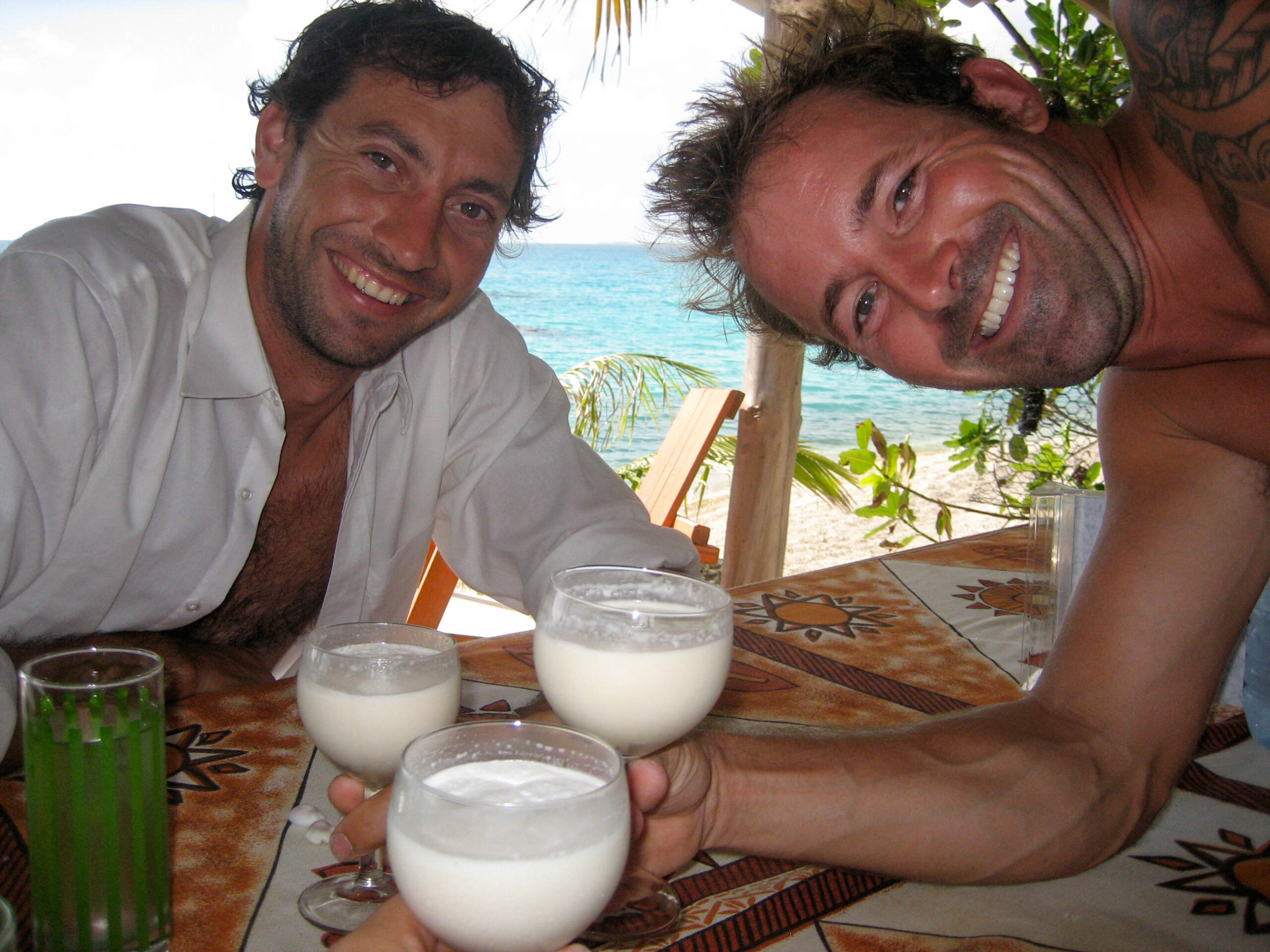
    At the boat, Mike shows us how to clean and gut the fish, and says that since these are our first fish that we’ve done that to, we have to have a piece of sashimi from the parrot fish, right then and there.  It was excellent.  We then work up a poisson cru, a popular Polynesian dish where the fish is steeped in lime juice.  Like ceviche, this kind of ‘cold cooks’ the fish.  We then cut up some late development coconuts to get at some of the coconut meat.  You are supposed to grate the coconut meat, then put the shavings into a cheese cloth and squeeze.  Out comes a delicious milky substance.  Add that and some cucumber and onion to the fish.  Poisson cru.  We started with a cheese grater for the coconut.  Matt upgraded us to a power drill with a sanding bit.  That was fun.
    That led to dinner, another game of Carcassone, and the day was done.  Thanks to Ken for showing me a great day!

  • Coconut Shenanigans

  • 1st Day

    (concerning events: June 17th)

    The alarm sounds at 6 am.  Despite being in a deep sleep, I quickly lash out an arm, flopping it around searching for how to turn it off.  Matt and Karen will not be up for another two or three hours and I don’t want to disturb them.  Last night, I told them I was getting up early to watch the sunrise.  They scoffed and said I would get over that soon.  (Three weeks later, I am still getting up at 6 am almost every day to watch the sunrise. I don’t even need the alarm anymore.)

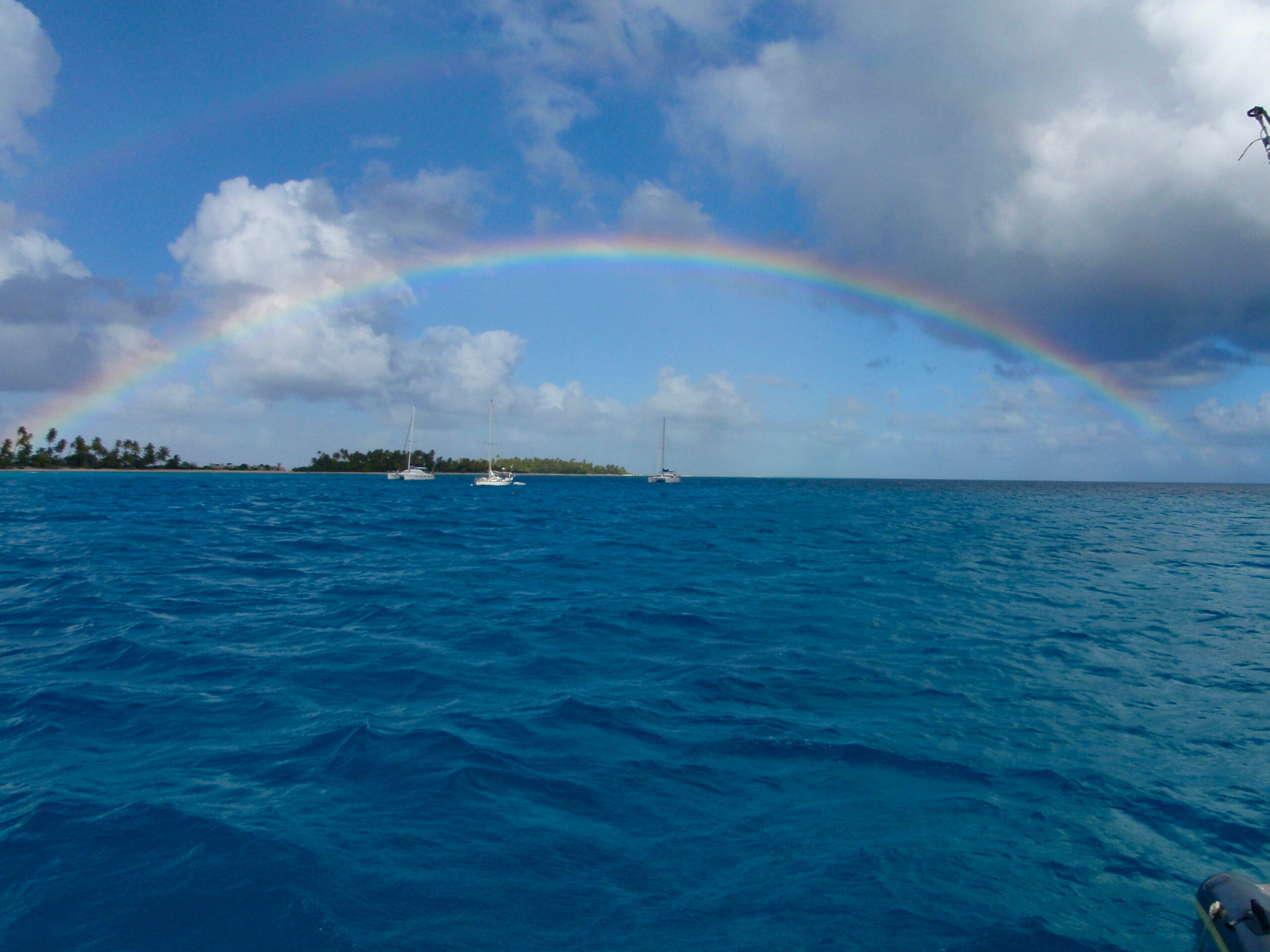
    Up on deck, I quietly watch the sunrise.  While not the most spectacular I’ve seen, that wasn’t the point.  I envision maximizing each day, enjoying all that I can and seeing every moment of beauty.  This is the fantasy, and for the first day, at least, I’m going to make it happen.
    I then find the dry bag and swimming goggles.  I put socks, shoes, and a shirt in the bag and roll it up, hoping it works; Matt voiced skepticism the night before.  I don the goggles and gingerly ease myself into the water, not because it is cold but because Matt and Karen might stir from a loud splash.  They have adapted to wake at any unusual sound, in case it might indicate something is wrong.  They have not had to deal with the morning sounds of a third person on the boat in over four months, much less a cannonball off the deck into the water.

    The shore is only 200 yards away and I reach it quickly.  The one road is a mere 10 feet away.  Walking towards town on the one road of this section of the atoll, I wave at some locals driving by.  I walk past the school, the one room hospital, an advertisement for a chiropractic session.  An aged basketball hoop appears;  I wish there was a game going that I could have joined.  I wonder how often the hoop gets used? Who installed it?

    Turning left of the main road I walk for 400 yards and find the ocean.  As Matt had promised, there are no wide, long white sandy beaches; the lagoon side of the atoll also lacked this traditional association with tropical paradise. The atolls have only small pieces of coral forming the shores.  After a stint along the ocean, with some pausing to soak in the beauty and awe of the atoll and the beauty and awe of the circumstances of chance and fortitude that brought me here, I walk back to the main road.  My distance along the ocean has brought me to the opposite end of town and so I begin the short walk back.  I find the a tiny grocery store.  The next day, I’ll swim to shore, retrieve a baguette, and swim back, baguette in dry bag.  Today finds me with no money.

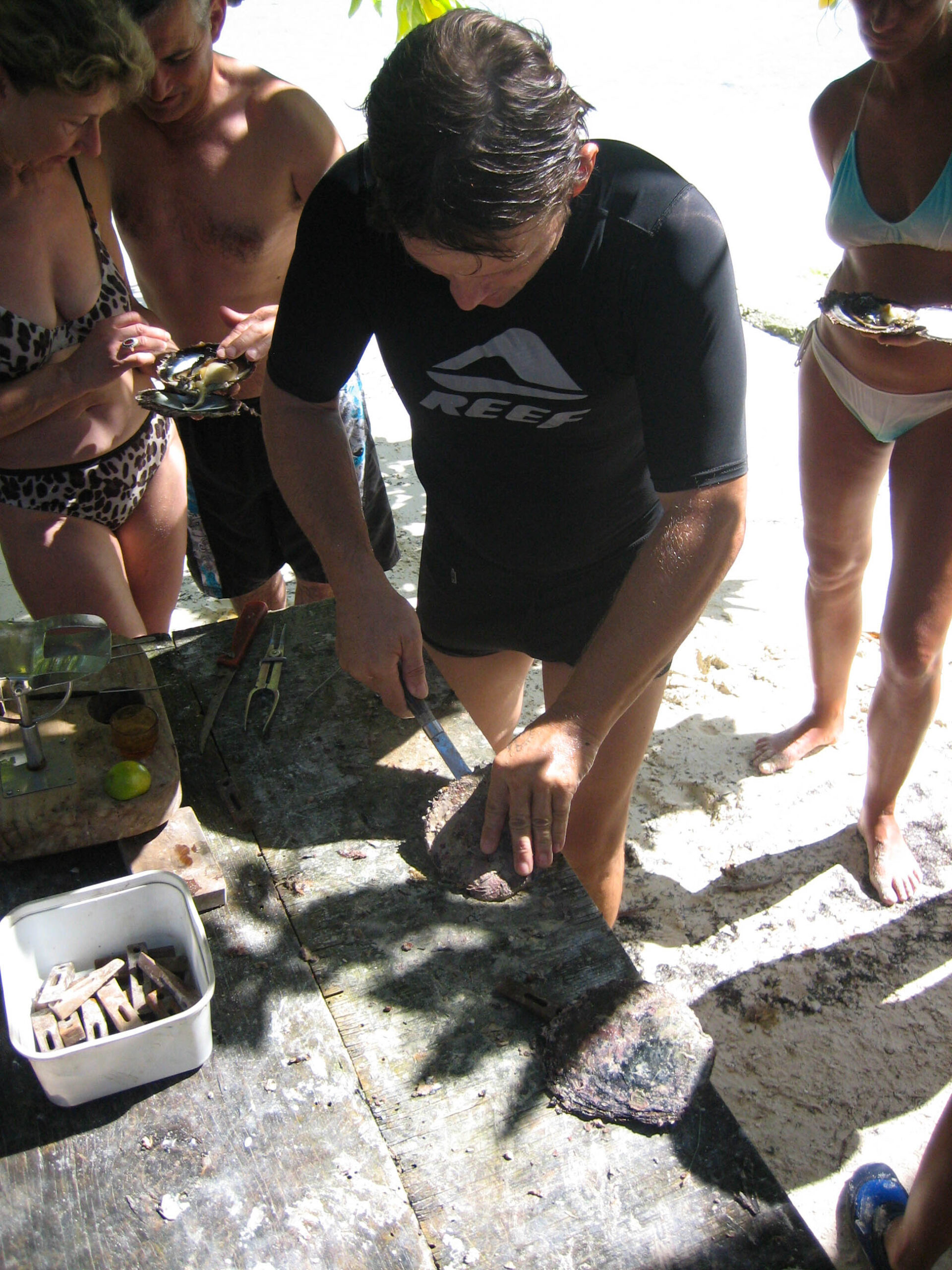
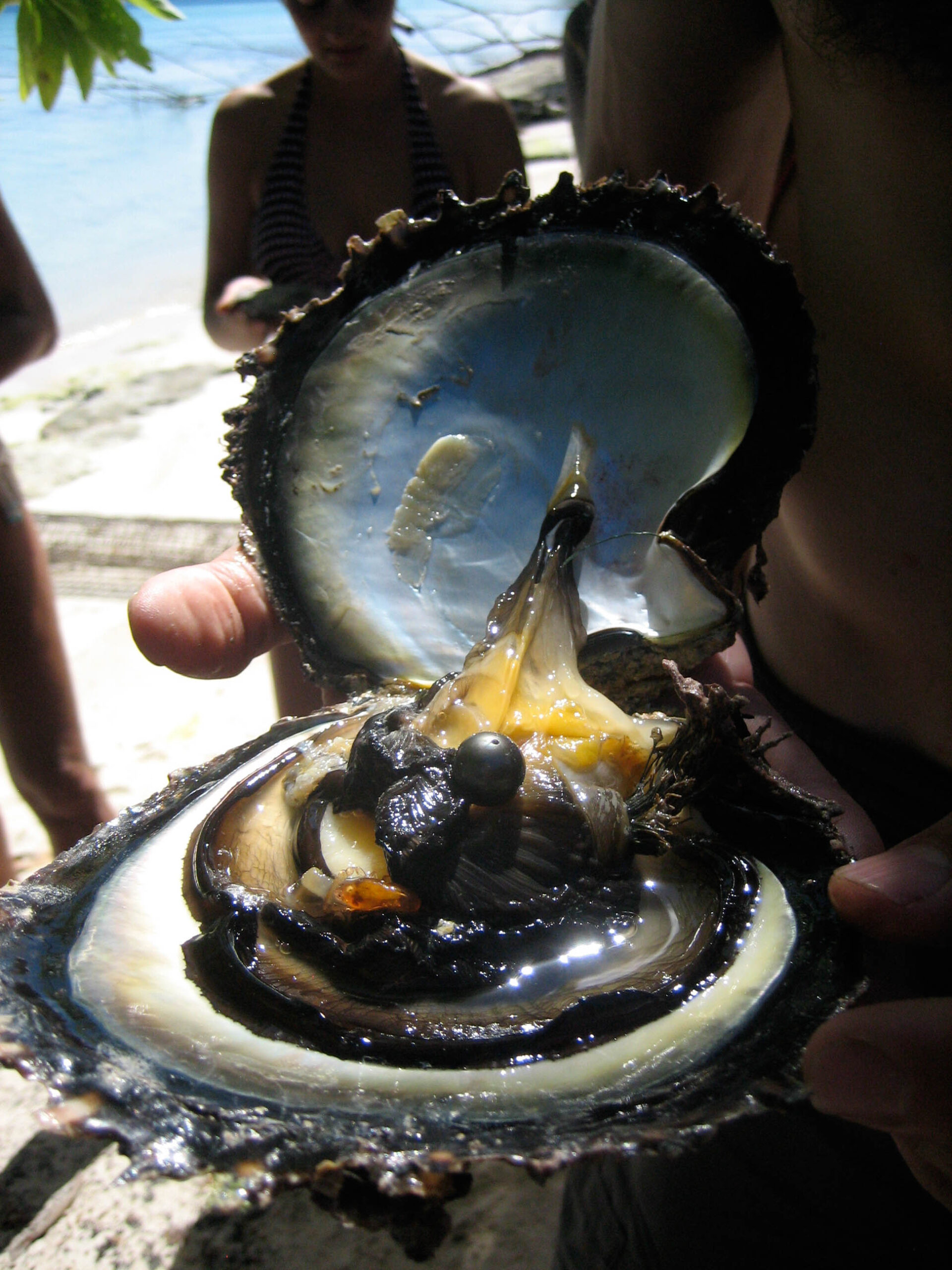
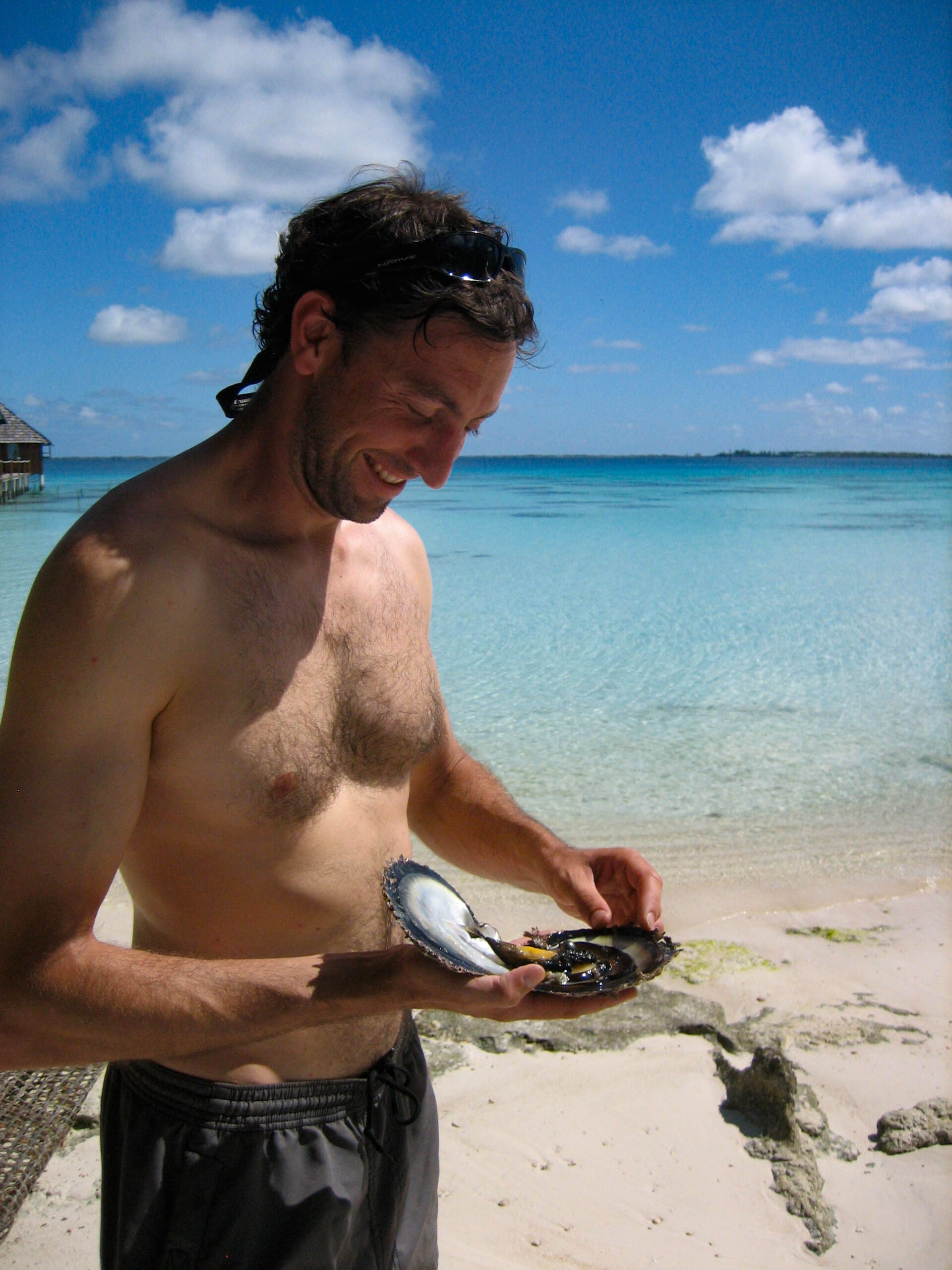
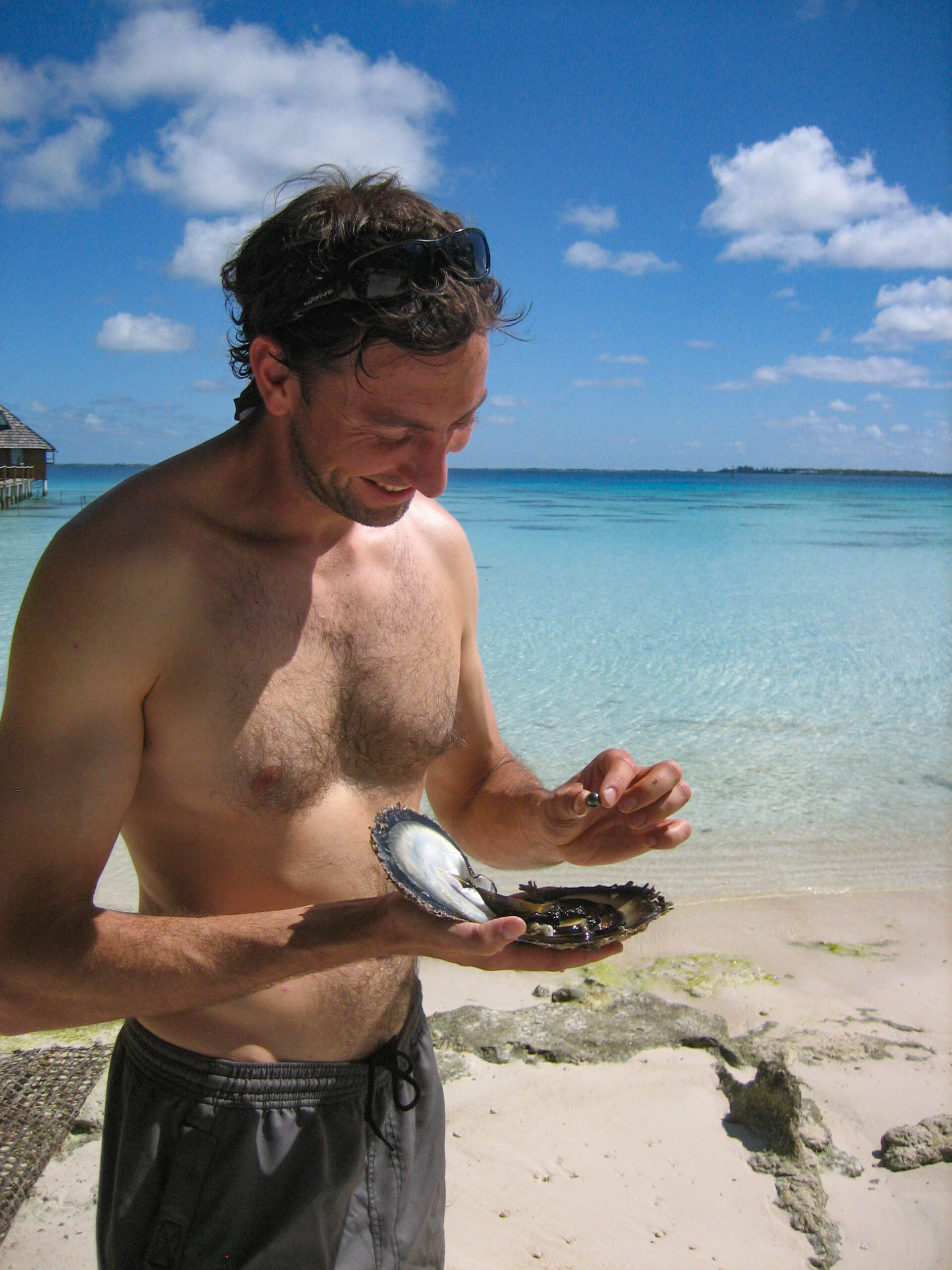
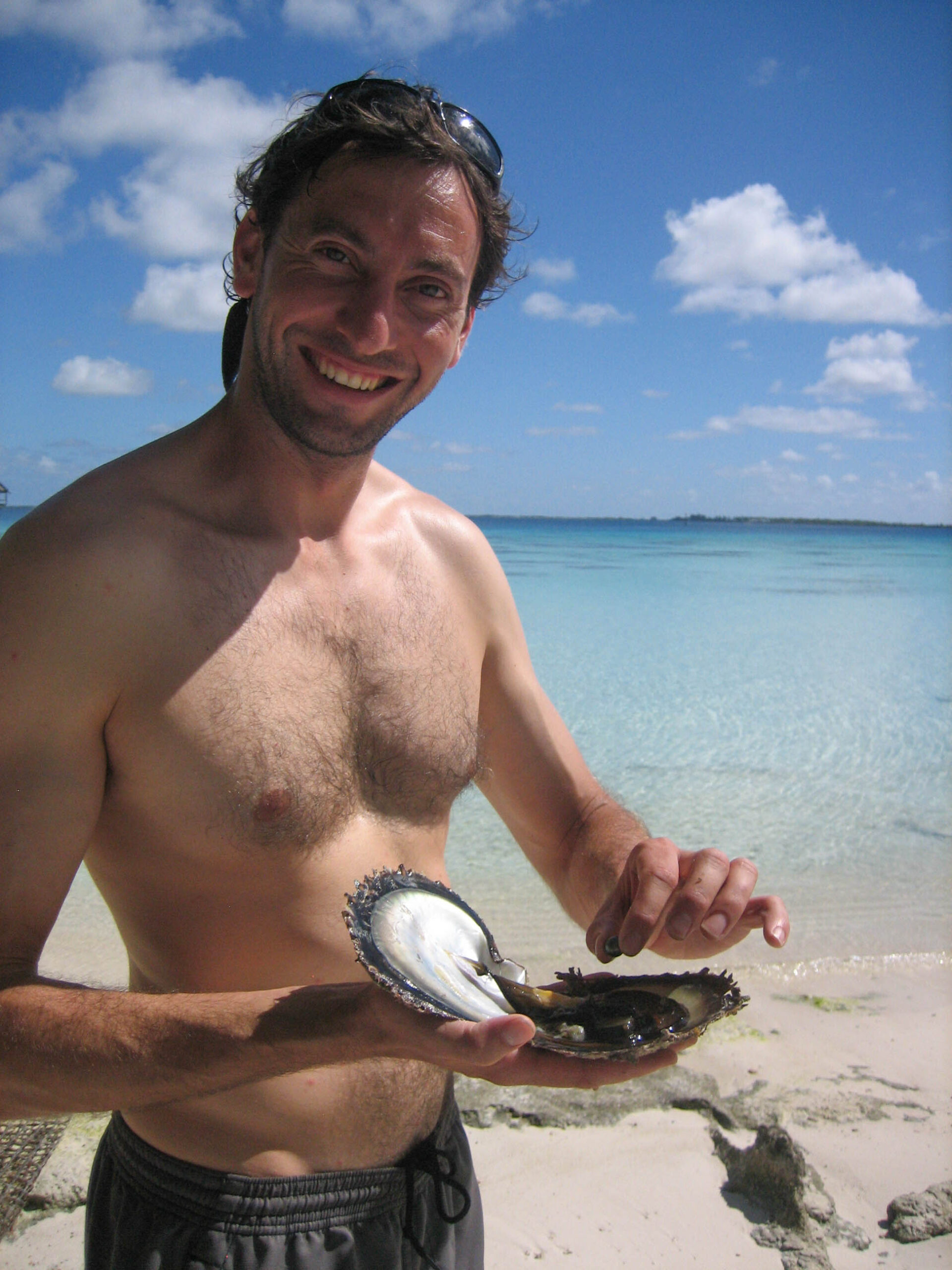
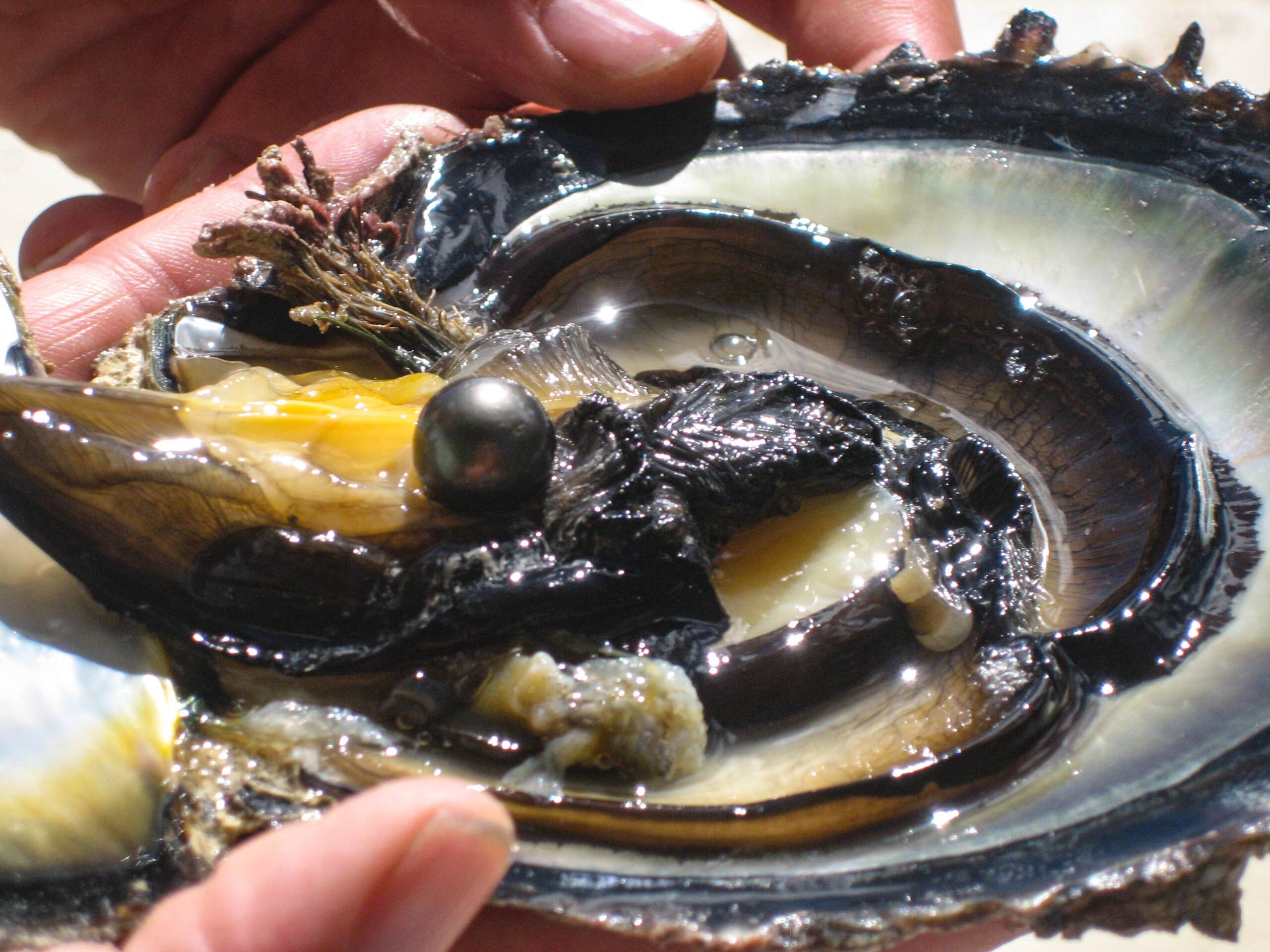
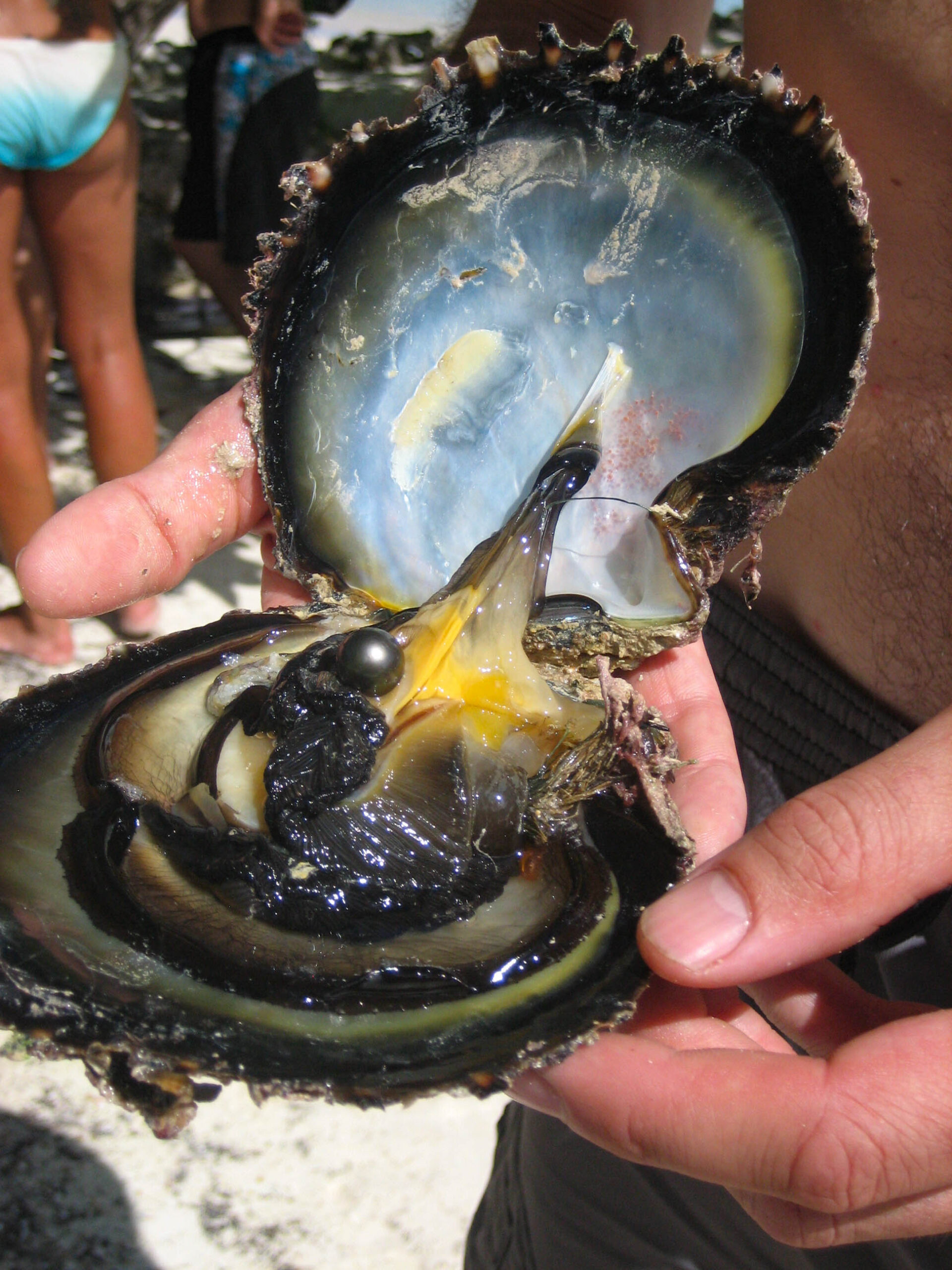
    Back to the boat, Matt and Karen are stirring.  After breakfast, we take the dinghy to shore, head to the one tiny grocery store to buy a few things.  We then visit a storefront for a pearl farm operation.  Through Matt and  Karen’s French, I inquire about a specific pearl farm I had read.  At one specific place, Havaraki Pearls, you can dive for your own oyster, retrieve it, and then crack it open and keep whatever pearl you find.  Sometimes, it’s an ok pearl, sometimes as the owner of Havarki explained later, sometimes though rarely, someone will find a pearl worth a few hundred dollars.  I may or may not have paid for the fun of getting my own oyster and leaving to chance what type of pearl I might find in it.

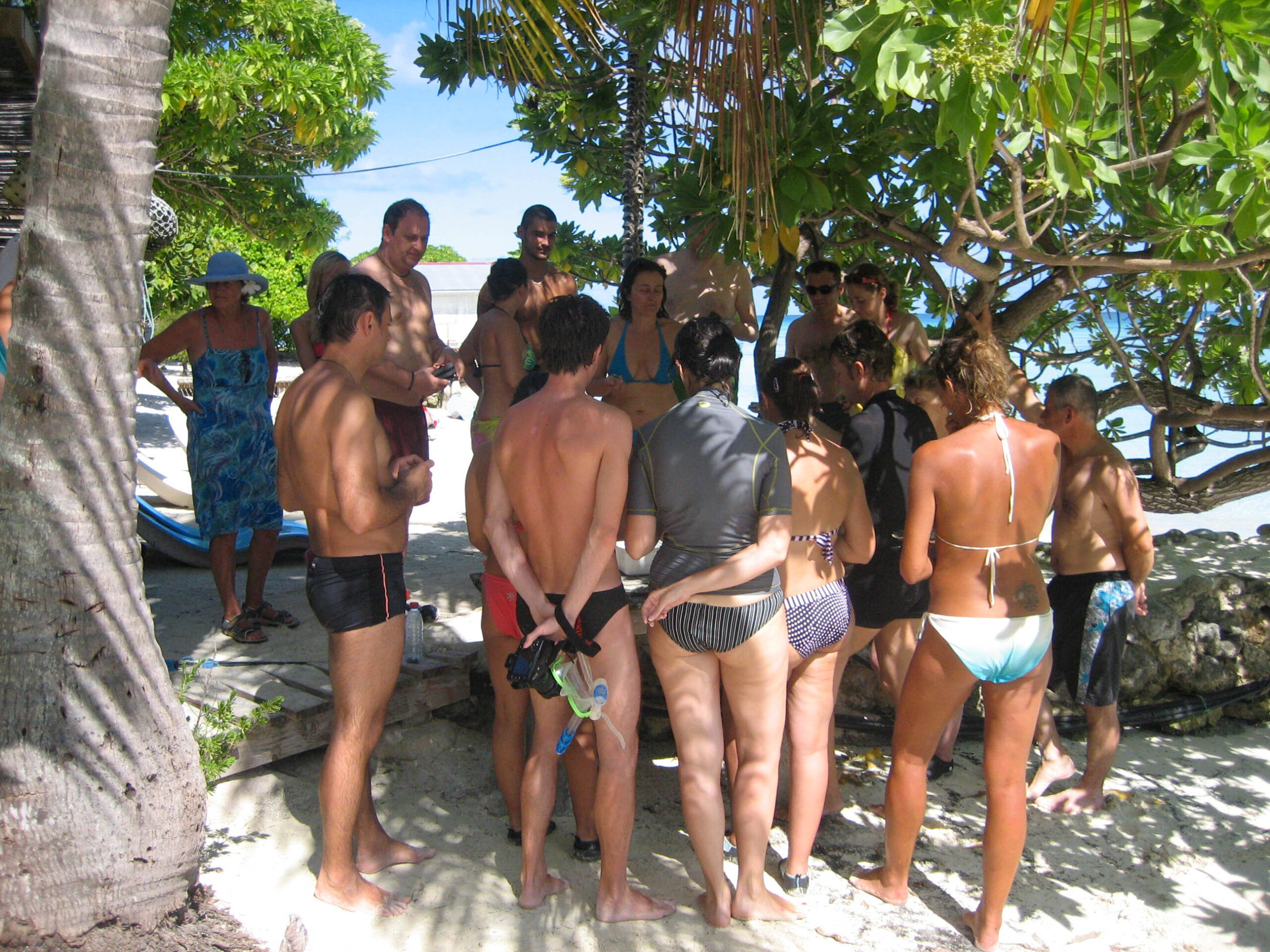
    The exact second we walked up to Havarki Pearls they were beginning an explanation of pearl farming, complete with cracking open some shells and showing us how you seed an oyster, how to transplant pearls from one oyster to another, how to remove the pearl, and what part of the oyster is still edible.  We watched as the proprietor used tools one might find in a dentist office: tiny little mirrors, tiny little scrapers.  It was clearly micro-surgery to properly transplant and farm the oysters!

    After the demonstration, it was about noon.  We decided that some drinks were in order.  Havarki pearls has a pension, which is a family-run place to stay, maybe a dozen individual thatch huts.  A beautiful open air restaurant and bar.  The bar: always open.   Awesome.  After drinks, it’s back to the boat and more catching up with Matt and Karen.  Matt and I discussed the tiny font, three column fully covered 8.5×11 page of paper listing all the work that should still be done to the boat.  It used to be Matt’s list.  Now it’s my list and I’m looking forward to tackling it, but it is laughingly long!

    Day one done.  Day two, day three, day one thousand, they are waiting.

  • Getting to Fakarava

    (concerning events, June 12th-June 16th)

    I wanted to take a rugged cargo ship from Tahiti to Fakarava.  A small cargo ship that bucked through wild seas for three days.  A vessel where I had to bring my own food and sleep on the deck for want of space anywhere under shelter.  The Cobia.  A wild adventure to start a indefinitely long voyage.  Sure there are nicer cargo ships, the Aranui 3 for example or the Stella Marie X, where the ships are large with less rolling, you are given a deluxe cabin, and fed three generous meals a day.  The Cobia however, is not one of the nicer.  It was the cheapest and the only amenities as far as i could tell was a life jacket.  It would take three days for the Cobia to reach Fakarava.  I imagined three days of pitching over a wild ocean, holding onto the rail and praying my one hundred pounds of supplies I was taking to Syzygy would not fly into the ocean.  I couldn’t wait.

    On Friday, trying to buy my ticket on the cargo ship to Fakarava, I had to walk three miles from Papette, mostly along a nearly deserted road leading to the cargo ships.  It was deserted because the cargo dock workers were in cahoots with the firemen, who had decided to strike on Thursday.  Incidentally, my flight from Los Angeles was the last international flight into or out of Tahiti for a week.  No firemen = no international flights.  For some reason, domestic flights could still happen.  Apparently the airport has lower standards of safety for it’s domestic travelers than the international tourist travelers.

    In route to the cargo ship offices, a mile from downtown Papette, I had to walk past a blockade.  In the middle of the two-lane road there were just a couple of small tires.  There was also a dozen large Tahitians.  They looked to be happily inebriated.  As I walked up to the blockade, I debated whether or not I should turn around as I had seen a number of cars and motorcycles  do during my tedious on-foot approach.  I figured the worst they could do to me was direct me to an alley, rob me and leave me for dead, but that most likely the worst would be a simple get lost.  So I strode up to the largest Tahitian I saw.  He was laughing, clearly enjoying not working and instead turning frustrated drivers around.  With my limited (read: non-existent) French, I pantomimed that I wished to walk over the bridge separating Papette from the cargo ships on Moto Utu.  I stumbled the words, I ‘erred’ quite a bit.  I smiled.  I said ‘It’s O.K.?”  repeatedly.  He boomed with laughter, clearly at me and kept repeating something in Tahitian.  Definitely not French, I can at least recognize French.  I walked on, sure I was the laughing stock of the dozen bouncers, but glad to have been able to walk across.

    Two miles later, I arrived at one of the cargo ship offices.  It was small, clean and wonderfully air-conditioned.  Sweat that had been running profusely stopped in it’s tracks.  No matter what happened, I planned on stretching out this visit as long as possible.  This would not be hard, I’m sure, given my aforementioned skills in French.

    Short it was not, but I exited with a ticket on the cargo ship Cobia bound for Fakarava.  I was even in a cabin instead of sleeping on the deck.  For food and water though, I was on my own for the three day trip.  It took me asking them about the strike though, for the nice ladies to realize I should call the captain first thing Monday morning to ascertain whether or not the Cobia would be leaving.  I left with his number in hand.

    I called Monday morning.  The Cobia was not leaving.  The strike was still on.  The captain said call the next day.  I called the next day.  The strike had lifted!  The Cobia was still not going.  Trouble with the fuel.  Try again next week.  Frustrated, I envisioned this laissez-faire attitude continuing indefinitely.  I wanted to be on my way to Fakarava now!  The incompatibility of travel outside industrialized nations combined with industrialized-nation-attitude of impatient hurry-ness was becoming apparent.

    No other cargo ships were leaving for Fakarava until next Monday so I wouldn’t get to Fakarava until next Thursday.  Nine more days of waiting in Papeete and on a ship was simply unacceptable to me.  So Tuesday afternoon a refund was procured, the nice Tahitian ladies in the air-conditioned office profusely apologized, and the cute French woman at Air Tahiti was happy to fly me to Fakarava.  I would be in Fakarava tomorrow.

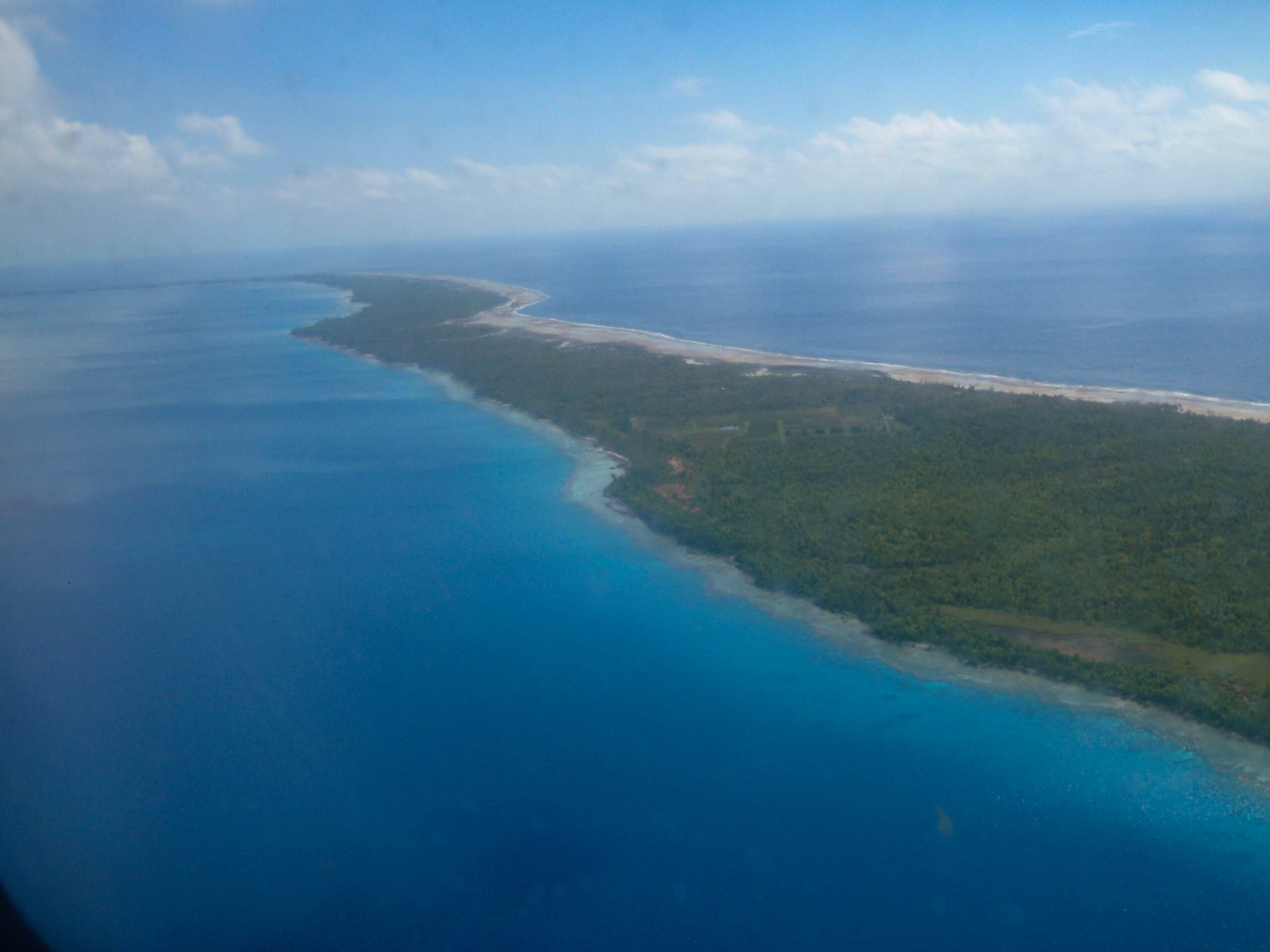
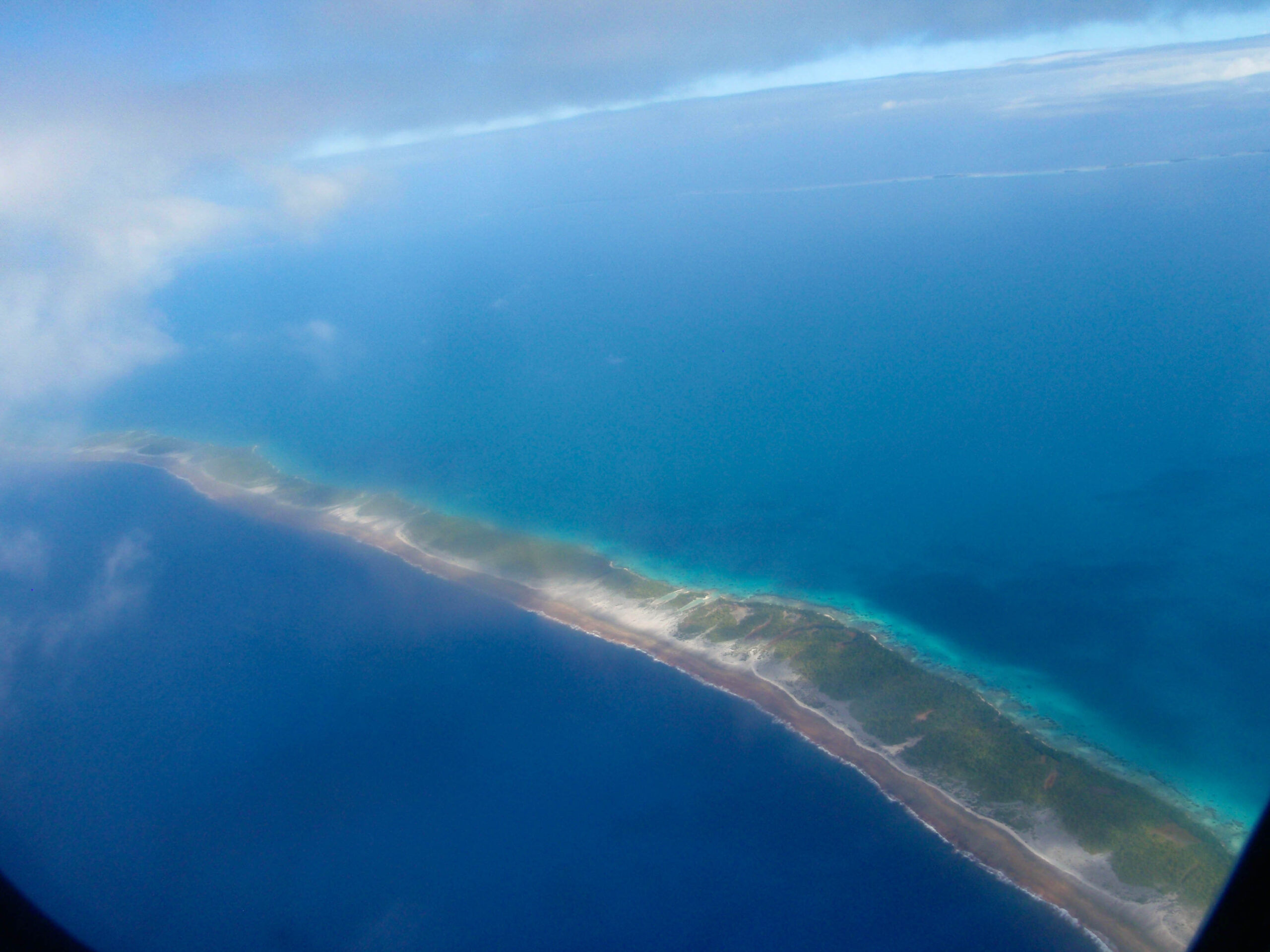
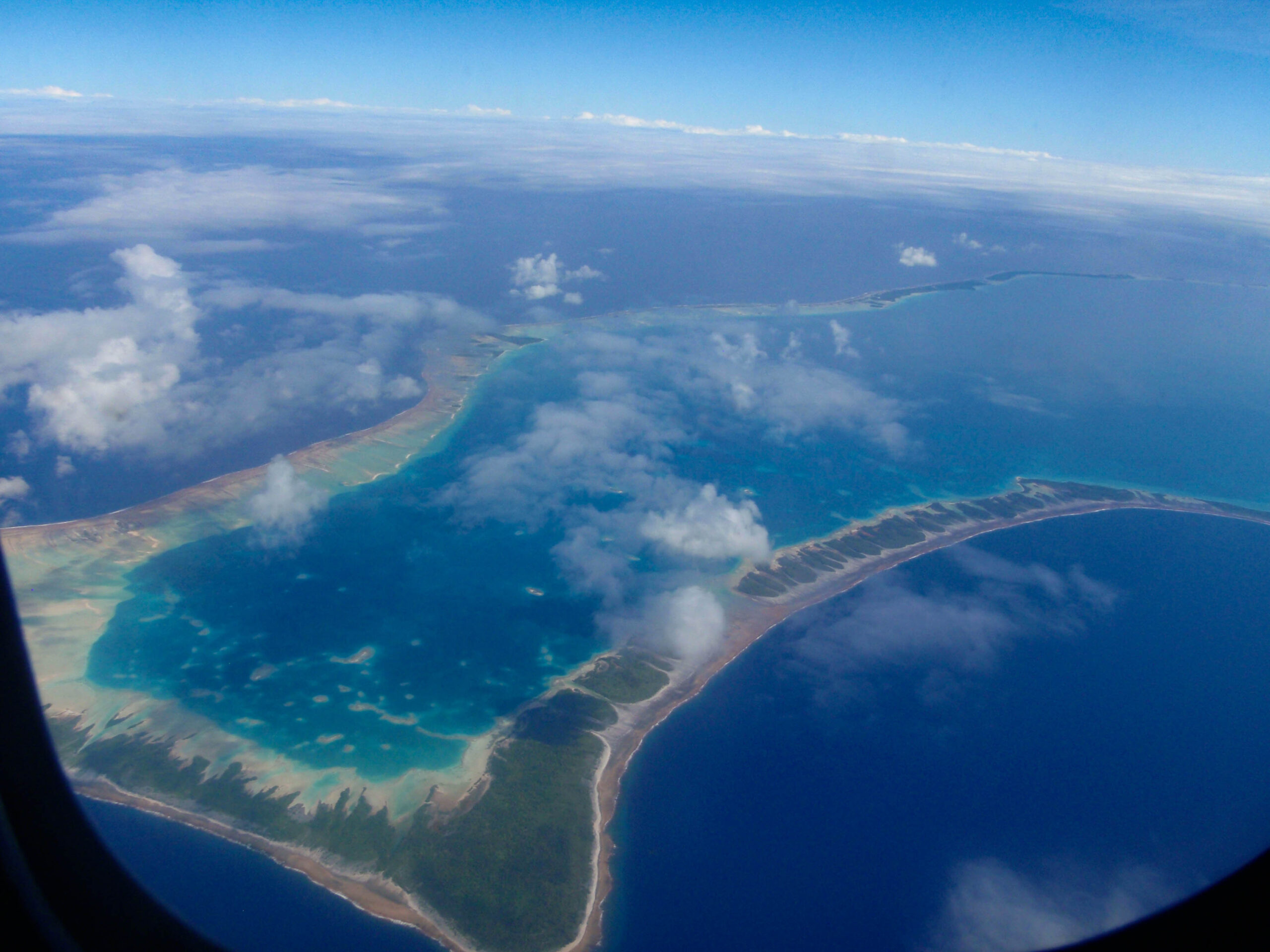
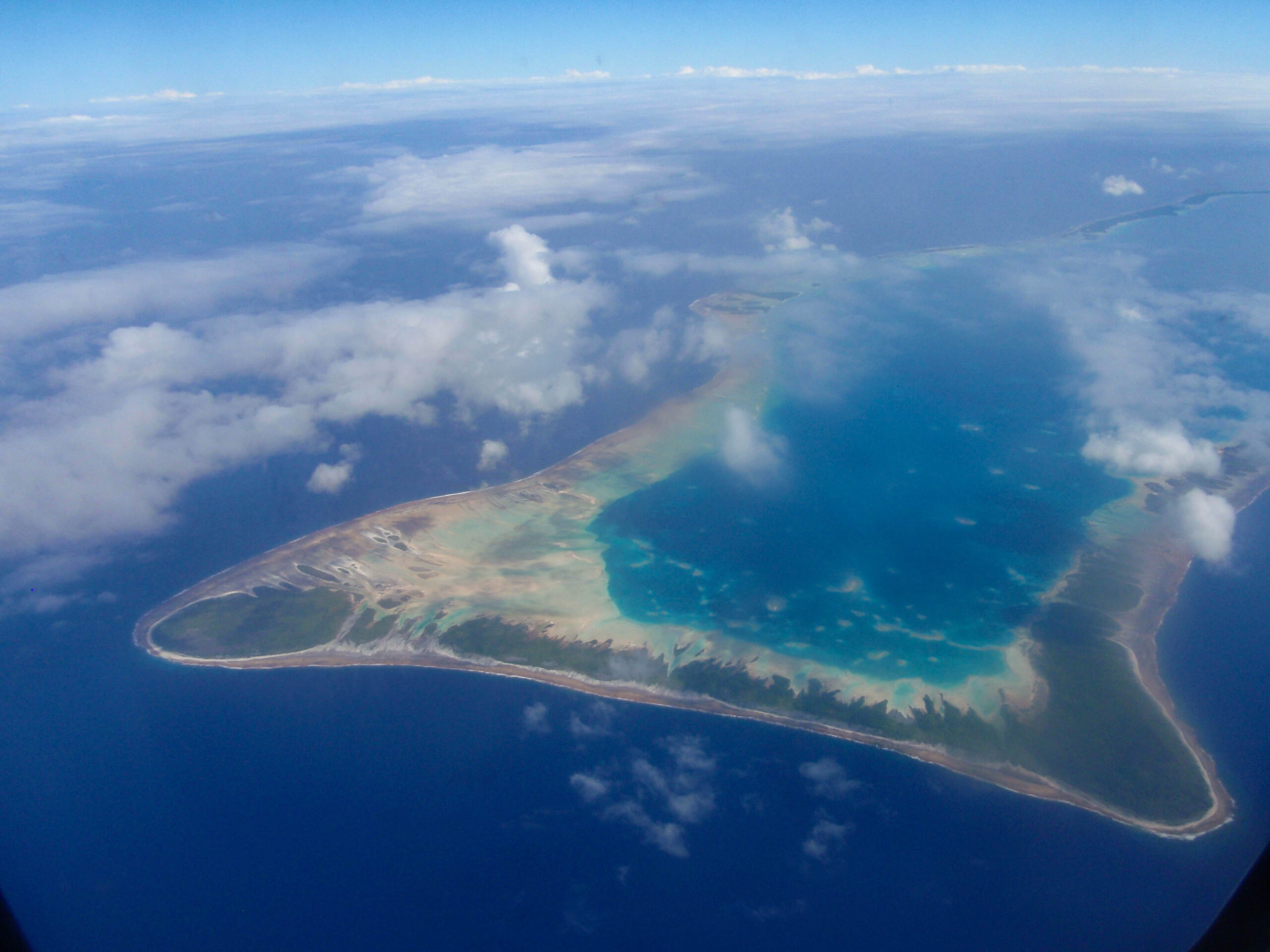
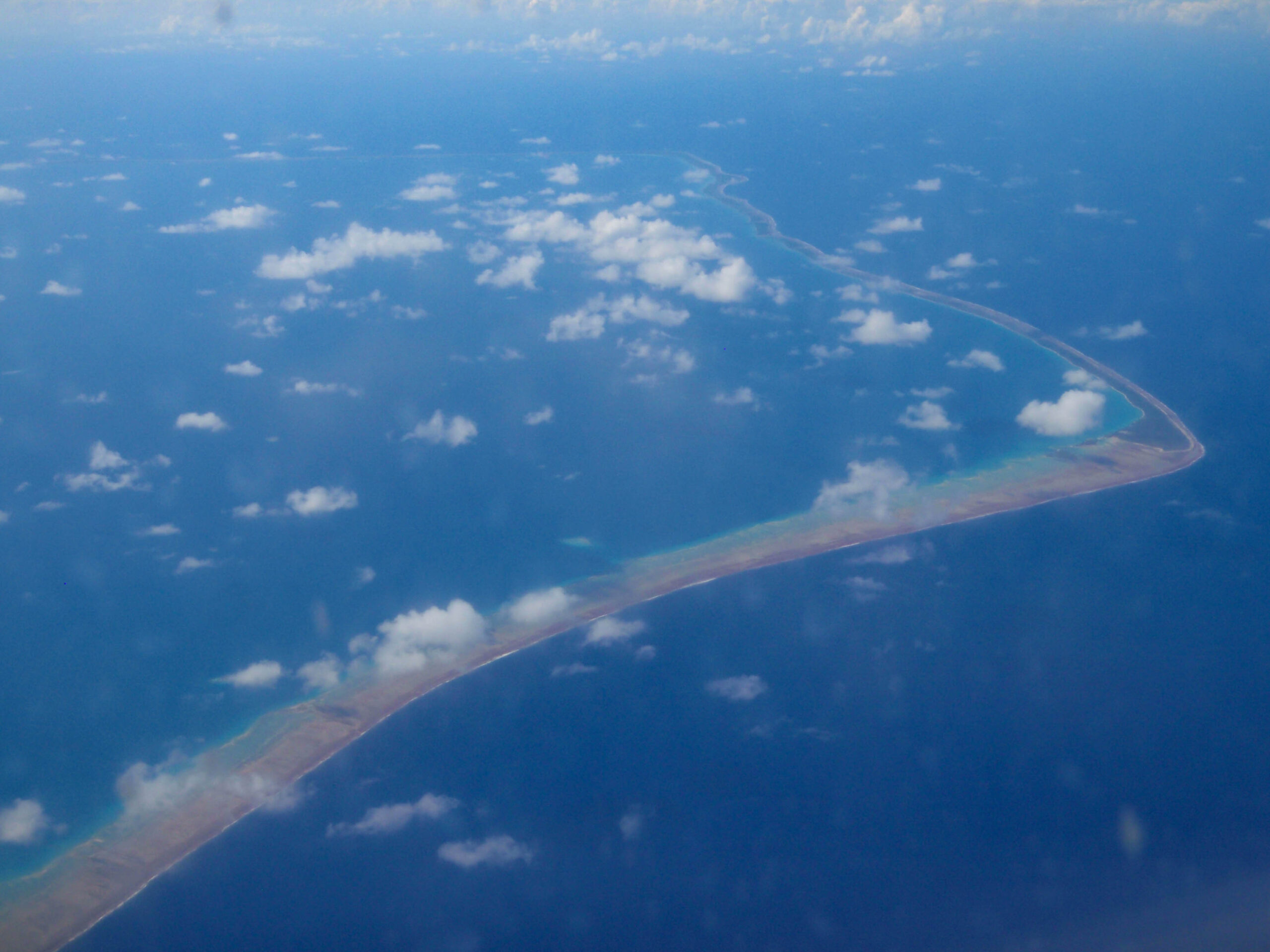
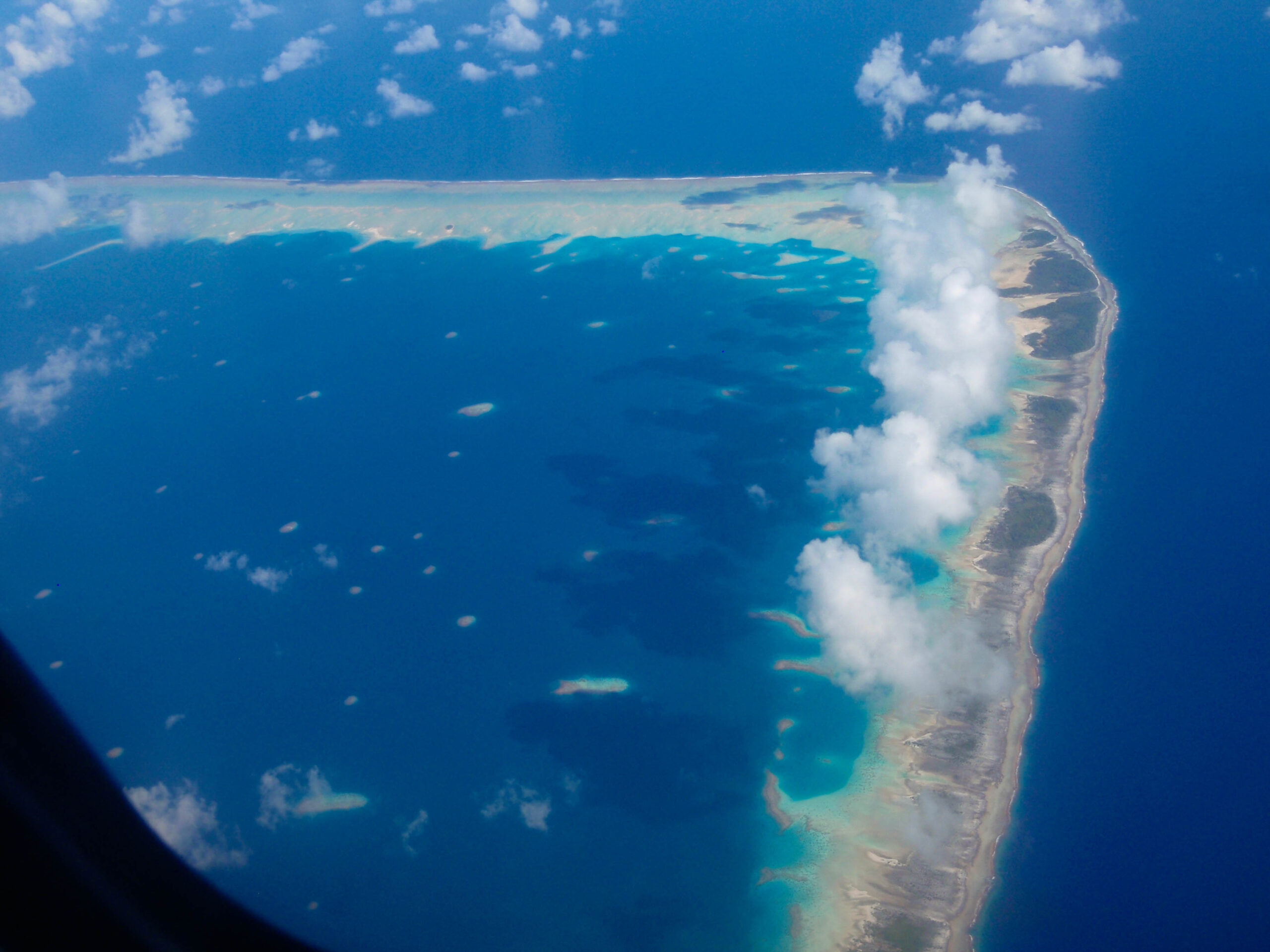
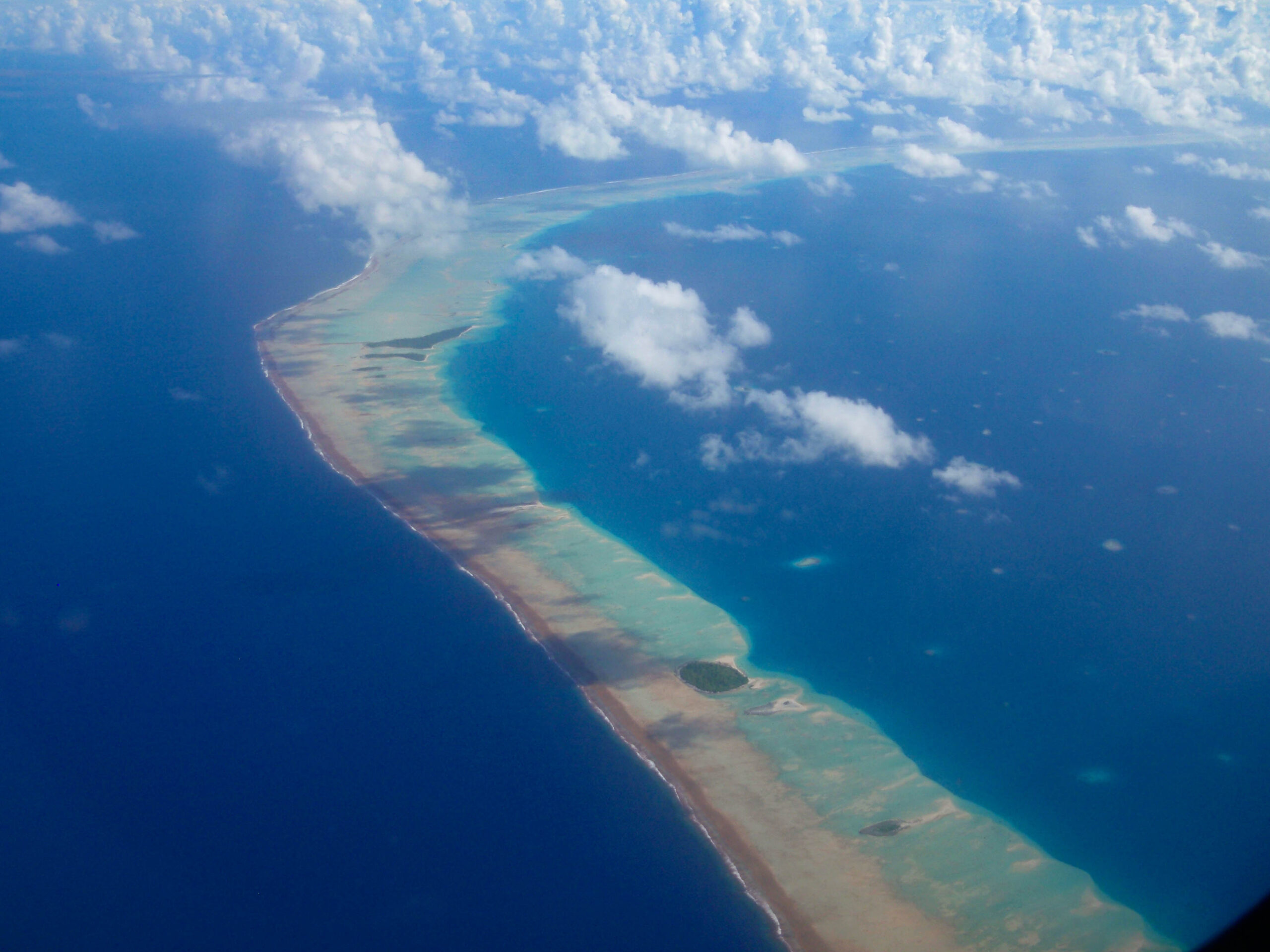
    I flew from Papeete to Fakarava on Wednesday for three times the cost and in only three hours, instead of three days.  A symmetrically fair trade I suppose.  I also traded the rugged wild seas for plush seats and fantastic overhead fly-by views of the atolls.

    Landing in Fakarava, you could look out both sides of the plane and see nothing but water.  The atoll ring is merely 450 feet wide, taken up almost entirely by a runway.  After the plane landed, a walked about 100 feet to the tiny open air baggage check.  20 feet beyond that was a small dock for dinghies.  I was disappointed that Matt was hanging out at the dock, but apparently he was having fuel problems of his own.  with my stellar French skills, I hitched a ride into town, got dropped off at the main dock, and asked the one boat there if he had a VHF.  I asked him this by pantomiming that I was holding something and talking into it and then said “VHF?”  with a clear uplift of my voice.  He replied “Oui!” but then intimated that it might not work.  Karen’s voice rang through though, when I called and Matt was sent to pick me up.

    I have finally joined our boat.  I am now part of the trip.  I am emotionally simultaneously exhausted/overwhelmed and bursting with energy.  I am ready for an indefinitely long voyage!

  • update

    a quick note to tell everyone that karen and I just arrived in Fakarava an hour ago–this is the first time we have had internet access since departing Nuku Hiva on the 22 of May.  Since then, we have visited five other remote islands: Hiva Oa, Tahuata, Fatu Hiva, Makemo, and Tahanea, and we both have a number of blog posts already written that will be added in the next few days.

    Everything is going really well.

    Two weeks ago on Fatu Hiva we hiked 10 miles to purchase a phone card to call jon to leave a message on his voice mail telling him to meet us on Fakarava on the 14th of june–plus or minus 5 days.  Well we’re in the anchorage and haven’t been to land yet or talked to anyone or even been able to receive email, but according to Jon’s last two posts he may still be in tahiti, or here, or on his way here, so all looks well.

    jon if you read this we are towards the north side of the anchorage, one boat to the north of the large dark-hulled megayacht

    all stories to follow